
Industrial Valve Market Demand, Industry Growth and Forecast, 2026-2034
REPORT DETAILS
Industrial Valve Market Summary
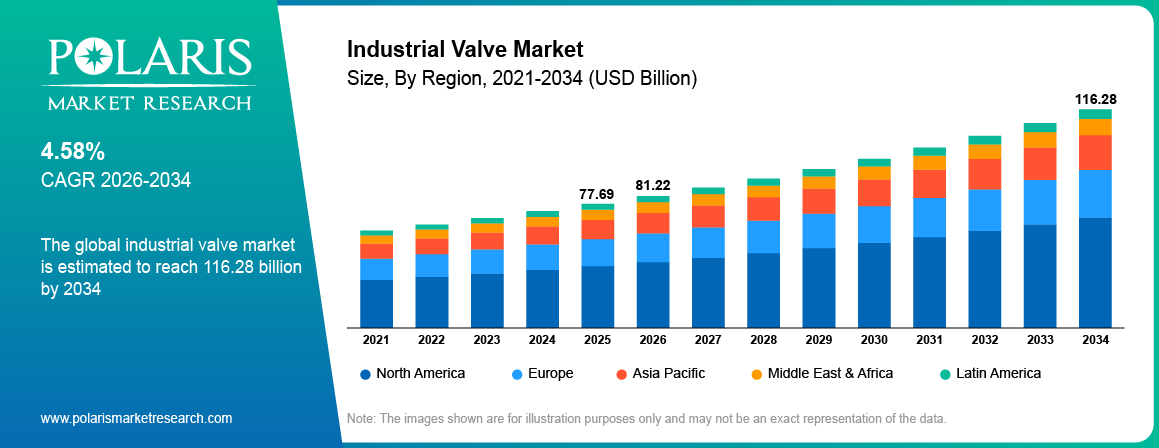
The global industrial valve market size was valued at USD 77.69 billion in 2025, growing at a CAGR of 4.58% from 2026 to 2034. The increased demand for energy efficient solutions and rising adoption of smart valve technologies are a few of the key factors driving market growth.
Market Statistics
Industrial Valve Market Key Takeaways
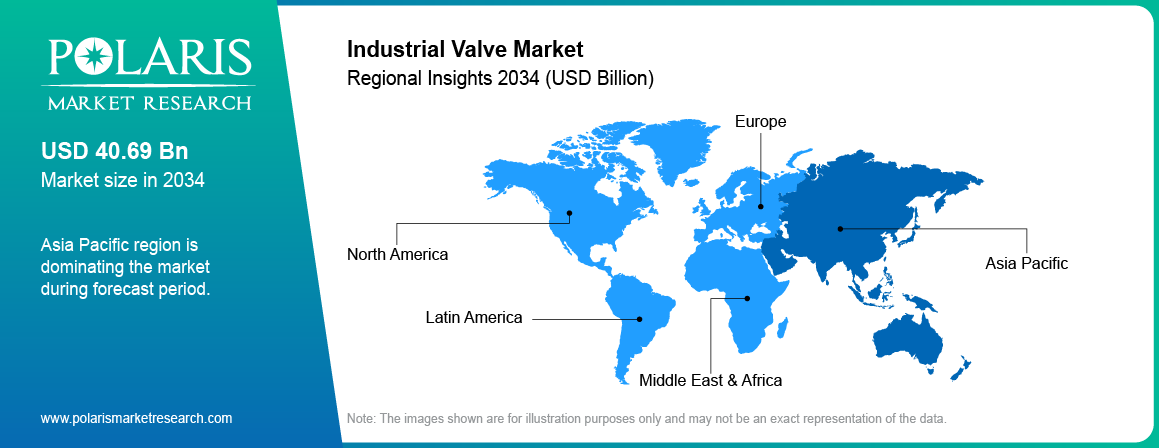
- Asia Pacific accounted for the largest market share of 35.0% in 2025. The regional market dominance is attributed to rapid urbanization and significant infrastructure development across key economies.
- North America is anticipated to register significant CAGR of 6.52% during 2026-2034, primarily due to the region’s strategic infrastructure investments across key sectors such as power generation and chemical processing.
- The oil & gas segment held 24.0% revenue share in 2025, driven by demand from exploration, refining, and pipeline operations.
- The butterfly valve segment is expected to grow at a CAGR of 6.02% during 2026–2034, supported by increasing use in water treatment, HVAC, and industrial systems.
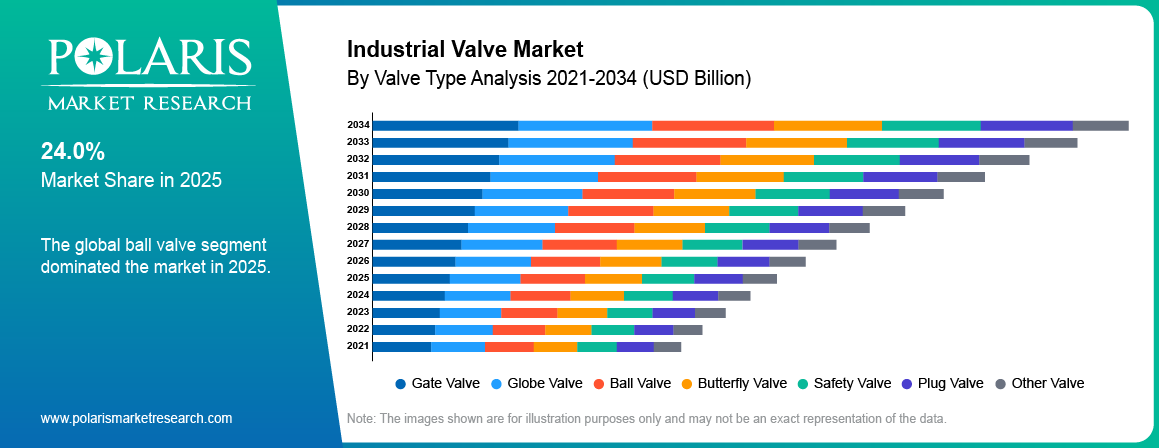
- The ball valve segment led the market with 24.0% share in 2025. The versatility and durability of ball valves make them crucial across industries such as manufacturing and wastewater treatment.
- The water & wastewater treatment segment is projected to grow witnessing 6.18% during 2026-2034, driven by increased investments in water infrastructure to meet increasing clean water demands.
Note: Figures and projections outlined in this report are the result of Polaris Market Research’s proprietary analytical processes, grounded in the latest available datasets and market observations.
What is Industrial Valve?
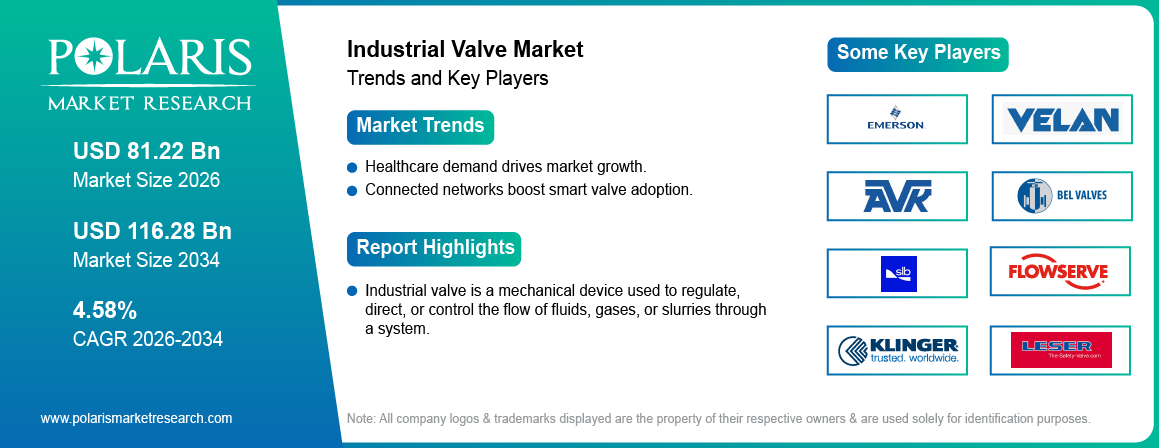
Industrial valve is a mechanical device used to regulate, direct, or control the flow of fluids, gases, or slurries through a system. Valves including control valves are critical components in various industries, including oil & gas, water treatment, chemical processing, and power generation, enabling safe and efficient operation under diverse conditions such as high pressure, temperature, and corrosive environments.
The global industrial valve market is experiencing steady growth driven by rising Industry 4.0, increased demand for energy efficient solutions, and the expansion of critical infrastructure projects across sectors such as oil & gas, water treatment, chemical processing, and power generation. Industries operating under high pressure and high temperature conditions are driving the demand for valves with enhanced safety, reliability, and performance. For instance, in February 2024, Valmet launched the Neles XH, a metal-seated ball valve in its X-series, aimed at high-pressure, high-cycle, and throttling applications. The valve is designed for industries such as power generation, chemical processing, and oil & gas, and is capable of supporting high-temperature and demanding environments, broadening its industrial applicability.
The adoption of smart valve technologies, including IoT sensor and automation, is optimizing the operational efficiency of valve systems and reducing maintenance expenses. Additionally, increasing focus on low-emission, sustainable solutions is driving innovations in valve manufacturing, with companies developing products that align with environmental standards and regulatory compliance
To Understand More About this Research: Download Sample Report
How Industrial Valves Work
- Fluid Enters the Valve System: Liquid, gas, steam, or slurry flows into the valve through the pipeline.
- Valve Mechanism Operates: The valve opens, closes, or partially adjusts to control the movement of the fluid.
- Pressure and Flow are Controlled: The valve regulates flow rate, pressure, and direction according to process requirements.
- Sensors and Actuators Support Automation: In automated systems, sensors monitor operating conditions while actuators adjust valve positions for efficient process control.
- Fluid Exits the System: The controlled fluid continues through the pipeline to the next stage of the industrial process.
Ball Valves vs Gate Valves vs Butterfly Valves
| Parameters | Ball Valves | Gate Valves | Butterfly Valves |
| Design | Uses a rotating ball with a bore for flow control | Uses a sliding gate/disc to start or stop flow | Uses a rotating disc mounted on a shaft |
| Pressure Handling | Suitable for high-pressure applications | Suitable for high-pressure and high-temperature conditions | Generally used in low- to medium-pressure applications |
| Shut-Off Efficiency | Excellent shut-off with very low leakage | Good shut-off but may experience wear over time | Good shut-off, but sealing performance is lower than ball valves |
| Flow Control | Best for on/off service, limited throttling capability | Primarily used for full open or full close operation | Can be used for both isolation and throttling applications |
| Operation Speed | Fast quarter-turn operation | Slower operation due to multiple turns required | Fast quarter-turn operation |
| Maintenance Requirements | Low maintenance with fewer moving parts | Higher maintenance due to gate and stem wear | Low maintenance and simple construction |
| Size & Weight | Compact and moderate in weight | Larger and heavier design | Lightweight and compact design |
| Cost | Moderate to high | Moderate | Generally lower cost for large-diameter systems |
| Common Industrial Applications | Oil & gas, chemical processing, water treatment, manufacturing | Power plants, oil & gas pipelines, water distribution systems | Water & wastewater treatment, HVAC, food processing, large pipeline networks |
Market Dynamics
Driver: Rising Demand from Healthcare and Pharmaceutical Industries
The healthcare and pharmaceutical industry rely on precise, contamination-free fluid handling. Valves in these industries are crucial for maintaining strict sterilization standards, making them essential for processes involving medications, chemicals, and purified water. For instance, in June 2023, Alfa Laval expanded its valve portfolio with a new hygienic control valve designed to meet stringent demands in pharmaceutical and biotech applications. The valve provides precision in fluid handling, supporting the industry's requirements for sterile production environments. Thus, the growing demand for industrial valves from healthcare and pharmaceutical industries is driving the industrial valve market expansion.
Driver: Growing Use of Connected Networks and Smart Industrial Valves
Smart industrial valves integrate sensors and communication technologies, enabling real-time data exchange and remote monitoring, which is especially valuable in complex and hazardous environments. For instance, Schneider Electric launched the EcoStruxure Control Valve in 2021. This smart valve solution combines built-in diagnostics and Bluetooth connectivity, which helps monitor valve performance and provides real-time status updates, making it ideal for energy and utility applications. The connectivity also enables predictive maintenance, reducing downtime and operational costs by identifying potential issues before they result in failures. Additionally, the use of IoT and automation in industries like water treatment, manufacturing, and oil & gas is increasing, and smart valves play a crucial role in optimizing these applications. This aligns with the broader shift in industrial sectors towards Industry 4.0 and digital transformation. Thus, the growing adoption of connected networks and smart valves, which improve efficiency, monitoring, and control capabilities in industrial processes, is boosting the industrial valve market revenue.
Challenges in Industrial Valve Market
- High Maintenance Costs: Regular servicing, repairs, and component replacement increase operating expenses.
- Corrosion Issues: Exposure to chemicals, moisture, and harsh environments can damage valves and shorten their lifespan.
- Fluctuating Raw Material Prices: Changes in steel, iron, and alloy prices affect manufacturing costs.
- Operational Downtime Risks: Valve failure or leakage can interrupt operations and reduce productivity.
- Strict Industrial Safety Regulations: Compliance with safety, quality, and environmental standards increases costs and testing requirements.
Segment Insights
Market Evaluation Based on Valve Type Insights
The global industrial valve market segmentation, based on valve type, includes gate valve, globe valve, ball valve, butterfly valve, safety valve, plug valve, and other valve. In 2025, the ball valve segment dominated the industrial valve market with 24.0% share, due to its versatility, durability, and ability to provide tight sealing, which is crucial for industries such as oil & gas, water treatment, and manufacturing. Ball valves are well suited for applications requiring quick shut off and minimal leakage, performing strongly in high-pressure and high temperature environments. Additionally, their detailed design facilitates ease of maintenance, an essential factor for industries aiming to minimize downtime and optimize efficiency. The widespread demand across various sectors further solidified the segment’s leading position in the market.
Market Assessment Based on End Use Insights
The global industrial valve market segmentation, based on end use, includes oil & gas, water & wastewater treatment, energy & power, pharmaceutical, food & beverage, chemical, building & construction, paper & pulp, metal & mining, agriculture, semiconductor, and others. The water & wastewater treatment segment is expected to experience growth in the industrial valve market witnessing 6.18% CAGR, due to the increasing global demand for clean water and improved sanitation. Rising urbanization, industrialization, and population growth are driving investments in water infrastructure and wastewater management systems to meet the increasing demand for clean water and efficient waste disposal. Industrial valve plays a crucial role in maintaining the flow of water, controlling pressure, and preventing leaks in these systems. Additionally, environmental regulations pushing for better water quality standards and efficient treatment processes are driving the demand for reliable and high-performance valve in the sector. These factors collectively contribute to the expansion of the water & wastewater treatment segment.
Regional Analysis
By region, the study provides market insights into North America, Europe, Asia Pacific, Latin America, and the Middle East & Africa. Asia Pacific dominated the industrial valve market with 35.0% share in 2025 due to rapid industrialization, increasing urbanization, and substantial infrastructure development in key economies such as China, India, and Southeast Asian countries. The region's growth in industries such as oil & gas, chemical processing, power generation, and water treatment has fueled demand for industrial valves. Furthermore, the ongoing adoption of smart technologies and automation in the manufacturing sector, along with government investments in large scale infrastructure projects, continues to drive market expansion. For instance, in 2022, AIIB approved two major projects: The Bukhara Region Water Supply and Sewerage Project, Phase II in Uzbekistan, and the Second Dam Rehabilitation and Improvement Project in India. As a result, Asia Pacific is expected to maintain its dominance in the global industrial valve market.
The North America industrial valve market is expected to grow with a significant CAGR of 6.52% during the forecast period due to strategic investments in infrastructure across key sectors such as oil and gas, chemical processing, and power generation. This region is prioritizing the modernization of its aging infrastructure, which, along with a rising demand for automation and advanced smart valve technologies, is catalyzing market expansion. Furthermore, the implementation of strict regulations focused on energy efficiency and environmental sustainability is driving industries to opt for sophisticated valve solutions. The increasing integration of digital technologies for predictive maintenance and real time monitoring is also a crucial factor underpinning this market growth.
Key Players and Competitive Insights
The competitive landscape of the industrial valve market is characterized by a mix of global industry leaders and regional players striving for market share through innovation, strategic partnerships, and regional expansion. Major companies in the market, such as Emerson Electric Co., Flowserve Corporation, and Velan Inc., leverage their strong R&D capabilities and extensive distribution networks to deliver advanced valve solutions for critical sectors, including oil and gas, water treatment, power generation, and chemical processing. These companies focus on product innovation, improving performance, durability, and energy efficiency to meet the growing demand for automation and smart technologies in industrial applications. On the other hand, smaller regional firms are carving out niches with specialized valve products that cater to local market needs, often focusing on customized solutions for specific industries or geographic areas. Competitive strategies include mergers and acquisitions, partnerships with technology firms, and expanding product portfolios to strengthen market presence in emerging markets. A few key major players are Emerson Electric Co.; Velan Inc.; AVK Water; BEL Valve Limited; SLB; Flowserve Corporation; KLINGER; GG Valve Private Limited; LESER GmbH & Co. KG; and Alfa Laval.
KLINGER is a company specializing in sealing solutions, fluid control, and fluid monitoring, with a global presence across over 60 countries and 45 operating companies. KLINGER initially gained recognition for its innovations in leakage-free transport solutions, such as the reflex level gauge and Klingerit gasket material. The company expanded its manufacturing capabilities over time, introducing products like large industrial ball valves and asbestos-free jointing materials such as KLINGERSIL. During the late 20th century, KLINGER focused on advancements in high-temperature sealing materials. In recent years, the company has pursued both organic growth and strategic acquisitions, broadening its reach beyond Europe. KLINGER’s products serve industries including oil and gas, chemicals, energy, automotive, and pharmaceuticals, with a strong emphasis on product reliability and technological advancements in fluid management. Additionally, KLINGER provides comprehensive maintenance and repair services, including leak detection and repair, maintenance and dry dock services, integrity services, repair and overhaul, shutdown services, and energy audits.
Emerson is a provider of industrial valves, specializing in process control and automation solutions for industries such as energy, chemical, life sciences, and mining. Based in Ferguson, Missouri, the company is well-known for its Fisher brand. Emerson offers control valves, actuators, and regulators that improve process availability, reduce maintenance costs, and enhance safety through advanced diagnostics with FIELDVUE technology. Emerson’s products are designed to handle severe conditions, with innovations such as Whisper noise reduction and anti-cavitation trims. The company emphasizes sustainability and provides digital solutions to help clients improve operational efficiency, ensuring reliable and low-emission fluid and gas management across complex industrial applications.
List of Key Companies
- Emerson Electric Co.
- Velan Inc.
- AVK Water
- BEL Valve Limited
- SLB
- Flowserve Corporation
- KLINGER
- GG Valve Private Limited
- LESER GmbH & Co. KG
- Alfa Laval
Future Outlook
The industrial valve market is expected to witness steady growth as industries continue investing in automation, energy projects, and water infrastructure development. The adoption of smart manufacturing is increasing the need for more advanced and connected valve systems. Technologies such as IoT-enabled valves, predictive maintenance, and AI-based monitoring are becoming more common to improve operational efficiency and reduce downtime. Demand for energy-efficient flow control solutions is also rising across industries. These developments are expected to create growth opportunities in oil & gas, chemicals, water treatment, power generation, and industrial processing applications.
Industrial Valve Industry Developments
- June 2026: Aalberts IPS launched the Apollo 76F-HCA stainless steel ball valve for corrosive and high-purity industrial environments. (Source: aalberts.com)
- May 2026: PRUSS and OMB introduced the PROcv control valve series with a modular design for industrial flow control applications. (Source: pruss.com)
- April 2026: Emerson launched the Fisher SVX Steam Conditioning Valve for pressure and temperature control in power and process industries. (Source: emerson.com)
- January 2026: Danfoss launched the OFB oil-free shut-off ball valve for oil-free chillers and heat pump systems. (Source: danfoss.com)
Market Segmentation
By Valve Type Outlook (Revenue – USD Billion, 2021–2034)
- Gate Valve
- Globe Valve
- Ball Valve
- Butterfly Valve
- Safety Valve
- Plug Valve
- Other Valve
By Fluid Type Outlook (Revenue – USD Billion, 2021–2034)
- Liquid
- Gas
- Natural Gas
- Compressed Air
- Industrial Gases
- Slurry Valve
By Function Outlook (Revenue – USD Billion, 2021–2034)
- On/Off Valve
- Control Valve
By Material Outlook (Revenue – USD Billion, 2021–2034)
- Steel
- Cast Iron
- Aluminum
- Alloy Based
- Plastic
- Other Materials
By End Use Outlook (Revenue – USD Billion, 2021–2034)
- Oil & Gas
- Water & Wastewater Treatment
- Energy & Power
- Pharmaceutical
- Food & Beverage
- Chemical
- Building & Construction
- Paper & Pulp
- Metal & Mining
- Agriculture
- Semiconductor
- Others
By Regional Outlook (Revenue – USD Billion, 2021–2034)
- North America
- US
- Canada
- Europe
- Germany
- France
- UK
- Italy
- Spain
- Netherlands
- Russia
- Rest of Europe
- Asia Pacific
- China
- Japan
- India
- Malaysia
- South Korea
- Indonesia
- Australia
- Vietnam
- Rest of Asia Pacific
- Middle East & Africa
- Saudi Arabia
- UAE
- Israel
- South Africa
- Rest of Middle East & Africa
- Latin America
- Mexico
- Brazil
- Argentina
- Rest of Latin America
Report Scope
| Report Attributes | Details |
| Market Size Value in 2025 | USD 77.69 billion |
| Market Size Value in 2026 | USD 81.22 billion |
| Revenue Forecast by 2034 | USD 116.28 billion |
| CAGR | 4.58% from 2026 to 2034 |
| Base Year | 2025 |
| Historical Data | 2021–2024 |
| Forecast Period | 2026–2034 |
| Quantitative Units | Revenue in USD billion and CAGR from 2026 to 2034 |
| Report Coverage | Revenue Forecast, Market Competitive Landscape, Growth Factors, and Trends |
| Segments Covered | By Valve Type By Fluid Type By Function By Material By End Use |
| Regional Scope |
|
| Competitive Landscape |
|
| Report Format |
|
| Customization | Report customization as per your requirements with respect to countries, regions, and segmentation. |
Source: Polaris Market Research Analysis
Industrial Valve Market FAQ's
The global industrial valve market size was valued at USD 77.69 billion in 2025 and is projected to grow to USD 116.28 billion by 2034.
The global market is projected to register a CAGR of 4.58% from 2026 to 2034.
Asia Pacific dominated the industrial valve market in 2025 with 35.0%.
A few key players in the market are Emerson Electric Co.; Velan Inc.; AVK Water; BEL Valve Limited; SLB; Flowserve Corporation; KLINGER; GG Valve Private Limited; LESER GmbH & Co. KG; and Alfa Laval.
In 2025, the ball valve segment dominated the industrial valve market with 24.0%.
The water & wastewater treatment segment is expected to experience growth at a CAGR of 6.18% in the industrial valve market.
Key growth drivers include rising demand for energy-efficient solutions, smart valve adoption, Industry 4.0 integration, and expanding water infrastructure investments globally.
Download Sample Report of Industrial Valve Market
Please fill out the form to request a customized copy of the research report.


