
Insurance Platform Market Size, Share, Trends & Forecast, 2026–2034
REPORT DETAILS
Insurance Platform Market Summary
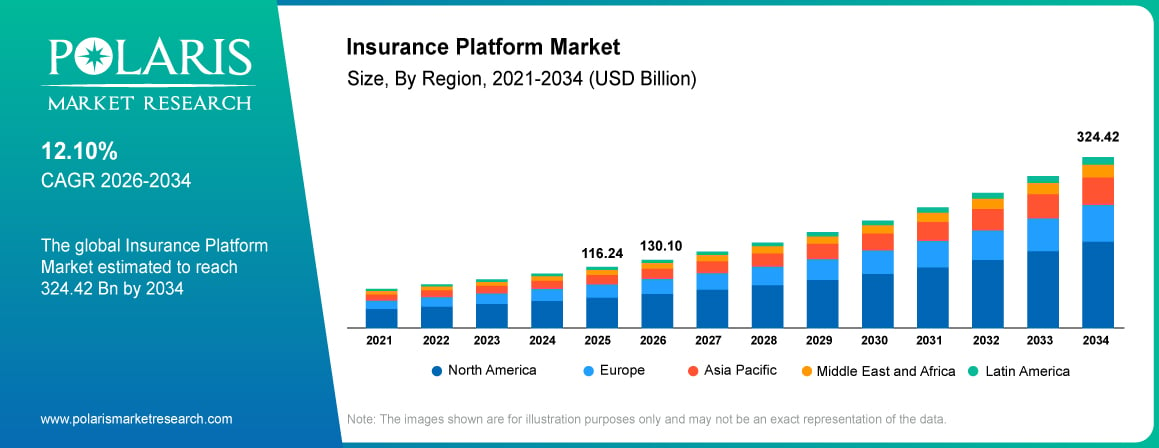
The global insurance platform market size was valued at USD 116.24 billion in 2025. The market is projected to grow at an 12.10% CAGR from 2026 to 2034. Rising adoption of artificial intelligence (AI) and automation is driving the insurance platform market growth. The market is also benefiting from the growing preference for user-friendly and self-service interfaces.
Market Statistics
Insurance Platform Market Key Takeaways
- North America led the global market with an 38.2% share in 2025. The presence of leading insurance companies contributes to the regional market dominance.
- Asia Pacific is projected to account for an 15.0% CAGR. Rising disposable incomes and increasing internet penetration are driving market growth in the region.
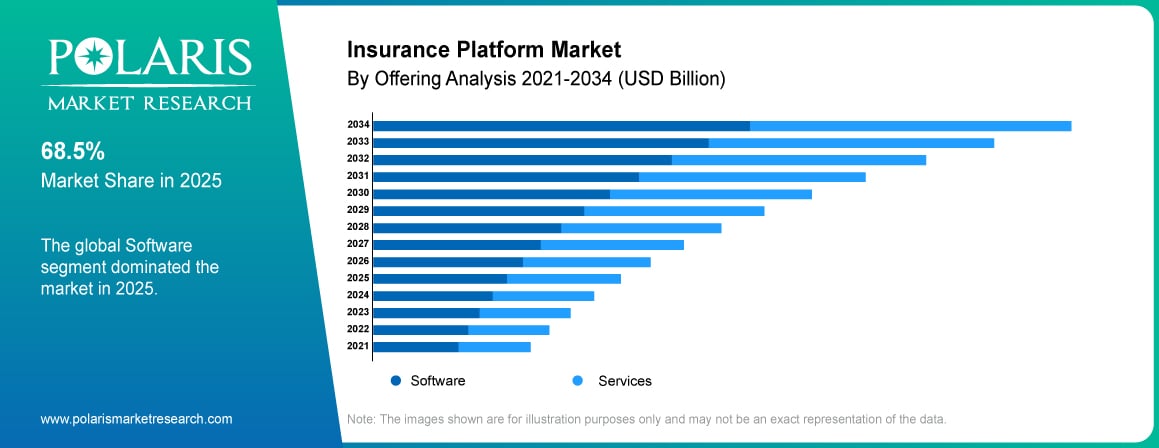
- The software segment accounted for an 68.5% insurance platform market share in 2025. Its ability to provide streamlined services contributes to its leading market share.
- The customer relationship management (CRM) segment held an 10.5% market share in 2025. The segment’s growth is driven by increased emphasis from companies on improving customer experience.
- The third-party administrators (TPAs) segment is projected to grow at an 12.4% CAGR. Growth is driven by the rising use of TPAs to coordinate insurance-related services.
Note: Figures and projections outlined in this report are the result of Polaris Market Research’s proprietary analytical processes, grounded in the latest available datasets and market observations.
What Is an Insurance Platform?
An insurance platform is the software application that insurance companies use to perform their business operations. This includes policy administration, underwriting, claims, billing, and customer information management. The insurance platform integrates all these features and enables employees to manage the insurance process using one common platform. It can also integrate with other applications used by insurance companies.
How Insurance Platforms Work?
Customer information is fed into the system: Customer information, policy information, and other information are added by insurance firms. The information can be viewed throughout the life of the policy.
The policy information is stored in the system: The information regarding insurance policies like coverages, premium rates, etc is stored in the system. The information can be consulted by employees in handling policies.
The insurance applications are managed: Application information can be viewed by the underwriting team in evaluating the applications. Information about applications is stored in the system.
The claim is recorded: Information about the claim and other relevant information is recorded in the system. The claims officers can view the claim information and update the status of the case.
Payments are recorded: The payment information regarding premiums and other billing information is recorded in the system. Payment information of the insurance policy is stored in the system.
Service requests are managed: The policy requests are handled through the system by employees.
Source: Polaris Market Research Analysis
Market Dynamics
Driver: Rising Adoption of AI, Cloud & Automation
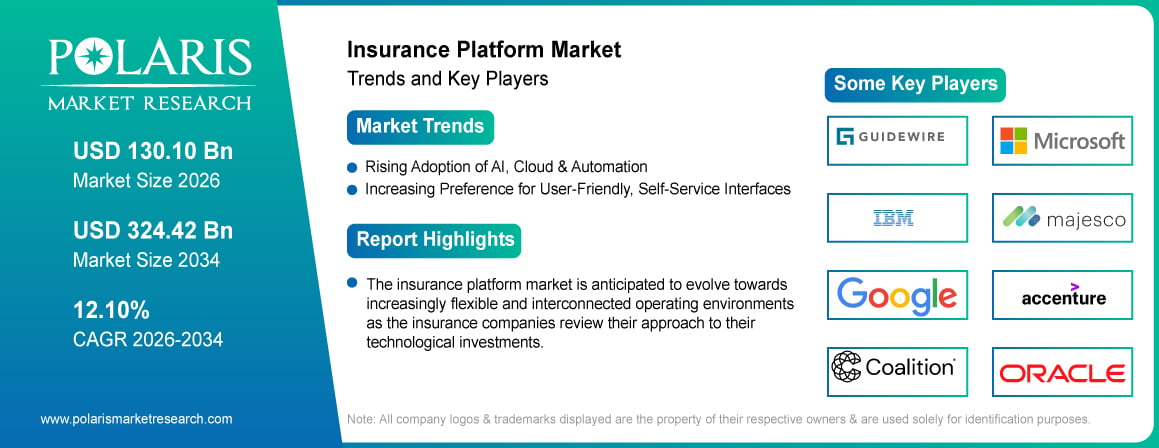
Insurance providers are increasingly migrating their operations onto cloud platforms as they replace their legacy infrastructure and seek more efficient approaches to managing their data and applications. In addition, cloud platforms offer a foundation for introducing automation and artificial intelligence (AI) into the daily processes of insurance companies. Routine operations in claims, underwriting, billing, and customer service are subject to automation, whereas document analysis, information assessment, fraud detection, and client inquiries receive solutions based on AI technologies. This trend is influencing the development of insurance platforms as well. In August 2026, Guidewire introduced the Qusar release of its Insurance Platform, which features an Agentic Framework built on Guidewire Cloud Platform. The Agentic Framework allows insurers to create and control AI agents that interact with policies, claims, and billing data (source: guidewire.com). Thus, the introduction of the platform highlights the growing focus on AI. The demand is likely to be oriented toward platforms integrating cloud infrastructure, automation, and AI technologies.
Driver: Increasing Preference for User-Friendly, Self-Service Interfaces
As more insurance consumers seek to undertake common tasks without having to engage with an agent or call center personnel, there is an increase in demand for insurance portals that provide intuitive user interfaces for policy viewing, downloading policy documents, payments, requesting modifications, and checking claims status. Mobile usage has also become essential as consumers leverage various channels to control their insurance policies. Insurance firms and e-commerce platforms have responded by enhancing the self-service process and digitizing the journey. For instance, Tata AIG has developed an omnichannel structure that provides self-service functionality through various channels including web, mobile, and messaging. IPDS V2 is a cloud platform developed by the firm that enables integration of these channels with core insurance platforms and processes. The company reported that over 90 percent of the consumer requirements can be catered for by self-service processes (source: tata.com). These developments show the growing focus on making insurance platform market solutions easier for customers to use.
Driver: Regulatory Push for Digital Insurance Accessibility
Regulatory programs are pushing insurers to improve the accessibility of their offerings and connect insurance services across different entities through shared platforms. In India, the Insurance Regulatory and Development Authority of India (IRDAI) conducted a discussion on the initiative of Public Insurance Registry and Bima Sugam among industry stakeholders in March 2026. These initiatives aim to make the digital insurance ecosystem interconnected for all concerned parties (source: irdai.gov.in). This shift increases the significance of insurance platforms that would be able to communicate with other systems and facilitate interactions in digital insurance. The role of insurance platform market vendors also gets wider, as they can now create insurance platforms that facilitate digital insurance procedures and improve policy access. As regulators pursue shared infrastructure in the digital sphere, platforms will become even more important.
Restraints and Challenges: Implementation, Integration & Data Security Challenges
Transitioning to a new insurance platform entails considerable costs associated with purchasing software, hardware, infrastructure, and integration with other systems. Many insurance companies use legacy systems developed during different periods of their technological evolution. Integrating these systems with more modern platforms can be costly and time-consuming. Small insurance companies may face difficulties in covering the high cost of implementation.
Modern insurance platform market solutions store critical information related to customers, policies, payments, claims, etc. Thus, these platforms become valuable targets for cyberattacks. Insurance companies also have to manage how the data is accessed, stored, collected, used, and distributed by the connected systems. Weak access control and data governance can pose additional cybersecurity challenges. These risks may become obstacles to adopting technologies and operating insurance platforms.
Opportunities : Embedded Insurance & API-Driven Ecosystems
Insurers are increasingly offering products through non-insurance channels and digital platforms. Embedded insurance allows for the selling of insurance products during activities such as shopping online, travel booking, automobile sales, and financial services. Insurance becomes easier to access since the customer can consider insurance during the transaction process. APIs enable embedded insurance by helping the insurance platform to interact with other applications and share data. In this case, the insurer is allowed to make quotations, issue policies, take payments, and manage policies through the partner platform. Furthermore, APIs-integrated insurance platforms allow insurers to partner with banks, retailers, mobility companies, and digital companies without making changes to their systems. The increasing requirement for integration of insurance into business processes is driving the demand for insurance platform market solutions.
Opportunities : Usage-Based & Parametric Insurance Models
Usage-based and parametric insurance policies have introduced new requirements for insurance platforms. Usage-based insurance makes use of information about how the customer uses the insured asset. For instance, auto insurance policies make use of the driving behavior of the customer to determine the premiums. Parametric insurance is a different model that offers a fixed payout when a specified trigger occurs. Usage-based and parametric insurance require the collection and analysis of data as well as the matching of this data to policy conditions. Insurance platforms can help in carrying out automatic premium calculation and trigger-based payouts. As insurance companies expand their offerings of this type of product, the need for insurance platforms to handle external data, process policy conditions, and automate workflows increases.
Trend: Shift Toward Modular Insurance Platforms
Insurance companies increasingly want platforms they can introduce in stages rather than replacing every existing system at once. The modular approach lets insurance companies choose modules based on immediate needs, whether for policy management, claims management, billing, or more. It also becomes easier to upgrade each module when business requirements change. This is suitable for insurance companies that would like to upgrade their existing solutions but want to keep certain aspects of their legacy system. Platform vendors have also become more responsive, providing software solutions that can be configured and extended as modules.
Generative AI in Insurance Platforms
Generative AI is influencing the way insurers use insurance platforms for their daily and knowledge-based tasks. The technology enables insurers to summarize policy documents, write answers to customer queries, extract relevant information from claims documents, and search huge amounts of internal documents. This helps decrease manual effort in document handling and improve access to relevant information.
In addition to that, generative AI can be used in claims and underwriting processes. Claims teams can benefit from the technology by using it to organize information from submitted documents and indicate the elements for further checking. In underwriting, it can provide assistance in dealing with policy documents, risk information, and any additional information needed for working with policies. Such usage of AI will enhance existing platform functionalities without altering the insurance process itself.
Generative AI functionality can be embedded directly into the products of insurance platform providers. This enables insurers to use AI in their workflow rather than applying separate applications for such purposes. However, some controls over data accessibility, accuracy, privacy, and human review will be required. These requirements will influence the speed of implementation of the technology into the insurance process.
Insurance Platform vs Traditional Insurance Systems
Modern insurance platform market solutions differ from traditional insurance systems in how insurers handle their core processes. This goes beyond the technology part, as it involves implementation, scalability, integration, and adaptation to the needs of the modern insurance industry.
| Comparison Factor | Insurance Platforms | Traditional Insurance Systems |
| System Architecture | Modular and configurable | Usually developed in fixed system architecture |
| Deployment | Easier to implement in phases | Full development project is needed for major updates |
| Scalability | Easily scalable according to business requirements | System expansion requires significant changes to the existing system |
| Integration | Easier to integrate with other systems | May require custom integration interface |
| Data Management | Easy to manage data in an integrated manner | Data will be managed separately in different systems |
| Process Management | Easier to configure workflow | Dependent on manual process management to some extent |
| Maintenance | System capability upgrade can be easily done | Change may impact other parts of the system |
Source: Polaris Market Research Analysis
Source: Polaris Market Research Analysis
Market Segmentation Overview
The insurance platform market is segmented on the basis of offering, application, insurance type, technology, end-user, and region. This reflects the variations in the functions performed by insurance platforms, technology use, and insurance processes. The segmentation also reflects how the demand pattern differs among insurers, intermediaries, and other industry players.
| Category | Key Segments |
| By Offering | Software (Intelligent Document Processing · Insurance Lead Management · Insurance Workflow Automation · Policy Management · Video KYC/eKYC · API & Microservices) · Services (Professional Services · Managed Services) |
| By Application | Claims Management · Underwriting & Rating · Customer Relationship Management (CRM) · Billing & Payments · Data Analytics · Compliance & Reporting · Policy Administration, Collection & Disbursement · Sales & Marketing · Property Estimation · Predictive Modeling/Extreme Event Forecasting |
| By Insurance Type | General Insurance (Health, Automobile, Homeowners, Travel) · Life Insurance (Term, ULIP, Whole Life) · Cybersecurity Insurance |
| By Technology | AI & ML · IoT · Blockchain · Data Analytics & Big Data · Regulatory Technology (Regtech) · Cloud Computing |
| By End-User | Insurance Companies (Large, Mid-Sized, Small & Startup) · Insurance Agencies & Brokers (Independent, Brokerage Firms, Online Aggregators) · Third-Party Administrators (TPAs) · Actuaries · Reinsurers |
| By Region | North America (U.S., Canada) · Europe (UK, Germany, France, Italy, Spain, Netherlands, Russia, Rest of Europe) · Asia Pacific (China, India, Japan, Malaysia, Indonesia, South Korea, Rest of Asia Pacific) · Latin America (Brazil, Mexico, Argentina, Rest of Latin America) · Middle East & Africa (Saudi Arabia, UAE, Israel, South Africa, Rest of Middle East & Africa) |
Source: Polaris Market Research Analysis
By Offering Analysis
Software
The software segment accounted for an 68.5% insurance platform share in 2025. Demand is driven by the need for automation of routine insurance operations and large amounts of information processed in a digital form. Intelligent document processing can reduce the manual work required to examine and extract information from documents. The importance of insurance workflow automation is also growing as insurers strive to automate routine operations. Demand for policy management software remains strong because it helps automate routine policy management tasks. Video KYC/eKYC solutions are becoming more widespread as the insurance industry adopts digital customer onboarding and verification. APIs and microservices meet demand by enabling insurers to integrate new applications into existing IT environments. Together, these features allow greater flexibility when improving individual modules without altering the entire technology ecosystem.
Services: Professional & Managed Services
The services segment is projected to grow at an 11.2% CAGR. Growth is supported by the need for external help from insurance companies when implementing the platform, integrating it into their infrastructure, migrating data, and maintaining it. Professional services allow insurers to integrate a new platform into their systems. Managed services allow insurers to continue getting support even after implementation. Another source of demand is the modernization of existing insurance technologies and the introduction of new ones. External service providers can help insurers deal with the transformation without hiring all professionals in-house. The increased complexity of the insurance technology environment is expected to contribute to further demand for both professional and managed services.
By Application Analysis
The insurance platform market supports several functions across policy, customer, financial, and risk management activities. Adoption differs by application based on insurers’ digitalization priorities and operational requirements.
Claims Management
The claims management segment accounted for an 18.5% share in 2025. Claims management is a key application area because insurers want to minimize the time and effort spent processing claims. Digital platforms can combine claim forms, client information, documentation, and updates related to individual claims. This makes it easier for staff responsible for processing claims to monitor claim status and pending tasks. Insurers continue to increase automation in their claims-handling activities. The ever-increasing number of digital claims makes platforms that enable claims management information processing more in demand. Improvements in claims automation is expected to influence the overall customer experience and therefore become a key application area.
Underwriting & Rating
The underwriting & rating segment held an 15.0% insurance platform market share in 2025. Underwriting and rating mechanisms are becoming crucial as insurance companies strive to develop consistency in their risk assessment and pricing procedures. The mechanisms can incorporate information utilized by underwriters and facilitate pricing strategies. Automation can help reduce duplication of tasks and allow underwriting teams to focus on complex risks. The need for faster processing has been increasing in view of the increasing number of online policy applications. The ability to update rating and underwriting mechanisms is another driver of this demand. These needs are particularly significant given the large amount of data insurers process.
Customer Relationship Management (CRM)
The customer relationship management segment held an 10.5% insurance platform market share in 2025. CRM solutions have become more crucial since insurers have started prioritizing customer retention. With the help of CRM solutions, employees have access to all customer information while interacting with customers. Insurers can also utilize insurance CRM solutions for channel communications. As insurers are increasingly relying on digital journeys, there is a growing need for CRM solutions, which connect customer data and provide services to them. CRM solutions can also be used for sales and renewals purposes because they enable insurers to understand their customer relationships more clearly. This has encouraged insurers to consider the incorporation of customer management into insurance platforms.
Billing & Payments
The billing & payments segment is projected to grow at an 11.7% CAGR. Billing and payment solutions are considered key areas since there is a need for insurance companies to effectively collect premiums for different policies, clients, and payment mechanisms. Digital systems can facilitate billing cycles, transactions, accounting, and reconciliation. The shift towards online and electronic payments has created a need for solutions capable of integrating different payment methods and providing real-time account status. Automating some processes means less manual effort when it comes to payment tracking and updating of billing information. Hence, insurers are now focusing on implementing billing solutions that can integrate with their policy and client data.
Predictive Modeling & Extreme Event Forecasting
The predictive modeling & extreme event forecasting segment is anticipated to register an 15.7% CAGR. Extreme event prediction is receiving increased interest due to the growing application of predictive analytics among insurers to assess risks and make decisions. Predictive modeling can be used in different contexts, including pricing, underwriting, claims, and assessing the risks of customers. Extreme event prediction is especially important for insurers that operate in conditions of weather-related and other extreme events. Analytical solutions can be integrated into an insurance platform by providing access to policy and risk data. Growing availability of data and the need for well-informed decisions are some of the factors that are driving the demand for such integration. The relevance of this application is increasing as demand grows for more effective assessment of changing risk conditions.
By Technology Analysis
Technology adoption is shaping how insurers build, operate, and upgrade their platforms. Each technology addresses different requirements across insurance operations, data management, customer services, and compliance.
Cloud Computing
The cloud computing segment held an 25.5% insurance platform market share in 2025. The use of cloud computing is helping to modernize insurance platforms as insurers seek alternatives to aging on-premises systems. Through cloud computing, it becomes easy to integrate new applications, increase computing power, and control platform resources depending on the changing demands. In addition, the use of cloud platforms enables insurers to utilize technology resources without the need to invest in similar physical infrastructure. The need for cloud platforms in insurers’ technology upgrading process is mainly driven by the ability to shift or adopt various aspects over time. The need is also driven by the ever-increasing demand to integrate insurance applications and data across business processes.
Cloud vs On-Premise Insurance Platform
| Dimension | Cloud-Based Insurance Platforms | On-Premise Insurance Platforms |
| Upfront Cost | Low (subscription/SaaS pricing) | High (infrastructure + licensing capex) |
| Maintenance | Vendor-managed, continuous updates | In-house IT team required |
| Scalability | Elastic, pay-as-you-grow | Requires capacity planning and hardware upgrades |
| Data Residency Control | Configurable by region, subject to provider footprint | Full control within owned data centers |
| Disaster Recovery | Built-in redundancy across provider regions | Requires separate DR investment |
| Best Fit | SMEs, digital-first insurers, multi-region carriers | Large carriers with strict legacy compliance/data residency mandates |
| Adoption Trend (2025–2026) | Majority of new insurer deployments | Concentrated in regulated legacy environments |
Source: Polaris Market Research Analysis
AI & ML
The AI & ML segment is projected to grow at an 15.3% CAGR. Growing adoption is supported by efforts made by insurers to invest in technologies that allow them to transform raw data into meaningful insights. AI and ML technologies are also being incorporated into the core of the infrastructure used by insurers instead of being offered as separate products. This allows insurers to introduce intelligent functionality to their systems as they continue developing them. Another reason for the growing adoption of these technologies is that machine learning models can be continuously developed and adjusted using new data. This provides insurers with opportunities to adjust their models in accordance with changes in the market. Platform providers are also working to integrate AI capabilities into their offerings.
IoT
The IoT segment held an 12.5% insurance platform market share in 2025. The adoption of Internet of Things (IoT) is increasing the volume of real-world data being collected by the insurers through the use of connected cars, devices, machinery, or properties. Telematics data may help insurers know the usage of the asset, the behavior of the insured person or asset, operating conditions, or possible risks associated with the asset. Similar applications can be developed in property or business insurance where the connected device gives data about the insured asset. Consequently, the increase in the adoption of connected devices is generating the need for platform providers who can collect and analyze the data from multiple sources.
Blockchain
The blockchain segment is projected to grow at an 14.7% CAGR. Blockchain is being considered for implementation in insurance processes that involve interaction among various stakeholders through data and transaction exchanges. A decentralized ledger of information provided by blockchain could be useful in situations where insurers, brokers, customers, and other stakeholders must authenticate the same records. Some potential areas of implementation can be policy documentation, claims process, identity management, and transaction processes. Despite blockchain being less widely adopted compared to cloud computing and artificial intelligence owing to integration challenges and regulations, its persistent importance in relation to the enhancement of data quality and avoiding redundancy continues.
Data Analytics & Big Data
The data analytics & big data segment held an 20.0% market share in 2025. Data analytics and big data have become important because insurance companies accumulate information from multiple sources. Information about customers' history, claims, policies, the market, and data from connected devices can help decision-making. Data analytics supports tasks such as pricing, underwriting, claims management, fraud detection, customer segmentation, and more. As the amount of information increases, the need for platforms that can analyze and store it grows. With better use of information, insurers can identify risks and track changes in customers' behavior.
Regulatory Technology (Regtech)
The regulatory technology segment is anticipated to grow at an 14.1% CAGR. Regtech technologies are becoming increasingly valuable for insurers as they face growing demands for compliance, reporting, customer verification, data protection, and risk management. Regtech has potential uses in automating certain compliance monitoring procedures and maintaining the documentation required by regulations. Regtech can also be used in checking customer and transaction data without requiring any manual verification of such information in regular cases. Regtech technologies are especially relevant for insurers operating in various markets, since regulatory requirements can vary in each. As insurance companies' operations become increasingly digitized, they also need to update their compliance processes accordingly.
By Insurance Type Analysis
General Insurance
The general insurance segment accounted for an 58.0% market share in 2025. Its position is supported by the diversity of products available under general insurance, such as automobile insurance, health insurance, homeowners insurance, and travel insurance. These segments involve many customers and frequent policy and claims activities, making it imperative for companies to have systems that facilitate insurance operations. Insurance companies are also looking into digitizing their policy servicing, claims processing, billing, and communication services. The application of data in risk evaluation and policy management is increasing the requirement for platforms that could integrate data between different processes. With general insurers increasingly updating their technology systems, there is a continued demand for insurance platforms in this segment.
Cybersecurity Insurance
The cybersecurity insurance segment is projected to grow at an 16.4% CAGR. The segment’s growth is attributed to the increasing financial implications of cyberattacks and rising need for distinct insurance coverage for digital risks. With an increasing number of organizations making use of cloud computing and digitization in their operations, there is a need for insurers to handle a changing risk environment. In addition, insurers are required to evaluate the security policies of organizations and also the possible losses in the process of offering cyber insurance. This implies that insurers need platforms that allow them to cater for dynamic risk parameters and provide specialized insurance products. Insurers are developing ways to manage cyber risks as threats evolve. These factors are expected to drive industry growth.
By End-User Analysis
Insurance Companies
The insurance companies segment led with an 53.5% share in 2025. This strong position is supported by the need for insurance companies to use platforms, regardless of size or type. Large players are building platforms to drive technology transformation within the company. At the same time, small- to medium-sized enterprises want a solution that improves their technology infrastructure without building a huge system in-house. Furthermore, growing pressure on insurance companies to meet their clients' changing needs and provide new insurance products has created a need to reassess the existing technological system. Besides, increased competition in the market stresses the need for rapid product development.
Third-Party Administrators (TPAs)
The third-party administrators (TPAs) segment is projected to grow at an 12.4% CAGR. Growth is driven by the rising use of TPAs in facilitating coordination of insurance-related services among insurers, healthcare providers, and policyholders. TPAs manage large amounts of information and frequently operate across multiple organizations, making it necessary to develop systems that help achieve effective coordination and information exchange. In addition, the growth of outsourced insurance administration is prompting TPAs to adopt technological solutions capable of accommodating the increasing number of clients. As insurers strive to simplify their administrative processes and collaborate with service providers, there is an expectation that TPAs will increasingly require such platforms to accommodate their needs.
Source: Polaris Market Research Analysis
Regional Insights
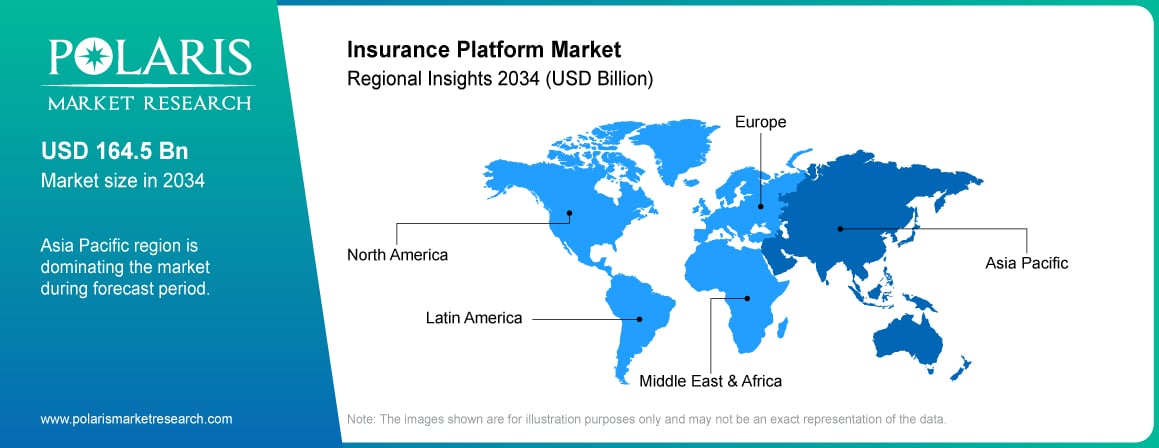
The insurance platform market exhibits varied trends in adoption based on factors such as differences in the level of insurance penetration, digitization, regulation, and technology spend. North America held the leading position, while the Asia Pacific region is poised to experience strong growth. Europe, Latin America, and the Middle East and Africa were other regions developing their insurance technology capabilities.
North America
North America accounted for a major share of 38.2% in 2025. This is due to an advanced insurance sector characterized by technology investment and the presence of large insurance companies and insurance technology vendors. These firms continue to upgrade their systems as they seek better options to address challenges in the insurance sector. Furthermore, demand for insurance platforms has risen due to the size of the U.S. insurance market and the country's high level of digitalization. There has been an increasing trend in the use of digital insurance platforms in Canada as insurers try to meet rising demands and changing products. The key factors behind the rising demand in the region include advanced technology vendors, an established insurance environment, and investments in cloud computing technology.
Asia Pacific
The Asia Pacific region is anticipated to witness the fastest growth at a 15.0% CAGR. This is attributed to increased insurance penetration and growth in digital financial services, creating a conducive environment for the adoption of platforms. Different stages of insurance technology evolution in countries such as China, India, Japan, South Korea, and other Southeast Asian countries provide opportunities for existing and upcoming platform providers. Some of the emerging countries, such as India, have increasingly turned to digital channels in order for insurers to explore ways beyond traditional methods of insurance policy distribution. There is also a prevalence of technology-driven companies as well as increasing numbers of digital customers. Insurers are seeking technologies that will enable them to grow their businesses and venture into other markets and customer segments.
Europe
Europe held an 27.0% insurance platform market share in 2025. Europe represents an established market for insurance platforms owing to the presence of a well-developed insurance market and investments in technology transformation. Insurance companies in the region continue to update their technology ecosystems to meet regulatory challenges and changes in market dynamics. The UK, Germany, France, and Italy are some of the countries with an established insurance market requiring technology infrastructure solutions. Further, the emphasis on data governance, digital services, and regulations in Europe is shaping technology investments in the region. Insurers are also seeking to modernize their systems without disrupting their existing operations. These factors are expected to drive steady market growth in the region.
Latin America and Middle East & Africa
Latin America and the Middle East & Africa are projected to grow at a CAGR of 13.0% and 13.6%, respectively. Latin America and the Middle East & Africa are considered emerging regions for insurance platforms owing to the emergence of the digital insurance ecosystem and advancements in financial services infrastructure technologies. For instance, Brazil and Mexico can be among those countries in Latin America with well-developed insurance industries, while Middle East countries are building their digital financial services. Insurance companies in these regions are increasingly interested in technology solutions to reach new customers and deliver insurance products digitally. However, different degrees of insurance penetration and maturity result in different rates of adoption between countries. More digitalization and investments in financial services infrastructure will bring new opportunities for insurance platforms.
Source: Polaris Market Research Analysis
Real-World Insurance Platform Use Cases & Case Studies
Insurance platforms are being adopted for specific business needs, from creating new operational environments to integrating insurance portfolios. Recent implementations reveal how insurance companies expand their operations without developing a new system for each functional area.
Case Study: In August 2026, Galaxy Health Insurance announced its partnership with Zoho to develop a digital distribution platform for its growing insurance operations. This platform was deployed in a period of just three months and has functionalities such as agent onboarding, tele-sales, customer support, grievance handling, and commission processing. It is also integrated with the insurer’s policy administration and document management systems. The platform handles over 250 new agent onboardings per week and approximately 40,000 tele-sales per month. This case study is an example of how a new insurer could leverage a platform to set up its distribution network while integrating with other insurance systems (source: financialexpress.com).
Migration of legacy portfolios: Insurance platforms may be used by established insurers when migrating their existing policies from their current administration system environments. This process may require the migration of policies that were generated through other policy structure designs and carry valuable historical data. The implementation strategy focused on migration would allow insurers to organize their records in a new environment while maintaining their existing portfolio during the process.
Consolidation of insurance portfolio: Insurance organizations may use a common platform during consolidation of portfolios following merger or acquisition processes or any other changes in business ownership. Organizations may have different policies, data formats, and administrative procedures. Consolidation of portfolios under one platform may provide a unified approach in management of the consolidated business. This use case is appropriate for insurers that want to unify their technological infrastructure due to growth and reorganization.
Configuration of a new product: Insurance platforms may be used when insurers develop a new product or make considerable changes in existing products. The parameters of a product, its coverage structure, eligibility criteria, and any other information may be configured within the platform. Insurers will have a tool to make changes and keep new products within their existing framework. This use case applies when insurers need to modify product portfolios due to changing market needs.
Insurance Platform Business Model & Pricing Approaches
Insurers may opt for different business models depending on the scale of the insurer, deployment, and support needs. The most commonly used business model is subscription, as insurers pay periodically for using platform features. Depending on the business, pricing can be based on users, number of policies managed, selected modules, or usage of the platform. Another popular model includes licensing, where insurers pay once or periodically for certain software features. This pricing model is suitable for insurers that want more control over their IT infrastructure.
Another business model is usage-based pricing, where the costs will be calculated based on transactional volumes, the volume of data, or usage of the platform. Insurance platform vendors may use a service-based business model, where implementation, customization, and integration, as well as technical support services, are paid separately. There are insurance platforms that combine both subscription and other pricing models. It offers insurers the flexibility to set prices depending on their needs and budget for technology use.
Regulatory & Compliance Landscape
Insurance platforms operate in a regulatory environment that varies by country and insurance type. Platforms need to take into account regulations concerning policyholder protection, insurance reporting, information management, client identification, and digital record-keeping in order to build the platform in compliance with regulations. There may also be differences in regulation regarding life insurance, general insurance, health insurance, and specialty insurance. For example, in the EU, the Digital Operational Resilience Act (DORA) defines the requirements to manage information and communications technology risk in financial institutions.
In India, the Insurance Regulatory and Development Authority of India (IRDAI) continues to develop the regulatory instruments that address insurance business, insurance intermediation, and the rights of the policyholders. The providers of the platforms need to manage the configurability of controls and keep records for the purposes of compliance. Insurance platform regulatory compliance requirements can thus influence the implementation of the platform.
Competitive Landscape & Key Market Players
The insurance platform marketplace is highly competitive. It includes established technology firms and specialized vendors that cater to the needs of various insurance companies. Factors that influence competition include product diversity, integration, geographical coverage, and services.
Strategic Collaborations Driving Competition
Strategic partnerships are emerging as one of the key strategies for insurance platform market providers seeking to enhance their capabilities and reach out to different customer bases. Partnerships between platform vendors, insurers, technology firms, and implementation partners can blend software capabilities with industry know-how and distribution channels. In addition, such partnerships can facilitate the entry into new markets by platform vendors without having to build all capabilities on their own. Partnerships can cover implementation, integration, data, cloud, and insurance-specific applications. For insurers, the partnerships not only provide access to different capabilities but also reduce the requirement to source multiple technology vendors separately. The emergence of partnerships of various types is thus increasing competition, particularly as vendors try to differentiate their offerings.
Vendor Positioning Comparison
| Vendor | Primary Focus | Deployment Model | Key Differentiator |
| Salesforce | CRM / customer engagement layer for insurers | Cloud-native (multi-tenant SaaS) | Financial Services Cloud unifies customer data across sales, service, and claims touchpoints |
| Guidewire Software | Core claims, policy, and billing systems | Cloud (Guidewire Cloud) and on-premise | Deep insurance-domain workflow depth for P&C carriers |
| Duck Creek Technologies | Policy administration and billing | Cloud-native, SaaS | High product/rating configurability without heavy custom code |
| Microsoft | Cloud infrastructure, data platform, embedded AI | Cloud (Azure) | Foundation layer enabling interoperability across other insurance platforms |
| IBM | Enterprise AI, data governance, risk analytics | Hybrid cloud | Strong fit for regulated, auditable AI decisioning |
| Oracle | Policy administration (OIPA) plus CX | Cloud and on-premise | Deep integration with finance/ERP systems for large carriers |
| SAP | Financial reporting, customer experience | Cloud | Datasphere/Analytics Cloud for group-wide financial transparency |
| Accenture | Systems integration & transformation services | Multi-cloud, vendor-agnostic | End-to-end transformation delivery, not a single product |
| Sapiens International | Core insurance software (life, P&C) | Cloud and on-premise | Broad global carrier footprint, strong in mid-market |
| Majesco | Cloud-native core insurance suite | Cloud-native SaaS | Purpose-built for digital-first and P&C/L&A carriers |
Source: Polaris Market Research Analysis
Insurance Platform Market Key Players 2026
- Accenture plc
- Coalition, Inc.
- Duck Creek Technologies LLC
- Google LLC
- Guidewire Software, Inc.
- Insurity, Inc.
- International Business Machines Corporation
- LexisNexis Risk Solutions Inc.
- Majesco
- Microsoft Corporation
- Oracle Corporation
- Salesforce, Inc.
- SAP SE
- Sapiens International Corporation N.V.
- Verisk Analytics, Inc.
Recent Developments
- September 2026: Insurtech platforms InsuranceDekho and RenewBuy merged to form a consolidated national distribution platform. The consolidated platform will operate under the InsuranceDekho name and become a major tech powerhouse with a premium book of more than INR 6,600 crore and more than 600,000 digital partners. (source: business-standard.com)
- September 2026: iPipeline announced the completion of the acquisition of Origo after receiving all required regulatory approvals. According to iPipeline, the acquisition will expand its expertise in market connectivity. It will also support the company’s strategy to help financial services organizations operate in a more efficient manner. (source: businesswire.com)
- June 2026: Poetic raised $50 million in Series A funding from investors including OpenAI, Founders Fund, and Kleiner Perkins. The platform is designed for automated underwriting and compliance infrastructure. It intends to transform regular processes from simple AI prompts to stable execution code. (source: prnewswire.com)
Future Outlook
The insurance platform market is anticipated to evolve towards increasingly flexible and interconnected operating environments as the insurance companies review their approach to their technological investments. The demand will vary between the companies based on their size, with smaller players looking for practical solutions that do not require substantial investments in technology, while larger organizations might prefer more advanced platforms that support their complex organizational structures. Increased competition among vendors is expected as suppliers try to address insurance needs and offer more configurable commercial models. Further market growth will largely depend on insurance companies’ interest in replacing fragmented technology environments and investing in platform development projects over an extended period.
Research Methodology
The insurance platform market report uses a combination of both primary and secondary research techniques in order to determine the size and structure of the insurance platform market as well as its growth potential. The research methodology is geared towards cross-checking figures and providing a standardized foundation for segmentation and forecasting.
Secondary sources include annual reports, company investor presentations, regulatory filings, company press releases, venture capital database information, industry publications, government data, and information from insurance regulators. Data gathered from vendors of insurance platforms and other industry stakeholders are used to determine historical trends in the insurance platform market from 2021 to the base year.
The primary research involved conducting interviews with C-level executives and product/strategy management teams of insurance platform providers, systems integrators, and buy-side (CIO, CTO, digital transformation heads at insurers, brokerages, and TPAs).
The market sizing process applies both top-down and bottom-up methodologies, where the top-down methodology involves aggregation of vendor revenue numbers by offering, application, technology, and insurance type segments, while the bottom-up approach is based on end-user adoption and spending analysis in regions. Forecasting was done using historical CAGR, adoption curve modeling, and sensitivity testing.
Insurance Platform Market Report Scope
| Report Attributes | Details |
| Market Size Value in 2025 | USD 116.24 billion |
| Market Size Value in 2026 | USD 130.10 billion |
| Insurance Platform Market Forecast 2034 | USD 324.42 billion |
| CAGR | 12.10% from 2026 to 2034 |
| Base Year | 2025 |
| Historical Data | 2021–2024 |
| Forecast Period | 2026–2034 |
| Quantitative Units | Revenue in USD billion and CAGR from 2026 to 2034 |
| Report Coverage | Revenue Forecast, Market Competitive Landscape, Growth Factors, and Industry Trends |
| Segments Covered |
|
| Regional Scope |
|
| Competitive Landscape |
|
| Report Format |
|
| Customization | Report customization as per your requirements with respect to countries, regions, and segmentation. |
Source: Polaris Market Research Analysis
Insurance Platform Market FAQ's
The insurance platform market size was valued at 116.24 billion in 2025. The market is projected to grow to USD 324.42 billion by 2034.
The market is projected to account for an 12.10% CAGR from 2026 to 2034.
A few of the key market companies include Accenture plc; Coalition, Inc.; Duck Creek Technologies LLC; Google LLC; Guidewire Software, Inc.; Insurity, Inc.; International Business Machines Corporation; LexisNexis Risk Solutions Inc.; Majesco; Microsoft Corporation; Oracle Corporation; Salesforce, Inc.; SAP SE; Sapiens International Corporation N.V.; and Verisk Analytics, Inc.
North America accounted for the largest insurance platform market share of 38.2% in 2025. The presence of leading insurance companies contributes to the regional market dominance.
The customer relationship management (CRM) segment led with an 10.5% share in 2025. This is owing to increased emphasis from companies on improving customer experience.
Insurance platforms integrate insurance data and processes under one umbrella. Insurance firms are able to handle policies, claims, payments, and all other tasks without having to rely on several applications to complete various functions.
Many insurers are switching to new applications instead of old legacy systems that are difficult to upgrade and integrate. Modern platforms provide greater flexibility whenever insurance companies decide to switch to new products or expand operations.
There are challenges related to implementation cost, integrations, migrations, security concerns, and management of the transition from legacy systems to a new platform.
Download Sample Report of Insurance Platform Market
Please fill out the form to request a customized copy of the research report.


