
Lice Treatment Market Size, Share, Trends & Forecast, 2026-2034
REPORT DETAILS
Lice Treatment Market Summary
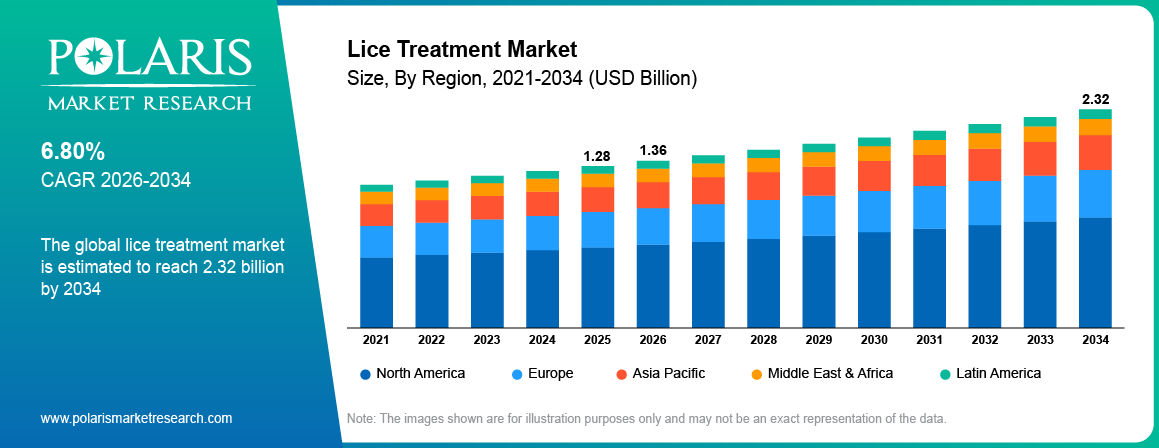
Global lice treatment market size was valued at USD 1.28 Billion in 2025. The market is anticipated to grow from USD 1.36 Billion in 2026 to USD 2.32 Billion by 2034, exhibiting the CAGR of 6.80% during the forecast period.
Market Statistics
Lice Treatment Market Key Takeaways
- North America held the largest market share in 2025, accounting for 38.7%. The high prevalence of lice infestations among school-aged children, strong healthcare expenditure, widespread treatment availability, and greater awareness regarding early diagnosis supported the region’s market leadership.
- Asia Pacific is projected to grow at the fastest CAGR of 8.4% during 2026–2034. Improving awareness of lice-related conditions, expanding access to pharmacies and healthcare services, increasing pediatric populations, and greater availability of affordable treatment products are supporting regional market growth.
- Pediculosis capitis held the largest share in 2025, at 76.5%. The high incidence of head lice among children, frequent outbreaks in schools and childcare facilities, and the ease of transmission through close personal contact contributed to strong treatment demand.
- OTC products accounted for 61.8% of the market in 2025. These products are widely preferred due to their easy availability, lower cost compared with prescription medicines, convenience of home treatment, and broad presence across retail and online pharmacies.
- The prescription medicines segment is expected to grow at a CAGR of 7.9% during 2026–2034. Prescription treatments are increasingly used for persistent infestations, resistant lice strains, recurring cases, and situations in which conventional OTC products fail to provide effective results.
- Retail pharmacies held a market share of 49.6% in 2025. Their extensive geographic reach, immediate availability of lice treatment products, pharmacist guidance, and strong consumer preference for purchasing non-prescription treatments through established pharmacy outlets supported segment growth.
Note: Figures and projections outlined in this report are the result of Polaris Market Research’s proprietary analytical processes, grounded in the latest available datasets and market observations.
What Is the Lice Treatment Market? Definition, Products & Infestation Types
The development, production, and sale of products used to treat and prevent lice infestations is referred as the lice treatment market. It covers OTC products, prescription medications, medicated shampoos, lotions, creams, sprays, and lice combs used by children and adults through hospitals, pharmacies, and online platforms.
Source: Polaris Market Research Analysis
To Understand More About this Research: Download Sample Report
How Is Lice Treated? Head, Body & Pubic Lice Treatment Pathways
Lice treatment starts when a lice infestation is diagnosed by examining the scalp. The treatment, which may be a medicated shampoo, lotion, or prescription product, is applied according to the instructions. This kills adult lice, and a fine toothed lice comb is used to remove eggs (nits) from the hair.
A second treatment may be needed in a few days to kill any lice that have hatched since the first treatment. In addition, household items such as bedding, clothing, hats, and hair accessories are cleaned to prevent re-infestation. These measures support to control the infestation and minimize the risk of spreading lice to others.
Lice Treatment Market Overview
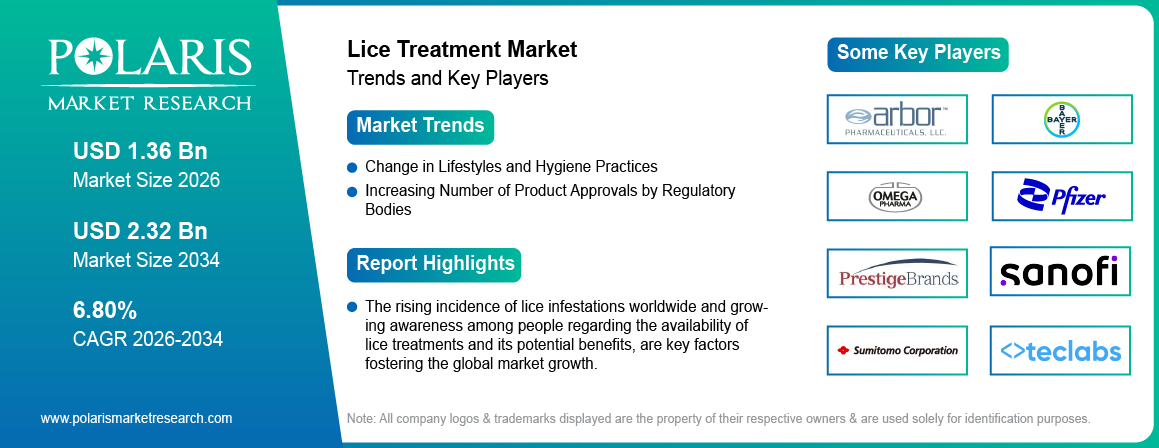
The rising incidence of lice infestations worldwide and growing awareness among people regarding the availability of lice treatments and its potential benefits, are key factors fostering the global market growth.
For instance, according to a report published by Centers for Disease Control and Prevention, around 6 million to 12 Mn cases of the head lice infestations take place each year in the United States in the children age 3 to 11 years, and the infestations are more often in girls than boys.
Head lice infestations are becoming very common issue especially among the children in school settings, thereby several awareness campaigns, initiatives, and educational programs being introduced by healthcare organizations to make people aware of the infestations and importance of their timely treatment.
Market Dynamics
Driver: Close-Contact Transmission, School/Household Exposure & Treatment Awareness
There has been drastic change in people lifestyles such as changes in living standards and hygiene practices that contribute to the prevalence of lice and boosting the demand for effective treatment options. Also, factors such as growing travel and rapid pace of urbanizations especially in developing economies are also expected to result in higher incidences of lice, thereby propelling the market growth.
For instance, according to a report published by Urbanet, the urban population in India is currently stood at around 461 million and the number is growing at CAGR 2.3 percent. Also, it is estimated that the 75 percent country’s national income come from urban areas.
Driver: Regulatory Approvals and Access to New Lice Treatments
The increase in the number of product approvals by leading regulatory authorities and agencies for the treatment of lice infestations and related issues, is anticipated to boost global market growth. Governments of several nations are mandating lice control measures in various settings including schools, healthcare facilities, and daycare centers, that foster the need for lice treatment products. For instance, according to a report by the Food and Drug Administration, they have approved several treatments for head lice including prescription drugs in shampoo, lotions, and cream rinse, and also non-prescription like OTC products.
Restraining Factors
Restraint: Treatment Cost, Resistance, Misdiagnosis & Awareness Gaps
The cost of lice treatments can be relatively high especially for families with low income and low awareness among people regarding the available treatment options and the importance of on-time effective treatment, are key factors expected to hamper the global market growth.
Trend: Persistent Head Lice Infestations and Recurrent Treatment Demand
Head lice infestations are prevalent in school-aged children due to close contact. The risk of community transmission and recurrent infestations has increased the need for the diagnosis and treatment of head lice infestations in a timely manner.
Due to increasing awareness programs in schools and healthcare settings, early detection and proper treatment is being promoted. Hence, demand for effective, easy to use and safe lice treatment products is continuously increasing.
Pediatric Head Lice Demand: School-Age Children and Household Transmission
Children are the largest users of lice treatment products because head lice are most common among school-aged groups. Schools and healthcare providers also encourage regular screening and early treatment to reduce the spread of infestations.
Manufacturers are introducing child-friendly and safe treatment options that are easy to use. At the same time, parental awareness programs and pediatric healthcare recommendations continue to support product adoption.
Source: Polaris Market Research Analysis
Lice Treatment Market Segmentation Analysis
The market is primarily segmented based on type, treatment, distribution channel, and region.
| By Type | By Treatment | By Distribution Channel | By Region |
|
|
|
|
Source: Polaris Market Research Analysis
Lice Treatment Market by Infestation Type
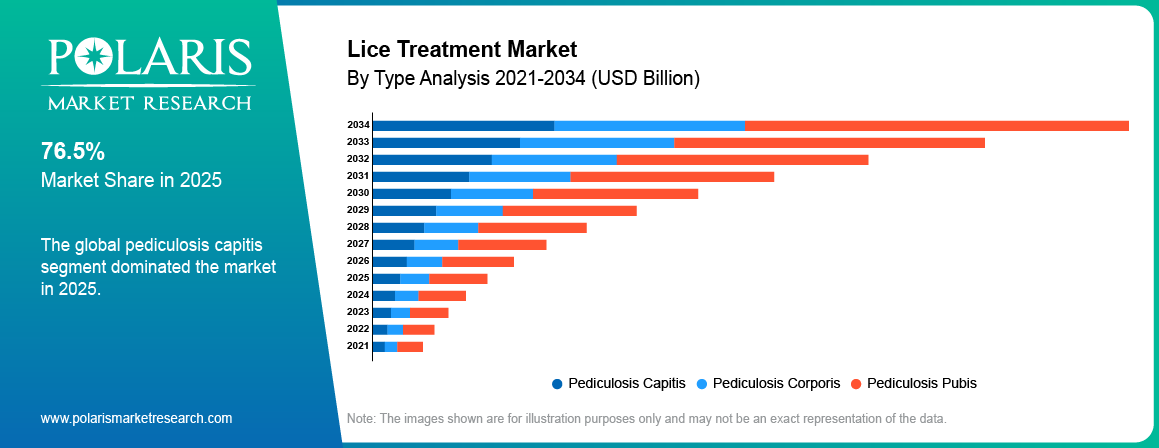
Pediculosis capitis held the largest share in 2025, at 76.5%. Segment’s dominance is attributed to greater prevalence of head lice infestations especially among school children and growing efforts to educate people about the importance of early detection of head lice detection and treatment. Additionally, growing advances and innovations in formulation technology that lead to the creation of new novel treatment options including lotions, shampoos, and combing devices, will further contribute to segment’s growth at significant pace.
Lice Treatment Market by Treatment
OTC products accounted for 61.8% of the market in 2025.This dominance is due to various factors including increasing people spending time in several close contact settings and significant changes in lifestyles. Additionally, OTC products offer range of benefits to consumers such as providing a convenient and easily accessible treatment option at their home without the need of prescription and they are also more affordable over prescription treatments.
The prescription medicines segment is expected to grow at a CAGR of 7.9% during 2026–2034.This growth is accelerated by their higher effectiveness in treating head lice infestations as compared to OTC products when used according to the recommendation of healthcare professionals. In addition, prescription medications offer fast treatment and better compliance because they require very fewer applications and have shorter treatment duration, that is resulting in increased demand for these medications.
OTC vs Prescription Lice Treatments: Access, Cost, Resistance & Clinical Supervision
| Feature | OTC Treatments | Prescription Treatments |
| Availability | Available at most pharmacies without a prescription | Given only after a doctor's prescription |
| Cost | Usually costs less | Usually costs more |
| Effectiveness for resistant lice | Suitable for common lice infestations | Better for resistant or repeated infestations |
| Accessibility | Easy to buy and use | Requires a doctor's visit |
| Clinical supervision | Can be used without medical supervision | Used under a doctor's guidance |
Source: Polaris Market Research Analysis
By Distribution Channel Insights
Hospital Pharmacies Are Forecast to Grow Fastest in the Lice Treatment Market
The hospital pharmacies segment will grow at highest growth rate. Segment’s growth is fueled by significant patient population in hospitals, easier access to prescription treatments, availability of healthcare professionals, and their collaboration with various delivery personnel in order to ensure that patients are receiving their medications conveniently.
Retail pharmacies held a market share of 49.6% in 2025.This dominance is driven by easy access to retail pharmacies for larger patient population, availability of wide range of lice treatment products like shampoos, combs, and creams. Moreover, there are several retail pharmacies focusing on the establishment of their online presence and providing medical products to their consumer through online channels to boost their sales and revenue, which will also foster the segment growth.
Lice Treatment Use Cases: Schools, Households, Resistant Infestations & Public Health
| Application | Example |
| School-age child lice infestations | A child gets head lice after close contact with classmates at school. |
| Household lice outbreak management | One family member has lice, so everyone at home is checked and treated. |
| Pediatric scalp treatment | A child uses a lice shampoo as advised by a doctor. |
| Community health programs | Schools hold awareness sessions on how to prevent and treat head lice. |
| Resistant lice infestation treatment | A doctor prescribes a stronger treatment after the first one fails. |
| Preventive scalp hygiene management | Parents check their children's hair regularly and avoid sharing combs. |
| Daycare center infestation control | A daycare cleans shared items after a lice case is reported. |
| Public health intervention programs | Local health departments provide simple guidance during lice outbreaks. |
Source: Polaris Market Research Analysis
Source: Polaris Market Research Analysis
Lice Treatment Market by Region
North America Dominated the Global Market in 2025
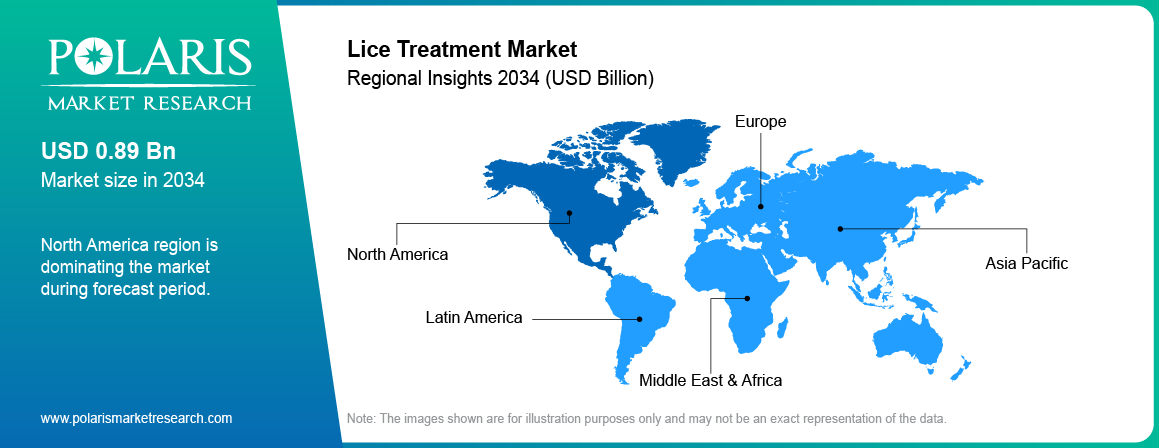
North America held the largest market share in 2025, accounting for 38.7%. Region’s dominance is attributed to presence of larger lice infestation patient pool and continuous increase in children population who are more susceptible to the disease. In addition, rising consumer disposable income especially in developed countries allowing consumers to spend higher on healthcare and afford expensive lice treatments like prescription options, is further escalating the product demand. For instance, according to the American Medical Association, health spending in the United States rose by nearly, 2.7% in 2021 to USD 4.3 trillion.
Asia Pacific is projected to grow at the fastest CAGR of 8.4% during 2026–2034.This growth is due to increasing awareness among people about the importance of early detection and treatment of head lice and growing availability of lice treatment products in pharmacies that is resulting in easier access to such medications. Moreover, continuous improvements in healthcare infrastructure across developing countries like India, China, Malaysia, and South Korea that led to greater access to advanced healthcare facilities and services, could also bode well for region’s growth.
Source: Polaris Market Research Analysis
Lice Treatment Competitive Landscape & Leading Companies
Competitive Strategy: Brand Strength, Resistance-Effective Formulations & Retail Reach
The lice treatment market is fragmented and is anticipated to witness competition due to several players' presence. Major companies are competing on various factors such as improving product efficacy, incorporating new active ingredients of formulations in treatment, strong marketing campaigns, and offering affordable price to the consumers. Also, companies are focusing on strategic partnerships and collaborations to expand their market presence and cater to wider customer base.
Some of the major players operating in the global market include:
- Arbor Pharmaceuticals LLC (US)
- Bayer AG (Germany)
- Insight Pharmaceuticals (US)
- Omega Pharma NV (Belgium)
- Parasol Laboratories (US)
- Pfizer Inc. (US)
- Prestige Brands Holding Inc. (US)
- Sanofi SA (France)
- Sumitomo Chemical Co. Ltd. (Japan)
- TAA Industries (Australia)
- TecLabs Inc. (US)
- Tyratech Inc. (US)
Lice Treatment Market Challenges: Resistance, Reinfestation, Misdiagnosis & Access
The lice treatment market faces several challenges. Some lice have become resistant to common treatments, creating a challenge of controlling infestations. Lice may spread further with misdiagnosis and delay in treatment. Recurring infestations are also common when eggs are not removed or follow-up treatment is missed. In many regions there is limited awareness about appropriate treatment and prevention which continues to impact product adoption and treatment outcomes.
Lice Treatment Market Recent Developments: Product Acquisitions, Launches & Resistance-Focused Innovation
- January 2026: Pelthos Therapeutics announced that it plans to commercialize XEGLYZE® (abametapir) Lotion for head lice in mid-2027. The company acquired the product from Hatchtech in late 2025. XEGLYZE is a single application therapy that treats both lice and their eggs.(Source: https://ir.pelthos.com)
Lice Treatment Market Future Outlook
The lice treatment market is expected to grow steadily over the coming years. It is supported by the continued prevalence of head lice infestations. Increased awareness and improved access to over-the-counter and prescription treatments will help support demand. Future product development will be directed at treatment resistance and providing safer formulations. The growth of online pharmacies and digital healthcare platforms will further improve access to lice treatment products.
Lice Treatment Market Report Coverage, Scope & Competitive Analysis
The lice treatment market report emphasizes on key regions across the globe to provide better understanding of the product to the users. Also, the report provides market insights into recent developments, trends and analyzes the technologies that are gaining traction around the globe. Furthermore, the report covers in-depth qualitative analysis pertaining to various paradigm shifts associated with the transformation of these solutions.
The report provides detailed analysis of the market while focusing on various key aspects such as competitive analysis, type, treatment, distribution channel, and their futuristic growth opportunities.
Lice Treatment Market Report Scope, Segmentation & Forecast Coverage
| Report Attributes | Details |
| Market size value in 2025 | USD 1.28 Billion |
| Market size value in 2026 | USD 1.36 Billion |
| Revenue forecast in 2034 | USD 2.32 Billion |
| CAGR | 6.80% from 2026 – 2034 |
| Base year | 2025 |
| Historical data | 2021 – 2024 |
| Forecast period | 2026 – 2034 |
| Quantitative units | Revenue in USD million and CAGR from 2026 to 2034 |
| Segments covered |
|
| Regional scope |
|
| Competitive Landscape |
|
| Report Format |
|
| Customization | Report customization as per your requirements with respect to countries, region, and segmentation. |
Source: Polaris Market Research Analysis
Lice Treatment Market FAQ's
The global lice treatment market size is expected to reach USD 2.32 Billion by 2034
Key players in the market are Sumitomo Chemical, TecLabs, Omega Pharma, Bayer AG
North America contributed notably to the global Lice Treatment Market, accounting for 38.7% of the market share in 2025.
Lice treatment market exhibiting the CAGR of 6.80% during the forecast period.
The key segments include Pediculosis capitis, Pediculosis corporis, and Pediculosis pubis. Pediculosis capitis held the largest share in 2025, at 76.5%.
Lice treatment Lice treatment involves using products to get rid of head lice and their eggs. These include shampoos, lotions, medicines and lice combs.
They kill live lice or prevent their survival and then a lice comb is used to remove the remaining eggs.
The best treatment depends on the severity of the infestation. Over-the-counter products are effective for many cases, but resistant cases may require prescription medication.
Most treatments work within one to two weeks. A second treatment is sometimes needed to remove newly hatched lice.
They may be more helpful for resistant or repeated infestations. A doctor usually recommends them when OTC products aren’t effective.
Nit combs remove lice eggs from the hair. They are often used after applying a lice treatment product.
Download Sample Report of Lice Treatment Market
Please fill out the form to request a customized copy of the research report.


