
Long Duration Energy Storage Market Size, Share, Trends & Forecast, 2026–2034
REPORT DETAILS
Long Duration Energy Storage Market Summary
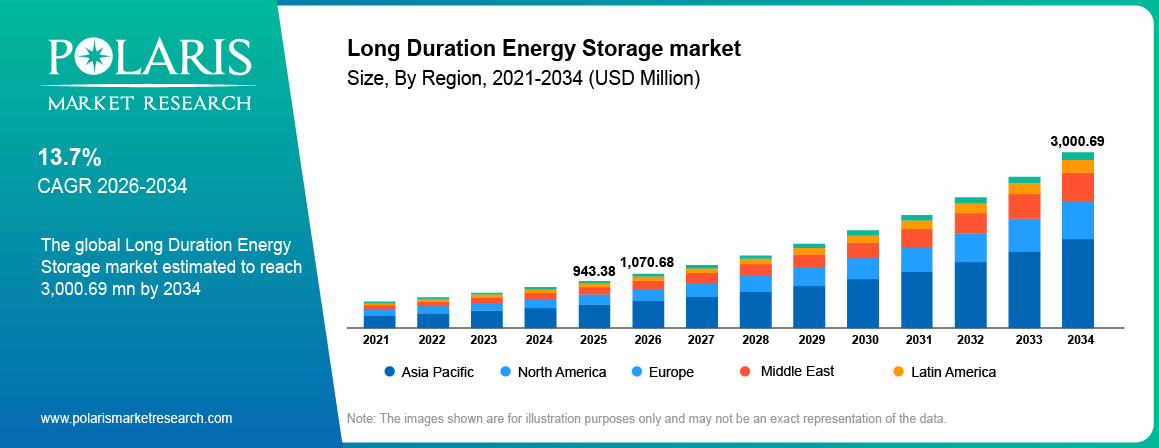
Long duration energy storage market size was valued at USD 943.38 million in 2025, exhibiting a CAGR of 13.7% from 2026 to 2034. Growing clean energy investments are fueling the energy storage systems industry. It is catalyzed by the decarbonization drive, technological improvements in storage, and the need for secure, clean power supplies in cities.
Market Statistics
Long Duration Energy Storage Market Key Takeaways
- North America held the largest share of 35.72% in the global market in 2025 owing to the rise in capacity addition and grid development activities.
- The Asia Pacific market is estimated to expand at a 16.32% CAGR during the forecast period, led by grid resiliency and green energy investments.
- The chemical storage segment is projected to grow at a 18.21% CAGR during 2026–2034, driven by rising hydrogen and power-to-gas adoption.
- Renewable energy integration constituted 40.16% revenue share in 2025 due to increased storage adoption for solar and wind balancing.
- The >36 hour segment is estimated to increase at a 17.86% CAGR on account of multi-day balancing and backup for renewables.
Note: Figures and projections outlined in this report are the result of Polaris Market Research’s proprietary analytical processes, grounded in the latest available datasets and market observations
What is Long Duration Energy Storage?
Long duration energy storage refers to advanced energy storage systems designed to deliver stored electricity for extended periods, generally ranging from multiple hours to several days depending on the technology and application. These include pumped hydro, flow batteries, iron-air batteries, compressed air energy storage (CAES), liquid air energy storage (LAES), thermal storage, gravity-based systems, hydrogen-based systems, and other electrochemical and chemical technologies. The common objective is to provide multi-day of multi-hour storage that can complement conventional lithium-ion battery systems.
The technology is particularly helpful when renewable generation and electricity demand do not coincide. For example, solar generation can provide excess electricity during daytime while demand can be high during evening hours. An LDES system can store some of the excess electricity, and then discharge it when solar production has fallen off. LDES can help decarbonize and achieve net-zero by enabling more variable renewable energy without requiring that electricity systems depend only on conventional dispatchable generation. It can also complement transmission expansion, demand response, conventional batteries, and flexible generation. The technology therefore forms part of a broader grid modernization strategy. Its value increases when renewable penetration, electricity demand, and the need for grid resilience rise simultaneously. J.P. Morgan projected USD 5.8 trillion in global grid investment from 2026–2035, including about USD 700 billion for digital grid technologies (Source: jpmorgan.com).
The LDES market growth is closely associated with the increasing penetration of solar and wind power. Renewable energy generation can vary with weather and time of day, leading to periods where there is excess generation and then periods where there is limited output. Long duration systems can store surplus electricity and release it later increasing renewable energy integration and reducing curtailment.
Grid-scale energy storage contributes to grid stability and resilience through the provision of dispatchable capacity during peak hours of electricity consumption. Unlike conventional batteries that are optimized mainly for shorter-duration applications, LDES can discharge for longer periods.
Given the increasing electricity demand from industrial electrification, electric vehicles, data centers and other digital infrastructure, the role of LDES is becoming more and more relevant. Under DOE’s LDES Liftoff analysis, DOE estimates the U.S. grid will need 225–460 GW of LDES by 2050, which highlights the potential scale of the requirement for the technology (Source: energy.gov).
How Does Long Duration Energy Storage Work
A long duration energy storage system generally follows five stages:
- Charging of Energy: The system gets electric power when production exceeds consumption.
- Storage of Energy: Electric power is transformed into other forms of stored energy by means of batteries, mechanical systems, thermal systems, or chemical reactions.
- Energy Management: Energy management systems control charge amounts, demand, renewable generation, and grid status.
- Discharge: In situations where there is an increase in demand or when there are fewer sources of energy, the energy is converted into electricity again.
- Delivery to Grid: The energy may be transmitted to the grid, to the buildings, micro-grids, or to whatever else that is connected to the grid.
In pumped hydro energy production, the water is pumped into an elevated reservoir and thereafter generating the electricity through the dropping of the water in the turbines. Flow batteries use liquid electrolytes in which electrochemical reactions occur to store energy. Iron-air batteries are intended for multi-day storage, and work by reversible chemical reactions between iron and air. CAES compresses air using electricity and then releases the energy by expanding the air. LAES liquefies air with electricity and recovers energy by expansion and power generation.
These technologies provide different mixes of energy density, duration, efficiency, lifetime, geographical requirements and capital intensity. Their suitability is therefore application-dependent, such as load shifting, renewable energy integration, peak-demand management, backup power and grid balancing.
Role in the Energy Transition
Long duration energy storage can play a key role in bridging the gap between variable renewable generation and electricity demand. In some periods solar and wind projects produce more electricity than the grid can handle and when demand remains high generation can fall off.
LDES systems use excess electricity and release it later. This ability can help to reduce the curtailment of renewable energy, provide capacity during periods of peak demand and improve grid flexibility.
Government programs are also increasing the focus on long-duration technologies. The US Department of Energy operates dedicated LDES demonstration and pilot programs covering technologies designed for 10-hour or longer discharge periods.
Role of AI in Long Duration Energy Storage System Market
- Artificial intelligence technology is used to predict renewable generation and electricity demand. It enables better storage scheduling.
- AI algorithms optimize battery operation based on grid conditions, electricity prices, and renewable availability.
- Predictive analytics is used to identify performance degradation, faults, and maintenance requirements earlier.
- AI-supported battery management helps optimize operating conditions. It reduces unnecessary cycling and degradation.
- The technology enables LDES systems to respond more effectively to fluctuations in renewable power generation and grid demand.
Market Dynamics
Driver: Rising Technological Advancements in Energy Storage Solutions
Innovation in storage solutions such as next-generation batteries, thermal storage, and hydrogen-based systems offer better performance and longer lifespans than traditional lithium-ion and lead-acid batteries. These improvements make long duration energy storage technology more capable of integrating renewable energy into the grid and supporting industrial operations. Additionally, advancements in technology reduce the cost of installation and maintenance of long duration energy storage systems, which encourages their wider adoption across electric grid stations. As the demand for reliable and sustainable energy storage grows, these innovations play a crucial role in enhancing grid stability, supporting industrial applications, and accelerating the transition to renewable energy. With continued advancements and cost reductions, long-duration energy storage solutions will become an essential component of the global energy infrastructure, driving a more resilient and efficient power system.
Smart grid technologies can control LDES with renewable generation, transmission networks, demand response and distributed energy resources. Digital twins can build virtual versions of storage systems and assist operators in assessing degradation, performance, maintenance requirements, and different operating scenarios. These technologies can increase asset utilization and support peak demand management while reducing unnecessary cycling. Digital optimization is particularly relevant as storage portfolios become larger and more technologically diverse.
Driver: Increasing Urbanization Worldwide
The urban population is increasing across the world. According to the World Bank, 58% of the global population was urban in 2025. Urban areas require reliable and sustainable energy sources to support growing populations, businesses, and transportation systems. To meet this requirement, governments and local organizations invest in renewable energy sources such as wind and solar. This factor increases the adoption of long duration energy storage systems as these systems store excess renewable energy during peak production and release it when power generation drops. Urbanization leads to the development of smart cities and the electrification of public transport. This increases the need for energy storage solutions such as long duration energy storage to prevent blackouts, optimize energy use, and support a cleaner, more resilient urban energy system. Therefore, the growing urbanization drives the long duration energy storage market growth (Source: worldbank.org).
Driver: Rising Electricity Demand from AI and Data Centers
AI infrastructure and data center growth is creating a new demand driver for reliable, flexible electricity supply. Data centers need to be running at all times and can really strain limited power networks.
These facilities can be benefited by the LDES through backup provision and protection from grid disruption, as well as load shifting of the electricity during periods of high and low system demand. In 2025, Energy Dome entered into a business partnership with Google, and the latter used CO2 Battery technology of Energy Dome because of growing electricity demand from computing.
Restraint: High Initial Project Costs
Large capital expenditures are required to build equipment, develop sites, engineer, connect to the grid and install long-duration energy storage (LDES) projects. Newer technologies can be more expensive to buy at first because the scale of manufacturing and the supply chains are less mature than for traditional lithium-ion batteries. Project costs can be further increased by additional expenses for balance-of-system components, permitting, and infrastructure. Electricity cost, utilization ratio, funding situations, and sources of revenue are uncertain and have the potential to affect project economics and payback periods. These variables might hinder the introduction of long duration energy storage technology, particularly in areas where there is no available funding arrangement.
Opportunity: Growth in Data Center and AI Infrastructure
With the increased expansion of the data centers and AI infrastructure, there is an increase in demand for electricity, thus making it essential to have reliable and resilient power supply systems. Data centers consume about 2% of global electricity consumption, and global data center capacity grew by 36% in the two years before 2026 to 67.7 GW, IDCA says. Long-duration energy storage systems can help data centers to meet peak loads, provide extended backup power, increase grid resilience, and support the integration of renewable electricity. This growth in AI data centers therefore creates opportunities for LDES providers to serve energy intensive sites with the need for reliable, flexible and low carbon energy solutions (Source: idc-a.org).
Challenge: Revenue Uncertainty
Long Duration Energy Storage (LDES) projects can participate in sources of revenue for energy arbitrage, capacity services, renewable energy integration, grid balancing and resilience applications. But the value of these services varies between electricity markets depending on power prices, grid conditions, regulations and available market mechanisms. This variability means the returns on projects are less certain and can make financing decisions more difficult. Limited availability of long-term contracts can also affect the bankability of a project, particularly in the case of emerging LDES technologies. This means that developers may need to have diversified sources of income, such as capacity payments, power purchase agreements and long-term service contracts to increase visibility for investment and allow for the large-scale deployment of long-duration energy storage.
Long Duration Energy Storage Market Segmentation Analysis
long duration energy storage market segmentation includes technology, duration, capacity, application, end user, and region.
By Technology Analysis
Types of long duration energy storage technologies include mechanical storage, thermal storage, electrochemical storage, and chemical storage. The mechanical storage segment held the largest revenue share of 45.68% in 2025. The dominance is driven by its scalability and high efficiencies in large-scale energy storage. Rising investments in grid modernization and increasing emphasis on renewable integration projects also support the segment's leading share. Rising demand for compressed air energy storage (CAES), pumped hydro storage, and flywheels is attributed to their long operating durations and grid stability retention. Advancements in CAES and gravitational storage improve the cost-effectiveness and feasibility of mechanical storage systems. Governments are investing in these systems and announcing policies and subsidies to promote energy transition goals.
The electrochemical storage segment held a share of 22.63% in 2025, due to its declining costs, high energy density, and proven performance in grid-scale applications. The increasing deployment of renewable energy sources, such as solar and wind, necessitated reliable storage solutions to address intermittency, and electrochemical storage emerged as the most capable option. Additionally, advancements in battery chemistry, such as the development of solid-state batteries and improvements in cycle life, further propelled the segment growth. Governments and private entities heavily invested in this technology, recognizing its potential to stabilize grids and support decarbonization goals.
The chemical storage segment is estimated to grow at 18.21% CAGR during 2026-2034, owing to increasing interest in hydrogen and power-to-gas technologies for multi-day and seasonal energy storage. These solutions could store surplus renewable electricity as chemical power and release it when needed. “The growing integration of renewable energy, grid flexibility needs and decarbonization efforts are also further driving demand for hydrogen-based storage and other chemical-based energy storage technologies in utility and industrial applications.
Technology Comparison
| Technology | Typical Duration | Maturity | Primary Grid Role | Example Player |
| Mechanical (pumped hydro, CAES, gravity) | 8–100+ hrs | Commercially mature | Large-scale, long-life bulk storage | Highview Power |
| Electrochemical (flow, iron-air, advanced batteries) | 8–100 hrs | Mature to early commercial | Cost-effective, scalable, fastest-deploying | Form Energy; VFlowTech |
| Thermal (molten salt, hot rock) | 8–24+ hrs | Early commercial | Industrial heat + power reconversion | Everllence SE |
| Chemical (hydrogen, power-to-gas) | 24 hrs–seasonal | Emerging / pilot stage | Seasonal storage, industrial feedstock overlap | GKN Hydrogen |
Source: Polaris Market Research Analysis
By Duration Analysis
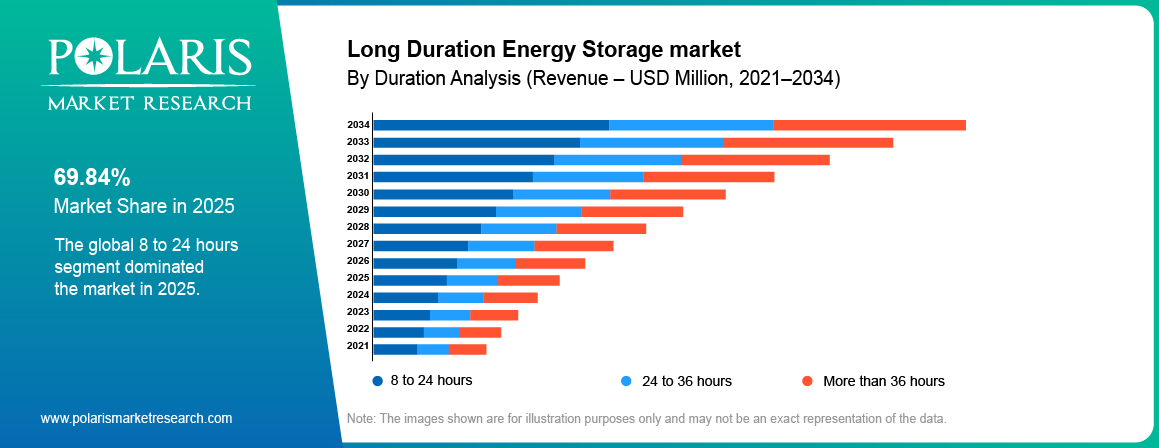
Markets are categorized based on their duration into 8 to 24 hours, 24 to 36 hours, and more than 36 hours. The 8 to 24 hours market accounted for 69.84% of the market in 2025, fueled by rising demand for renewable energy storage, peak demand management, and power grid stabilization. Such systems assist in storing any surplus energy generated through solar and wind intermittency during high-production periods and dispatch power during peak demand periods.
The >36 hours segment is anticipated to record a CAGR of 17.86% from 2026 to 2034 on account of increased demand for storage of multi-days in low renewable electricity production periods and extended power grid failures. These storage systems provide a constant flow of electricity in periods of low solar/wind electricity production. There are also increasing demands from growing grid resilience needs, extreme weather events, and high renewable energy penetration rates.
Duration Comparison
| Duration | Typical technology fit | Grid role | Illustrative example |
| 8–24 hours | Flow batteries, thermal, CAES | Daily solar/wind balancing | Flow-battery microgrid backup |
| 24–36 hours | Advanced batteries, thermal, mechanical | Multi-day weather-event resilience | Multi-day pumped hydro dispatch |
| >36 hours | Iron-air, hydrogen, gravity | Seasonal / extreme-weather backup | 100-hour iron-air discharge systems |
Source: Polaris Market Research Analysis
By Capacity Analysis
The market is split into up to 50 MW, 50–100 MW, and more than 100 MW. More than 100 MW segment was 24.60% share in 2025 back up by the growth of utility-scale renewable energy projects and large grid storage requirements. These high capacity systems can provide significant energy shifting, grid balancing, renewable firming and backup capacity and are becoming increasingly important for modern power networks with increasing renewable penetration.
The 50–100 MW segment is expected to grow at a CAGR of 13.42% during 2026–2034, driven by increasing demand from medium-scale renewable projects, industrial facilities, microgrids, and regional power systems. These systems offer scalable storage capacity for applications including renewable energy integration, peak demand management and backup power. The ongoing efforts to modernize the grid and increase electrification are expected to support additional deployment in commercial and industrial energy infrastructure.
By Application Analysis
In terms of application, the long duration energy storage market is segregated into grid management, power backup, renewable energy integration, and off grid & micro grid systems. The renewable energy integration segment dominated the long duration energy storage market revenue share with 40.16% in 2025 due to a global push toward decarbonization and the rapid expansion of solar and wind energy projects. Renewable energy integration systems provide the flexibility to store excess energy during periods of high generation and release it during peak demand or low generation periods, ensuring grid stability. Governments and utilities worldwide are implementing policies and incentives to accelerate the adoption of storage technologies that seamlessly integrate renewables into the energy mix. Additionally, advancements in energy management systems and declining costs of storage technologies fueled the growth of the segment.
The off-grid & microgrid systems segment is expected to register a 14.67% CAGR during 2026–2034, owing to the increasing demand for reliable and resilient power systems in remote communities, industrial facilities, and critical infrastructure. Segment growth is further supported by increasing deployment of renewable energy, distributed generation and long-duration energy storage (LDES). "These systems can offer longer backup power, improve energy reliability, decrease reliance on centralized grids, and support access to electricity in areas with poor grid connectivity.
By End User Analysis
The utilities segment has achieved 47.18% market share in 2025 due to rising grid balancing needs, incorporation of renewable energy and the requirement for increased capacity. The utilities sector is utilizing LDES systems for managing peak load, increasing grid flexibility, renewable generation and improving the reliability of power systems. Increased electrification and incorporation of renewable energy are increasing the need for grid energy storage systems that can provide extended duration capacity.
The residential & commercial market segment is anticipated to post a 14.61% CAGR during the forecast period from 2026 to 2034, on account of growing electricity demand, requirement for peak load balancing, and renewable energy use by major electricity consumers. Long Duration Energy Storage systems could offer backup energy, lower peak electricity costs, enhance energy resilience, and renewable energy integration. The growing deployment in commercial buildings, data centers, industries, and distributed energy systems are expected to offer more growth avenues for LDES systems.
Long Duration Energy Storage Use Cases
Long duration energy storage supports several applications across the electricity value chain.
- Integrating renewable energy sources: The storage of excess generation from solar and wind power for usage as required.
- Grid operation: Helps in controlling peak demand and energy generation.
- Backup power: Provides backup energy to vital facilities and industries.
- Microgrids: Facilitates electricity availability in decentralized power systems.
- Industry energy management: Helps in the energy management for large electricity users.
- Data centers: Provides extra security of energy supply in addition to existing approaches.
- Energy time-shifting: Shifting of energy from low demand periods to high demand periods.
The growing use of storage for energy shifting is also visible across the wider battery market. IEA analysis indicates that energy shifting accounted for more than 90% of new battery projects by primary application in 2025, compared with around 40% in 2015.
Long Duration Energy Storage Market Regional Insights
North America Long Duration Energy Storage Market
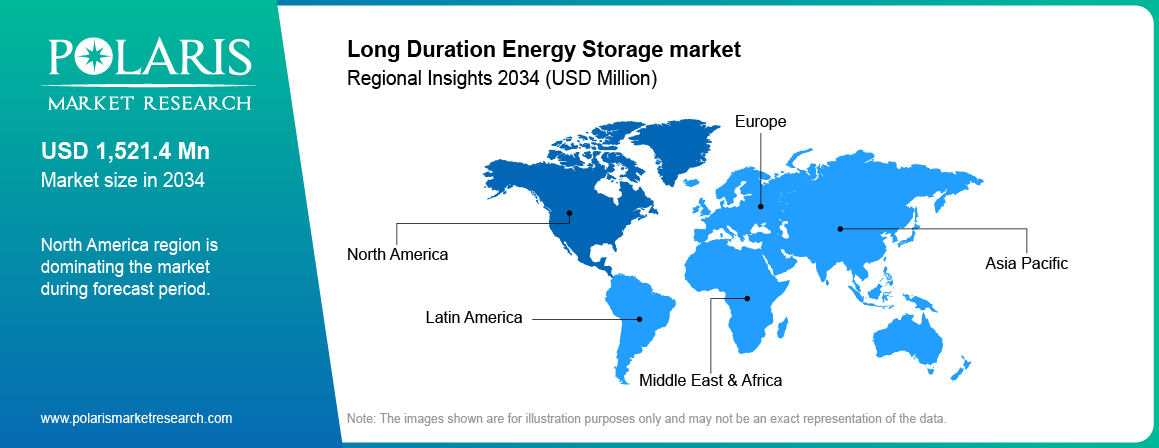
North America dominated global long duration energy storage market share with 35.72% in 2025. Growth is linked to rising investments in renewable energy expansion, grid resilience requirements, clean energy investment, and government programs for advanced storage. In March 2026, ESS joined SRP and Google’s Project New Horizon, deploying a 5 MW/50 MWh iron-flow LDES system in Arizona for real-world evaluation, with delivery targeted for December 2027 (Source: essinc.com). Data centers and other large loads are also driving up electricity demand in the region. This trend drives the need for storage technologies to deliver grid flexibility and longer back-up periods. Additionally, the increasing frequency of extreme weather events in the region, such as hurricanes and wildfires, is creating the need for resilient energy systems, such as advanced storage solutions, which propels the long duration energy storage market expansion in North America.
The U.S. led the North American market with 68.45% share in 2025, due to its aggressive decarbonization goals and significant funding for clean energy initiatives. Federal and state-level incentives, such as tax credits and grants for energy storage deployment, played a crucial role in accelerating the adoption of long duration energy storage systems. DOE programs target technologies capable of 10-hour or longer discharge, including flow batteries, iron-based technologies, thermal storage, and other emerging systems.
Asia Pacific Long Duration Energy Storage Market
Asia Pacific market is projected to grow at a 16.32% CAGR from 2026 to 2034. due to rapid industrialization, expanding renewable energy capacity, and strong government support for energy storage initiatives. Favorable policies, including subsidies for energy storage deployment and mandates for renewable capacity expansion, are expected to provide lucrative market growth opportunities in the region during the forecast period. Japan, South Korea, India, and Australia are also building storage capabilities, advancing battery technologies, and investing in resilient energy infrastructure. In September 2026, HiTHIUM announced the world’s first 4 MWh sodium-ion energy storage system, ∞Power N4.0MWh, with a 30-year service life and full-scale production and delivery planned for 2027 (Source: prnewswire.com). India is also developing new storage technologies. In September 2026, NTPC invited global bids for a grid-connected sodium-ion battery energy storage pilot to evaluate performance, safety, reliability, and economic viability under Indian conditions.
In 2025, China led the regional market with 12.84%, driven by aggressive investments in grid modernization and large-scale battery storage projects. The country’s ambitious carbon neutrality targets and commitment to renewable energy integration fueled demand for long duration energy storage technologies.
Europe Long Duration Energy Storage Market
Europe is anticipated to grow at a 24.86% CAGR over the period 2026–2034. Renewable energy expansion, grid flexibility needs and policy measures for long-duration storage are generating demand across the region. The UK introduced a cap and floor for LDES projects. The scheme demands minimum eight hours of full power discharge from projects and looks to improve investment conditions for long duration storage assets. Italy is also developing storage procurement mechanisms. In October 2025, Italy’s first MACSE auction awarded 10 GWh of battery storage capacity at an average USD 14,950/MWh-year, 65% below the reserve price. Projects are expected to enter operation in 2028 (Source: pv-magazine.com).
Latin America Long Duration Energy Storage Market
Latin America is projected to grow at a 14.18% CAGR during the forecast period. Growth is linked to renewable energy expansion, grid reliability requirements, remote power applications, and increasing interest in hybrid renewable energy projects. Brazil, Mexico, Chile, and other countries are developing renewable power capacity that can create additional demand for storage. LDES can be used to manage variable renewable generation and improve electricity supply in areas with grid constraints.
Middle East & Africa Long Duration Energy Storage Market
Middle East & Africa market is projected to grow at a 14.76% CAGR during 2026-2034. Demand is related to renewable energy projects, electricity reliability, remote power systems and grid modernization. Countries across the region are ramping up investment in solar and other renewable technologies. Long-duration energy storage can move renewable electricity into evening demand periods and provide backup power for remote or critical facilities.
Innovation & Technology Trends
Several technology trends are shaping the long duration energy storage market.
- Iron-air batteries are currently being developed and will be used to store energy for more than one day.
- Flow batteries have the potential for energy flexibility and scalability.
- Thermal energy storage enables storing energy as heat, which later can be converted into power or industrial heat.
- Liquefied air energy storage provides long-duration energy storage via liquefaction and expansion of air.
- Energy storage using gravity utilizes elevation for energy storage and release.
- Hydrogen energy storage is possible for long-term energy storage.
- AI-based energy management will help in forecasting, scheduling, and asset management.
- Energy platforms will combine energy storage with renewable energy production.
Highview Power's Carrington project in the UK, for example, is designed around liquid air energy storage and includes a planned 300 MWh storage system with 50 MW output (Source: highviewpower.com).
Long Duration Energy Storage Cost & Economic Outlook
Long duration energy storage cost per kWh is dependent on technology, project duration, power and energy capacity, utilization, financing and revenue structure.
Cost continues to decline and short-duration battery storage is being deployed more broadly.Utility-scale battery storage costs can fell sharply with longer-duration projects getting more attention as power systems need more flexibility.
Economics of LDES can be improved if a project provides revenue from multiple services. Such services may include shifting renewable energy, providing capacity, energy arbitrage, grid balancing, congestion management and resilience.
Longer duration systems can also reduce the need for separate assets across various grid applications. Still, project economics depend on market design and the availability of long-term revenue mechanisms.
Competitive Insights
The long duration energy storage market is fragmented, with the presence of numerous global and regional market players. The global market includes battery manufacturers, energy storage technology developers, engineering firms, renewable energy companies, and specialized storage providers. These market participants are undertaking a variety of strategic activities to expand their global footprint, with important market developments such as innovative launches, international collaborations, higher investments, and mergers and acquisitions between organizations.
Competitiveness is a function of technology performance, storage duration, project economics, safety, system life, scalability, manufacturing capability, and project execution. Companies are pursuing a variety of approaches to address the need for storage that lasts longer. These include flow batteries, iron-air batteries, liquid air energy storage, thermal storage, hydrogen, gravity storage, and other advanced technologies. Prominent market players are investing heavily in research and development to expand their offerings, which will boost the long duration energy storage market growth.
List of LDES Key Players
- Alsym Energy Inc.
- CMBlu Energy AG
- Energy Vault Holdings, Inc.
- Eos Energy Enterprises, Inc.
- ESS Tech, Inc.
- Everllence SE
- Form Energy, Inc.
- Highview Enterprises Ltd.
- Invinity Energy Systems plc
- Largo Inc.
- Malta Inc.
- Everllence SE
- MGA Thermal Pty Ltd
- RheEnergise Limited
- Stryten Energy LLC
- Sumitomo Electric Industries, Ltd.
- VFLOWTECH PTE. LTD.
- VoltStorage GmbH
Competitive Benchmarking – Long Duration Energy Storage (LDES) Market
| Company | Primary Technology | Headquarters | Notable Differentiator |
| Alsym Energy Inc. | Non-flammable sodium-ion battery | Malden, Massachusetts, U.S. | Proprietary non-flammable sodium-ion chemistry designed for high-performance, cost-effective energy storage and applications requiring enhanced safety. |
| CMBlu Energy AG | Organic SolidFlow battery | Alzenau, Germany | SolidFlow architecture combines flow-battery scalability with solid energy-storage materials; designed for 10+ hour duration and long operating life. |
| Energy Vault Holdings, Inc. | Gravity energy storage | Westlake Village, California, U.S. | G-VAULT systems use gravity-based mechanical storage, including composite blocks and water, with targeted asset life of 35+ years. |
| Eos Energy Enterprises, Inc. | Zinc-based aqueous battery | Pittsburgh, Pennsylvania, U.S. | Eos Z3 uses proprietary zinc-based aqueous chemistry and supports approximately 4–16+ hours of discharge for grid-scale and C&I applications. |
| ESS Tech, Inc. | Iron flow battery | Wilsonville, Oregon, U.S. | Long-duration iron-flow technology using earth-abundant materials, with applications spanning grid and commercial/industrial storage. |
| Everllence SE | Electro-thermal energy storage (ETES) | Germany | Converts electricity into thermal energy and subsequently reconverts stored heat into electricity, supporting large-scale industrial and grid applications. |
| Form Energy, Inc. | Iron-air battery | Somerville, Massachusetts, U.S. | Commercial iron-air battery designed for up to 100 hours of energy storage and multi-day grid applications. |
| Highview Enterprises Ltd. | Liquid air energy storage (LAES) | London, U.K. | Cryogenic liquid-air technology enables large-scale, multi-hour to multi-day energy storage without relying on conventional electrochemical batteries. |
| Invinity Energy Systems plc | Vanadium redox flow battery (VRFB) | London, U.K. | Modular vanadium flow systems provide non-flammable storage and 20,000+ deep-discharge cycles, supporting long-duration applications. |
| Largo Inc. | Vanadium redox flow battery / vanadium-based storage | Toronto, Canada | Vertically integrated vanadium supply position combined with its energy-storage activities through Storion Energy LLC. |
| Malta Inc. | Electrochemical-thermal energy storage | Cambridge, Massachusetts, U.S. | Uses a thermal energy-storage architecture that converts electricity into heat and cold, with the stored energy subsequently converted back to electricity. |
| MGA Thermal Pty Ltd | Thermal energy storage | Australia | Uses Miscibility Gap Alloy (MGA) technology to store thermal energy at high temperature and support long-duration energy storage applications. |
| RheEnergise Limited | High-density pumped hydro energy storage | U.K. | HD Hydro uses a proprietary high-density fluid instead of water, allowing pumped-storage concepts to be deployed at sites with lower elevations and smaller reservoirs. |
| Stryten Energy LLC | Vanadium redox flow battery (VRFB) | Alpharetta, Georgia, U.S. | VRFB systems are designed for 4–12 hours of storage, with applications including utility-scale storage, microgrids, data centers, and military facilities. |
| Sumitomo Electric Industries, Ltd. | Vanadium redox flow battery (VRFB) | Osaka, Japan | Established flow-battery technology with independently scalable power and energy capacity, suited to utility-scale long-duration storage. |
| VFLOWTECH PTE. LTD. | Vanadium redox flow battery (VRFB) | Singapore | Modular PowerCube flow-battery architecture designed for scalable, long-duration energy storage applications. |
| VoltStorage GmbH | Vanadium redox flow battery | Munich, Germany | Modular flow-battery systems designed for long-duration renewable-energy storage, with emphasis on safe, sustainable stationary storage. |
Source: Polaris Market Research Analysis
Recent Developments
- In September 2026, Trina Storage announced it will supply an 81.5 MW/562 MWh BESS for Frontier Energy’s 132 MW Waroona solar project in Western Australia, with generation targeted for 2028. (Source: energy-storage.news)
- In September 2026, MN8 Energy, Eos Energy Enterprises, and Google announced their plans for a project in West Virginia. The project comprises 86 megawatts of utility-scale solar, 10 MW/100 MWh of zinc-based LDES, and 70 MW/280 MWh of Li-ion energy storage. (Source: publicpower.org)
- In March 2026, UK Research and Innovation (UKRI) launched a USD 1.36 million challenge to advance long duration energy storage (LDES) technologies capable of storing clean energy for 100+ hours. (Source: ukri.org)
- In March 2026, Form Energy and Crusoe signed a strategic capacity agreement to deliver 12 gigawatt-hours of multi-day energy storage systems. It will support the increasing power needs of AI data centers starting in 2027. (Source: formenergy.com)
- In April 2025, Ofgem launched a cap-and-floor scheme to unlock investment in Long Duration Energy Storage (LDES) projects, targeting 2.7–7.7 GW of capacity through the first application window. (Source: solarpowerportal.co.uk)
Long Duration Energy Storage Market Segmentation
By Technology Outlook (Revenue, USD Million, 2021–2034)
- Mechanical Storage
- Thermal Storage
- Electrochemical Storage
- Chemical Storage
By Duration Outlook (Revenue, USD Million, 2021–2034)
- 8 to 24 Hours
- 24 to 36 Hours
- > 36 Hours
By Capacity Outlook (Revenue, USD Million, 2021–2034)
- Up to 50 MW
- 50–100 MW
- > 100 MW
By Application Outlook (Revenue, USD Million, 2021–2034)
- Grid Management
- Power Backup
- Renewable Energy Integration
- Off Grid & Micro Grid Systems
By End User Outlook (Revenue, USD Million, 2021–2034)
- Residential & Commercial
- Transportation & Mobility
- Utilities
- Others
By Regional Outlook (Revenue, USD Million, 2021-2034)
- North America
- U.S.
- Canada
- Europe
- Germany
- France
- UK
- Italy
- Spain
- Netherlands
- Russia
- Rest of Europe
- Asia Pacific
- China
- Japan
- India
- Malaysia
- South Korea
- Indonesia
- Australia
- Vietnam
- Rest of Asia Pacific
- Middle East & Africa
- Saudi Arabia
- UAE
- Israel
- South Africa
- Rest of Middle East & Africa
- Latin America
- Mexico
- Brazil
- Argentina
- Rest of Latin America
Long Duration Energy Storage Market Report Scope
| Report Attributes | Details |
| Market Size in 2025 | USD 943.38 Million |
| Market Size in 2026 | USD 1,070.68 Million |
| Revenue Forecast by 2034 | USD 3,000.69 Million |
| CAGR | 13.7% from 2026 to 2034 |
| Base Year | 2025 |
| Historical Data | 2021–2024 |
| Forecast Period | 2026–2034 |
| Quantitative Units | Revenue in USD Million and CAGR from 2026 to 2034 |
| Report Coverage | Revenue Forecast, Competitive Landscape, Growth Factors, and Industry Trends |
| Segments Covered |
|
| Regional Scope |
|
| Competitive Landscape |
|
| Report Format |
|
| Customization | Report customization as per your requirements with respect to countries, regions, and segmentation. |
Source: Polaris Market Research Analysis
Future Outlook
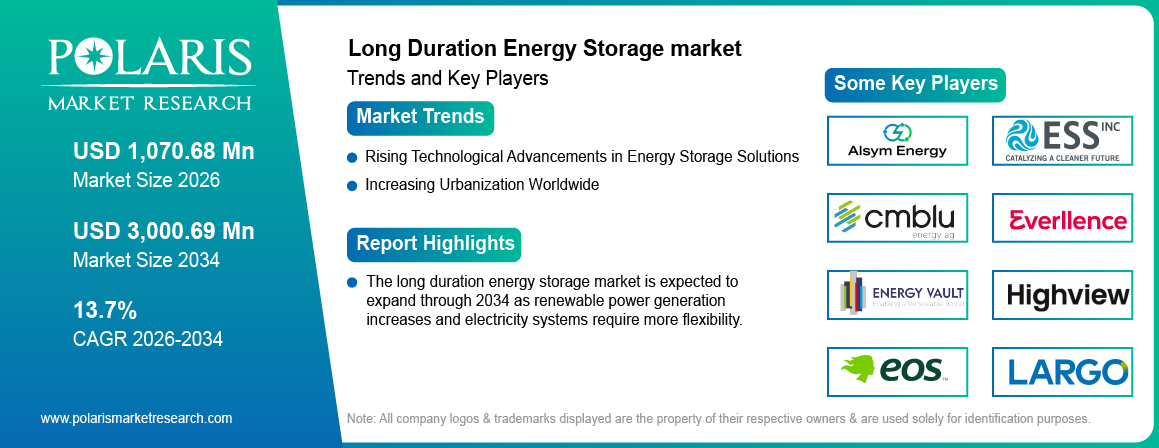
The long duration energy storage market is expected to expand through 2034 as renewable power generation increases and electricity systems require more flexibility. Energy shifting, grid resilience, renewable integration, and extended backup applications are expected to remain major areas of demand.
There will be ongoing technology development in flow batteries, iron-air batteries, thermal storage, liquid air energy storage, gravity storage and hydrogen. AI-based energy management and digital monitoring can enhance system operation and asset utilization.
Government procurement programs and revenue mechanisms may also be important to project development. The UK cap-and-floor framework and US LDES demonstration programs show the growing use of policy mechanisms to advance longer-duration storage.
The market is also expected to move toward integrated solutions combining renewable generation, storage, grid services, and energy management software.
Research Methodology
The Polaris Market Research long duration energy storage market report follows a structured analytical framework to develop market estimates, segment analysis, regional forecasts, and competitive insights.
Secondary Research & Data Collection
The analysis uses information from the International Energy Agency, US Department of Energy, national energy agencies, regulatory bodies, company annual reports, investor presentations, project announcements, industry associations, technology publications, and other verified industry sources.
Market Estimation & Modelling
Top-down and bottom-up approaches are used to estimate the market across technology, duration, capacity, application, end user, and regional segments. Company revenues, project capacity, storage deployments, average selling prices, technology economics, and industry investment trends are considered in the estimation process.
Primary Validation
Market assumptions are validated by discussions with energy storage manufacturers, technology developers, utilities, renewable energy companies, project developers, grid operators, system integrators, and industry experts.
Data Triangulation & Final Review
Compare company information, project data, industry databases, government statistics, and primary research to check market estimates. Final figures are based on the analyst team’s judgment and are checked against recent market developments prior to publication.
Long Duration Energy Storage Market FAQ's
The market includes technologies for long-term electricity storage, such as mechanical, thermal, electrochemical, and chemical storage.
In 2025, the market had a valuation of USD 943.38 million, which is estimated to increase to a valuation of USD 3,000.69 million by 2034. The growing emphasis on decarbonization is generating a surging need for long duration energy storage.
The market is projected to grow at a 13.7% CAGR from 2026 to 2034, due to increasing urbanization and rising technological advancements in energy storage systems.
The mechanical storage segment accounted for the largest share of 45.68% in 2025, fueled by its scalability and high efficiencies in large-scale energy storage.
These include pumped hydro, flow batteries, iron air batteries, thermal storage, gravitational storage and hydrogen.
Key factors driving the market include renewable energy installations, grid improvements, resilient need and innovation.
North America dominated with 35.72% market share in 2025, due to high renewable energy investment and energy storage system development.
The industry is likely to grow by 2034, owing to increasing demand for renewable energy integration and grid flexibility and resilience.
LDES is well suited for storing energy for periods ranging from hours to days while lithium ion batteries are used for storing energy for shorter durations.
Costs vary by technology, duration, capacity, and project configuration.
Key types include pumped hydro, flow batteries, iron-air batteries, CAES, LAES, thermal storage, hydrogen, and gravity storage.

Download Sample Report of Long Duration Energy Storage Market
Please fill out the form to request a customized copy of the research report.


