
Machine Identity Management Market Size, Share, and Forecast 2026 to 2034
REPORT DETAILS
Machine Identity Management Market Summary
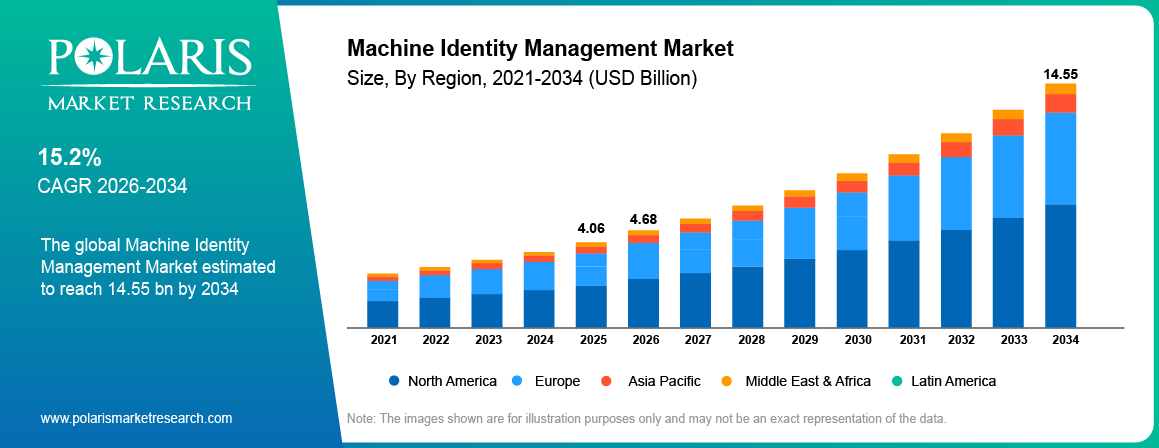
The global machine identity management market size was valued at USD 4.06 billion in 2025. The market is expected to register a CAGR of 15.2% from 2026 to 2034. Growth is driven by the increasing number of machine identities across cloud environments and rising demand for certificate lifecycle automation. Shorter public TLS certificate validity periods and the expansion of workload and AI agent identities also boost the market expansion.
Market Statistics
Key Takeaways
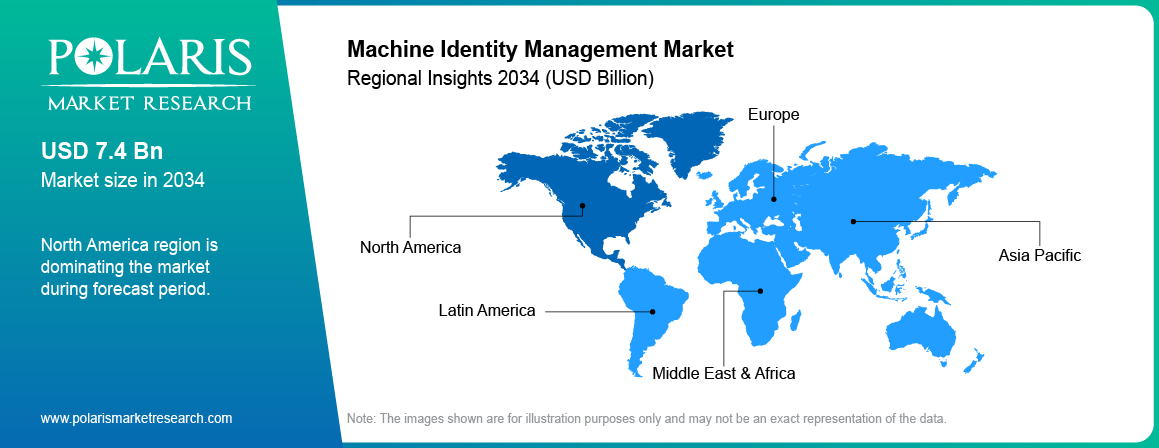
- North America accounted for 41.73% of the machine identity management market share in 2025. The dominance is supported by enterprise cybersecurity investment, established PKI infrastructure, cloud adoption, and the presence of major identity security providers.
- The Asia Pacific market is projected to grow at the highest CAGR of 17.71% during the forecast period. This is owing to the rising adoption of automated identity controls, increasing cybersecurity needs, digital transformation, and growing cloud infrastructure.
- The software segment held 61.84% of the offering segment in 2025, owing to the demand for centralized certificate discovery, policy-based issuance, credential renewal, and identity governance platforms.
- Managed services are expected to grow at a CAGR of 18.43% during the projected period as enterprises look to modernize PKI, migrate certificates, get implementation support, and provide ongoing machine identity operations.
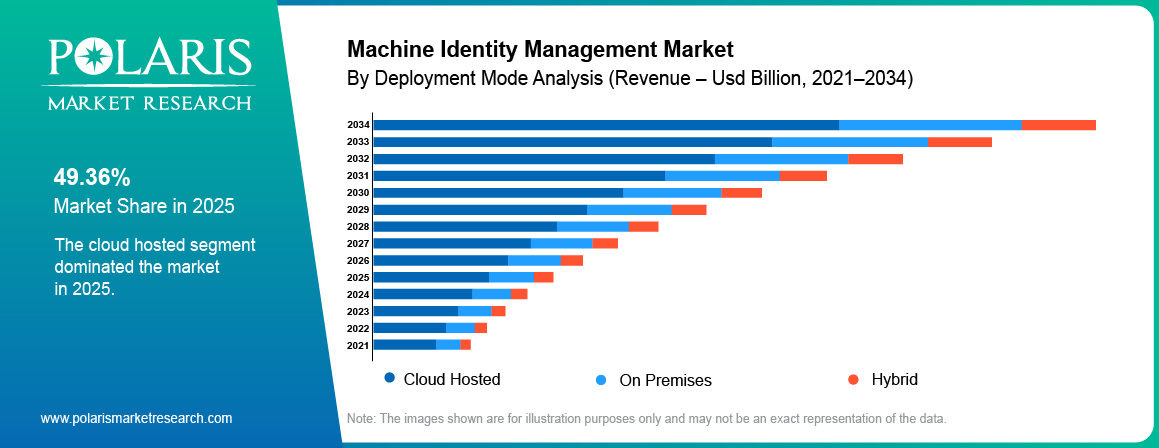
- Cloud-hosted segment held 49.36% share in 2025, supported by centralized identity management, scalable infrastructure, and integration with distributed cloud environments.
- The hybrid deployment segment is projected to grow at a CAGR of 17.02% during the forecast period. This is owing to the demand for centralized policy management along with locally operated components and protected internal key material for enterprises.
Note: Figures and projections outlined in this report are the result of Polaris Market Research’s proprietary analytical processes, grounded in the latest available datasets and market observations.
Machine Identity Management Market Definition
The machine identity management market is comprised of software platforms and services used to create, manage, monitor, and govern digital identities and credentials of non-human entities. These are applied to applications, servers, devices, APIs, cloud workloads, containers, service accounts, and software bots. Machine identity management includes credential discovery, ownership mapping, issuance, authentication, renewal, rotation, revocation, and access policy enforcement. Market segments include certificate lifecycle management, enterprise public key infrastructure (PKI) automation, secrets management, workload identity security, and AI agent identity governance.
Machine identities enable secure communication and authentication across an enterprise’s technology environment. Applications leverage certificates and cryptographic credentials to establish trusted connections. Service accounts and API credentials are used to provide automated access to infrastructure and business systems. As services scale, deploy, or terminate, cloud-native workloads need identities that can be issued and retired. Enterprises use non-human identity management platforms to coordinate these credentials, maintain ownership records, enforce permissions, and monitor identity activity across infrastructure.
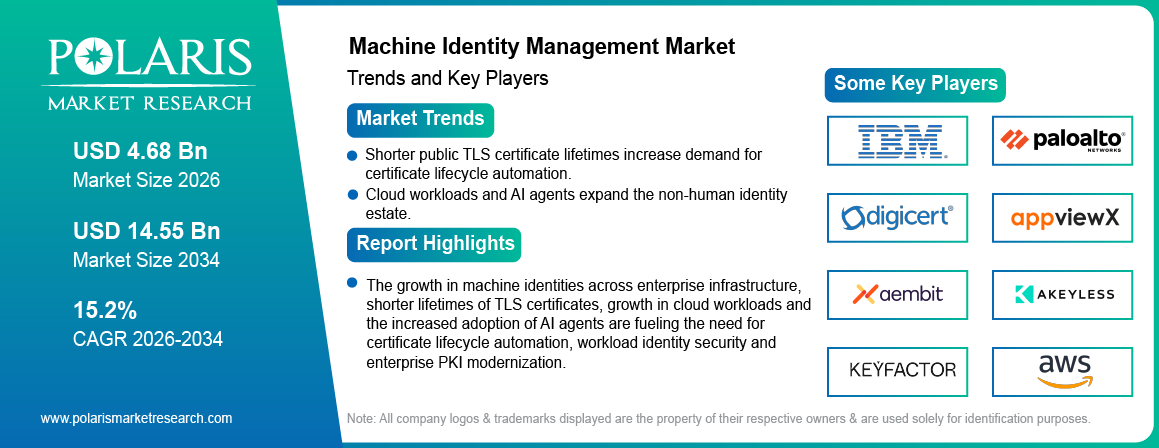
Certificate lifecycle automation is a major part of the market. These platforms discover certificates across public and private infrastructure, coordinate certificate authority integration, automate enrollment and renewal, and distribute updated credentials to connected applications and endpoints. Shorter public TLS certificate lifetimes are increasing the frequency of certificate replacement and raising the importance of automated deployment, verification, and monitoring. Mutual TLS also relies on managed certificates to authenticate both sides of a connection and support trusted service-to-service communication (Source: CA/Browser Forum).
Workload identity security is the practice of assigning cryptographically verifiable identities to applications and services running across containers, virtual machines, Kubernetes clusters, and hybrid cloud environments. Frameworks such as SPIFFE support portable workload identities, and related infrastructure can automate attestation and credential distribution. Secrets and service account governance involves API keys, tokens, passwords, and other credentials used by applications and automated processes. The AI Agent identity applies these requirements to software agents that access tools, data and enterprise applications with delegated permissions.
Zero trust architecture, cryptographic inventory, policy-based issuance, secret rotation and crypto agility are driving the market. Enterprises are embedding machine identity controls in their DevSecOps pipelines, cloud security operations and infrastructure governance. These capabilities help organizations manage credentials across distributed environments, govern machine-to-machine access, and consistently enforce security policies as applications and automated workloads scale (Source: NIST.gov).
Machine Identity Management Market Dynamics
Driver: Shorter Public TLS Certificate Lifetimes Increase Demand for Certificate Lifecycle Automation
The operational requirements related to machine credential management are rising as public TLS certificate validity periods are being shortened. The CA/Browser Forum has published a phased schedule starting in April 2025 to reduce the maximum public TLS certificate validity to 47 days by March 2029. This change speeds up the issuance, deployment, renewal, and replacement of certificates across the enterprise infrastructure. Consequently, there is a growing focus among organizations on automating the discovery, enrollment, deployment, and monitoring of certificates.
Shorter certificate lifetimes require certificate authorities, application servers, load balancers, service meshes, and cloud infrastructure to work together. Certificate lifecycle platforms automate renewals, store private keys securely, distribute updated certificates, and monitor deployment status. Automated discovery enables security teams to find certificates in distributed environments and to relate them to technical owners. These functions help manage large certificate inventories and help infrastructure teams to ensure service continuity when credentials are changed frequently.
Organizations are also incorporating certificate management into their DevOps and infrastructure automation pipelines. Policy-based issuance enables companies to standardize certificate requests, approval rules, validity periods, and renewal schedules. Integration with certificate authorities and secrets platforms allows for coordinated credential operations across applications and cloud environments. With certificate replacement becoming more frequent, there is an increasing need for machine identity security platforms that offer discovery, automation, policy enforcement, and operational monitoring.
Driver: Cloud Workloads and AI Agents Expand the Non-Human Identity Estate
The number of machine identities used in enterprise environments has increased due to the growth of cloud-native apps, containerized infrastructure, APIs, and automated software processes. Applications and workloads need credentials to authenticate against databases, cloud services, internal APIs, and other software components. Kubernetes clusters and distributed cloud environments also create demand for workload identity security, short-lived credentials, and automated service account governance. These requirements are expanding the role of machine identity management beyond conventional TLS certificate administration.
AI agents are introducing a new category of non-human identity into the enterprise infrastructure. These agents can use tools, retrieve information, initiate workflows, and communicate with enterprise applications using delegated permissions. Organizations need identity controls to link agents to accountable owners, to define authorized actions, to oversee access, and to allow for rapid revocation. In September 2026, DigiCert launched AI Trust Manager with agent discovery, identity, policy, and revocation capabilities.
The evolution of workload and agent identity capabilities is impacting supplier strategies and product portfolios. Keyfactor announced in July 2026 that it would acquire Cofide to extend its capabilities across cloud workloads and AI agents. This development indicates the growing importance of identity controls for software running on cloud infrastructure and automated environments.
Restraint: Legacy Infrastructure and Integration Complexity Increase Implementation Requirements
Enterprise infrastructure is a mix of public and private certificate authorities, legacy applications, databases, network appliances, internal scripts, and cloud-native workloads. These systems have different credential types, trust models, renewal procedures, and integration methods. Implementing machine identity management across such environments requires compatibility with existing infrastructure, certificate stores, application servers, load balancers, and key management systems. Integration requirements can take longer to deploy and increase the cost of implementation, especially for organizations managing complex or geographically spread technology estates.
Legacy systems present operational challenges with certificate replacement and secret rotation. Some applications require scheduled maintenance windows, manual configuration changes, or application-specific deployment procedures. Owners of infrastructure and applications must work with security teams to maintain services and renew certificates. The Sectigo Orchestration Gateway documentation includes integrations with a range of server types, credential stores, and remote management protocols, highlighting the variety of systems involved in certificate lifecycle operations.
Organizations require good ownership records and consistency of policies across different technology teams. Financial institutions, telecommunications operators, and government organizations can operate multiple PKI environments in conjunction with hardware security modules, secrets vaults, and cloud identity services. The integration of these systems involves development of connectors, migration planning, technical validation, and operational support. These implementation requirements can increase the resource requirements for the deployment of machine identity security platforms across heterogeneous infrastructure.
Opportunity: Workload Identity Standards Enable Cross-Platform Trust
Workload identity standards are emerging and opening up opportunities for machine identity management vendors in cloud-native and hybrid infrastructure. SPIFFE defines a model for software workload identification using SPIFFE IDs and cryptographically verifiable identity documents. SPIRE enables the deployment of workload attestation and identity distribution and can be deployed across multiple Kubernetes clusters, virtual machines, and cloud infrastructure (Source: SPIFFE.io).
Enterprises are using workload identity with service meshes, container orchestration platforms, and DevSecOps pipelines. Short-lived credentials and mutual TLS facilitate service-to-service authentication, decreasing the need for static shared credentials. SPIFFE-compatible implementations can offer consistent identity policies across many clusters and cloud environments. Enterprise requirements for portable workload identity can be met by vendors that provide certificate authority integration, workload attestation, automated issuance, and policy-based control of access.
The rise of hybrid cloud infrastructure is also an opportunity for solutions that link workload identity to enterprise PKI and existing security platforms. Organizations need visibility into service identities, trust domains, application dependencies, and who owns credentials. Platforms that bring together workload identity security, certificate discovery, cryptographic inventory, and secret rotation enable more expansive machine identity governance across distributed infrastructure.
Opportunity: AI Agent Identity Governance Broadens Enterprise Identity Security Requirements
The growing use of AI agents in enterprise applications is creating a need for identity and authorization controls that are designed for autonomous software activity. AI agents can talk to business applications, access enterprise data, get things done, and call external tools. All these operations require verifiable identities, ownership attribution, scoped permissions, activity monitoring, and revocation controls. Machine identity management providers are extending their capabilities to meet the needs of organizations that are embedding AI agents into business and technology workflows.
In September 2026, DigiCert introduced the AI Trust Manager, which can discover agents, manage identities, policies, and revocation. Product development indicates an increase in dedicated identity controls for software agents. Organizations are looking at how agent identities relate to enterprise access policies, credential management, and security monitoring. These requirements present opportunities for suppliers that integrate cryptographic identity with authorization and governance capabilities.
Agent identity governance creates a desire for integration across identity platforms, secrets management systems, APIs, and enterprise security tools. Buyers are assessing how agents receive credentials, how their permissions are restricted, and how access can be revoked when ownership or business requirements change. Solutions that support auditable agent activity, policy-based authorization, and secure credential rotation can address the evolving requirements of enterprise AI deployments.
Machine Identity Management Market Segmentation Analysis
The machine identity management market analysis is segmented on the basis of offering, deployment mode, identity type, enterprise size, end-use industry, and region. These categories distinguish the commercial offering, infrastructure configuration, identity function, customer scale, and industry-specific requirements associated with machine identity security.
By Offering
The software segment accounted for 61.84% of the offering segment in 2025. Machine identity management software offers centralized certificate discovery, credential issuance and renewal, secret rotation, workload identity, and access policy enforcement capabilities. These platforms are used by enterprises to manage machine credentials across applications, servers, devices, cloud environments, and automated workloads. Software platforms also facilitate reporting, monitoring, and integration with certificate authorities, secrets vaults, and DevOps tools.
The managed services segment is expected to record a CAGR of 18.43% during the forecast period. Managed services are for organizations that need ongoing certificate administration, PKI operations, credential monitoring, and identity lifecycle management. Service providers can help with certificate inventory mapping, migration, policy deployment, renewal operations, and ongoing infrastructure support. These services are the perfect fit for enterprises with complex legacy systems and limited PKI resources.
By Deployment Mode
The cloud-hosted segment held 49.36% share of the deployment mode segment in 2025. Cloud-hosted machine identity platforms provide centralized management across distributed applications, workloads, and infrastructure. These platforms allow remote administration, scalable operations for credentials, and integration with public cloud services. Enterprises leverage cloud-hosted solutions to manage certificates, secrets, and workload identities across multiple accounts and environments.
The hybrid segment is estimated to record a 17.02% CAGR growth during the forecast period. Management capabilities are hosted in the cloud, with components operated locally to support internal infrastructure, restricted networks, and secured key material. This architecture is for organizations that operate public cloud workloads alongside on-premises apps, private certificate authorities, and legacy systems. Hybrid deployment allows you to manage policy across multiple infrastructure environments from a single location.
By Identity Type
TLS and PKI certificates accounted for 43.68% of the identity type segment in 2025. TLS and PKI certificates establish a cryptographic trust between connected servers, applications, devices, and systems. Certificate lifecycle platforms help enterprises discover certificates, manage certificate authorities, automate enrollments, coordinate renewals, and monitor certificate deployments. These capabilities enable secure web services, internal applications, APIs, and machine-to-machine communication.
The AI agent identities segment is expected to witness the fastest CAGR of 25.37% during the forecast period. AI agents’ identities are used to authenticate and authorize autonomous software agents when they access tools and applications in the enterprise. Adoption is driven by Kubernetes deployments, cloud-native app development, automated workflows, and enterprise AI implementation.
By Enterprise Size
Large enterprises dominated the machine identity management market share with 65.28%in 2025. Large organizations maintain large inventories of certificates, multiple private and public certificate authorities, distributed cloud environments, and complex application infrastructures. Enterprise PKI automation, centralized credential governance, service account management, audit reporting, and integration with existing security systems are part of their machine identity requirements. Large enterprises also require consistent identity policies across business units, geographies, and technology teams.
The small and medium enterprises segment is expected to grow at a CAGR of 17.43% during the forecast period. SMEs are turning to cloud-based identity platforms and subscription services for security to handle certificates, application credentials, and automated access. Cloud delivery enables smaller organizations to access certificate lifecycle automation and machine identity security capabilities through scalable software services. Demand is also driven by the rise of cloud applications, APIs, and automated business processes.
By End Use Industry
The BFSI segment constituted 26.38% of the end-use industry segment in 2025. Machine identities are used by banks, insurance companies, financial institutions, and payment providers to secure digital transactions, APIs, internal applications, payment infrastructure, and data exchange systems. They need reliable certificate management, service account governance, secure application authentication and detailed audit records. Enterprise PKI automation allows for management of credentials across financial applications and distributed technology environments.
The IT and telecommunications segment is anticipated to register the rate of growth of 15.40% during the forecast period. IT and telecommunications companies run large network infrastructures, cloud platforms, APIs, service applications, and distributed computing environments. These systems leverage machine-to-machine authentication and automated credentials to allow applications, network components, and cloud workloads to talk to each other. As 5G infrastructure, cloud-native services, and automated network operations expand, workload identity security and certificate lifecycle automation become increasingly important.
Healthcare segment is expected to record a CAGR of 17.36% during the projected period. Healthcare organizations use machine identities to protect clinical applications, imaging systems, laboratory information platforms, connected medical infrastructure, and data exchange services. Manufacturing companies and energy operators need trusted communication across industrial gateways, engineering workstations, operational technology networks, and enterprise applications. The priority in government and defense is credential ownership, key custody, control of access, and auditability across sensitive infrastructure. Machine identities are used by retail and e-commerce companies to secure payment systems, APIs, customer platforms, and automated business applications.
North America Machine Identity Management Market Regional Analysis
The machine identity management market includes North America, Europe, Asia Pacific, Latin America, and the Middle East and Africa. Regional demand is driven by the adoption of cloud infrastructure, investment in security, the maturity of enterprise PKI, digital transformation, regulatory requirements, and the growth of automated workloads.
North America Machine Identity Management Market Trends
In 2025, North America held a 41.73% share of the global machine identity management market. The dominance is fueled by established enterprise cybersecurity infrastructure, cloud adoption, digital services, and the presence of major identity security suppliers. The U.S. is a key market for certificate lifecycle management, enterprise PKI automation, secrets management, and workload identity security. Machine identity controls are used by financial services, technology companies, telecommunications operators, and government organizations across applications, networks, and cloud infrastructure.
The regional supplier ecosystem includes enterprise security providers such as Palo Alto Networks, Keyfactor, DigiCert, Sectigo, Amazon Web Services, and others. In February 2026, Palo Alto Networks acquired CyberArk to bolster its identity security portfolio. In February 2026, AWS announced updates to AWS Certificate Manager, including a 198-day default validity period for newly issued public certificates and updated pricing for exportable certificates. These developments emphasize the significance of certificate automation and machine identity security in enterprise cloud and cybersecurity strategies.
Canada contributes to regional demand for financial services, telecommunications, government technology, and cloud infrastructure. North American companies are investing in automated credential operations, cryptographic inventory, and identity governance to manage distributed technology environments. Demand is also driven by the adoption of zero trust architecture and growing use of cloud-native applications and AI-enabled software.
Europe Machine Identity Management Market Trends
In 2025, Europe represented 27.46% of the machine identity management market share. The leading share is propelled by enterprise investment in security, digital infrastructure development, cloud adoption, and demand for secure data exchange. Organizations across Germany, the UK, France, Italy, and other European markets use machine identity platforms to manage certificates, application credentials, workload authentication, and access policies. The sectors creating regional demand are financial services, manufacturing, telecommunications, and government organizations.
European enterprises operate heterogeneous application and infrastructure environments that need certificate discovery, private PKI management, and coordinated credential renewal. Manufacturing and industrial organizations also require trusted communication between operational technology systems, connected devices, and enterprise applications. These requirements support demand for certificate authority integration, workload identity security, and cryptographic inventory capabilities.
Machine identity platforms that are hybrid-deployable, enable automated policy enforcement, and cross-platform workload authentication are also establishing opportunities in the region’s enterprise technology landscape. Organizations are incorporating short-lived credentials, mutual TLS, and service account governance into security strategies across cloud and on-premises environments. The increasing use of automated software processes is also raising the importance of AI agent identity and access policy management.
Asia Pacific Machine Identity Management Market Trends
The Asia Pacific market is projected to register the fastest CAGR of 17.71% during the forecast period. Growth is driven by cloud infrastructure expansion, digital transformation, increasing cybersecurity investment, and the adoption of automated applications across major economies. China, India, Japan, South Korea, and Australia are important markets for enterprise identity security, cloud services, telecommunications infrastructure, and industrial digitization.
Businesses across the region are increasing their use of cloud platforms, APIs, connected devices, and automated business applications. These environments rely on machine credentials to authenticate, communicate from service-to-service, and access enterprise resources. Certificate lifecycle automation and secrets management enable organizations to orchestrate credential operations across distributed applications, while workload identity security supports cloud-native infrastructure and containerized workloads.
The demand for secure machine-to-machine communication is being driven by the growth of financial technology, telecommunications, manufacturing, and e-commerce. Enterprises are also deploying AI-enabled applications and automated workflows, which is driving demand for AI agent identity, service account governance, and policy-based issuance. Regional cloud adoption and investment in enterprise cybersecurity are supporting the development of the machine identity security market.
Latin America Machine Identity Management Market Trends
Latin America accounted for 4.81% of market revenue share in 2025. Regional demand is supported by digital banking, cloud adoption, telecommunications infrastructure, e-commerce expansion, and enterprise cybersecurity investment. Brazil, Mexico, Chile, and other Latin American economies are building digital services based on secure APIs, automated applications, and connected enterprise infrastructure.
Financial institutions and payment service providers need machine credentials to secure transactions, APIs, and data exchange in the digital banking environment. Retail and e-commerce businesses need secure authentication between their applications and payment systems, while telecommunications companies utilize machine identities across their network infrastructure and service platforms. These use cases fuel the need for certificate lifecycle automation, secret rotation, and service account governance.
The growth of cloud services and adoption of enterprise software are creating opportunities for hybrid and cloud-hosted machine identity platforms. Organizations are looking into centralized credential discovery, certificate renewal, and workload identity security to manage application infrastructure across distributed environments. Regulatory requirements, security staffing, and integration of legacy systems with modern cloud platforms also influence demand.
Middle East and Africa Machine Identity Management Market Trends
The Middle East and Africa held 3.62% share in 2025. Regional demand is influenced by digital transformation, cloud infrastructure investment, financial services modernization, telecommunications expansion, and government technology programs. Enterprise cybersecurity, digital services, and secure infrastructure development are key markets in Saudi Arabia, the UAE, and South Africa.
Machine identities are used by financial institutions, government agencies, energy companies, and telecommunications operators to secure applications, network infrastructure, APIs, and connected systems. The rise of cloud services and digital platforms creates a need for centralized credential management, certificate discovery and automated renewal. Organizations also need service account governance and cryptographic inventory to manage credentials across the enterprise infrastructure.
The regional opportunity includes a need for hybrid machine identity platforms that connect cloud environments to on-premises applications and critical infrastructure. Energy and utilities providers need trusted communication across their operational and enterprise networks, while financial services and government organizations need access control, credential ownership, and audit records. The expansion of automated workloads and enterprise AI applications is also creating demand for workload identity security and AI agent identity management.
Competitive Landscape
The machine identity management market is characterized by competition among certificate lifecycle management providers, enterprise PKI suppliers, secrets management platforms, cloud infrastructure providers, and identity security companies. Suppliers compete through certificate discovery, automated issuance and renewal, secret rotation, workload attestation, AI agent identity, policy enforcement, and integration with enterprise infrastructure. Product differentiation also depends on supported certificate authorities, deployment protocols, cloud integrations, audit capabilities, and operational coverage across legacy and cloud-native environments.
Vendor Positioning
| Supplier | Position / Product Evidence | Evidence |
| Palo Alto Networks / CyberArk | Machine identity capabilities and enterprise identity security post CyberArk acquisition | February 2026 acquisition |
| Keyfactor | Certificate lifecycle management and extending to workload and AI agent identity | July 2026 acquisition announcement |
| DigiCert | Certificate trust services and AI Trust Manager for agent identity and policy | September 2026 product launch |
| Sectigo | Orchestration Gateway and certificate lifecycle orchestration | 2026 product documentation |
| Amazon Web Services | AWS Certificate Manager and public certificate exportable services | February 2026 service announcement |
| IBM / HashiCorp | Hybrid cloud security capabilities and secrets management | Corporate acquisition and product portfolio |
Source: Polaris Market Research Analysis
The competitive landscape is shaped by the convergence of workload identity, secrets management, certificate management, and non-human identity governance. Palo Alto Networks completed its acquisition of CyberArk in February 2026, adding wider identity security capabilities to its portfolio. Keyfactor announced its intent to acquire Cofide in July 2026 to expand its capabilities across cloud workloads and AI agents. These developments reflect supplier investment in machine identity requirements beyond traditional certificate administration.
DigiCert is strengthening its identity offering with AI Trust Manager, which assists with agent discovery, identity, policy, and revocation. Sectigo's Orchestration Gateway delivers certificate lifecycle integrations across server environments and credential stores. AWS Certificate Manager helps provision and manage certificates for AWS infrastructure. IBM’s HashiCorp portfolio has secrets management capabilities, while specialist vendors like AppViewX, Akeyless, Aembit, and Teleport address certificate lifecycle, secrets, workload identity, and infrastructure access needs.
Supplier comparisons include certificate discovery coverage, automated renewal, secrets rotation, workload attestation, policy-based issuance, and integration with certificate authorities. Enterprise buyers also look for support for Kubernetes, virtual machines, service meshes, legacy applications, private PKI, and hybrid cloud infrastructure. The competitive position of each provider is influenced by its ability to coordinate credential operations and access governance across the customer's technology environment.
Technology and Innovation Landscape
Machine identity management combines cryptographic credentials, certificate authorities, secrets management, workload attestation, identity governance, and automated policy enforcement. The technology architecture determines how machine identities are discovered, issued, authenticated, renewed, and revoked across applications, devices, servers, containers, and AI agents. Important capabilities include certificate discovery, mutual TLS, short-lived credentials, secret rotation, cryptographic inventory, and integration with enterprise PKI systems.
SPIFFE offers a standards-based framework for identifying software workloads through SPIFFE IDs and cryptographically signed identity documents. SPIRE provides workload attestation and identity distribution for infrastructure environments. These technologies allow applications to get workload identities across Kubernetes clusters, virtual machines, and hybrid cloud infrastructure. Integration with service meshes provides mutual TLS and automatic credential rotation between services.
Certificate lifecycle automation platforms combine discovery, approval, issuance, deployment, renewal, and monitoring in coordinated workflows. Certificate authority integration allows enterprises to connect public and private PKI systems with application infrastructure and secrets platforms. It is important to have automated deployment because renewed certificates need to get to all the connected servers, load balancers, service meshes, and applications. Policy-based issuance also helps ensure that certificate requirements are consistent across infrastructure teams.
Secrets management technology secures API keys, tokens, passwords, and application credentials used by automated processes. Secret rotation allows for controlled replacement across connected systems, reducing dependence on static credentials. Service account governance allows for visibility into programmatic account ownership, permissions, and usage. They are increasingly incorporated with workload identity platforms and zero trust architectures.
Crypto agility and cryptographic inventory are emerging as new technology priorities as enterprises get ready for shifts in cryptography, certificates, and key infrastructure. Organizations need to see the certificates they have deployed, the cryptographic algorithms used, the key dependencies, and the trust relationships. The NIST key management guidance serves as a reference for cryptographic key stewardship and lifecycle practices. Larger machine identity security strategies add inventory and migration planning to organizations.
AI agent identity is extending machine identity management into autonomous software operations. Agent identity platforms connect software agents to owners, approved purposes, permissions, and revocation controls. These capabilities facilitate identity attribution and access governance as agents interact with enterprise tools, APIs, and data systems. The technology roadmap is increasingly focusing on combining cryptographic identity with authorization, auditability, and runtime policy enforcement.
Use Case Analysis
Financial Services: Secure Transactions and Regulated APIs
Machine identities are used by financial institutions to authenticate payment applications, banking APIs, transaction processing systems, and internal services. Certificates and service credentials allow financial applications, payment gateways, databases, and external service providers to communicate in a secure manner. Certificate lifecycle automation helps security and infrastructure teams align renewal schedules, manage private keys, and maintain visibility of credentials across production environments.
Service account governance with machine identity security benefits financial applications and automated processes. Organizations can own technical accounts, limit permissions, rotate secrets, and maintain audit logs of credential activity. Mutual TLS allows certificate-based authentication between communicating services, enabling trusted communication in distributed financial infrastructure.
IT and Telecommunications: Workload Authentication and Network Infrastructure
IT and telecommunications service providers use cloud platforms, network systems, APIs, service applications, and distributed computing environments. Machine identities authenticate services and infrastructure components that share data over networks. Workload identity security secures applications running in Kubernetes clusters, virtual machines and hybrid cloud environments, while short-lived credentials allow for automated authentication as workloads are created and retired.
Telecom operators also deal with credentials across network infrastructure, service platforms, and connected devices. Machine credentials can be found across distributed environments with the help of certificate discovery and cryptographic inventory. Automated issuance and secret rotation provide consistent management of credentials across network applications and operational systems.
Healthcare: Secure Clinical Applications and Connected Systems
Healthcare organizations connect imaging applications, laboratory information systems, clinical platforms, connected devices, and external service providers. Machine identities allow authentication between these systems and secure data exchange across clinical and administrative infrastructure. Certificate lifecycle automation enables credential renewal across applications and connected systems, while access policies govern machine-to-machine communication.
In healthcare technology environments, there is also a need for credential ownership, revocation tracking, and controlled access across sensitive workflows. Service account governance provides visibility into application credentials and automated accounts. Crypto agility and cryptographic inventory help manage keys and certificates across clinical systems, connected infrastructure, and enterprise applications.
Manufacturing and Energy: Trusted Industrial and Enterprise Connectivity
Manufacturing and energy organizations connect industrial gateways, engineering workstations, operational technology networks, connected equipment, and enterprise applications. Machine identities allow these systems to communicate securely and help orchestrate access across operational and corporate infrastructure. Visibility into credentials used by connected applications and infrastructure components is provided by certificate discovery and workload identity security.
Industrial environments also need coordinated certificate replacement, key management, and controlled credential rotation. Production environments might have scheduled maintenance windows and staged deployment processes. Cryptographic inventory helps organizations build a map of certificate dependencies and coordinate security updates across industrial gateways, network appliances and enterprise systems.
AI-Enabled Enterprises: Agent Authentication and Authorization
Enterprises deploying AI agents need identity controls that bind each agent to an owner, approved purpose, and defined access permissions. Agent identities assist in authenticating autonomous software when it is interacting with enterprise applications, APIs, databases, and external tools. Machine identity management platforms can associate agent credentials with policy enforcement, activity monitoring, and revocation workflows.
Service account governance, short-lived credentials, and auditable authorization are also required for agent governance. Organizations consider how agents obtain credentials, how permissions are limited, and how access can be revoked as business needs evolve. With the growing adoption of automated software, these capabilities are increasingly becoming part of enterprise non-human identity management strategies.
Buyer Analysis and Barriers to Market Entry
| Buyer Group | Typical Need | Decision Criteria |
| CISO and identity security teams | Machine identity governance and risk control | Inventory coverage, policy enforcement, auditability and revocation |
| PKI and certificate operations teams | Certificate lifecycle automation | Certificate discovery, CA integration, renewal workflows, and verification of deployment |
| Platform engineering teams | Workload identity and DevOps integration | SPIFFE support, Kubernetes integration, APIs, short-lived credentials |
| Procurement and finance teams | Software licensing and service evaluation | Pricing unit, implementation effort, contract terms and support |
| Compliance and audit teams | Credential accountability and evidence retention | Ownership records, event logs and policy history and reports |
Source: Polaris Market Research Analysis
Barriers to supplier entry include enterprise PKI expertise, certificate authority integration, cryptographic key management, infrastructure compatibility and ability to support complex deployment environments. Providers require integrations with web servers, databases, cloud platforms, secrets vaults, service meshes and legacy applications. Enterprise buyers also look at the ability to automate certificate deployment and renewal across production systems.
Another challenge is the discovery and ownership of machine credentials. Large organizations operate certificates, service accounts, API keys, and workload identities across multiple technology teams. Platforms need to identify credentials, map them to accountable owners, and connect them with the appropriate access policies. Certificate authority integration and cryptographic inventory are important capabilities for organizations consolidating identity operations.
Trust-model complexity affects buying decisions. Public TLS certificates have one credential and authorization model. Private PKI has another model. SPIFFE workload identities have another model. Secrets have another model. AI agent identities have another model. These identity types must be enabled by suppliers through appropriate integration and policy controls. Enterprise buyers look at identity issuance, authentication, permissions, renewal, and revocation across different environments.
Another important consideration is operational accountability. Certificate issuance, credential deployment, and application availability involve security teams, infrastructure operators, developers, and application owners. Organizations consider vendor support for deployment monitoring, alerts for failed renewals, rollback procedures, and audit records. The identity of an AI agent also means more demands on attribution of ownership and controlled authorization in automated workflows.
Pricing and procurement requirements create additional barriers for new suppliers. Licensing models can be certificate-based, endpoint-based, managed identity-based, workload-based, API usage-based, connector-based or subscription tier-based. Buyers consider implementation services, migration costs, enterprise support, and ongoing managed operations as well. Organizations can compare total ownership costs and evaluate platform requirements with the aid of a clear cryptographic inventory and deployment baseline.
Premium Insights and Forward Outlook
From Certificate Inventory to Runtime Non-Human Identity Governance
Machine identity management is moving from certificate administration to governance of non-human identities. Companies are looking at platforms that link certificates, secrets, service accounts, workloads and AI agents in coordinated identity management strategies. DigiCert’s AI Trust Manager, launched in September 2026, shows a growing emphasis on agent discovery, identity, policy and revocation. The approach is for more robust ownership attribution, runtime identity controls, and auditable access decisions across automated software environments.
This shift is increasing the importance of workload attestation, policy-based issuance, credential provenance and integration with enterprise authorization systems. Certificate management providers are expanding toward workload and agent identity capabilities, while secrets management and identity security suppliers are strengthening cryptographic lifecycle controls. Buyers are assessing whether platforms can support traditional infrastructure, cloud-native applications, and autonomous software agents within a consistent governance framework.
Post-Quantum Readiness Increases the Importance of Cryptographic Inventory
Cryptographic inventory is becoming an important component of enterprise security planning. Organizations need visibility into deployed algorithms, certificates, keys, trust relationships, and application dependencies to coordinate cryptographic changes. NIST key management guidance provides a foundation for managing cryptographic keys and related security processes. These requirements are driving interest in crypto agility and centralized visibility across enterprise PKI environments.
Organizations must identify current cryptographic dependencies and plan technology upgrades across applications and infrastructure as they move toward new cryptographic standards. Platforms for machine identity management can help here, with certificate discovery, key inventory, ownership mapping, and lifecycle coordination. These capabilities are relevant to financial services, government, telecommunications, healthcare, and other sectors managing large-scale digital infrastructure.
Workload Identity Standards Strengthen Cloud-Native Security
Cloud-native infrastructure is increasing the importance of workload identity security across Kubernetes clusters, containers, virtual machines, and hybrid cloud environments. SPIFFE and SPIRE offer a framework for workload identity and attestation that enables the use of cryptographically verifiable identities across software environments. Companies are combining these technologies with service meshes, mutual TLS, and automated credential distribution.
Workload identity is impacting DevSecOps and application development practices. Automated issuance and short-lived credentials can help manage identity as workloads are deployed, scaled, and retired. Vendors that integrate with cloud platforms, certificate authorities, secrets management systems and development pipelines are well positioned to meet enterprise needs for scalable machine identity operations.
Industry Forecast Considerations
Workload identity adoption, shorter TLS certificate lifetimes, cloud infrastructure growth, enterprise cybersecurity spending, and the increasing use of automated software agents all have an impact on the machine identity management market forecast. Predictions also include certificate lifecycle automation, enterprise PKI modernization, secrets management, service account governance, and identity security integration across hybrid environments. Applications powered by AI and cloud-native workloads are expected to boost demand for non-human identity management and workload identity security.
Adoption of SPIFFE-based workload identity, mutual TLS, short-lived credentials, and policy-based issuance are also shaping the market. Enterprises are embedding machine identity controls into DevSecOps workflows and zero trust architecture initiatives. Enterprise planning for certificate and key management across long-lived infrastructure is also being shaped by the increasing importance of cryptographic inventory and crypto agility.
Supplier activity, product launches, acquisitions, certificate validity requirements and cloud platform developments are important inputs to read market direction. The forecast also looks at demand across software, professional services and managed services, and at differences between cloud-hosted, on-premises and hybrid deployment models. The regional analysis assesses cybersecurity investment, enterprise IT maturity, digital infrastructure development, and industry-specific adoption patterns.
Cost and Pricing Benchmarking Analysis
Machine identity management pricing varies according to the number of certificates, managed identities, workloads, endpoints, API operations, connectors, and supported infrastructure environments. Enterprise platform costs may also include implementation services, migration support, certificate authority integration, monitoring, and managed operations. Compare public certificate issuance charges against enterprise machine identity management subscriptions and workload identity platform contracts.
AWS announced in February 2026 that the default lifetime of exportable public certificates issued through AWS Certificate Manager is 198 days. Its published pricing includes USD 7 per fully qualified domain name and USD 79 per wildcard name for exportable public certificates. These prices provide public transaction benchmarks for certificate issuance and renewal within the AWS service environment.
Table: Publicly Disclosed Certificate Pricing Benchmarks
| Product / Service | Public Price | Unit / Qualification |
| AWS ACM exportable public certificate, FQDN | USD 7 | Per issuance or renewal |
| AWS ACM exportable public certificate, wildcard | USD 79 | Per issuance or renewal |
| Enterprise certificate lifecycle management subscription | USD 2,100 | Platform fee; vendor quotation |
| Enterprise workload identity suite | USD 3 | Contract dependent |
Source: AWS Certificate Manager pricing; Polaris Market Research Analysis
Enterprise certificate lifecycle management platforms are priced according to product scope, certificate inventory, automation requirements, integrations, and service coverage. Workload identity platforms may use subscription tiers, managed identity volumes, workload counts, or enterprise contract structures. Buyers also evaluate implementation costs, support commitments, connector availability, and the resources required to integrate machine identity controls with existing infrastructure.
Key Players
- Aembit, Inc.
- Akeyless Security Ltd.
- Amazon Web Services, Inc.
- AppViewX, Inc.
- DigiCert, Inc.
- IBM Corporation
- Keyfactor, Inc.
- Palo Alto Networks, Inc.
- Sectigo Limited
- Teleport, Inc.
Industry Developments
- October 2026: Sectigo published Orchestration Gateway release notes covering credential store support and endpoint changes. The update supports certificate lifecycle orchestration across enterprise infrastructures. (Source: Sectigo.com)
- September 2026: DigiCert launched AI Trust Manager, which includes capabilities for AI agent discovery, identity, policy management, and revocation. The launch extends machine identity controls to autonomous software environments. (Source: DigiCert.com)
- July 2026: Keyfactor announced its intention to acquire Cofide to extend its identity capabilities across cloud workloads and AI agents. The proposed transaction supports the growth of workload identity and agent identity solutions.
- February 2026: AWS announced a default validity period of 198 days for new AWS Certificate Manager public certificates and updated pricing for exportable certificates. The update addresses public certificate management and certificate lifecycle requirements in AWS environments.
- February 2026: Palo Alto Networks acquired CyberArk to enhance its identity security capabilities and bolster its enterprise identity protection footprint.
- April 2025: The CA/Browser Forum published a phased timeline for reducing public TLS certificate validity to a final 47-day period in March 2029. The change increases the operational importance of automated certificate renewal and deployment.
Machine Identity Management Market Report Segmentation
By Offering Outlook (Revenue, USD Billion, 2021–2034)
- Software
- Professional Services
- Managed Services
By Deployment Mode Outlook (Revenue, USD Billion, 2021–2034)
- Cloud Hosted
- On Premises
- Hybrid
By Identity Type Outlook (Revenue, USD Billion, 2021–2034)
- TLS and PKI Certificates
- Secrets and Service Accounts
- Workload Identities
- AI Agent Identities
By Enterprise Size Outlook (Revenue, USD Billion, 2021–2034)
- Large Enterprises
- Small and Medium Enterprises
By End Use Industry Outlook (Revenue, USD Billion, 2021–2034)
- BFSI
- IT and Telecommunications
- Healthcare
- Manufacturing
- Government and Defense
- Retail and E-commerce
- Energy and Utilities
- Others
By Region Outlook (Revenue, USD Billion, 2021–2034)
- North America
- U.S.
- Canada
- Europe
- Germany
- UK
- France
- Italy
- Rest of Europe
- Asia Pacific
- China
- Japan
- India
- South Korea
- Australia
- Rest of Asia Pacific
- Latin America
- Brazil
- Mexico
- Rest of Latin America
- Middle East & Africa
- Saudi Arabia
- UAE
- South Africa
- Rest of Middle East & Africa
Machine Identity Management Market Report Scope
| Report Attributes | Details |
| Market Size in 2025 | USD 4.06 Billion |
| Market Size in 2026 | USD 4.68 Billion |
| Revenue Forecast by 2034 | USD 14.55 Billion |
| CAGR | 15.2% from 2026–2034 |
| Base Year | 2025 |
| Historical Data | 2021–2024 |
| Forecast Period | 2026–2034 |
| Quantitative Units | Revenue in USD Billion and CAGR |
| Report Coverage | Revenue Forecast, Growth Factors, Competitive Landscape, Industry Trends, Technology Developments, and Strategic Analysis |
| Segments Covered |
|
| Regional Scope |
|
| Competitive Landscape |
|
| Report Format | PDF + Excel |
| Customization | Available by Country, Region, Identity Type, Deployment Mode, and End Use Industry |
Source: Polaris Market Research Analysis
Why Choose Polaris Market Research
Polaris Market Research & Consulting, Inc. provides a structured assessment of the Machine Identity Management Market across software platforms, professional services, managed services, deployment configurations, identity categories, enterprise sizes, and end-use industries. The research examines the technologies used to manage certificates, secrets, service accounts, workloads, and AI agent identities across enterprise infrastructure. Buyers can assess how certificate lifecycle automation, enterprise PKI modernization, workload identity security, and nonhuman identity management will impact enterprise security strategies.
The report examines the competitive landscape of certificate management vendors, identity security vendors, cloud infrastructure vendors, and secrets management platforms. It features certificate discovery, automated renewal, secret rotation, SPIFFE workload identity, mutual TLS, policy-based issuance, cryptographic inventory, and AI agent identity governance. Buyers can evaluate supplier capabilities in cloud-hosted, on-premises and hybrid environments, with a focus on enterprise PKI integration and workload authentication.
The research also examines the commercial implications of shorter TLS certificate lifetimes, growth in cloud-native workloads and the adoption of autonomous AI agents. Customized research can be developed around certificate types, workload environments, identity governance needs, enterprise size, end-use industry, and regional demand. Buyers may also request additional supplier comparisons, product benchmarking, pricing analysis, and assessment of machine identity security requirements for different technology environments.
Research Methodology
Machine identity management market research begins by defining the commercial scope of solutions and services used to manage credentials and identities assigned to non-human entities. The research includes certificate lifecycle management, enterprise PKI automation, secrets management, workload identity security, and AI agent identity governance. The market assessment includes software, professional services and managed services for cloud-hosted, on-premises and hybrid deployments.
Secondary research is based on original standards, vendor product documentation, official company announcements, service disclosures, technical specifications, and industry publications. The research examines trends in certificate validation requirements, certificate authority integration, SPIFFE workload identity, secrets management, cryptographic key management, and AI agent identity. To comprehend supplier capabilities and technological advancements, company acquisitions, product launches, and service updates are examined.
The market segmentation analyzes revenue by offering, deployment mode, identity type, enterprise size, end-use industry, and region. Supplier analysis includes automated certificate discovery, issuance and renewal, secret rotation, workload attestation, access policy enforcement, and integration with enterprise infrastructure. Inventory coverage, implementation complexity, licensing structures, and operational support are evaluated against buyer requirements.
The market estimation for the specified market categories is calculated using Polaris proprietary company and market datasets. The analysis applies consistent allocation rules for software, professional services, and managed services, including bundled products that combine certificate management, secrets management, and workload identity capabilities. Regional estimates are presented within the framework of the regional analysis.
AI agent deployment, workload identity adoption, cloud infrastructure growth, enterprise cybersecurity spending, certificate validity requirements, and the need for automated credential operations are all taken into account when creating forecasts. The forecast also assesses technology integration, enterprise PKI modernization, supplier product development, and regional adoption patterns.
Five-Phase Research Methodology
| Phase | Activity | Output |
| 1. Scope Definition | Define machine identity management commercial boundaries revenue categories market segmentation | Market boundary and segmentation framework |
| 2. Secondary Research | Review standards, vendor documentation, official announcements, service disclosures, industry | Source register and technology evidence |
| 3. Supplier and Buyer Mapping | Evaluate enterprise buying needs and classify suppliers by functionality | Supplier landscape and buyer analysis |
| 4. Market Estimation and Forecasting | Assess proprietary revenue forecasts by segment, industry and geography. | Market model and forecast |
| 5. Validation and Quality Review | Review numeric tables, source accuracy, segmentation, company coverage, and editorial consistency | Validated report and forecast |
Source: Polaris Market Research Analysis
The research workflow combines technology analysis, primary-source research, supplier mapping, and market estimation. The source framework includes CA/Browser Forum publications, SPIFFE specifications, NIST key management guidance, cloud service documentation, and official company disclosures. Market estimates and forecasts are reconciled to Polaris proprietary datasets prior to publication.
Machine Identity Management Market FAQ's
The market covers platforms and services used to manage credentials for applications, servers, devices, workloads, and automated agents.
The global market was valued at USD 4.06 billion in 2025 and is projected to reach USD 14.55 billion by 2034, at a CAGR of 15.2%.
North America led the market in 2025, accounting for 41.73% share. This is driven by cybersecurity investment, cloud adoption, and established PKI infrastructure.
Software led the offering segment with 61.84% in 2025, supported by demand for certificate automation, credential management, and identity governance.
Human identities represent people, while machine identities represent applications, servers, devices, workloads, APIs, and automated agents.
Enterprises use certificate lifecycle platforms to discover, renew, deploy, and monitor certificates automatically.
The CA/Browser Forum's phased schedule reduces public TLS certificate validity to 47 days by March 2029, increasing demand for automated certificate renewal.
SPIFFE provides standardized identities for software workloads, enabling secure authentication across cloud and hybrid environments.
Secrets management secures API keys, tokens, passwords, and application credentials through controlled storage, access, and rotation.
Companies use automated certificate discovery, renewal, deployment, monitoring, and expiration alerts.
AI agents receive machine identities with defined ownership and permissions, enabling authentication, access control, monitoring, and credential revocation.
Cryptographic inventory tracks enterprise certificates, keys, algorithms, and trust relationships to support security and cryptographic governance.
Key industries include BFSI, IT and telecommunications, healthcare, manufacturing, government, retail, and energy and utilities.
Pricing depends on certificate volumes, managed identities, workloads, endpoints, deployment requirements, and support services.
Key providers include Aembit, Akeyless Security, Amazon Web Services, AppViewX, DigiCert, IBM, Keyfactor, Palo Alto Networks, Sectigo, and Teleport.

Download Sample Report of Machine Identity Management Market
Please fill out the form to request a customized copy of the research report.


