
Nanosatellite and Microsatellite Market Size, Share, Trends & Forecast, 2026–2034
REPORT DETAILS
Nanosatellite and Microsatellite Market Summary
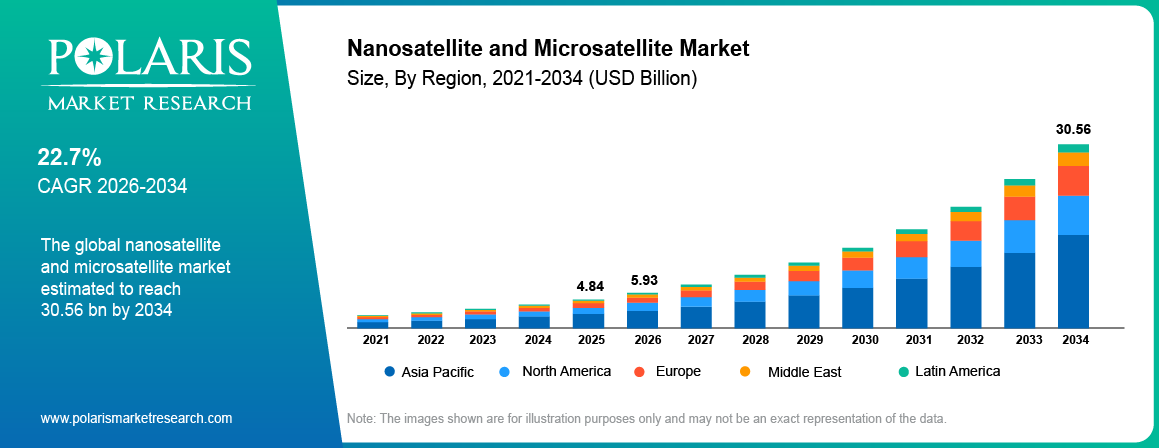
The global nanosatellite and microsatellite market size was valued at USD 4.84 billion in 2025. The market is projected to register a CAGR of 22.7% from 2026 to 2034. Market growth is primarily driven by increasing demand for cost-effective, lightweight platforms for Earth observation and satellite com munication. It also benefits from technological advancements and expanding government and commercial applications.
Market Statistics
Nanosatellite and Microsatellite Market Key Takeaways
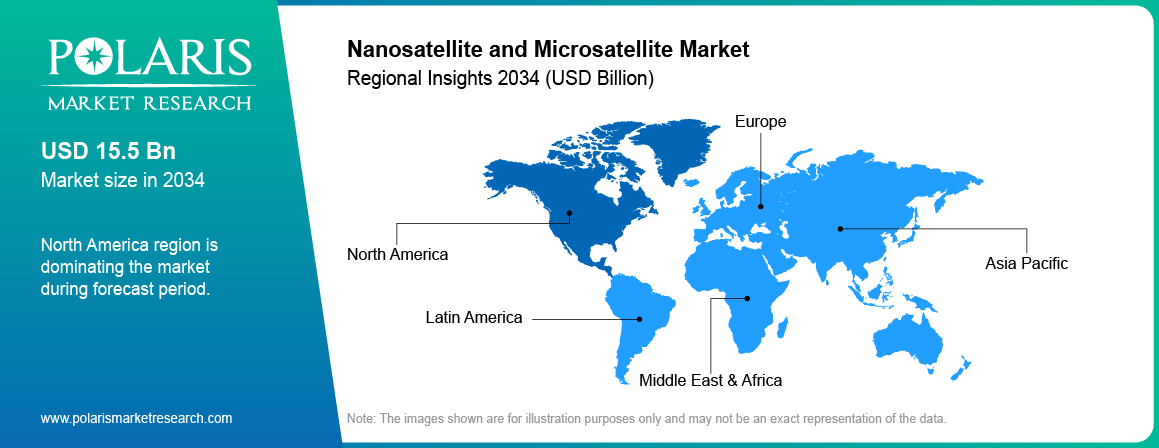
- The North America nanosatellite and microsatellite market led the market with a 42.76% revenue share in 2025 due to significant funding for advanced satellites from both government and private bodies.
- In Europe, the market is projected to register a notable CAGR of 20.18% due to the advancement of microsatellite technology for Earth observation and scientific endeavors.
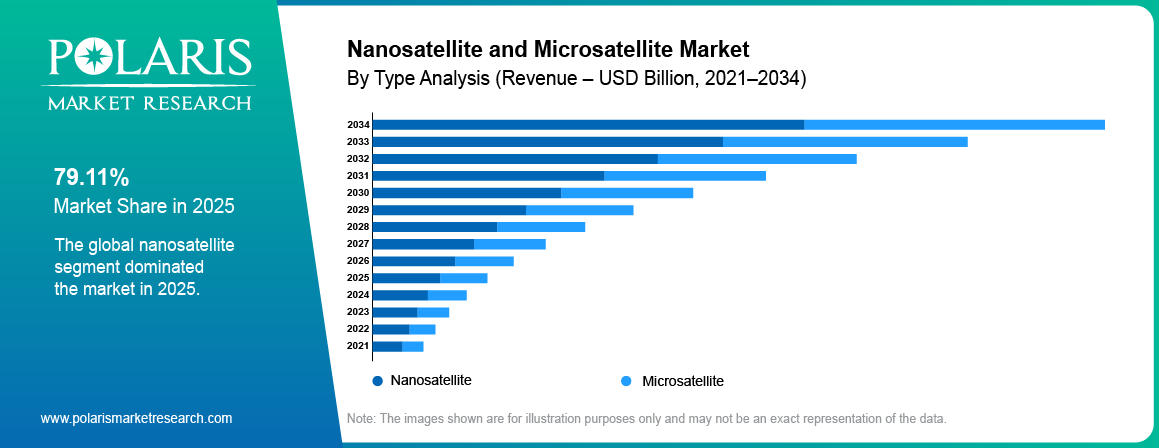
- The nanosatellite segment accounted for the largest market share of 79.11% in 2025. This is due to the increased deployment of nanosatellites for various applications.
- The scientific research & academic training segment is projected to account for a significant CAGR of 24.18% from 2026 to 2034 because of the growing usage of nanosatellites and microsatellites in academic and research bodies.
- The commercial segment held the largest nanosatellite and microsatellite market share of 46.71% in 2025. Rising usage of nanosatellites and microsatellites for various commercial applications contributes to the segment’s leading market position.
Note: Figures and projections outlined in this report are the result of Polaris Market Research’s proprietary analytical processes, grounded in the latest available datasets and market observations.
What is a Nanosatellite and Microsatellite market?
A nanosatellite is a small satellite generally weighing 1–10 kg, while a microsatellite generally weighs 10–100 kg. These satellites offer lower-cost and faster-deployment alternatives to traditional large satellites. Their small form factor enables them to conduct missions for Earth observation, communication, technology demonstration, scientific research, defense, and IoT connectivity.
The nanosatellite and microsatellite market is closely related to satellite miniaturization. These satellites reduce the spacecraft mass, power requirements, manufacturing complexity, and launch requirements. Nanosatellites are especially suitable for focused missions that require moderate payload capability and short development cycles. Microsatellites also provide increased payload capacity, power availability, communications capability, and mission endurance. These features make them suitable for more demanding Earth observation, defense, and commercial applications.
Multiple small satellites can provide more frequent observations, improve geographic coverage, create redundancy, and support continuous communications services. This model has become particularly important for Earth observation, broadband, maritime monitoring, and satellite IoT.
How Nano & Micro Satellites Work
A small-satellite mission typically follows six stages:
- Mission Design: Specify mission goal, payload, orbit, and system requirements.
- Development & Integration Design: Integrate and test satellite and payload systems.
- Launch: Orbital launches using a rideshare or dedicated launch vehicle (most often rideshare for cost).
- Sunset Deployment: Separate the satellite and perform initial power, communication ,and stabilization tests.
- Ground Control: Ground stations monitor for satellite health, send commands, and perform operations.
- Data Collection: Sensors collect data for the mission, which is processed and sent to customers or research users.
These stages can be repeated for satellite constellations, enabling frequent observations and continuous services.
Nanosatellite vs Microsatellite vs CubeSat vs Traditional Satellites
| Feature | CubeSat | Nanosatellite | Microsatellite | Traditional Satellite |
| Mass | ≤1.33 kg per unit | 1–10 kg | 10–100 kg | >100 kg (often tonnes) |
| Form Factor | 10×10×10 cm (1U) units | Compact, flexible | Small to medium | Large, complex bus |
| Typical Launch Cost | Lowest — rideshare / ISS deploy | Very low — rideshare | Moderate | Highest — dedicated launch |
| Mission Life | 6 months – 2 years | 1–5 years | 3–8 years | 10–20+ years |
| Payload Capacity | Very limited | Basic to moderate | Moderate to advanced | Large, multi-instrument |
| Typical Orbit | LEO | LEO, SSO, Polar | LEO, MEO, SSO | GEO, MEO, LEO |
| Development Time | 6–18 months | 12–24 months | 18–36 months | 5–10+ years |
| Primary Users | Universities, startups, research | Commercial, academic, government | Defense, EO, broadband | Telecom, navigation, defense |
| Example Use Cases | Tech demonstration, IoT, imaging | EO, comms, scientific research | High-res EO, SAR, comms | GPS, TV broadcast, deep space |
Source: Polaris Market Research Analysis
AI & Data Analytics in Satellite Operations
Artificial intelligence (AI) is increasingly being integrated into satellite operations, Earth observation analytics, mission planning, anomaly detection, and onboard data processing. AI satellite operations can automate routine decisions and reduce dependence on continuous ground intervention.
- AI accelerates satellite data processing and reduces the time between image acquisition and usable intelligence.
- Machine learning can identify changes in vegetation, infrastructure, weather patterns, ships, and other objects.
- AI-supported anomaly detection can identify unusual spacecraft behavior and support predictive maintenance.
- Autonomous operations can optimize scheduling, power allocation, communications, and imaging priorities.
- Edge processing can reduce the amount of raw data that must be transmitted to Earth.
- AI can combine satellite imagery with external datasets to produce decision-ready insights.
Planet's commercial Earth-imaging network provides an example of the data environment supporting AI applications. The company describes its global near-daily scan and a large historical archive as resources for AI and analytics, whereas its 2025 materials highlighted the use of Earth observation datasets for training AI models (Source: planet.com).
Market Dynamics
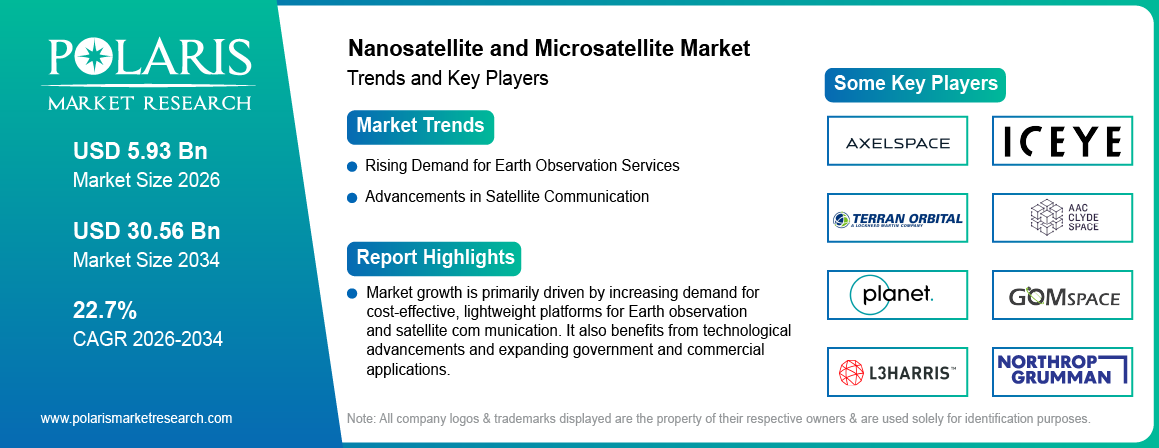
Driver: Rising Demand for Earth Observation Services
Earth observation (EO) is the process of collecting information about the Earth’s surface, atmosphere, and waters. Earth observation services gather data for a variety of purposes, including weather forecasting, climate monitoring, ecosystem accounting, and climate mitigation and adaptation. The need for high-resolution Earth imaging has increased across various sectors. These images can be used for various applications, such as efficient management of forest, land, and water resources. Also, space-based imaging can help fulfill a country’s security, infrastructure analysis, and disaster management needs. For instance, in July 2025, NASA and the Indian Space Research Organization (ISRO) collaborated to launch the NISAR mission. According to ISRO, the mission uses advanced L-band and S-band dual-frequency radar. It will provide high-resolution, time-series imagery for global monitoring of ecosystems and climate change every 12 days. Thus, the rising demand for Earth observation is fueling the nanosatellite and microsatellite market development (Source: jagranjosh.com).
Driver: Advancements in Satellite Communication
Nanosatellites and microsatellites have been critical in improving satellite communication systems over the past few years. Such satellites can form communication constellations, enabling global coverage and connectivity. For example, in March 2026, SpaceX placed its 10,000th active Starlink LEO satellite. It follows back-to-back Falcon 9 launches on March 16 and 17 (Source: keeptrack.space). Starlink satellite constellation has significantly expanded global satellite broadband services. Nanosatellites and microsatellites can also help bridge the digital divide by providing access to basic services in isolated regions and improving connectivity in remote areas. Nanosatellites and microsatellites support satellite-based connectivity for remote sensing, asset tracking, and communication. Thus, the ability of nanosatellites and microsatellites to improve satellite communication systems contributes to the nanosatellite and microsatellite market expansion.
Driver: Rise of the NewSpace Economy
The emerging NewSpace market economy is further contributing to market development. More private firms, startups, and investors are joining the space industry, thus exploring sectors that used to be the responsibility of government agencies. For instance, in February 2026, Rocket Lab USA. Inc. signed a multi-launch deal with BlackSky Technology Inc. The company revealed that the deal will further expand its service as the primary launch provider for Blacksky. This has led to increased demand for small-satellite hardware, payload systems, and launch capabilities (Source: investors.rocketlabcorp.com).
Driver: Declining Launch Costs and Rideshare Services
Reducing costs of satellite launches allow nanosatellite and microsatellite operators to reach space effectively. According to the University of Cambridge, the cost of launch to Low Earth Orbit (LEO) will decrease by 58% and reach USD 1,569/kg by 2030, down from USD 3,868/kg in 2025. Perhaps, it will go even as low as USD 273/kg by 2040 (Source: phys.org).
There is a rising preference for rideshare launch services among organizations. Rideshare missions enable multiple spacecraft to split the cost of a launch. It lowers the barrier to entry for startups, universities, research organizations, and government programs. SpaceX currently advertises dedicated smallsat rideshare missions from $350,000 for up to 50 kg to SSO, with additional mass priced at $7,000/kg, illustrating the continuing commercialization of small-satellite launch access. More frequent satellite deployment is also enabled by greater availability of flexible launch options. Lower launch barriers are especially advantageous to constellation operators and organizations seeking to enable faster technology deployment and replacement cycles (Source: spacex.com).
Restraint: Technical Limitations of Small Satellites
Despite rapid market expansion, small satellites face technical, regulatory, and operational limitations. Limited spacecraft volume restricts payload size, onboard processing, power generation, thermal management, and propulsion capacity. These constraints can reduce the suitability of nanosatellites for missions requiring high power, large sensors, or extended operational lifetimes.
Orbital congestion is another challenge. ESA reported that more than 300 launches occurred in 2025 and more than 4,000 payloads were placed into orbit, while large constellations and rideshare missions continued to increase the number of objects deployed per launch (Source: esa.int).
As satellite networks connect to terrestrial infrastructure and cloud-based ground systems, cybersecurity and spectrum management are also becoming more and more important. Operators are responsible for protecting command links, payload data, ground stations, and user terminals against unauthorized access. Spectrum coordination may become more complex as the number of communication constellations increases. Such factors may increase costs of compliance, insurance, design, and operations, restraining market expansion.
Opportunity: Expansion of Satellite IoT and Connectivity
The growing demand to connect remote assets and devices is opening new opportunities for small satellites in satellite IoT connectivity. Small-satellite constellations can offer reliable connectivity in areas with limited terrestrial network coverage. Applications include asset tracking, logistics monitoring, maritime surveillance, agriculture, energy infrastructure, and machine-to-machine communication. In September 2025, FOSSA Systems partnered with Leaf Space to support new satellites with IoT technology. This evolution demonstrates the increasing confluence of satellite networks with connected devices and industrial systems. As demand for real-time monitoring and remote asset management grows, the satellite IoT market is likely to expand the commercial application base for nanosatellites and microsatellites (Source: satnow.com).
Space Debris & Sustainability Concerns
The rising number of spacecraft is increasing the chances of collisions and operational risks, making space debris a major concern for satellite operators. ESA’s 2026 Space Environment Report states that in 2025, more than 4,000 payloads were launched into orbit and the debris population continues to grow. ESA’s statistics show approximately 47,080 regularly tracked space objects, including active spacecraft, rocket bodies and debris, as of July 31, 2026 (Source: sdup.esoc.esa.int).
The 2025 ESA report estimated more than 1.2 million debris objects larger than 1 cm, including more than 50,000 objects larger than 10 cm. ESA also highlighted the increasing density of objects in LEO (Source: openinnovation.regione.lombardia.it).
Consequently, space debris mitigation is becoming an important design requirement. Operators increasingly consider reliable tracking, collision avoidance, passivation, controlled re-entry, and post-mission disposal when designing spacecraft. Active Debris Removal and In-Orbit Servicing programs are also being developed to address larger high-risk objects. Long-term sustainability will increasingly influence licensing, insurance, constellation design, orbital selection, and end-of-life planning.
Microsatellite and Nanosatellite Applications
Satellite IoT connectivity is creating a new application layer for nanosatellite and microsatellite constellations. Satellite networks can connect sensors and machines in locations where terrestrial cellular networks are unavailable or unreliable.
- Fleet Tracking in Logistics: Tracking containers, vehicles, and assets across remote routes.
- Maritime Asset Management: Monitoring vessels and transmitting location and operational data beyond coastal networks.
- Energy: Connecting sensors across pipelines, mines, oil fields, and renewable-energy installations. Enables effective equipment monitoring.
- Agricultural Sensing: Monitoring remote agricultural equipment, irrigation infrastructure, and environmental sensors.
- Industrial: Connecting remote machines and infrastructure for predictive monitoring. Facilitates remote infrastructure monitoring.
Use Case Examples
Swarm Technologies developed a low-cost satellite IoT network intended to provide global connectivity for applications including shipping, tracking, agriculture, energy, and other commercial uses.
SFL Missions launched and deployed four small satellites aboard SpaceX’s Transporter-16 rideshare mission in March 2026. It is supporting maritime tracking and RF detection (Source: sflmissions.com).
Key Areas of Nanosatellites and Microsatellites Market
Rise of CubeSat Technology
CubeSat technology is a key component of this ecosystem. CubeSats are a class of standardized nanosatellites that are modular. A 1U CubeSat is approximately 10 × 10 × 10 cm, with larger configurations of 3U, 6U, and 12U, according to NASA. CubeSat technology has moved from an educational platform to a widely adopted architecture for research, technology demonstration, Earth observation, communications and commercial missions.
The standardized architecture simplifies development, since spacecraft developers rely on tried and true methods of structure, deployment, test, and integration. That makes CubeSats especially attractive to universities, startups, research institutions, and government technology programs.
The main users and operators of CubeSats are universities, NASA programs, commercial companies working in Earth observation, defense organizations, and satellite developers with special expertise. The technology also supports constellation architectures and distributed missions. It allows organizations to test technologies before scaling them across a larger fleet of satellites.
Increasing Defense & Military Satellite Applications
Nanosatellites and microsatellites are increasingly being used for defense and national-security applications where rapid deployment, distributed architectures and mission flexibility are important. Applications of small satellite constellations include surveillance and reconnaissance, Earth observation, communications, maritime awareness, and border monitoring.
Distributed spacecraft can provide redundancy in that the failure of a single satellite does not necessarily take out the entire mission. Constellations can also enable more frequent observations of strategically important areas than a single spacecraft.
Defense users can use small satellites for imagery collection, communications, signals monitoring, disaster response, infrastructure assessment, and battlefield awareness. Commercial Earth observation providers are also increasingly developing dual-use capabilities, creating overlap between commercial satellite services and government requirements.
Segmentation Analysis
Nanosatellite and microsatellite market segmentation includes type, component, orbit, propulsion technology, application, end use, and region.
By Type Analysis
The nanosatellite and microsatellite market, based on type, is bifurcated into nanosatellites and microsatellites. The nanosatellite segment led the market with a nanosatellite market share of 79.11% in 2025, driven by the increased deployment of nanosatellites for various applications. Nanosatellites are cost-effective and can be produced more quickly than their large counterparts. Also, the versatility of these satellites enables them to be used for a range of applications, such as scientific research satellites, remote sensing nanosatellites, and data collection satellites. These benefits of nanosatellites contribute to their high popularity and solidify the rising nano satellite market size.
Microsatellites is expected to grow witnessing 19.72% CAGR during 2026-2034. These satellites are important for missions that need higher performance. Microsatellite applications include defense, Earth observation microsatellites, and communication satellites, where better onboard systems and longer operation can justify higher costs.
By Component Analysis
By component, the nanosatellite and microsatellite market can be assessed across hardware, software and data processing, launch services, and space services. The hardware segment accounted for 49.37% revenue share in 2025. Hardware remains a significant source of value as operators spend on payload systems, communications satellite hardware, processors, satellite propulsion systems, sensors, attitude control, and power generation systems.
The software and data processing segment is expected to record a CAGR of 24.18% during the forecast period. As small satellites collect more and more imagery and RF intelligence, software and data processing have become increasingly vital from a strategic perspective. Customers demand more actionable insights rather than just satellite data. Thus, there will likely be a growing need for onboard processing capabilities and AI- enabled satellite analytics.
The launch services segment is projected to exhibit a CAGR of 21.56% during the projected period. Launch services continue to be essential to commercialization, since rideshare missions and increased orbital access have facilitated lowering the threshold to entry. At the same time, the ability to predict schedules, compatibility of launch, and mission integration have become increasingly important purchase parameters.
The space services segment is projected to exhibit the highest CAGR of 23.03% during 2026–2034. Space services, such as mission operators, ground segment support, and onboard data processing, are likely to be increasingly important as satellite fleets grow. The space services layer helps shift the small satellite industry from hardware-driven to a holistic space ecosystem.
By Orbit Analysis
By orbit, the nano and micro satellite market is segmented into low earth orbit (LEO), medium earth orbit (MEO), geostationary orbit (GEO), Sun-synchronous orbit, and polar orbit. The low earth orbit (LEO) segment dominated the market with a 56.48% revenue share in 2025. The LEO satellite category is significant because it enables low-latency operation, enhanced imaging resolution, and ease of constellation formation for LEO communication applications and Earth observation satellites. In April 2025, Myriota launched four new LEO nanosatellites to expand global IoT connectivity, coverage and data transfer. The market has progressively shifted from individual spacecraft toward distributed architectures and LEO satellite constellation deployments. Commercial launch vehicles are increasingly used, providing additional access to orbit (Source: capacityglobal.com).
Sun-synchronous and polar orbits remain highly suitable for Earth observation applications due to their consistent illumination and good coverage. Thus, orbital considerations become a significant commercial decision rather than just an engineering one.
By Propulsion Technology Analysis
Liquid-Fuel propulsion dominated the market share with 72.61% in 2025. This leading share is driven by the segment's features such as high density, high efficiency and proven reliability, across various space missions. This propulsion type is used to power small launch vehicles, heavy-lift vehicles, and others. Rising investments from governments of major economies in satellite launches and increasing emphasis on improving fuel efficiency drive the segment expansion.
Gas-based propulsion is projected to register a CAGR of 23.62% during the forecast period. Gas-based propulsion systems are becoming increasingly important for small spacecraft. Their relatively compact architecture permits maneuvering and orbital control and is compatible with the size and mass constraints of small satellites.
By Application Analysis
Based on application, the market is segmented into Earth observation, communication, technology demonstration, biological experimentation, scientific research & academic training, and others. The scientific research & academic training segment is anticipated to register a significant CAGR of 24.18% from 2026 to 2034. This is because of the increasing need for satellites used in scientific research and academic training. Such satellites allow scientists and researchers to perform experiments and gather data about greenhouse gases at a more affordable price and efficiency level. Moreover, the quick development of such satellites allows for better progression of research projects.
Earth observation segment held 47.38% share in 2025. Small and miniature satellites are extensively applied for land use mapping, crop health monitoring, weather analysis, maritime domain awareness, disaster response management, and infrastructure monitoring. The frequent data collection capability and reduced costs make them ideal for users who require timely geospatial data updates.
By End Use Analysis
Based on end use, the market serves defense, civil and construction, government, energy, commercial, and other sectors. The commercial segment dominated with the largest market share of 46.71% in 2025. Small satellites have seen increased usage from commercial customers. Applications include geospatial analysis, communications, supply chain monitoring, logistics intelligence, asset tracking, and environmental risk analysis.
Defense segment is expected to record the highest CAGR of 22.54% during the forecast period. Defense agencies and governments continue to invest in the areas of earth observation, surveillance, secure communications, and science applications. The national security needs and sovereignty in space are projected to ensure sustained demand.
Also, the use in civil, energy, and infrastructure purposes is on the rise. Small satellites have been used for pipeline monitoring, tracing of utilities, and renewable energy site assessment. They also help in the land use assessment and disaster preparation. This shows how versatile satellite data can be beyond the space sector.
Market Segmentation Summary Table
| Dimension | Leading Sub-Segment (2025) | Fastest-Growing Sub-Segment | Key Metric |
| By Type | Nanosatellites | Microsatellites | Nano: 79.11% share; Micro: 19.72% CAGR |
| By Component | Hardware | Space Services | Hardware: 49.37% share; Space Services: 23.03% CAGR |
| By Orbit | Low Earth Orbit (LEO) | LEO | LEO: 56.48% revenue share |
| By Propulsion Technology | Electric Propulsion | Gas-Based Propulsion | Liquid-Fuel: 72.61% share; Gas-based propulsion: 23.62% CAGR |
| By Application | Earth Observation | Scientific Research & Academic | EO: 47.38% share; Scientific Research: 24.18% CAGR |
| By End Use | Commercial | Defense | Commercial: 46.71% share |
Source: Polaris Market Research Analysis
Regional Insights
By region, the nanosatellite and microsatellite market report covers North America, Europe, Asia Pacific, Latin America, and the Middle East & Africa.
North America Nanosatellite and Microsatellite Market
North America led the global nanosatellite and microsatellite market share by holding 42.76% in 2025. The regional market growth is primarily fueled by significant investments in advanced satellites by both government and private entities. Also, the presence of several market participants leading small satellite innovation contributes to the North America nanosatellite market development. In June 2026, USC announced that its MAVERIC nanosatellite is set to launch aboard SpaceX to test AI-enabled navigation, 2D/3D imaging, and low-cost magnetic sensing (Source: usc.edu).
The prominent regional presence of North America can be attributed to its robust defense space ecosystem, growing commercial launch environment, and high venture capital funding and institutional procurement. These have all contributed to making North America one of the key centers for the development and launch of nanosatellites and microsatellites.
Europe Nanosatellite and Microsatellite Market
The Europe nanosatellite and microsatellite market is projected to register a notable CAGR of 20.18% from 2026 to 2034. Space agencies across Europe are making significant investments in developing microsatellite technology for Earth observation and scientific missions. Further, market participants and European academic institutions are developing innovative solutions for microsatellites and investigating novel applications in environmental monitoring and maritime surveillance, thereby propelling market growth in the region. In April 2026, Denmark launched the SATSOL project to develop low-cost silicon solar cells for small satellites and strengthen Europe’s space supply chain (Source: innovationsfonden.dk).
Asia Pacific Nanosatellite and Microsatellite Market
The Asia Pacific market is projected to exhibit a 25.84% CAGR during 2026–2034. Governments and private companies develop satellites for communication, agriculture, emergency management, and navigation, and to enhance national space capabilities. The Asia Pacific satellite market is further supported by the increasing ability of local industry and government sectors to gain affordable access to space.
The India nanosatellite and microsatellite market is expected to record a 28.20% CAGR during the forecast period, owing to space programs and private sector growth in the nation. Several government agencies and space firms are developing nanosatellites and microsatellites for uses like communication, earth observation, research purposes, and other applications. The emphasis of the Indian government and its space agencies on affordable space missions will further foster innovation and help India become more involved in the international space industry.
Latin America and the Middle East & Africa
Latin America and the Middle East & Africa can be considered emerging opportunity areas. The potential demand is expected to be driven by climate monitoring, border surveillance, telecommunications availability, smart agriculture satellites, and government reform initiatives. Although the Latin America satellite market and Middle East satellite demand are currently smaller, they may offer lucrative opportunities for specialized, cost-effective mission implementation.
India's Growing Small Satellite Ecosystem
India is increasingly emerging as an important player in the global small satellite industry. SSLV continues to be a launch support for ISRO small satellite. In September 2025, ISRO, NSIL, IN-SPACe and HAL signed a technology-transfer agreement for the SSLV. It is intended to launch spacecraft of up to 500 kg into LEO and to support industrial production (Source: isro.gov.in).
India’s private ecosystem is also booming. By 2025, Pixxel had finished the initial phase of its hyperspectral constellation Firefly. Dhruva Space had deployed its LEAP-1 commercial mission aboard SpaceX’s Falcon 9 in August 2025. In August 2025, Pixxel-led consortium with Dhruva Space, SatSure and PierSight was awarded an Earth Observation Public-Private Partnership by IN-SPACe. The program has a constellation of 12 satellites with an outlay of more than Rs 12.51 crore. As per our small satellite market forecast 2034, such strategies are boosting India’s private launch infrastructure and indigenous propulsion capabilities (Source: pixxel.space).
Competitive Insights
The market consists of both established nanosatellite companies and new microsatellite manufacturers that emphasize modularity, affordability, and specialization of their platforms. Best microsatellite and nanosatellite companies are constantly striving to improve their products, integrate payloads, and strategically form satellite partnerships to enhance their competitive edge.
The nanosatellite and microsatellite market research report offers a market assessment of all the leading market players. Increasing competitive pressure is driving differentiation through satellite modularity, rapid manufacturing, mission-critical payload integration, autonomous flight, and post-flight analysis. Beyond traditional comparisons between competing firms, the competitive structure is increasingly organizing around ecosystems. It includes platform providers, earth observation service providers, defense firms, launch providers, and analytics service providers.
Companies that can integrate space vehicle capabilities with analysis, operations management, and deployment support will likely gain an edge over time. This transition implies that value creation in the industry is no longer dependent solely on technology but also on comprehensive service provision.
List of Key Players
- AAC Clyde Space (AAC SpaceQuest)
- Axelspace Corporation
- GomSpace Group AB
- ICEYE Ltd.
- L3Harris Technologies
- Lockheed Martin Corporation (Terran Orbital)
- Northrop Grumman Corporation
- Planet Labs PBC
- Rocket Lab USA, Inc.
- RTX Corporation
- Sierra Nevada Corporation
- Spire Global, Inc.
- Surrey Satellite Technology Limited (SSTL)
- Thales Group
- The Boeing Company
Key Player Market Positioning
| Company | HQ | Primary Focus | Segment Strength | Notable Product / Program | Market Positioning Archetype |
| AAC Clyde Space (AAC SpaceQuest) | Sweden | Nanosatellite platforms, subsystems and space data services | Commercial / Government | Sirius subsystem and platform line; space data-as-a-service | Platform & Subsystem Specialist |
| Axelspace Corporation | Japan | Earth observation | Commercial | GRUS optical EO constellation | Data & Services Specialist |
| GomSpace Group AB | Denmark | Platform and bus manufacturing | Government / Academic | GomX and CubeSat platforms | Platform & Subsystem Specialist |
| ICEYE Ltd. | Finland | SAR Earth observation | Commercial / Government | ICEYE SAR constellation | Data & Services Specialist |
| L3Harris Technologies | USA | Defense, EO, communications | Government / Defense | Tactical satellite payloads | Prime Integrator |
| Lockheed Martin Corporation (Terran Orbital) | USA | Defense, EO, telecom; platform and mission services | Government / Defense | Pony Express, LM 50 smallsat bus; Terran Orbital modular nanosatellite buses | Prime Integrator |
| Northrop Grumman Corporation | USA | Defense and space systems; satellite buses and launch | Government / Defense | Smallsat buses; Space Development Agency constellation satellites; Minotaur and Pegasus launch | Prime Integrator |
| Planet Labs PBC | USA | Earth observation | Commercial EO | Dove, SuperDove, SkySat | Data & Services Specialist |
| Rocket Lab USA, Inc. | USA | Launch, spacecraft platforms and components | Commercial / Government | Photon spacecraft platform; Electron launch vehicle | Vertically Integrated Innovator |
| RTX Corporation | USA | Defense, aerospace; smallsat buses and sensors | Government / Defense | Blue Canyon Technologies smallsat buses | Prime Integrator |
| Sierra Nevada Corporation | USA | Defense, RF intelligence | Defense / Commercial | Vindler RF constellation | Prime Integrator |
| Spire Global, Inc. | USA | Weather, maritime, aviation | Commercial data | LEMUR constellation, HyMS | Data & Services Specialist |
| Surrey Satellite Technology Limited (SSTL) | UK | EO, communications, defense | Government / Defense | Juno program | Platform & Subsystem Specialist |
| Thales Group | France | Communications, defense, navigation | Government / Defense | Kineis IoT constellation | Prime Integrator |
| The Boeing Company | USA | Defense, broadband (via Millennium Space Systems) | Government / Defense | LEO constellation systems | Prime Integrator |
Source: Polaris Market Research Analysis
Recent Developments
- In September 2026, AXISCADES partnered with France’s U-Space to explore India’s growing microsatellite market and combine French technology with local manufacturing capabilities. (Source: sahi.com)
- In July 2026, Greece launched Hyperion GR-1, its first optical microsatellite and the first of a seven-satellite constellation for Earth observation. (Source: greeknewsagenda.gr)
- In May 2026, Axelspace announced plans to launch seven GRUS-3 Earth observation microsatellites to enhance wide-area, high-frequency imaging capabilities. (Source: axelspace.com)
- In May 2026, Sateliot and Telenor IoT announced a partnership aimed at enabling standard NB-IoT devices to move between terrestrial and satellite networks without proprietary satellite-specific hardware. (Source: iot.telenor.com)
- In May 2026, Icarus launched its Raven microsatellite to provide space-based IoT for near-real-time global animal tracking and environmental monitoring. (Source: icarus.mpg.de)
- In May 2025, IHI launched microsatellites, working with Finland’s ICEYE, to broaden cooperation in satellite-based Earth observation and space technology. (Source: asia.nikkei.com)
Future Outlook
The nanosatellite market growth trajectory is expected to remain strong through 2034. Growth will be supported primarily by increasing Earth observation requirements, satellite communications and constellation deployment, and declining launch barriers. Commercial applications in agriculture, maritime intelligence, IoT, logistics, defense, energy, and geospatial analytics are expected to broaden the addressable market. North America will remain an important market, while Asia Pacific and India are positioned for faster expansion as domestic space capabilities, private investment, and small-satellite launch infrastructure develop.
The use of nanosatellites and microsatellites will see a steady increase in demand due to the increasing need for more affordable and flexible satellites. Satellites were conventionally utilized for various purposes, including communications, observations, scientific missions, defense, and Internet of Things (IoT) services. The advent of new technologies that allow small satellites to be built in a better manner, with more efficient computational resources, and advanced mission planning. AI adoption is making space missions easier and cheaper. In addition, the increased investments by private players, governmental organizations, and research institutions will provide a substantial boost to the market growth. It is also believed that the increased demand for real-time data gathering, fast internet, and surveillance will present lucrative prospects.
Research Methodology
The Polaris Market Research nanosatellite and microsatellite market report follows a four-stage analytical framework to develop consistent market estimates, segment analysis, and regional forecasts.
Secondary Research & Data Collection:
The analysis uses information from NASA, ESA, ISRO, JAXA, regulatory bodies, company reports, patent databases, press releases, launch records, trade publications, and other verified industry sources. Historical market information covers 2021–2024.
Market Estimation & Modelling:
The top-down and bottom-up approaches are used to estimate the market by considering satellite production, launch activity, platform economics, average selling prices, payload requirements, and service revenues for various categories of satellites.
Primary Validation:
The market assumptions are tested through discussions with satellite manufacturers, launch providers, defense organizations, commercial users, data companies, system integrators and industry experts in key markets.
Data Triangulation & Final Review:
Company filings, third party databases, launch records and primary research are used to check market estimates. The final estimates reflect the analyst team's assessment and are reviewed against relevant market developments.
Nanosatellite and Microsatellite Market Segmentation
By Type Outlook (Revenue, USD Billion, 2021–2034)
- Nanosatellites
- Microsatellites
By Component Outlook (Revenue, USD Billion, 2021–2034)
- Hardware
- Software and Data Processing
- Launch Services
- Space Services
By Orbit Outlook (Revenue, USD Billion, 2021–2034)
- Low Earth Orbit (LEO)
- Medium Earth Orbit (MEO)
- Geostationary Orbit (GEO)
- Sun-Synchronous Orbit (SSO)
- Polar Orbit
By Propulsion Technology Outlook (Revenue, USD Billion, 2021–2034)
- Electric Propulsion
- Gas-Based Propulsion
- Liquid-Fuel Propulsion
By Application Outlook (Revenue, USD Billion, 2021–2034)
- Earth Observation
- Communication
- Technology Demonstration
- Biological Experimentation
- Scientific Research & Academic Training
- Navigation
- Others
By End Use Outlook (Revenue, USD Billion, 2021–2034)
- Defense
- Civil and Construction
- Government
- Energy
- Commercial
- Others
By Regional Outlook (Revenue, USD Billion, 2021-2034)
- North America
- U.S.
- Canada
- Europe
- Germany
- France
- UK
- Italy
- Spain
- Netherlands
- Russia
- Rest of Europe
- Asia Pacific
- China
- Japan
- India
- Malaysia
- South Korea
- Indonesia
- Australia
- Vietnam
- Rest of Asia Pacific
- Middle East & Africa
- Saudi Arabia
- UAE
- Israel
- South Africa
- Rest of Middle East & Africa
- Latin America
- Mexico
- Brazil
- Argentina
- Rest of Latin America
Nanosatellite and Microsatellite Market Report Scope
| Report Attributes | Details |
| Market Size in 2025 | USD 4.84 Billion |
| Market Size in 2026 | USD 5.93 Billion |
| Revenue Forecast by 2034 | USD 30.56 Billion |
| CAGR | 22.7% from 2026 to 2034 |
| Base Year | 2025 |
| Historical Data | 2021–2024 |
| Forecast Period | 2026–2034 |
| Quantitative Units | Revenue in USD Billion and CAGR from 2026 to 2034 |
| Report Coverage | Revenue Forecast, Competitive Landscape, Growth Factors, and Industry Trends |
| Segments Covered |
|
| Regional Scope |
|
| Competitive Landscape |
|
| Report Format |
|
| Customization | Report customization as per your requirements with respect to countries, regions, and segmentation. |
Source: Polaris Market Research Analysis
Nanosatellite and Microsatellite Market FAQ's
The market covers the design, manufacturing, launch, operation, and data services of spacecraft weighing approximately 1–100 kg. The satellites are used to serve Earth observation, communications, research, defense, and IoT applications.
The global market was valued at USD 4.84 billion in 2025 and is projected to reach USD 30.56 billion by 2034. Increasing technological advancements and rising focus on improving satellite communication systems drive the market growth.
The market is projected to grow at a 22.7% CAGR from 2026 to 2034, due to rising investments in Earth observation initiatives.
Nanosatellites led the type segment with 79.11% share in 2025, due to their cost effectiveness and faster production process.
Demand for Earth observation, satellite communications, IoT connectivity, constellation deployment, and lower-cost launch services is driving growth.
Their primary uses are for Earth observation, communications, technology demonstration, scientific research, defense and satellite IoT connectivity.
India is a high-growth market supported by ISRO, IN-SPACe, SSLV development, private satellite companies, and expanding domestic capabilities, strengthening the small satellite market forecast 2034.
The market is expected to grow till 2034 with satellite constellations, Earth observation, communications, IoT, defense applications, and enhancement in satellite technologies as the growth drivers.
A nanosatellite is a small satellite typically weighing 1–10 kg, used for Earth observation, communications, research, and technology demonstrations.
Small satellites are launched through dedicated rockets or rideshare launch services, where multiple spacecraft share launch capacity and costs.
Nanosatellite applications include Earth observation, communications, scientific research, technology demonstrations, defense, and IoT connectivity.
Leading nanosatellite companies include Planet Labs, GomSpace, AAC Clyde Space, Surrey Satellite Technology, Tyvak, Pixxel, and Dhruva Space.
The satellite IoT market connects remote devices and assets through satellite networks for applications such as logistics, maritime tracking, agriculture, and energy monitoring.
Download Sample Report of Nanosatellite and Microsatellite Market
Please fill out the form to request a customized copy of the research report.


