
Natural Gas Market Share, Opportunity, Trends, Industry Analysis Report, 2026 - 2034
REPORT DETAILS
Natural Gas Market Summary
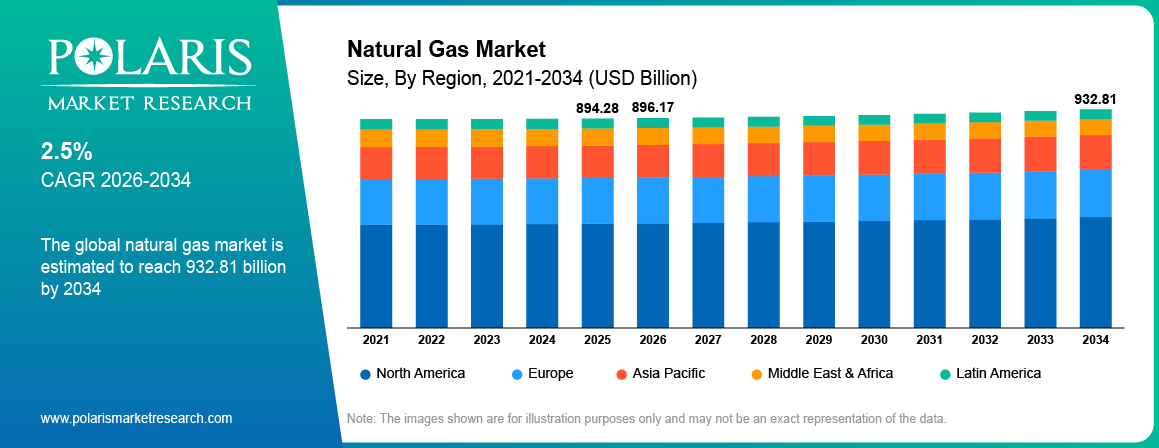
The global natural gas market is estimated around USD 894.28 Billion in 2025,with consistent growth anticipated during 2026–2034. Growth is supported by rising demand for cleaner-burning fuels, expansion of LNG trade, and increasing use of natural gas across power generation and industrial sectors. The market is projected to grow at a CAGR of 2.5% during the forecast period.
Market Statistics
Key Takeaways
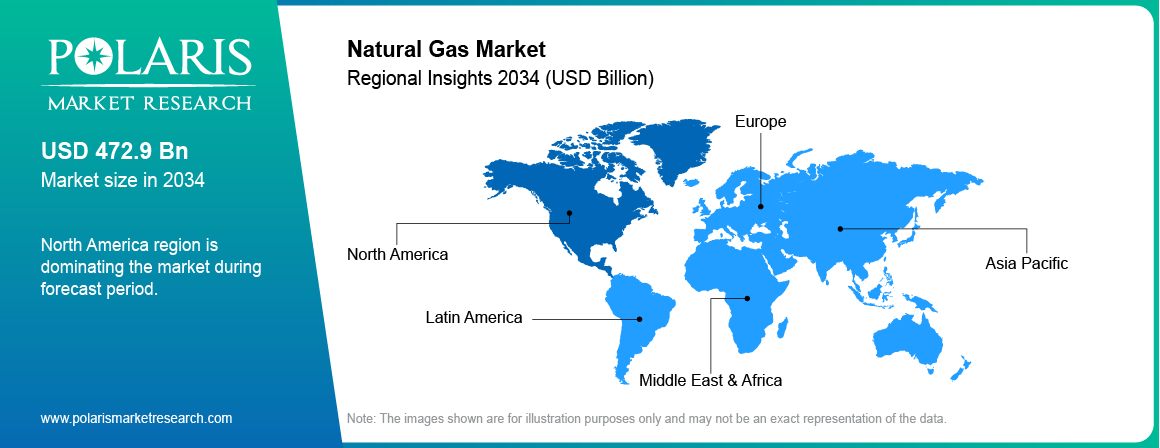
- North America dominated the market with a share of ~36% in 2025, driven by high shale gas production and well-established LNG export infrastructure.
- LNG accounted for approximately 31% of the market share in 2025, due to its flexibility in long-distance transportation and expanding global trade networks.
- Traditional natural gas usage held around 35% of the market share in 2025, supported by abundant reserves and cost-effective extraction infrastructure.
- Power generation captured nearly 38% of the market share in 2025, driven by rising electricity demand and the need for grid stability.
- The energy sector led the market with a share of about 41% in 2025, owing to the high dependence on gas-based power generation.
- The transport segment is expected to grow at a CAGR of approximately 8.7% during the forecast period, propelled by increasing adoption of CNG and LNG as alternative fuels.
Industry Dynamics
- Rising demand for cleaner-burning fuels is increasing natural gas consumption across residential and industrial sectors.
- The growth in industrialization and power generation is boosting the demand for natural gas as a flexible energy option.
- Price volatility and regulatory challenges continue to be major challenge for the industry growth.
- Renewable natural gas and small-scale LNG solutions are offering new opportunities in the energy transition landscape.
What is included in the Natural Gas market?
The natural gas market is a significant segment of the global energy landscape that is influenced by the dynamics of energy transition and rapid growth of the global LNG market. The natural gas industry overview includes exploration, production, processing, transportation, and distribution of natural gas for use in power generation, industries, residential heating, and transportation.
The natural gas is measured in terms of its multi-trillion cubic meter consumption base, and its growth rate is constant. The current market trend for the natural gas market is growing at a moderate CAGR growth rate during the forecast period due to the addition of new capacities in LNG sector and rising need for gas as a transition fuel.
Source: Polaris Market Research Analysis
To Understand More About this Research:Download Sample Report
Drivers & Opportunities
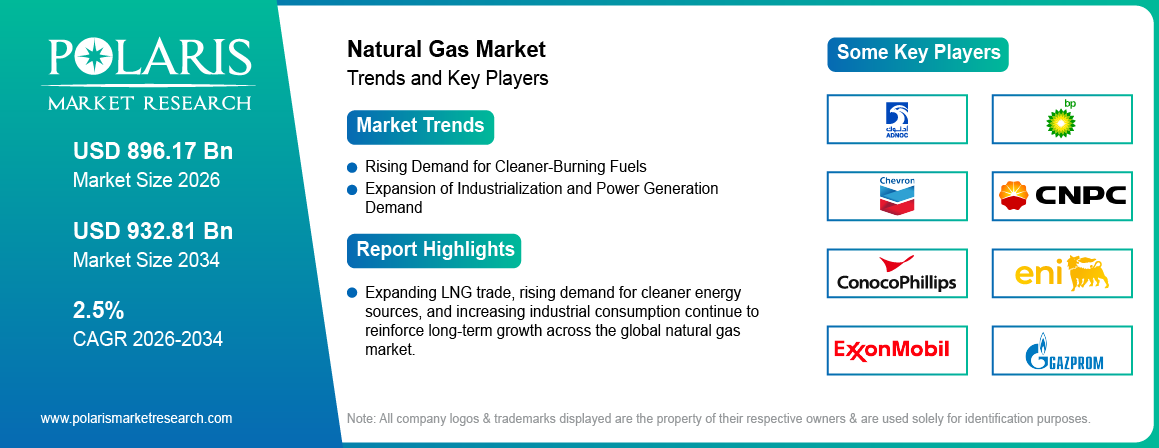
Rising demand for cleaner-burning fuels increasing gas consumption: The move towards clean-burning fuels, from coal and other conventional fuels, is boosting the demand for natural gas. It is a clean fuel with lower carbon emissions and better combustion efficiency, making it a transition fuel of choice. As per the International Energy Agency, more than 2 billion people lack access to clean cooking fuels and are reliant on biomass, kerosene, or coal. This gap creates strong volume-side growth in natural gas consumption, particularly in emerging economies. Expansion of gas distribution networks and LNG demand growth supports long-term natural gas market forecast 2034, even as natural gas market size 2024 reflects steady value expansion.
Industrialization and power generation expansion driving demand: Increasing electricity demand and industrialization are also fueling the growth of natural gas. The electricity demand in the global market is predicted to grow by more than 3.5 percent annually in the next ten years,. Natural gas is predicted to contribute to the electricity generation sector along with other energy resources such as solar and nuclear energy. The electricity generation facilities utilizing gas are fueling the growth of natural gas in various usage forms.
Restraints & Challenges
Price volatility and regulatory pressures: The price volatility of natural gas is a major restraint for the industry. The geopolitical environment and the price volatility of natural gas and LNG result in uncertainties for procurement strategies. Moreover, the environmental regulations and decarbonization policies impose a cost on the production and restrain company's from investing in the long term.
Opportunity
Growth of renewable natural gas and small-scale LNG solutions: The growth in renewable natural gas, which comes from biogas and waste, offers new opportunities that are consistent with a lower carbon future. The renewable natural gas offers lower carbon emissions and utilizes existing gas infrastructure to support a lower carbon future. In addition, small-scale LNG solutions are helping to expand access to remote and off-grid regions. Increasing investment in decentralized LNG infrastructure and sustainable gas production are projected to create significant future opportunities in the market.
Source: Polaris Market Research Analysis
Segmental Insights
This report provides comprehensive information of the market for natural gas by source, form, application, and industry to aid readers in identifying the segment with the highest growth potential.
By Source
-
Conventional Gas
Conventional gas dominated the market shar in 2025, due to its existing extraction infrastructure and substantial proven reserves available for extraction. Conventional sources of natural gas make up a larger portion of global production, ensuring consistent supply to power generation and industrial sectors.
-
Unconventional Gas
Unconventional gas held leading market share in natural gas, driven by shale and tight gas production. Advances in hydraulic fracturing and horizontal drilling technology have increased production capacity.
By Form
-
Pipeline Gas
Pipeline gas held largest market share in natural gas, owing to its supply of gas to industrial gas consumption and power generation. This form of gas provides a cost advantage in regional markets owing to existing infrastructure.
-
LNG (Liquefied Natural Gas)
LNG witnessed largest market growth rate in natural gas segmentation. LNG provides long-distance transportability of gas to regions where pipelines are not available. Global trade, flexible gas supply contracts, and LNG demand from Asia Pacific are key growth factors.
By Application
-
Power Generation
Power generation gas demand represents the largest share in the natural gas application market. The use of natural gas in electricity generation is common, given the lower emissions compared to other fuels like coal and oil. The trend towards clean fuels is boosting the growth of the market.
-
Transport
Transport segment is projected to witness the fastest growth, due to the rising adoption of CNG and LNG as alternative fuels. The increase in the number of vehicles running on gas and emission regulations are also boosting market growth.
By End-Use Industry
-
Energy Sector
Energy sector witnessed largest market share in the gas end-use industry segment. Natural gas is a major fuel used in electricity generation and grid stabilization. The rising trend towards electricity generation using natural gas is likely to sustain dominance.
-
Chemicals Industry
Chemical segment is projected to grow at a rapid pace during the forecast period, due to rising adoption of natural gas as a feedstock material in the manufacture of petrochemicals. Growth in ammonia, methanol, and fertilizer production is driving natural gas demand.
Source: Polaris Market Research Analysis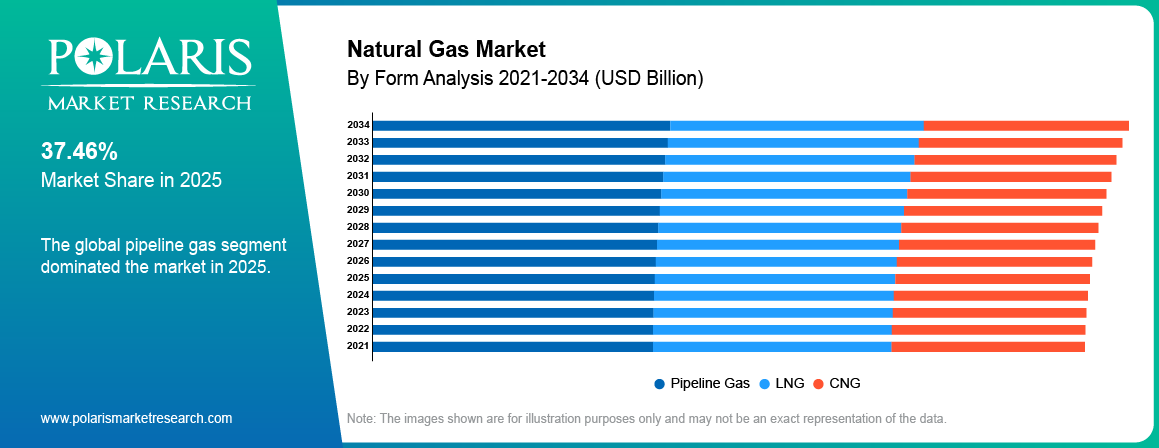
Regional Analysis
North America Natural Gas Market Assessment
North America held dominating position in the global natural gas market in terms of market share. The region’s market size for natural gas remained significant due to high production capacity and the availability of developed pipeline and export infrastructure. According to the Center for Climate and Energy Solutions, the US was the world’s largest producer of natural gas and exported about 4.4 Tcf of LNG in 2024. The high production capacity in the US shale gas market helped the region to hold the leadership position in the global market for natural gas.
Europe Natural Gas Market Overview
Europe natural gas market is growing steadily, driven by government initiatives and expansion of infrastructure to improve energy security and diversification in the region. Rising investment in LNG facilities, storage, and pipeline interconnections are improving energy security in Europe. Government regulations and strategies to improve energy transition have impacted market trends, with a focus on achieving a balance between energy security and transition in Europe.
Asia Pacific Natural Gas Market Insight
Asia Pacific is projected to grow at the fastest growth rate in the natural gas market due to the high rate of industrialization and urbanization, coupled with high energy demand in countries like China and India. Asia Pacific LNG demand growth accelerated as countries increased their LNG imports to support power generation and industrial fuel demand. As per the International Energy Agency, India’s natural gas demand is likely to increase by almost 60% by 2030, and demand has already increased by more than 10% between 2023 and 2024. This also boosted China LNG market, where the infrastructure and industrial demand continued to support regional demand.
Middle East & Latin America Natural Gas Market Assessment
Middle East continued to be a significant producer and exporter in the global natural gas market. Latin America also witnessed increasing demand due to industrialization and rising energy needs in power generation, especially in countries that are building their gas-based energy infrastructure. All these factors continued to support the regions' contribution to the global supply while also supporting the increasing demand within their respective economies.
Source: Polaris Market Research Analysis
Key Players & Competitive Analysis Report
The competitive environment of the natural gas market is shaped by large-scale upstream production, LNG infrastructure expansion, and global energy trade dynamics, where natural gas market key players operate across integrated value chains including exploration, production, liquefaction, transportation, and distribution to strengthen gas market share across regions. LNG companies and energy companies' strategies in the natural gas sector are to increase liquefied natural gas capacity, secure long-term supply contracts, and build cross-border pipeline infrastructure. The factors affecting the competition in the gas industry include price volatility, geopolitical issues, and supply reliability.
Leading companies in the Natural Gas market include ADNOC (Abu Dhabi National Oil Company), BP p.l.c., Chevron Corporation, China National Petroleum Corporation (CNPC), ConocoPhillips, Eni S.p.A., Exxon Mobil Corporation, Gazprom PJSC, Occidental Petroleum Corporation, Petróleo Brasileiro S.A., PJSC Lukoil, QatarEnergy, Rosneft Oil Company, Saudi Arabian Oil Company, and Shell plc.
Key Players
- ADNOC (Abu Dhabi National Oil Company)
- BP p.l.c.
- Chevron Corporation
- China National Petroleum Corporation (CNPC)
- ConocoPhillips
- Eni S.p.A.
- Exxon Mobil Corporation
- Gazprom PJSC
- Occidental Petroleum Corporation
- Petróleo Brasileiro S.A.
- PJSC Lukoil
- QatarEnergy
- Rosneft Oil Company
- Saudi Arabian Oil Company
- Shell plc
Pricing Trends, Supply Chain & Market Outlook
-
Natural Gas Pricing Trends (Henry Hub, LNG Benchmarks)
The pricing trends of natural gas differ across regions, depending upon various factors such as supply-demand balance, infrastructure, and contract structures. In the US, the price is benchmarked against Henry Hub, and therefore, Henry Hub price forecast is a crucial factor. On the other hand, in Europe, TTF is considered, and in Asia, LNG price analysis is considered, depending upon oil and spot LNG contracts.
-
Supply Chain Analysis (Upstream–Midstream–Downstream)
The supply chain of natural gas is divided into three segments, namely upstream, midstream, and downstream. Upstream is where exploration and production of natural gas resources occur. Midstream is the processing, storage, and transportation of natural gas via pipeline and LNG transportation infrastructure. Downstream is refers to supply of natural gas to consumers, covering industries, power generation, and transportation.
-
Future Outlook (Demand, LNG Trade, Energy Transition)
The outlook for the market of natural gas is stable, and it is based on power generation, industrial, and LNG-related demands. Emerging economies are contributing to an increase in gas demand, based on their need to diversify their energy mix. LNG is likely to play a crucial role in bridging regional supply-demand gaps in the future.
Covering a period from 2030 to 2034, natural gas is likely to act as a transitional energy carrier in facilitating a transition from coal to cleaner energy carriers, though its demand is likely to slow down with an increase in renewable energy uptake.
Regulatory Landscape & Sustainability Trends
-
Environmental Regulations & Methane Policies
Increasing regulations on the natural gas industry are focusing on the reduction of methane emissions during the production and transportation processes. Methane emission regulations are increasing investments in detection and monitoring systems for controlling emissions. These regulations are increasing operational costs while enhancing environmental performance.
-
Role of Natural Gas in Energy Transition
Natural gas is playing an important role in the energy transition as a clean energy transition gas, as it has lower carbon emissions compared to coal and oil, and it is still providing support to the grid and renewables. However, the environmental impact of the natural gas industry is under increasing scrutiny as climate change regulations are becoming more stringent.
-
ESG & Clean Energy Integration
ESG factors are an important aspect in capital allocation in this sector. There is growing focus on investing in strategies to reduce carbon, carbon capture, and low-carbon operations. ESG in the gas sector is also looking to integrate with renewable energies such as hydrogen and biomethane to fit in with their long-term decarbonization strategies.
Premium Insights & Strategic Recommendations
-
Key Strategic Insights for Stakeholders
The market is shifting towards flexible trade in LNG, infrastructure development, and diversified supplies. Companies are working towards portfolio management, long-term contracts, and regional positioning to address volatility and geopolitical risks.
-
Investment Opportunities
Significant opportunities for the natural gas market exist in the LNG terminal, pipeline expansions, and storage infrastructure. The investment opportunities in the LNG market focus on the development of liquefaction and regasification plants to meet the increasing trade needs worldwide.
-
Future Market Scenarios
The future outlook for the gas market is influenced by balancing energy security and sustainability. Investment in gas infrastructure investments is projected to remain important in the medium term, while in the long term, gas market growth will be influenced by integration with low-carbon energy systems.
Industry Developments
- January 2026: Bharat Petroleum Corporation Limited (BPCL) launched the PNG & CNG Drive 2.0, an industry initiative to fast-track the growth of piped natural gas and compressed natural gas markets across residential, commercial, and mobility domains.
- December 2024: bp, in partnership with XRG (ADNOC’s international investment arm), launched Arcius Energy, a new regional natural gas platform focused on developing and supplying lower-carbon gas resources.
Natural Gas Market Segmentation
By Source Outlook (Revenue, USD Billion, 2021-2034)
- Conventional Gas
- Unconventional Gas
By Form Outlook (Revenue, USD Billion, 2021-2034)
- Pipeline Gas
- LNG
- CNG
By Application Outlook (Revenue, USD Billion, 2021-2034)
- Power Generation
- Industrial
- Residential
- Transport
By End-Use Industry Outlook (Revenue, USD Billion, 2021-2034)
- Energy
- Chemicals
- Manufacturing
By Regional Outlook (Revenue, USD Billion, 2021-2034)
- North America
- US
- Canada
- Europe
- Germany
- France
- UK
- Italy
- Spain
- Netherlands
- Russia
- Rest of Europe
- Asia Pacific
- China
- Japan
- India
- Malaysia
- South Korea
- Indonesia
- Australia
- Vietnam
- Rest of Asia Pacific
- Middle East & Africa
- Saudi Arabia
- UAE
- Israel
- South Africa
- Rest of Middle East & Africa
- Latin America
- Mexico
- Brazil
- Argentina
- Rest of Latin America
Natural Gas Market Report Scope
| Report Attributes | Details |
| Market Size in 2025 | USD 894.28 Billion |
| Market Size in 2026 | USD 896.17 Billion |
| Revenue Forecast by 2034 | USD 932.81 Billion |
| CAGR | 2.5% from 2026 to 2034 |
| Base Year | 2025 |
| Historical Data | 2021–2024 |
| Forecast Period | 2026–2034 |
| Quantitative Units | Revenue in USD Billion and CAGR from 2026 to 2034 |
| Report Coverage | Revenue Forecast, Competitive Landscape, Growth Factors, and Industry Trends |
| Segments Covered |
|
| Regional Scope |
|
| Competitive Landscape |
|
| Report Format |
|
| Customization | Report customization as per your requirements with respect to countries, regions, and segmentation. |
Source: Polaris Market Research Analysis
Natural Gas Market FAQ's
The global market size was valued at USD 894.28 Billion in 2025 and is projected to grow to USD 932.81 Billion by 2034.
North America held the dominant position in the natural gas market due to the presence of abundant shale gas production and pipeline infrastructure.
The primary applications of natural gas include power generation, industrial applications, residential heating, and transportation.
The major players in the natural gas market are ADNOC (Abu Dhabi National Oil Company), BP p.l.c., Chevron Corporation, China National Petroleum Corporation (CNPC), ConocoPhillips, Eni S.p.A., Exxon Mobil Corporation, Gazprom PJSC, Occidental Petroleum Corporation, Petróleo Brasileiro S.A., PJSC Lukoil, QatarEnergy, Rosneft Oil Company, Saudi Arabian Oil Company, and Shell plc.
The factors driving the natural gas market include the increasing demand for clean fuels, growing LNG infrastructure, industrial energy requirement, and global electricity demand.
The role of LNG in the natural gas market is to facilitate the transportation of gas over long distances without the use of pipelines.
Download Sample Report of Natural Gas Market
Please fill out the form to request a customized copy of the research report.


