
North America AI in Medical Imaging Market Size, Share, Trends and Forecast, 2026-2034
REPORT DETAILS
North America AI in Medical Imaging Market Overview
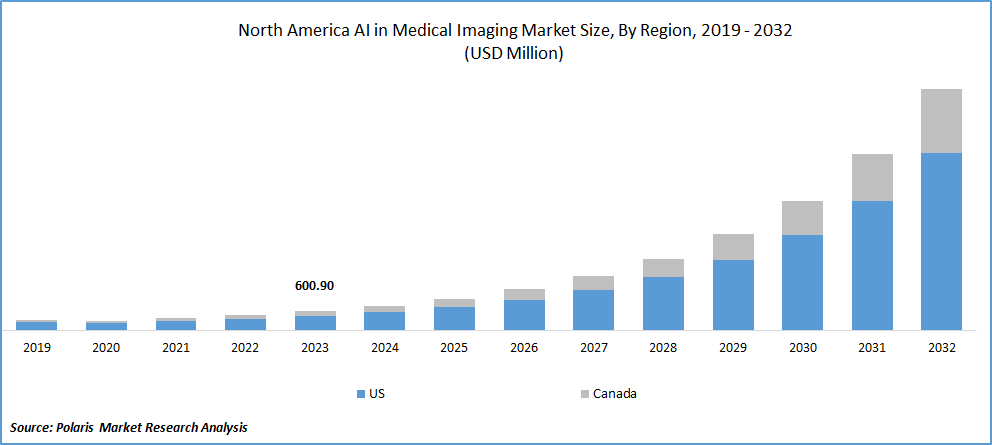
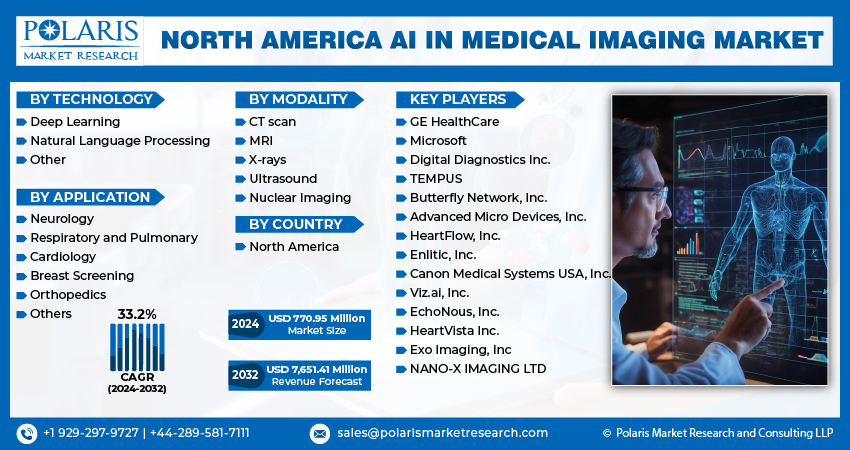
The North America AI in medical imaging market size was valued at USD 803.71 million in 2025. The market is anticipated to grow at a CAGR of 33.50% from 2026 to 2034. An increase in imaging volumes and radiologists staffing challenges are driving market growth. This market is also benefiting from the need for early detection and implementation of artificial intelligence technology with PACS, RIS, EHR, and cloud imaging systems.
Market Statistics
Key Takeaways
- The market in Canada is projected to grow at a xx% CAGR. Canada is gaining relevance due to rising digital health investments in the country.
- The U.S. held the largest market share of 88.0% in 2025. The country’s leading position is driven by rising technological partnerships.
- The neurology segment held the largest revenue share of 19.0% in 2025. This is owing to the increased adoption of AI in neurology.
- The breast screening segment is projected to witness rapid growth at a 32.60% CAGR. The rising patients' inclination towards early-stage detection are driving the segment’s growth.
- The CT scans segment accounted for the largest market of 22.0% in 2025. CT scans provide more comprehensive data compared to alternative methods.
- The X-ray segment is expected to grow at a 32.20% CAGR. This is because of increased usage of intervention x-ray machines for image-guided surgeries.
Note: Figures and projections outlined in this report are the result of Polaris Market Research’s proprietary analytical processes, grounded in the latest available datasets and market observations.
What AI in Medical Imaging is and How it Works?
AI in Medical Imaging in Simple Terms
Artificial intelligence in medical imaging involves the application of computer programs that analyze medical images to assist doctors in recognizing disease conditions more quickly and accurately, including AI-powered cancer detection. Artificial intelligence acts as an intelligent tool for the radiologist, identifying patterns and potential anomalies.
How AI in Medical Imaging Works?
Medical Image Acquisition: These images are acquired using different imaging modalities like X-rays, CT, MRI, ultrasound, and mammography.
AI Analysis of the Images: AI medical imaging software analyzes the images and processes the information before analyzing the images.
Pattern Recognition: AI analyzes the images and recognizes patterns and structures of normal and abnormal states.
Recognition of Abnormality: The software recognizes abnormalities in images such as tumors, fractures, and different diseases in comparison to training data.
Diagnosis by Radiologist: Following the process of AI, the radiologist analyzes the images along with the images analyzed by AI software.
Treatment Plan: Depending on the result of the analysis, proper decisions are made for diagnosis, precision oncology solutions, and treatment.
Rising demand for managing extensive and intricate medical datasets has resulted in a higher uptake of artificial intelligence within medical imaging. This upward trend is propelled by AI's capacity to refine diagnostic accuracy, hasten image interpretation, and enhance overall healthcare efficacy through sophisticated data handling and analysis capabilities. For instance, Rayscape CXR distinguishes between regular X-rays and those presenting abnormalities, streamlining patient treatment, and facilitating prompt physician assessment. With the ability to identify more than 147 pathologies, it provides a rapid and effective means for doctors to prioritize and manage patient requirements. (source: rayscape.ai)
Source: Polaris Market Research Analysis
To Understand More About this Research:Download Sample Report
Government efforts in the U.S. to promote the integration of artificial intelligence into healthcare, especially within medical imaging, have driven notable progress in the field. These initiatives encompass financial support and regulatory backing, fostering partnerships between public and private entities. The consequent increase in AI utilization in medical imaging has boosted diagnostic precision, optimized processes, and elevated patient care standards, thereby advancing the market.
In June 2026, NIH Common Fund made a statement that there were opportunities for funding in the newly launched Precision Medicine with AI: Integrating Imaging with Multimodal (PRIMED-AI) program. The PRIMED-AI program aims at developing innovative and affordable AI-powered tools that integrate clinical imaging with other data types. The tools are intended to enhance personalized medicine for patients with chronic or other health conditions (source: commonfund.nih.gov).
Market Drivers, Opportunities, and Implementation Barriers
Growth Drivers
-
Increasing Complexity of Healthcare Datasets
AI technology is being utilized by healthcare providers in identifying emergency cases, efficient workflow management, and faster reporting. With more diagnostic imaging cases, there has been a rise in the need for smart tools to help analyze the images. Also, advancements in AI technology have improved the accuracy of diagnosis and therefore the acceptance of such tools.
-
Financial assistance to innovative AI start-ups
The U.S. market for artificial intelligence (AI) in medical imaging is expected to experience growth driven by increased financial support for AI-based startups. For instance, in April 2026, clinical AI solutions provider Aidoc raised $150 million in Series E funding. The funding was led by Growth Equity at Goldman Sachs Alternatives. According to Aidoc, the funding will accelerate the expansion of its clinical foundation model and enterprise AI platform to combat diagnostic harm. It will also help improve efficiency across health systems (source: aidoc.com). Thus, rising financial assistance and investments in innovative AI companies are driving market growth
Market Opportunities
Expansion of AI in Community Hospitals and Outpatient Imaging Centers
Many of the AI imaging products were initially embraced by large academic hospitals, which leaves significant room for growth in community hospitals, rural hospitals, and diagnostic imaging centers that operate independently. Since AI technologies become more affordable with the emergence of subscription-based business models, such medical facilities are projected to implement AI tools to enhance the quality of diagnosis and solve radiologist shortage issues with minimal financial investments in infrastructure. Moreover, cloud computing allows AI technologies to reach those medical facilities that lack adequate IT resources. Thus, as adoption of such technologies progresses at smaller healthcare institutions, vendors have a significant opportunity to increase their client base and provide advanced diagnostic imaging services to patients in North America.
Implementation Barriers
Integration and Regulatory Compliance Challenges
AI adoption in medical imaging in North America is hampered by clinical validation needs, data privacy, cybersecurity, model explainability, interoperability, and monitoring AI functionality post-deployment. The U.S. FDA maintains an updated database of approved AI-enabled medical devices and has come up with lifecycle-based guidelines for software functions of AI-enabled devices. Health Canada released pre-market guidance in April 2026 for Class II, III, and IV machine learning-enabled medical devices in Canada. This guidance document introduced the concept of a predetermined change control plan (source: canada.ca). These validation and regulatory requirements add time to the process of product development, approval, and procurement and hence increase implementation cost, but guarantee transparency and safety in clinical implementation.
Source: Polaris Market Research Analysis
FDA and Health Canada Regulatory Landscape
In North America, the regulations concerning the use of AI in medical imaging are constantly evolving to maintain consistency with the pace of technology development, but at the same time, to ensure patient safety and the effectiveness of the medical imaging procedures. In the U.S., the FDA supervises the use of AI devices through a risk-based approach and has created pathways for approval of software with AI and machine learning components.
Similar regulation in Canada is provided by Health Canada, which has developed guidelines on pre-market requirements for medical devices that use machine learning. Both organizations are working on improving the regulatory framework and solving problems of software updating, transparency of algorithms, real-world performance monitoring, and cybersecurity. The evolving regulations are contributing to creating a predictable environment for the developers of AI-powered medical imaging solutions.
North America AI in Medical Imaging Trends for 2026
Growing Integration of AI with Healthcare Systems
Medical imaging AI, including oncology AI software, is becoming more incorporated into the hospital systems to optimize clinical processes and enhance patient care. It cooperates with Electronic Health Records (EHR), Picture Archiving and Communication Systems (PACS), Radiology Information Systems (RIS), and cloud-based imaging systems to enable access to patient data and imaging results. This method fosters collaboration between health care professionals, improves decision making, and boosts efficiency. Use of AI reduces manual data input, ensures smooth transfer of information between different departments, and enables health care institutions to have effective clinical workflows.
AI Medical Imaging vs. Traditional Medical Imaging
| Feature | AI Medical Imaging | Traditional Medical Imaging |
| Diagnosis Time | More rapid image processing and classification | More time-consuming manual image analysis |
| Correctness | Enhances detection of small abnormalities | Entirely dependent on the opinion of the radiologist |
| Efficiency | Automated processes and report generation | A largely manual process |
| Human Interpretation | Helps in making clinical decisions | Entirely dependent on specialist knowledge |
| Image Data Processing | Large sets of images are analyzed and patterns are identified | Limited manual analysis of images |
| Costs | Higher up-front costs, greater efficiency later on | Lower up-front costs, but higher manual costs |
Source: Polaris Market Research Analysis
Expanding Use of AI in Radiology Workflows
AI has become an increasingly useful technology in the field of radiology due to its ability to help radiologists process imaging studies much faster. AI can help identify abnormalities, prioritize studies with urgency, and generate reports. This enables radiologists to concentrate on more challenging cases. Additionally, solutions from radiology AI market can increase consistency across imaging studies by making interpretations more similar. With the growing amount of imaging studies, AI helps health care facilities be more productive.
Report Segmentation
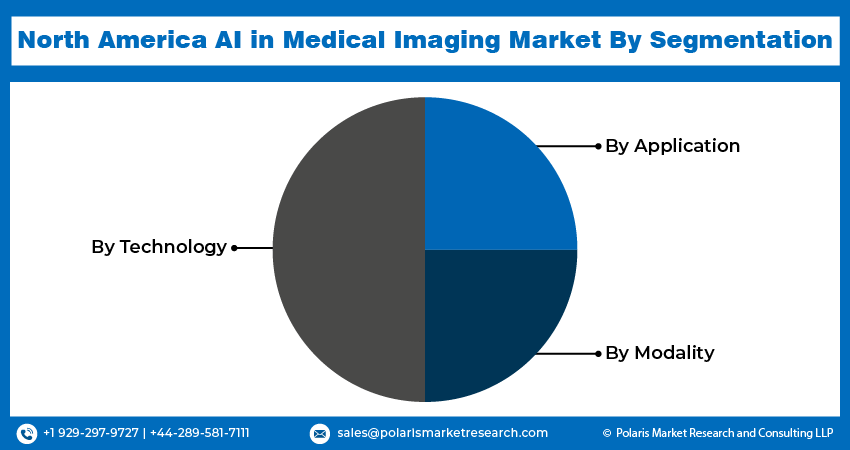
The market is primarily segmented based on technology, application, modality, and region.
| By Technology | By Application | By Modality | By Region |
|
|
|
|
Source: Polaris Market Research Analysis
By Technology Analysis
Deep Learning Led Market Share in 2025
The deep learning segment accounted for a xx% share in 2025. Deep learning is widely used in medical imaging applications because it can detect patterns with high accuracy. Deep learning is useful in disease detection, image classification, tissue segmentation, and predictive analysis regardless of the method being used to create images. As a result of training through large amounts of medical data, deep learning models are becoming increasingly accurate over time. These models find their application in areas such as radiology, AI in oncology, cardiology, and neurology where they assist in the detection of various diseases.
The natural language processing (NLP) segment is projected to grow at a xx% CAGR. The growth is due to the rising implementation of AI-based solutions for extraction, understanding, and summarizing of information provided in radiology reports, EHRs, and other clinical documentation. NLP facilitates the process of automation of report generation and clinical documentation, as well as improves decision-making, by converting unstructured healthcare data into structured data. Increased attention to workflow optimization and interoperability in the healthcare sector is expected to be one of the factors contributing to the development of NLP in the field of medical imaging.
By Application Analysis
-
Neurology segment held the largest share in 2025
The neurology segment held the largest share of 19.0% in 2025 This is propelled by the increased adoption of AI in neurology, which enhances patient care while ensuring higher accuracy and efficiency. Additionally, AI technology finds applications in neuro-oncology, brain injury detection, & neurosurgery. For instance, in November 2025, RapidAI announced the U.S. FDA clearance of five new imaging modules. These modules include Rapid LMVO, Rapid OH, Rapid DeltaFuse, Rapid MLS, and Rapid Aortic for measurement. The company stated that the new clearances will expand the Rapid Enterprise Platform. They will also help elevate neurology and vascular care through deep clinical AI (source: rapidai.com).
The breast screening segment is projected to account for a 32.60% CAGR. Factors such as the rising occurrence of breast cancer cases and patients' inclination towards early-stage detection for timely and accurate treatment initiation are key drivers stimulating the demand for breast screening services. Moreover, government initiatives aimed at facilitating clinical interpretation and the increased availability of breast cancer screening technologies are expected to play pivotal roles in fostering market expansion.
By Modality Analysis
-
CT Scans segment accounted for the largest market share in 2025
The CT scans segment accounted for a 22.0% share in 2025. CT scans provide more comprehensive data compared to alternative methods, and there is no conclusive evidence demonstrating that the low levels of radiation utilized in CT scans pose long-term harm. The market is segmented based on modality into MRI, CT scan, ultrasound, X-ray, and nuclear imaging. For example, in February 2026, Brainomix increased its Series C funding to $25.4 million to aid in its U.S. expansion plans. According to the company, the new funds will contribute to speeding up innovations in its Brainomix 360 Stroke and e-Lung AI imaging platforms (source: brainomix.com).
The X-ray segment is projected to grow at a 32.20% CAGR. This is primarily due to increasing use of interventional X-ray equipment for imaging-guided surgeries, such as C-arms and similar devices. The advancements in C-arm technology, particularly the development of compact C-arms featuring flat panel detectors and digital radiography, have significantly boosted the global demand for X-rays. For instance, in December 2025, GE HealthCare introduced its image guiding solution, Allia Moveo. The company stated that the new Allia platform features a cable-free C-arm that allows full movement and patient access. It intends to redefine the way clinical care is delivered in the interventional suite (source: gehealthcare.com).
Use Cases of AI in Medical Imaging
| Use Case | Description |
| Prioritization of Emergency Imaging Scans | Using artificial intelligence, emergency imaging is prioritized based on the recognition of important conditions like bleeding inside the body and a pulmonary embolism. |
| Lung Diseases Screening | AI is used to analyze images of the lungs and diagnose different conditions like pneumonia, pulmonary tuberculosis, lung nodules, and artificial intelligence in cancer diagnostics. |
| Improving the Image Quality | Artificial intelligence reduces the noise in the image and increases its clarity in order to improve the overall quality of the picture. |
| Disease Follow-Up Monitoring | Comparing previous and current medical images, AI monitors disease development and the effectiveness of the applied treatment. |
Source: Polaris Market Research Analysis
Source: Polaris Market Research Analysis
Regional Insights
-
The U.S. Held the Largest Share in 2025
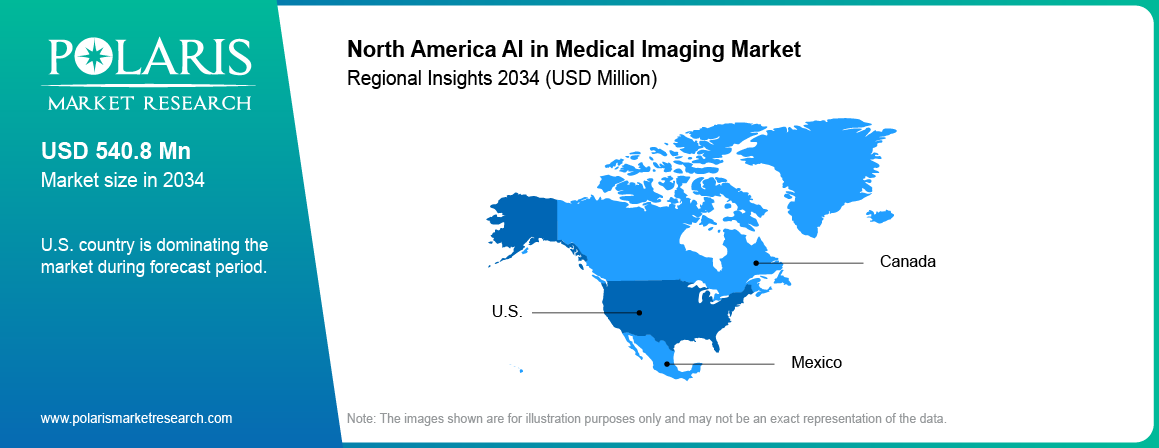
The U.S. accounted for 88.0% market share in 2025. This is due to the presence of advanced imaging infrastructure, huge investment in technology, the presence of radiology AI software vendors, and collaborative efforts between hospitals and tech vendors. FDA approval process and the increasing use of AI-driven medical devices are contributing to market growth. Factors such as performance monitoring, cybersecurity issues, expenses of integration, and reimbursement play a significant role in influencing adoption. AI has been increasingly adopted by healthcare organizations in the optimization of worklists, triaging strokes and pulmonary, image enhancement, measurements, and enterprise imaging.
Canada is Projected to Witness Significant Growth
Canada is projected to grow at a xx% CAGR. The country has emerged as an important market for AI-powered medical imaging because of existing research organizations that are working on artificial intelligence, provincial digital health initiatives, and the requirement for advanced diagnostics of a distributed population. In particular, the guidelines issued by Health Canada regarding the medical devices that utilize machine learning technology in 2026 have helped manufacturers understand the criteria in advance and plan their strategies accordingly in the future. The areas having great growth potential in the region include cloud imaging, remote diagnostics, workflow automation, image reconstruction, and clinical decision support.
Source: Polaris Market Research Analysis
Key Market Players & Competitive Insights
The North America competitive landscape comprises imaging equipment providers, clinical AI software providers, enterprise imaging and workflow solutions providers, and compute or cloud computing providers. Competition is seen through the expansion of the AI enabled imaging suite, improved integration with hospital information systems, and increased precision and speed of the diagnostic workflow. Strategic partnerships, product launches, and acquisitions continue to be important strategies that help vendors establish themselves in the market. Investments in cloud based imaging solutions and AI algorithm development have become important drivers of innovation and competition.
Aidoc is a clinical AI company specializing in the development of clinical artificial intelligence applications in imaging and care coordination. These artificial intelligence applications allow healthcare professionals to identify important findings, prioritize critical cases, and optimize workflow processes in radiology, helping them make decisions faster and more efficiently.
Philips is a global leader in health technology with solutions in diagnostic imaging, image-guided therapy, and AI-based informatics. Philips concentrates on incorporating AI technologies in imaging workflows to increase diagnostic precision and operational performance.
List of Key Players
- Advanced Micro Devices, Inc. (Compute Enabler)
- Aidoc
- Butterfly Network, Inc.
- Canon Medical Systems USA, Inc.
- DeepHealth (RadNet)
- Digital Diagnostics Inc. (Autonomous AI Diagnostics and Retinal Imaging)
- EchoNous, Inc.
- Enlitic, Inc.
- Exo Imaging, Inc.
- GE HealthCare
- HeartFlow, Inc.
- HeartFlow, Inc.
- Microsoft (Infrastructure Provider)
- Nano-X Imaging Ltd. (Nanox)
- NVIDIA Corporation (Infrastructure Provider)
- Philips
- Siemens Healthineers AG
- Subtle Medical, Inc.
- Tempus AI, Inc. (Arterys Imaging Capabilities and Digital Pathology)
- Vista AI, Inc.
- Viz.ai, Inc.
Future Outlook
It is anticipated that the market for AI in medical imaging in North America will exhibit steady growth due to the ongoing adoption of AI-based imaging technology in order to enhance the precision and efficiency of diagnoses made. Advancements in machine learning and deep learning, along with cloud-based imaging technology, are expected to facilitate adoption of these technologies in hospitals and other diagnostic centers. The rising need for faster imaging analysis, disease diagnosis, and the digitization of the healthcare industry are expected to propel the market.
Recent Developments in the Industry
- June 2026: Subtle Medical secured FDA clearance for its AI-based image enhancement technology called SubtleHD (CT). The firm announced that this technology has been developed to reduce the noise and improve low contrast visibility on CT images. (source: subtlemedical.com)
- March 2026: Mosaic Clinical Technologies announced FDA Breakthrough Device Designation for Cognita Chest X-Ray (CXR) across multiple critical indications. According to Mosaic, the breakthrough designation means Cognita will engage in prioritized interactions with the FDA regarding the clearance of a device designed to address the radiology capacity bottleneck. (source: businesswire.com)
Report Coverage
This report analyzes the North America artificial intelligence in medical imaging market based on technology, application, modality, end use, and country. It provides market size, growth factors, adoption challenges, clinical applications, regulations from the FDA & Health Canada, workflow integration, competitive landscape, and business opportunities. The country analysis includes the U.S. and Canada. This report includes historical data for 2021-2024, 2025 is the base year, and forecast data extends from 2026 to 2034.
Report Segmentation
By Technology
- Deep Learning
- Natural Language Processing (NLP)
- Other
By Application
- Neurology
- Respiratory and Pulmonary
- Cardiology
- Breast Screening
- Orthopedics
- Others
By Modality
- CT scan
- MRI
- X-rays
- Ultrasound
- Nuclear Imaging
By End Use
- Diagnostic Imaging Centers
- Hospitals
- Other End Use
By Country
- U.S
- Canada
North America AI in Medical Imaging Market Report Scope
| Report Attributes | Details |
| Market size value in 2025 | USD 803.71 million |
| Market size value in 2026 | USD 1070.06 million |
| Revenue forecast in 2034 | USD 10821.51 million |
| CAGR | 33.50% from 2026 – 2034 |
| Base year | 2025 |
| Historical data | 2021 – 2024 |
| Forecast period | 2026 – 2034 |
| Quantitative units | Revenue in USD million and CAGR from 2026 to 2034 |
| Segments covered |
|
| Regional scope |
|
| Competitive Landscape |
|
| Report Format |
|
| Customization | Report customization as per your requirements with respect to countries, region and segmentation. |
Source: Polaris Market Research Analysis
North America AI in Medical Imaging Market FAQ's
The key companies in North America AI in Medical Imaging Market GE HealthCare, Microsoft, Digital Diagnostics, TEMPUS, Butterfly Network, Advanced Micro Devices
The North America AI in medical imaging market is expected to grow at a CAGR of 33.50% from 2026 to 2034.
North America AI in Medical Imaging Market report covering key segments are technology, application, modality, and region
The key driving factors in North America AI in Medical Imaging Market Increasing complex healthcare datasets
The market was valued at USD 803.71 million in 2025 and is projected to reach USD 10,821.51 million by 2034.
AI performs automated image analysis, prioritization of urgent cases, and report generation. These benefits make work easier for radiologists and shorten the time needed to generate reports.
Neurology held the largest application share, accounting for 19.0% of regional revenue in 2025.
There are several factors driving the incorporation of artificial intelligence in medical imaging. These are increased number of imaging tests, increased incidence of chronic diseases, insufficient number of competent radiologists, and requirement of accuracy and speed in diagnosis.
The U.S. led the regional market with an 88.0% revenue share in 2025.
AI is used to assist in image interpretation, triaging, measurements, workflow and reporting. Radiologists and other healthcare professionals are still tasked with clinical interpretation and care management of patients.
CT scans held the largest modality share, accounting for 22.0% of the market in 2025.
Download Sample Report of North America AI in Medical Imaging Market
Please fill out the form to request a customized copy of the research report.


