
Palm Oil Market Share, Size, Trends, Industry Analysis Report, 2026 - 2034
REPORT DETAILS
What is the Market Size of Palm Oil Market?
The global palm oil market was valued at USD 77.00 billion in 2025 and is expected to grow at a CAGR of 5.0% during the forecast period. Increasing demand from end-use industries such as personal care & cosmetics, food & beverage, biofuel & energy, pharmaceuticals, and others is expected to propel market growth over the forecast period.
Market Statistics
Key Takeaways
- The conventional segment dominated the market in 2025 with a revenue share of 90.0%, due to the development of efficient production systems in certain regions, which enabled cost-effectiveness.
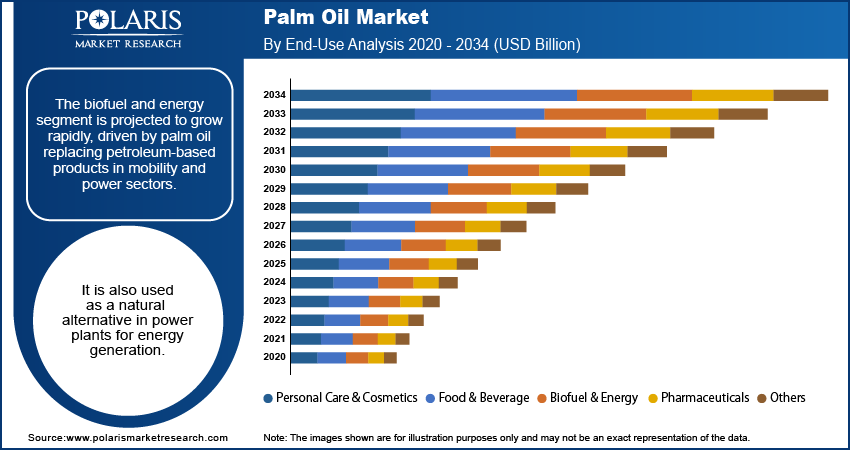
- The biofuel and energy segment is expected to witness substantial growth with a CAGR of 6.1% throughout the projected period, driven by the increasing adoption of natural alternatives in power plants for energy generation.
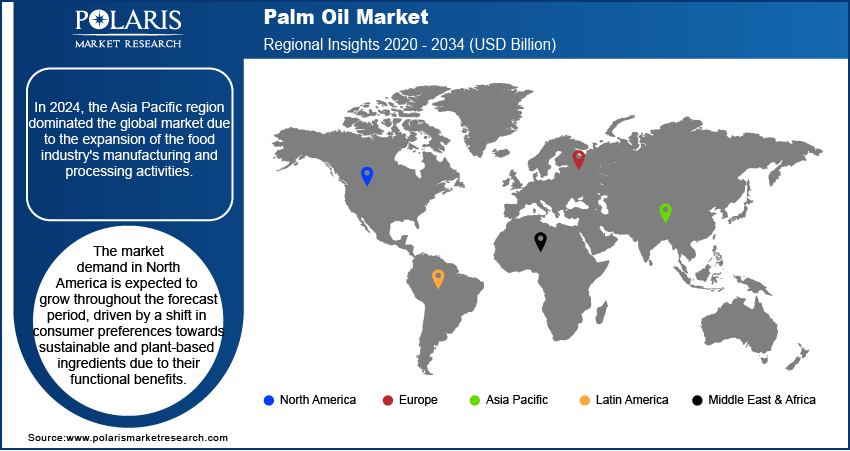
- In 2025, the Asia Pacific region dominated the global market capturing 84.4%, due to the expansion of the food industry's manufacturing and processing activities.
- The market demand in North America is expected to grow with a CAGR of 5.6% throughout the forecast period, driven by a shift in consumer preferences towards sustainable and plant-based ingredients due to their functional benefits.
Industry Dynamics
- The rising demand for palm oil as a source of nutrition and fuel has boosted production growth due to its extended storage life and lower cost compared to alternative vegetable oils, which is expected to drive market expansion.
- Increasing demand from end-use industries, such as personal care & cosmetics, has boosted the market demand due to the cost-effective raw materials used in soaps, creams, and lotions.
- Deforestation and biodiversity loss pose significant challenges for governments, reputational entities, as well as brands and producers.
- The rise in demand for affordable oil for vegetable production and high agricultural productivity creates growth opportunities, especially in underdeveloped regions.
AI Impact on Palm Oil Market
- Forecast optimal harvest timing, detect diseases early, and boost farm yields.
- Smart logistics and real-time tracking boost supply chain efficiency
- Strict sustainability monitoring enables resisting deforestation and certifications
- New palm oil-based biofuels and ingredients development with algorithms boosts product innovation
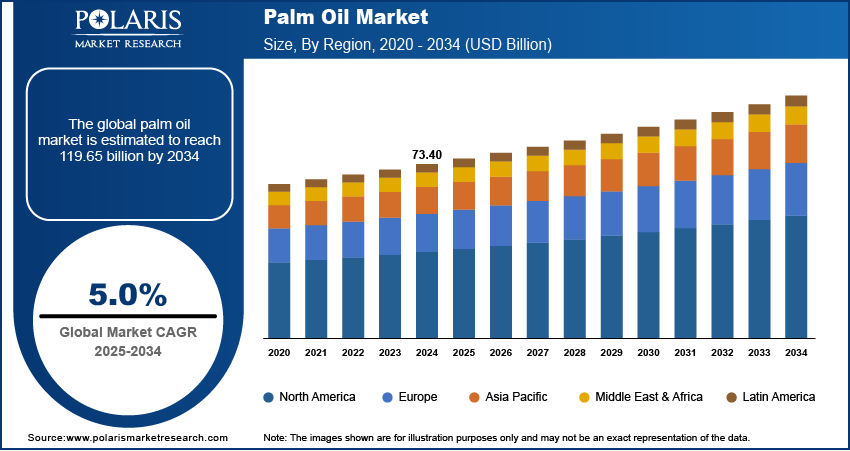
Source: Polaris Market Research Analysis
What is palm oil? Why is it important?
Palm oil is an essential component of everyday products such as fats, shortening, sweets, confectionery, and prepackaged fast meals. The key benefit of the product is its inexpensive and useful characteristics compared to its counterparts. It's also used to produce commodities such as cosmetics, detergents and soaps, lubricants, and printing ink. The product is also used to produce biodiesel, which is becoming increasingly important due to the significant role of conventional energy in greenhouse gas (GHG) emissions. Moreover, this widespread dependency on palm oil for cultivation is a major reason for deforestation and biodiversity loss. The palm oil sector is facing pressure from consumers and regulations to provide ethically sourced options. This has boosted the adoption of certifications to ensure compliance across global chains, which creates challenges.
Types and Applications of Palm Oil
| Type of Palm Oil | Major Applications |
| Crude Palm Oil (CPO) | Raw material for refining into edible oils, processed foods, biodiesel, and industrial products |
| Refined Palm Oil (RPO) | Cooking oils, frying oils, margarine, bakery products, confectionery, and packaged foods |
| Palm Kernel Oil (PKO) | Soaps, detergents, cosmetics, confectionery fats, candles, and personal care products |
| Palm Olein | Household cooking oil, deep frying, food processing, snacks, and instant noodles |
| Palm Stearin | Margarine, shortening, bakery fats, soap manufacturing, candles, and industrial lubricants |
| Red Palm Oil | Nutritional supplements, health foods, cooking oil, and vitamin-rich food products |
| Organic/Sustainable Palm Oil | Premium food products, eco-friendly cosmetics, sustainable household products, and green industrial applications |
Source: Polaris Market Research Analysis
Industry Dynamics
Growth Drivers
Why Rising Demand for Nutrition and Fuel Supply Drives the Growth Opportunities?
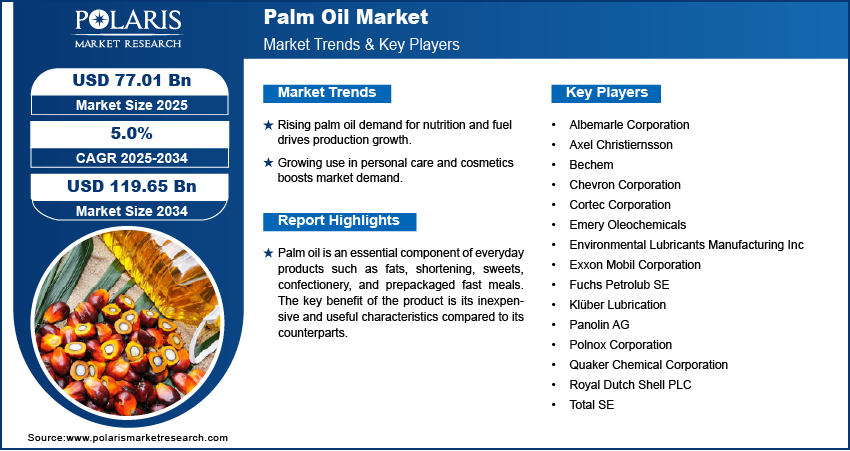
The rising demand for this commodity as a source of nutrition and fuel has reflected growth in production. Eliminating GMOs, gluten, and milk in edible fats, such as palm oil, is attracting customer attention worldwide. The product has an extended storage life and is less expensive than alternative vegetable oils, which is expected to drive market expansion as the public becomes increasingly aware of these health benefits. The product has gained popularity as an edible and economical option with applications in various home and commercial settings. Furthermore, despite the presence of numerous companies active in the sector's R&D, the palm oil market is expected to grow. The consumption of palm-related fat, as well as the business, is expected to rise over the projected period as the food industry grows.
Source: Polaris Market Research Analysis
Report Segmentation
The market is primarily segmented based on product, nature, end-use, and region.
| By Product | By Nature | By End-Use | By Region |
· |
|
|
|
Source: Polaris Market Research Analysis
Segmental Insights
Nature Analysis
Which Segment by Nature Dominated the Palm Oil Market in 2025?
The conventional segment dominated the market with a revenue share of 90.0% in 2025. This is due to the well-established supply chains and their cost advantage over the certified alternatives. The development of efficient production systems in some regions drives cost-effectiveness, which benefits from economies of scale, allowing for sustainable practices to be sustained. Moreover, the rising demand from traditional and price-sensitive industries, where sustainability is not a purchasing issue, boosts the segment's expansion. The existing infrastructure for traditional palm oil, from mining to refining, also creates a dullness in structure that slows down the widespread adoption.
Source: Polaris Market Research Analysis
End-Use Analysis
Why Biofuel and Energy Segment is Expected to Witness Substantial Growth?
The biofuel and energy segment is expected to grow at a considerable pace with a CAGR of 6.1%, throughout the projected period. This is due to the mobility and power sectors, where palm oil increasingly overtakes petroleum-based goods as a viable substitute. It is also used as a natural alternative in power plants for energy generation. Furthermore, the increasing demand for renewable and environmentally friendly resources is also expected to drive growth in the segment, thereby boosting market demand.
Geographic Overview
Why Asia Pacific Held the Largest Revenue Share in 2025?
Asia Pacific dominated the global market capturing 84.4% share in 2025. This is due to the region's industrial development, which is linked to rising disposable income and the substitution of healthy and nutritious cuisine for traditional meals. The expansion of the food industry's manufacturing and processing, with major consumption of palm oil as a cost-effective ingredient, also contributes to the growth of this market. This region is the largest consumer and producer of palm oil, with Indonesia and Malaysia dominating the global supply chains to create a production loop. The rise in urbanization and changing dietary patterns have also contributed to the increasing demand for packaged foods. Furthermore, regulatory policies in underdeveloped nations also support industrial and agricultural growth to strengthen their market position. Thus, the well-established supply chains with rising demand boost expansion opportunities.
What is the Reason for North America's Substantial Growth During the Forecast Period?
The market demand in North America is expected to grow at a considerable pace with a CAGR of 5.6%, throughout the forecast period, driven by shifting eating habits and increasing demand in the food & beverage sector. The growth of this region is further boosted by a shift in consumer preferences towards sustainable and plant-based ingredients due to their functional benefits. The industrial and manufacturing base also utilizes palm oil primarily in non-food sectors, such as beauty products, to create additional demand. Moreover, regulatory policies for blending are designed to promote the use of renewable energy sources.
Source: Polaris Market Research Analysis
Competitive Insight
Major market players operating in the global market include ADM, Asian Agri, Cargill Inc., Godrej Agrovet Limited, Golden Agri Resources Limited, IJM Corporation Berhad, IOI Corporation Berhad, Kuala Lumpur Kepong Berhad, Kulim Berhad, London Sumatra, PT. Bakrie Sumatera Plantations Tbk, Sime Darby, United Plantations Berhad, Univanich Palm Oil Public Company Ltd., and Wilmar International Ltd.
These players are adopting marketing strategies such as long-term agreements, product launches, up-gradation, partnerships, and agreements along with mergers & acquisitions in order to increase their market presence and boost their revenue. For instance, in June 2021, Cargill is constructing a new $200 million coconut oil refinery in Lampung, Indonesia, which will speed the company's efforts to establish a sustainable palm supply chain and offer clients verified deforestation-free goods.
Industry Developments
March 2026: CME Group announced 100 contracts of the South Asia Crude Palm Oil (Fastmarkets) futures traded as a block between Avere Commodities and Olam Agri. It was brokered by ICAP on March 5, 2026. The company launched its four new South Asia edible oil futures contracts. (Source: cmegroup.com)
November 2025: GS Caltex and POSCO launched a major palm oil refinery in Balikpapan, Indonesia, designed to process crude palm oil into refined edible oils and biodiesel feedstock, with an annual capacity of 500 kilotons, enhancing the region's bioenergy production.
July 2025: AAK, Musim Mas, and Nestlé renew their collaboration to advance sustainable palm oil in Indonesia. This program is designed to train independent oil palm smallholders and Village Extension Officers (VEOs) in sustainable agricultural practices and the principles of NDPE.
November 2024: Inner Mongolia Yili Industrial Group (Yili Group) and Yihai Kerry Arawana Holdings Co., Ltd (Yihai Kerry) collaborated for the first shipment of RSPO-Identity Preserved (IP) Certified Sustainable Palm Oil. A total of 750 tonnes of Certified Sustainable Palm Oil, certified under the Identity Preserved (IP) supply chain model, marks the initial batch of Yili’s palm oil procurement for 2024-2025.
October 2024: Wilmar International launched the PROSPEK program to support and empower 26,000 palm oil smallholders across Indonesia. This initiative builds on earlier development efforts and reinforces Wilmar’s dedication to sustainability and community advancement within the palm oil industry.
July 2024: the Indonesian Peasants Union (SPI) established a new Oil Palm Plantation Cooperative in Sei Kopas Village, Asahan Regency, North Sumatra, with the goal of strengthening the region’s palm oil sector.
Future of Palm Oil Market
The palm oil market is expected to witness steady growth in the coming years. Growing demand from food processing, personal care, biofuel, and oleochemical industries will boost the industry expansion. Rising population, rapid urbanization, and changing dietary habits will propel the consumption of edible oils. Environmental concerns and regulations are intensifying across the world. Thus, sustainable palm oil production and certifications such as RSPO are becoming major focus areas. Technological advancements in plantation management and processing are improving yield and efficiency. Surging demand for bio-based products and renewable energy applications will support market expansion. Further, supply chain transparency and sustainability will shape long-term industry competitiveness.
Palm Oil Market Report Scope
| Report Attributes | Details |
| Market Size in 2025 | USD 77.01 billion |
| Market Size in 2026 | USD 80.78 Billion |
| Revenue Forecast by 2034 | USD 119.46 billion |
| CAGR | 5.0% from 2026 - 2034 |
| Base Year | 2025 |
| Historical Data | 2021–2024 |
| Forecast Period | 2026–2034 |
| Quantitative Units | Revenue in USD Billion and CAGR from 2026 to 2034 |
| Report Coverage | Revenue Forecast, Competitive Landscape, Growth Factors, and Industry Trends |
| Segments Covered |
|
| Regional Scope | North America, Europe, Asia Pacific, Latin America, Middle East & Africa |
| Competitive Landscape |
|
| Report Format |
|
| Customization | Report customization as per your requirements with respect to countries, regions, and segmentation. |
Source: Polaris Market Research Analysis
Palm Oil Market FAQ's
The global market size was valued at USD 77.00 billion in 2025 and is projected to grow to USD 119.46 billion by 2034.
The global market is projected to register a CAGR of 5.0% during the forecast period.
Asia Pacific dominated the market in 2025.
A few of the applications include personal care & cosmetics, food & beverage, biofuel & energy , pharmaceuticals, others.
Palm oil has a wide range of uses, it is economically efficient (because it has a high?yield per hectare), and contains vitamins A and E, making it a solid option in the production of food, cosmetics and biofuel.
Rich in saturated fat, which?can raise levels of LDL cholesterol and increase the risk of cardiovascular disease when consumed in excess.
Download Sample Report of Palm Oil Market
Please fill out the form to request a customized copy of the research report.


