
Pectinase Market Size, Share ,Industry Report, 2026-2034
REPORT DETAILS
Pectinase Market Overview
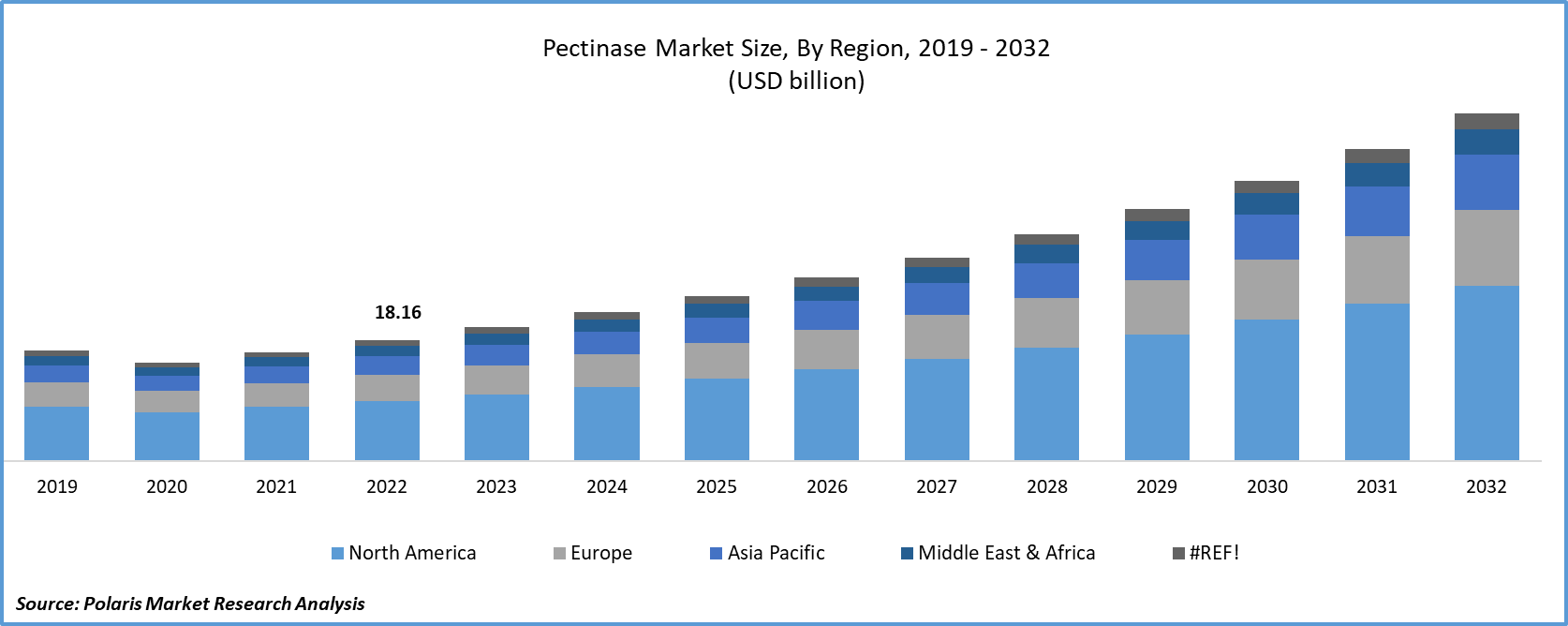
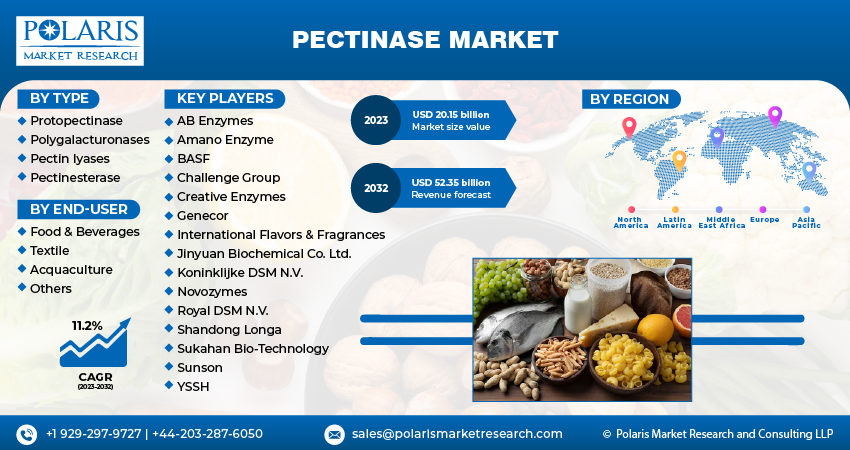
The global pectinase market size was valued at USD 24.81 billion in 2025 and is expected to register a CAGR of 11.2% from 2026 to 2034. Increasing use of pectinase in the food & beverage industry and surging demand for natural ingredients drive the market growth. The growing emphasis on sustainable processing technologies and rising regulatory support boost the industry growth.
Market Statistics
Key Takeaways
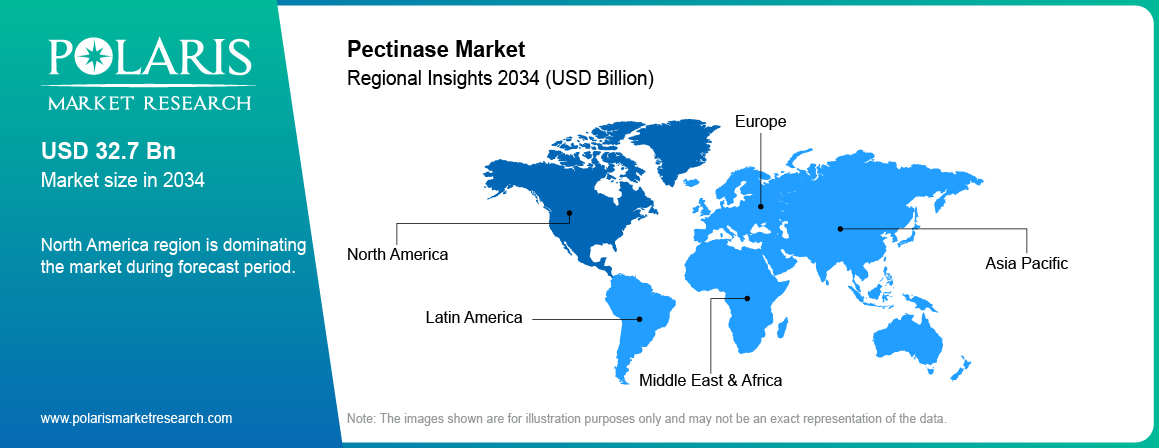
- North America led the global market revenue share of 49.88% in 2025. Surging number of health-conscious consumers and growing research and development activities to find product applications in the pharmaceutical industry drive the regional market dominance.
- The Asia Pacific pectinase market is expected to witness the highest CAGR of 12.4% during the forecast period. Rising product use in various industries including food processing, pharmaceutical, and textile boosts the regional growth. Also, growing adoption of pectinase as an environmentally-friendly alternative to various harmful or conventional enzymes fuels the growth.
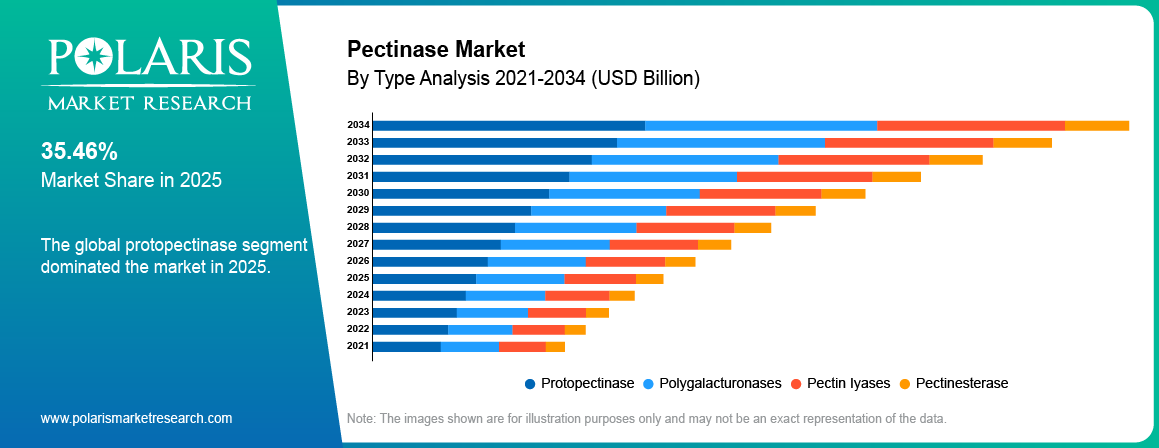
- The protopectinase segment dominated the pectinase market share with 35.78% in 2025. Increasing utilization of protopectinase in food processing and rising consumer preferences for natural products boost the segment dominance.
- The food & beverage segment held the largest market share of 42.29% in 2025. The leading position is driven by the expanding juice and beverage industry and the increasing wine production and consumption worldwide.
*Note: Figures and projections outlined in this report are the result of Polaris Market Research’s proprietary analytical processes, grounded in the latest available datasets and market observations.
Industry Dynamics
- Globalization of food trade and favorable regulatory policies are driving the global market growth.
- The expansion of processed fruit products and premium beverage manufacturing propels the demand for pectinase.
- Increasing emphasis on natural ingredient processing and industrial enzyme applications contributed to industry growth.
- Growing interest in sustainable processing technologies is expected to create lucrative opportunities in the coming years.
- Rising focus on ensuring formulation consistency across varying industrial conditions can hinder market penetration.
- In price-sensitive end-use markets, fluctuations in enzyme costs negatively influence procurement behavior. It limits adoption among smaller processors.
Source: Polaris Market Research Analysis
To Understand More About this Research:Download Sample Report
What is Pectinase?
Pectinase is a group of enzymes that break down pectic substances found in plant cell walls. These enzymes are essential for industrial processing. Manufacturers use them to improve extraction efficiency and enhance product clarity. Pectinase is also used to accelerate processing cycles and increase yield recovery. The rising significance of enzyme-based processing in the food, beverage, textile, and biotechnology industries boosts the commercial prospects for the global pectinase industry.
The food & beverage industry increasingly uses pectinase for various applications. Its applications include juice clarification, wine production, and fruit processing. This factor drives the market expansion. In the industry, pectinase is increasingly valued for improving filtration performance, reducing viscosity, increasing juice recovery, and supporting the production of cleaner-label products. The rising product utilization in the textile industry, especially for designing cotton fabrics and sourcing, propels the global market growth. In textile processing, the enzyme is gaining attention as an environmentally preferable alternative to harsher chemical treatments, especially in applications where manufacturers are under pressure to reduce water consumption and lower chemical intensity.
Pectinase enzyme types are used in various applications across the pharmaceutical and biotechnology sectors, including cell culture and drug production. Therefore, the need for new enzymes with advanced characteristics and features is projected to fuel market growth. Advances in enzyme engineering, fermentation technology, and bioprocess improvement support market growth. Manufacturers focus on developing customized pectinase solutions. They aim for these solutions to have improved thermal stability, substrate specificity, and operational efficiency. These features help end users boost production in specialized industrial settings.
The pectinase market is attracting growing commercial interest as industrial users seek enzyme-based processing solutions that improve productivity while aligning with sustainability goals. Demand is being shaped by the expansion of processed fruit products, premium beverage manufacturing, natural ingredient processing, and industrial biotechnology applications.
Many companies in the market have increased their focus and investments in developing customized enzyme solutions to meet specific customer needs. It basically involves customizing enzyme formulations to optimize processes in different industries such as food and beverage, textiles, agriculture, and others. The rising demand for customization is one of the emerging pectinase market trends. Customization is important in applications where processing conditions vary significantly by substrate, temperature, pH range, and production scale. As a result, enzyme suppliers offering application-specific formulations, technical support, and performance consistency would strengthen their competitive position in the coming years.
As per our pectinase industry analysis, the prices of enzymes, including pectinase, often change. Raw material availability, production costs, and market demand influence the costs. Additionally, enzymes face regulatory oversight. They must comply with labeling and safety rules set by government agencies. These factors are acting as major restraints for market growth. Supply chain volatility and variability in substrate availability are a few pectinase market restraints. The time required for regulatory approvals in food-contact and ingredient-sensitive applications also hinders the market growth.
Industry Dynamics
Pectinase Market Growth Drivers
Increasing Demand for Beverages and Refreshments: High-income and developed countries such as the U.S., Canada, and France are witnessing growing demand for products like beverages, refreshments, and nutraceuticals. Consumers are purchasing organic and natural products without any kind of synthetic or harmful substances. The role of pectinase in beverage processing extends beyond simple clarification. It helps processors improve extraction yield, enhance filtration efficiency, and support consistency in finished product quality. These performance benefits are particularly important in premium fruit and juice concentrates, wine processing, and functional beverage formulations where visual clarity and process efficiency directly affect commercial outcomes. Therefore, rising preference for refreshing and health-conscious beverages propels pectinase demand in beverages.
Globalization of Food Trade and Favorable Regulatory Policies: Food manufacturers are expanding into cross-border supply chains. There is a greater focus on processing technologies that improve shelf life, extraction efficiency, texture, and product standardization. Pectinase plays a key role in preserving and processing food products for international markets. Pectinase is especially used by companies that handle fruit-derived raw materials at scale. Rising emphasis on natural processing aids is expected to further support demand across global food trade networks. Further, the growing number of regulatory agencies are promoting the use of pectinase as a safe and natural food additive. Therefore, the exponential rise in the globalization of food trade and favorable regulatory policies fuels the demand for pectinase.
Opportunities
Growing Emphasis on Sustainable Processing Technologies : Introduction of eco-friendly enzyme solutions can reduce dependence on harmful chemicals. It can improve raw material utilization and lower waste in several industrial workflows. This makes pectinase increasingly relevant to manufacturers seeking to improve operational efficiency and environmental performance simultaneously. Therefore, rising interest in sustainable processing enzymes is expected to create lucrative pectinase market opportunities during the forecast period.
Development of Application-Specific Pectinase: End users are increasingly seeking tailored pectinase solutions. These solutions are suitable for fruit type, process stage, operating temperature, and output quality targets. Suppliers that can pair product performance with technical advisory support are likely to benefit from stronger long-term demand. Thus, the development of high-performance, application-specific enzyme blends are projected to create numerous opportunities in the coming years.
Source: Polaris Market Research Analysis
Segmentation Analysis
By Type Analysis
Market for pectinase, by type, is segmented into protopectinases, polygalacturonases, pectin lyases, and pectinesterase. The protopectinase segment held the largest share in 2025. Protopectinase supports the conversion of insoluble pectic substances into more processable forms. Thus, it remains commercially attractive. It is useful in fruit and vegetable processing applications. Its relevance is particularly high in operations where extraction efficiency, texture management, and downstream processing performance are critical. Segment growth is attributed to the surging enzyme demand in food processing. There is growing consumer interest in natural products without chemical additives. This factor drives the demand for protopectinase. Research and development in enzyme technology lead to new enzyme variants, including protopectinase. These discoveries provide better properties and efficiency. They create more revenue opportunities for companies that develop innovative enzyme solutions.
The polygalacturonases segment is expected to register a significant growth rate in the coming years. Polygalacturonases can hydrolyze pectic chains. This makes it important for applications such as juice processing, maceration, and improving extraction. Pectin lyases are useful in depectinization processes where manufacturers require improved clarification and reduced viscosity under suitable process conditions. Pectinesterase plays an important role in modifying pectin structure and can be relevant in formulations where texture, stability, and process behavior need to be carefully managed.
By End-Use Industry Analysis
The food & beverage segment dominated the market share in 2025. In food and beverage processing, pectinase supports several commercially valuable outcomes. It is used to improve juice yield, produce clearer beverages, enable smoother processing, and achieve better filtration performance. Pectinase is increasingly used in fruit juices and wine. It is also used in jam and jelly production, fruit pulp handling, and selected specialty beverage applications where processing efficiency and product quality are closely linked. The leading segment share is majorly driven by the continuous expansion of juice and beverage industry. Increasing number of consumers seek healthier beverage options, driving the segment growth. With the increasing wine production and consumption worldwide, the need for pectinase is growing rapidly. It is being widely used for the maceration and clarification of grapes.
The textile segment is anticipated to register the highest CAGR during the forecast period. Pectinase in textile industry offers an eco-friendly alternative to traditional chemical processes. It also helps reduce the use of water and harsh chemical. Thus, there is a growing adoption of pectinase in textile industry.
Source: Polaris Market Research Analysis
Regional Insights
North America dominated the global pectinase industry in 2025. Surge in the number of health-conscious consumers leads to higher adoption of fruit-based or plant-based food products. North America is witnessing growing R&D activities to find product applications in the pharmaceutical industry for the extraction of active compounds from plant materials. Apart from this, the robust presence of global leading producers and suppliers in the region contributed to the North America pectinase market expansion. The market growth is also propelled by increased focus on developing new product applications with higher investments. North America continues to represent a strong market for pectinase due to its mature food processing ecosystem and established industrial biotechnology base. Further, strong demand for premium beverages, natural ingredient processing, and productivity-enhancing enzyme solutions fuel the market growth. The region also benefits from the presence of advanced manufacturing, well-developed distribution channels, and strong adoption of value-added food processing technologies.
The Asia Pacific pectinase market is expected to register the highest CAGR during the forecast period. Rising pectinase use in various industries, including food processing, pharmaceutical, and textile, drives the regional market growth. The growing adoption of pectinase as an environmentally-friendly alternative to various harmful or conventional enzymes will also boost the growth. In addition, the rapid increase in wine consumption propels the pectinase demand across the region. Changing consumer dietary preferences toward healthier and plant-based products in countries like India, China, and Indonesia would also create lucrative opportunities for the regional market over the years. Asia Pacific is likely to gain from industrial growth, rising processed food consumption, stronger beverage manufacturing, and increasing awareness of enzyme-assisted processing. As local manufacturers expand operations and look for more efficient processing aids, pectinase is expected to be used in established and new industrial applications.
Europe remains an important market due to its established wine industry and advanced food processing standards. Also, increasing emphasis on natural and sustainable ingredient systems contributes to the Europe pectinase market penetration. Pectinase demand in Europe is also supported by ongoing innovation in enzyme applications, particularly in beverage processing and selected industrial uses. However, Latin America and the Middle East & Africa are expected to offer selective opportunities over the forecast period. While these regions represent a smaller share of total revenue. They can benefit from rising food processing activities and improving industrial pectinase uses. These region will witness gradual expansion of enzyme-based processing solutions in niche applications during the forecast period.
Source: Polaris Market Research Analysis
Key Market Players & Competitive Insights
The pectinase industry is highly competitive with the presence of several regional and global market players. Pectinase companies are extensively focusing on several business development strategies, including collaboration, partnerships, acquisition, new product launches, and production capacity expansion. These strategies help them expand their market reach and fulfil growing product demand. Market competition is focused on formulation performance and the ability to serve different end-use industries. Leading pectinase manufacturers focus on customizing their products for specific applications and improving production efficiency. Major pectinase companies have strong research and development skills along with fermentation expertise. They also provide technical service support. This helps them meet the needs of customers who want reliable processes and clear improvements in output. Strategic partnerships and acquisitions will be important as pectinase suppliers expand their enzyme offerings and increase their presence in different industries.
List of Market Players
- AB Enzymes
- Amano Enzyme
- BASF
- Challenge Group
- Creative Enzymes
- Genecor
- International Flavors & Fragrances
- Jinyuan Biochemical Co. Ltd.
- Koninklijke DSM N.V.
- Novonesis
- Royal DSM N.V.
- Shandong Longa
- Sukahan Bio-Technology
- Sunson
- YSSH
Pectinase Industry Recent Developments
- September 2024: Constructive Bio raised USD 58 million in a Series A round bringing total funding to USD 75 million to develop its BioForge fermentation platform for production of peptide therapeutics with non canonical amino acids (ncAAs). (Source: constructivebio.com)
Pectinase Market Report Scope
The pectinase industry report offers an in-depth assessment of the global market. The market is segmented on the basis of type, form, functionality, end-use industry, and region. It evaluates growth drivers, emerging opportunities, restraints, competitive developments, and regional and segmental analysis. The report provides detailed market forecasts and strategic insights. It is intended to support business planning, investment assessment, and competitive benchmarking.
Pectinase Market Segmentation
By Type Outlook (Revenue – USD Billion, 2021–2034)
- Protopectinases
- Polygalacturonases
- Pectin Lyases
- Pectinesterase
By Form Outlook (Revenue – USD Billion, 2021–2034)
- Powder
- Liquid
- Granular
By Functionality Outlook (Revenue – USD Billion, 2021–2034)
- Clarification
- Stabilization
- Depectinization
By End-Use Industry Outlook (Revenue – USD Billion, 2021–2034)
- Food & Beverage
- Textile
- Aquaculture
- Paper
- Others
By Regional Outlook (Revenue – USD Billion, 2021–2034)
- North America
- U.S.
- Canada
- Europe
- Germany
- UK
- France
- Italy
- Spain
- Russia
- Netherlands
- Rest of Europe
- Asia Pacific
- China
- India
- Japan
- South Korea
- Indonesia
- Malaysia
- Rest of Asia Pacific
- Latin America
- Argentina
- Brazil
- Mexico
- Rest of Latin America
- Middle East & Africa
- UAE
- Saudi Arabia
- Israel
- South Africa
- Rest of Middle East & Africa
Pectinase Market Report Scope
| Report Attributes | Details |
| Market Size in 2025 | USD 24.81 Billion |
| Market Size in 2026 | USD 27.54 Billion |
| Revenue Forecast by 2034 | USD 64.56 Billion |
| CAGR | 11.2% from 2026–2034 |
| Base Year | 2025 |
| Historical Data | 2021–2034 |
| Forecast Period | 2026–2034 |
| Quantitative Units | Revenue in USD billion and CAGR from 2026 to 2034 |
| Report Coverage | Revenue Forecast, Market Competitive Landscape, Growth Factors, and Trends |
| Segments Covered |
|
| Regional Scope |
|
| Competitive Landscape |
|
| Report Format | PDF + Excel |
| Customization | Report customization as per your requirements with respect to countries, regions, and segmentation. |
Source: Polaris Market Research Analysis
Pectinase Market FAQ's
The market was valued at USD 24.81 billion in 2025. It is projected to reach USD 64.56 billion by 2034, registering a CAGR of 11.2% during 2026–2034.
Food processing and beverage production are the primary end users. In these industries, pectinase is widely used in fruit juice extraction, jam manufacturing, and wine clarification.
Key restraints include raw material cost fluctuations and stringent regulatory requirements. Also, supply chain disruptions and the need to maintain consistent enzyme performance across industrial applications hinder the growth.
North America held the largest market share in 2025. However, the market in Asia Pacific would register the highest CAGR during 2026–2034. It is driven by the rising food & beverage demand across Asia Pacific.
The protopectinase segment accounted for the largest market share in 2025. Growing use of protopectinase in food processing supports its leading position. Its ability to break down pectin in fruits and vegetables also helped its dominance.
Protopectinase is associated with converting insoluble pectic substances into more processable forms. However, polygalacturonase hydrolyzes pectic chains. It supports breakdown during extraction and clarification.
Beyond food, pectinase is increasingly used in textile bioscouring and paper pulp treatment. It also finds applications in biofuel production from agricultural waste and pharmaceutical drug delivery formulations.
Different substrates and operating conditions require different enzyme properties. Tailored formulations help improve performance under specific pH, temperature, and production conditions.
Pectinase products used in food-related applications must comply with labeling, safety, and regulatory standards. Compliance process is complex and time-consuming. Thus, it affects time to market and increases compliance costs.
AB Enzymes, Amano Enzyme, BASF, Challenge Group, Creative Enzymes, Genecor, International Flavors & Fragrances, Jinyuan Biochemical Co. Ltd., Koninklijke DSM N.V., Novozymes, Royal DSM N.V., Shandong Longa, Sukahan Bio-Technology, Sunson, and YSSH are among the key market players. The companies compete through innovation, acquisitions, and enzyme portfolio expansion.
Download Sample Report of Pectinase Market
Please fill out the form to request a customized copy of the research report.


