
People Counting System Market Size, and Global Outlook 2026-2034
REPORT DETAILS
People Counting Systems Market Summary
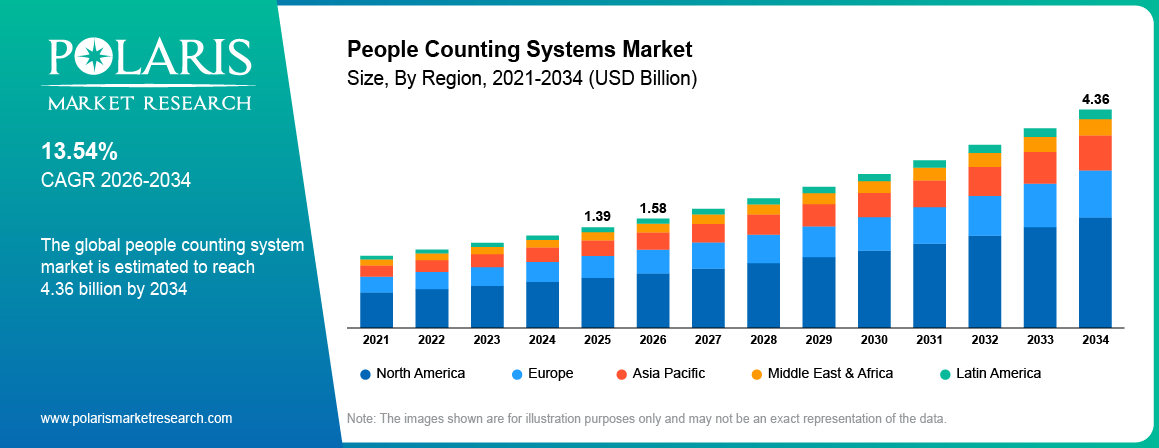
The global people counting systems market is estimated around USD 1.39 Billion in 2025, with consistent growth anticipated during 2026–2034. Growth is driven by rising demand for real-time occupancy monitoring and increasing adoption of smart infrastructure across global commercial and public spaces. The market is projected to grow at a CAGR of 13.54% during the forecast period.
Market Statistics
Key Takeaways:
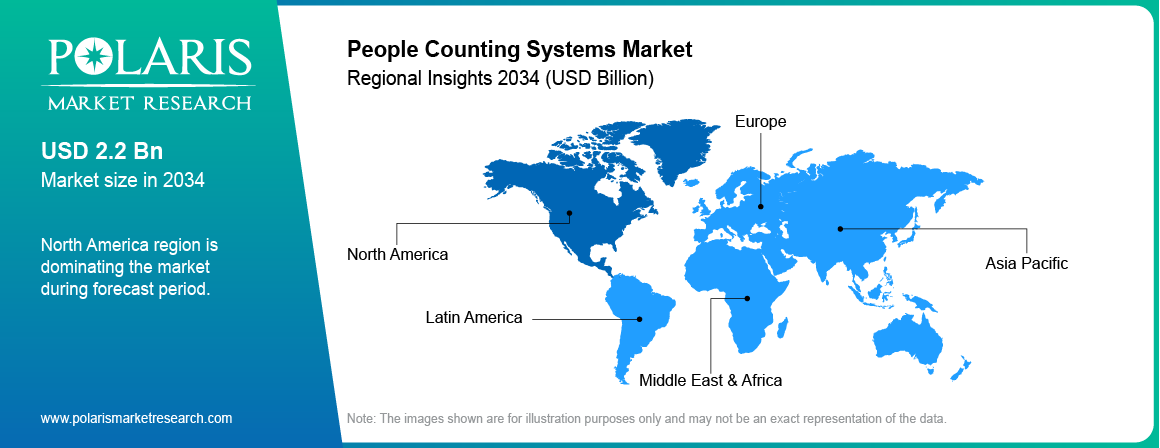
- North America people counting systems market dominated in 2025, accounting for approximately 39.80% market share.
- Asia Pacific people counting systems market is projected to grow at the fastest rate, registering a CAGR of approximately 13.65%.
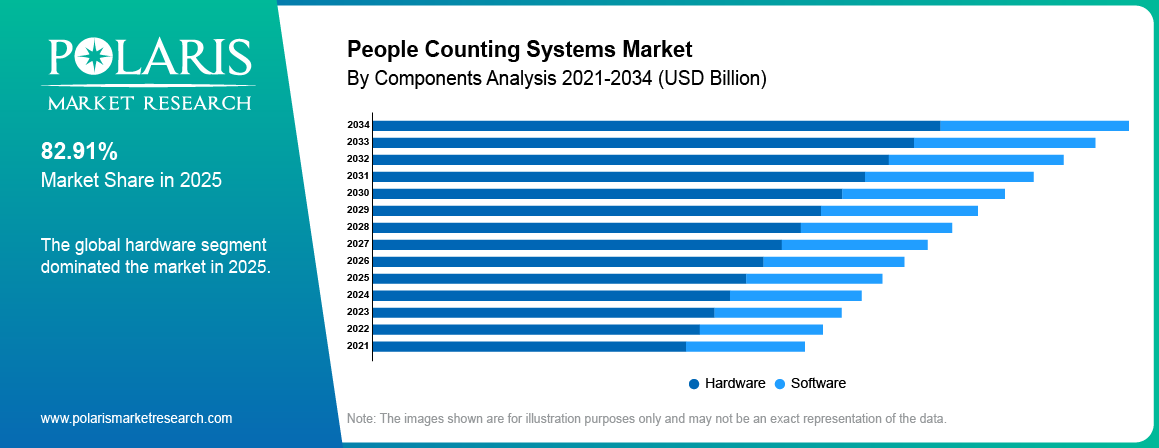
- Hardware segment accounted for the largest share of the market, holding approximately 37.25%.
- The IoT infrastructure segment was dominant in the market in 2025, contributing approximately 35.60% market share.
- The retail segment accounted for the largest share of the market in 2025, accounting for approximately 33.90%.
Industry Dynamics
- Growing application in retail and logistics is boosting the need for footfall analysis.
- There is a rise in the number of intelligent buildings and the IoT platforms, leading to the need for integration.
- Problems concerning data security have become obstacles in the implementation of video solutions.
- Advancements in AI and edge computing are creating long-term growth opportunities in the people counting systems market.
What is the People Counting Systems Market?
People counter systems or footfall counting systems refer to the technology that enables companies to track and analyze the numbers of people moving in and out of a particular area. Sensor and camera technology may be included in such systems, along with the analysis tools required for reliable measurements in real-time as well as through history. This is in contrast to generic surveillance systems, which concentrate on security as opposed to numerical occupancies.
The industry operates within a broader smart infrastructure and analytics ecosystem that focuses on accuracy, privacy compliance, and real-time insights. The need for advanced counting systems has grown as a result of strict regulations concerning occupancy management and safety. Manufacturers focus on enhancing the precision of counting and integrating artificial intelligence into their systems. The people counting systems industry meet with regulatory requirements and enterprise analytics needs.
Source: Polaris Market Research Analysis
To Understand More About this Research:Download Sample Report
The need for people counting systems is on an uptick owing to the increasing implementation of retail analytics and smart cities. Increased installations within transport centers and commercial facilities are aiding the adoption of people counting solutions. Digital transformation programs have been implemented in various sectors, contributing to sustained demand for such systems.
Drivers & Opportunities
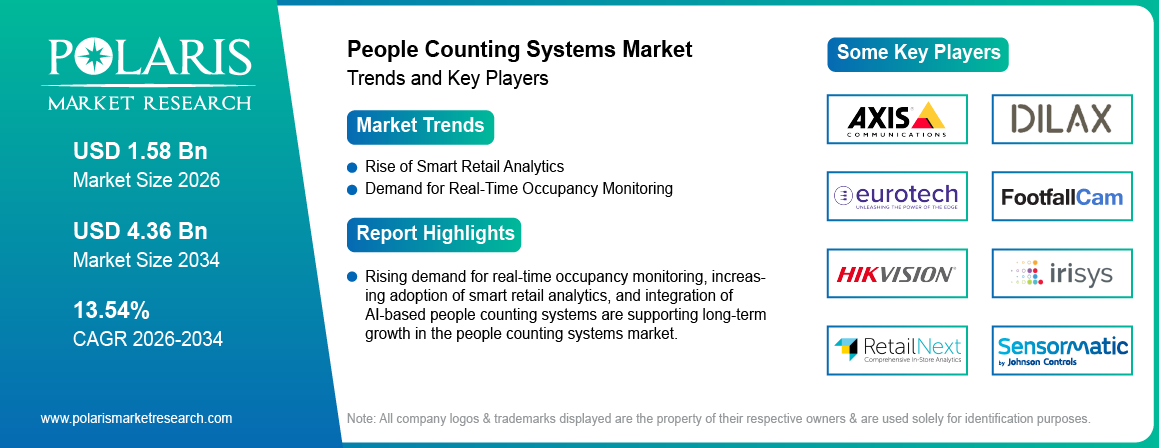
Rise of Smart Retail Analytics: The rise in the use of analytics applications within the retail industry has led to an increased need for people counters in order to measure customers’ movements and the performance of their stores. Companies are applying the information gathered from customer traffic to improve store designs and merchandise positioning. Combining it with POS and CRM systems has enhanced decision-making effectiveness. In July 2025, Visionarea introduced intelligent people counters with embedded AI capabilities, which offer real-time and precise occupancy insights. This trend is supporting steady growth in retail-focused deployments.
Demand for Real-Time Occupancy Monitoring: Increased emphasis on safety and the utilization of space has created a rising demand for the deployment of real-time occupancy monitoring systems. The application of people counters has increased due to the fact that such systems are capable of providing real-time data, which can help in monitoring and optimizing energy consumption and the utilization of space.
Restraints & Challenges
Privacy Concerns in Video-Based Systems: The issue of data privacy is holding back the adoption of camera-based people counter systems. There are many regulations on personal data protection which are affecting the compliance level of system providers. Infrared cameras and sensors are some of the popular choices among consumers. It has been identified as one of the major challenges in the deployment of people counting technology.
Opportunity
AI & Predictive Analytics Opportunities: Artificial Intelligence and advanced analytics are improving the capacity of people counter systems to provide more predictive insights. Predictive analytics helps in forecasting demand and analyzing crowd movement and behavior, which helps in making plans. For instance, in May 2025, Groundlight developed a Counting Mode function that leverages visual artificial intelligence technology to count objects in real time without requiring an understanding of machine learning. It becomes very easy for businesses to deploy this solution immediately after installing the software.
Technology & Solution Landscape
Types of People Counting Technologies
People counting technology is categorized into several types, including infrared people counting technology, thermal people counting technology, video people counting technology, and 3D people counting technology. The following are some types:
-
Infrared People Counting Systems
Infrared technology makes use of beam interruption in order to determine entry and exit. Other than being relatively affordable, infrared people counting technology is also highly reliable. But the level of accuracy and risk to privacy is still moderately high.
-
Thermal People Counting Systems
Thermal sensors detect heat signatures, increasing the accuracy of counting in dimly lit areas and crowded places. These types of systems have sufficient privacy compliance and better performance than the infrared people counter systems in such conditions.
-
Video-Based People Counting Systems
The Video-based system uses artificial intelligence and computer vision for high levels of accuracy and advanced analytics including behavioral analysis. The privacy issues are more associated as images have to be captured and stored.
-
3D People Counting Technology
3D systems leverage time-of-flight sensors to provide accurate results in crowded areas by separating humans from other items. The accuracy provided is less prone to errors, and privacy risks are comparatively lower.
Software vs Hardware vs Cloud-Based Solutions
The approaches for people counting include hardware tools, people counting software tools, and cloud-based applications. Hardware tools include sensors, cameras, and other tools that help in gathering real-time information about people at various checkpoints. The software tools help in analyzing the collected data. While cloud-based applications have increased the scope of scalability, remote access, and multi-location analytics.
Integration with AI, IoT, and Smart Systems
AI-based people counting technologies can increase the accuracy of people counting by making use of advanced algorithms for pattern recognition and behavior analysis. The Internet of Things (IoT)-based people counting technology helps in sharing real-time information between various devices. These technologies improve predictive capabilities and expand use cases across retail, transportation, and commercial infrastructure.
Source: Polaris Market Research Analysis
Segmental Insights
This report offers detailed coverage of the people counting systems market by components, integration ecosystem, and end-use industry to help readers identify the fastest expanding and most attractive demand segments.
By Components
-
Hardware
Hardware segment accounted for the largest share of the market in 2025, driven by high deployment of sensors and cameras across retail and infrastructure facilities. The increase in the use of physical devices for real-time data collection will aid in segment dominance.
-
Software
The software segment is expected to exhibit the highest CAGR throughout the forecast period, owing to growing demands for real-time analytics as well as cloud computing platforms. The growing trend towards making decisions based on data has led to the adoption of smart people counting software.
By Integration Ecosystem
-
IoT Infrastructure
The IoT infrastructure segment was dominant in the market in 2025, aided by growing integration of IoT-connected devices in smart cities and buildings. Growing installations of IoT-based technologies are aiding seamless data capture and real-time monitoring.
-
CRM Platforms
The IoT infrastructure segment was dominant in the market in 2025, aided by growing integration of IoT-connected devices in smart cities and buildings. Growing installations of IoT-based technologies are aiding seamless data capture and real-time monitoring.
By End-Use Industry
-
Retail
The retail segment accounted for the largest share of the market in 2025 owing to growing utilization of in-store analytics to enhance the efficiency of stores and customer experience. Growing demand for footfall analysis is aiding the adoption among retail chains.
-
Smart Buildings
Smart buildings segment is projected to grow at the fastest CAGR during the forecast period, driven by increasing focus on energy efficiency and space utilization. Rising adoption of intelligent infrastructure is supporting demand for occupancy monitoring systems.
Source: Polaris Market Research Analysis
Regional Analysis
North America Market Assessment
North America people counting systems market dominated in 2025, driven by high adoption of retail analytics and advanced surveillance technologies. Strong presence of large retail chains is Growing number of large retail chain stores has increased the demand for AI-driven people counting systems to optimize store performance and gain insights into customers. The presence of intelligent infrastructure and security measures introduced by the government has enabled the successful integration of such solutions in transport hubs and offices. The increasing deployment of Internet of Things technologies within buildings and infrastructure has further contributed to the acceptance of real-time people counting solutions. In October 2024, Density announced the launch of self-installation radar sensors that can be installed quickly and operate in real-time without any interruptions.
Asia Pacific People Counting Systems Market Insights
Asia Pacific people counting systems market is projected to grow at the fastest rate, driven by rapid urbanization and expansion of smart city projects. Smart cities like China and India have been focusing on analytics and infrastructure development, which has helped in deploying people counting systems. For instance, Under India’s Union Budget 2024–25, the Smart Cities Mission received USD 19.67 billion. Around 7,502 out of the total number of projects (93%) had been completed, while only 560 projects (7%) were still under implementation.
Europe People Counting Systems Market Overview
Europe was the second-largest market for people counting systems, thanks to high-level privacy protection laws as well as a rising need for technology that complies with these rules. The uptake of thermal and infrared people counting systems is on the rise due to the relatively low level of privacy concerns associated with their use. The smart city analytics projects are carried out in various countries including Germany and France have helped foster adoption in urban infrastructure development projects. There is an increase in modernization of retail establishments and transportation infrastructure that will aid demand for accurate footfall analytics products.
Source: Polaris Market Research Analysis
Competitive Landscape & Future Outlook
Key People Counting Systems Companies
The business environment in which the people counter systems function is characterized by high customer expectations concerning data analytics and smart infrastructure. The leading players in the people counter system industry focus on leveraging AI-driven people counter systems and cloud technology to improve the functionality of the system. Companies engaged in occupancy analytics are performing well in the retail, transport, and smart buildings domains.
The main companies operating in the industry are Axis Communications, Hangzhou Hikvision Digital Technology Co., Ltd., Teledyne FLIR LLC, RetailNext, Inc, Sensormatic Solutions, V-Count, Xovis AG, InfraRed Integrated Systems Ltd, Eurotech S.p.A., DILAX Intelcom GmbH, FootfallCam, ShopperTrak Analytics, and others.
Market Positioning & Competitive Strategies
The vendors of footfall analytics solutions are increasingly forming strategic partnerships with retail establishments and infrastructure providers in order to ensure a steady flow of income. The companies are developing advanced algorithms based on artificial intelligence for improved performance and predictive analysis. The suppliers of these services have come up with new strategies designed to increase their reach across the globe through IoT integration and building management systems integration.
Future Outlook
The future of people counter systems is bright owing to the rising popularity of smart cities and advanced real-time occupancy systems. Adoption of predictive analytics platforms is expected to enhance efficiency and elevate customer experience. The development of the sector will rely on advancements in AI, edge computing, and privacy regulations. Vendors that focus on scalability and interoperability will have an upper hand.
Key Players
- Axis Communications
- DILAX Intelcom GmbH
- Eurotech S.p.A.
- FootfallCam
- Hangzhou Hikvision Digital Technology Co., Ltd.
- InfraRed Integrated Systems Ltd
- RetailNext, Inc
- Sensormatic Solutions
- ShopperTrak Analytics
- Teledyne FLIR LLC
- V-Count
- Xovis AG
Industry Developments
- January 2026: AIStorm addresses key people counting challenges through edge AI by embedding intelligence directly into sensors, enabling accurate real-time tracking while reducing latency, power consumption, and system complexity. [Source:www.htrnews.com]
- November 2025: Eurotech’s PCN systems use edge technology to deliver accurate real-time passenger data and improve operational efficiency. [Source: www.eurotech.com]
People Counting Systems Market Segmentation
By Components Outlook (Revenue, USD Billion, 2021-2034)
- Hardware
- Thermal Cameras
- Infrared Sensors
- Fixed Cameras
- Fixed Dome Cameras
- Pan-Tilt-Zoom Cameras
- Software
- Services
By Integration Ecosystem Outlook (Revenue, USD Billion, 2021-2034)
- POS systems
- CRM platforms
- Building Management Systems (BMS)
- IoT infrastructure
By End-Use Industry Outlook (Revenue, USD Billion, 2021-2034)
- Retail
- Transportation
- Smart Buildings
- Healthcare
- Hospitality & Events
By Regional Outlook (Revenue, USD Billion, 2021-2034)
- North America
- US
- Canada
- Europe
- Germany
- France
- UK
- Italy
- Spain
- Netherlands
- Russia
- Rest of Europe
- Asia Pacific
- China
- Japan
- India
- Malaysia
- South Korea
- Indonesia
- Australia
- Vietnam
- Rest of Asia Pacific
- Middle East & Africa
- Saudi Arabia
- UAE
- Israel
- South Africa
- Rest of Middle East & Africa
- Latin America
- Mexico
- Brazil
- Argentina
- Rest of Latin America
People Counting Systems Market Report Scope
| Report Attributes | Details |
| Market Size in 2025 | USD 1.39 Billion |
| Market Size in 2026 | USD 1.58 Billion |
| Revenue Forecast by 2034 | USD 4.36 Billion |
| CAGR | 13.54% from 2026 to 2034 |
| Base Year | 2025 |
| Historical Data | 2021–2024 |
| Forecast Period | 2026–2034 |
| Quantitative Units | Revenue in USD Billion and CAGR from 2026 to 2034 |
| Report Coverage | Revenue Forecast, Competitive Landscape, Growth Factors, and Industry Trends |
| Segments Covered |
|
| Regional Scope |
|
| Competitive Landscape |
|
| Report Format |
|
| Customization | Report customization as per your requirements with respect to countries, regions, and segmentation. |
Source: Polaris Market Research Analysis
People Counting System Market FAQ's
The global market size was valued at USD 1.39 Billion in 2025 and is projected to grow to USD 4.36 Billion by 2034.
North America dominates the market, driven by high adoption of retail analytics and smart infrastructure technologies.
Major applications include retail analytics, transportation hubs, smart buildings, crowd management, and occupancy monitoring.
A few of the key players in the market are Axis Communications, Hangzhou Hikvision Digital Technology Co., Ltd., Teledyne FLIR LLC, RetailNext, Inc, Sensormatic Solutions, V-Count, Xovis AG, InfraRed Integrated Systems Ltd, Eurotech S.p.A., DILAX Intelcom GmbH, FootfallCam, ShopperTrak Analytics, and others.
Key drivers include rising demand for real-time occupancy data, growth in smart city projects, and increasing adoption of AI-based analytics.
Major demand comes from retail, transportation, commercial real estate, healthcare, and hospitality sectors.
The market outlook remains strong due to growth in predictive footfall analytics and increasing integration with IoT and smart systems.
Download Sample Report of People Counting System Market
Please fill out the form to request a customized copy of the research report.


