
Process Mining Software Market Size, Share, Trends, Industry Analysis Report, 2026 - 2034
REPORT DETAILS
Process Mining Software Market Summary
The global process mining software market size was valued at USD 1.93 billion in 2025. The market is projected to grow at a CAGR of 56.1% during 2026 to 2034. Key market demand drivers include widespread digital transformation initiatives, an emerging need for process optimization and efficiency, and increased regulatory compliance.
Market Statistics
Key Takeaways
- The BFSI segment held the largest revenue share in 2025. BFSI processing mining is also expected to retain its dominance during the projection period. This is due to fierce competition among global banking and financial service companies.
- The on-premise segment is projected to grow at a robust pace in the coming years. This is due to the need to enhance data security and control over critical business data.
- The Europe process mining software market held the largest revenue share in 2025, owing to high adoption of digital and automation tools.
- Asia Pacific is expected to witness the fastest CAGR in the global market during the forecast period. This is due to the growing requirement among businesses to improve process audits and compliance.
The BFSI process mining software implementation is due to a high volume of transactions, regulatory compliance needs, and process cycle time reductions in processes like onboarding, KYC, loan origination, and claims. Cloud deployment is further enhanced by process mining implementation ease, connector availability, and multi-entity support.
Process mining software analyzes event log data generated by enterprise systems such as ERP, CRM, ITSM, and finance apps to understand and improve real business processes. Some features include process discovery, conformance checking, and performance analysis to identify inefficiencies. For this study, the market definition includes process mining platforms and services. Adjacent categories, such as BPM suites and RPA solutions, are considered only when they directly enable process mining outcomes.
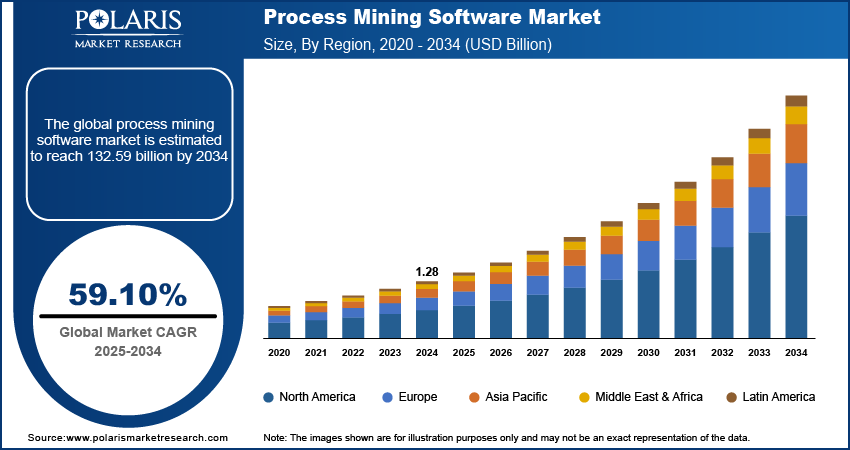
Source: Polaris Market Research Analysis
To Understand More About this Research:Download Sample Report
Forecast growth reflects accelerating enterprise adoption, deeper integration with automation technologies, and expanding use across shared services and compliance-driven functions as organizations focus on efficiency, transparency, and process control.
AI Impact on Process Mining Software Market
- AI process mining software helps organizations quickly identify issues, understand their root causes, and put measures in place to minimize time, rework, and associated risks.
- AI features support continuous conformance monitoring, including faster issue triage via natural language.
- With increased usage, emphasis is placed on process mining data governance and access controls. There is also a focus on data protection, which often involves protecting data from events that could expose sensitive operations and customer data.
The process mining software market is in high demand due to the growing need to improve enterprises' audits and compliance processes. These software are also being driven by increased use of cloud solutions and services, digital transformation projects, and a growing awareness among enterprises of the need to understand and analyze business activities. For instance, digital transformation usually has three effects on businesses: a change in the business model, a change in the product and service offering, and a shift in the value chain. Enterprises are being prompted to assess existing practices to make necessary adjustments to improve productivity and the customer experience as a result of digital transformation.
Process mining platforms analyze event logs related to processes such as ERP, CRM, and IT service management. Such an analysis helps organizations map actual processes, identify bottlenecks, and measure alignment with specified process standards. Process mining allows companies to focus on processes where changes can have the greatest impact on overall functions, such as order-to-cash, procure-to-pay, and record-to-report.
As a result, an organization's focus switches to process mining to optimize existing data-focused studies to provide real-time updates on their progress. The major players' initiatives in the process mining software market are also boosting the growth during the forecast period. For instance, in March 2021, SAP SE announced the completion of its acquisition of Signavio. The partnership integrated Signavio's process transformation suite into SAP's Business Process Intelligence (BPI) portfolio. SAP Signavio process mining provides end users with a 360-degree view of every business through standardized process mining, behavioral mining, KPIs, benchmarking data, and customer experience analysis.
Also, in September 2021, People Tech Group (PTG), a cloud, data, and AI transformation and engineering services company, and UiPath, a leading enterprise automation application company, announced the launch of a Robotic process automation (RPA) services capability for organizations looking to increase efficiency through enterprise automation applications.
PTG can now provide its customers across the world with the UiPath automation platform and proactive, ongoing service and support to help them with their digital transformation efforts. Thus, the key players' collaborations, M&A, partnerships, and advanced technology product launches have propelled the market growth. However, companies in emerging markets still use sticky notes and interviews as part of their typical process mining application. This traditional approach is sometimes criticized for being unduly subjective, and it is received with justified mistrust.
Apart from this, the vendors are differentiating themselves by offering pre-built connectors, packaged industry accelerators, and AI-assisted insights to minimize implementation effort and time to value. In addition, market players are strengthening their ecosystem engagement with system integrators to support enterprise-scale solutions, governance, and value realization.
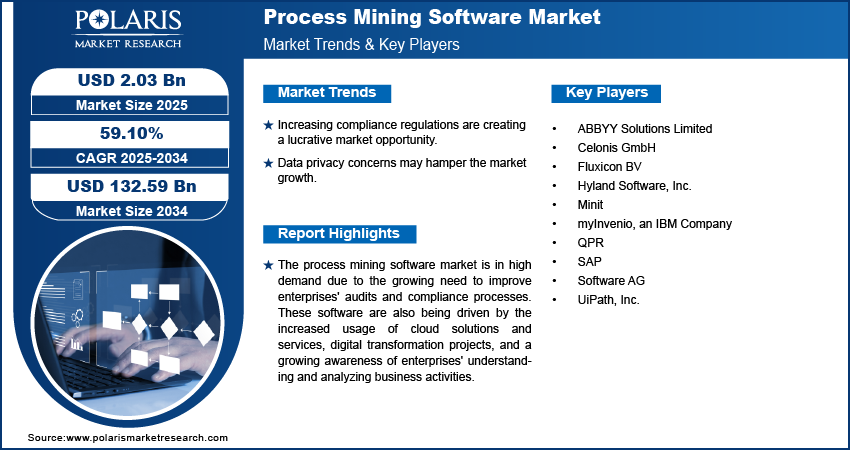
Source: Polaris Market Research Analysis
Industry Dynamics
Growth Drivers
The process mining software market has witnessed significant developments in recent years, driven by the combination of process mining and RPA applications and the growing adoption of technology-based applications. With automation, businesses across industries are moving toward digital transformation. They're looking for technology that can help them increase productivity while lowering investment costs.
The demand for RPA to improve performance and productivity is growing rapidly as a result of this expansion. Companies are dependent on digital systems to automate both back-end and front-end activities. Adoption of RPA solutions continues as businesses seek opportunities to standardize hybrid work environments, implement shared services, and develop sustainable and quantifiable efficiency initiatives. This is facilitated through process mining, as it can identify high-value automation opportunities and measure performance to prevent changes to processes.
Furthermore, businesses are also integrating RPA with such services to optimize the impact of automation. Throughout the RPA mining application, the software can provide crucial insights such as strategy planning, essential upgrades, new ideas, and others. Human-driven and information technology-based data-driven business processes can benefit from the integrated solution. It performs RPA analysis and monitoring to enable future improvements. As a result, businesses turn to process mining automation to acquire real-time data and analysis.
For instance, in February 2021, Software AG partnered with Automation Anywhere to make scalable automation more accessible to a wide range of enterprises. The partnership integrated Automation Anywhere RPA with Software AG's ARIS platform. This makes it easier to find automation potential and maintain automated operations. Automation Anywhere is a pioneer in RPA technology, which has seen a major surge in demand in the last year as businesses want to improve efficiency and cut costs. Thus, the adoption of advanced technology in mining applications and major players' contributions to developing mining software are expected to boost market growth during the forecast period.
Report Segmentation
Insight by Industry Vertical
Based on industry vertical, the BFSI segment held the largest revenue share in the global process mining software market in 2025 and is expected to retain its dominance in the foreseen period. This segment's prominence can be attributed to high competition among global banking and financial service companies and their efforts to improve client experience and provide better services. Furthermore, due to budget constraints, BFSI firms are shifting their focus to both robust and cost-effective solutions, driving increased demand across the mining software market. Also, banks and financial services firms strive to improve the customer experience and provide better services, prompting them to use process mining software.
Insights by Deployment
By deployment, the on-premise segment is expected to account for a significant CAGR during the forecast period. This growth can be attributed to factors such as the need to enhance data security and control over critical business data. Deployment in the on-premise segment is also expected to grow in large firms, especially those in highly regulated environments. This deployment helps firms customize the software to their needs. They can also experience control over the infrastructure. Furthermore, on-premises solutions can be deployed in environments with limited internet connectivity.
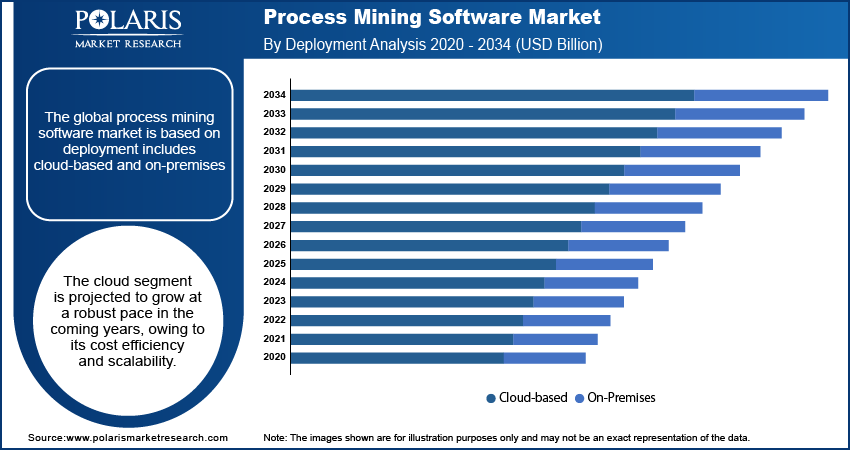
Source: Polaris Market Research Analysis
Geographical Overview
In terms of geography, Europe had the largest revenue share in 2025. The region is among the first to adopt advanced technologies and has the highest adoption of digital and automation tools and services. With automation, numerous sectors are undergoing a digital transition. These industries are always on the lookout for innovative ideas that can help them increase efficiency while lowering investment costs. Thus, adoption of solutions such as process mining software has increased in the region.
Moreover, the Asia Pacific process mining software market is expected to witness the fastest CAGR growth in the global market. This is due to the growing requirement among businesses to improve process audits and compliance. Growing cloud infrastructure spending by large, small, and medium businesses, as well as the creation of many startups, is also driving the regional market forward.
Data readiness gaps, lack of system integration, and budget prioritization restrain the adoption in certain parts of the region. This forces several organizations to stick to old manual process documentation. But at the same time, this presents opportunities for phased adoption through cloud deployments and targeted high-ROI use cases.
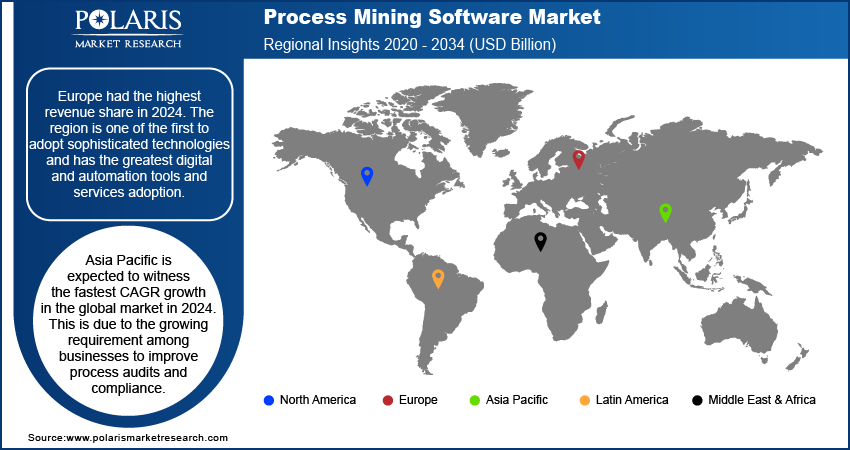
Source: Polaris Market Research Analysis
Competitive Insights
Competition in the process mining software market is growing. This is due to both global leaders and niche providers competing. Process mining vendors are choosing AI features, automation, and cloud deployment to meet the changing needs of enterprises. Many are also choosing partnerships or acquiring smaller firms to strengthen their offerings. Process mining software companies such as Celonis, Software AG, UiPath, and ABBYY continue to lead the space. They focus on scalability and tailored solutions for different industries. Some of the major players operating in the global market include ABBYY Solutions Limited, Celonis GmbH, Fluxicon BV, Hyland Software, Inc., Minit, myInvenio, an IBM Company, QPR, SAP, Software AG, and UiPath, Inc.
Enterprises evaluate process mining solutions based on
- Extent to which these solutions provide pre-built connectors to ERP, CRM, and ITSM systems
- Quality of solution-specific conformance checking and root cause analysis
- Support for real-time monitoring
- Integration with automation technologies such as RPA and workflow systems
- Support for governance-related features such as role-based feature management and auditing.
List of Key Companies
- ABBYY Solutions Limited
- Celonis GmbH
- Fluxicon BV
- Hyland Software, Inc.
- Minit
- myInvenio, an IBM Company
- QPR Software Plc
- SAP
- Software AG
- UiPath, Inc.
Process Mining Software Industry Developments
In July 2023, Microsoft introduced Power Automate Process Mining. The company stated that the new solution is powered by next-generation AI. This new solution empowers an organization to understand its processes, achieve insightful outcomes, and implement available improvement recommendations. It can also facilitate the simplification of processes within organizations through automation and optimization.
In May 2023, Pegasystems released Pega Process Mining, a process-mining solution. Pega Process Mining features AI-driven tools and generative-AI–ready APIs. It helps users uncover and correct inefficiencies within the Pega Platform, improving workflow optimization.
Process Mining Software Market Segmentation
By Component Outlook (Revenue, USD Billion, 2021–2034)
- Software
- Services
By Deployment Outlook (Revenue, USD Billion, 2021–2034)
- Cloud-based
- On-Premises
By Organization Size Outlook (Revenue, USD Billion, 2021–2034)
- Small Enterprises
- Medium Enterprises
- Large Enterprises
By Business Function Outlook (Revenue, USD Billion, 2021–2034)
- Order-to-Cash
- Procure-to-Pay
- Record-to-Report
- Claims
- ITSM
By Application Outlook (Revenue, USD Billion, 2021–2034)
- Strategic Sourcing
- Contract Management
- Category Management
- Transactional Procurement
- Supplier Management
By Industry Vertical Outlook (Revenue, USD Billion, 2021–2034)
- Manufacturing
- Healthcare
- BFSI
- Consumer Goods & Services
- Telecommunications &IT
- Logistics &Transportation
- Others
By Regional Outlook (Revenue, USD Billion, 2021–2034)
- North America
- US
- Canada
- Europe
- Germany
- France
- UK
- Italy
- Spain
- Netherlands
- Russia
- Rest of Europe
- Asia Pacific
- China
- Japan
- India
- Malaysia
- South Korea
- Indonesia
- Australia
- Vietnam
- Rest of Asia Pacific
- Middle East & Africa
- Saudi Arabia
- UAE
- Israel
- South Africa
- Rest of Middle East & Africa
- Latin America
- Mexico
- Brazil
- Argentina
- Rest of Latin America
Process Mining Software Market Report Scope
| Report Attributes | Details |
| Market Size in 2025 | USD 1.93 billion |
| Market Size in 2026 | USD 3.02 billion |
| Revenue Forecast by 2034 | USD106.57 billion |
| CAGR | 56.1% |
| Base Year | 2025 |
| Historical Data | 2021–2024 |
| Forecast Period | 2026–2034 |
| Quantitative Units | Revenue in USD billion, and CAGR from 2026 to 2034 |
| Report Coverage | Revenue Forecast, Market Competitive Landscape, Growth Factors, and Trends |
| Segments Covered |
|
| Regional Scope |
|
| Competitive Landscape | Process Mining Software Industry Trend Analysis (2025) Company profiles/industry participants profiling include company overview, financial information, product/service benchmarking, and recent developments |
| Report Format | PDF + Excel |
Source: Polaris Market Research Analysis
Process Mining Software Market FAQ's
The market for process mining software stood at USD 1.93 billion in 2025. The market is projected to grow to USD 106.57 billion by 2034.
The market is projected to account for a CAGR of 56.1% between 2026 and 2034.
Europe led the global market in 2025. This is due to the high adoption of advanced technologies in the region.
A few of the key players in the market include ABBYY Solutions Limited, Celonis GmbH, Fluxicon BV, Hyland Software, Inc., Minit, myInvenio, an IBM Company, QPR, SAP, Software AG, and UiPath, Inc.
The BFSI segment led the process mining software market in 2025. This is due to the high competition among global banking and financial services companies.
Process mining requires basic system data that shows "what happened," "when it happened," and to which "transaction or case it belonged." This data typically comes from day-to-day business systems, such as ERP, CRM, or ticketing systems.
Process mining looks at the full flow of a process across systems. Task mining focuses on individual user actions on a screen.
Most organizations can expect to see the results after a few weeks, when data access is implemented. A rollout across various processes can take a few months.
Organizations can complete processes faster, eliminate repetitive steps, and improve rule compliance. It also helps organizations avoid delays and maintain consistency.
The event log files may contain sensitive information regarding the business or users. Hence, it is recommended that process mining access to event log files be restricted to specific users. Organizations must also ensure data anonymization and adhere to data protection regulations.
Download Sample Report of Process Mining Software Market
Please fill out the form to request a customized copy of the research report.


