- April 2026: Akeneo introduced the Spring 2026 release. The release featured Ask Ziggy (an AI PIM assistant) and a Digital Showroom to turn product data into a sales tool. (source: akeneo.com)
- March 2026: Inriver announced its Spring 2026 release. It introduced AI-powered content onboarding and enrichment and visual workflow orchestration. The new capabilities are meant to give enterprise manufacturers and brands the tools to control this growing data complexity and reduce manual work. (source: inriver.com)
- In November 2025: Salesforce completed a USD 8 billion purchase of Informatica to add cloud data management, catalog, and master data tools into the Agentforce AI platform, building an autonomous data foundation. (Source: salesforce.com)
- In September 2025: Syndigo bought 1WorldSync, creating a USD 3.5 billion company serving 18,000 customers and 3,500 retailers with combined PIM, syndication, and user content services. (Source: syndigo.com)

Product Information Management (PIM) Market Share, Size, Trends, Industry Analysis Report, 2026 - 2034
Product Information Management (PIM) Market Share, Size, Trends, Industry Analysis Report, 2026 - 2034
REPORT DETAILS
Report Code: PM2780
No. of Pages: 117
Format: PDF
Published Date:
Base Year: 2025
Author: Apurva Agarwal
Historical Data: 2021-2024
Reviewed By: Likhil Gajbhiye
Product Information Management (PIM) Market Summary
The global product information management (PIM) market was valued at USD 15.85 billion in 2025. The market is expected to grow at a CAGR of 16.5% from 2026 to 2034. The rising investment in research & development activities, coupled with the availability of highly advanced technologies worldwide, are the major factors expected to drive the growth of the global market during the forecast period.
Market Statistics
2026 Market Size USD 18.91 billion
2034 Projected Market Size USD 62.67 Billion
CAGR (2026 - 2034) 16.5%
Largest Market in 2025 Asia Pacific
Key Takeaways
- Asia Pacific held the largest share of 35.47% in 2025. The regional market is supported by an advanced IT infrastructure and high investment in digital transformation.
- North America is projected to register a high growth rate of 16.5% over the study period. This is owing to the rapid adoption of advanced technologies for reducing manual tasks and various streamlined workflows.
- The on-premise segment held the largest market share of 54.61% in 2025. This is due to the rise in the adoption of PIM solutions across various industries.
- The cloud segment is projected to register the highest CAGR of 18.2%. This is owing to its high reliability in IT security.
- The large enterprises segment accounted for the largest market share of 53.27% in 2025. Large enterprises have high budgets and continuously invest in R&D.
Note: Figures and projections outlined in this report are the result of Polaris Market Research’s proprietary analytical processes, grounded in the latest available datasets and market observations.
Industry Dynamics
- The rising demand for seamless omnichannel experiences compels businesses to maintain consistent, accurate, and enriched product information across multiple platforms.
- Increasing digitisation across industries is fueling the need for efficient handling of complex and large product catalogues.
- The rapid expansion of e-commerce, coupled with the growth of cross-border trade, requires businesses to manage multilingual and region-specific product information effectively.
-market-size-by-region-2020-2034.png)
Source: Polaris Market Research Analysis
AI Impact on the Market
- AI-powered data enrichment tools enable automatic classification, tagging, and standardisation of product attributes.
- Machine learning algorithms improve personalisation by analysing customer behaviour and linking it with product attributes
- Natural Language Processing (NLP) capabilities in AI simplify multilingual content creation and translation, helping companies efficiently manage global catalogues.
Product information management (PIM) Defined
Product information management can be defined as a strategy that involves managing the enrichment and distribution of product information through centralization. The process includes collecting, managing, enriching, and distributing information pertaining to products across different selling channels
Furthermore, industries such as retail, BFSI, baking, and transportation are adopting new and advanced technologies like Artificial Intelligence and metric capacity unit to stay ahead of the competitors. Artificial Intelligence powered information management offers various features such as classification of merchandise, enrichment processes, and anomaly detection, which is likely to fuel the growth of the global market at a significant growth rate over the forecast period.
For instance, in January 2022, Walmart declared its expansion strategy for its online grocery delivery to around 30 Mn United States households. With this expansion, Walmart plans to hire more than 3,000 delivery partners over the year. This is projected to fuel the demand and growth of the PIM market in the retail sector.
The outbreak of the COVID-19 pandemic has positively impacted the product information management market, as governments across various regions, including France, India, US, the UK, and others-imposed lockdowns in order to prevent the spread of COVID-19. This has resulted in the high adoption of PIM among various businesses and global organizations around the globe to maintain their productivity and data syndication across several channels. During the pandemic, online sales increased rapidly in order to avoid physical contact, which fueled the adoption of these technologies in the consumer goods & retail industry.
-market-size-worth-$62.67-billion-by-2034.png)
Source: Polaris Market Research Analysis
PIM vs Traditional Spreadsheet-Based Product Management
| Aspect | PIM (Product Information Management) | Traditional Spreadsheet-Based Management |
| Data Management | Centralized database for storing product data | Decentralized databases stored in various spreadsheets |
| Data Accuracy | High level of accuracy through validation and governance | High possibility of errors and inconsistency |
| Scalability | Easy management of big and complex product portfolios | Difficult as data size increases |
| Collaboration | Real time multi user access and update of data | Limited data collaboration and often issues with versioning |
| Automation | Automation possible in data enrichment and distribution | Majority of the process remains manual |
| Integration | Integration capability with ERP, CRM, e-commerce, and DAM systems | Integration capability is limited |
| Efficiency | Efficient in making product updates in various channels | Longer process when updates are required in various files |
| Usage | Designed for omnichannel commerce and enterprise purpose | For use in very small scale operations |
Source: Polaris Market Research Analysis
Industry Dynamics
Growth Drivers
The continuously rising focus on attaining seamless omnichannel syndication among various retail and manufacturing industries to offer their customers the capability to shop and interact with the businesses when and where it is convenient for them is the major factor expected to drive the growth of the global market throughout the forecast period. Moreover, continuously growing technological development and the high emergence of e-commerce across the globe are other factors anticipated to propel the demand and growth of the market over the coming years.
However, misapprehensions associated with data privacy and security risks, as product information management involves data collection and transmission of the data from one channel to another, are likely to be the major factor hindering market growth. Moreover, complex data governance and high system integration face several issues while integrating with the existing IT solutions, which is also a major challenge for the service providers of the global market in the coming years.
Report Segmentation
The market is primarily segmented based on deployment, organization size, verticals and region.
| By Deployment | By Organization Size | By Verticals | By Region |
|
|
|
|
Source: Polaris Market Research Analysis
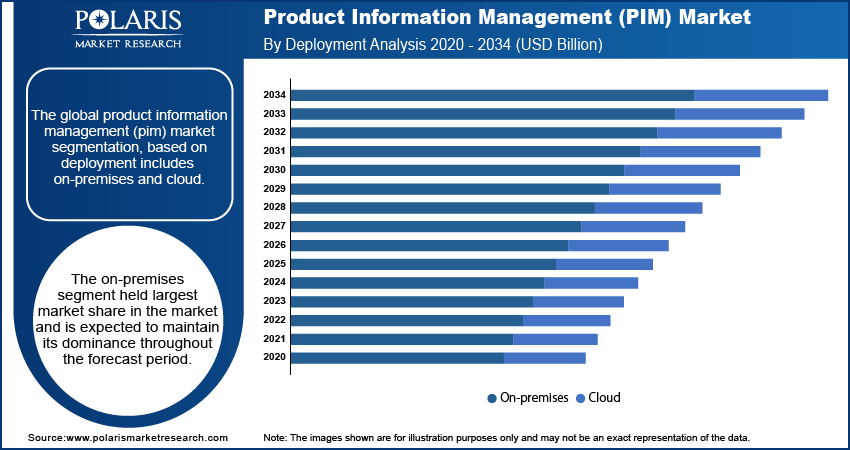
On-premises segment held the largest market share of 54.61% in 2025
The on-premises segment held largest market share in the market and is expected to maintain its dominance throughout the forecast period. An extensive rise in the adoption of PIM solutions in several industries, including healthcare, banking, financial services, insurance, and life sciences, coupled with the high utilization of these solutions to maintain control over data and information technology infrastructure, are key factors anticipated to fuel the demand and growth of the segment market over the coming years.
Furthermore, cloud-based solutions are witnessing the fastest CAGR of 18.2% during the forecast period owing to high reliability in IT security as it eliminates the complete risk of system breakdown and reduces requirements for several security platforms. In addition, the availability of sufficient resources among global large enterprises contributes significantly to market growth.
Source: Polaris Market Research Analysis
Large enterprise accounted for the largest market share of 53.27% in 2025
The high adoption of PIM solutions among various large enterprises is comparatively higher than the small enterprises. The availability of high budgets and continuously rising investment in research & development activities are the major factors driving the growth of the segment market at a strong pace. Moreover, to increase overall production and high efficiency, many large organizations are heavily funding novel technology. The rising demand for flexible, scalable, and easily accessible services around the globe is fostering the need and prevalence of PIM solutions in the segment over the forecast period.
| Size of Organization | Description | Benefit | Use Cases |
| Large Enterprises | Large firms having various product listings and numerous channels for selling their products. | Handle high amounts of product information effectively with greater precision. | Multinational retailers, manufacturing organizations, global brands |
| Small Enterprises | Young firms having less product offerings with fewer marketing channels. | Ease of product management and increased efficiency. | Local retailers, small online shops, startup firms |
Source: Polaris Market Research Analysis
Retail sector is expected to hold a significant revenue share over the forecast period.
The popularity and penetration of product information management solutions are projected to be the highest in the retail and e-commerce industry owing to the rising focus on improving customer experience and the rising prevalence of artificial intelligence and retail analytical tools. A massive growth in the e-commerce sector, customer preferences and purchasing behavior has changed rapidly, which is a key driving factor for the growing adoption of PIMs in the retail and e-commerce industry.
According to Shopify, by 2021, the global e-commerce market was around USD 4.97 trillion, with an increase of over 400% in the last seven years, which Asia Pacific region was the largest contributor, with a contribution of USD 831.7 billion in e-commerce sales, followed by North America with a total sales value of USD 552.6 billion. And it was estimated that there were around 1.92 billion global digital buyers in 2020.
The Asia Pacific region dominated the global market in 2025
Asia Pacific region held a healthy market share of 35.47% in 2025 owing to the rising need for data storage and security coupled with the rising consumer awareness regarding new innovations and the availability of latest technologies in the region. Moreover, the rapid penetration of smartphones and the high emergence of online shopping among consumers, especially in developing economies like India, China, and Indonesia, is also expected to drive the growth and demand for PIM solutions over the forecast period. According to our findings, online sales across India were around USD 67 billion in the year 2021, and it is projected to grow to over USD 145 billion by 2025. The Indian e-commerce market is the world’s fastest-growing market in the e-commerce sector.
North America registered a high growth rate of CAGR 16.5% over the study period, owing to the rapid adoption of advanced technologies for reducing manual tasks and various streamlined workflows. In addition, wide presence of large product information management vendors, such as IBM Corporation, Oracle Corporation, Informatica LLC, and Riversand Technologies Inc., is also fueling the growth of the market in the region. For instance, as per the U.S. Census Bureau report, total e-commerce retail sales in North America rose by 7.8% in the very first quarter of 2021 compared to the same period of the last year, reaching a value of USD 1581.4 billion.
-market-trends-by-region-2020-2034.png)
Source: Polaris Market Research Analysis
Competitive Insight
Some of the major players operating in the global market:
- Oracle Corporation,
- IBM Corporation,
- Informatica LLC,
- Akeneo,
- Stibo Systems,
- Truecommerce,
- Magnitude Software,
- SAP SE,
- Salsify Inc.,
- Riversand Technologies Inc.,
- Adam Software NV,
- Agility Multichannel,
- Pimcore,
- Inriver Inc.,
- Winshuttle,
- Perfion,
- Syndigo,
- Viamedici Deutschland GmbH.
Recent Developments
Product Information Management (PIM) Market Report Scope
| Report Attributes | Details |
| Market size value in 2025 | USD 15.85 billion |
| Market size value in 2026 | USD 18.91 billion |
| Revenue forecast in 2034 | USD 62.67 billion |
| CAGR | 16.5% from 2026 – 2034 |
| Base year | 2025 |
| Historical data | 2021 – 2024 |
| Forecast period | 2026 – 2034 |
| Quantitative units | Revenue in USD billion and CAGR from 2026 to 2034 |
| Segments Covered | By Deployment, By Organization Size, By Verticals, By Region |
| Regional scope | North America, Europe, Asia Pacific, Latin America; Middle East & Africa |
| Key Companies | Oracle Corporation, IBM Corporation, Informatica LLC, Akeneo, Stibo Systems, Truecommerce, Magnitude Software, SAP SE, Salsify Inc., Riversand Technologies Inc., Adam Software NV, Agility Multichannel, Pimcore, Inriver Inc., Winshuttle, Perfion, Syndigo, and Viamedici Deutschland GmbH. |
Source: Polaris Market Research Analysis
Product Information Management (PIM) Market FAQ's
The global market size was valued at USD 15.85 billion in 2025 and is projected to grow to USD 62.67 billion by 2034.
The global market is projected to register a CAGR of 16.5% during the forecast period.
Asia Pacific dominated the market with 35.47% share in 2025.
The on-premise segment held the largest market share of 54.61% in 2025.
Page last updated on:
Download Sample Report of Product Information Management (PIM) Market
Please fill out the form to request a customized copy of the research report.


