
Psychiatric Digital Biomarkers Market Growth, Industry Report, 2026–2034
REPORT DETAILS
Psychiatric Digital Biomarkers Market Summary
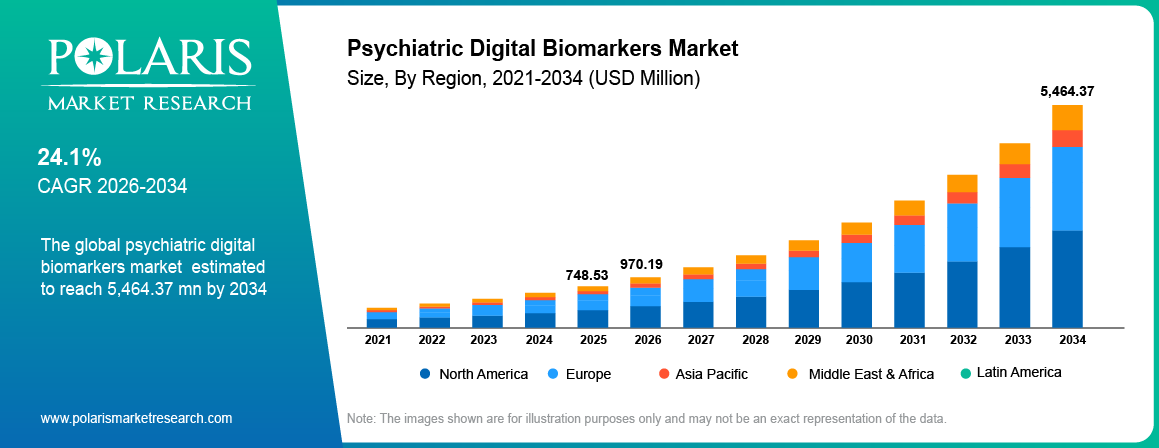
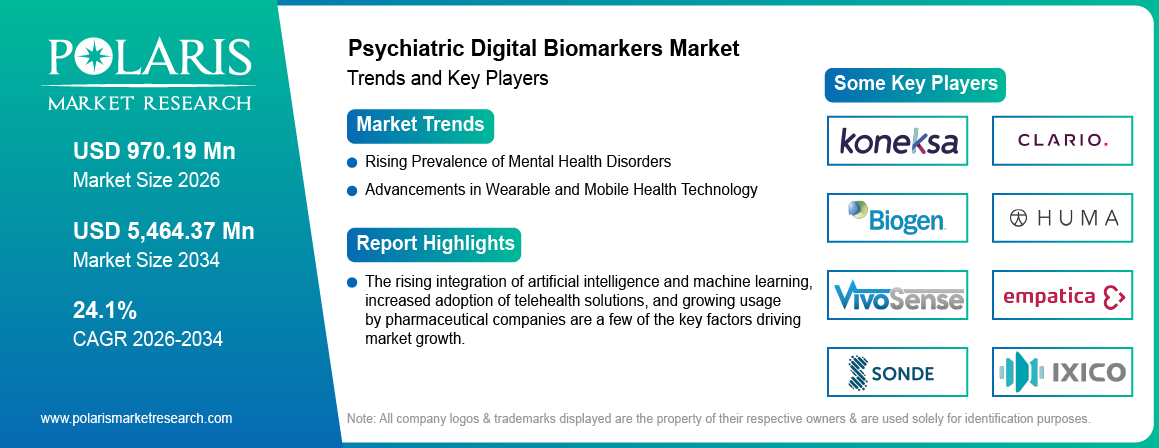
The psychiatric digital biomarkers market size was valued at USD 784.53 million in 2025, growing at a CAGR of 24.1% during 2026–2034. The rising integration of artificial intelligence and machine learning, increased adoption of telehealth solutions, and growing usage by pharmaceutical companies are a few of the key factors driving market growth.
Market Statistics
Key Takeaways
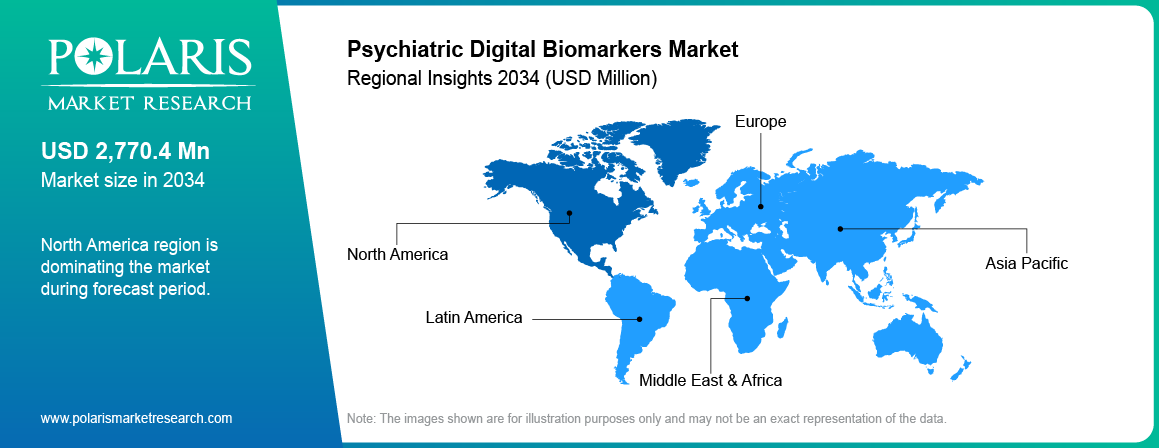
- North America accounted for 58.2% of the psychiatric digital biomarkers market revenue in 2025, maintaining its leading position. Advanced healthcare infrastructure, strong investments in digital health technologies, and increasing adoption of AI-driven mental health diagnostics support its dominance.
- Europe is projected to register the highest CAGR of 25.6% during the forecast period, driven by government initiatives supporting mental health research, digital health transformation, and growing adoption of wearable and AI-powered diagnostic tools.
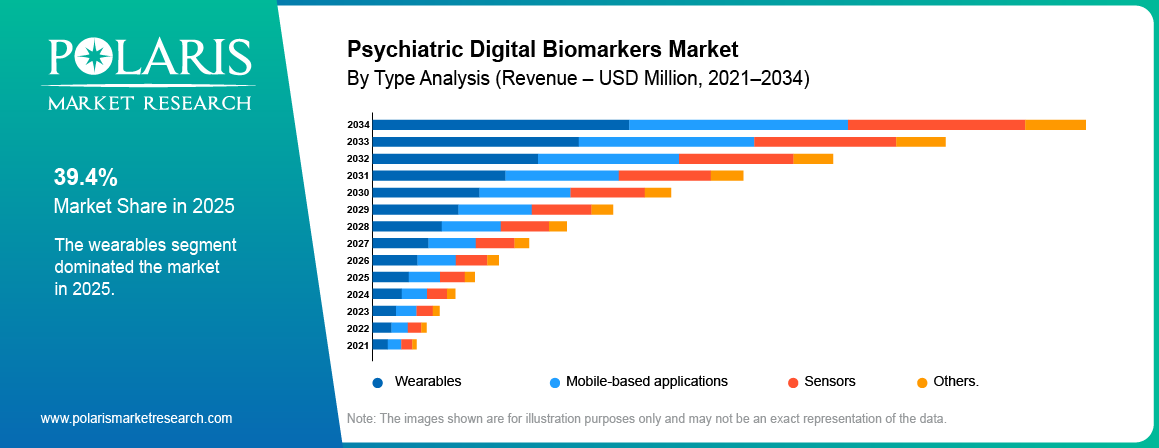
- The wearable segment accounted for 39.4% of the psychiatric digital biomarkers market revenue in 2025, maintaining its leading position. Increasing adoption of advanced biosensors in smartwatches, fitness trackers, and wearable EEG devices is supporting demand for continuous mental health monitoring.
- The mobile-based applications segment is projected to register a CAGR of 26.3% during the forecast period. Increasing adoption of smartphone-based mental health monitoring, passive data collection, and AI-driven psychiatric assessment tools is supporting segment growth.
- The healthcare companies segment accounted for 50.3% of the psychiatric digital biomarkers market revenue in 2025, maintaining its leading position. Growing adoption of psychiatric digital biomarkers for early diagnosis, treatment personalization, and patient monitoring is supporting segment growth.
Note: Figures and projections outlined in this report are the result of Polaris Market Research’s proprietary analytical processes, grounded in the latest available datasets and market observations.
What Is the Psychiatric Digital Biomarkers Market?
The psychiatric digital biomarkers market focuses on digital tools that measure behavioral, cognitive, and physiological signals linked to mental health conditions. These tools include wearable technology devices, smartphone applications, sensors, and artificial intelligence (AI)-based analytics. They help monitor mental health and support the assessment of psychiatric disorders.
Psychiatric digital biomarkers use data such as sleep patterns, physical activity, heart rate variability, speech, and smartphone usage. Machine learning (ML) and AI analyze these signals to identify patterns linked to conditions such as depression, schizophrenia, bipolar disorder, and anxiety disorders. This approach supports early risk detection and more personalized mental healthcare.
The growing adoption of telehealth and remote patient monitoring is driving demand for psychiatric digital biomarkers. Healthcare providers can use digital tools to track changes in patient behavior between clinical visits. These insights can support treatment decisions and help clinicians monitor patient progress over time.
Pharmaceutical companies are also using digital biomarkers in psychiatric drug development and clinical trials. These tools can support patient monitoring, participant selection, and the assessment of treatment responses. In addition, regulatory guidance from agencies such as the U.S. Food and Drug Administration (FDA) and the European Medicines Agency (EMA) is shaping the development and validation of digital health technologies. Together, advances in AI, wearable technology, and digital mental health solutions are supporting growth in the psychiatric digital biomarkers market.
How Psychiatric Digital Biomarkers Work
Psychiatric digital biomarkers use data from wearable devices, smartphone applications, and sensors to track changes in mental health. Artificial intelligence (AI) and machine learning (ML) analyze these signals to identify patterns linked to psychiatric conditions.
The process begins with data collection from devices that track sleep patterns, physical activity, heart rate variability, speech, and daily behavior. Digital tools capture these behavioral and physiological signals, which are then processed by AI and ML algorithms to identify changes over time.
Digital biomarker platforms analyze these patterns to assess potential mental health risks associated with conditions such as depression, bipolar disorder, and schizophrenia. The results can help identify changes in symptoms and support continuous mental health monitoring.
Healthcare professionals interpret these insights alongside medical history, clinical assessments, and patient feedback. This information can support treatment planning, patient monitoring, and personalized psychiatric care. However, psychiatric digital biomarkers support clinical decision-making and do not replace professional diagnosis or clinical judgment.
Market Trends and Innovation
The psychiatric digital biomarkers market is evolving with advances in artificial intelligence (AI), machine learning (ML), wearable technology, and remote mental health monitoring. These technologies help collect and analyze behavioral and physiological data linked to psychiatric conditions. Growing interest in continuous monitoring and personalized mental healthcare is also supporting market development.
Digital Phenotyping and Passive Sensing
Digital phenotyping uses data from smartphones, wearable devices, and other digital tools to study changes in a person's behavior and daily activities. Active data collection involves information provided directly by users, such as responses to questionnaires. Passive sensing collects data in the background, including sleep patterns, physical activity, mobility, and smartphone usage. These methods support remote mental health monitoring and help researchers study behavioral patterns linked to psychiatric conditions.
AI, Behavioral Signal Processing and Multimodal Analysis
AI and ML are increasingly used to analyze digital biomarkers for mental health assessment. Behavioral signal processing helps identify patterns in speech, movement, sleep, and physiological data. Natural language processing (NLP) can analyze language patterns, while voice analysis tools examine speech features. Multimodal analysis combines data from different sources to provide a broader view of changes in mental health. Model validation is important to assess reliability and reduce bias before clinical use.
Precision Psychiatry Ecosystem
Psychiatric digital biomarkers support precision psychiatry by helping researchers and healthcare professionals study differences in symptoms and treatment responses. Combining digital signals with clinical assessments may support personalized medicine biomarkers planning and patient monitoring. Pharmaceutical companies can also use these tools in clinical trials to track changes over time and assess treatment responses. Growing integration with AI-based analytics and digital health platforms is strengthening the role of digital biomarkers in personalized psychiatric care.
Market Dynamics
Market Driver: Rising Prevalence of Mental Health Disorders
The growing burden of mental health conditions is increasing demand for better monitoring tools. In June 2026, the Digital Medicine Society (DiMe) released a set of seven digital measures for common mental health disorders, covering areas such as sleep, physical activity, cognitive function, and speech. This initiative supports the development of more consistent ways to measure symptoms and treatment responses, creating opportunities for psychiatric digital biomarkers in clinical research (Source: dimesociety.org).
Market Driver: Advancements in Wearable and Mobile Health Technology
Advances in wearable devices and smartphone sensors are supporting continuous mental health monitoring. These devices can collect sleep, activity, and heart rate variability data between clinic visits, which lets clinicians track change over time.
Market Opportunity: Growing Use of Digital Biomarkers in Clinical Trials
Digital biomarkers are creating new opportunities in clinical trials by helping researchers track changes in symptoms, behavior, and treatment responses over time. Wearable devices and smartphone applications can collect data outside clinical settings, allowing researchers to monitor participants more frequently. In April 2026, the U.S. Advanced Research Projects Agency for Health (ARPA-H) awarded funding to a project focused on using smartphone and wearable data to measure changes in behavioral health. The project will study signals such as sleep, behavior, and physiological activity during a clinical trial involving a meditation app for depression. Such research may expand the use of psychiatric digital biomarkers in clinical trials and treatment-response assessment (Source: arpa-h.gov).
Market Opportunity: Integration of Multimodal Data for Personalized Mental Healthcare
Multimodal data integration combines information from different sources, such as wearable devices, smartphone applications, speech analysis, and clinical assessments, to provide a broader view of mental health. This approach may help researchers identify behavioral patterns and understand differences in treatment responses. Validation across devices and populations remains necessary before these combined signals are used in routine care. Combining different digital signals may support personalized psychiatric care and improve research into new treatments.
Market Restraint: Data Privacy and Clinical Validation Challenges
Psychiatric digital biomarkers rely on sensitive personal data, raising concerns about privacy, consent, and data security. In January 2026, the UK’s Medicines and Healthcare products Regulatory Agency (MHRA) issued updated guidance for people using mental health apps and technologies. The wider regulatory focus highlights the need for clear safety standards and reliable evidence. Differences in device performance and data quality can also make clinical validation more challenging (Source: gov.uk).
Segment Insights
By Type
The global psychiatric digital biomarkers market segmentation, based on type, includes wearables, mobile-based applications, sensors, and others. The wearable segment accounted for 39.4% of market revenue in 2025, driven by the growing use of smartwatches, fitness trackers, and wearable EEG devices for mental health monitoring. These devices track signals such as heart rate variability, sleep patterns, and physical activity, supporting the assessment of behavioral and physiological changes.
The mobile-based applications segment is projected to grow at a CAGR of 26.3% during 2026–2034. Increasing use of smartphone-based mental health monitoring, passive data collection, and AI-driven behavioral analysis is supporting segment growth. Growing demand for remote psychiatric assessments and continuous symptom tracking is also creating opportunities for mobile applications, sensors, and other digital tools in mental health research and care.
By End Use
The global psychiatric digital biomarkers market segmentation, based on end use, includes healthcare companies, healthcare providers, payers, and others. The healthcare companies segment accounted for 50.3% of market revenue in 2025, driven by the growing use of digital biomarkers in psychiatric drug development, clinical trials, and patient monitoring. Pharmaceutical and medical technology companies are adopting AI-based biomarker analytics to study treatment responses and support research into mental health conditions.
The healthcare companies segment is projected to grow at a CAGR of 24.3% during 2026–2034, supported by rising investment in digital health technologies and the growing use of biomarkers in clinical research. Healthcare providers are also adopting digital tools for remote patient monitoring and psychiatric assessments, while payers are exploring digital health solutions to support care management and evaluate treatment outcomes. Growing demand for continuous mental health monitoring and personalized treatment is expected to support adoption across these end-use segments.
By Clinical Practice
The global psychiatric digital biomarkers market segmentation, based on clinical practice, includes diagnostic psychiatric digital biomarkers, monitoring psychiatric digital biomarkers, predictive and prognostic psychiatric digital biomarkers, and others. The diagnostic segment accounted for 42.6% of market revenue in 2025, driven by the growing use of digital tools to assess behavioral, cognitive, and physiological signals linked to psychiatric disorders. Wearables, smartphone applications, and sensors support clinical assessments by identifying patterns associated with mental health conditions.
The monitoring segment is projected to grow at a CAGR of 25.8% during 2026–2034. Increasing demand for continuous symptom tracking, remote patient monitoring, and treatment response assessment is supporting its growth. Artificial intelligence (AI) and machine learning (ML) help analyze changes in sleep, activity, and behavior over time. These tools can support healthcare professionals in monitoring patients and planning personalized mental healthcare.
Technology Comparison
Psychiatric digital biomarkers use different technologies to collect and analyze mental health data. Wearables track physiological signals, sleep, and physical activity. Mobile applications monitor behavior and daily routines through smartphones. Standalone sensors measure specific signals, while voice and speech analysis examines language patterns. Multimodal platforms combine data from multiple sources for a broader view of mental health. Each technology offers different capabilities for psychiatric assessment and patient monitoring.
| Technology / Data Source | Signals Commonly Captured | Potential Psychiatric Use | Limitations |
| Wearables | Heart rate, heart rate variability (HRV), sleep, movement, and activity | Long-term monitoring and treatment response research | Device differences, inconsistent use, and signals not specific to mental health disorders |
| Smartphone Apps and Sensors | Screen use, mobility, app interactions, self-reports, and typing patterns | Remote monitoring and tracking changes in daily routines | Privacy risks, missing data, and differences across operating systems |
| Voice and Speech Analytics | Speech rate, pauses, tone, acoustic features, and language patterns | Research into mood, cognition, and symptom changes | Language differences, recording quality, and limited diagnostic reliability |
| Dedicated Sensors and EEG | Movement, physiological signals, and brain activity | Specific psychiatric assessments and clinical research | Differences in device accuracy, clinical validation, and intended use |
| Multimodal Platforms | Combined wearable, smartphone, speech, and clinical assessment data | Long-term monitoring and identification of patient patterns | Data integration, bias, explainability, and validation challenges |
Source: Polaris Market Research Analysis
Market Regional Analysis
North America
North America accounted for the largest share of the psychiatric digital biomarkers market revenue in 2025, representing 58.2% of the global market. The region’s advanced healthcare infrastructure, strong investment in digital health, and growing use of artificial intelligence (AI) in mental healthcare support its leading position. Wearable devices, smartphone applications, and remote monitoring platforms are gaining attention for tracking behavioral and physiological changes linked to psychiatric conditions. Pharmaceutical companies and research institutions are also exploring digital biomarkers for clinical trials and treatment response assessment. In addition, the presence of digital health companies and ongoing research into personalized psychiatry is supporting innovation. Growing demand for early assessment and continuous mental health monitoring is expected to strengthen regional market growth.
Europe
Europe is projected to register the highest CAGR of 25.6% during the forecast period from 2026 to 2034. The region’s growing focus on digital healthcare, mental health research, and personalized treatment is supporting demand for psychiatric digital biomarkers. Healthcare providers and research institutions are exploring wearable devices, smartphone-based monitoring, and AI-powered tools to track behavioral and physiological signals. Digital biomarkers are also gaining attention in clinical trials, where they can help researchers assess symptom changes and treatment responses over time. Government initiatives supporting digital health and mental healthcare are further encouraging adoption. In addition, collaboration among pharmaceutical companies, technology developers, and academic institutions is helping advance research and the development of digital tools for psychiatric assessment.
Asia Pacific
The Asia Pacific psychiatric digital biomarkers market is expected to grow as healthcare systems increasingly adopt digital technologies for mental health assessment and monitoring. Rising awareness of mental health conditions and growing demand for accessible healthcare services are creating opportunities for digital solutions. Wearable devices and smartphone applications can help track sleep, physical activity, and behavioral patterns outside clinical settings. Countries such as China, Japan, India, and South Korea are expanding their digital health capabilities, supporting interest in remote monitoring and AI-based healthcare tools. The region’s growing technology sector and increasing investment in healthcare innovation may further support market development. However, differences in healthcare infrastructure, digital access, and data privacy requirements may affect adoption across countries.
Middle East and Africa
The psychiatric digital biomarkers market in the Middle East and Africa is developing as healthcare providers explore digital tools for mental health monitoring. Increasing awareness of psychiatric conditions and growing investment in healthcare technology are creating opportunities for wearable devices, mobile applications, and remote monitoring platforms. Digital solutions may improve access to mental health services, particularly in areas with limited specialist availability. Healthcare modernization initiatives across parts of the Middle East are also supporting interest in AI-based healthcare tools. However, limited digital infrastructure in some areas, data privacy concerns, and the need for clinical validation may slow adoption. Continued investment in digital healthcare and mental health services could support regional market growth.
Latin America
The Latin America psychiatric digital biomarkers market is expected to develop as awareness of mental health and digital healthcare solutions increases. Wearable devices, smartphone applications, and remote monitoring tools offer opportunities to track behavioral patterns and support psychiatric care. Growing smartphone use and expanding digital health services may improve access to mental health monitoring, especially for people living far from specialist facilities. Healthcare providers and research institutions are also exploring technology-based approaches to patient monitoring and clinical research. However, differences in healthcare access, limited funding, and concerns about data privacy may affect adoption across the region. Greater investment in digital infrastructure and mental health services could create further opportunities for market expansion.
Real-World and Emerging Use Cases
Psychiatric digital biomarkers are being explored for mental health monitoring, clinical research, and personalized treatment. Wearables, smartphone applications, and speech analysis tools can collect data on sleep, physical activity, speech patterns, and daily behavior. These signals may help researchers understand changes in symptoms and assess treatment responses over time.
Digital biomarkers are also being studied in clinical trials to collect data outside traditional healthcare settings. Combining digital signals with clinical assessments may help researchers identify patterns linked to different psychiatric conditions. However, these technologies require clinical validation. The following examples illustrate potential applications of psychiatric digital biomarkers.
| Signal or Data Source | Potential Use | Key Consideration |
| Sleep patterns from wearables | Tracking sleep changes associated with mood symptoms | Sleep changes are not specific to psychiatric disorders |
| Physical activity and mobility data | Monitoring changes in daily routines and activity levels | Results may be affected by lifestyle and physical health |
| Smartphone usage patterns | Identifying changes in social engagement and daily behavior | Privacy, consent, and missing data are important concerns |
| Voice and speech patterns | Studying changes in mood, cognition, and symptoms | Language, culture, and recording quality can affect results |
| Heart rate variability and other physiological signals | Exploring stress responses and changes during treatment | Signals may be influenced by medication and other health conditions |
| Combined wearable, smartphone, and clinical data | Supporting research into personalized treatment and symptom monitoring | Data integration, bias, and clinical validation remain challenges |
Source: Polaris Market Research Analysis
Key Players & Competitive Analysis Report
The competitive landscape of the psychiatric digital biomarkers market is characterized by the presence of established healthcare technology firms, digital health startups, and pharmaceutical companies investing in AI-driven mental health solutions. Key players are focusing on advancing machine learning algorithms, wearable biosensors, and mobile-based psychiatric assessments to enhance diagnostic accuracy and real-time monitoring. Strategic collaborations between technology firms and healthcare providers are driving innovation, while regulatory approvals and data security compliance remain critical differentiators. Companies are also expanding their product portfolios through acquisitions, R&D investments, and partnerships with academic institutions. The increasing adoption of digital biomarkers in clinical trials has further intensified competition, with firms competing to integrate these solutions into personalized psychiatric care models.
Biogen is engaged in the discovery, development, and delivery of innovative therapies for serious neurological diseases. Specializing in neuroscience, Biogen was founded in 1978 and is headquartered in Massachusetts, USA. The company's product portfolio includes treatments for multiple sclerosis, spinal muscular atrophy, and Alzheimer's disease. Biogen provides comprehensive solutions for neurological conditions, focusing on advancing digital biomarkers and personalized medicine. The company has a significant presence globally, with operations in multiple countries. Biogen has been involved in developing digital biomarkers for neurodegenerative diseases, which is crucial for early diagnosis and personalized treatment.
Empatica Inc. is engaged in the development of wearable devices and software for monitoring human health. The company was founded in 2011, and headquartered in Massachusetts, USA. It specializes in creating wearable sensors that track physiological signals, providing insights into neurological conditions. Empatica's product portfolio includes the Embrace smartwatch, designed to detect seizures and provide alerts. The company offers services related to data analytics and health monitoring, with a presence in North America and Europe.
Key Players
- Biogen
- Clario
- Empatica Inc.
- Huma
- IXICO plc
- Koneksa Health
- Sonde Health, Inc.
- VivoSense
Vendor Positioning Table
| Company Name | Headquarters | Role | Main Technology or Service |
| Biogen | Cambridge, Massachusetts, USA | Pharmaceutical research | Drug development and clinical research |
| Clario | Philadelphia, Pennsylvania, USA | Clinical trial technology | Digital endpoints and clinical trial services |
| Empatica Inc. | Boston, Massachusetts, USA | Wearable biosensing | Wearable devices and digital biomarkers |
| Huma | London, United Kingdom | Digital health technology | Remote patient monitoring and digital health platforms |
| IXICO plc | London, United Kingdom | Clinical trial analytics | Digital endpoints and neuroimaging analysis |
| Koneksa Health | New York, New York, USA | Digital biomarker research | Digital biomarker platforms and clinical research |
| Sonde Health, Inc. | Boston, Massachusetts, USA | Voice-based health assessment | Voice and speech analysis |
| VivoSense | Newport Coast, California, USA | Digital biomarker analytics | Wearable sensor data and clinical trial measures |
Source: Polaris Market Research Analysis
Recent Developments
- August 2026: INVI MindHealth selected Epitel as its EEG data collaborator for its ARPA-H-funded EVIDENT mental health research project. The collaboration will use wearable EEG technology to monitor brain activity over extended periods and study treatment responses in veterans. (Source: invi-mindhealth)
- June 2026: INVI MindHealth selected Oura as a wearable biometric data collaborator for its EVIDENT mental health project. The collaboration will combine sleep, heart rate variability, temperature, and activity data with clinical assessments and other behavioral signals to study mental health treatment responses.
- May 2026: Emobot Health presented clinical validation findings for its EMOCARE smartphone-based depression monitoring tool at the American Society of Clinical Psychopharmacology annual meeting. The tool analyzes voice, facial expressions, movement, and screen behavior to track depressive symptoms and support ongoing patient monitoring.(Source:nrx-pharmaceuticals)
- September 2025: Topcon Healthcare made a strategic investment in Senseye to advance mental health assessment using ocular biomarkers. Senseye uses artificial intelligence and smartphone cameras to analyze eye movements and pupil responses, supporting the assessment and monitoring of conditions such as depression, post-traumatic stress disorder, and generalized anxiety disorder.
Future Outlook
The psychiatric digital biomarkers market is expected to evolve as artificial intelligence, wearable devices, and smartphone-based monitoring become more widely used in mental healthcare. Growing research into digital measures for sleep, speech, physical activity, and behavioral patterns may help improve symptom tracking and treatment response assessment. Pharmaceutical companies may also expand their use of digital biomarkers in clinical trials to collect data outside traditional healthcare settings. However, wider adoption will depend on clinical validation, data privacy, regulatory clarity, and the ability of these tools to perform reliably across different patient groups. Collaboration among technology companies, healthcare providers, and research institutions may support further development. The pace of adoption will depend on whether these technologies demonstrate meaningful clinical value and fit into existing care practices.
Research Methodology
The research methodology for the psychiatric digital biomarkers market combines primary and secondary research to assess market trends, technology adoption, competitive developments, and growth opportunities. The study examines the use of wearable devices, smartphone applications, sensors, and artificial intelligence (AI) in mental health monitoring and clinical research.
Primary research involves gathering insights from industry participants, healthcare professionals, technology providers, pharmaceutical companies, and research experts. These insights help assess market demand, product adoption, technological developments, and challenges related to clinical validation and data privacy.
Secondary research includes reviewing company websites, annual reports, product announcements, scientific publications, clinical trial records, regulatory documents, and industry reports. These sources help identify key companies, emerging technologies, partnerships, product launches, and research developments in psychiatric digital biomarkers.
Market estimates and forecasts are developed by evaluating historical trends, current market conditions, adoption patterns, and potential growth factors. The analysis also considers regional differences in healthcare infrastructure, digital health investment, regulatory requirements, and access to mental healthcare.
The findings from primary and secondary research are compared to improve consistency and reliability. Market projections remain subject to changes in technology, clinical evidence, regulatory policies, and adoption across healthcare systems.
Psychiatric Digital Biomarkers Market Report Scope
| Report Attributes | Details |
| Market Size Value in 2025 | USD 784.53 Million |
| Market Size Value in 2026 | USD 970.19 Million |
| Revenue Forecast by 2034 | USD 5464.37 Million |
| CAGR | 24.1% from 2026 to 2034 |
| Base Year | 2025 |
| Historical Data | 2021–2024 |
| Forecast Period | 2026–2034 |
| Quantitative Units | Revenue in USD Million, and CAGR from 2026 to 2034 |
| Report Coverage | Revenue Forecast, Market Competitive Landscape, Growth Factors, and Trends |
| Segments Covered |
|
| Regional Scope |
|
| Competitive Landscape |
|
| Report Format |
|
| Customization | Report customization as per your requirements with respect to countries, regions, and segmentation. |
Source: Polaris Market Research Analysis
Psychiatric Digital Biomarkers Market FAQ's
The psychiatric digital biomarkers market accounted for USD 784.53 million in revenue in 2025. Growing interest in digital mental health monitoring, wearable devices, and AI-based assessment tools is supporting market development.
The market is projected to register a CAGR of 24.1% during the forecast period from 2026 to 2034. Growth will depend on clinical validation, technology adoption, and the integration of digital biomarkers into mental healthcare and clinical research.
Psychiatric digital biomarkers are measurable behavioral, cognitive, or physiological signals collected through digital technologies. Examples include sleep patterns, speech features, physical activity, heart rate variability, and smartphone usage patterns that researchers study to understand changes associated with mental health conditions.
Key technologies include wearable devices, smartphone applications, standalone sensors, voice and speech analysis, electroencephalography (EEG), and artificial intelligence (AI). These technologies collect and analyze different types of data to support mental health monitoring and research.
Market growth is supported by rising interest in mental health monitoring, advances in wearable technology, increasing smartphone use, and growing adoption of remote healthcare. Pharmaceutical companies are also exploring digital biomarkers to monitor participants and assess treatment responses in psychiatric clinical trials.
North America held the largest share of the psychiatric digital biomarkers market revenue in 2025. Its advanced healthcare infrastructure, investment in digital health technologies, and established clinical research ecosystem support regional demand.
Key challenges include data privacy concerns, inconsistent data quality, limited clinical validation, and differences in device performance. Digital signals can also be influenced by lifestyle, medication, and other health conditions, making reliable interpretation and clinical integration important.
The psychiatric digital biomarkers market is estimated at USD 970.19 million in 2026.
Wearables lead the market, accounting for 39.4% of revenue in 2025.
Europe is projected to grow the fastest, at a CAGR of 25.6% from 2026 to 2034.
Key companies include Biogen, Clario, Empatica Inc., Huma, IXICO plc, Koneksa Health, Sonde Health, Inc. and VivoSense.
Digital biomarkers measure behavioral, cognitive or physiological signals, such as sleep, activity, speech and heart rate variability, to support assessment and monitoring. Digital therapeutics deliver a treatment, usually through software. Digital biomarkers do not replace professional diagnosis or clinical judgment.

Download Sample Report of Psychiatric Digital Biomarkers Market
Please fill out the form to request a customized copy of the research report.


