
Quantum Photonics Market Share, Size, Growth Analysis Report, 2026 - 2034
REPORT DETAILS
Quantum Photonics Market Summary
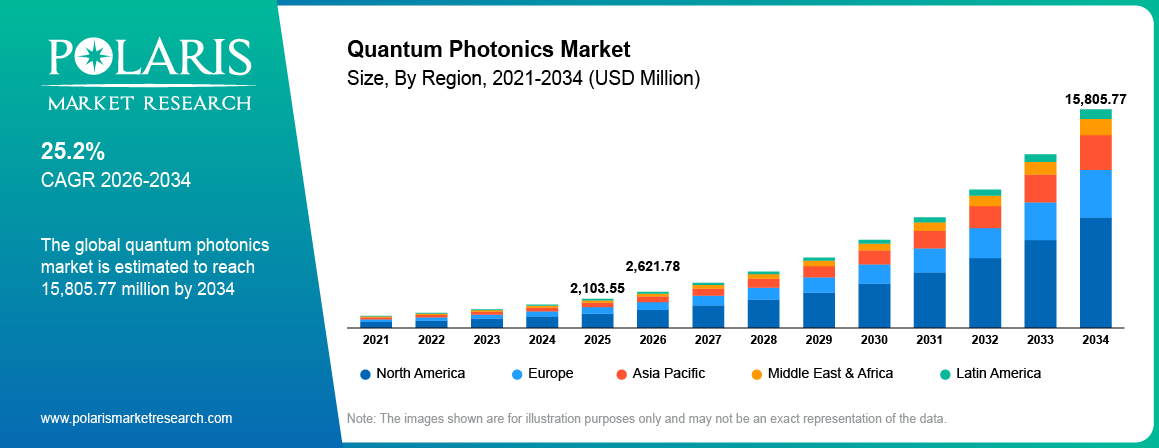
The global quantum photonics market is estimated around USD 2,103.55 million in 2025, with consistent growth anticipated during 2026–2034. Growth is driven by rising investment in quantum computing and expansion of secure communication infrastructure across global markets. The market is projected to grow at a CAGR of 25.2% during the forecast period.
Market Statistics
Key Takeaways
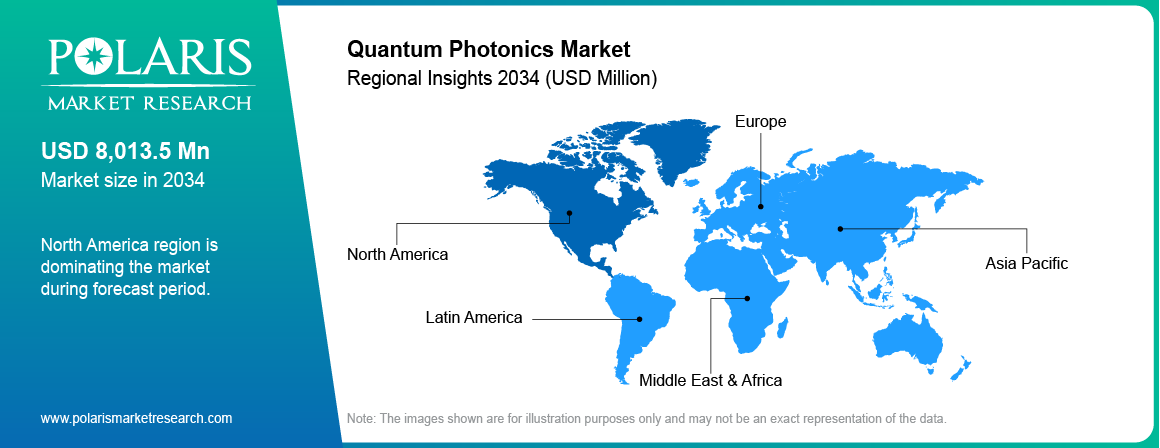
- North America quantum photonics market dominated the global market in 2025, accounting for approximately 40.60% market share.
- Europe quantum photonics market was the second largest, holding approximately 27.35% market share.
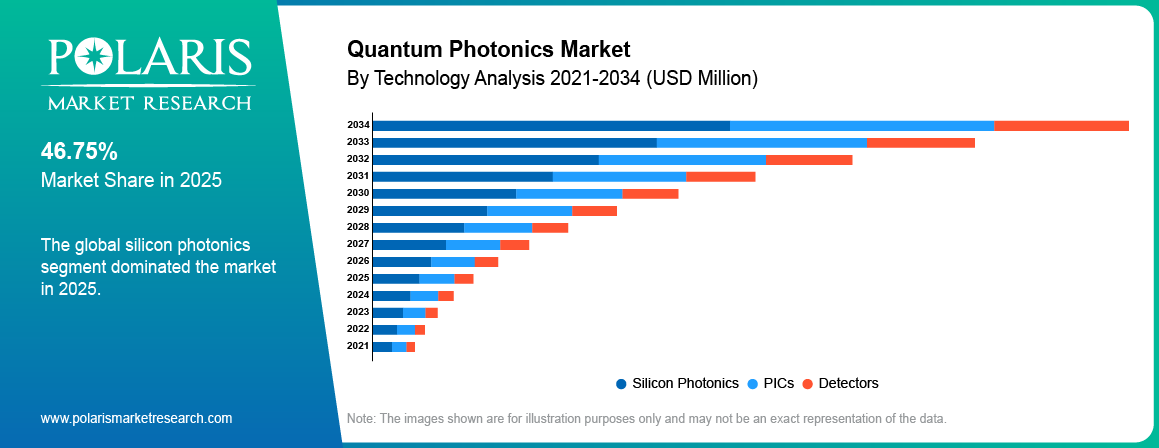
- The silicon photonics component captured the leading market share in 2025, accounting for approximately 36.80%.
- The quantum communication component captured the leading market share in 2025, contributing approximately 34.55%.
- IT & research institutions segment dominated the market in 2025, holding approximately 38.25% market share.
Industry Dynamics
- Growing quantum computing software is fuelling the quantum photonics devices demand.
- Rise in quantum communication networks is contributing to market growth.
- Expensive developmental expenses are posing difficulties in wide-scale adoption.
- Innovation in photonic chip technology is providing growth prospects in the quantum photonics industry.
What is Quantum Photonics?
Quantum photonics utilizes the application of light particles called photons for handling quantum information through computation, communication, and sensing applications. It employs photonic qubits rather than electronic currents, thereby allowing secure information transmission and advanced computing features. The quantum photonics market is expanding due to rising investments in quantum computing and secure communication systems. The industry operates within a research-driven ecosystem that includes semiconductor fabrication, advanced materials, and quantum optics. Increasing attempts to improve stability and scalability of the quantum photonics technology have been observed using quantum photonics integration technique.
Quantum photonics differs from classical photonics in terms of information processing. The classical method employs continuous waves of light, whereas the quantum system utilizes discrete units of photons that act as qubits for encoding information. Classical optics versus photonics serves as the basis for quantum cryptography and high-performance computing systems. The distinction between quantum optics and photonics reveals how there is an evolution from the conventional method of transferring signals to controlling light at the quantum level. There is an increasing interest in developing better photon control and minimizing errors within the system.
To Understand More About this Research:Download Sample Report
Some of the essential elements of quantum photonics technology systems are the single-photon source, photonic circuits, detectors, and controllers. These elements facilitate the production, manipulation, and detection of photonic qubits in an integrated form. The trend of integrated quantum photonics is gaining popularity as it allows the design to be small and efficient. The funding for the manufacturing of silicon photonic chips is growing. Growth in quantum communication networks and research partnerships is supporting long-term demand in the quantum photonics market.
Drivers & Opportunities
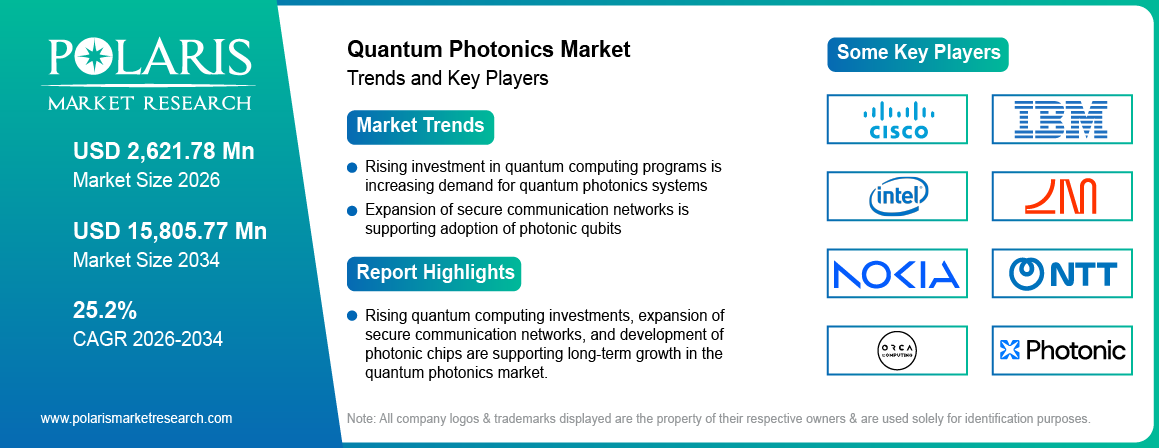
Rising investment in quantum computing programs is increasing demand for quantum photonics systems: Increasing funding in quantum computing programs is supporting the development of advanced photonic systems for data processing and communication. Technology companies and governments are allocating capital toward quantum infrastructure, which is increasing demand for quantum photonics technology. According to Qureca, the total investment by government into quantum computing all over the world came up to USD 55.7 billion by 2025, where China was the leader followed by Japan and US.[ Guinness Global Investors, 'Quantum Computing Explained: Should investors be interested?', guinnessgi.com] Furthermore, many research organizations are investing heavily in the development of photonic qubits to enhance computing abilities.
Expansion of secure communication networks is supporting adoption of photonic qubits: Growing focus on data security is increasing the deployment of quantum communication networks. In March 2026, Quantum Computing Inc. and Ciena demonstrated next-generation quantum-secured communications using high-speed encryption with PQC and QKD at OFC 2026.[ Ciena, 'Quantum Computing Inc. and Ciena demonstrate next-generation quantum-secured communications with high-speed encryption using PQC and QKD at OFC 2026', ciena.com] Qubit Photonic helps in securing the transmission of information through quantum encryption techniques. Telecommunication companies and government authorities are making investments in safe communication infrastructure. This trend is driving the use of quantum photonics devices in communication applications.
Restraints & Challenges
High development cost is limiting large-scale deployment of quantum photonics systems: High expenses incurred for the development of systems and manufacture of parts is hindering the large-scale commercialization process. The use of advanced materials and advanced manufacturing techniques is leading to high production costs. Enterprises are finding it difficult to manage production expenses efficiently. This trend is restraining the adoption of quantum photonics solutions.
Opportunity
Development of photonic quantum chips is creating new commercialization pathways: Growing emphasis on photonic chip research is facilitating the combination of different elements within the device. The use of integrated quantum photonics is boosting the scalability and efficiency of systems. Organizations are making investments in the design of chips for effective commercial implementation. In April 2026, scientists at the National Institute of Standards and Technology (NIST) introduced photonic chip packaging that delivers robust performance in harsh conditions such as extreme heat, radiation, and outer space.[ NIST / Manufacturing Dive, 'NIST researchers develop photonic chip packaging for extreme environments', manufacturingdive.com] This advancement is offering ample growth prospects in the quantum photonics industry.
Segmental Insights
This report offers detailed coverage of the quantum photonics market by technology, application, and end user to help readers identify the fastest expanding and most attractive demand segments.
By Technology
-
Silicon Photonics
The silicon photonics component captured the leading market share in 2025 due to its suitability for use in the existing semiconductor fabrication setup. Companies are placing their attention on scalability aspects for manufacturing and integration, thus promoting the adoption of quantum photonics technology.
-
Photonic Integrated Circuits (PICs)
The segment for PIC is expected to witness the highest CAGR growth over the forecast period, owing to growing demands for integrated quantum photonic systems. Growing emphasis on miniaturization and effectiveness is leading to the adoption of the PIC architecture.
By Application
-
Quantum Communication
The quantum communication component captured the leading market share in 2025 owing to increasing demand for data transmission security. Increasing deployment of quantum encryption networks is supporting adoption of photonic qubits in communication systems.
-
Quantum Computing
Quantum computing segment is projected to grow at the fastest CAGR during the forecast period, due to increasing investments in high-performance computing technologies. Development of photonic-based quantum processors is supporting segment growth.
By End User
-
IT & Research Institutions
IT & research institutions segment dominated the market in 2025, driven by increasing research activities and funding in quantum technologies. Collaboration between academic institutes and technology companies is supporting demand for quantum photonics systems.
-
Telecommunications
Telecommunications segment is projected to grow at the fastest CAGR during the forecast period, due to expansion of quantum communication infrastructure. Rising focus on secure networks is increasing adoption of quantum photonics technology in this sector.
Regional Analysis
North America Market Assessment
North America quantum photonics market dominated the global market in 2025, driven by strong investment in quantum computing programs and advanced research infrastructure. In November 2025, the U.S. Department of Energy has invested USD 625 million in the development of the next generation of National Quantum Information Science Research Centers.[ U.S. Department of Energy, 'Energy Department announces $625 million to advance National Quantum Information Science Research Centers', energy.gov] Further, the US dominates the global market due to the presence of leading technology firms and the active involvement of government-led investments. There is a high emphasis on secure communication systems that is driving the uptake of quantum photonics technology.
Asia Pacific Quantum Photonics Market Insights
Asia Pacific quantum photonics market is projected to grow at the fastest CAGR during the forecast period, driven by increasing government funding and expansion of semiconductor manufacturing capabilities. According to the Semiconductor Industry Association, Asia Pacific’s revenue increased from USD 13.42 billion in 2025 to USD 25.98 billion in 2026, indicating a YOY rise of 93.5%.[Semiconductor Industry Association, 'Global Semiconductor Report February 2026', semiconductors.org] Moreover, countries such as China, Japan, and India are investing in quantum communication and computing infrastructure. Increasing attention towards integrated quantum photonics and cost-effective manufacturing is boosting growth in the region.
Europe Quantum Photonics Market Overview
The Europe quantum photonics market was second largest owing to robust regulatory backing and existing research environment. Germany, France, and the UK are actively involved in developing quantum technology via national programs. Demand for photonic qubits is fueled by investments in the secure communication infrastructure. Innovation and cooperation across international borders have been fueling market growth.
Competitive Landscape & Pricing Analysis
The quantum photonics market is moderately concentrated due to the presence of big technological companies and R&D organizations. Competition is based on performance, scalability, and integration capabilities. Businesses are concentrating on the integration of quantum photonics and the development of photonic chips. Such efforts have been enabled through strategic collaborations.
The key companies operating in the market are IBM Corporation, Intel Corporation, Cisco Systems Inc., Nokia Corporation, Toshiba Corporation, NTT Corporation, Xanadu Quantum Technologies, PsiQuantum Corp., QuiX Quantum B.V., ORCA Computing, Photonic Inc., Lightmatter, and others.
Investment Trends & Future Outlook
Venture Capital & Government Funding: Quantum photonics investment trends show rising funding from governments and venture capital. Startups are attracting capital for photonic qubits and integrated quantum photonics solutions.
R&D Investments: Investment in R&D in quantum photonics is growing within businesses and science organizations. These fields include photonic computing, scalability, and systems optimization.
Future Market Opportunities: Development opportunities are motivated by quantum networking and photonics chip design. Small companies and partnerships are helping with the commercialization process.
Challenges, Risks & Commercialization Barriers
Technical Barriers: Challenges within the field of quantum photonics include limited manipulation of photons and erroneous photonic qubits operations. System stability and scalability are the critical problems that hinder the implementation of quantum photonics.
Cost & Infrastructure Challenges: The cost of quantum photonics is high due to raw material costs and assembly processes. Lack of manufacturing capability is hindering mass production of these products.
Regulatory & Talent Gaps: Regulatory issues in the quantum industry stem from the lack of a uniform regulatory structure. Shortage of skilled professionals in quantum optics and photonics is limiting development and slowing adoption.
Key Players
- Cisco Systems Inc.
- IBM Corporation
- Intel Corporation
- Lightmatter
- Nokia Corporation
- NTT Corporation
- ORCA Computing
- Photonic Inc.
- PsiQuantum Corp.
- QuiX Quantum B.V.
- Toshiba Corporation
- Xanadu Quantum Technologies
Industry Developments
- March 2026: Scientists at MIT have invented a chip that utilizes curved microstructures to efficiently transmit light into free space, allowing multi-beam scalability in applications such as LiDAR, 3D printing, and quantum computing. [source: web.mit.edu]
- November 2025: Quantum Computing Inc. launched Neurawave, a photonics-based reservoir computing system that delivers energy-efficient, room-temperature AI processing for edge and high-performance applications. [source: quantumcomputingreport.com]
Quantum Photonics Market Segmentation
By Technology Outlook (Revenue, USD Million, 2021-2034)
- Silicon Photonics
- PICs
- Detectors
By Application Outlook (Revenue, USD Million, 2021-2034)
- Quantum Computing
- Quantum Communication
- Quantum Sensing & Imaging
- Medical diagnostics
- Navigation systems
- Environmental monitoring
By End User Outlook (Revenue, USD Million, 2021-2034)
- Telecommunications
- Defense & Aerospace
- Healthcare
- IT & Research Institutions
By Regional Outlook (Revenue, USD Million, 2021-2034)
- North America
- US
- Canada
- Europe
- Germany
- France
- UK
- Italy
- Spain
- Netherlands
- Russia
- Rest of Europe
- Asia Pacific
- China
- Japan
- India
- Malaysia
- South Korea
- Indonesia
- Australia
- Vietnam
- Rest of Asia Pacific
- Middle East & Africa
- Saudi Arabia
- UAE
- Israel
- South Africa
- Rest of Middle East & Africa
- Latin America
- Mexico
- Brazil
- Argentina
- Rest of Latin America
Quantum Photonics Market Report Scope
| Report Attributes | Details |
| Market Size in 2025 | USD 2,103.55 Million |
| Market Size in 2026 | USD 2,621.78 Million |
| Revenue Forecast by 2034 | USD 15,805.77 Million |
| CAGR | 25.2% from 2026 to 2034 |
| Base Year | 2025 |
| Historical Data | 2021–2024 |
| Forecast Period | 2026–2034 |
| Quantitative Units | Revenue in USD Million and CAGR from 2026 to 2034 |
| Report Coverage | Revenue Forecast, Competitive Landscape, Growth Factors, and Industry Trends |
| Segments Covered |
|
| Regional Scope |
|
| Competitive Landscape |
|
| Report Format |
|
| Customization | Report customization as per your requirements with respect to countries, regions, and segmentation. |
Source: Polaris Market Research Analysis
Quantum Photonics Market FAQ's
The global market size was valued at USD 2,103.55 million in 2025 and is projected to grow to USD 15,805.77 million by 2034.
North America dominates the market due to strong investment in quantum computing and advanced research infrastructure.
Major applications include quantum computing, quantum communication, and quantum sensing & imaging.
A few of the key players in the market are IBM Corporation, Intel Corporation, Cisco Systems Inc., Nokia Corporation, Toshiba Corporation, NTT Corporation, Xanadu Quantum Technologies, PsiQuantum Corp., QuiX Quantum B.V., ORCA Computing, Photonic Inc., Lightmatter, and others.
Key drivers include rising investment in quantum technologies, expansion of secure communication networks, and development of integrated quantum photonics.
Major demand comes from telecommunications, defense & aerospace, IT, and research institutions.
The market outlook remains strong due to growing development of photonic quantum chips and increasing commercialization efforts.
Download Sample Report of Quantum Photonics Market
Please fill out the form to request a customized copy of the research report.


