
Medical Simulation Market Size, & Trend Analysis Report, 2026-2034
REPORT DETAILS
Medical Simulation Market Summary
The global medical simulation market is estimated around USD 2.1 Billion in 2025,with consistent growth anticipated during 2026–2034. This growth is driven by rising adoption of digital health training systems, increasing focus on patient safety, and growing integration of AI, VR, and AR technologies in medical education. The market is projected to grow at a CAGR of 16.9% during the forecast period.
Market Statistics
Key Takeaways
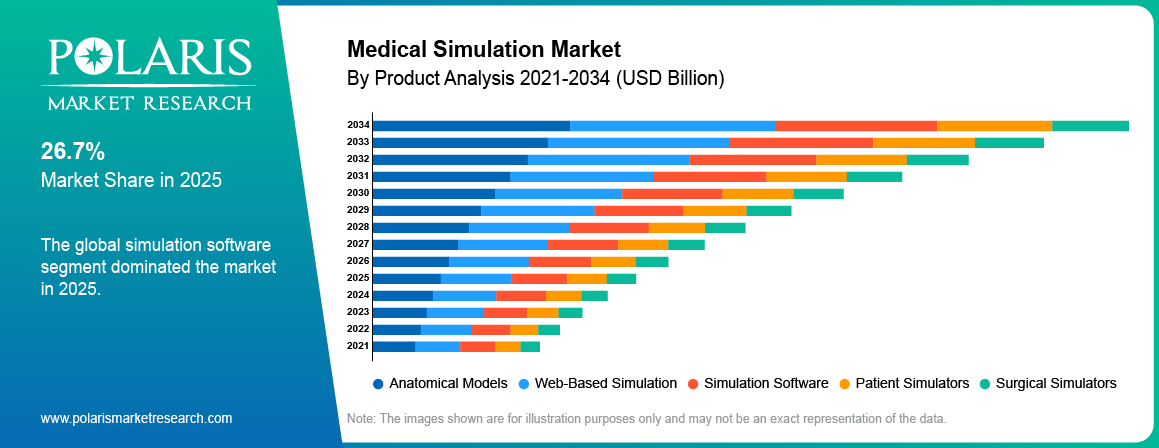
- Simulation software segment held 26.7% of the global market in 2025 due to increasing adoption of digital healthcare training platforms.
- Hospitals segment held 35.3% of the global market in 2025 owing to rising investments in workforce competency and patient safety programs.
- Web-based simulation segment is projected to grow at the fastest CAGR of 17.5% during the forecast period due to rising remote healthcare training adoption.
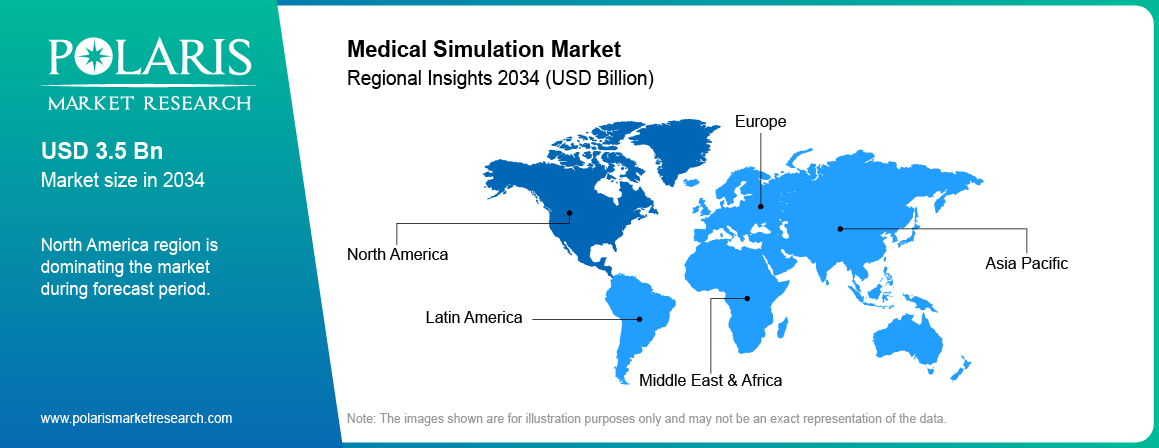
- North America dominated the market by 40.8% of total revenue in 2025 due to advanced healthcare infrastructure and strong technology integration.
- Asia Pacific is projected to grow at the fastest CAGR of 17.5% during the forecast period due to expanding healthcare infrastructure.
What is Medical Simulation?
Medical simulation refers to the use of advanced digital technologies and simulated clinical environments to train healthcare professionals without exposing patients to medical risks. These systems are widely used for surgical training, emergency response practice, anatomy learning, and procedural skill development across hospitals and academic institutions.
The value chain for this market includes software developers, simulation hardware suppliers, healthcare organizations, distributors, medical universities, and end-users. The technology organizations manufacture software simulation and training simulation equipment. The healthcare organizations put these technologies into practice to increase the competence of their workforces.
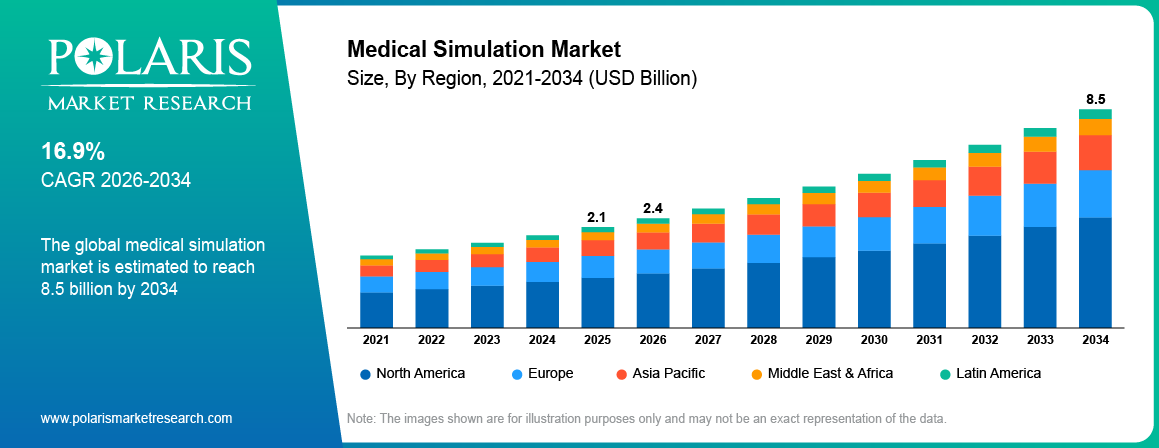
The growth factors for this market include increasing healthcare digitization, rising shortage of healthcare workers, and growing need for competency-based training of medical staff. The growth opportunities include precision medicine, regenerative medicine, and organoids commercialization. Health organizations is expected to continue to make use of AI-based training platforms to enhance training and avoid errors.
Markket Dynamics
Driver: Rising Focus on Patient Safety
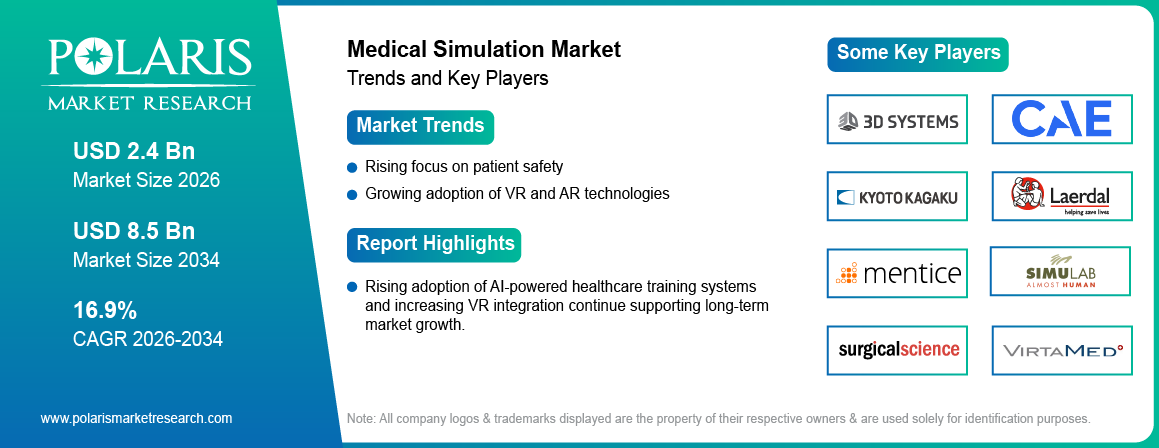
Healthcare facilities have turned their attention towards the reduction of clinical mistakes and improvement in procedure precision. Simulation is an effective approach where clinical procedures are practiced by healthcare experts before treating patients. Investments have been made consistently in simulation labs by hospitals and medical colleges to further healthcare simulation learning. In May 2025, Florida State University College of Nursing launched an advanced healthcare simulation lab to enhance clinical skills training and medical simulations education.[Florida State University News, ‘FSU’s College of Nursing Opens Cutting-Edge Simulation Lab to Train Future Health Care Leaders’, news.fsu.edu]
Driver: Growing Adoption of VR and AR Technologies
The use of virtual reality and augmented reality in training programs within healthcare is becoming more prevalent. In April 2025, SimX partnered with Elevate Healthcare to offer state-of-the-art VR-based medical simulation technology in order to train medical practitioners better. Immersive medical training technology provides better visualization for surgeries, better emergency training, and better understanding of human anatomy.
Restraints: High Initial Setup Costs
Medical simulation facilities necessitate significant financial inputs in the form of software systems, VR equipment, infrastructural improvements, and maintenance support. Hospitals and healthcare organizations lack the finances required to deploy such an expensive technology on a large scale. Moreover, emerging economies have infrastructural constraints that hamper the adoption rate of such platforms.
Opportunity: Expansion of Cloud-Based Simulation Platforms
Cloud-based medical simulation platforms are presenting many growth avenues within healthcare training and workforce development. For example, in May 2025, Mentice released the new iteration of Ankyras in the US, after receiving FDA approval to release its cloud-based medical simulation platform that plans neurointerventional procedures tailored for specific patients. They provide institutions the ability to run centralized training without requiring huge infrastructure costs. Increasing remote learning adoption and digital healthcare transformation continue supporting market expansion.
Segmental Insights
The report provides a comprehensive analysis of the medical simulation market by product, technology, and end user to pinpoint the key revenue generating and growth segments.
By Product
-
Simulation Software
Simulation software segment held 26.7% of the global market in 2025 due to increasing integration of AI analytics, competency tracking, and digital healthcare learning platforms. Healthcare institutions continue adopting simulation management software to improve workforce assessment and procedural training efficiency.
-
Web-Based Simulation
Web-based simulation segment is projected to grow at the fastest CAGR of 17.5% during the forecast period due to rising demand for remote healthcare education and scalable e- learning systems. Hospitals and academic institutions are increasingly deploying cloud-connected training platforms to improve accessibility and operational flexibility.
By Technology
-
Virtual Reality Simulation
Virtual reality simulation segment dominated the market by 35.5% share in 2025 owing to increasing use of immersive healthcare training environments across hospitals and medical universities. VR-based platforms improve surgical rehearsal, anatomy learning, and emergency response simulation efficiency.
-
Augmented Reality Simulation
Augmented reality simulation segment is projected to grow at the fastest CAGR of 17.4% during the forecast period due to increasing adoption of real-time procedural visualization technologies. Healthcare professionals are increasingly using AR-based learning systems for precision-focused clinical training.
By End User
-
Hospitals
Hospitals segment held 35.3% of the global market in 2025 due to increasing focus on workforce competency development and patient safety improvement. Healthcare facilities continue investing in advanced simulation centers to reduce procedural risks and strengthen operational efficiency.
-
Academic Institutions
Academic institutions segment is projected to grow at the fastest CAGR during the forecast period due to increasing adoption of experiential healthcare learning systems. Medical schools and nursing universities are expanding simulation laboratory infrastructure to improve practical medical education.
Regional Analysis
North America Medical Simulation Market Overview
North America dominated the market by 40.8% of total revenue in 2025 due to strong healthcare infrastructure, advanced digital healthcare adoption, and increasing investments in AI-powered medical education systems across the US and Canada. In April 2026, Obesity Medicine Association launched an AI-powered patient simulation platform to enhance obesity care training through realistic clinical conversation simulations.[Obesity Medicine Association, ‘Obesity Medicine Association Launches AI-Powered Patient Simulation Tool to Transform Obesity Care Conversations’, obesitymedicine.org] Rising healthcare spending and strong presence of simulation technology providers continue supporting regional market growth.
Asia Pacific Medical Simulation Market Insights
Asia Pacific is projected to grow at the fastest CAGR of 17.5% during the forecast period due to expanding healthcare infrastructure, rising medical student enrollment, and increasing healthcare digitization across China, India, Japan, and South Korea. In February 2026, Maverick Simulation Solutions launched a high-fidelity critical care simulator to enhance advanced medical training and emergency response education. Governments across the region continue investing in healthcare modernization and workforce training systems. The increasing usage of healthcare education software keeps on helping the region expand.
Europe Medical Simulation Market Insights
Europe region held a large share of the market due to favorable regulatory conditions for healthcare in addition to the growing use of medical simulation technology in Germany, France, and the UK. In March 2026, Oxford Medical Simulation obtained funding amounting to USD 6.71 million aimed at developing an AI-based VR health care platform.[EU-Startups, ‘Oxford Medical Simulation Secures €5.78 Million to Tackle Healthcare Training Gap with Virtual Reality’, eu-startups.com] Hospitals and academic institutions continue increasing investments in simulation laboratories and VR-based training platforms. Rising focus on patient safety and workforce preparedness continues supporting market growth across the region.
Middle East & Africa Medical Simulation Market Insights
Middle East & Africa is witnessing steady growth due to increasing healthcare modernization initiatives and rising investments in smart hospital infrastructure across Saudi Arabia and the UAE. In May 2026, MedLab Training Institute launched a new surgical training hub at Dubai Science Park to strengthen hands-on clinical education and advanced surgical training across the Middle East. Healthcare facilities have started using virtual health care education tools to improve workforce competency.
Competitive Landscape & Key Players
The medical simulation market is moderately fragmented due to the presence of global healthcare technology providers and regional simulation system developers. The competitive factors are related to software capabilities, simulation accuracy, pricing, and technology integration. Companies continue focusing on partnerships, AI integration, acquisitions, and expansion of cloud-based healthcare training platforms.
The leading players involved in the industry include 3D Systems Corporation, CAE Inc., Gaumard Scientific, Kyoto Kagaku Co., Ltd., Laerdal Medical, Limbs & Things Ltd., Mentice AB, Simulab Corporation, Surgical Science Sweden AB, SYNBONE AG, VirtaMed AG, Zimmer Biomet Holdings, Inc., and others.
Premium Insights
Immersive Healthcare Training
The medical simulation industry is shifting toward immersive healthcare training ecosystems supported by AI, VR, and AR technologies. The use of digital patient twins and AI-driven systems for measuring competencies is increasing efficiency in clinical training among hospitals and medical universities.
Simulation-as-a-Service Growth
Simulation-as-a-service solutions are becoming more popular owing to the increasing need for adaptable and affordable health care simulation platforms. Cloud computing allows institutions to benefit from advanced simulation technology without requiring significant infrastructure expenditure.
AI-Driven Learning Systems
The adoption of AI-based simulators is enhancing personalized learning in healthcare by means of adaptive learning and performance assessment. The growing utilization of predictive analytics is helping in advanced workforce training.
Long-Term Outlook
There is strong potential for growth attributed to healthcare modernization and growing adoption of digital medical education along with the need for advanced training systems. Precision medicine and regenerative healthcare trends are further supporting market expansion.
Key Players
- 3D Systems Corporation
- CAE Inc.
- Gaumard Scientific
- Kyoto Kagaku Co., Ltd.
- Laerdal Medical
- Limbs & Things Ltd.
- Mentice AB
- Simulab Corporation
- Surgical Science Sweden AB
- SYNBONE AG
- VirtaMed AG
- Zimmer Biomet Holdings, Inc.
Industry Developments
- March 2026: Surgical Science released a new version of the endometriosis ultrasound simulator equipped with better diagnostic training using AI technologies. [source: surgicalscience.com]
- March 2026: Education Management Solutions (EMS) unveiled SIMULATIONiQ 2.0 – an innovative healthcare simulation management platform equipped with AI-enabled analytics and scalability. [source: ems-works.com]
Medical Simulation Market Segmentation
By Product Outlook (Revenue, USD Billion, 2021-2034)
- Anatomical Models
- Web-Based Simulation
- Simulation Software
- Patient Simulators
- Surgical Simulators
By Technology Outlook (Revenue, USD Billion, 2021-2034)
- Virtual Reality Simulation
- Augmented Reality Simulation
- Haptic Technology
- Artificial Intelligence-Based Simulation
- Mixed Reality Simulation
By End User Outlook (Revenue, USD Billion, 2021-2034)
- Hospitals
- Academic Institutions
- Military Organizations
- Research Centers
By Regional Outlook (Revenue, USD Billion, 2021-2034)
- North America
- US
- Canada
- Europe
- Germany
- France
- UK
- Italy
- Spain
- Netherlands
- Russia
- Rest of Europe
- Asia Pacific
- China
- Japan
- India
- Malaysia
- South Korea
- Indonesia
- Australia
- Vietnam
- Rest of Asia Pacific
- Middle East & Africa
- Saudi Arabia
- UAE
- Israel
- South Africa
- Rest of Middle East & Africa
- Latin America
- Mexico
- Brazil
- Argentina
- Rest of Latin America
Medical Simulation Market Report Scope
| Report Attributes | Details |
| Market Size in 2025 | USD 2.1 Billion |
| Market Size in 2026 | USD 2.4 Billion |
| Revenue Forecast by 2034 | USD 8.5 Billion |
| CAGR | 16.9% from 2026 to 2034 |
| Base Year | 2025 |
| Historical Data | 2021–2024 |
| Forecast Period | 2026–2034 |
| Quantitative Units | Revenue in USD Billion and CAGR from 2026 to 2034 |
| Report Coverage | Revenue Forecast, Competitive Landscape, Growth Factors, and Industry Trends |
| Segments Covered |
|
| Regional Scope |
|
| Competitive Landscape |
|
| Report Format |
|
| Customization | Report customization as per your requirements with respect to countries, regions, and segmentation. |
Source: Polaris Market Research Analysis
Medical Simulation Market FAQ's
The global market size was valued at USD 2.1 Billion in 2025 and is projected to grow to USD 8.5 Billion by 2034.
North America dominated the market by 40.8% of total revenue in 2025 owing to high infrastructure for healthcare and adoption of technology.
Major applications include surgical training, emergency response simulation, anatomy learning, and procedural competency development.
A few of the key players in the market are 3D Systems Corporation, CAE Inc., Gaumard Scientific, Kyoto Kagaku Co., Ltd., Laerdal Medical, Limbs & Things Ltd., Mentice AB, Simulab Corporation, Surgical Science Sweden AB, SYNBONE AG, VirtaMed AG, and Zimmer Biomet Holdings, Inc.
Market growth is driven by rising patient safety concerns, increasing AI and VR adoption, and growing healthcare workforce training demand.
Hospitals segment held 35.3% of the global market in 2025 due to increasing investments in workforce competency and patient safety systems.
AI-enabled training systems, cloud-based simulation software solutions, and VR learning technologies is expected to drive market growth in the coming years.
Download Sample Report of Medical Simulation Market
Please fill out the form to request a customized copy of the research report.


