
Non-Invasive Cancer Diagnostics Market Size, Share & Trends Analysis Report, 2026-2034
REPORT DETAILS
Non-Invasive Cancer Diagnostics Market Summary
The global non-invasive cancer diagnostics market is estimated around USD 78.77 Billion in 2025,with consistent growth anticipated during 2026–2034. This growth is driven by rising demand for early-stage cancer detection, increasing adoption of liquid biopsy technologies, and growing use of AI-powered oncology platforms. The market is projected to grow at a CAGR of 6.9% during the forecast period.
Market Statistics
Key Takeaways
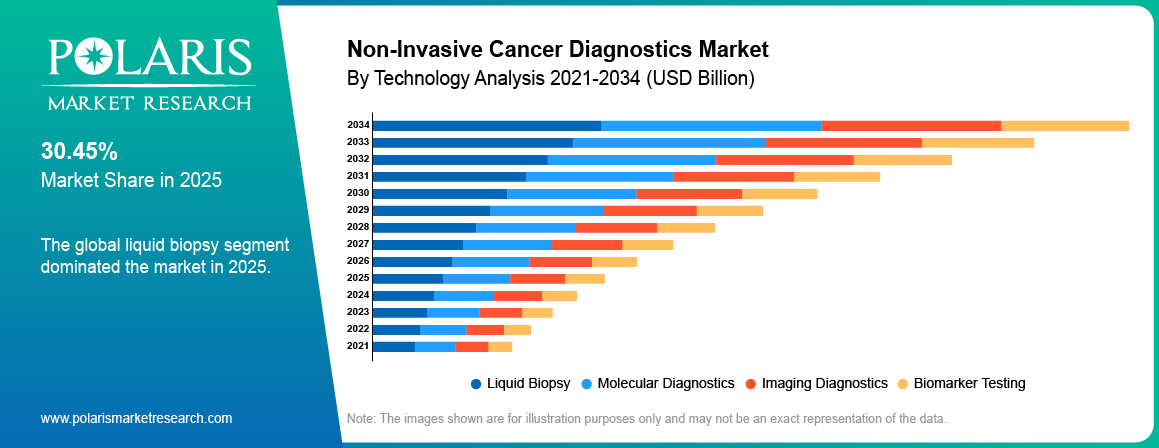
- Liquid biopsy segment held substantial market share of 20.45% in 2025 due to rising adoption of blood-based cancer testing platforms.
- Hospitals segment dominated the market by 44.56% revenue share in 2025 driven by increasing oncology testing volumes and growing investments in cancer diagnostics infrastructure.
- Molecular diagnostics segment is projected to grow at the fastest CAGR of 7.7% during the forecast period owing to rising adoption of genomic testing technologies.
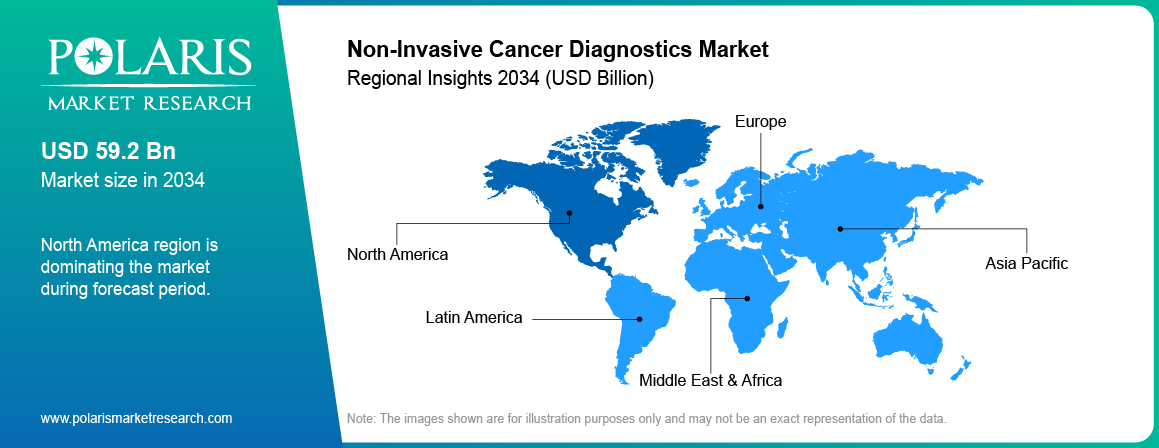
- North America dominated the market by 40.79% share in 2025 due to strong healthcare infrastructure and increasing precision oncology investments
- Asia Pacific is projected to grow at the fastest CAGR of 7.5% during the forecast period owing to rising healthcare expenditure.
Industry Dynamics
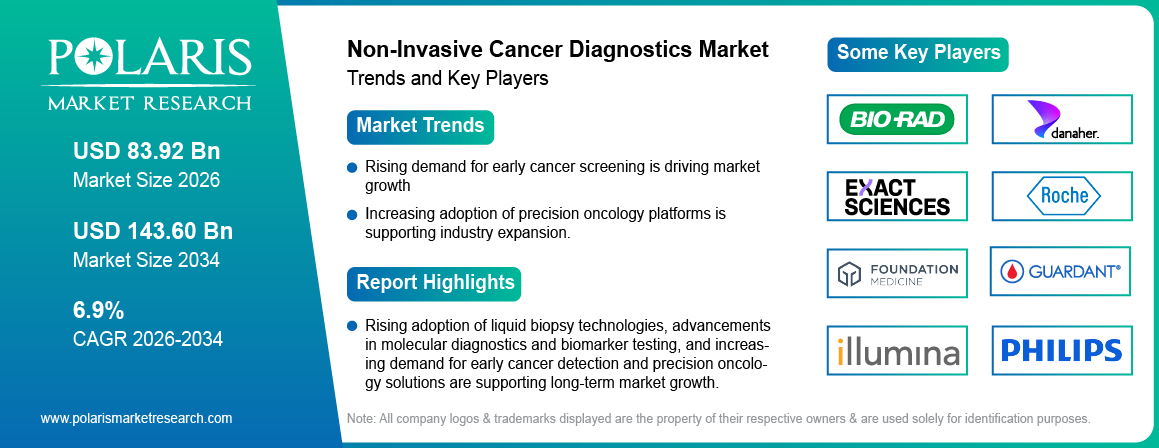
- Rising demand for early cancer screening is driving market growth
- Increasing adoption of precision oncology platforms is supporting industry expansion
- Reimbursement limitations are restricting adoption of advanced diagnostics
- AI-enabled cancer diagnostics platforms are creating new market opportunities
What is the Non-Invasive Cancer Diagnostics Market?
Non-invasive cancer diagnostics includes technologies used to detect cancer without surgical biopsy procedures. These technologies include liquid biopsy, molecular diagnostics, imaging analytics, and biomarker testing platforms. These solutions help healthcare providers improve early-stage cancer detection and reduce procedural risks.
The market value chain includes raw material suppliers, diagnostics technology developers, software providers, healthcare laboratories, hospitals, distributors, and end users. Companies are increasingly investing in genomic testing platforms, AI-enabled imaging systems, and biomarker analysis tools to strengthen cancer diagnostics capabilities.
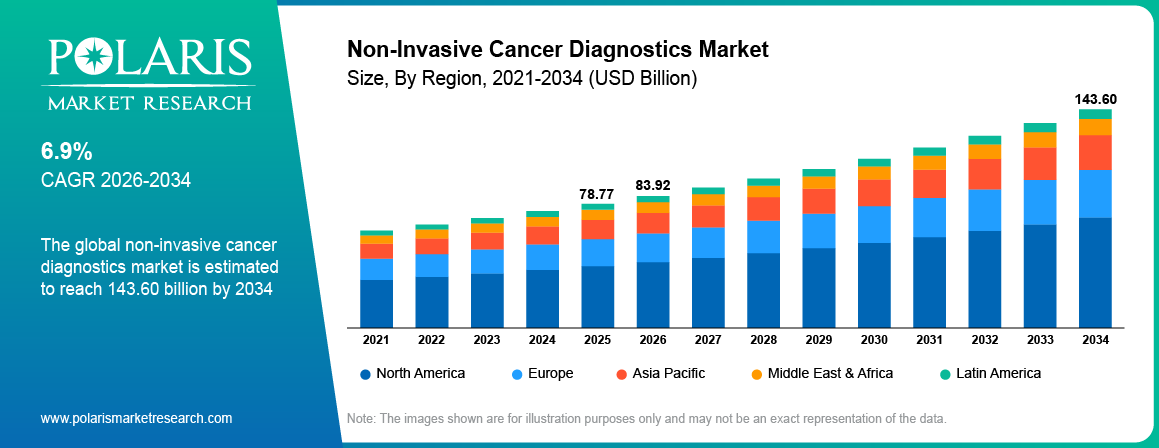
The market is expanding due to rising cancer prevalence, increasing healthcare awareness, and growing adoption of precision medicine. Healthcare providers are focusing on early-stage diagnosis and personalized treatment planning. The rise in funding for oncology research and AI-based health care analytics is aiding in fueling the growth of the industry.
Drivers & Opportunities
Rising Demand for Early Cancer Detection is Driving Market Growth: There is an increase in the emphasis by healthcare providers on early detection of cancer to help improve survival rates and lower treatment costs. In October 2025, OraLiva raised USD 2 million in a seed funding round for developing an AI platform for non-invasive cancer diagnosis via cytology. Non-invasive diagnostic tools facilitate rapid disease diagnosis and patient monitoring. Blood tests for cancer are growing popular in hospitals and oncology centers.
Advancements in Liquid Biopsy Technologies are Accelerating Industry Expansion: The liquid biopsy technologies are becoming highly popular due to the capability of these technologies to identify circulating tumor DNA using minimally invasive methods. The applications of liquid biopsy technologies include monitoring of treatments, recurrence detection, and precision oncology. There is an increase in investment by biotech firms in innovative genomics testing tools.
Restraints & Challenges
Reimbursement and Regulatory Challenges are Limiting Market Growth: The development of advanced cancer diagnostic tools usually comes with high validation and commercialization costs. Some healthcare organizations are exploring reimbursement models for non-invasive oncology testing. Approval delays and varying coverage policies are limiting the adoption of these tools in emerging healthcare markets.
Opportunity
AI-Enabled Diagnostics Platforms are Creating New Growth Opportunities: AI technology is advancing the efficiency and precision of diagnostic platforms for cancer. Pathology and imaging solutions using AI assist healthcare professionals in spotting abnormalities within the tissues. In April 2026, PanGIA Biotech revealed a new non-invasive AI urine-based liquid biopsy that detects prostate cancer with a sensitivity of 97.8%. Growing integration of machine learning algorithms with oncology diagnostics platforms is expected to create long-term market opportunities.
Segmental Insights
The report provides a comprehensive analysis of the non-invasive cancer diagnostics market by technology, cancer type, and end user to identify key revenue generating and high-growth segments.
By Technology
-
Liquid Biopsy
Liquid biopsy segment held substantial market share of 20.45% in 2025 due to increasing demand for blood-based cancer screening technologies. These platforms support early-stage detection and improve patient convenience. Healthcare providers are increasingly adopting circulating tumor DNA testing solutions across oncology workflows.
-
Molecular Diagnostics
Molecular diagnostics segment is projected to grow at the fastest CAGR of 7.7% during the forecast period owing to rising adoption of genomic sequencing and biomarker testing technologies. Hospitals and diagnostic laboratories are integrating next-generation sequencing platforms into precision oncology programs.
By Cancer Type
-
Lung Cancer
Lung cancer segment dominated the market by 30.5% revenue share in 2025 due to rising global incidence of lung cancer and increasing adoption of low-dose CT screening technologies. As per the latest report by World Health Organization shows that lung cancer remained the leading cause of cancer deaths in 2022, with 2.5 million cases and 1.8 million deaths worldwide.[World Health Organization, 'Lung Cancer', who.int] Healthcare providers are expanding investments in oncology imaging and biomarker testing platforms.
-
Colorectal Cancer
Colorectal cancer segment is projected to grow at the fastest CAGR of 7.4% during the forecast period owing to increasing adoption of stool-based and blood-based cancer screening solutions. Rising awareness regarding preventive screening programs is supporting segment growth.
By End User
-
Hospitals
Hospitals segment dominated the market by 44.56% revenue share in 2025 due to increasing oncology testing procedures and rising investments in integrated diagnostics infrastructure. Hospitals are deploying advanced cancer screening technologies to improve clinical workflow efficiency.
-
Diagnostic Laboratories
Diagnostic laboratories segment is projected to grow at the fastest CAGR during the forecast period owing to increasing demand for high-throughput genomic testing and molecular diagnostics services. Laboratories are adopting AI-enabled pathology platforms to improve operational efficiency.
Regional Analysis
North America Non-Invasive Cancer Diagnostics Market Assessment
North America dominated the market by 40.79% share in 2025 driven by strong healthcare infrastructure, increasing oncology research activities, and rising precision medicine adoption. For instance, in February 2026, The US FDA approved Novocure’s Optune Pax, a portable non-invasive TTFields device for treating adults with locally advanced pancreatic cancer.[US Food and Drug Administration, 'FDA Approves First-of-its-Kind Device to Treat Pancreatic Cancer', fda.gov] Moreover, the US remains the leading country in the region due to high adoption of liquid biopsy technologies and strong investments in AI-based cancer diagnostics platforms.
Asia Pacific Non-Invasive Cancer Diagnostics Market Insights
Asia Pacific is projected to grow at the fastest CAGR of 7.5% during the forecast period owing to rising healthcare expenditure, growing cancer prevalence, and increasing diagnostics infrastructure development. The Cancer Atlas by the American Cancer Society reported that Southern, Eastern, and Southeast Asia account for around 9.2 million new cancer cases and 5.1 million cancer deaths annually, representing nearly 50% of the global burden.[The Cancer Atlas, 'Cancer in Southern, Eastern and Southeast Asia', canceratlas.cancer.org] China, India, Japan, and South Korea are witnessing rising adoption of precision oncology and genomic testing technologies.
Europe Non-Invasive Cancer Diagnostics Market Overview
Europe held a significant market 28% share in 2025 due to increasing cancer screening initiatives and growing adoption of molecular diagnostics technologies. The European Commission launched Europe’s Beating Cancer Plan in 2021 with a USD 4.3 billion investment to support cancer prevention, early detection, diagnosis, treatment, and patient care across the EU.[European Health and Digital Executive Agency, 'Spotlight on Cancer Projects Advancing the Fight Against One of Europe’s Biggest Public Health Challenges', ec.europa.eu] Countries such as Germany, UK, and France are expanding oncology reimbursement frameworks and supporting precision diagnostics investments.
Latin America Non-Invasive Cancer Diagnostics Market Overview
Latin America market is witnessing steady growth due to rising healthcare modernization initiatives and increasing investments in oncology diagnostics infrastructure. Countries such as Brazil and Mexico are expanding adoption of cancer screening technologies and molecular diagnostics platforms.
Middle East & Africa Non-Invasive Cancer Diagnostics Market Overview
Middle East & Africa market is experiencing gradual growth driven by improving healthcare infrastructure and rising awareness regarding early-stage cancer detection. UAE, Saudi Arabia, and South Africa are investing in advanced oncology diagnostics technologies.
Competitive Landscape
The non-invasive cancer diagnostics market is moderately fragmented due to the presence of global diagnostics companies and regional biotechnology firms. Competition is based on product innovation, genomic testing capabilities, AI integration, and pricing strategies. Companies are focusing on partnerships, acquisitions, and precision oncology expansion strategies to strengthen market presence.
The prominent players operating in the non-invasive cancer diagnostics market include Bio-Rad Laboratories, Inc., Danaher Corporation, Exact Sciences Corporation, F. Hoffmann-La Roche Ltd., Foundation Medicine, Inc., Guardant Health, Illumina, Koninklijke Philips N.V., QIAGEN N.V., Siemens Healthineers AG, Sysmex Corporation, Thermo Fisher Scientific Inc., and others.
Premium Insights
Growing Shift Toward AI-Enabled Precision Oncology
The future of the non-invasive cancer diagnostics market will increasingly focus on AI-enabled oncology platforms, precision diagnostics, and multi-cancer early detection technologies. An increasing number of patients are diagnosed with early-stage cancers through the use of liquid biopsy, genomic profiling, and AI imaging technology.
Expansion of Decentralized and Home-Based Diagnostics
Another important change within the industry includes the development of distributed cancer screening systems and at-home diagnostic tools. The companies that can combine biomarker tests, artificial intelligence, and molecular diagnostics infrastructure will likely have an advantage in the market in the future.
Key Players
- Bio-Rad Laboratories, Inc.
- Danaher Corporation
- Exact Sciences Corporation
- F. Hoffmann-La Roche Ltd.
- Foundation Medicine, Inc.
- Guardant Health
- Illumina
- Koninklijke Philips N.V.
- QIAGEN N.V.
- Siemens Healthineers AG
- Sysmex Corporation
- Thermo Fisher Scientific Inc.
Industry Developments
- February 2026: The US FDA granted Breakthrough Device designation to ErlySign’s non-invasive saliva-based oral cancer test for early cancer detection. [source: erlysign.com]
- March 2026: Darwin AG launched commercialization of its non-invasive Multi-Cancer Check blood test for early detection of 13 cancer types using liquid biopsy and AI-based multi-omics analysis. [source: darwin-biotech.com]
Non-Invasive Cancer Diagnostics Market Segmentation
By Technology Outlook (Revenue, USD Billion, 2021–2034)
- Liquid Biopsy
- Molecular Diagnostics
- Imaging Diagnostics
- Biomarker Testing
By Cancer Type Outlook (Revenue, USD Billion, 2021–2034)
- Lung Cancer
- Breast Cancer
- Colorectal Cancer
- Prostate Cancer
- Others
By End User Outlook (Revenue, USD Billion, 2021–2034)
- Hospitals
- Diagnostic Laboratories
- Cancer Research Centers
- Specialty Clinics
- Others
By Regional Outlook (Revenue, USD Billion, 2021-2034)
- North America
- US
- Canada
- Europe
- Germany
- France
- UK
- Italy
- Spain
- Netherlands
- Russia
- Rest of Europe
- Asia Pacific
- China
- Japan
- India
- Malaysia
- South Korea
- Indonesia
- Australia
- Vietnam
- Rest of Asia Pacific
- Middle East & Africa
- Saudi Arabia
- UAE
- Israel
- South Africa
- Rest of Middle East & Africa
- Latin America
- Mexico
- Brazil
- Argentina
- Rest of Latin America
Non-Invasive Cancer Diagnostics Market Report Scope
| Report Attributes | Details |
| Market Size in 2025 | USD 78.77 Billion |
| Market Size in 2026 | USD 83.92 Billion |
| Revenue Forecast by 2034 | USD 143.60 Billion |
| CAGR | 6.9% from 2026 to 2034 |
| Base Year | 2025 |
| Historical Data | 2021–2024 |
| Forecast Period | 2026–2034 |
| Quantitative Units | Revenue in USD Billion and CAGR from 2026 to 2034 |
| Report Coverage | Revenue Forecast, Competitive Landscape, Growth Factors, and Industry Trends |
| Segments Covered |
|
| Regional Scope |
|
| Competitive Landscape |
|
| Report Format |
|
| Customization | Report customization as per your requirements with respect to countries, regions, and segmentation. |
Source: Polaris Market Research Analysis
Non-Invasive Cancer Diagnostics Market FAQ's
The global market size was valued at USD 78.77 Billion in 2025 and is projected to reach USD 143.60 Billion by 2034 at a CAGR of 6.9%.
North America dominated the market by 40.79% share in 2025 due to strong healthcare infrastructure and increasing precision oncology investments.
Major companies operating in the market include Bio-Rad Laboratories, Inc., Danaher Corporation, Exact Sciences Corporation, F. Hoffmann-La Roche Ltd., Foundation Medicine, Inc., Guardant Health, Illumina, Koninklijke Philips N.V., QIAGEN N.V., Siemens Healthineers AG, Sysmex Corporation, Thermo Fisher Scientific Inc., and others.
Imaging Diagnostics held the largest market share of 40.3% in 2025 owing to its widespread adoption in cancer screening, diagnosis, staging, and treatment monitoring.
Market growth is driven by the rising number of people diagnosed with cancer, increasing precision oncology adoption rates, and the growing need for diagnostics.
These diagnostic tests are commonly used for cancer screening, genetic profiling, biomarker testing, and monitoring therapy.
The market outlook remains positive due to increasing AI integration, genomic testing expansion, and rising investments in oncology diagnostics infrastructure.
Download Sample Report of Non-Invasive Cancer Diagnostics Market
Please fill out the form to request a customized copy of the research report.


