
Security Solutions Market Size, Share, Trends and Forecast, 2026–2034
REPORT DETAILS
Security Solutions Market Summary
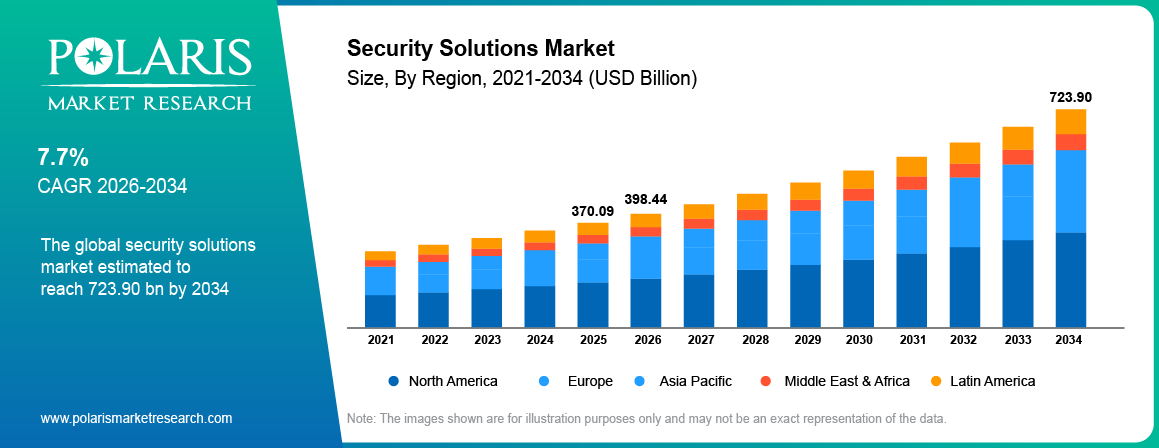
The global security solutions market size was valued at USD 370.09 billion in 2025. The market is projected to grow at an 7.7% CAGR from 2026 to 2034. The rising investments in smart cities globally are driving the demand for security solutions. Increased defense spending by governments worldwide to improve security is another factor shaping the market landscape.
Market Statistics
Key Takeaways
- North America accounted for the largest security solutions market share of 34.20% in 2025. This is owing to significant investments in advanced technology in the region.
- Asia Pacific is projected to witness rapid growth at an 9.20% CAGR. Rapid urbanization and increasing government initiatives towards digitalization drive the regional market growth.
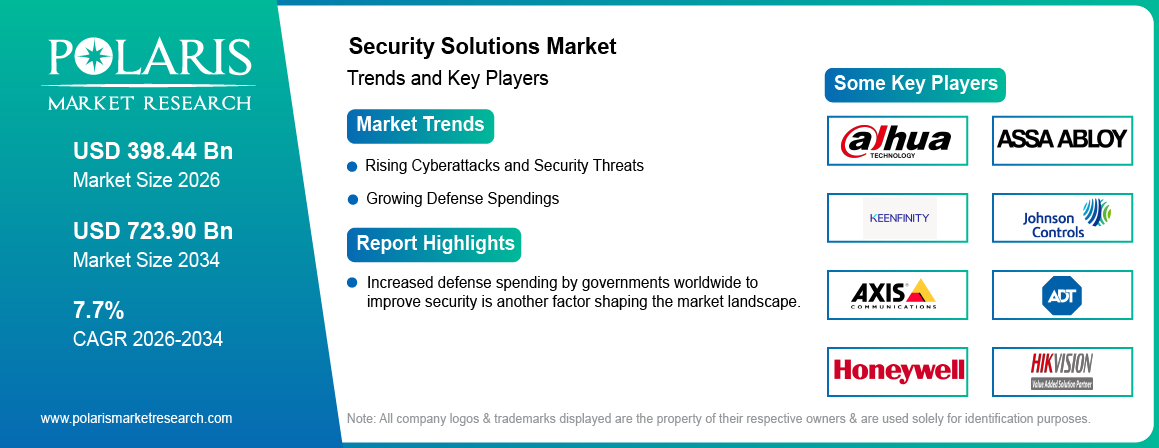
- By offering, the products segment held an 65.30% share in 2025. This is due to the widespread adoption of advanced hardware solutions such as surveillance cameras and access control systems.
- By offering, the services segment is projected to grow at an 9.90% CAGR. The shift towards recurring revenue and cloud management is driving market growth.
- By end user, the commercial segment accounted for an 31.50% security solutions market share in 2025. The segment’s major market share is attributed to high investments in protecting physical and digital business assets.
- By end user, the military & defense segment is projected to grow at an 6.90% CAGR. Increasing international threats and rising defense spending are driving segmental growth.
Note: Figures and projections outlined in this report are the result of Polaris Market Research’s proprietary analytical processes, grounded in the latest available datasets and market observations.
What Are Security Solutions?
Security solutions provide protection against security threats to buildings, facilities, networks, and any sensitive information. Examples of physical security solutions include video surveillance and access control. Digital security solutions protect networks and data from unauthorized access. The kind of security solutions used varies according to the security requirements. For example, banks may need advanced access control levels. On the other hand, manufacturing plants may benefit more from surveillance.
How Security Solutions Work
The operation of the security solutions may be different based on the security system type. The process usually begins with getting an understanding of what the security needs are.
Risk assessment: An analysis of the system is done. This helps in identifying the security gaps. It also provides insight into what needs protection.
System Installation: The selection of the system is done based on the identified gaps. The installation of access devices may be done at strategic points.
Monitoring: The installed system monitors the area. It collects data from the secured zone. The monitoring process may be manual or automatic.
Threat Detection: The system generates an alarm if there is any unusual activity. An alarm may be generated in case of an attempt at unauthorized access.
Response: The security personnel analyze the situation and take appropriate action. In some cases, a system may respond automatically. For example, it may block restricted access points.
Security Solutions Market Dynamics
Security requirements vary among different sectors. There are different requirements for a commercial property than for a military base or a manufacturing unit. Changes in the threat environment and use of connected systems affect the approach towards security solutions. Government investment has led to some demand for security solutions. However, the cost of modernizing infrastructure remains a problem for many buyers.
Growth Driver : Rising Cyberattacks and Security Threats
The increasing frequency of cyberattacks means that there is now a greater need for security solutions than ever before. Cyberattacks on business organizations that affect their network and digital infrastructure and even compromise the private details of their customers pose significant operational risks. This is especially significant because firms have grown more dependent on technology and digital means. The problem is also getting tougher to handle with the use of more innovative means by the perpetrators. As seen in the October 2026 report by India's Computer Emergency Response Team (CERT-In), there were occurrences where artificial intelligence bots gained unauthorized access to the information technology resources of organizations in India. The CERT-In also noted cases of open-source artificial intelligence being used by cyber criminals to perpetrate attacks (source: cert-in.org.in).
Growth Driver : Growing Defense Spendings
With increased military budgets, demand for security solutions is increasing among military and government institutions. Governments are investing in the modernization of their defense facilities with an emphasis on improved surveillance and perimeter security systems. The shift is evident in Europe and Asia. Countries in these regions have increased their military investments as a response to local security challenges. According to the Stockholm International Peace Research Institute (SIPRI), in 2025, the world's total military spending reached USD 2.89 trillion. This represents an increase of 2.9% from 2024. The figures were published in April 2026 (source: sipri.org). The increase in military budget allocations also enables the purchase of modern surveillance and border security systems. Military installations need effective security systems in order to secure their sensitive activities from unauthorized access. This increases the need for security providers that work with military agencies.
Growth Driver : Cloud and IoT Adoption
Companies are changing the way they secure their properties because of the expansion of online operations. Businesses that own several locations can utilize a cloud service that will allow them to check the safety of their properties without establishing security offices in each of them. Advances in technology, supported by Internet of Things devices, make the process even simpler. Connected devices provide information about the state of various parts of the building to the security team. This is especially important when it comes to large production or office facilities where it can be difficult to monitor the work of the safety devices.
Growth Driver : Regulatory Requirements
Data privacy regulations have made security a critical component of compliance. For example, under the GDPR framework, organizations are required to keep personal information safe and demonstrate that they adhere to the data privacy regulations. This is similar to what companies in the United States are required to do under the CCPA framework and HIPAA for the health sector. Financial institutions, healthcare organizations, and other organizations that deal with sensitive documents require appropriate security mechanisms. This has increased the importance of identity management and access control software.
Growth Driver : Growth of Wireless Technologies
Wireless connectivity is also changing how security systems are installed. This is especially the case in places where cable installation can be difficult. Wireless cameras and access control devices do not require much modification to the existing systems for their installation. This is convenient for old commercial properties and large facilities that have multiple locations. Better wireless connectivity also makes it easy for security guards to view camera feeds and get alerts from wherever they happen to be. These aspects make wireless systems a viable alternative for companies upgrading their security systems.
Restraints and Challenges : High Implementation Costs and Integration Issues
The high cost of implementation may act as an impediment for organizations that do not have large amounts of funding. Modern security systems such as surveillance cameras and access control technology require a hefty initial investment. Moreover, the costs do not stop there, as maintenance of systems is imperative, and upgrades are necessary from time to time. This becomes more complicated for old buildings, whose infrastructure may not be compatible with modern technology. Besides all this, it may not be easy to find good staff who can manage security systems effectively. Another issue related to modern security systems is biometric security. It poses privacy issues due to the use of personal information.
Opportunities : Growing Demand for Cloud-Based Security Services
Many enterprises have several locations, which makes it challenging to manage on-site security systems. Thus, remote monitoring services provide an advantage since they enable security staff to monitor facilities from a centralized point. Subscription-based model adoption provides new opportunities for companies that provide VSaaS and ACaaS (security as a service). These services allow enterprises to benefit from surveillance and access control solutions without the need to invest heavily in them. AI-powered video analytics solutions represent yet another opportunity. Security staff can utilize these technologies to analyze footage and detect any suspicious activity.
Opportunities :Security Solutions Market Trends
Security solutions are not limited to individual devices any longer. Companies require security solutions that can exchange information between sites and react to threats in real time. AI and cloud technology advancements are changing the way security professionals manage their operations.
Opportunities : Role of AI in Security Solutions
The use of AI in security solutions is changing the way security personnel manage surveillance and threat detection operations. Conventional CCTV requires individuals to monitor the streams of video from the cameras, which becomes challenging for large premises. AI video analytics helps in analyzing the video content and marking those actions that require attention. For instance, the software can help identify actions in unauthorized zones and at entry points. The security personnel can get notifications on-the-go during the occurrence of events, rather than going through the recorded video afterward. In some cases, the systems can automatically initiate actions such as alerting the control room. These applications are used in airports, factories, and commercial facilities.
Opportunities : Convergence of Physical and Cyber Security
The convergence of physical and cyber security systems has changed how businesses secure their properties. CCTV cameras and access control systems are being networked, and thus cybersecurity becomes an integral part of the physical security system. An integrated security system combines the feeds from cameras and access information in one system. The security personnel can use the system to monitor activities on their premises and detect anything out of the ordinary. If there is a suspicious attempt at access, then that may need to be verified in relation to any activity in the networked system. The physical and cyber security convergence is also making businesses evaluate how they manage their interconnected security devices. Attack surface management helps in finding and monitoring vulnerabilities across these connected devices. A vulnerability in one system could expose other components of the security structure.
Opportunities : Cloud and Managed Security Adoption
The shift to remote and hybrid work environments has changed the way businesses approach security on their premises. Nowadays, a large number of companies require surveillance systems that can be accessed without the presence of security personnel at their site. Cloud technology is useful for monitoring facilities through integrated security software. It is also convenient to manage security in several locations from one centralized location. Many companies opt for subscription-based solutions rather than purchasing and maintaining the necessary equipment. VSaaS and ACaaS (security as a service) provide access to video surveillance and access control using cloud-based services. Confidential computing can provide an additional level of security for data because it protects sensitive data while it is being processed in cloud environments. This model reduces the need for in-house technical support.
Security Solutions vs Cybersecurity Solutions
While security solutions and cybersecurity solutions target different spheres of protection, their tasks might overlap. The sphere of security solutions is related to protecting individuals, property, and premises by using physical methods. Cybersecurity solutions provide protection against any attempts to gain access to digital assets. Currently, physical and cybersecurity solutions are converging. Many companies that use connected security solutions require both physical and digital protection. Below is a table with differences between the two.
| Attribute | Security solutions | Cybersecurity solutions |
| Scope | Physical and digital protection of people, premises, assets, and data | Protection of networks, endpoints, applications, cloud, and data |
| Threats addressed | Intrusion, theft, vandalism, fire, unauthorized access, plus cyberattacks | Malware, ransomware, phishing, data breaches, unauthorized system access |
| Typical offerings | Video surveillance, access and entrance control, intruder alarms, fire protection, thermal cameras, integration and monitoring services | Firewalls, encryption, threat detection, identity management |
| Typical buyers | Commercial, residential, industrial, government, military and defense | IT and security teams across all sectors |
| Relationship | Broader stack in which cybersecurity is one component as systems converge | Subset focused on digital assets |
Source: Polaris Market Research Analysis
Security Solutions Market Segment Insights
| Segmentation Axis | Segments |
| By Offering | Products (Fire Protection · Video Surveillance · Access Control · Entrance Control · Intruder Alarms · Thermal Cameras) · Services (Security Systems Integration · Remote Monitoring Services · Fire Protection Services · Video Surveillance Services · Access Control Services) |
| By End User | Commercial · Residential · Industrial · Government · Military & Defense · Others |
| By Region | North America (US, Canada) · Europe (Germany, France, UK, Italy, Spain, Netherlands, Russia, Rest of Europe) · Asia Pacific (China, Japan, India, Malaysia, South Korea, Indonesia, Australia, Vietnam, Rest of Asia Pacific) · Middle East & Africa (Saudi Arabia, UAE, Israel, South Africa, Rest of Middle East & Africa) · Latin America (Mexico, Brazil, Argentina, Rest of Latin America) |
Source: Polaris Market Research Analysis
By Offering
The products segment accounted for an 65.30% security solutions market share in 2025. Its leading position reflects the direct role of security equipment in building and facility protection. The video surveillance system allows the security system to track events across vast territories. Access control systems prevent unauthorized individuals from entering restricted territories. Moreover, fire protection systems are widely used for detecting fires. Thermal cameras are used by facilities that require surveillance under poor lighting conditions. Many companies also need to upgrade old equipment or cover new premises with surveillance cameras. These needs keep product purchases vital for security investments.
The services segment is projected to grow at an 9.90% CAGR. The demand is increasing due to the need for ongoing support among organizations in managing their security infrastructures. Installation of different security systems often requires technical expertise to ensure that the devices interact with each other. This is where security system integration services come into play. Remote monitoring services enable businesses to monitor their premises without the need for security personnel at all locations. The segment also includes fire protection services, video surveillance services, and access control services. Many organizations are outsourcing the task of maintenance and monitoring of the systems to avoid developing a large in-house team.
| Segment | What it Covers | Typical Buyers | Growth Driver |
| Video surveillance | Cameras, monitors, storage, analytics software | Commercial, government, retail | AI analytics, biometric systems |
| Access control | Readers, controllers, electronic locks, software | Commercial, industrial | Biometric and mobile credentials |
| Entrance control | Gates, turnstiles, barriers | Commercial, government | Perimeter security |
| Intruder alarms | Sensors, panels, alarms | Residential, commercial | Rising safety awareness |
| Thermal cameras | Thermal imaging for low-light detection | Industrial, defense, critical infrastructure | Low-light and perimeter use |
| Fire protection | Detection, suppression, response | Commercial, industrial | Compliance mandates |
| Security systems integration (service) | Design, install, unify multiple systems | Enterprises, government | Complexity of multi-vendor estates |
| Remote monitoring (service) | Off-site alarm and video monitoring | Commercial, residential | Remote work, cloud video |
Source: Polaris Market Research Analysis
By End User
The commercial segment accounted for the largest security solutions market share of 31.50% in 2025. Commercial properties have frequent movement of staff and clients, thus creating a need for access control. Companies need to know who entered their property and ensure that sensitive zones are safe. Video monitoring assists security officers in maintaining oversight of what is happening on a large property. Additionally, there is high demand because of the increase in the number of commercial infrastructures. New office buildings and retail properties need security equipment to become operational. Many companies are also upgrading their systems to use connected security equipment.
The military & defense segment is projected to grow at an 6.90% CAGR. Security requirements in military premises have been increasing as governments continue to provide additional security around their defense structures. Surveillance around perimeters is one critical area that continues to receive investment, especially where premises require controlled access. Additionally, there is increased modernization and upgrades of existing security systems in military installations. Large military complexes need constant surveillance due to large coverage areas, which makes it necessary to have proper surveillance systems. This need has grown through modernization initiatives where military facilities are replacing old security equipment with new ones.
Security Solutions Market Regional Analysis
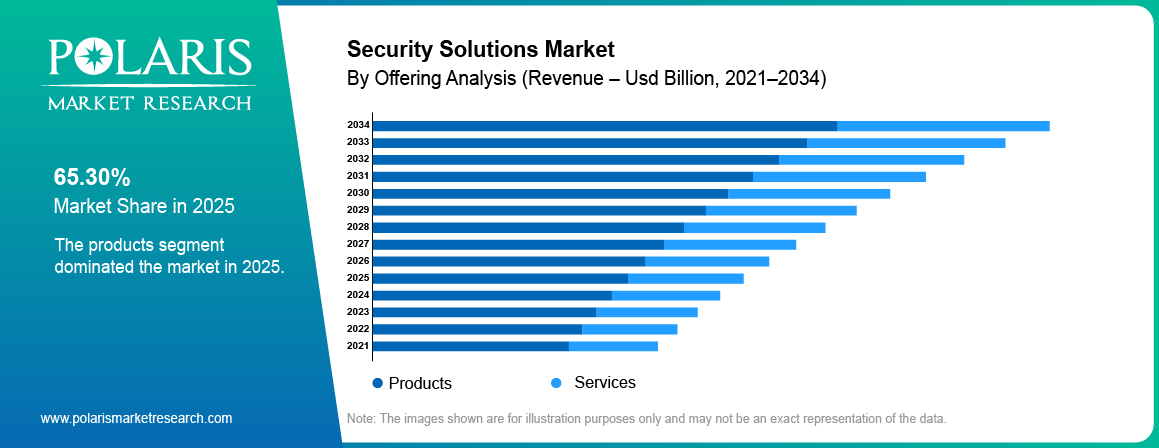
Security solution requirements differ across regions. North America holds the largest market share. The region has a well-established market for security solutions. Demand comes from both private and government institutions. Asia Pacific is projected to witness rapid growth. Rising urbanization and new project development drive regional growth. Regulatory requirements shape the market landscape across Europe. Latin America and the Middle East and Africa are still in the early stages of adoption.
North America
North America accounted for the largest security solutions market share of 34.20% in 2025. The U.S. market is driven by the demand for security at business properties and government facilities. Requirements for the security of federal buildings are also factors that affect the application of these systems. In 2024, the General Services Administration adopted minimum standards for video surveillance and intrusion detection at government-owned buildings under its jurisdiction. Canada has its own requirements for the security of government property. The Royal Canadian Mounted Police provides information about the installation of CCTV cameras and the management of access. There are specific security requirements for nuclear facilities in Canada.
Asia Pacific
Asia Pacific is projected to witness rapid growth at an 9.20% CAGR. Countries such as India, China, Japan, and South Korea are spending more on security as businesses expand their digital operations and governments invest in public infrastructure. The rise in cyberattacks has made data protection a concern for businesses of all sizes. Demand for physical security is also growing as cities expand and more public facilities require surveillance. In May 2026, India and South Korea signed an agreement to strengthen cooperation in defense cybersecurity. This reflects the growing attention to security across the region and adds to the demand for better security solutions.
Europe
Europe held an 24.00% security solutions market share in 2025. Security regulations in the region are influenced by the various laws that govern the safety of buildings and the protection of data. Organizations must have systems that allow for the control of access to places. The use of video surveillance has become widespread in various places, including offices, airports, and shopping facilities. The introduction of the GDPR adds more restrictions to organizations that operate cameras because now they are required to deal with personal data according to the rules about privacy. This influences the way organizations implement surveillance systems.
Latin America and Middle East & Africa
Latin America and the Middle East & Africa are projected to grow at a CAGR of 8.00% and 8.50%, respectively. Latin America and the Middle East and Africa represent two regions that are developing markets for security solutions. The adoption rate increases due to business organizations and public authorities searching for innovative solutions for securing their premises and controlling access to them. In Latin America, the demand comes from commercial premises and public infrastructure where surveillance and access control are needed. In the Middle East, new investments in the development of infrastructure result in growing needs for security solutions. In Africa, the adoption of security solutions differs from one country to another as businesses and public infrastructure gradually adopt innovative solutions.
Competitive Landscape
There is a diverse competitive structure within the security solutions market, where different vendors meet the demands of various customers. Competition includes improvements in products, prices, and service quality. While some companies supply video surveillance or access control equipment, others provide their customers with fully integrated security systems for commercial structures or public places.
Many vendors now integrate software applications and remote monitoring into their portfolio of products to be able to provide security solutions to the customers who require systems at different locations. Another strategy for expanding the market base adopted by vendors is partnerships and entering new regions. The top security solutions companies are trying to ensure compatibility of their products with the existing infrastructure since many businesses want to upgrade but not completely replace their systems.
Vendor Positioning
| Company | Group | Security Solutions Offerings |
| Physical and integrated | Building security is part of Honeywell's broader building automation business. Its security portfolio includes access control and video surveillance systems. | |
| Johnson Controls International plc | Physical and integrated | The C•CURE platform is used to manage building access. The company also has video surveillance and intrusion detection products. |
| KEENFINITY Group | Physical and integrated | Video surveillance and intrusion alarm systems form key parts of its security portfolio. Access control is another area of its business. |
| ADT Inc. | Physical and integrated | Monitored alarm systems are central to ADT's business. Its services also include security cameras and smart home protection. |
| Hangzhou Hikvision Digital Technology Co., Ltd. | Physical and integrated | Video surveillance remains its main business area. The product range includes network cameras and video recording equipment. |
| Zhejiang Dahua Technology Co., Ltd. | Physical and integrated | Surveillance cameras and video recorders make up a major part of Dahua's portfolio. Its range also covers building access systems. |
| Axis Communications AB | Physical and integrated | Network cameras are at the centre of Axis Communications' business. Its portfolio has expanded to include access control and network audio. |
| ASSA ABLOY AB | Physical and integrated | Door opening solutions are the company's main area of business. Electronic locks and digital access products are part of this portfolio. |
| Physical and integrated | Building security forms part of Siemens' Smart Infrastructure business. Its systems cover access management and video surveillance. | |
| Cisco Systems, Inc. | Cyber and network | Network protection is a major part of Cisco's security business. Its portfolio includes firewalls and secure network access products. |
| Fortinet, Inc. | Cyber and network | The FortiGate firewall range is central to Fortinet's business. The company also has products for cloud and industrial network security. |
| Palo Alto Networks, Inc. | Cyber and network | Enterprise network security is a key part of its portfolio. Cloud protection and endpoint security are other major product areas. |
| Thales S.A. | Cyber and network | Cybersecurity is one part of Thales' broader technology business. Its offerings include data encryption and digital identity management. |
| ABB Ltd | Industrial and OT | Industrial cybersecurity sits within ABB's automation business. Its solutions address security risks in industrial control systems. |
| Schneider Electric SE | Industrial and OT | Cybersecurity is part of Schneider Electric's industrial automation portfolio. Its services help protect operational technology systems. |
Source: Polaris Market Research Analysis
Recent Industry Developments
- October 2026: Dahua Technology unveiled a new VSaaS (Video Surveillance as a Service) ecosystem. The ecosystem is aimed at supporting telecom operators and security companies in providing cloud-based video surveillance solutions. (source: dahuasecurity.com)
- October 2026: Fortinet enhanced the capabilities of its Unified SASE platform to provide better security for small office branch networks. In addition, a new FortiGuard service was launched for protecting AI-based applications. (source: fortinet.com)
- October 2026: Hikvision released Quick Pass, a platform providing access control for residential and commercial properties. The platform combines the management of the entry of people and vehicles into a property. (source: hikvision.com)
- October 2026: Honeywell Technologies revealed Forge Cognition. The platform supports the operations of buildings and industries. With Forge Cognition, it will be possible to analyze equipment problems and study building alarms on the basis of real-time facility data. (source: honeywell.com)
- September 2026: Dahua Technology announced the launch of its WizTalk IP video intercom system. The intercom allows combining the functions of visitor interaction and security at residences. (source: dahuasecurity.com)
Future Outlook
The security solutions market forecast 2034 highlights a shift towards connected and intelligent security systems. AI will be used by security teams for reviewing footage and identifying suspicious activity. It will also help reduce the manual effort it takes to respond to potential threats. Cloud-based platforms will make it easier to monitor facilities from different locations. Cloud technology is also being used for the remote management of security equipment. Increased connection of devices to business networks means the line between physical security and cybersecurity may be less distinct. The market is expected to witness increased demand for security systems that can protect physical assets and digital infrastructure.
Research Methodology
Polaris Market Research estimates the global security solutions market using combined top-down and bottom-up approaches. Secondary research establishes scope, market definition, and parent-market context from company annual reports and filings, government and defense-budget publications, industry associations, and trade and technical literature.
Primary research validates these findings through interviews with manufacturers, systems integrators, service providers, and end users across North America, Europe, Asia Pacific, Latin America, and the Middle East & Africa.
The bottom-up build aggregates vendor revenues and segment estimates by offering and end user, while the top-down view cross-checks totals against parent-market data. Data triangulation reconciles both views, and the forecast model documents assumptions on cyberattack incidence, smart-city and defense spending, regulation, and technology adoption.
The base year is 2025. Historical data cover 2021-2024, and forecasts run to 2034. Estimates are reviewed by the report author and reviewer before release and re-checked at each refresh.
Market Segmentation
By Offering Outlook (Revenue, USD Billion, 2021–2034)
- Products
- Fire Protection
- Video Surveillance
- Access Control
- Entrance Control
- Intruder Alarms
- Thermal Cameras
- Services
- Security Systems Integration
- Remote Monitoring Services
- Fire Protection Services
- Video Surveillance Services
- Access Control Services
By End User Outlook (Revenue, USD Billion, 2021–2034)
- Commercial
- Residential
- Industrial
- Government
- Military & Defense
- Others
By Regional Outlook (Revenue, USD Billion, 2021–2034)
- North America
- US
- Canada
- Europe
- Germany
- France
- UK
- Italy
- Spain
- Netherlands
- Russia
- Rest of Europe
- Asia Pacific
- China
- Japan
- India
- Malaysia
- South Korea
- Indonesia
- Australia
- Vietnam
- Rest of Asia Pacific
- Middle East & Africa
- Saudi Arabia
- UAE
- Israel
- South Africa
- Rest of Middle East & Africa
- Latin America
- Mexico
- Brazil
- Argentina
- Rest of Latin America
Security Solutions Market Report Scope
| Report Attributes | Details |
| Market Size Value in 2025 | USD 370.09 billion |
| Revenue Forecast in 2026 | USD 398.44 billion |
| Revenue Forecast by 2034 | USD 723.90 billion |
| CAGR | 7.7% from 2026 to 2034 |
| Base Year | 2025 |
| Historical Data | 2021–2024 |
| Forecast Period | 2026–2034 |
| Quantitative Units | Revenue in USD billion and CAGR from 2026 to 2034 |
| Report Coverage | Revenue Forecast, Market Competitive Landscape, Growth Factors, and Trends |
| Segments Covered |
|
| Regional Scope |
|
| Competitive Landscape |
|
| Report Format |
|
| Customization | Report customization as per your requirements with respect to countries, regions, and segmentation. |
Source: Polaris Market Research Analysis
Security Solutions Market FAQ's
The security solutions market size was valued at USD 370.09 billion in 2025. The market is projected to reach USD 723.90 billion by 2034.
The market is projected to account for a CAGR of 7.7% from 2026 to 2034.
North America accounted for the largest market share of 34.20% in 2025. Significant investments in advanced technology drive the region’s leading position. The market also benefits from increased security requirements across government and private sectors.
Key players include Honeywell International Inc.; Johnson Controls International plc; KEENFINITY Group; ADT Inc.; Hangzhou Hikvision Digital Technology Co., Ltd.; Zhejiang Dahua Technology Co., Ltd.; Axis Communications AB; ASSA ABLOY AB; Siemens AG; Cisco Systems, Inc.; Fortinet, Inc.; Palo Alto Networks, Inc.; Thales S.A.; ABB Ltd; and Schneider Electric SE.
The products segment held an 65.30% security solutions market share in 2025. Its dominant position reflects the direct role of security equipment in building and facility protection.
Security solutions refer to software and services that help protect people, property, machinery, and other assets. This involves video surveillance, access control, intrusion detection, and fire protection. Companies use these solutions to monitor their properties as well as control access to certain premises.
One of the main drivers for market growth is the necessity of protecting commercial properties and infrastructure. Apart from that, companies are implementing interconnected systems that enable remote monitoring. Artificial intelligence is becoming a part of surveillance. It helps security teams detect unusual behavior.
There are several industries that implement security solutions. Banking, healthcare, retail, manufacturing, transport, and government organizations all require such systems to ensure the safety of their properties. Their demands vary depending on the type of property and access control.
Security solutions primarily safeguard individuals and other physical property using technology like cameras and access control systems. Cybersecurity entails the safeguarding of data and computer systems from any unauthorized access attempts. Connected security systems may need both types of protection.
The use of AI for surveillance and the convergence of physical and cybersecurity solutions are expected to influence the security system market through 2034. The market is also expected to benefit from business requirements to monitor multiple facilities from a single interface.

Download Sample Report of Security Solutions Market
Please fill out the form to request a customized copy of the research report.


