
Confidential Computing Market Size, Share, Trends & Forecast, 2026–2034
REPORT DETAILS
Confidential computing Market Summary
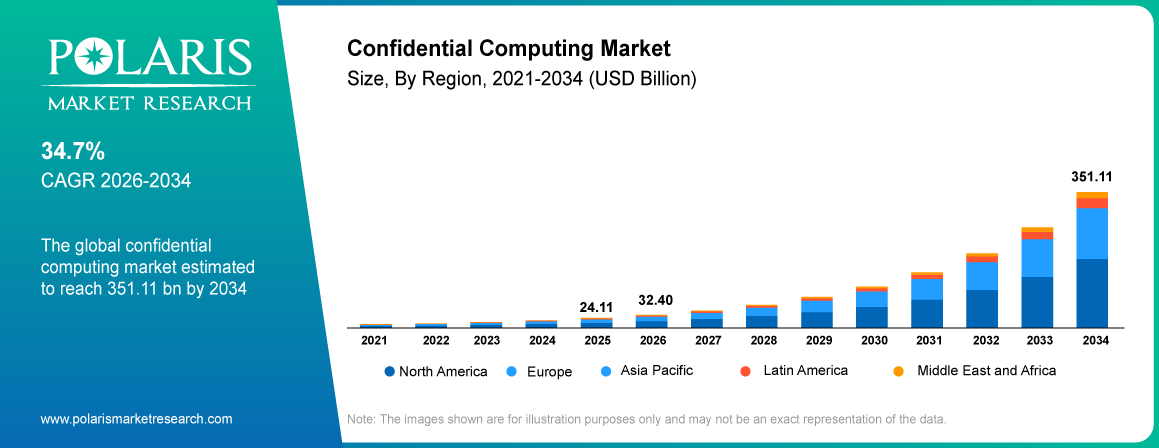
The global confidential computing market size was valued at USD 24.11 billion in 2025. The market is projected to grow at an 34.7% CAGR from 2026 to 2034. The rising prevalence of cyberattacks and growing concerns related to data privacy are a few of the key factors shaping the confidential computing market landscape.
Market Statistics
Key Takeaways
- North America led the global confidential computing market with an 51.6% share in 2025. The presence of a robust ecosystem of technology companies and cloud providers contributes to the regional market dominance.
- Asia Pacific is projected to grow at an 38.6% CAGR. Rising awareness of data privacy risks has increased the need for confidential computing in the region.
- By component, the service segment led with an 64.03% confidential computing market share in 2025. There has been an increased demand for software solutions as organizations adopt advanced data processing technologies.
- By application, the privacy & security segment held an 58.4% share in 2025. The growing need for robust data protection solutions contributes to the segment’s leading share.
- By deployment, the on-premises segment is projected to grow at an 32.9% CAGR. The rise of hybrid IT environments is driving rapid growth of the segment.
Note: Figures and projections outlined in this report are the result of Polaris Market Research’s proprietary analytical processes, grounded in the latest available datasets and market observations.
What Is Confidential Computing?
Confidential computing is a security approach that enables secure data processing during the computation phase. The encryption utilizes trusted execution environments (TEE), which help to isolate the workloads in such a way that they are protected from any interference from other processes that run in the same infrastructure. This allows companies to process their sensitive data in edge, shared, and cloud computing environments.
How Confidential Computing Works?
Environment verification: Attestation of the TEE takes place prior to allowing sensitive data or workloads to execute.
Data entry: Sensitive data is transmitted to a secure area of the computer system.
Workload processing: The program executes inside a trusted execution environment (TEE). No other programs or systems have direct access to the data being computed.
Memory protection: The TEE secures the data stored in memory while executing. It decreases the likelihood of the exposure of data during computation.
Result delivery: The program completes its execution and sends the requested result to the user or system.
Confidential Computing vs. Traditional Encryption
The key distinction in confidential computing vs encryption at rest is when protection is applied. In the case of standard encryption, data is protected during storage and transmission but has to be decrypted before it can be used by an application. In confidential computing, protection is added to that phase through the use of trusted execution environment (TEE).
| Aspect | Traditional Encryption | Confidential Computing |
| Protection stage | Data at rest or in transit | Data in use |
| Processing | Data is typically decrypted during processing | Data remains isolated while being processed |
| Core mechanism | Encryption and key management | Hardware-based trusted execution environment |
| Infrastructure exposure | Decrypted data may be accessible to the processing environment | TEE restricts access from the host system and other workloads |
| Main purpose | Protect stored data and data moving between systems | Protect sensitive workloads during computation |
| Role in security | Covers storage and communication risks | Adds a protection layer for the processing stage |
| Deployment context | Databases, storage systems, backups, and networks | Cloud, multi-tenant, edge, and shared computing environments |
Source: Polaris Market Research Analysis
Core Technology Components
Confidential computing relies on the use of multiple hardware and software elements in order to separate workloads and ensure their integrity. Trusted execution environments represent the key security layer, whereas memory encryption serves to limit access to data during processing. Remote attestation is used by the system to prove the security of the computing environment.
| Component / Technology | How it Supports Confidential Computing |
| Intel Software Guard Extensions (SGX) / Intel Trust Domain Extensions (TDX) | Intel SGX creates protected enclaves for specific application workloads. Intel TDX extends confidential computing to virtual machines by isolating guest workloads from the host environment. |
| AMD Secure Encrypted Virtualization-Secure Nested Paging (SEV-SNP) | AMD SEV-SNP protects virtual machines through memory encryption and adds checks that help prevent unauthorized modification of guest memory. |
| ARM Confidential Compute Architecture (CCA) / TrustZone | ARM CCA creates isolated realms for confidential workloads. TrustZone separates trusted and normal execution environments, mainly for security-sensitive functions on ARM-based systems. |
| Remote attestation | Remote attestation provides evidence about the hardware and software state of a protected environment. A remote party can use this information to decide whether sensitive data should be released. |
Source: Polaris Market Research Analysis
Confidential Computing Market Dynamics
Driver : Rising Risk of Cyberattacks on Cloud Workloads
With the rise of cyberattacks, the need to secure sensitive workloads in addition to securing networks and storage is becoming imperative. In cloud computing, data can be exposed while being processed since workloads are executed using shared infrastructure. Confidential computing addresses this issue through isolation and protection of data even while being processed. This is especially pertinent for industries like financial services, healthcare, government, and many others that deal with highly sensitive data. In March 2026, Microsoft revealed the general availability of Azure Confidential Computing virtual machines for use in U.S. government environments (source: microsoft.com). Such developments demonstrate how cloud vendors are now building confidential infrastructure into systems that have heightened security needs. As companies adopt more sensitive applications on their cloud computing systems, security from malicious software and infrastructure becomes increasingly important.
Driver : Growing Need to Protect Data Privacy During Processing
Privacy needs have evolved not only to safeguard stored records and data that is transferred from one system to another. Companies require solutions that can restrict exposure of any sensitive data that is being analyzed or processed using cloud-based applications. Confidential computing market solutions help meet these needs as the data remains isolated in a secure environment while being processed. There are applications such as collaborative analysis, AI inferencing, and healthcare data processing where companies may need to use the data without disclosing any details about the data. In June 2026, Google Cloud highlighted the extension of its confidential computing capabilities to the G4 series with NVIDIA RTX PRO 6000 Blackwell Server Edition GPUs (source: cloud.google.com). The extension of the above solutions indicates that privacy protection is expanding into high performance computation rather than being confined to traditional cloud computing only.
Restraints & Challenges : High Implementation Complexity
Confidential computing can be challenging to implement in the existing information technology infrastructures. Organizations may need to make adjustments to their software so that it works in a trusted execution environment. In addition, confidential computing can also require specific hardware and compatible cloud providers. These may lead to longer deployment times as well as increased technical effort. Moreover, there is a need for teams with an understanding of workload isolation, attestation, and secure key management. Such technical needs become more difficult to handle when the firm has legacy applications in place. Thus, the technical requirements may become a barrier to adoption for organizations that lack expertise in confidential computing.
Opportunities : Confidential Containers and Cloud-Native Workloads
The transition to containers and Kubernetes opens up possibilities for confidential computing market providers outside of traditional VMs. Most businesses today operate their applications as more lightweight workloads, instead of monolithic applications. Confidential containers can provide hardware isolation for such cloud-native workloads. This provides developers with a mechanism to include confidential computing into applications without having to redesign the whole application based on a specific architecture. This concept can also work for workloads that need to be transferred from one cloud environment to another. The integration with Kubernetes can help to manage confidential workloads more efficiently. Thus, there is an opportunity for cloud providers, container security companies, and software providers to integrate confidential computing into existing cloud-native services. It can also provide additional protection when combined with zero trust security methods.
Opportunities : Confidential Computing for Federated Learning
Confidential computing has a use case in federated learning. Federated learning allows the system to learn on multiple datasets without moving all the data to one centralized location. Confidential computing can serve as an additional execution environment in which the sensitive parts of the federated learning process can be conducted. This approach is useful in cases when companies need to develop their models using the data owned by other organizations or business units. Organizations can use such approaches to build models in collaboration without data pooling. It can be used, for example, by financial companies, health organizations, or research groups. This application is not limited to data protection. It can also serve as a new type of collaboration model in which companies can provide computing power or data without making them generally available.
Trends : Greater Adoption of Confidential Containers
Confidential containers have attracted significant interest as enterprises look for ways to secure containerized workloads while in use. This involves the use of hardware-level isolation for containerization rather than securing only traditional virtual machines. This can prove helpful for cloud-native apps dealing with confidential data. Cloud platform support has also made it easier to deploy confidential containers for enterprise workloads. This solution is important for companies that want to secure their containerized apps without changing the app's architecture.
Impact of Generative AI & AI-Workload Security
Generative AI is increasing the amount of sensitive information processed by cloud and shared computing environments. Enterprise AI workloads may use proprietary models, customer records, internal documents, and other confidential data. This creates security concerns during model training and inference, when data must be available to the AI system for processing.
Confidential computing provides a way to protect these workloads while they are in use. Trusted execution environments can isolate AI processes from the underlying host and other workloads. This can help reduce exposure of training data, model parameters, and inference inputs.
Confidential AI has also helped in the adoption of hardware-based security in AI research and deployment. These solutions can be used by organizations while working on sensitive data sets in third-party infrastructures. Secure AI training has become highly relevant in cases where an organization needs to train its models on proprietary data without exposing the entire data set.
Confidential computing market solutions can also ensure that AI inference is performed securely by protecting prompts, input data, and interim data. As more organizations adopt generative AI in cloud infrastructures, these considerations have increased the significance of confidential computing in AI workloads.
Market Segmentation Analysis
By Component
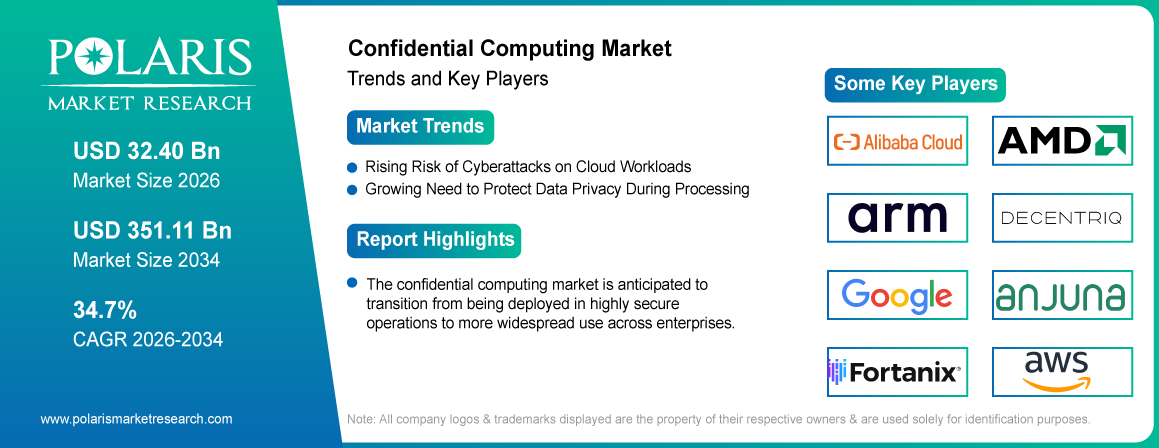
The software segment accounted for the largest confidential computing market share of 44.15% in 2025. The segment has benefited from the requirement for software solutions to aid in the implementation and management of confidential computing environments. These are used by firms to modify their applications in order to fit within trusted execution environments, as well as to manage workloads between cloud and on-premises infrastructure. In addition, the software can be used for incorporating confidential computing into security and virtualization solutions that are already in place. The availability of solutions in various computing environments has facilitated adoption by different firms with varying IT infrastructures. The increasing demand for these solutions is also related to the rising use of cloud infrastructures, which require firms to put in more controls to secure sensitive workloads during processing.
The hardware segment is projected to grow at an 34.76% CAGR. The segment’s growth is driven by increasing usage of processors and computing platforms equipped with security capabilities to perform confidential operations. Hardware provides the underlying environment for the isolation of sensitive information when applications run. Furthermore, another driving factor behind the increased demand is the deployment of confidential computing in cloud data centers and enterprises. Increasingly, confidential computing needs are being considered by companies when upgrading their infrastructure due to the migration of sensitive workloads to shared and virtualized environments. Enhanced capabilities of processors in confidential computing are also helping vendors cater to various workload needs.
By Deployment
The cloud segment accounted for the largest confidential computing market share of 61.8% in 2025. Its dominance can be attributed to the rising deployment of cloud infrastructure for workloads that process sensitive business and client information. Businesses usually share physical infrastructure with other consumers in a cloud environment, and thus there is an increased need to safeguard workloads from any unauthorized access. Confidential computing provides hardware isolation for data processing, adding extra security to workloads. Confidential computing technology has also become more widely available through confidential virtual machines and other computing environments from cloud providers, making it easier to deploy within existing cloud infrastructure. The versatility of cloud infrastructure and confidential computing as a service (CCaaS) has enabled businesses to implement confidential computing without investing in private on-premises infrastructure.
The on-premises segment is projected to grow at an 32.9% CAGR. The demand for on-premises confidential computing is driven by enterprises that want to keep the processing of sensitive workloads in-house. With this kind of environment, there is more control over the hardware, data access, and security policies. This is applicable to companies that have strict security measures internally or sensitive workloads that could not be migrated to the public cloud. Furthermore, the on-premises environment can be incorporated with current data centers, which can enable the organization to build confidential computing into the upgrade of its hardware and security.
By Enterprise Type
The large enterprises segment led with an 70.45% confidential computing market share in 2025. Larger companies usually maintain complex IT setups that comprise numerous applications, cloud computing services, and data solutions. This increases the demand for the protection of confidential workloads being processed. Confidential computing provides organizations with isolation of workloads and restricted access from the infrastructure itself. Larger companies also usually deal with larger amounts of confidential business and client data, thus having a greater need for protection of data during computations. Moreover, the adoption of this technology is facilitated by the ability of large companies to invest in specialized infrastructure and security solutions. All of these factors have contributed to the segment’s leading share in the global market.
The SMEs segment is projected to grow at an 37.2% CAGR. Smaller firms are adopting cloud computing and outsourced IT infrastructure for workloads that process business and customer data. With the workloads moving out of internally managed facilities, SMEs require security solutions that can ensure protection of the data in the processing phase. Cloud-based confidential computing offers access to hardware-supported workload protection without any need for the firm to create an independent security environment. This makes the technology relevant to SMEs lacking substantial internal infrastructure. Increased awareness about data protection needs is also prompting small businesses to seek enhanced security solutions for their workloads. Adoption by SMEs is expected to rise as cloud service providers make confidential computing features more accessible.
By Application
The privacy & security segment dominated the global confidential computing market with an 58.4% share in 2025. Demand for the segment is linked with the need to ensure information confidentiality during processing. Enterprises leverage confidential computing to secure access to their data and workloads running on common or external infrastructures. It is especially important in view of increasing application migration to cloud services and outsourcing computation processes to third parties. Confidential computing can provide an additional layer of protection for data at the processing stage when standard encryption techniques are not enough. Another factor that positively impacts the segment is the increasing awareness regarding data privacy in several industries that deal with confidential information about customers and companies' finances. All of these factors support the leading market position of privacy & security applications.
The multi-party computing segment is projected to grow at an 36.5% CAGR. The growth is facilitated by the expansion of digital workflows that involve multiple enterprises. Businesses increasingly rely on third-party entities in terms of conducting transactions, obtaining specialized services, conducting research, and operating technology infrastructures. It requires computing infrastructures that allow common security policies to apply across different enterprises and their IT infrastructures. The adoption is also relevant in industries where the use of contract controls and compliance measures affects the management of technology infrastructures. Better cloud infrastructure could ease the deployment of such technologies by allowing coordination between multiple enterprises involved in these arrangements. This could decrease the necessity for separate infrastructures and facilitate the use of multi-party computing environments.
By End Use
The BFSI segment dominated the confidential computing market with an 46.30% share in 2025. The finance industry deals with sensitive data in a range of processes, including banking, transactions, loans, and investments. For all these activities, there is a need for robust control over the systems used for processing financial information. Confidential computing can assist financial businesses in implementing hardware-based protection for sensitive workloads using modern IT infrastructure. Adoption is further fueled by the use of digital banking platforms as well as third-party technology services in the industry. In addition to this, security solutions that can easily integrate into the current computing infrastructure are being considered by banks and financial institutions. The need to secure critical workloads while retaining operational flexibility has been driving confidential computing adoption in the BFSI industry.
The healthcare & life sciences segment is projected to account for an 35.8% CAGR. Growth is driven by the rising adoption of digital technologies in healthcare delivery, pharmaceutical research, and clinical development. These segments include confidential health data, research data, and proprietary data that should only have authorized access. Confidential computing can serve as another way to secure workloads used in these environments. Confidential computing can also be applied by pharmaceuticals that cooperate with third-party research firms and technology suppliers. With the modernization of the IT architecture in healthcare, confidential computing can be included in the system used for data processing and research. Rising adoption of digital technologies in healthcare and life science platforms is expected to support demand for confidential computing in this industry.
Segmentation Comparison
| Segment Category | Leading Segment | Fastest/Rapidly Growing Segment | Why It Matters |
| Component | Software | Hardware | Cloud providers are packaging TEEs as managed services |
| Deployment | Cloud | On-premises | Hybrid IT is pulling workloads toward cloud-native confidential VMs |
| Enterprise Type | Large Enterprises | SMEs | Larger companies usually maintain complex IT setups |
| Application | Privacy & Security | Multi-Party Computing | Cross-company data collaboration is the newest high-growth use |
| End Use | BFSI | Healthcare & life sciences | Fraud detection and supply-chain collaboration are pulling in new verticals |
Source: Polaris Market Research Analysis
Real-World Confidential Computing Use Cases
| Real-World Use Case | Buyer-Side Application |
| Financial analytics | Banks may use confidential computing during the process of financial analytics while working with confidential data using infrastructure controlled by an independent third party. |
| Medical research | The companies that are engaged in the development and research of medicines and pharmaceutical products may use confidential computing in order to perform sensitive actions with research and medical data. |
| Digital identity services | The providers of digital identity services may use confidential computing while performing verification actions related to personal and authentication data. |
| Business-to-business supply chain orchestration | Some particular workloads of supply chain related to the processing of commercially sensitive information can be leveraged using confidential computing. |
| Device management | The sensitive actions performed by remote devices may be executed in a safe manner using confidential computing at the edge. |
| Confidential AI training | Companies can use confidential computing to train AI models on sensitive internal data without exposing that data to the underlying infrastructure. The approach is also relevant for AI agents that need to work with private company data. |
Source: Polaris Market Research Analysis
Regional Analysis
North America
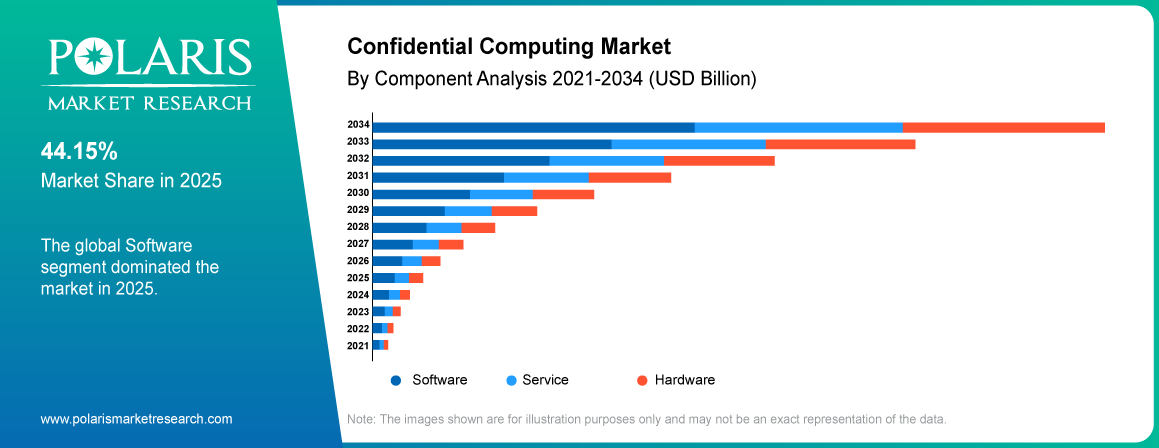
North America dominated the confidential computing market with an 51.6% share in 2025. There is a high level of adoption of cloud infrastructure and enterprise computing technology in this region. Also, large companies in the U.S. and Canada are adopting security systems that help deal with risks associated with workloads deployed on external infrastructure. The presence of major cloud and technology providers contributes to the availability of confidential computing solutions and corresponding hardware. The demand for confidential computing is also driven by its application in industries such as finance, healthcare, and technology. Furthermore, investments in data security and infrastructure improvements contribute to the development of a favorable environment for market adoption.
Asia Pacific
Asia Pacific is projected to witness the fastest growth at an 38.6% CAGR. There is a growing deployment of cloud services and digital infrastructure in the region among leading economies. Corporations have begun using connected infrastructure and online platforms, thereby raising the number of workloads that need more robust security controls. Initiatives taken by the government in terms of digital infrastructure and data security have been driving investments in secure computing. Additionally, the presence of large technology markets such as China, Japan, South Korea, and India is driving regional demand. The adoption of computing infrastructure is expected to create additional opportunities for confidential computing solutions providers.
Europe
Europe accounted for an 19.7% share of the global confidential computing market in 2025. Demand in the region is supported by increasing adoption of cloud business applications and digital infrastructure. Enterprises in Europe have also been focusing on securing sensitive workloads due to increasingly distributed computing infrastructure. There is a solid presence of organizations, including banks, hospitals, and technology enterprises, that run systems that process sensitive data. Requirements for data protection also prompt companies to evaluate their approach to managing sensitive workloads in their internal and external infrastructure. Technology providers and cloud platforms in Europe are expanding access to security-focused computing solutions. These factors are driving market growth in the region.
Latin America
The Latin America confidential computing market is projected to grow at an 32.4% CAGR. Adoption of confidential computing is being facilitated by the ongoing shift towards cloud applications and digital business services. Organizations are also modernizing their IT infrastructure to facilitate online banking, digital payments, electronic commerce, and other technology-based operations. This is creating the demand for security solutions that can be implemented for workloads hosted on shared or outsourced infrastructure. Financial services and telecommunications are among the industries where secure computing could assist in the increasing use of digital platforms. The availability of cloud services is also improving in major countries, making it easier for local companies to access advanced security technology. These developments are expected to facilitate gradual adoption of confidential computing in Latin America.
Middle East & Africa
The Middle East & Africa confidential computing market is projected to grow at an 30.8% CAGR. Growth is facilitated by increased investments in cloud infrastructures and digital transformations throughout the region. Companies are adopting digital platforms in areas of financial services, government, telecommunications, and others that involve dealing with sensitive workloads. Also, the development of data centers in the region is providing access to advanced IT infrastructures. Businesses are becoming more concerned about security with an increase in applications and data in the cloud or distributed systems. This creates the need for technologies that can offer enhanced security while executing workloads. Increased investments in digital infrastructures are expected to support the adoption of confidential computing in the Middle East & Africa.
Competitive Landscape & Key Players
In the confidential computing market, there are both established technology suppliers and specialized security vendors. Competition is driven by the differences in product portfolio, platform compatibility, and supported workloads. Suppliers continue to diversify their portfolios in terms of processor types, cloud services, software tools, and security platforms. Partnerships between infrastructure suppliers and security technology suppliers contribute to extending vendors' market presence. Vendors concentrate on developing products that enable handling diverse workloads and simplify adoption across current IT infrastructures.
Some vendors rely on wide portfolios of infrastructure solutions to be competitive in the confidential computing market; others specialize in confidential computing itself. Vendors can differentiate by supporting various processor architectures and clouds. Additionally, vendors develop developer tools and management features to support the adoption of confidential computing. Vendors leverage product diversity and ecosystem support to differentiate themselves for potential customers focused on performance, compatibility, and deployment.
Confidential Computing Technology & Vendor Positioning
| Company | HQ | Core Confidential Computing Offering |
| Advanced Micro Devices, Inc. (AMD) | Santa Clara, U.S. | AMD SEV-SNP for protecting virtual machines |
| Alibaba Cloud | Hangzhou, China | Confidential computing services based on Intel TDX and Dragonwell Enclave |
| Seattle, U.S. | AWS Nitro Enclaves for isolated application environments | |
| Anjuna Security Inc. | Palo Alto, U.S. | Anjuna Confidential Cloud for deploying applications in confidential environments |
| Arm Limited | Cambridge, U.K. | Arm Confidential Compute Architecture (CCA) and Realm Management Extension |
| Decentriq | Zurich, Switzerland | Confidential computing-based data clean rooms |
| Santa Clara, U.S. | Confidential Computing Manager for managing TEE-based workloads | |
| | Mountain View, U.S. | Confidential VMs, Confidential GKE, and Confidential Space |
| Habu Inc. (Ecosystem/Technology Partner) | San Francisco, U.S. | Habu Data Clean Room with confidential computing for privacy-preserving data collaboration |
| IBM | Armonk, U.S. | IBM Secure Execution for Linux |
| Inpher (Emerging Pure-Play Confidential-AI Vendor) | New York, U.S. | SecurAI for confidential AI inference |
| Intel Corporation | Santa Clara, U.S. | Intel SGX and Intel TDX |
| LiveRamp | San Francisco, U.S. | Confidential Computing Clean Rooms |
| Microsoft | Redmond, U.S. | Azure Confidential Computing and confidential VMs |
| NVIDIA Corporation | Santa Clara, U.S. | NVIDIA Confidential Computing for GPU-based workloads |
| SAP SE (Ecosystem Partner) | Walldorf, Germany | Confidential computing capabilities for SAP cloud environments |
| Saudi Information Technology Company (SITE) (Regional Partner) | Riyadh, Saudi Arabia | Confidential computing services through its security technology ecosystem |
| Swisscom | Bern, Switzerland | Confidential computing for secure cloud-based data processing |
Source: Polaris Market Research Analysis
Industry Developments
- September 2026: VMware announced the general availability of VMware Cloud Foundation (VCF) 9.1.1. Alongside this release, VMware detailed the platform’s matured, generally available Confidential Computing capabilities, including step-by-step operational architectures for Intel Trust Domain Extensions (TDX) and AMD SEV-SNP. (source: vmware.com)
- August 2026: Alibaba Cloud published an updated guide for building confidential computing environments with Intel TDX on Elastic Compute Service. The update provides instructions for deploying TDX-based confidential virtual machines on Alibaba Cloud infrastructure. (source: alibabacloud.com)
- June 2026: Anjuna launched Anjuna Overwatch, a control layer designed for confidential computing environments. The offering provides a way to manage and protect workloads running across confidential infrastructure. (source: prnewswire.com)
Future Outlook
The confidential computing market is anticipated to transition from being deployed in highly secure operations to more widespread use across enterprises. Confidential computing capabilities are becoming more widely available through cloud platforms, which may facilitate adoption by companies that use cloud infrastructure. Also, the hardware support is widening across different architectures, giving enterprises a greater choice in selecting their confidential computing environment.
Over time, confidential computing is expected to become more closely integrated with existing cloud security and workload management solutions. Additionally, adoption is anticipated to vary depending on the type of workload because enterprises will consider whether data processing needs to be protected depending on the level of information sensitivity. Regulatory demands and cross-organizational computing needs can further support demand in industries dealing with restricted data.
Research Methodology
This report's estimates are built on a triangulated, top-down and bottom-up approach that combines primary and secondary research. Secondary research draws on company annual reports, investor presentations, regulatory filings, and industry association data to size the overall confidential computing ecosystem and validate historical revenue for key hardware, software, and service providers. Primary research consists of structured interviews with C-level executives, product and security leaders, and channel partners across hyperscale cloud providers, semiconductor vendors, and independent confidential computing software companies, used to validate assumptions on segment splits, regional adoption rates, and forward growth drivers.
Market sizing reconciles the top-down view (total addressable cybersecurity and cloud infrastructure spend) with a bottom-up view (unit shipments of TEE-enabled processors and confidential VM instance adoption) to arrive at a consensus estimate for each segment and region. Forecasts are modeled using historical growth trends, macroeconomic indicators, regulatory catalysts (such as data-sovereignty and AI-governance rules), and expected technology cost curves for secure hardware enclaves. All figures are cross-validated against at least two independent data sources before inclusion, and estimates are revisited at each report refresh cycle to reflect newly disclosed vendor revenue, M&A activity, and shifts in cloud hyperscaler roadmaps.
Confidential Computing Market Segmentation
By Component Outlook
- Hardware
- Software
- Services
By Deployment Outlook
- On-premises
- Cloud
By Enterprise Type Outlook
- SMEs
- Large Enterprises
By Application Outlook
- Privacy & Security
- Blockchain
- Multi-party Computing
- IoT & Edge
- Personal Computing Devices
- Other Applications
By End Use Outlook
- BFSI
- Government & Defense
- Healthcare & Life Sciences
- IT & Telecommunications
- Manufacturing
- Retail & Consumer Goods
- Others
By Regional Outlook
- North America
- US
- Canada
- Europe
- Germany
- France
- UK
- Italy
- Spain
- Netherlands
- Russia
- Rest of Europe
- Asia Pacific
- China
- Japan
- India
- Malaysia
- South Korea
- Indonesia
- Australia
- Vietnam
- Rest of Asia Pacific
- Middle East & Africa
- Saudi Arabia
- UAE
- Israel
- South Africa
- Rest of Middle East & Africa
- Latin America
- Mexico
- Brazil
- Argentina
- Rest of Latin America
Confidential Computing Market Report Scope
| Report Attributes | Details |
| Market Size Value in 2025 | USD 24.11 billion |
| Market Size Value in 2026 | USD 32.40 billion |
| Confidential Computing Market Forecast 2034 | USD 351.11 billion |
| CAGR | 34.7% from 2026 to 2034 |
| Base Year | 2025 |
| Historical Data | 2021–2024 |
| Forecast Period | 2026–2034 |
| Quantitative Units | Revenue in USD billion and CAGR from 2026 to 2034 |
| Report Coverage | Revenue Forecast, Market Competitive Landscape, Growth Factors, and Industry Trends |
| Segments Covered |
|
| Regional Scope |
|
| Competitive Landscape |
|
| Report Format |
|
| Customization | Report customization as per your requirements with respect to countries, regions, and segmentation. |
Source: Polaris Market Research Analysis
confidential computing market FAQ's
The confidential computing market size was valued at USD 24.11 billion in 2025. The market is projected to reach USD 351.11 billion by 2034.
The market is projected to account for a CAGR of 34.7% from 2026 to 2034.
North America dominated with an 51.6% share in 2025. This is due to the presence of several established technology companies in the region.
The on-premises segment is anticipated to register the fastest growth at an 32.9% CAGR. The rise of hybrid IT environments contributes to the segment’s rapid growth.
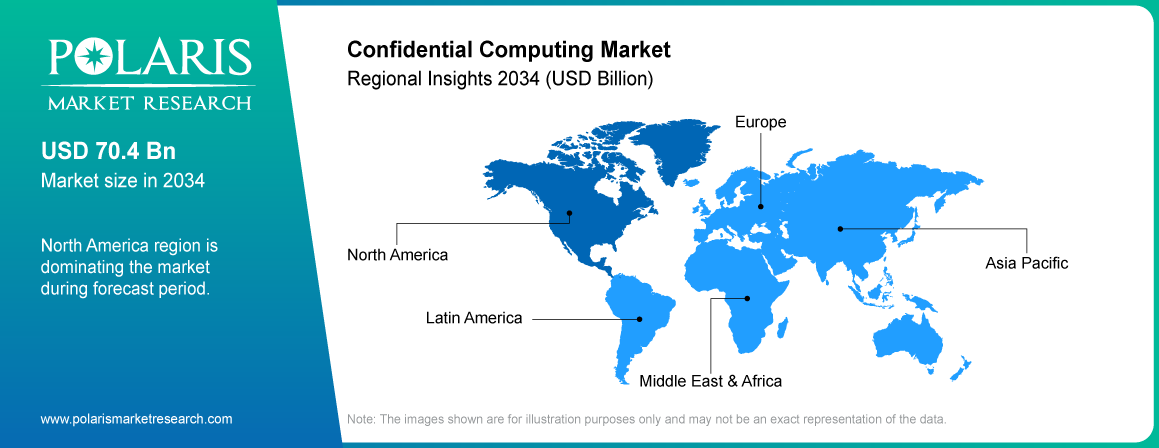
A few of the key market players include Advanced Micro Devices, Inc. (AMD); Alibaba Cloud; Amazon Web Services, Inc. (AWS); Anjuna Security Inc.; Arm Limited; Decentriq; Fortanix Inc.; Google; IBM; Inpher; Intel Corporation; LiveRamp; Microsoft; NVIDIA Corporation; SAP SE; Saudi Information Technology Company (SITE); and Swisscom.
Confidential computing can protect AI workloads while they are running. It places the workload inside a trusted execution environment, where access to the data and code is restricted. This can help protect sensitive training data and information submitted during AI inference.
Confidential computing can help secure data when it must be kept safe during computation. Such data includes financial data, health care data, customer data, business data, and application data. The protection applies when the data is processed within the trusted execution environment.
Confidential computing uses hardware-based isolation to keep data and code protected while workloads are running. This limits access from the host operating system, hypervisor, or other unauthorized processes, depending on the technology used.
Download Sample Report of confidential computing market
Please fill out the form to request a customized copy of the research report.


