
SMS Firewall Market Size, Share, Trends & Forecast, 2026–2034
REPORT DETAILS
SMS Firewall Market Summary
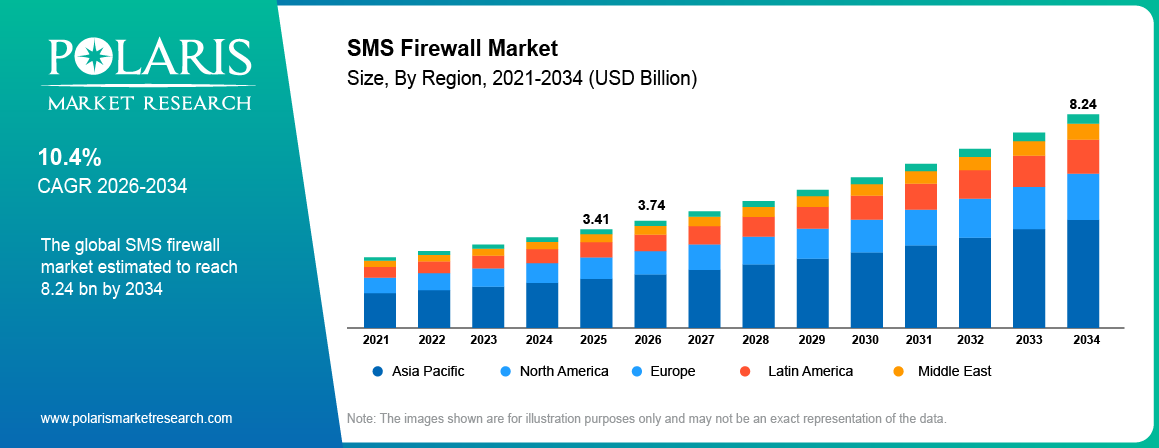
The global SMS firewall market was valued at USD 3.41 billion in 2025 and is expected to grow at a CAGR of 10.4% during the forecast period. The growth is driven by growing SMS fraud, expansion of A2P messaging and government regulations worldwide.
Market Statistics
SMS Firewall Market Key Takeaways
-
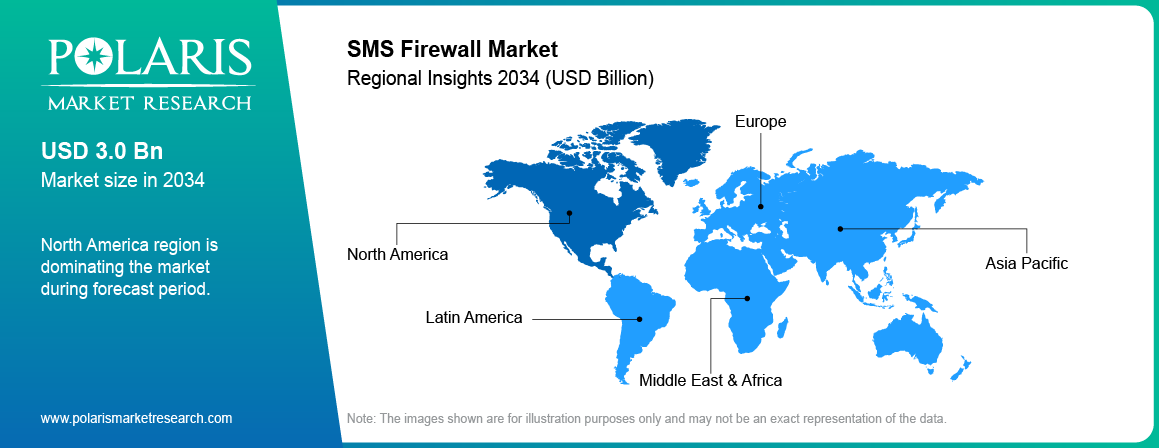
North America dominated the SMS firewall market size with 37.41% in 2025 as businesses are relying more on A2P messaging for transaction alerts, appointment reminders, marketing messages, and other customer communications
-
Asia Pacific is expected to witness growth of CAGR 12.1% during the forecast period due to its large mobile user base and the high volume of SMS traffic generated across the region.
-
Europe is expected to witness growth of CAGR 9.8% during the forecast period as the countries in the region have different telecom regulations and operators at different stages of network modernization
-
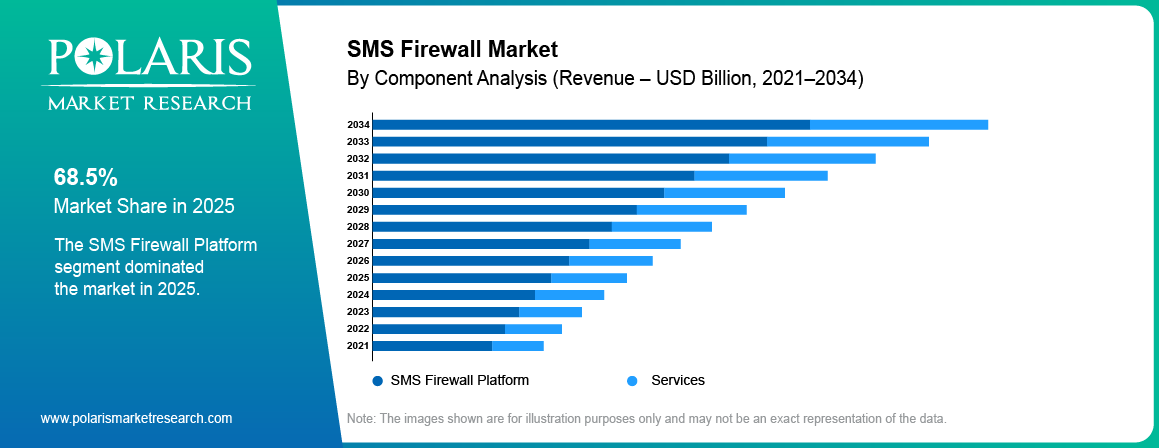
The SMS firewall platform segment dominated the SMS firewall market share in 2025 with 68.5% as it provide fraud prevention, grey-route detection, and protection of messaging revenue to the operators
-
Application-to-Person (A2P) messaging holds the largest share of 64.81% as SMS is widely used for wide range of messaging use cases.
Note: Figures and projections outlined in this report are the result of Polaris Market Research’s proprietary analytical processes, grounded in the latest available datasets and market observations.
What is SMS Firewall?
An SMS firewall is a security and revenue-protection system used by mobile network operators and messaging providers to check, filter, and direct SMS traffic before it reaches a customer's phone. It mainly handles two types of messages: Application-to-Person (A2P), such as business alerts and verification codes, and Person-to-Person (P2P), which are regular messages between individuals. The firewall works within the operator's network and uses tools such as message pattern checks, sender verification, and traffic analysis to identify genuine business messages and separate them from spam, phishing attempts, and “grey route” messages that use unauthorized or unapproved routes.
The technology also plays an important role in protecting operator revenue. By finding and blocking unauthorized SMS traffic that avoids normal delivery agreements and fees, operators can recover revenue that would otherwise be lost.
As SMS usage continues to grow and fraud methods become more advanced, including AI-based sender spoofing and SIM-box abuse, SMS firewalls are becoming less of an optional security tool and more of a basic requirement for operators handling business-related SMS traffic.
Market Dynamics
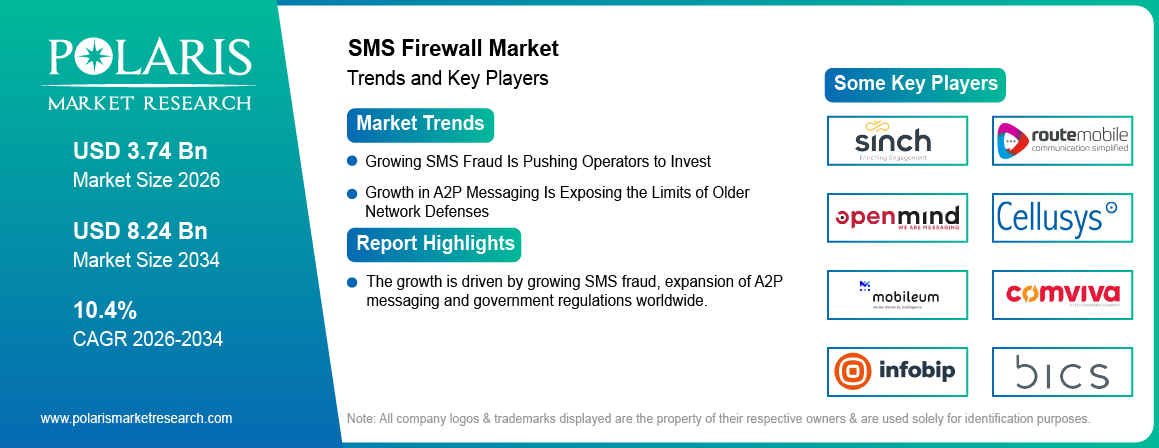
Driver: Growing SMS Fraud Is Pushing Operators to Invest
Phishing, fake sender identities, and spam through SMS are becoming more advanced. This makes it harder for mobile operators to treat firewall investment as optional. According to the Anti Phishing Working Group, 1,003,924 phishing attacks were recorded in the first quarter of 2025. Grey-route activity continues to cause real revenue losses by allowing messages to bypass normal delivery agreements, even though its overall share of traffic is gradually declining. Fraudsters are further changing their methods faster than older filtering systems can respond. This is prompting operators to adopt firewalls that use machine learning and real-time traffic analysis instead of relying only on fixed filtering rules, thereby driving the SMS firewall market growth (Source: apwg.org).
Driver: Growth in A2P Messaging Is Exposing the Limits of Older Network Defenses
Businesses increasingly depend on SMS for wide range of services. This include service such as one-time passwords, appointment reminders, transaction alerts, and marketing campaigns. Older messaging systems that were mainly designed for person-to-person communication are finding it harder to handle the scale and security requirements as business-generated SMS traffic grow. SMS firewalls help address this problem by allowing operators to protect, control, and manage a communication channel. This has become an important part of how businesses interact with their customers, thereby driving the SMS firewall demand.
Restraint: RCS and Messaging Apps Could Limit the Long-Term SMS Market
Rich Communication Services (RCS) and messaging apps are gradually separating consumer and business communication from traditional SMS. This is because RCS provide interactive text boxes and secure communication channels. This shift could limit how much operators are willing to spend on protecting SMS over the long term. Vendors are responding by expanding their firewall platforms to support RCS and other messaging channels. However, this also means that SMS firewall spending increasingly has to compete with investments in newer messaging technologies and platforms.
Opportunity: AI-Based Threat Detection Is Creating a New Upgrade Opportunity
Operators using older firewalls based mainly on fixed rules are becoming an important customer group as AI-based systems show that they can identify fraud patterns that traditional filters may miss. This creates an opportunity for vendors to benefit from new firewall installations and from customers replacing older systems. Vendors that show clearly better fraud detection and prevention results can charge higher prices and win customers from older platforms that have not kept up with changing threats.
Opportunity: Greater Focus on Identity and Fraud Services Creates New Cross-Selling Opportunities
Companies operating in the market are actively involved in product launch, acquisitions and partnerships that combine mobile identity checks, messaging compliance, and security tools. For instance, in September 2026, Xconnect launched mobile identity verification platform in UK for fintech vendors. This show that vendors have an opportunity to offer more than basic SMS filtering. By combining firewall services with authentication, customer identity checks, and fraud-risk scoring, providers can offer operators a wider security solution. This can create longer-term and higher-value customer relationships because operators receive several related services from one provider instead of purchasing SMS filtering as a standalone service (Source: ffnews.com).
Segments Analysis
By Component Assessment: SMS Firewall Platform
The SMS firewall platform segment dominated the SMS firewall market share in 2025 with 68.5%. This includes the main software used to monitor, filter, and manage SMS traffic. SMS firewall platforms provide fraud prevention, grey-route detection, and protection of messaging revenue to the operators. Mobile operators and businesses are looking at messaging security as an important business requirement rather than just a technical issue. This has fueled the platform solutions demand for customers entering this market.
The Services segment is expected to witness growth of CAGR 11.8% during the forecast period. This includes managed and professional services which is growing faster as operators, especially smaller and mid-sized carriers, who choose to outsource regular rule updates and threat monitoring instead of maintaining these capabilities in-house.
By SMS Type Assessment: A2P Messaging
Application-to-Person (A2P) messaging holds the largest share of 64.81% as SMS is widely used for wide range of messaging use cases. This includes login verification, transaction alerts, appointment reminders, and marketing campaigns. Regulators in several major regions further classify a significant portion of overall SMS traffic as A2P, highlighting how important business messaging has become to everyday operations, thereby driving the segment growth.
Person-to-Person (P2P) messaging is expected to witness growth of CAGR 8.9% during the forecast period as smartphone usage expands and consumers continue to use SMS as an affordable and widely supported way to communicate.
A2P Messaging Vs P2P Messaging: Key Differences
| Dimension | A2P messaging | P2P messaging |
Meaning | Application-to-person messaging | Person-to-person messaging |
Origin | Generated by an application, enterprise platform, API, chatbot, or automated workflow | Sent manually by one individual to another |
Typical examples | OTPs, authentication codes, alerts, delivery updates, appointment reminders, marketing messages, and banking notifications | Personal conversations between friends, family members, or colleagues |
Traffic pattern | Often high-volume, repetitive, scheduled, or event-triggered | Usually lower-volume, irregular, and conversational |
Sender identity | Short code, alphanumeric sender ID, toll-free number, 10DLC number, or verified business number | Individual mobile number or consumer messaging identity |
Interaction model | Usually one-way, although two-way A2P conversations are possible | Naturally conversational and two-way |
Commercial purpose | Business, service, transactional, or promotional communication | Generally private and non-commercial communication |
Routing | SMS gateway, CPaaS provider, enterprise messaging platform, or approved operator route | Consumer handset or consumer messaging service |
Regulatory treatment | Commonly subject to sender registration, consent, content rules, throughput controls, and carrier filtering | Usually treated differently, although automated or application-mediated traffic may still be classified as A2P |
Firewall relevance | Main target for A2P monetization, grey-route detection, spam filtering, smishing prevention, and revenue assurance | Monitored for spam, malware, spoofing, bypass, and abnormal traffic patterns |
Classification challenge | Automated traffic may be disguised as P2P to avoid A2P charges or registration requirements | High-volume or automated traffic can resemble A2P and may be reclassified by carriers |
Key distinction | The message is generated or mediated by an application | The message is exchanged directly between people |
Regional Insights
North America
North America dominated the SMS firewall market size with 37.41% in 2025 as businesses are relying more on A2P messaging for transaction alerts, appointment reminders, marketing messages, and other customer communications. U.S. mobile operators are also introducing systems such as 10DLC to better organize and control business SMS traffic. The need for tools that can monitor and protect that traffic further increases as more business messages move through these systems. Moreover, strong spending by businesses in the region and well-developed rules around consumer messaging provide favorable conditions for vendors offering advanced and AI-based SMS firewall solutions, thereby driving the region growth.
Asia Pacific
Asia Pacific is expected to witness growth of CAGR 12.1% during the forecast period due to its large mobile user base and the high volume of SMS traffic generated across the region. Countries such as India, Indonesia, and China have high mobile usage. According to the Indian Ministry of Statistics & Programme Implementation, 96.8% of rural population of India aged 15-29 have used mobile phone at least once in first quarter of 2025. This creates huge volumes of both business and personal messages every day. This large user base further makes grey-route fraud and lost messaging revenue ongoing concerns for operators. Moreover, government and regulatory efforts to improve SMS tracking and reduce spam in several countries are further supporting firewall adoption in the region, thereby driving the Asia Pacific SMS firewall industry growth (Source: pib.gov.in).
Europe
Europe is expected to witness growth of CAGR 9.8% during the forecast period. The countries in the region have different telecom regulations and operators at different stages of network modernization. Recent acquisitions in the region, including deals that combine mobile identity and messaging compliance with existing security products, show that European operators are increasingly looking at firewalls as part of a wider fraud-prevention and compliance solution rather than as a standalone product. Data protection requirements, including those linked to GDPR, further influence how vendors offer cloud-based and on-premise solutions across European markets.
Middle East & Africa
The Middle East & Africa SMS firewall market is expected to witness growth of CAGR 9.5% during the forecast period driven by increasing mobile usage and the expansion of digital services and mobile-money platforms that rely on SMS for secure customer verification. Grey-route fraud has been a significant issue in the countries across the region. This is fueling the demand for the SMS firewall solution, thereby driving the region growth in the market.
Regulation on SMS Firewall: By Region
| Region | Regulatory / carrier framework | Main A2P SMS requirements | SMS-firewall implications |
| United States | TCPA, FCC rules, CTIA and carrier policies, A2P 10DLC | Consent, sender identification, opt-out handling, content restrictions, and brand/campaign registration for 10DLC traffic. | Detect unregistered traffic, spoofing, prohibited content, artificial traffic inflation, and high-risk routes. |
| Canada | CASL and carrier policies | Prior consent, sender identification, commercial-message information, and unsubscribe capability. | Validate consent, sender identity, opt-out behavior, traffic patterns, and content. |
| European Union / EEA | GDPR, ePrivacy rules, national direct-marketing laws, and operator policies | Consent or another lawful basis for marketing messages, clear sender identity, and opt-out mechanisms. Requirements vary by member state. | Apply country-specific rules, sender-ID validation, anti-spoofing, content screening, and privacy-aware analytics. |
| United Kingdom | UK GDPR, PECR, Ofcom and carrier policies | Consent is generally required for unsolicited electronic marketing, with limited soft-opt-in exceptions. Sender identification and opt-out controls are required. | Filter unsolicited marketing, spoofed sender IDs, malicious links, and non-compliant international routes. |
| India | TRAI TCCCPR framework and operator-managed DLT platforms | Principal Entity registration, registered headers or sender IDs, approved message templates, and consent records for commercial messaging. | Match entity, header, template, consent, and message-type information. Block unregistered or template-mismatched traffic. |
| China | MIIT rules and mobile-operator controls | Sender and content controls, anti-spam requirements, and restrictions on prohibited or sensitive content. Local routing and approval requirements may apply. | Enforce content inspection, sender authentication, local routing, and blocking of unauthorized traffic. |
| Japan | Act on Regulation of Transmission of Specified Electronic Mail and operator rules | Prior consent for commercial electronic messages, sender identification, and unsubscribe functionality. | Detect unsolicited traffic, validate sender information, and enforce opt-out and content policies. |
| Singapore | Spam Control Act, Personal Data Protection Act, and operator policies | Sender identification, unsubscribe functionality, consent, and privacy compliance. | Apply sender and content validation, suppression-list enforcement, and URL reputation checks. |
| Australia | Spam Act 2003, ACMA guidance, and carrier policies | Consent, accurate sender identification, and a functional unsubscribe mechanism. | Identify unconsented campaigns, spoofing, malicious links, and repeated traffic designed to evade commercial routing. |
Competitive Landscape
The SMS firewall market is fragmented, with no small group of companies controlling most of the market. Telecom-focused companies with strong connections to messaging and international networks, such as BICS, Sinch, Infobip, and Route Mobile, compete with specialist companies focused on SMS security and fraud detection, including Cellusys, Openmind Networks, and Mobileum. Regional and service-focused providers such as HAUD Systems and AMD Telecom also maintain strong positions in selected markets. Competition is increasingly being shaped by acquisitions rather than companies building all their capabilities internally. Recent deals have combined mobile identity verification, messaging compliance, and other cybersecurity services with existing firewall products. This suggests that vendors are increasingly trying to offer broader security solutions instead of focusing only on SMS filtering.
Vendor Landscape Snapshot
| Vendor | Headquarters | Market Position | Core Focus in Scope |
| Infobip Ltd. | Croatia | Leader | Anam Protect operator SMS firewall and A2P monetization |
| Sinch | Sweden | Leader | Managed SMS firewall and A2P monetization for operators |
| BICS | Belgium | Leader | Managed SMS firewall with bypass fraud and A2P protection |
| Proofpoint, Inc. | United States | Leader | Cloudmark messaging security for operators across SMS, MMS, and RCS |
| Route Mobile Limited | India | Challenger | Route Shield AI driven SMS firewall and A2P monetization |
| Comviva | India | Challenger | AI driven messaging firewall integrated with telecom BSS |
| Cellusys | Ireland | Challenger | Grey route detection and A2P revenue assurance |
| Mobileum | United States | Challenger | SMS and signaling security with fraud analytics |
| Tata Communications Limited | India | Challenger | Managed SMS firewall on carrier signaling networks |
| Openmind Networks | Ireland | Specialist | SMS firewalling within messaging hubs and infrastructure |
| HAUD Systems Ltd. | United Kingdom | Specialist | A2P monetization and SMS fraud prevention |
| AMD Telecom | Greece | Specialist | SMS hub and firewall within A2P monetization |
Source: Polaris Market Research analysis based on cited company announcements and industry reporting. Market positions reflect Polaris Market Research’s qualitative assessment of portfolio breadth, scale, and operator reach, and do not represent market share.
Key Companies in the SMS Firewall Market
- BICS
- Cellusys
- Sinch
- Comviva
- Route Mobile Limited
- Infobip Ltd.
- Openmind Networks
- Mobileum
- HAUD Systems Ltd.
- AMD Telecom
- Proofpoint, Inc.
- Tata Communications Limited
Recent Industry Developments
-
May 2026, AcePeak Introduced a carrier-grade enterprise SMS Firewall for MNOs and MVNOs, demonstrated live at International Telecoms Week (ITW) USA 2026. (Source: itwglobalevent.com)
-
April 2026, PAiCore Technology and TelecomsXchange launched an AI-powered SMS Firewall, integrating OpenTextShield with PAiCore SMSC to detect and block spam and phishing threats in real time. The solution strengthened messaging security while delivering private, scalable, high-throughput protection across operator networks. (Source: mvno-index.com)
Future Outlook
The SMS firewall market is expected to grow steadily as businesses increase their use of A2P messaging and fraud threats become more advanced. Operators will continue investing in AI-based detection, automated monitoring, and revenue protection. Cloud-based solutions and managed services are also likely to gain popularity, while vendors expand into RCS, identity verification, and broader messaging security services.
SMS Firewall Market Segmentation:
SMS Firewall Component Outlook (USD Billion, 2021-2034)
- SMS Firewall Platform
- Services
SMS Firewall SMS Type Outlook (USD Billion, 2021-2034)
- A2P Messaging
- P2P Messaging
- Others
SMS Firewall SMS Traffic Outlook (USD Billion, 2021-2034)
- National Traffic
- International Traffic
SMS Firewall Deployment Outlook (USD Billion, 2021-2034)
- On-premise
- Cloud
SMS Firewall Regional Outlook (USD Billion, 2021-2034)
-
North America
-
US
-
Canada
-
Europe
-
Germany
-
France
-
UK
-
Italy
-
Spain
-
Netherlands
-
Russia
-
Rest of Europe
-
Asia-Pacific
-
China
-
Japan
-
India
-
Malaysia
-
South Korea
-
Indonesia
-
Australia
-
Vietnam
-
Rest of Asia-Pacific
-
Middle East & Africa
-
Saudi Arabia
-
UAE
-
Israel
-
South Africa
-
Rest of Middle East & Africa
-
Latin America
-
Mexico
-
Brazil
-
Argentina
-
Rest of Latin America
SMS Firewall Report Scope
| Report Attributes | Details |
| Market size value in 2025 | USD 3.41 billion |
| Market size value in 2026 | USD 3.74 billion |
| Revenue Forecast in 2034 | USD 8.24 billion |
| CAGR | 10.4% from 2026 – 2034 |
| Base year | 2025 |
| Historical data | 2021 – 2024 |
| Forecast period | 2026 – 2034 |
| Quantitative units | Revenue in USD billion and CAGR from 2026 to 2034 |
| Report Coverage | Revenue Forecast, Market Competitive Landscape, Growth Factors, and Trends |
| Segments covered |
|
| Regional scope |
|
| Competitive Landscape |
|
| Report Format |
|
| Customization | Report customization as per your requirements with respect to countries, regions, and segmentation. |
Source: Polaris Market Research Analysis
SMS Firewall Market FAQ's
The market was valued at USD 3.41Billion in 2025 and is expected to reach USD 8.24 billion by 2034.
The market is expected to witness growth of CAGR 10.4% during the forecast period of 2026-2034.
North America dominated the market with 37.41% share in 2025 due to strong regulations and presence of major operators.
An SMS firewall is a network security system that inspects and filters SMS traffic before it reaches subscribers, blocking spam, phishing, and unauthorized ‘grey route’ messages while helping mobile operators protect and monetize their messaging revenue.
The market was valued at USD 3.41 billion in 2025, is estimated at USD 3.74 billion in 2026, and is projected to reach USD 8.24 billion by 2034 at a 10.4% CAGR.
A2P (Application-to-Person) firewalls focus on business-originated traffic such as OTPs, alerts, and marketing messages, prioritizing fraud detection and revenue assurance at scale. P2P (Person-to-Person) firewalls protect consumer-to-consumer messaging, focusing more on spam and grey-route detection between individual subscribers.
Operators use SMS firewalls to prevent revenue loss from grey-route and fraudulent traffic, block spam and phishing attempts that damage subscriber trust, and meet growing regulatory requirements around message traceability and spam control.
Cloud-based deployment is the more widely adopted model today, valued for faster rollout, easier maintenance, and elastic scalability as traffic volumes grow. On-premise deployment remains preferred by operators that need full control over configuration and data handling for compliance reasons.
Leading vendors include BICS, Sinch, Infobip, Comviva, Route Mobile, Mobileum, Cellusys, and Openmind Networks, alongside a growing set of players expanding into the space through acquisitions of identity-verification and messaging-compliance specialists.
Growth is being driven primarily by the rising volume and sophistication of SMS-based fraud, the rapid expansion of A2P messaging across industries, and tightening regulatory requirements around message traceability and spam prevention in major mobile markets.

Download Sample Report of SMS Firewall Market
Please fill out the form to request a customized copy of the research report.


