
Stationary Air Compressor Market Opportunity & Global Report, 2026-2034
REPORT DETAILS
Stationary Air Compressor Market Summary
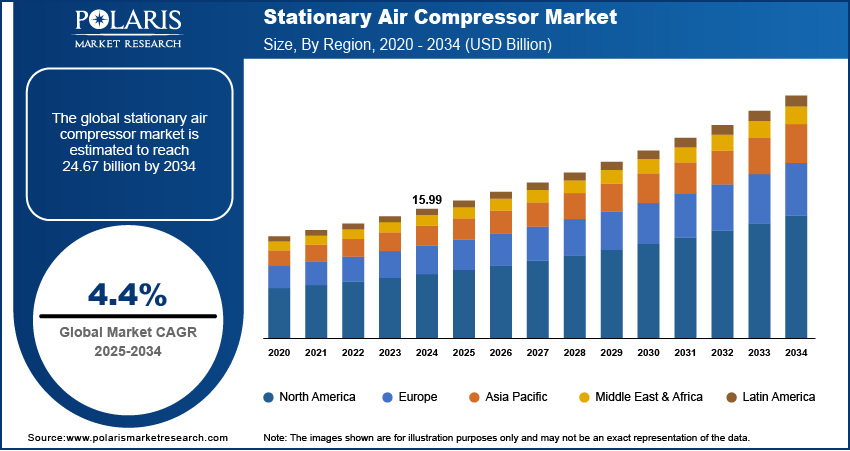
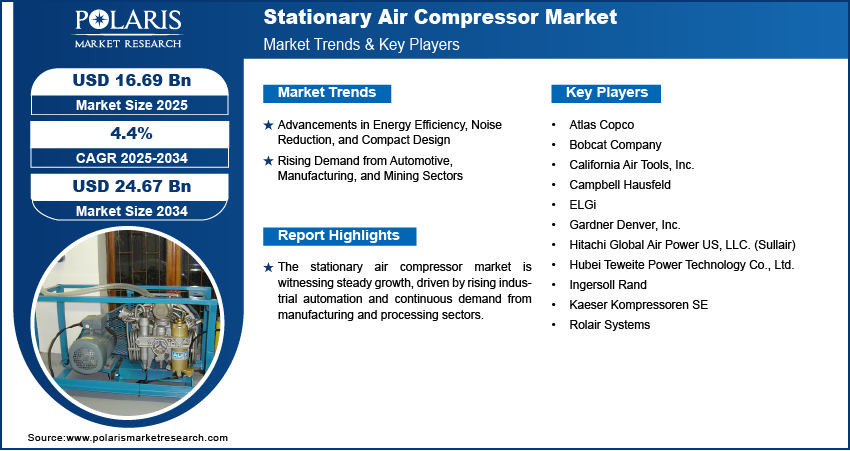
The global stationary air compressor market size was valued at USD 17.40 billion in 2025, growing at a CAGR of 4.53% from 2026 to 2034. The market is driven by increasing industrial automation, growing demand from manufacturing and oil & gas sectors, and advancements in compressor technology that enhance energy efficiency, reduce maintenance costs, and support continuous, high-volume compressed air applications.
Market Statistics
Key Takeaways
- Asia Pacific held the largest market share in 2025 accounting for 40.0% of global revenue, supported by rapid industrialization and infrastructure development.
- North America is projected to grow at the fastest CAGR of 3.57% during 2026–2034, driven by strong industrial and automotive demand.
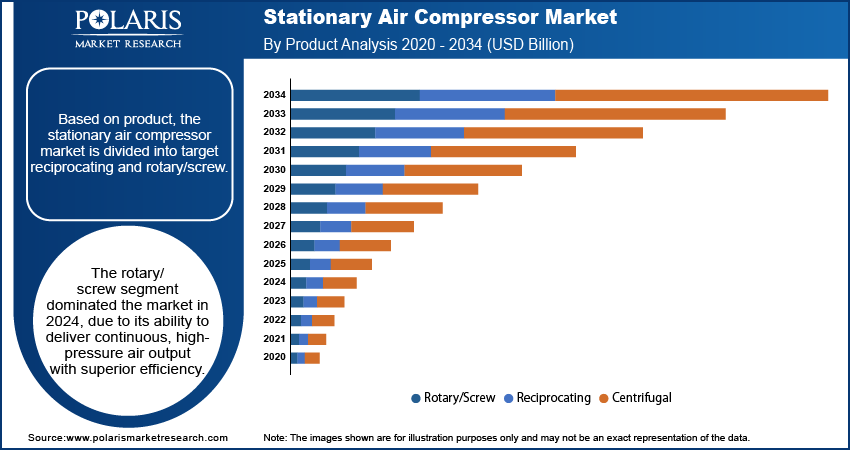
- Rotary/screw compressors dominated the market in 2025, holding a share of 55.0% due to their efficiency and continuous operation.
- The internal combustion engine segment is expected to register a CAGR of 1.77%, driven by demand from construction, mining, and agriculture sectors.
- The oil-free segment is forecast to grow at a CAGR of 5.94%, fueled by increasing demand for contaminant-free compressed air.
- The up to 20 kW segment is projected to expand at a CAGR of 3.25%, owing to its compact design and energy-efficient performance.
Note: Figures and projections outlined in this report are the result of Polaris Market Research’s proprietary analytical processes, grounded in the latest available datasets and market observations.
Industry Dynamics
- Advancements in energy-efficient technologies are reducing power consumption and operating costs, driving market growth.
- Increasing adoption of noise-reduction features is boosting demand in residential and indoor industrial applications.
- Growing preference for compact and lightweight designs is improving compressor portability and usability.
- Rising demand from automotive, manufacturing, and mining sectors is accelerating compressor adoption across industrial operations.
- High initial costs of advanced compressor systems may restrain adoption among cost-sensitive users.
AI Impact on Stationary Air Compressor Market
- AI-powered predictive maintenance reduces equipment downtime by detecting potential failures early.
- AI-based monitoring improves compressor efficiency through real-time performance analysis.
- AI-driven automation optimizes pressure control and energy consumption.
- AI-enabled remote diagnostics support faster troubleshooting and better asset management.
Stationary air compressors are non-portable systems installed in a permanent location to provide reliable air power for machinery and production processes. The demand for stationary air compressors is gaining momentum due to the increasing pace of industrialization and construction activities. There is a rising need for efficient, mobile air compression solutions to support on-site operations as economies expand and manufacturing bases diversify. These compressors enable the smooth execution of tasks such as drilling, nailing, and painting, making them essential on construction sites and in the industrial sector, where flexibility and reliability are crucial. The convenience of portability allows businesses to reduce operational downtime and improve productivity, further reinforcing their adoption in emerging industrial landscapes.
Source: Polaris Market Research Analysis
To Understand More About this Research: Download Sample Report
The rise in infrastructure development and urbanization boosts growth opportunities. Urban expansion projects such as residential and commercial building developments, road construction, and public utility installations require consistent and adaptable pneumatic conveying systems, which portable compressors effectively provide. The need for compact, efficient, and durable equipment grows as urban planning increasingly incorporates smart cities initiatives and rapid development agendas. This rising urban footprint creates a favorable environment for these air compressors, as they offer operational flexibility across diverse terrains and project scales, making them a strategic tool in modern infrastructure execution.
Stationary vs Portable Air Compressors
| Factors | Stationary Air Compressors | Portable Air Compressors |
| Capacity & Operation | Provide higher capacity and continuous operation | Designed for intermittent and flexible operation |
| Mobility | Fixed installation | Offer mobility for field applications |
| End Use | Ideal for industrial manufacturing facilities | Commonly used at temporary construction sites |
| Work Environment | Suitable for permanent industrial setups | Suitable for remote and changing job sites |
| Air Output | Consistent output for large-scale operations | Lower output for mobile applications |
Industry Dynamics
Advancements in Energy Efficiency, Noise Reduction, and Compact Design
Advancements in energy efficiency, noise reduction, and compact design are driving expansion opportunities by improving product functionality and user convenience. Manufacturers are increasingly focusing on developing compressors that consume less power, produce lower noise levels, and are more space-efficient to meet the evolving expectations of end users across sectors. For instance, in November 2025, Atlas Copco launched the GA 11–30 FLX, its first dual-speed industrial air compressor. The company stated that the compressor requires up to 20% less energy than its traditional fixed-speed compressors, owing to reductions in start-up peaks, unload power, and transient energy losses. The system also features a compact design while providing optimized airflow across different operating pressures, enabling users to improve energy efficiency without requiring excessive installation space. These technological improvements can lower operating costs and make stationary compressors more suitable for facilities where energy consumption and available floor space are important considerations. Furthermore, the integration of advanced controllers, variable-speed technologies, efficient motors, and smart monitoring systems is improving compressor performance and operational control, thereby increasing the attractiveness of modern stationary air compressors across manufacturing and other industrial applications. (Source: atlascopco.com)
Rising Demand from Automotive, Manufacturing, and Mining Sectors
The rising demand from the automotive, manufacturing, and mining sectors is accelerating the adoption of portable compressors. These industries rely heavily on pneumatic tools and systems for tasks such as painting, tire inflation, assembly line operations, and drilling, which require reliable and mobile sources of compressed air. In particular, portable compressors allow greater flexibility and mobility in field operations and maintenance activities, which is critical in sectors such as mining and heavy machinery. The need for high-performance, transportable compressors continues to grow as these industries expand and modernize, reinforcing their value as an essential component of industrial productivity and operational efficiency.
Source: Polaris Market Research Analysis
Segmental Insights
Product Analysis
The segmentation, based on product, includes reciprocating, rotary/screw, and centrifugal. The rotary/screw segment dominated the market with 55.0% in 2025, due to its ability to deliver continuous, high-pressure air output with superior efficiency. These compressors are particularly favored in demanding industrial and construction environments where consistent operation is essential. Their lower maintenance requirements, higher energy efficiency, and quieter operation compared to reciprocating models have made them the preferred choice for large-scale and commercial applications. The robust design and better adaptability to varying load conditions contribute to the widespread adoption of rotary/screw compressors across diverse end use sectors.
Operation Modes Analysis
Based on operation modes, the segmentation includes electric and internal combustion engine. The internal combustion engine segment is expected to witness substantial growth with 1.77% CAGR during the forecast period due to its strong adaptability in various industrial and automotive applications. Despite the growing focus on cleaner technologies, internal combustion engines (ICEs) continue to offer high power density, proven reliability, and ease of integration across legacy systems. In sectors such as agriculture, mining, and construction, ICE-based systems remain indispensable owing to their capability to operate in off-grid environments where electric alternatives are less viable. Furthermore, ongoing advancements in fuel efficiency and hybridization strategies are helping extend the lifecycle of ICEs. This blend of traditional utility and modern optimization is expected to maintain demand and boost steady expansion in the segment.
Lubrication Analysis
The segmentation, based on lubrication, includes oil free and oil filled. The oil free segment is expected to witness a faster growth with 5.94% CAGR during the forecast period due to the rising demand in various industries, such as food processing, pharmaceuticals, and electronics, that require clean, contaminant-free air. Oil-free compressors eliminate the risk of oil contamination in end products, assuring compliance with strict quality and hygiene standards. Their low maintenance needs and growing compatibility with precision applications further increase their appeal. The shift toward oil-free technologies is expected to accelerate rapidly as sustainability and product purity gain priority in industrial processes.
Power Range Analysis
The segmentation, based on power range, includes up to 20 kW, 21–50 kW, 51–250 kW, 251–500 kW, and over 500 kW. The 20 kW segment is expected to witness the fastest growth with 3.25% CAGR during the forecast period, owing to its optimal balance between compact size and operational output. It is highly suitable for diverse applications in both stationary and mobile platforms. This power range is increasingly favored in sectors such as commercial vehicles, off-road equipment, and light industrial machinery, where energy efficiency and performance must be achieved without excessive weight or complexity. The rising adoption of modular and scalable energy systems is also propelling demand in this category, especially in emerging markets with space and budget constraints. Additionally, technological improvements in miniaturization and power electronics are making 20 kW systems more efficient and accessible, accelerating their uptake across various end-use industries.
Source: Polaris Market Research Analysis
Regional Analysis
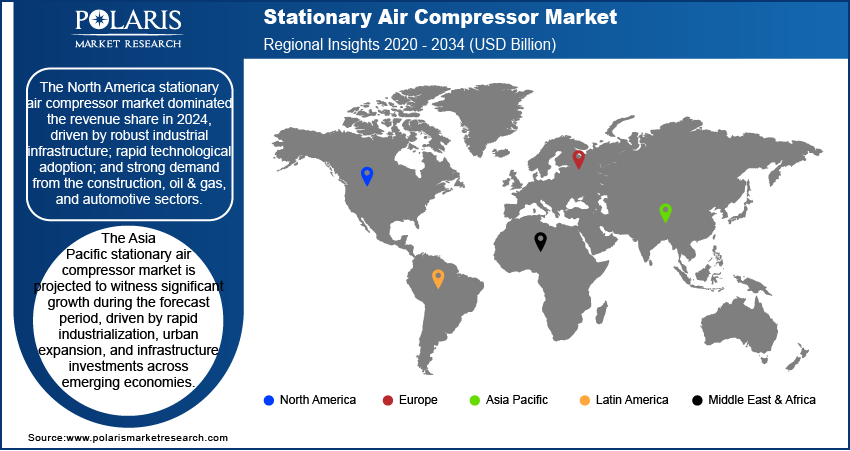
The report provides market insights into North America, Europe, Asia Pacific, Latin America, and the Middle East & Africa. The North America stationary air compressor is expected to witness 3.57% CAGR, driven by robust industrial infrastructure; rapid technological adoption; and strong demand from the construction, oil & gas, and automotive sectors. According to the U.S. Bureau of Economic Analysis, in June 2026, expenditures by foreign direct investors to acquire, establish, or expand businesses in the U.S. reached USD 232.2 billion in 2025, increasing 49.5% from 2024. Of this total, the manufacturing sector accounted for USD 121.8 billion, or 52.5% of all new foreign direct investment expenditures. Continued capital deployment across manufacturing facilities supports modernization, capacity expansion, and the adoption of advanced industrial equipment, including energy-efficient compressed-air systems. The region’s developed end-user base and increasing focus on automation, energy efficiency, intelligent controls, and low-noise compressor technologies further support the North America stationary air compressor market expansion. (Source: bea.gov)
US Stationary Air Compressor Market Trends
The US market held 83.50% share in 2025, primarily due to the country’s strong aftermarket service ecosystem and widespread equipment rental networks. This accessibility supports flexible usage across various short-term and long-term projects, particularly in construction and industrial maintenance. Additionally, the high rate of technology adoption in machinery and tools improves the appeal of portable compressors designed with smart features and remote monitoring capabilities.
Source: Polaris Market Research Analysis
Asia Pacific Stationary Air Compressor Market Outlook
The Asia Pacific market held the largest market share in 2025 accounting for 40.0% of global revenue, driven by rapid industrialization, urban expansion, and infrastructure investments across emerging economies. According to the Government of India’s Press Information Bureau in February 2026, the Union Budget 2026–27 proposed public capital expenditure of approximately USD 127.44 billion, compared with approximately USD 117.10 billion in FY2025–26. The same government release reported that India’s capital goods output under the Index of Industrial Production increased by 8.1% year-over-year in December 2025, reflecting continued expansion in industrial investment and productive capacity. Rising investments in infrastructure, capital equipment, manufacturing facilities, and industrial modernization are increasing requirements for reliable compressed-air systems across production and processing operations. Furthermore, growing construction activity and government initiatives supporting domestic manufacturing are creating favorable conditions for stationary air compressor adoption. The region’s cost-sensitive industrial base is also encouraging demand for energy-efficient, compact, durable, and technologically advanced compressors capable of reducing operating costs across diverse industrial applications. (Source: pib.gov)
China Stationary Air Compressor Market Assessment
The market in China is experiencing 5.65% CAGR growth, fueled by the expanding presence of domestic manufacturers offering cost-effective and customizable solutions. The country’s focus on boosting export-oriented manufacturing, coupled with ongoing infrastructure megaprojects, is increasing the need for reliable compression systems. Moreover, the adoption of automation in local industries is further accelerating the integration of compact, efficient compressors into production workflows.
Europe Stationary Air Compressor Market Insights
The Europe market is projected to witness substantial growth with 23.0% share in 2025, driven by the region's focus on sustainable development, energy efficiency, and technological innovation. The growing shift toward electric and oil-free compressors aligns well with the region’s strict environmental regulations and green building standards. Additionally, advancements in manufacturing technologies, along with robust automotive and aerospace sectors, are fueling consistent demand. The integration of smart technologies and IoT-based monitoring systems in compressors is also gaining momentum, positioning Europe as a hub for innovation-driven growth.
UK Stationary Air Compressor Market Overview
Rising investments in renovation and refurbishment projects across commercial and residential infrastructure drive the UK market growth. These activities require adaptable and lightweight equipment suited for urban job sites with limited space, where portability and low noise levels are essential. In addition, the growing preference for precision tools in sectors such as aerospace and advanced manufacturing is boosting the use of high-performance stationary air compressors to meet quality and operational standards.
Key Players and Competitive Analysis
The stationary air compressor sector is experiencing dynamic shifts driven by technological advancements and sustainable value chains, with players such as Atlas Copco and Ingersoll Rand focusing on competitive positioning through energy-efficient designs. Latent demand and opportunities in construction, manufacturing, and emerging sectors, such as renewable energy, fuel revenue growth. Industry trends highlight a rise in oil-free compressors for eco-sensitive applications, while supply chain disruptions challenge production scalability. Developed markets dominate adoption, but emerging markets show high potential due to infrastructure growth. Strategic investments in IoT-enabled compressors and hybrid models are reshaping future development strategies, with SMEs increasingly adopting compact, cost-effective units. Expert insights highlight regional footprint expansion and partnership ecosystems to address economic and geopolitical shifts. Competitive intelligence reveals consolidation via joint ventures while disruptive technologies such as AI-driven maintenance gain traction.
A few key players are Atlas Copco; Bobcat Company; California Air Tools, Inc.; Campbell Hausfeld; ELGi; Gardner Denver, Inc.; Hitachi Global Air Power US, LLC. (Sullair); Hubei Teweite Power Technology Co., Ltd.; Ingersoll Rand; Kaeser Kompressoren SE; and Rolair Systems.
Key Players
- Atlas Copco
- Bobcat Company
- California Air Tools, Inc.
- Campbell Hausfeld
- ELGi
- Gardner Denver, Inc.
- Hitachi Global Air Power US, LLC. (Sullair)
- Hubei Teweite Power Technology Co., Ltd.
- Ingersoll Rand
- Kaeser Kompressoren SE
- Rolair Systems
Industry Developments
- May 2026: Atlas Copco launched the E-Air V1100 VSD electric compressor, offering energy-efficient operation, lower emissions, and reduced noise levels for industrial applications. (Source: atlascopco.com)
- March 2026: Atlas Copco introduced the X-Air 900-20 compressor, featuring adjustable pressure settings, fuel-saving capabilities, and improved flexibility for mining and construction operations. (Source: atlascopco.com)
Challenges in Stationary Air Compressor Market
- High Initial Installation Costs: Advanced stationary air compressor systems require significant upfront investment, which can limit adoption among small and medium-sized enterprises.
- Maintenance and Repair Expenses: Regular servicing, component replacement, and unexpected repairs can increase overall operating costs.
- Energy Consumption Concerns: Continuous compressor operation can result in high electricity usage, creating cost and efficiency challenges for end users.
- Noise Pollution and Environmental Regulations: Compliance with noise-control standards and environmental regulations may require additional investments in mitigation technologies.
Future Outlook
The stationary air compressor market is expected to witness steady growth due to increasing industrial automation, rising demand for energy-efficient equipment, and expanding manufacturing activities. Growing adoption of AI-based predictive maintenance, IoT-enabled monitoring systems, oil-free compressor technologies, and smart factory solutions is expected to support market expansion during the forecast period.
Stationary Air Compressor Market Segmentation
By Product Outlook (Revenue, USD Billion, 2021–2034)
- Reciprocating
- Rotary/Screw
- Centrifugal
By Operation Mode Outlook (Revenue, USD Billion, 2021–2034)
- Electric
- Internal Combustion Engine
By Lubrication Outlook (Revenue, USD Billion, 2021–2034)
- Oil Free
- Oil Filled
By Range Outlook (Revenue, USD Billion, 2021–2034)
- Up to 20 kW
- 21–50 kW
- 51–250 kW
- 251–500 kW
- Over 500 kW
By End Use (Revenue, USD Billion, 2021–2034)
- Manufacturing
- Oil & Gas
- Semiconductor & electronics
- Home Appliances
- Healthcare/Medical
- Food & Beverage
- Energy
- Others
By Regional Outlook (Revenue, USD Billion, 2021–2034)
- North America
- US
- Canada
- Europe
- Germany
- France
- UK
- Italy
- Spain
- Netherlands
- Russia
- Rest of Europe
- Asia Pacific
- China
- Japan
- India
- Malaysia
- South Korea
- Indonesia
- Australia
- Vietnam
- Rest of Asia Pacific
- Middle East & Africa
- Saudi Arabia
- UAE
- Israel
- South Africa
- Rest of Middle East & Africa
- Latin America
- Mexico
- Brazil
- Argentina
- Rest of Latin America
Stationary Air Compressor Market Report Scope
| Report Attributes | Details |
| Market Size in 2025 | USD 17.40 billion |
| Market Size in 2026 | USD 18.19 billion |
| Revenue Forecast by 2034 | USD 25.94 billion |
| CAGR | 4.53% from 2026 to 2034 |
| Base Year | 2025 |
| Historical Data | 2021–2024 |
| Forecast Period | 2026–2034 |
| Quantitative Units | Revenue in USD Billion and CAGR from 2026 to 2034 |
| Report Coverage | Revenue Forecast, Competitive Landscape, Growth Factors, and Industry Trends |
| Segments Covered |
|
| Regional Scope |
|
| Competitive Landscape |
|
| Report Format |
|
| Customization | Report customization as per your requirements with respect to countries, regions, and segmentation. |
Source: Polaris Market Research Analysis
FAQs
The global market size was valued at USD 17.40 billion in 2025 and is projected to grow to USD 25.94 billion by 2034.
The global market is projected to register a CAGR of 4.53% during the forecast period.
Asia Pacific held the largest market share in 2025 accounting for 40.0% of global revenue.
A few of the key players in the market are Atlas Copco; Bobcat Company; California Air Tools, Inc.; Campbell Hausfeld; ELGi; Gardner Denver, Inc.; Hitachi Global Air Power US, LLC. (Sullair); Hubei Teweite Power Technology Co., Ltd.; Ingersoll Rand; Kaeser Kompressoren SE; and Rolair Systems.
The compressors dominated the market in 2025, holding a share of 55.0%.
The oil-free segment is forecast to grow at a CAGR of 5.94%.
Download Sample Report of Stationary Air Compressor Market
Please fill out the form to request a customized copy of the research report.


