
Unmanned Composites Market Size, Growth, Trend & Insight, 2026-2034
REPORT DETAILS
What is Unmanned Composites Market Size?
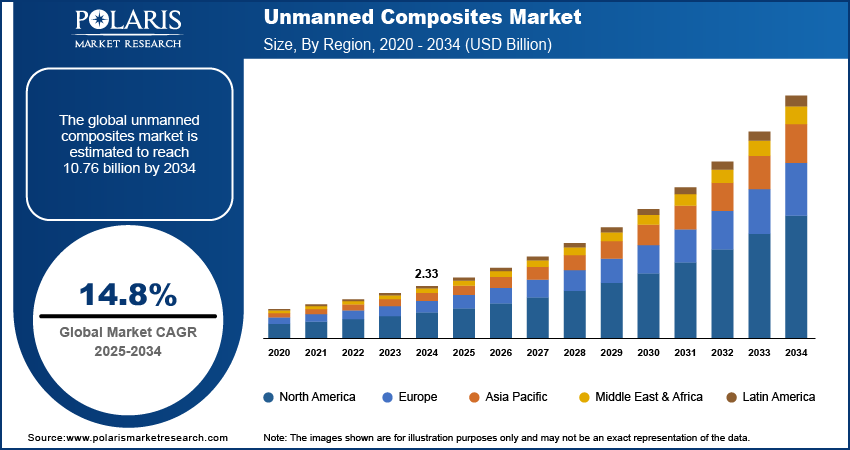
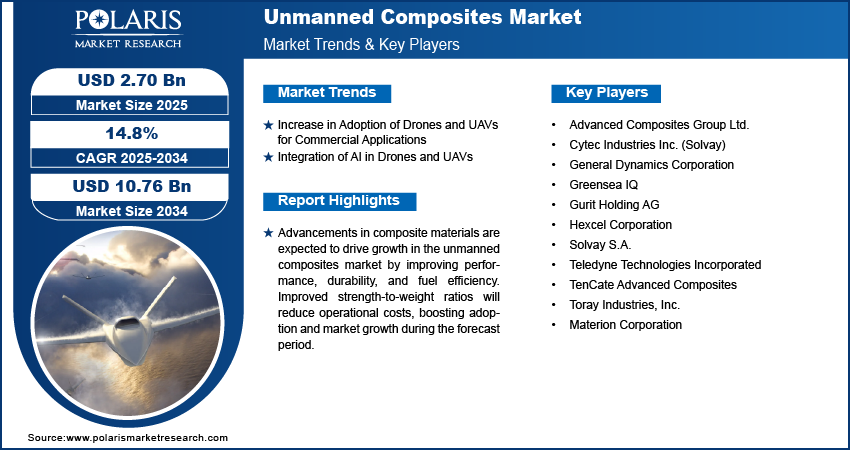
The global unmanned composites market size was valued at USD 2.53 billion in 2025, growing at a CAGR of 13.2% from 2026–2034. Key factors driving the growth is rising public and private funding, favorable government policies, and technological advancement.
Market Statistics
Key Takeaways
- North America dominated with 40.85% market share in 2025 due to high defense spending and early adoption of advanced technologies
- Asia Pacific is expected to witness the significant growth rate of CAGR 14.4% during the forecast period driven by increasing industrialization and rising investments in defense and technology.
- China dominated within the Asia Pacific region in 2025 with 49.07% share due to strong government support and rapid industrial growth
- Based on product type, the carbon fiber reinforced polymer dominated with 55.94% market share in 2025 due to its excellent strength-to-weight ratio. It is much lighter than metals while still providing high durability and stiffness
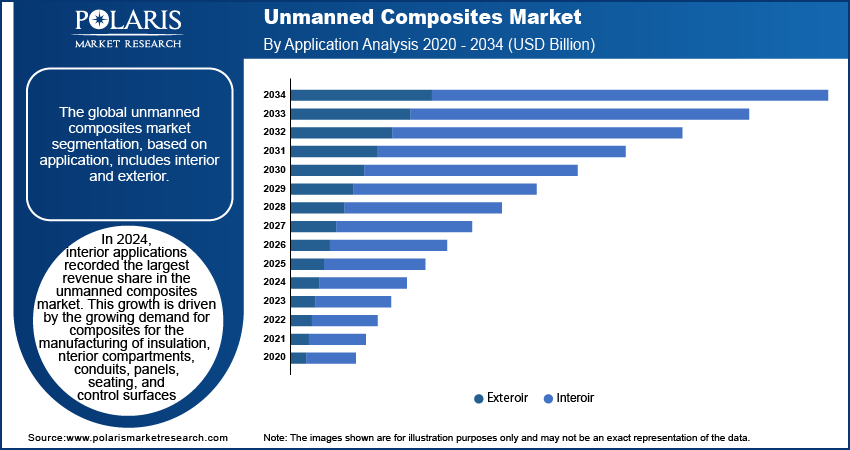
- Based on application, exterior segment is expected to witness growth rate of CAGR 12.7% during the forecast period as these parts require strong yet lightweight materials to ensure optimal performance.
Note: Figures and projections outlined in this report are the result of Polaris Market Research’s proprietary analytical processes, grounded in the latest available datasets and market observations
Industry Dynamics
- The rising public and private funding is driving the growth.
- Increase in commercial usage is fueling the growth.
- Technological advancement is boosting the growth.
- High production costs limit the growth of the market.
AI Impact on Unmanned Composites Market
- AI makes a significant contribution to enhancing the development of unmanned composites through the assessment of the performance of materials, as well as decreasing weight.
- It facilitates greater precision during manufacturing through the identification of any defects to ensure that the composite produced is of high quality.
- AI contributes to predicting maintenance needs for unmanned vehicles through structural analysis.
- It allows for effective optimization of the manufacturing process
Unmanned composites are material used to manufacturer unmanned systems such as drones, UAVs, and autonomous vehicles. These advance materials contain carbon fiber-reinforced polymer to provide high strength-to-weight ratios, durability, and corrosion resistance. This improves the efficiency and performance. These materials are widely applied in aerospace, defense, and robotics to enable lightweight, long-endurance, and high-performance unmanned platforms
The rapid growth of commercial use cases for unmanned systems is driving the demand for composites material for unmanned systems. Industries such as agriculture, logistics, energy, and infrastructure are increasingly adopting drones and autonomous vehicles to improve efficiency and reduce operational costs. For instance, in February 2026, India based logistics company Skye Air Mobility launched door to door delivery through drones. This widespread adoption creates a steady demand for durable, lightweight, and reliable materials. Composites are preferred because they improve performance and longevity. The need for advanced materials grows as more businesses integrate unmanned technologies into their operations, thereby driving the industry growth.
Source: Polaris Market Research Analysis
To Understand More About this Research:Download Sample Report
The advancements in technology, supported by research institutions and industry collaborations, are boosting the adoption of composites. For instance, in April 2025, Hexcel Corp a major player in industry collaborated with FIDAMC a research and technology centre in composite manufacturing to explore new applications which is expected to improve the performance and sustainability of composite materials. Moreover, governments and organizations are funding research programs focused on advanced materials, automation, and manufacturing efficiency. These innovations make composites more cost-effective, easier to produce, and better in performance. As a result, more manufacturers are able to integrate these materials into unmanned systems, thereby driving the growth.
Composites vs Traditional Metals in UAVs
| Factors | Composite Materials | Conventional Metals |
| Weight | Very light | Heavy |
| Resistance to Corrosion | High | Satisfactory |
| Efficiency of Fuel | Better because of low weight | Low efficiency |
| Strength | Very high strength to weight ratio | Very strong, but heavy |
| Maintenance | Low Maintenance | High Maintenance |
| Aerodynamics | Good flexibility in design | Low flexibility in design |
Source: Polaris Market Research Analysis
Drivers & Opportunities
What are Factors Driving Industry Growth?
Increase in Public and Private Funding: The investment from governments and private companies in unmanned system is growing. Governments are allocating higher budgets for defense modernization, drone programs, and advanced air mobility initiatives. According to the U.S. Department of War, in 2024 the U.S. allocated funding of USD 849.8 billion to department of Defense for wide range of activities including defense modernization. At the same time, venture capital firms and private investors are funding startups and technology developers working on unmanned systems and advanced materials. This financial support helps accelerate research, product development, and large-scale manufacturing capabilities, thereby fueling the industry growth.
Favorable Government Policies and Regulations: Supportive policies and regulatory frameworks are encouraging the growth of unmanned systems, which in turn drives demand for composites. Many governments are introducing policies to promote drone usage, smart mobility solutions, and domestic manufacturing capabilities. According to the India Press Information Bureau, in February 2026, India introduced policies to promote drone usage in major sectors such as agriculture, land mapping, disaster management, and highway development. These include subsidies, tax incentives, and simplified approval processes for drone operations. Such initiatives create a positive environment for industry growth and investment. Companies are more confident in expanding their operations as regulations become more favorable and structured, leading to increased use of composite materials in unmanned applications, thereby driving the industry growth.
Importance of Lightweight Materials in UAV Design: Minimizing weight is essential during the design and manufacturing process of unmanned aerial vehicles. The utilization of lightweight materials is very important when it comes to the production and functioning of these machines. Weight minimization may prove beneficial to UAVs due to the increased effectiveness of their operations. Energy expenditure is reduced while flight duration is prolonged. Carbon fiber composite materials are widely used in the construction of UAVs owing to their high strength-to-weight ratio compared to conventional metals. These materials enable UAVs to cover long distances while flying smoothly and effortlessly.
Raw Material Supply and Cost Challenges
The unmanned composites market may face challenges sourcing and costing advanced materials, such as carbon fibers, aramid fibers, and resins. The use of advanced materials is important in creating lighter and tougher unmanned vehicles. However, they cost more than ordinary materials. Any changes in material sourcing and global demand for advanced composite materials will cause delays in production and increased production costs. Additionally, the manufacturing process of composites is complex and costly.
Regulations on Commercial Drones in Key Region
| Region | Regulator | Registration | Certification/License | Key Operational Limits | 2026 Updates |
| USA | FAA | >250g (0.55 lbs) via FAADroneZone | Part 107 for commercial; Remote ID mandatory | <400 ft altitude; VLOS; no-fly zones; LAANC for controlled airspace | Stricter Remote ID enforcement; digital waivers |
| EU | EASA | All drones per category; class marks (C0-C6) | EU training for A1/A3; STS for specific ops | Risk-based: Open (<120m, VLOS); Specific (SORA 2.5) | U-Space for urban; cert up to 600kg |
| UK | CAA | Flyer ID, Operator ID; class marks UK0-UK6 | A2 CofC for >250g; GVC for advanced | Sub-250g over people; C1 in cities; <120m; Remote ID | UK class marks; night/urban expansions |
| India | DGCA | >250g via Digital Sky; UIN required | Remote Pilot Certificate (RPC) for commercial | No-fly zones; max 500kg; VLOS/BVLOS approvals | Expanded to 500kg; simplified licensing |
| China | CAAC | Real-name for civil; ID codes | Airworthiness for medium/large; approvals | Micro/light exempt; airspace restrictions | Enhanced tracking; low-altitude economy push |
Source: Polaris Market Research Analysis
Source: Polaris Market Research Analysis
Segmental Insights
What are the Segmental Insights by Product Type?
Based on product type, the carbon fiber reinforced polymer dominated with 55.94% market share in 2025 due to its excellent strength-to-weight ratio. It is much lighter than metals while still providing high durability and stiffness. This makes it ideal for unmanned systems like drones and autonomous cars and vehicles. CFRP helps improve flight time, fuel efficiency, and payload capacity, which are critical for performance. Its resistance to corrosion and fatigue further increases the lifespan of components. The demand for CFRP continues to grow in both defense and commercial applications as demand for high-performance and lightweight materials grows, thereby driving the segment growth.
Why Exterior Segment is Expected to Witness Significant Growth?
Based on application, exterior segment is expected to witness growth rate of CAGR 12.7% during the forecast period as these parts require strong yet lightweight materials to ensure optimal performance. Components such as wings, fuselage, propellers, and outer shells are commonly made using composites to improve aerodynamics and reduce overall weight. These materials further provide resistance to harsh environmental conditions such as heat, moisture, and UV exposure. Using composites in exterior structures helps improve durability while maintaining efficiency in operation. The demand for reliable and high-quality exterior composite components continues to increase steadily as unmanned systems become more advanced and widely used, thereby boosting the segment growth.
Source: Polaris Market Research Analysis
Regional Analysis
What are Regional Statistics of Industry?
North America
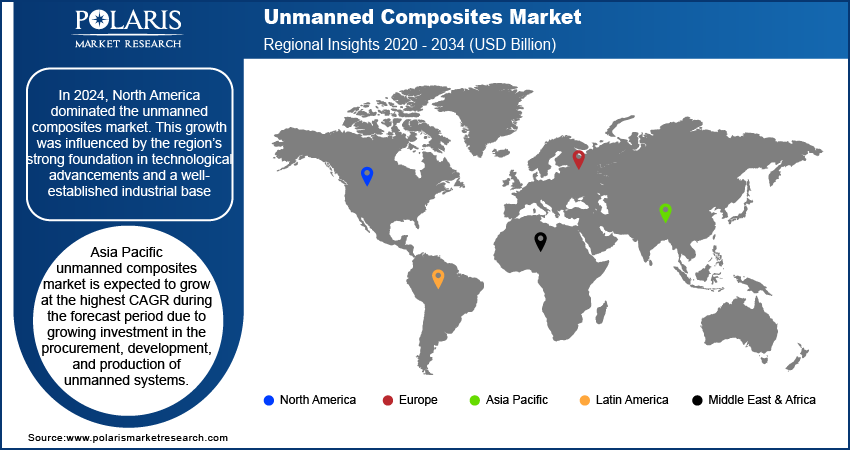
North America dominated with 40.85% share in 2025 due to high defense spending and early adoption of advanced technologies. The United States leads the region with significant investments in unmanned aerial vehicles, advanced air mobility, and next-generation defense systems. According to the Michigan Economic Development Corporation, in July 2025, state announced Michigan Advanced Air Mobility (AAM) Initiative to improve advanced air mobility capabilities. The initiative has attracted USD 42 million in public and private sector investment[5]. Moreover, the presence of major aerospace and material companies, along with strong research and development capabilities, supports continuous innovation in composite materials. Government funding and supportive policies further encourage market growth. Increasing commercial use of drones across industries such as logistics and agriculture is further driving demand for lightweight and high-performance composite solutions, thereby fueling the industry growth in region.
Asia Pacific
Asia Pacific is expected to witness the significant growth rate of CAGR 14.4% during the forecast period driven by increasing industrialization and rising investments in defense and technology. Countries like China, India, and Japan are actively expanding their unmanned systems capabilities for both military and commercial use. Government initiatives supporting domestic manufacturing and innovation are boosting the adoption of advanced materials, including composites. The region further benefits from a growing number of drone startups and expanding applications in agriculture, surveillance, and infrastructure. Asia Pacific is expected to see strong and sustained market growth as demand for cost-effective and efficient unmanned solutions increases.
China
China dominated within the Asia Pacific region in 2025 with 49.07% share due to strong government support and rapid industrial growth. The country is actively investing in unmanned aerial vehicles for defense, agriculture, and commercial delivery services. It also has a well-established manufacturing base, which helps in producing composite materials at competitive costs. Government initiatives promoting domestic innovation and self-reliance further boost market expansion. Additionally, the presence of numerous drone manufacturers and increasing export activities further drives the demand, thereby driving the industry growth.
Source: Polaris Market Research Analysis
Key Players & Competitive Analysis
The industry is competitive and dominated by vertically integrated material suppliers and aerospace-defense players such as Hexcel Corporation, Toray Industries, Inc., and Solvay S.A. (including Cytec Industries Inc.), which lead through advanced carbon fiber and resin technologies. Firms such as Gurit Holding AG, TenCate Advanced Composites, and Materion Corporation focus on niche high-performance materials, while Teledyne Technologies Incorporated and General Dynamics Corporation integrate composites into unmanned systems. Emerging players such as Greensea IQ add software-hardware synergy. Competition is driven by R&D, partnerships, and lightweight performance innovation.
Key Players
- Advanced Composites Group Ltd.
- Cytec Industries Inc. (now part of Solvay)
- General Dynamics Corporation
- Greensea IQ
- Gurit Holding AG
- Hexcel Corporation
- Materion Corporation
- Solvay S.A.
- Teledyne Technologies Incorporated
- TenCate Advanced Composites
- Toray Industries, Inc.
Industry Developments
- March 2026: Toray Group jointly exhibited at JEC World 2026 in Paris. The company introduced its largest PEI-based composite, Cetex TC1005. It stated that the composite is designed to offer an outstanding balance of value and performance. (source: jec-world.events)
- December 2025: GKN Aerospace partnered with Anduril Industries to enhance manufacturing of next-generation unmanned aerial vehicles (UAVs) using advanced composite technologies. The collaboration aims to reduce costs and lead times for complex airframes, strengthening the UK’s industrial base for autonomous defense platforms. (Source: GKN Aerospace)
- August 2025: Archer Aviation acquired a composite manufacturing facility and key assets from Mission Critical Composites to support its autonomous aircraft programs. The 60,000‑sq‑ft site enables production of high-performance carbon fiber structures, accelerating prototyping and manufacturing of components for hybrid-electric VTOL and defense UAVs. (Source: Aerospace Manufacturing and Design)
- May 2025: Flyber launched a U.K. manufacturing site to produce advanced composite propellers for UAV and AAM markets, using automated, out-of-autoclave processes that reduced cycle times, improved performance, lowered weight, and enabled scalable, sustainable production across aerospace mobility applications. (Source: Composite World)
- December 2024: Hexcel announced a collaboration with Boeing to support the development of the MQ-25 Stingray, evaluating its Flex-Core HRH-302 honeycomb core for use in structural components surrounding the high-temperature exhaust nozzle of the engine powering the U.S. Navy’s MQ-25 aircraft.(Source: Hexcel)
- March 2024: The new Toray Cetex TC915 PA+ was launched by Toray Advanced Composites, expanding its product portfolio. The thermoplastic material was designed for high-performance applications, offering enhanced strength, stiffness, temperature stability, and moisture resistance, complementing Toray Cetex TC910. (Source: Toray Advance Composites)
Unmanned Composites Market Segmentation
By Product Type Outlook (Revenue, USD Billion, 2021–2034)
- Carbon Fiber Reinforced Polymer
- Glass Fiber Reinforced Polymer
- Aramid Fiber Reinforced Polymer
- Other Products
By Application Outlook (Revenue, USD Billion, 2021–2034)
- Interior
- Exterior
By Platform Outlook (Revenue, USD Billion, 2021–2034)
- Unmanned Aerial Vehicle (UAV)
- Unmanned Ground Vehicle (UGV)
- Unmanned Surface Vehicle (USV)
- Autonomous Underwater Vehicle (AUV)
- Remotely Operated Vehicle (ROV)
- Autonomous Ship
- Passenger Drone
By Regional Outlook (Revenue, USD Billion, 2021–2034)
- North America
- US
- Canada
- Europe
- Germany
- France
- UK
- Italy
- Spain
- Netherlands
- Russia
- Rest of Europe
- Asia Pacific
- China
- Japan
- India
- Malaysia
- South Korea
- Indonesia
- Australia
- Vietnam
- Rest of Asia Pacific
- Middle East & Africa
- Saudi Arabia
- UAE
- Israel
- South Africa
- Rest of Middle East & Africa
- Latin America
- Mexico
- Brazil
- Argentina
- Rest of Latin America
Unmanned Composites Market Report Scope
| Report Attributes | Details |
| Market Size in 2025 | USD 2.53 Billion |
| Market Size in 2026 | USD 2.85 Billion |
| Revenue Forecast by 2034 | USD 7.76 Billion |
| CAGR | 13.2% from 2026 to 2034 |
| Base Year | 2025 |
| Historical Data | 2021–2024 |
| Forecast Period | 2026–2034 |
| Quantitative Units | Revenue in USD Billion and CAGR from 2026 to 2034 |
| Report Coverage | Revenue Forecast, Competitive Landscape, Growth Factors, and Industry Trends |
| Segments Covered |
|
| Regional Scope |
|
| Competitive Landscape |
|
| Report Format |
|
| Customization | Report customization as per your requirements with respect to countries, regions, and segmentation. |
Source: Polaris Market Research Analysis
Unmanned Composites Market FAQ's
The global market size was valued at USD 2.53 billion in 2025 and is projected to grow to USD 7.76 billion by 2034.
The global market is projected to register a CAGR of 13.2% during the forecast period.
North America dominated with 40.85% market share in 2025.
A few of the key players in the market are Advanced Composites Group Ltd.; Cytec Industries Inc. (now part of Solvay); General Dynamics Corporation; Greensea IQ; Gurit Holding AG; Hexcel Corporation; Materion Corporation; Solvay S.A.; Teledyne Technologies Incorporated; TenCate Advanced Composites; Toray Industries, Inc.
Based on product type, the carbon fiber reinforced polymer dominated with 55.94% market share in 2025.
Based on application, exterior segment is expected to witness growth rate of CAGR 12.7% during the forecast period.
Download Sample Report of Unmanned Composites Market
Please fill out the form to request a customized copy of the research report.


