
Autonomous Cars Market Research Report, Size & Forecast, 2026 – 2034
REPORT DETAILS
Autonomous Cars Market Summary
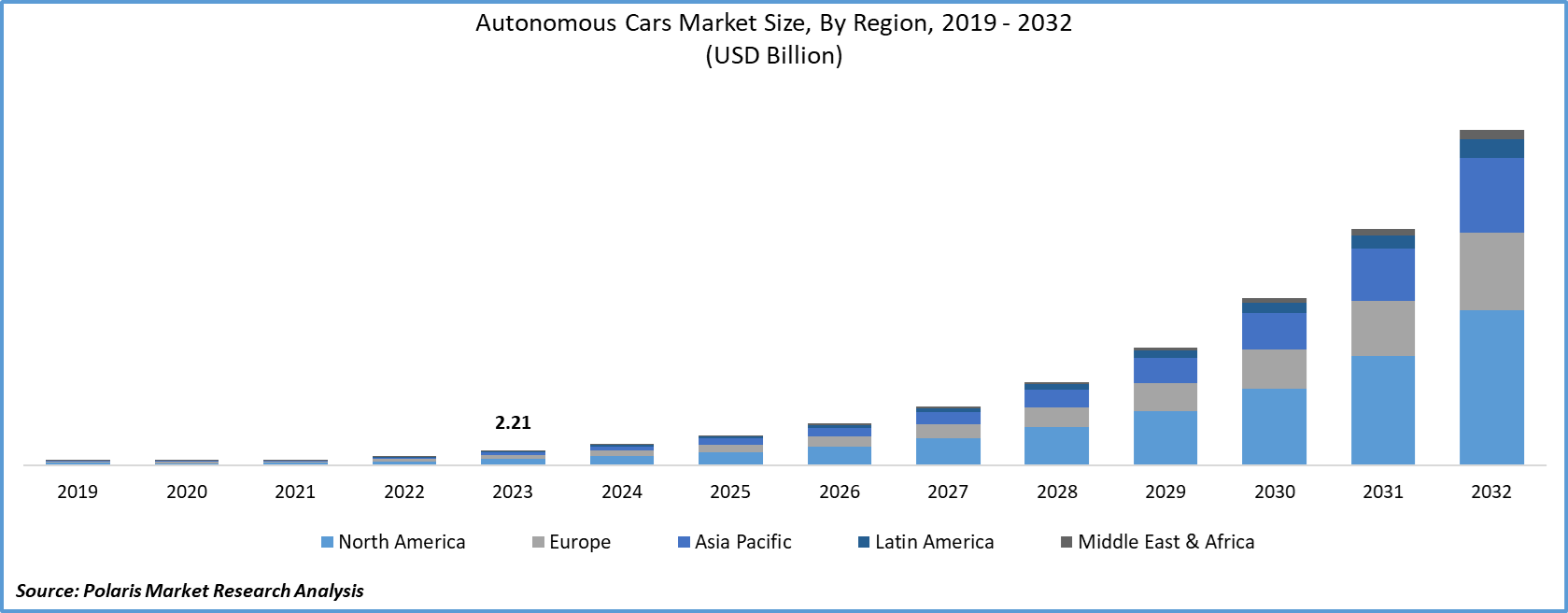
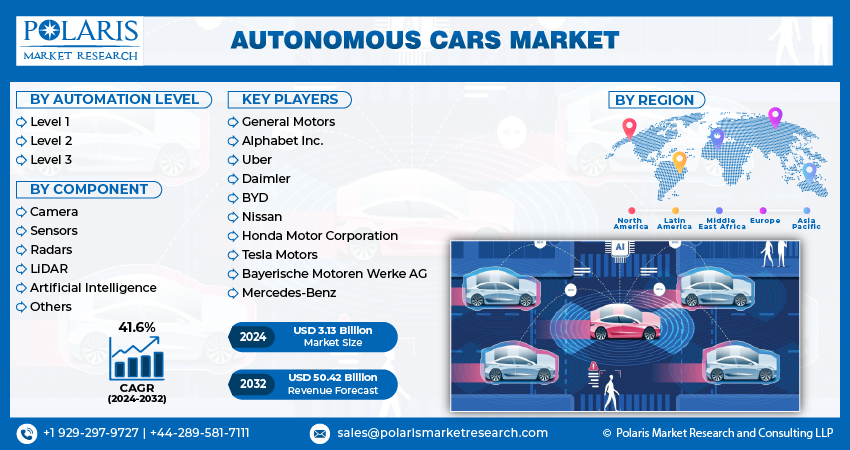
The global autonomous cars market was valued at USD 40.22 billion in 2025 and is anticipated to grow at a CAGR of 22.70% from 2026 to 2034. The market is driven by advancements in AI, LiDAR, and sensor technologies enabling self-driving capabilities.
Market Statistics
Key Takeaways
- North America led the global market with a 38.03% revenue share in 2025. This is due to the robust infrastructure in the region.
- Asia Pacific is projected to register the fastest growth at a 23.6% CAGR. This is because autonomous cars can increase mobility and reduce transportation costs in the region.
- The level 2 segment led the market with a 44.2% share in 2025. The segment’s leading position is due to its ease of use and high integration in modern vehicles.
- The sensors segment held substantial market share of 23.2% in 2025. Cameras and radars are foundational to current ADAS and Level 2+ automation.
- The artificial intelligence segment is projected to register the highest CAGR of 23.7%, as vehicles shift from basic automation to higher levels.
Note: Figures and projections outlined in this report are the result of Polaris Market Research’s proprietary analytical processes, grounded in the latest available datasets and market observations.
Industry Dynamics
- The rising emphasis on efficient traffic management has led to increased demand for autonomous cars.
- Increasing disposable incomes and improving living standards are also supporting the growth of the market.
- The rapid adoption of autonomous technology by ride-hailing services is creating market opportunities.
- High development and component costs may hinder market development.
AI Impact on Autonomous Cars Market
- AI forms the crux of technologies used in autonomous vehicles. It enables vehicles to perceive roads, traffic, and other impediments in real time.
- It assists in quick decision-making, such as braking, changing lanes, and avoiding collisions.
- AI assists in route optimization depending on traffic and road conditions.
- It utilizes driving data for enhanced vehicle performance and improved user experience.
Source: Polaris Market Research Analysis
Autonomous cars are self-driving cars capable of operating without human intervention. Autonomous cars are also known as driverless cars, robot cars, self-driving cars or autonomous vehicles. Autonomous cars operate using a combination of different technologies such as GPS sensing knowledge for navigation, sensors for collision avoidance, and augmented reality for driver information. Leading automotive companies such as BMW, Lexus, Google, and Mercedes have developed self-driving technologies. Fully-driverless technology is still at an advanced testing stage; however, partially autonomous technology has increasingly been used over the last few years.
The major driving factors of the autonomous cars market include growing need to reduce accidents and efficient traffic management in the coming years. Growing penetration of connected cars would further accelerate market growth. Increase in disposable income, and improving living standards are factors supporting market growth. Other factors driving the growth of this market include increasing need to provide safe and efficient driving options, and dynamic mobility applications. The increasing advancements in technologies, growing use of mapping software, and rising adoption of IOT further supplement the growth of autonomous cars market. Expansion of established companies into emerging economies and benefits offered by autonomous cars over manual driving cars would provide numerous growth opportunities in the autonomous cars market.
Source: Polaris Market Research Analysis
Level 1–5 Autonomy Comparison Table
| Level | Explanation | Driver Interventions Required |
| Level 1 | A basic driving assist system such as cruise control | Completely automated by the driver |
| Level 2 | Mobility help for steering and velocity | Manual driver intervention required |
| Level 3 | Conditional automation | Driver intervention on request |
| Level 4 | Semi-autonomous vehicle in designated areas | Minimal human intervention required |
| Level 5 | Fully autonomous vehicle | None required |
Source: Polaris Market Research Analysis
Segment Analysis
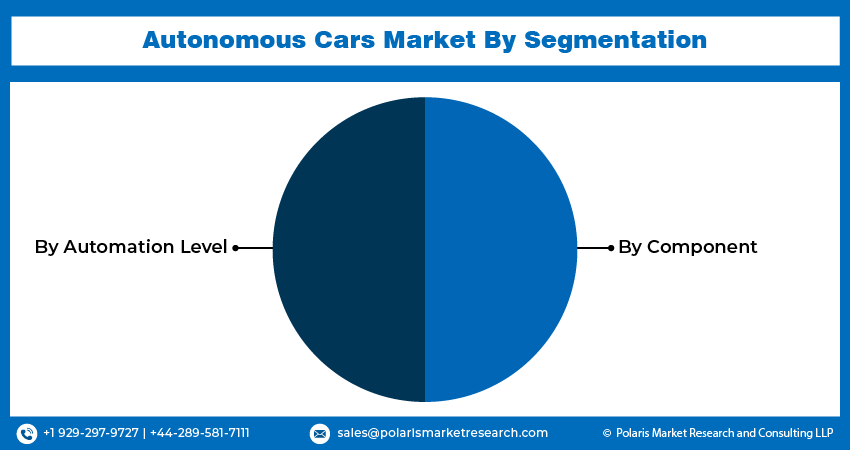
The global autonomous cars market is segmented on the basis of automation level, components, and geography. Based on the type of automation level, the market is segmented into Level 1, Level 2, and Level 3. Level 3 autonomous cars are expected to witness significant growth during the forecast period owing to technological advancements, and increasing adoption of connected cars.
The component segment is categorized into Cameras, Sensors, Radars, LiDAR, Artificial Intelligence, and others.
Source: Polaris Market Research Analysis
Autonomous Vehicles Real-World Uses
- Ride Sharing Service: Autonomous taxis to provide transportation service in urban areas.
- Freight: Autonomous trucks for transporting goods to customers.
- Personal Transportation: Autopilot function for highway transport.
- Mass Transportation: Self-driving buses in universities and airports.
- Transportation Fleets: Autonomous commercial vehicles to cut down expenses.
Regional Analysis
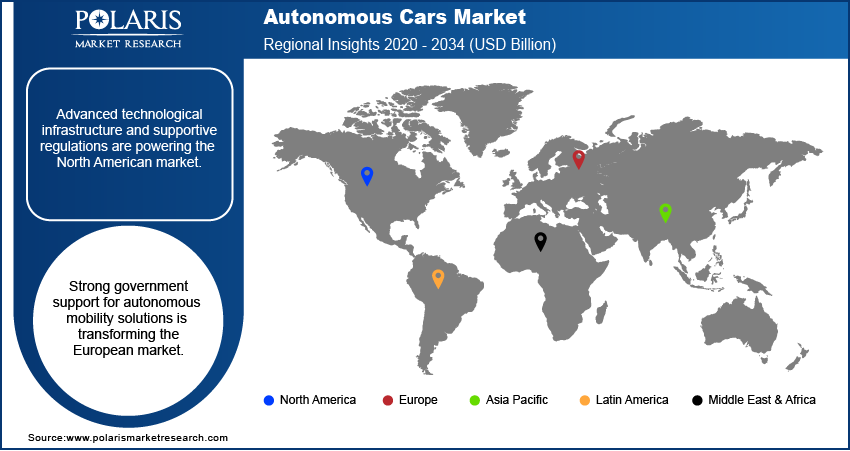
Geographically, the autonomous cars market is distributed across North America, Europe, APAC, Latin America, and MEA. North America is further segmented into U.S., Canada, and Mexico. Europe is divided into Germany, UK, Italy, France, and Rest of Europe. Asia-Pacific is bifurcated into China, India, Japan, and Rest of Asia-Pacific. North America accounted for the largest share in the global Autonomous Cars in 2017. The factors driving the market growth in this region include technological advancements, and significant investments in research and development. The government regulations regarding testing of driverless automobiles on public roads, and increasing need for improved road safety further support market growth. The growing adoption of IOT and dynamic mobility services, along with rising need for automation of driving to reduce human errors and improve road safety are expected to boost the adoption of autonomous vehicles during the forecast period.
Source: Polaris Market Research Analysis
Competitive Landscape
The major players operating the autonomous cars market:
- General Motors
- Alphabet Inc.
- Uber
- Daimler
- BYD
- Nissan
- Honda Motor Corporation
- Tesla Motors
- Bayerische Motoren Werke AG
- Mercedes-Benz among others.
These vendors in the market are launching new products to meet the growing customer needs. In addition, the leaders in the market are acquiring and collaborating with top companies in the market to enhance their offerings in the market and expand their customer base.
Recent Developments
September 2025: Qualcomm and BMW introduced Snapdragon Ride Pilot, a software suite used in autonomous driving technology. The Level 2+ autonomous driving system powered by artificial intelligence has been tested in over 60 countries. According to Qualcomm, it will be expanded to cover over 100 countries by 2026. (source: www.qualcomm.com)
December 2025: China implemented new regulations to enable Level 3 (L3) autonomous driving in personal vehicles, creating a clear legal framework that allows automakers like XPeng, Li Auto, and Tesla to advance toward mass production of L3-equipped cars. This development marks the beginning of large-scale global commercialization of L3 autonomous vehicles. (Source: english.scio.gov.cn)
Autonomous Cars Market Report Scope
| Report Attributes | Details |
| Market Size in 2025 | USD 40.22 Billion |
| Market Size in 2026 | USD 49.21 Billion |
| Revenue Forecast by 2034 | USD 253.54 Billion |
| CAGR | 22.70% from 2026 to 2034 |
| Base Year | 2025 |
| Historical Data | 2021–2024 |
| Forecast Period | 2026–2034 |
| Quantitative Units | Revenue in USD Billion and CAGR from 2026 to 2034 |
| Report Coverage | Revenue Forecast, Competitive Landscape, Growth Factors, and Industry Trends |
| Segments Covered |
|
| Regional Scope |
|
| Competitive Landscape |
|
| Report Format |
|
| Customization | Report customization as per your requirements with respect to countries, regions, and segmentation. |
Source: Polaris Market Research Analysis
Autonomous Cars Market FAQ's
The global autonomous cars market was valued at USD 40.22 billion in 2025.
The market is anticipated to grow at a CAGR of 22.70% from 2025 to 2034, reaching USD 253.54 billion by 2034.
The major players operating in the autonomous cars market include General Motors, Alphabet Inc., Uber, Daimler, BYD, Nissan, Honda Motor Corporation, Tesla Motors, Bayerische Motoren Werke AG (BMW), and Mercedes-Benz, among others.
Key driving factors include the growing need to reduce accidents and improve traffic management, rising penetration of connected cars, increasing disposable income and improving living standards, advancements in AI, LiDAR, and sensor technologies, growing use of mapping software, rising adoption of IoT, and the expansion of established companies into emerging economies.
North America holds the largest share in the global autonomous cars market.
Download Sample Report of Autonomous Cars Market
Please fill out the form to request a customized copy of the research report.


