
U.S. AI Diabetic Retinopathy Screening Market Demand, Industry Trends, 2026-2034
REPORT DETAILS
U.S. AI Diabetic Retinopathy Screening Market Summary
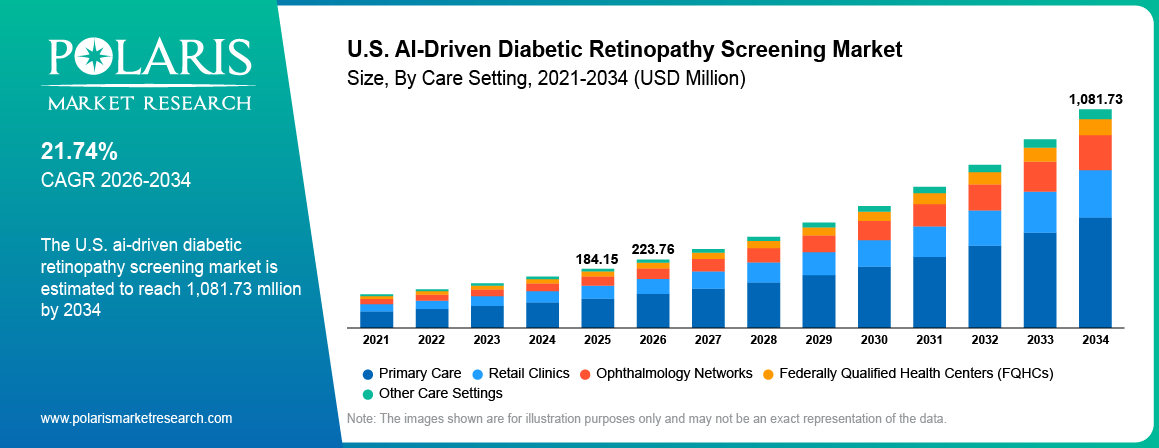
The U.S. AI-driven diabetic retinopathy screening market was valued at USD 184.15 million in 2025 and is projected to reach USD 1,081.73 million by 2034, expanding at a CAGR of 21.74% during the forecast period. Market growth is driven by the high and growing prevalence of diabetes across the U.S. adult population, the regulatory establishment of autonomous AI as a validated screening modality following FDA De Novo authorization of LumineticsCore, and increasing integration of AI retinal imaging into primary care and federally qualified health center workflows.
Market Statistics
U.S. AI-Driven Diabetic Retinopathy Screening Market Key Takeaways 2025
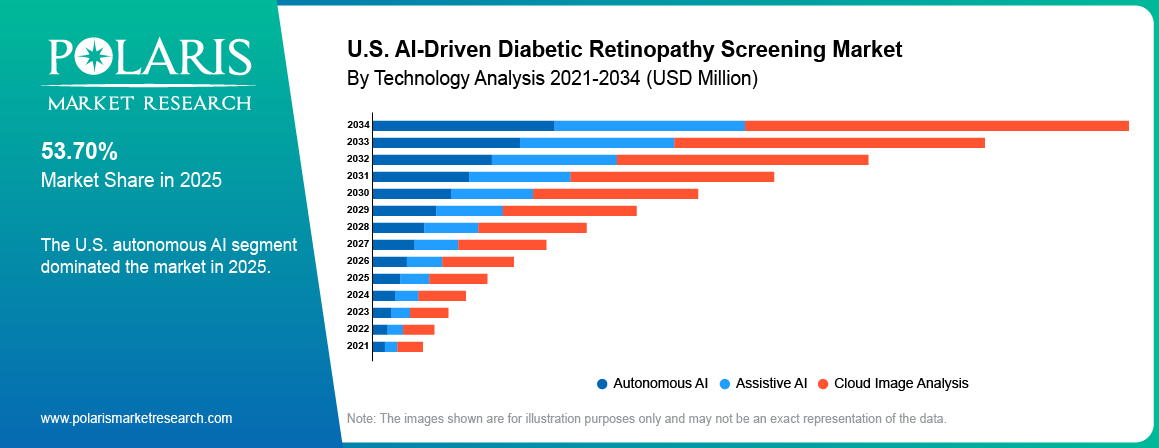
- Autonomous AI was the leading technology type in 2025 with a 53.70% market share, driven by approval from the FDA to LumineticsCore and its use in primary care.
- Primary Care constituted to be the leading care setting segment with 49.70% share owing to the use of retinal screenings in regular diabetes treatment.
- Healthcare organizations held the largest share of end users with 46.70% share propelled by the wide adoption of AI-powered retinal screenings in healthcare organizations.
- The payer-based screening programs market is anticipated to grow at the highest CAGR of approximately 12.10%, driven by Medicare Advantage and employer-based screening programs.
Note: Figures and projections outlined in this report are the result of Polaris Market Research’s proprietary analytical processes, grounded in the latest available datasets and market observation
What is AI-Driven Diabetic Retinopathy Screening?
AI-driven diabetic retinopathy screening involves the use of deep learning technology and CNN algorithms for analysis of the retinal fundus images to diagnose diabetic retinopathy, one of the top reasons for preventable blindness in people who have diabetes. AI-driven platforms obtain retinal fundus images using non-mydriatic retinal cameras and provide diagnosis or referral advice at the time of care. This is conducted to screen patients suffering from diabetic retinopathy in primary care, endocrinology and community healthcare settings without the need for immediate consultation with an ophthalmologist.
Unlike traditional retinal screening methods, AI-based technology provides rapid diagnostic assistance in the context of standard diabetes check-ups. This increases the accessibility of screening and facilitates the incorporation of eye examination into the diabetes management process. The U.S. market offers autonomous AI solutions, where diagnosis is provided independently of any physician’s intervention, and assistive AI tools to help professionals analyze retinal scans.
Source: Polaris Market Research Analysis
U.S. AI-Driven Diabetic Retinopathy Screening Market Driver Impact Analysis
The U.S. AI-driven diabetic retinopathy screening market is projected to grow at a CAGR of 21.74% through 2034. The table below highlights the major growth drivers and their expected impact across care settings and regions.
| Market Driver | Est. CAGR Impact | Relevance | Impact Timeline |
| High and growing U.S. diabetes prevalence driving unmet screening demand | +2.4% | National highest in South and Southeast states | Short to medium term |
| CMS reimbursement expansion for autonomous AI diabetic retinopathy screening under Medicare and Medicaid | +2.1% | National Medicare Advantage and Medicaid managed care | Short to medium term |
| Integration of AI retinal screening into primary care chronic disease management workflows | +1.7% | Nationwide concentrated in FQHC and large health systems | Medium term (2–4 years) |
| Payer-directed preventive screening programs deploying AI retinal imaging across diabetic member populations | +1.4% | Medicare Advantage, commercial payers, employer plans | Medium to long term |
| Expansion of AI screening into retail pharmacy, urgent care, and community health settings | +1.1% | High-prevalence states: TX, FL, GA, NC, AZ | Medium term |
| Multi-disease AI retinal analysis expanding per-scan clinical value | +0.8% | National | Long term |
* Indicative estimates based on market context and analyst judgment. Figures reflect relative driver weight, not additive CAGR contributions. Source: Polaris Market Research Analysis.
U.S. AI-Driven Diabetic Retinopathy Screening Market Industry Dynamics
- Expanding CMS coverage for AI-based diabetic retinopathy screening under the 2024 Physician Fee Schedule is reducing reimbursement uncertainty and accelerating health system adoption of autonomous AI platforms at primary care sites.
- Growing deployment of non-mydriatic fundus cameras in primary care offices and FQHCs is creating the hardware infrastructure base necessary for widespread autonomous AI screening program rollout.
- Physician awareness gaps regarding AI retinal screening program integration and workflow optimization continue to slow adoption rates in smaller independent primary care practices.
- Increasing collaboration between AI retinal screening companies and electronic health record vendors is reducing integration friction and enabling automated patient recall, result documentation, and referral generation within existing care workflows.
U.S. AI-Driven Diabetic Retinopathy Screening Market Drivers, Restraints and Opportunities
How Is U.S. Diabetes Prevalence Driving Growth in the AI-Driven Diabetic Retinopathy Screening Market?
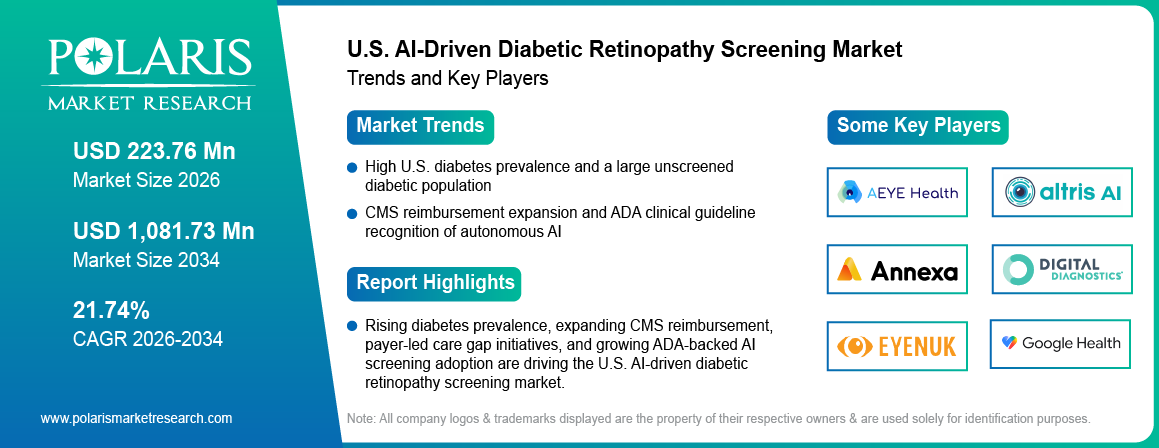
The increase in diabetes patients in the US is among the key drivers of AI-driven screening for diabetic retinopathy in the country. Based on data from 2023, the American Diabetes Association estimates that more than 40 million Americans, which constitutes 12% of the U.S. population, are living with diabetes. This includes over 2 million people with type 1 diabetes, among them approximately 314,000 children and adolescents (Source: diabetes.org). Annual retinal examinations are recommended for every person with diabetes, but a large share of patients remain unscreened each year. This unmet need has created strong demand for AI-enabled point-of-care screening in primary care and community healthcare settings. More people in the U.S. are living with diabetes, so the need for diabetes screening and preventive eye care is increasing. Shortage of ophthalmologists and optometrists is the issue face by many places. This has led clinics to use digital health tools and AI diagnostics to support routine screening. Healthcare automation helps save time and allows medical staff to focus on patients who need more attention. Therefore, AI healthcare solutions are now being implemented in retail clinics, community health centers, and primary care practices. The changes are improving access to eye screening. It increases the number of people screened before their sight problems become severe.
How is CMS Reimbursement Policy Reshaping the AI-Driven Diabetic Retinopathy Screening Market?
CMS reimbursement remains one of the major drivers of the growth of the AI diabetic retinopathy screening market in the US. It allows making screening profitable and supports the implementation of the technology among hospitals, healthcare organizations, and primary care providers. The expansion of reimbursement policies helps develop the value-based care and preventive screening programs for the treatment of diabetes. As a result of this development, in April 2026, the Centers for Medicare & Medicaid Services adopted the final Medicare Advantage and Part D Payment Policies for 2027 (Source: www.cms.gov).
What Challenges Threaten U.S. AI-Driven Diabetic Retinopathy Screening Market Expansion?
Reimbursement Permanence and Workflow Integration
The current system of payment under CMS is based on Category III CPT codes that are meant for emerging technology and not for permanent reimbursement. This leads to an uncertain situation for healthcare organizations that consider investing in artificial intelligence screening programs in the long run. Moreover, the integration of AI platforms with EHR systems, primary care workflows, and referral systems takes a lot of time and effort. These implementation challenges continue to slow adoption, particularly among smaller healthcare providers002E
What Opportunities Exist in the U.S. AI-Driven Diabetic Retinopathy Screening Market?
Payer-Directed Population Health Screening Programs
Medicare Advantage plans and Medicaid managed care organizations represent a major growth opportunity for the market. Many payers are expanding AI-based retinal screening to improve diabetes quality measures and reduce healthcare costs associated with preventable vision loss. Payer-sponsored screening initiatives are creating new deployment opportunities beyond traditional health system procurement.
Source: Polaris Market Research Analysis
Segment and Regional Leaders at a Glance
According to Polaris Market Research, Autonomous AI leads the market while Assistive AI the fastest-growing region.
- Dominant Technology Segment: Autonomous AI
- Fastest-Growing Technology Segment: Assistive AI
- Largest Care Setting Segment: Primary Care
- Fastest-Growing Care Setting Segment: Retail Clinics
- Largest End User Segment: Health Systems
- Fastest-Growing End User Segment: Payers
U.S. AI-Driven Diabetic Retinopathy Screening Market Segmentation Analysis
The report provides a comprehensive analysis of the U.S. AI-driven diabetic retinopathy screening market by technology, care setting, and end user to identify key revenue-generating and high-growth segments.
U.S. AI-Driven Diabetic Retinopathy Screening Market by Technology
What is the Largest Technology Segment in the AI-Driven Diabetic Retinopathy Screening Market?
Autonomous AI dominated the U.S. AI-powered diabetic retinopathy screening market share in 2025, with a 53.70% revenue share. This is due to the commercialization of LumineticsCore, which is the first FDA De Novo-authorized autonomous AI diagnostic solution for diabetic retinopathy. It allows primary care doctors and endocrinologists to screen retinas during routine visits without needing an immediate analysis from specialists. This has significantly expanded access to diabetic eye screening.
Which Technology Segment is Growing Fastest in the AI-Driven Diabetic Retinopathy Screening Market?
The assistive AI segment is expected to register the fastest CAGR of approximately 11.70% during the forecast period. Growth is supported by increasing use of AI-assisted image analysis, referral prioritization tools, and multi-disease retinal screening platforms in ophthalmology practices and health systems.
U.S. AI-Driven Diabetic Retinopathy Screening Market by Care Setting
Which Care Setting Leads the U.S. AI-Driven Diabetic Retinopathy Screening Market?
Primary care represented the largest market share of 49.70% in 2025. Combining AI screening in routine diabetes screening increases screening rates while reducing the need for specialist referral. Health systems and Federally Qualified Health Centers (FQHCs) have reported higher patient screening completion after implementing AI-based screening in primary care settings.
Which Care Setting is Growing Fastest in the U.S. AI-Driven Diabetic Retinopathy Screening Market?
The retail clinic segment is projected to grow at the fastest CAGR of approximately 11.90% during the forecast period. Expansion of chronic disease services by pharmacy-based clinics and improved access for uninsured and underserved patients are supporting market growth. AI retinal screening is also emerging as a valuable preventive service within retail healthcare networks.
U.S. AI-Driven Diabetic Retinopathy Screening Market by End User
Which End User Leads the U.S. AI-Driven Diabetic Retinopathy Screening Market?
Health systems captured the largest market share of 46.70% in 2025. Large health systems have the ability to deploy AI screening technologies in numerous primary care and specialty care facilities. Many academic medical centers also use AI retinal screening as part of broader diabetes population health programs.
Which End User Segment is Growing Fastest in the U.S. AI-Driven Diabetic Retinopathy Screening Market?
The payer segment is expected to record the fastest CAGR of approximately 12.10% during the forecast period. Medicare Advantage, Medicaid MCOs, and private payers continue to invest in AI retina screenings to increase preventive care, address screening gaps, and lower future costs of vision-related care. These programs are creating new funding opportunities for AI screening beyond traditional health system procurement.
Source: Polaris Market Research Analysis
Segment Summary Table
| Segment | Category | 2025 Status | Forecast CAGR | Key Driver |
| Autonomous AI | Technology | Largest share, 53.70% | High | FDA De Novo authorization and primary care integration |
| Assistive AI | Technology | Fastest growing, ~11.70% CAGR | High | Multi-disease retinal AI and ophthalmology network adoption |
| Primary Care | Care Setting | Largest share | High | Point-of-care diabetes visit integration and FQHC deployment |
| Retail Clinics | Care Setting | Fastest growing, | High | Pharmacy health clinic chronic disease service expansion |
| Health Systems | End User | Largest share | High | Enterprise AI screening program deployment at scale |
| Payers | End User | Fastest growing | High | HEDIS quality measure improvement and care gap closure programs |
Source: Polaris Market Research Analysis
Competitive Landscape and Key Players
The U.S. AI-driven diabetic retinopathy screening market is moderately concentrated. Competition includes autonomous AI developers, assistive AI providers, retinal imaging companies, and large technology firms. Key differentiators include FDA authorization, clinical validation, EHR integration, reimbursement support, hardware compatibility, and successful deployment across health systems and Federally Qualified Health Centers (FQHCs).
How Are FDA Approvals Accelerating Autonomous AI Adoption?
FDA clearance has supported more healthcare providers use autonomous AI for diabetic retinopathy screening. It shows that for clinical use these AI medical devices have met safety and performance requirements. To use them in daily practice this gives doctors and clinics more confidence. It also helps companies bring new digital diagnostics to the market faster. Some FDA-cleared systems can detect diabetic retinopathy without an immediate specialist review. This makes screening easier and supports patients get referred sooner when needed. By giving reliable screening results these tools also help clinical decision support. As more approved systems become available, more clinics can offer early screening and improve access to timely diagnosis and treatment.
How Does CMS Reimbursement Support Market Growth?
CMS reimbursement has made it easier for healthcare providers to adopt diabetic retinopathy screening. Medicare and many commercial insurers now cover these services. This supports clinics recover their costs through healthcare reimbursement. It also improves the return on investment for new screening systems. More providers are adding these services to routine care. This supports preventive healthcare by finding eye disease at an early stage. It also fits the goals of value-based care, which focuses on better patient outcomes and lower healthcare costs. Because of this, reimbursement continues to play a major role in the growth of the market.
Competitive Positioning Table
| Company | Est. Market Position | Primary Focus | Geographic Focus | In Report |
| Digital Diagnostics | Top 3 | Autonomous AI (LumineticsCore) first FDA De Novo authorized platform for diabetic retinopathy | US nationwide, FQHC and health systems | Yes |
| Eyenuk | Top 3 | Autonomous AI (EyeArt) FDA De Novo authorized; retail and primary care deployment | US, global | Yes |
| AEYE Health | Top 5 | Autonomous AI screening with payer-directed program partnerships | US, Israel | Yes |
| Google Health / Verily | Top 5 | Deep learning retinal AI development and health system partnerships | US, global | Yes |
| Topcon Healthcare | Top 5 | Fundus imaging hardware with integrated AI-assisted analysis capabilities | Global, strong US presence | Yes |
| RetinaLyze | Top 10 | Cloud-based AI retinal analysis for clinical and community settings | US, Europe | Yes |
| Optomed | Top 10 | Handheld non-mydriatic fundus cameras with AI screening integration | Global, US expanding | Yes |
Source: Polaris Market Research Analysis
Technology and Innovation Landscape 2025–2026
The U.S. AI-driven diabetic retinopathy screening market is advancing through innovation in multi-disease retinal AI analysis, handheld and portable fundus camera integration, EHR-native AI platform deployment, foundation model approaches to retinal image analysis, and payer-integrated data analytics for population health screening program management.
| Technology | Adoption Stage | Key Development | Market Impact |
| Autonomous AI Retinal Diagnostic Platforms | Mainstream adoption | FDA De Novo authorized platforms deployed across FQHCs and primary care health systems | Enables point-of-care DR screening without ophthalmologist review at time of image analysis |
| Assistive AI Retinal Triage and Reading Center Tools | Growing deployment | AI-prioritized reading queues and automated severity grading for teleophthalmology programs | Improves reading center throughput and reduces time-to-result for specialist-interpreted screening programs |
| Multi-Disease Retinal AI Analysis | Growing deployment | Simultaneous AI detection of DR, DME, glaucoma, AMD, and cardiovascular risk markers | Increases per-scan clinical value and expands reimbursable service scope per patient encounter |
| Handheld and Portable Non-Mydriatic Fundus Cameras | Growing deployment | Miniaturized imaging devices enabling retinal screening in mobile health, home care, and rural settings | Expands screening into care settings without fixed imaging infrastructure |
| EHR-Native AI Platform Integration | Early commercial deployment | Direct integration of AI screening results and referral workflows within Epic, Cerner, and athenahealth systems | Reduces implementation friction and automates patient recall, documentation, and referral generation |
| Foundation Models for Retinal Image Analysis | Early commercial deployment | Large-scale pre-trained retinal AI models enabling transfer learning across disease detection tasks | Accelerates algorithm development and improves generalizability across diverse patient populations |
Source: Polaris Market Research Analysis
Near-term market development will be driven primarily by autonomous AI platform expansion into retail clinic and payer-directed program settings, and the advancement of Category I CMS reimbursement coding for autonomous AI diabetic retinopathy screening.
Who Buys U.S. AI-Driven Diabetic Retinopathy Screening Market Research and Why?
The U.S. diabetic retinopathy screening market report is useful in assessing the commercial potential, the competitive environment, and the reimbursement landscape for developing an investment strategy on program and vendor selection and market entry within the ophthalmology diagnostic and population health management markets in the US.
| Buyer / Investor Type | Primary Use Case | Key Insight Sought | Decision Horizon |
| Health System Strategy Teams | AI retinal screening program evaluation and vendor selection | Platform ROI, EHR integration, and reimbursement pathway | 1–3 years |
| Payer Population Health Teams | Care gap closure program design and vendor contracting | HEDIS measure impact and per-member-per-month cost model | 1–3 years |
| AI Diagnostics Companies | Commercial strategy and market sizing | Segment opportunity, competitive benchmarking, and state priorities | 2–5 years |
| Venture Capital and Private Equity | Investment evaluation in AI ophthalmology companies | Market growth durability and reimbursement risk assessment | 3–7 years |
| FQHC and Community Health Networks | Technology procurement and grant program planning | Platform cost, FDA authorization status, and deployment requirements | 1–3 years |
Source: Polaris Market Research Analysis
What are the Barriers to Entering the Market?
- FDA clearance: It is necessary for De Novo or 510(k) clearance to be granted after considerable clinical evidence and regulation process.
- CMS reimbursement: The Permanent Category I CPT Reimbursement is developed at the moment.
- Clinical proof: Healthcare providers need clinical evidence of the system's efficiency and validity.
- Integration with EHR systems: Integration with such systems as Epic and Cerner needs time and technical development.
- Long sales cycle: Sales cycle for healthcare enterprise procurement typically takes up to 12-24 months due to several stages of approval.
- Dependence on hardware: AI platforms are hardware dependent and require using non-mydriatic fundus cameras.
Premium Insights and Forward Outlook
Category I CMS Reimbursement as the Defining Commercial Inflection Point
Permanent Category I CMS reimbursement is expected to be a major milestone for the U.S. market. This would remove any ambiguity surrounding reimbursement and promote wider usage by hospitals, primary care clinics, Medicare, Medicaid, and private health insurers. Industry players are still developing the necessary clinical data for achieving Category I CPT coding and this is expected between 2026 and 2029.
Multi-Disease Retinal AI as the Next Revenue Expansion Layer
The availability of AI solutions that detect different types of retinal diseases with one scan will create additional opportunities in the market. Apart from diabetic retinopathy, they can be used to detect diabetic macular edema, glaucoma, age-related macular degeneration, and hypertensive retinopathy. The identification of several conditions makes such screening more clinically valuable and financially rewarding.
Cost Benchmarking Table
| Product / Service Type | Est. Price Range (USD) | Key Cost Driver | Complexity Tier |
| Autonomous AI Retinal Screening Platform License (per site per year) | USD 15,000–USD 60,000 | Site volume, EHR integration scope, and support tier | Standard-High |
| Non-Mydriatic Fundus Camera (handheld) | USD 5,000–USD 15,000 | Image sensor quality and connectivity features | Standard |
| Non-Mydriatic Fundus Camera (tabletop, clinical grade) | USD 10,000–USD 35,000 | Resolution, auto-capture capability, and software integration | Standard-High |
| Enterprise Health System AI Screening Program (multi-site) | USD 200,000–USD 1,500,000+ annually | Site count, integration complexity, and service level | Enterprise |
| Payer-Directed Screening Program (per-member per month) | USD 2–USD 8 per diabetic member per month | Member population size and screening frequency | Standard |
| AI Reading Center Assistive Tool License | USD 20,000–USD 80,000 per year | Volume of reads and specialist reviewer seats | High |
Source: Polaris Market Research Analysis
Key Players
- AEYE Health Ltd.
- Altris AI Inc.
- Annexa Inc.
- Digital Diagnostics Inc.
- Eyenuk Inc.
- Google Health (Verily Life Sciences LLC)
- IDx Technologies Inc.
- Optomed Plc
- Retinal AI Ltd.
- RetinaLyze A/S
- Topcon Healthcare Inc.
- Voxeleron LLC
Industry Developments
- May 2026: Duke Eye Center introduced the first wide-scale AI-based diabetic retinopathy screening program in the U.S., using FDA-approved autonomous AI screening system in endocrinology clinics for prompt diagnosis at the point of care (source: dukeeyecenter.duke.edu)
- October 2024: Eyenuk collaborated with the American Academy of Ophthalmology (AAO) in order to promote AI-based diabetic retinopathy screening in disadvantaged areas of Delaware through EyeCare America program (source: www.ophthalmologytimes.com).
Market Segmentation
By Technology Outlook (Revenue, USD Million, 2021–2034)
- Autonomous AI
- Assistive AI
- Cloud Image Analysis
By Care Setting Outlook (Revenue, USD Million, 2021–2034)
- Primary Care
- Retail Clinics
- Ophthalmology Networks
- Federally Qualified Health Centers (FQHCs)
- Other Care Settings
By End User Outlook (Revenue, USD Million, 2021–2034)
- Health Systems
- Payers
- Employers and Employer Health Plans
- Public Programs (Medicaid, FQHC, IHS)
- Others
Report Scope
| Report Attributes | Details |
| Market Size in 2025 | USD 184.15 Million |
| Market Size in 2026 | USD 223.76 Million |
| Revenue Forecast by 2034 | USD 1,081.73 Million |
| CAGR | 21.74% from 2026 to 2034 |
| Base Year | 2025 |
| Historical Data | 2021–2024 |
| Forecast Period | 2026–2034 |
| Quantitative Units | Revenue in USD Million and CAGR from 2026 to 2034 |
| Report Coverage | Revenue Forecast, Competitive Landscape, Growth Factors, and Industry Trends |
| Segments Covered | By Technology | By Care Setting | By End User |
| Geographic Scope | US – with state-level focus on California, Texas, Florida, New York, Illinois, Pennsylvania, Ohio, Georgia, North Carolina, Arizona |
| Competitive Landscape | Industry Trend Analysis (2025); Company Profiles including overview, financial information, product benchmarking, and recent developments |
| Report Format | PDF + Excel |
| Customization | Report customization available as per requirements with respect to states, segments, and end-user types. |
U.S. AI Diabetic Retinopathy Screening Market FAQ's
• U.S. diabetic retinopathy screening using AI technology had a value of USD 184.15 million in 2025, and it is expected to achieve a value of USD 1,081.73 million by 2034.
• It is projected that the market to record a CAGR of 21.74% between 2026 and 2034.
• In 2025, autonomous AI dominated the market with a market share of 53.70%, due to the use of FDA-approved technologies like LumineticsCore and EyeArt.
• Retail clinics are expected to record the fastest CAGR of approximately 11.90%, supported by expanding pharmacy-based chronic disease screening services.
• The payer category is expected to register the highest CAGR of around 12.10% fueled by the Medicare Advantage and Medicaid care gap programs.
• Major companies include Digital Diagnostics Inc., Eyenuk Inc., AEYE Health Ltd., Google Health (Verily), Topcon Healthcare, RetinaLyze, and Optomed.
• Drivers include growing prevalence of diabetes, CMS reimbursement expansion, adoption of AI retinal imaging, and preventative screening programs led by payers.
• Texas, Florida, California, Georgia, and North Carolina offer strong growth potential due to high diabetes prevalence and large Medicare and Medicaid populations.
Download Sample Report of U.S. AI Diabetic Retinopathy Screening Market
Please fill out the form to request a customized copy of the research report.


