
VCSEL Market Size, Share, and Forecast 2026 to 2034
REPORT DETAILS
VCSEL Market Summary
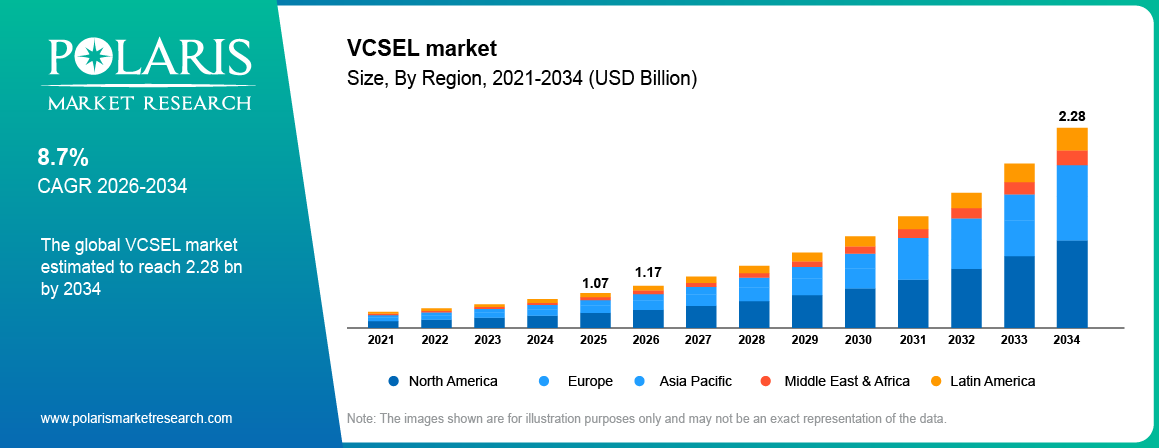
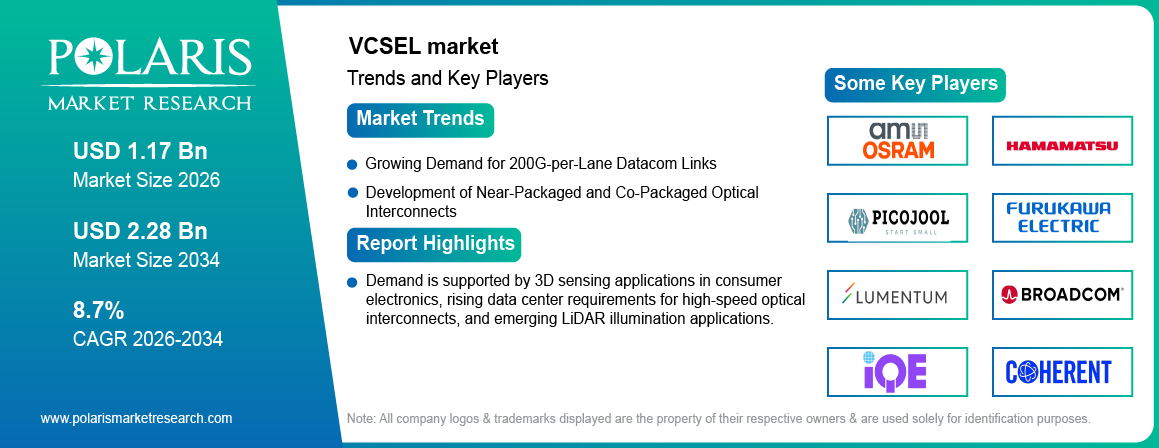
The global VCSEL market size was valued at USD 1.07 billion in 2025. The market is projected to record a CAGR of 8.7% from 2026 to 2034. Demand is supported by 3D sensing applications in consumer electronics, rising data center requirements for high-speed optical interconnects, and emerging LiDAR illumination applications.
Market Statistics
Key Takeaways
- North America accounted for 27.50% of the global VCSEL market share in 2025. It is supported by established consumer 3D sensing supply relationships, the Coherent and Apple multiyear VCSEL supply agreement, and datacom technology development.
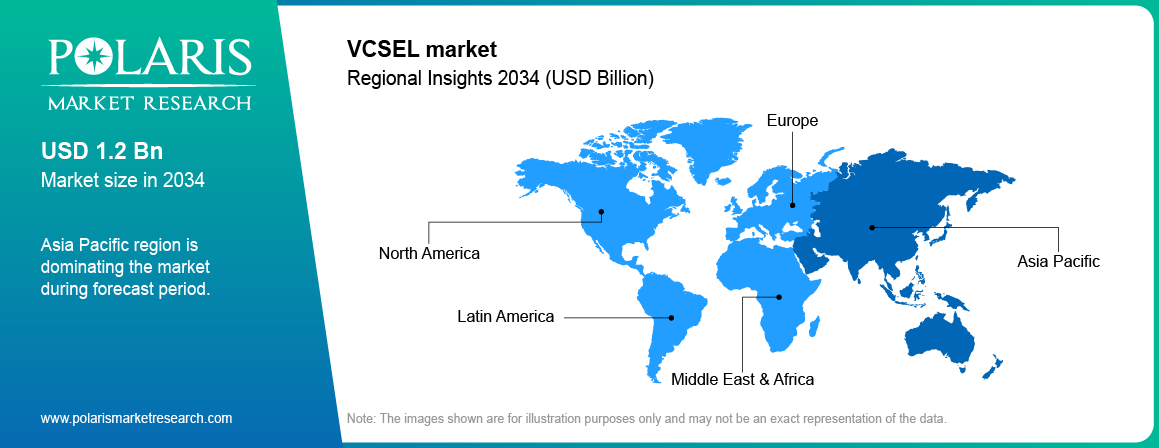
- The Asia Pacific market is projected to register a CAGR of 10.95% during the forecast period. This is driven by investments in VCSEL manufacturing, gallium arsenide epitaxy capabilities, and photonics production infrastructure.
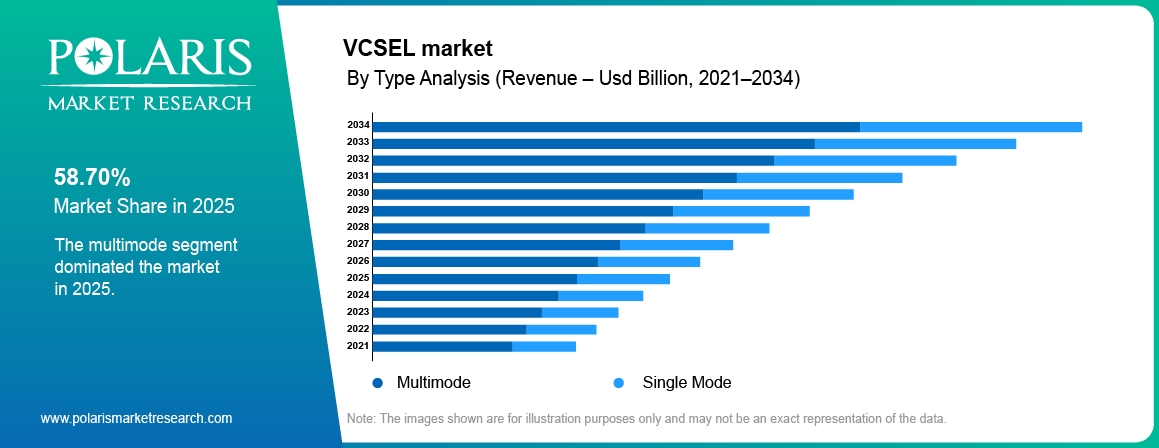
- Multimode VCSELs accounted for 58.70% of the type segment in 2025, fueled by their established role in 3D sensing and ongoing development for high-speed data communication applications.
- Sensing accounted for 34.65% of the application segment in 2025, driven by demand for smartphone facial recognition, time-of-flight systems, and industrial sensing applications.
- Data communication is projected to register a CAGR of 7.40% during the forecast period, driven by demand for higher-bandwidth optical interconnects in AI data centers, including development of 200G-per-lane VCSELs, PAM4 signaling, 1.6T SR8 chipsets, and near-packaged optics.
- Consumer electronics segment accounted for 47.39% of the end-use segment in 2025, propelled by Face ID-related VCSEL supply activity and established 3D sensing platforms.
Note: Figures and projections outlined in this report are the result of Polaris Market Research’s proprietary analytical processes, grounded in the latest available datasets and market observations.
What is VCSEL Market?
The vertical cavity surface emitting laser ((VCSEL) market covers the production and sale of vertical cavity surface emitting lasers (VCSEL). VCSELs are a type of semiconductor laser diode. They emit light perpendicular to the surface of the semiconductor wafer. They offer advantages such as low power consumption, high-speed operation, compact design, and efficient optical coupling. Unlike conventional edge-emitting lasers, VCSELs direct optical output through the surface of the semiconductor wafer. The technology is available as chips, dies, arrays, and modules, in single-emitter configurations and two-dimensional arrays, for sensing, data communication, and LiDAR applications. The market scope also covers epitaxial wafers supplied to VCSEL manufacturers.
The vertical cavity surface emitting laser market scope covers multimode and single mode VCSEL devices for 3D sensing, facial recognition, time of flight, short reach optical communication, industrial sensing, and LiDAR illumination. Device performance depends on wavelength, optical power, modulation speed, emitter configuration, thermal characteristics, and the quality of manufacture. Gallium arsenide epitaxy is a key component in the manufacturing supply chain, especially for current 850 nm devices and for new VCSEL designs. The analysis also looks at the role of epitaxy wafer suppliers such as IQE and manufacturing partners such as WIN Semiconductor.
VCSELs are used in a number of sectors including consumer electronics, data centers, automotive systems, and industrial equipment. In consumer electronics, they enable 3D sensing and facial recognition functions. The development of high-speed optical interconnects for data communication applications, including 200G per lane demonstrations, PAM4 signaling, and 1.6T SR8 chipset development, is gaining traction. The VCSEL technology market is also looking at 1060 nm devices and near-packaged optics for future optical links.
Market Dynamics
Driver: Growing Demand for 200G-per-Lane Datacom Links
High-speed optical links for communication between servers, accelerators, and switching systems are of increasing interest. This is due to the growing bandwidth requirements of AI data centers and high-performance computing infrastructures. VCSELs are developed for short-reach optical interconnects using multimode fiber, parallel transmission, and PAM4 modulation. Higher lane rates are allowing suppliers to improve modulation speed, power efficiency, and signal integrity, while retaining the benefits of VCSEL-based optical architectures. This trend is reinforcing the position of the VCSEL market in next-generation data center connectivity.
In March 2025, Coherent and Keysight showed a 200G-per-lane multimode VCSEL operating at 106.25 GBaud PAM4. The demonstration showed the technical capability of VCSELs for higher speed datacom links. Semtech announced September 2025 sampling of its 200G VCSEL driver and transimpedance amplifier as part of a 1.6T SR8 chipset, with Broadcom providing the 200G VCSEL. TRUMPF’s datacom VCSEL portfolio also includes 850 nm devices for high-speed data center applications. These developments indicate continued product engineering across the VCSEL supply chain, including emitters, drivers, and optical interconnect systems (Source: Keysight.com).
Driver: Development of Near-Packaged and Co-Packaged Optical Interconnects
The growth in AI computing infrastructure is forcing optical component makers to develop interconnect architectures that bring optical links closer to processors and switching devices. Near-packaged optics and co-packaged optics are gaining attention. This is because they reduce the distance traveled by high-speed electrical signals and allow for higher bandwidth density in advanced computing systems. VCSEL arrays are evaluated for these architectures, especially when compact optical sources and parallel transmission channels are required. This offers an alternative development path for the VCSEL industry apart from traditional pluggable optical modules.
At OFC 2026, Lumentum showed a 1060 nm multimode VCSEL array co-packaged with a host ASIC using fan-out wafer-level packaging. The platform was designed for extreme operating environments, including temperatures over 150°C. Furukawa Electric is among the suppliers working on VCSEL-based near-packaged optics, mirroring growing interest in the industry for getting optical connectivity closer to computing components. Such initiatives are relevant to future scale-up of optical interconnects in AI and high performance computing systems (Source: Lumentum.com).
Restraint: Commercial Qualification and Delayed Revenue Realization
The shift from technical demonstrations to commercial deployment remains an important consideration for the VCSEL market. High speed datacom devices must undergo customer qualification, meet reliability and manufacturing requirements, and win design wins to contribute to recurring product revenue.Although manufacturers are advancing 100G and 200G devices through product launches, engineering samples, and technology demonstrations, these developments do not necessarily indicate immediate commercial adoption. Qualification timelines, production scalability, and integration into customer systems can delay revenue realization. These challenges are particularly relevant to emerging 1060 nm VCSEL devices and advanced optical packaging architectures, where commercialization depends on broader ecosystem readiness and customer adoption.
The current product pipeline is the development of mature 850 nm datacom and newer 1060 nm demonstrations. TRUMPF introduced high-speed 850 nm datacom VCSELs, and Lumentum, Qualcomm, and Corning demonstrated an optical die-to-die link at ECOC 2026 using a 1060 nm VCSEL and 32 Gb/s NRZ optical channels. ams OSRAM also showed an 850 nm thin-film microVCSEL platform at 32 Gb/s NRZ in September 2026. Although these developments highlight improvements in VCSEL performance and optical interconnect capabilities, converting them into volume production and sustained commercial revenue remains dependent on customer qualification and deployment timelines.
Opportunity: Expansion of 3D Sensing and Consumer Electronics Applications
Consumer electronics continues to provide a well-established application base for VCSEL emitters and arrays. Smartphone facial recognition, depth measurement, and time-of-flight sensing all require compact optical sources that can provide structured illumination and reliable sensing performance. The continuing trend of adding 3D sensing capabilities to consumer devices is creating opportunities for suppliers of VCSEL chips, arrays, and related optical components. Established supply relationships in this segment also provide a commercial base for manufacturers developing higher performance emitter designs.
Coherent and Apple signed a multi-year contract for the supply of VCSELs for Face ID applications, highlighting the lasting importance of VCSEL technology in smartphone biometric sensing. In March 2026, Lumentum announced it had shipped more than 10 billion emitters on its 3D sensing platform. These developments highlight the established scale of use of VCSELs in consumer sensing applications and the importance of long-term supply relationships for the component manufacturers.
Opportunity: Automotive LiDAR and Industrial Sensing Applications
Specialized VCSEL products are expected to find additional opportunities in automotive and industrial applications. In automotive systems, VCSELs are investigated for LiDAR illumination, depth sensing, object detection, and driver assistance functions. These applications require optical components designed around operating conditions such as temperature, reliability, optical output, and system integration. Industrial equipment offers a separate application base, where VCSEL-based reflective sensors can support object detection and position monitoring in automated machinery, printers, and conveyor systems.
Lumentum's VCSEL portfolio includes devices for automotive 3D sensing, LiDAR illumination, depth sensing, object detection, and driver assistance. Vertilite presented automotive VCSEL technology at CES 2026 and discussed AR VCSEL applications for LiDAR at Photonics West. In industrial sensing, ROHM's RPR-0730 VCSEL photo reflector entered mass production in October 2025 for applications including printers and conveyor systems. These developments illustrate the range of application-specific opportunities emerging beyond smartphone sensing, while automotive LiDAR remains an area where product qualification and system-level adoption will influence commercial demand (Source: rohm.com).
VCSEL Market Segmentation Analysis
The VCSEL market is segmented on the basis of type, application, and end use. These categories distinguish the emitter architecture, the function performed by the VCSEL, and the industries where the devices are deployed.
Type Insights
The multimode VCSELs segment dominated the VCSEL market share with 58.70% in 2025. Its position is supported by established use in 3D sensing and continued development for short-reach optical communication. Multimode devices are being developed for higher-speed data transmission using multimode fiber laser and PAM4 modulation. Recent product demonstrations have focused on 100G and 200G-per-lane performance, reflecting the technical requirements of next-generation data center links. These developments support the continued role of multimode architectures across sensing and data communication applications.
The segment growth is also supported by development in high-speed datacom and advanced optical packaging. TRUMPF has presented a 100G 850 nm datacom VCSEL for 800G SR8 and 400G SR4 active optical cable applications. Lumentum's 1060 nm multimode array demonstration at OFC 2026 further reflects the development of these devices for co-packaged optical interconnects. Such product activity is expanding the potential applications of multimode VCSELs in high-bandwidth optical systems.
The single-mode VCSELs segment is projected to register a CAGR of 11.20% during the forecast period. Single-mode VCSELs are relevant to applications that require controlled beam characteristics and specific optical performance. Their use depends on the optical requirements of the target system, including output characteristics, wavelength, modulation performance, and integration requirements. The segment has a distinct technical role within the broader VCSEL technology market, particularly where beam quality and optical precision influence component selection.
Recent 2025 and 2026 datacom demonstrations have been more concentrated on multimode devices, while further commercial programs and customer qualification activity will help establish the market position of single-mode products. The distinction between the two architectures remains relevant to buyers selecting VCSEL devices for specific sensing and communication requirements.
Application Insights
The sensing segment accounted for the significant share of 34.65% in 2025. Demand is driven by the use of VCSEL emitters and arrays in smartphone facial recognition, depth measurement, and time-of-flight systems. Such devices offer controlled optical illumination for 3D sensing functions and are relevant to biometric authentication and other compact sensing applications. Industrial sensing adds demand from equipment manufacturers who need compact optical detection components. This application is still supported by existing consumer electronics supply relationships.
Its growth is also attributed to the increasing adoption of VCSEL technology across consumer electronics and industrial equipment. The significance of these elements in smartphone biometric systems is clear from Coherent’s multi-year supply contract for VCSELs to Apple for Face ID applications. Lumentum has also delivered more than 10 billion emitters through its 3D sensing platform. ROHM’s RPR-0730 VCSEL photo reflector began mass production in October 2025 for use in printers, conveyors, and robots in industrial applications. These developments demonstrate the applications of VCSEL emitters in sensing.
The data communication segment is expected to register a CAGR of 7.40% in 2025. Demand is driven by short-distance optical links in data centers and high-performance computing infrastructure. VCSELs are well suited for optical communication over multimode fiber, especially compact emitters and parallel transmission channels. This segment is closely related to the optical transceiver market, where higher data rates and growing bandwidth requirements are fueling component development. The development of higher-speed VCSEL devices and optical packaging architectures also boost the segment expansion. Near-packaged optics and co-packaged optics are also creating opportunities for VCSEL arrays in future data center interconnect architectures.
The LiDAR segment accounted for 16.35% of the application segment in 2025. VCSELs serve as optical sources in LiDAR systems, supporting illumination for distance measurement and object detection. Automotive applications are an important area of development, with requirements shaped by optical output, operating temperature, reliability, and system integration. The LiDAR market covers complete sensing systems, whereas this report considers the VCSEL emitter component supplied for those systems. The segment expansion is also supported by continued development of automotive and advanced sensing technologies. Continuous developments by key players reflect ongoing supplier activity in optical illumination for automotive sensing applications, with commercial growth dependent on system-level integration and customer qualification.
The others segment accounted for 8.80% of the application segment in 2025. It includes industrial photo-reflector applications, laser printing, infrared illumination, and other specialized uses that fall outside the principal sensing, data communication, and LiDAR categories. These applications use VCSELs where compact optical sources, controlled illumination, and integration into electronic equipment are required. Industrial automation and equipment sensing provide examples of this broader application base.
End Use Insights
Consumer electronics held the largest share of 47.39% in 2025. The demand is supported by the usage of VCSELs in smartphones and biometric sensing systems, especially for facial recognition and 3D depth measurement. Face ID is the most mature consumer device example of VCSEL-based sensing. Coherent’s multiyear supply agreement with Apple, and Lumentum’s reported shipping history for its 3D sensing platform underscore the significance of consumer electronics in the VCSEL supply chain. These applications require small emitters that can be incorporated into electronic products with space constraints.
The segment is witnessing growth due to the increasing integration of biometric authentication, depth sensing, and other optical capabilities in electronic devices. Demand is driven by smartphone product cycles, component qualification, and the optical performance and long-term supply agreements between device manufacturers and VCSEL suppliers. Smaller emitter configurations such as microVCSELs are also developed, providing opportunities for compact sensing designs.
Data center segment held a 28.61% share in 2025. VCSELs are also increasingly used in data centers, where the demand for higher-bandwidth optical communication is driven by AI computing and high-performance networking. Short-reach links interconnect servers, accelerators, and switching equipment. This generates a demand for optical components that support higher transmission rates. Developments in 200G-per-lane devices, 1.6T SR8 chipsets, and advanced optical packaging are driving the technology pipeline for this end-use.
The data center segment growth is driven by continued development of high-speed optical interconnects and next-generation computing infrastructure. Broadcom, Semtech, Lumentum, TRUMPF, Coherent, and ams OSRAM are among the companies involved in relevant product development, demonstrations, or sampling activity. Near-packaged optics and co-packaged optics are also creating opportunities for VCSEL arrays as optical connectivity moves closer to processing and switching components.
The automotive segment is expected to register a CAGR of 13.20% during the forecast period. VCSELs are used or developed for automotive sensing applications, including LiDAR illumination, depth sensing, object detection, and driver assistance. Automotive buyers assess optical output, thermal performance, reliability, and qualification requirements when selecting components for vehicle sensing systems. Supplier activity from Lumentum and Vertilite reflects the development of VCSEL technologies for automotive and advanced sensing applications.
The automotive segment growth is supported by ongoing development of advanced driver-assistance systems and optical sensing technologies. Vertilite's automotive VCSEL presentation at CES 2026 and Lumentum's automotive sensing portfolio demonstrate product activity in this area. IQE has also reported developments in next-generation 3D sensing VCSEL technologies and products qualified with Tier 1 customers. Commercial expansion will depend on automotive customer qualification, component reliability, and integration into production vehicle platforms.
The industrial and other segment accounted for 9.25% of the end-use segment in 2025. This category includes automation equipment, robotics, printing systems, conveyors, and specialized sensing products. VCSEL-based photo reflectors can support object detection and position monitoring in industrial equipment, where compact size and consistent optical performance are important.
The segment growth is supported by the use of optical sensing in automated equipment and specialized electronic systems. Demand depends on the number of sensing points, equipment design, operating environment, and requirements for component reliability. VCSELs incorporated into sensor modules are counted at the emitter die value in this market analysis, keeping the segment focused on VCSEL component revenue rather than the full value of the finished module.
VCSEL Market Regional Analysis
North America VCSEL Market Trends
North America accounted for 27.50% of the global VCSEL market in 2025, supported by established consumer electronics supply relationships and ongoing development of high-speed optical communication technologies. The region has an important role in the VCSEL supply chain through semiconductor manufacturing, datacom component development, and advanced optical interconnect research. Coherent's multiyear VCSEL supply agreement with Apple for Face ID applications provides a direct example of commercial demand from the consumer electronics sector. The agreement also supports manufacturing activity at Coherent's Sherman, Texas facility, which houses compound semiconductor epitaxy, fabrication, and device manufacturing capabilities. These developments strengthen North America's position in the VCSEL market.
Europe VCSEL Market Trends
Europe accounted for 19.50% of the global VCSEL market in 2025. This is fueled by semiconductor materials expertise, silicon photonics manufacturing, and high-speed optical component development across Germany, Austria, and the UK. TRUMPF presented its 100G 850 nm multimode datacom VCSEL in September 2025 for 800G SR8 and 400G SR4 active optical cable and transceiver applications. In September 2026, Austria-based ams OSRAM, together with a connectorized multicore fiber solution from BizLink, presented its 850 nm thin-film microVCSEL platform. It demonstrated error-free 32 Gb/s NRZ operation, energy efficiency of about 0.25 pJ/bit and more than 2,000 hours of reliability validation. IQE (UK) announced H1 2026 revenues of GBP 64.6 million, of which GBP 38.5 million was generated from photonics. The company mentioned next-generation 3D sensing VCSEL technologies and qualification activity for GaAs-based optical interconnects. These developments are indicative of the European contribution to existing sensing applications and the emerging needs of high-speed optical communications.
Asia Pacific VCSEL Market Trends
The market in Asia Pacific is projected to register a CAGR of 10.95% during the forecast period. This is owing to its strong semiconductor manufacturing ecosystem, GaAs epitaxy capabilities, and optical component production activity in China, Japan, and Taiwan. Vertilite signed a deal in August 2026 to build a planned optical chip and device manufacturing base in Changzhou, China, with an investment of approximately USD 751 million. The project is mainly for InP laser chip research and manufacturing, but its wider manufacturing ecosystem also includes six-inch GaAs MOCVD VCSEL epitaxy, packaging, testing, and qualification capabilities. Japan adds ROHM’s RPR-0730 photo reflector that combines a 940 nm VCSEL and began mass production in October 2025 for printers and conveyor systems.
In October 2026, Furukawa Electric was selected for a NEDO research and development program. Through a Japanese industry consortium, it is also working on technology development for manufacturing optical chiplets for next-generation AI computing. PicoJool’s planned facility expansion in Taiwan, combined with its dependence on WIN Semiconductor and other GaAs foundries, complements the region’s VCSEL manufacturing ecosystem. These developments strengthen the role of Asia Pacific in compound semiconductor manufacturing, industrial sensing and next-generation optical connectivity.
Middle East & Africa VCSEL Market Trends
The Middle East & Africa VCSEL market accounted for 3.60% of global revenue in 2025. Regional demand is assessed through the adoption of consumer electronics, data center infrastructure, industrial automation, and automotive sensing technologies that use VCSEL-based components. The market opportunity is linked to the deployment of optical sensing systems and short-reach communication infrastructure, along with procurement requirements from electronics and industrial equipment manufacturers. The development of regional data center capacity and industrial technology applications provides a basis for evaluating future VCSEL demand.
Latin America VCSEL Market Trends
The Latin America VCSEL market accounted for 4.20% of global revenue in 2025. Demand is associated with the use of VCSEL-enabled components in consumer electronics, industrial sensing equipment, automotive systems, and data communication infrastructure. Market development depends on the adoption of optical sensing technologies, expansion of data center facilities, and procurement of electronic components by regional manufacturers and system integrators. Industrial automation and connected infrastructure also provide potential application areas for VCSEL-based sensing products. These factors form the basis for assessing Latin America's contribution to the global VCSEL market and its future growth potential.
Competitive Landscape
The VCSEL market includes established chip and array manufacturers, specialist suppliers, epitaxy providers, and companies developing optical interconnect architectures. Coherent's multiyear supply agreement with Apple for Face ID is the clearest identified commercial supply agreement in the research package. Lumentum and Coherent are major listed suppliers, while their consolidated financial disclosures do not provide separate VCSEL revenue lines.
The competitive landscape also includes Broadcom, ams OSRAM, TRUMPF, Vertilite, ROHM, and PicoJool as VCSEL chip and array suppliers. IQE operates as an epitaxy wafer supplier, while Furukawa Electric is developing VCSEL-based near-packaged optics. The 10 companies are categorized by value-chain role rather than ranked by market share. Company-level VCSEL revenue and market share remain proprietary estimation inputs.
Vendor Positioning
| Rank | Company | Headquarters | Positioning | VCSEL Focus & Portfolio | Key Applications | Key Strengths | Watch Points / Limitations |
| 1 | Lumentum Holdings Inc. | San Jose, California, US | Leader – Sensing & AI Datacom | High-volume GaAs VCSEL arrays for 3D sensing; high-density 1,060 nm multimode VCSEL array platform (launched Mar 2026) for AI scale-up networks and optical interconnects | Consumer 3D sensing; AI/datacom interconnect; industrial | Scale in volume VCSEL manufacturing; tier-1 consumer electronics relationships; early move into AI scale-up VCSEL arrays | Dependence on a few large consumer-electronics programs; competition from CPO/silicon-photonics approaches in AI links |
| 2 | ams-OSRAM AG | Premstätten, Austria | Leader – Sensing & Automotive | IR VCSEL and VCSEL-array portfolio for 3D sensing, illumination, automotive LiDAR and in-cabin sensing; microLED work targeting AI optical interconnects | Mobile/consumer sensing; automotive LiDAR & driver monitoring; industrial | Broad opto-semiconductor portfolio; automotive qualification experience; strong sensing-system integration | Cyclical mobile 3D-sensing exposure; ongoing cost restructuring; limited presence in datacom VCSELs |
| 3 | Coherent Corp. | Saxonburg, Pennsylvania, US | Leader – Datacom & Industrial | Datacom VCSELs for transceivers and AOCs; VCSELs for 3D sensing and industrial heating; offered mainly via the Networking segment | Datacom/AI data centers; 3D sensing; industrial heating | Vertical integration from GaAs materials to devices and modules; in-house transceiver business | VCSEL is one line in a broad photonics portfolio; short-reach VCSEL share exposed to single-mode/silicon-photonics shift |
| 4 | Broadcom Inc. | San Jose, California, US | Leader – Datacom | 850 nm GaAs short-reach VCSEL die for high-speed datacom (25G to 100G per lane class); optical sensing components | Datacom transceivers/AOCs; sensing | Merchant-silicon scale; laser and IC co-design; deep ties with transceiver makers | VCSEL is a small part of a very large portfolio; limited VCSEL-specific disclosure |
| 5 | TRUMPF SE + Co. KG | Ditzingen, Germany | Challenger – Datacom & Sensing | Via TRUMPF Photonic Components (Ulm): 56G VCSEL arrays, new 850 nm multimode 100G VCSEL (ECOC 2025), subwavelength surface-grating technology, matched 112G PAM4 photodiodes; also sensing and heat-treatment VCSELs | Datacom; consumer; automotive; industrial sensing & heating | Long track record in volume, reliable VCSELs; VCSEL plus photodiode pairing; industrial/automotive qualification | Photonic Components is a small unit inside a machine-tool group; scale below top-tier peers |
| 6 | Vertilite Co., Ltd. | Changzhou, Jiangsu, China | Challenger – LiDAR & 3D Sensing | Founded 2015; high-power multi-junction VCSEL arrays incl. anti-reflective (AR) VCSELs (up to 9-junction) for LiDAR; 3D sensing and high-speed VCSELs; modules and epiwafers | Automotive/robotics LiDAR; 3D sensing; datacom | Close ties to China LiDAR ecosystem (RoboSense, Hesai and BYD reported as investors); rapid junction-count roadmap; 6-inch mass production | Geopolitical/export-control exposure; customer concentration in China LiDAR OEMs |
| 7 | IQE plc | Cardiff, UK | Niche – Epiwafer Foundry (Value-Chain Enabler) | Compound semiconductor epiwafer supplier; GaAs VCSEL epitaxy at 150 mm and 200 mm (first commercial 200 mm VCSEL wafers), Newport foundry qualified for VCSEL production; InP capacity being added for AI/datacom | Smartphone 3D sensing; automotive in-cabin monitoring; AI/datacom (InP) | Long VCSEL epitaxy heritage; second-generation 3D sensing VCSEL ramp for a leading smartphone platform; automotive-qualified VCSEL orders; strategic review concluded with £81m fundraise (incl. MACOM) | Supplies wafers rather than finished VCSELs; VCSEL wafer demand fell as device yields improved; recent balance-sheet repair after strategic review |
| 8 | ROHM Co., Ltd. | Kyoto, Japan | Niche – Industrial & Consumer Sensing | VCSEL modules integrating VCSEL and MOSFET (sub-10 ns pulse drive, about 30% higher output vs non-modular); VCSEL-based photosensor (RPR-0730); complementary edge-emitting LiDAR laser diodes up to 1 kW class | AGVs; robot vacuums; printers/MFPs; ToF ranging | Laser-plus-driver integration; power-device expertise; broad opto portfolio | Dual VCSEL and edge-emitter strategy dilutes focus; negligible datacom presence |
| 9 | Furukawa Electric Co., Ltd. | Tokyo, Japan | Niche – Datacom & Industrial VCSEL | Long-running 1060 nm VCSEL development with low power consumption, high speed and high reliability (Al-free InGaAs/GaAs quantum wells); high-density VCSEL arrays for parallel optical links; also high-power laser diode modules | Datacom/parallel optics; intra-chip and short-reach links; industrial laser sources | Deep laser-diode and optical-fiber heritage; proven low-power, reliable high-speed VCSEL technology; fiber-to-chip module know-how | VCSEL is a small part of a diversified infrastructure group; limited public information on current VCSEL volumes |
| 10 | Hamamatsu Photonics K.K. | Hamamatsu, Shizuoka, Japan | Niche – Technology Specialist | Photonic-crystal surface-emitting lasers (iPMSEL) for beam-steering LiDAR and 3D measurement, positioned against conventional DOE-plus-VCSEL approaches; wider laser and detector portfolio | LiDAR; 3D measurement; drones; medical/biophotonics | Deep photonics R&D; detector expertise enabling emitter-plus-receiver solutions | Not a volume VCSEL supplier; commercialization timeline for iPMSEL unclear |
| 11 | VERTILAS GmbH | Garching near Munich, Germany | Niche – Long-Wavelength InP VCSEL | Single-mode InP VCSELs from 1.3 to 2.3 µm (buried tunnel junction); TDLAS gas sensing, 1310/1490/1550 nm telecom, 2D InP arrays for SWIR sensing; 106G PAM4 VCSEL technology | Gas sensing; telecom/datacom; SWIR imaging | Pioneer of long-wavelength InP VCSELs (spin-out of TU Munich); eye-safe wavelengths; low power consumption | Small-scale operation with limited capacity; InP cost and yield vs GaAs |
| 12 | PicoJool | Palo Alto, California, US (R&D in US and Taiwan) | Emerging – AI Datacom | Founded 2025; 200G-per-lane VCSEL (over 37 GHz bandwidth), quad 100G/200G chips, micro-VCSELs (50G NRZ, 64G NRZ/PAM4); fabricated on 6-inch GaAs at WIN Semiconductor | AI data center scale-up links; NPO/CPO; AOCs | Leading-edge 200G/lane performance; $27.5M Series A (Sep 2026); sampling since Q3 2026, volume ramp expected early 2027 | Pre-scale; customer qualification and hyperscaler adoption unproven; reliance on foundry partners |
Source: Polaris Market Research Analysis
Technology and Innovation Landscape
VCSEL technology is progressing through higher-speed modulation, denser emitter arrays, wavelength development, and advanced optical packaging. A key development in 2026 was ams OSRAM's thin-film microVCSEL, announced at a 25 µm pitch. The device demonstrated 32 Gb/s NRZ operation, approximately 0.25 pJ/bit energy consumption, and more than 2,000 hours without failure. Its fine emitter pitch supports dense array architectures for optical communication applications.
Wavelength development is an important area. Conventional 850 nm devices remain relevant to established multimode datacom links, while 1060 nm devices are being developed for higher-bandwidth optical interconnect applications. Lumentum demonstrated a 1060 nm multimode array co-packaged with a host ASIC at temperatures above 150°C. Its collaboration with Qualcomm and Corning also demonstrated a 1060 nm VCSEL die-to-die link at 32 Gb/s NRZ, with approximately 1 Tb/s per millimeter of shoreline bandwidth and a target of 4 Tb/s per millimeter.
Higher data rates are shaping product development. Coherent and Keysight demonstrated a 200G-per-lane multimode VCSEL at 106.25 GBaud PAM4. TRUMPF presented a 100G 850 nm datacom VCSEL, while PicoJool is developing 100G and 200G VCSELs and microVCSEL products for early sampling. Furukawa Electric's near-packaged optics development adds another path for integrating VCSELs closer to computing and networking components.
The 1060 nm VCSEL vs 850 nm VCSEL comparison is increasingly relevant to product planning. The 850 nm platform has established datacom applications and a mature product ecosystem, while 1060 nm development is associated with newer optical interconnect architectures and higher-speed link demonstrations. The research package identifies a higher cost for 1060 nm devices. Public data on VCSEL wafer cost, yield, and output power remains limited.
Use Case Analysis
Consumer Electronics: Face ID and 3D Sensing
Smartphones use VCSELs as compact optical sources in 3D sensing systems for facial recognition and depth measurement. Coherent signed a multiyear VCSEL supply agreement with Apple for Face ID applications, reported in August 2025. Lumentum's 3D sensing platform has shipped more than 10 billion emitters, providing a large-scale example of VCSEL deployment in consumer sensing. IQE has also reported next-generation 3D sensing VCSEL technologies. These applications make emitter reliability, optical performance, device size, and supply continuity important purchasing factors.
Data Center: 1.6T SR8 Chipset and High-Speed Links
AI data centers require high-speed short-reach optical links between computing and networking equipment. In September 2025, Semtech sampled a 200G VCSEL driver and TIA as part of a 1.6T SR8 chipset, with Broadcom supplying the 200G VCSEL. TRUMPF's 100G 850 nm device is designed for 800G SR8 and 400G SR4 active optical cable applications. ams OSRAM's microVCSEL development and Lumentum's 1060 nm demonstrations add to the technology pipeline. These developments place VCSELs within the evolving optical communication architecture for AI clusters.
Automotive: LiDAR Illumination
Automotive LiDAR systems use optical sources to illuminate objects and measure distance for advanced sensing and driver-assistance functions. Vertilite presented automotive VCSEL technology at CES 2026 and discussed AR VCSEL applications for LiDAR at Photonics West. Lumentum's portfolio includes VCSELs for depth sensing, object detection, and driver assistance. IQE has reported long-wavelength infrared and dual-band products qualified with Tier 1 customers. These developments show supplier activity across automotive sensing and LiDAR illumination.
Industrial and Other: ROHM RPR 0730
Industrial equipment uses VCSEL-based reflective sensors for applications requiring compact optical detection. ROHM's RPR 0730 photo reflector entered mass production in October 2025 and is designed for printers, conveyors, and robots. The product illustrates the integration of VCSEL technology into industrial sensing components.
Buyer Analysis and Barriers to Market Entry
VCSEL buyers include hyperscalers, AI cluster developers, smartphone manufacturers, automotive Tier 1 suppliers, LiDAR manufacturers, and industrial equipment OEMs. Each buyer group evaluates devices according to application requirements, performance specifications, reliability, supply availability, and integration needs.
| Buyer Group | Typical Requirement | Key Decision Criteria | Evidence from the Market |
| Hyperscalers and AI cluster builders | Short-reach optical links at 200G per lane | Power per bit, link reach, bandwidth, cost, and reliability | Coherent and Keysight demonstration; Broadcom and Semtech chipset sampling |
| Smartphone OEMs | 3D sensing and face unlock | Emitter size, optical performance, supply security, and qualification | Coherent and Apple supply agreement |
| Automotive Tier 1 suppliers and LiDAR makers | Automotive sensing and LiDAR illumination | Temperature tolerance, reliability, optical performance, and qualification | IQE and Vertilite developments |
| Industrial equipment OEMs | Reflective sensing and object detection | Detection speed, precision, operating environment, and integration | ROHM RPR 0730 |
Source: Polaris Market Research Analysis
Barriers to Market Entry
Gallium arsenide epitaxy and device manufacturing create significant entry barriers for VCSEL suppliers. Manufacturers require access to epitaxial wafers, fabrication capabilities, packaging, and testing infrastructure. PicoJool's reliance on WIN Semiconductor and other GaAs foundries highlights the importance of external manufacturing partners.
Customer qualification affects market entry. Datacom and automotive buyers assess optical performance, reliability, thermal behavior, and system integration before approving suppliers. ams OSRAM's collaboration with BizLink illustrates ongoing product development, while volume production still depends on customer qualification.
Wavelength transitions influence product economics. The established 850 nm platform remains relevant to multimode datacom, while 1060 nm development targets emerging high-speed optical interconnects. Suppliers must demonstrate performance advantages, manufacturing consistency, and reliability to support adoption. Limited visibility into standalone VCSEL revenue and product pricing adds complexity to market assessment.
Premium Insights and Forward Outlook
Lumentum and Coherent: Company Revenue Versus VCSEL Revenue
Lumentum reported fiscal 2026 revenue of USD 3.01 billion, while Coherent reported fourth-quarter revenue of USD 2.05 billion. Neither company discloses a separate VCSEL revenue line. Coherent's multiyear Apple supply agreement confirms commercial VCSEL demand, although its value remains undisclosed. IQE's GBP 38.5 million photonics revenue also covers a broader business category. These reporting limitations make product-level estimation across VCSEL dies, arrays, modules, and epitaxial wafers important for VCSEL market analysis.
850 nm and 1060 nm: The Wavelength Transition
The 850 nm platform remains established in multimode datacom applications, including TRUMPF's 100G VCSEL development. In comparison, Lumentum's 1060 nm array and collaboration with Qualcomm and Corning highlight emerging opportunities in co-packaged and die-to-die optical interconnects. Furukawa Electric is also advancing near-packaged optics using VCSEL technology. Adoption will depend on performance improvements, manufacturing scale, and customer qualification.
Datacom Demonstrations and Commercial Qualification
The transition from demonstrations and sampling to customer qualification and serial production will shape the VCSEL industry's next growth phase. Coherent and Keysight demonstrated 200G-per-lane operation, Semtech sampled a 1.6T SR8 chipset with a Broadcom VCSEL, and ams OSRAM demonstrated a 32 Gb/s thin-film microVCSEL. TRUMPF's 100G device and PicoJool's sampling program further reflect ongoing development for AI data-center connectivity.
Cost and Pricing Benchmarking Analysis
Public pricing for VCSEL devices is limited. The research package does not provide a confirmed price per die, array, wafer, or transceiver. Company revenue, funding, and manufacturing investment provide context for supplier activity, while the table separates reported financial and capacity figures from proprietary price inputs.
| Item | Value | Basis | Date |
| Lumentum fiscal 2026 revenue | USD 3.01 billion; no VCSEL split | Company reported | August 11, 2026 |
| Coherent fourth-quarter revenue | USD 2.05 billion; no VCSEL split | Company reported | August 12, 2026 |
| IQE half-year revenue | GBP 64.6 million; photonics GBP 38.5 million | Company reported | September 7, 2026 |
| IQE photonics share | Approximately 59.6% | Derived from photonics revenue as a share of total revenue | September 7, 2026 |
| PicoJool Series A | USD 27.5 million; USD 39.5 million total raised | Reported funding | September 24, 2026 |
| Vertilite Changzhou base | RMB 5 billion; investment associated with InP laser chips | Reported investment | August 17, 2026 |
| Hesai LiDAR capacity | 4 million units planned; light source not stated | Company-reported capacity plan | January 7, 2026 |
| Coherent and Apple agreement | Multiyear supply agreement; value not stated | Reported commercial agreement | August 7, 2025 |
Source: Polaris Market Research Analysis
VCSEL Companies List
- ams-OSRAM AG
- Broadcom Inc.
- Coherent Corp.
- Furukawa Electric
- Hamamatsu Photonics K.K.
- IQE plc
- Lumentum Holdings Inc.
- PicoJool
- ROHM Co., Ltd.
- TRUMPF SE + Co. KG
- VERTILAS GmbH
- Vertilite Co., Ltd.
Industry Developments
- September 2026: PicoJool raised $27.5 million in Series A funding led by Socratic Partners. Using this funding, the company will expand its teams and facilities in the U.S. and Taiwan as it brings its VCSEL and optical link products to market. (Source: businesswire.com)
- September 2026: ams OSRAM introduced Thin-Film VCSEL for AI Scale-Up. It showcased a connectorized multi-core fiber solution and an expanding ecosystem network.
- August 11: Vertilite Inc. signed an agreement to locate its high-end optical communication chip and device R&D and manufacturing base in Changzhou, Jiangsu Province.
- September 2025: Coherent introduced next-generation 2D VCSEL and photodiode arrays featuring a 1.6T, 850 nm architecture for high-speed optical interconnects. The arrays are designed to support near-packaged optics (NPO) and co-packaged optics (CPO), addressing rising data transmission requirements in AI data centers (Source: coherent.com).
VCSEL Market Report Segmentation
By Type Outlook (Revenue, USD Billion, 2021–2034)
- Single Mode
- Multimode
By Application Outlook (Revenue, USD Billion, 2021–2034)
- Sensing
- Data Communication
- LiDAR
- Others
By End Use Outlook (Revenue, USD Billion, 2021–2034)
- Consumer Electronics
- Data Center
- Automotive
- Industrial and Other
By Region Outlook (Revenue, USD Billion, 2021–2034)
- North America
- U.S.
- Canada
- Europe
- Germany
- France
- UK
- Italy
- Spain
- Netherlands
- Rest of Europe
- Asia Pacific
- China
- Japan
- India
- South Korea
- Taiwan
- Australia
- Rest of Asia Pacific
- Latin America
- Brazil
- Mexico
- Argentina
- Rest of Latin America
- Middle East & Africa
- Saudi Arabia
- UAE
- South Africa
- Rest of Middle East & Africa
VCSEL Market Report Scope
| Report Attributes | Details |
| Market Size in 2025 | USD 1.07 Billion |
| Market Size in 2026 | USD 1.17 Billion |
| Revenue Forecast by 2034 | USD 2.28 Billion |
| CAGR | 8.7% from 2026–2034 |
| Base Year | 2025 |
| Historical Data | 2021–2024 |
| Forecast Period | 2026–2034 |
| Quantitative Units | Revenue in USD Billion and CAGR |
| Report Coverage | Revenue Forecast, Growth Factors, Competitive Landscape, Industry Trends, and Strategic Analysis |
| Segments Covered |
|
| Regional Scope |
|
| Competitive Landscape | VCSEL Industry Trends (2025) Company Profiling, Product Benchmarking, Financial Analysis, Market Developments, and Strategic Initiatives |
| Report Format | PDF + Excel |
| Customization | Available by Country, Region, and Segment |
Source: Polaris Market Research Analysis
Why Choose Polaris Market Research
Polaris Market Research & Consulting, Inc. provides a structured assessment of the VCSEL market across single-mode and multimode devices, sensing, data communication, LiDAR, and key end-use industries. The VCSEL market report profiles 10 companies across chip and array manufacturing, epitaxy wafer supply, and optical interconnect development. Its competitive analysis uses dated company and product evidence to examine the distinction between technical demonstrations, sampling activity, qualification, and signed supply agreements.
The research also provides an explicit application-to-end-use crosswalk, helping readers distinguish the VCSEL function from the industry or deployment environment that purchases the device. Technology analysis covers 850 nm and 1060 nm development, microVCSELs, PAM4, and near-packaged and co-packaged optical interconnects. Cost and pricing benchmarking separates reported company figures, derived values, and proprietary price inputs, while the market estimation framework evaluates demand across the defined segmentation structure.
For buyers seeking a VCSEL market report, the study provides market sizing, competitive analysis, regional assessment, supplier positioning, and technology developments in one research framework. If you need this scope cut by wavelength or by application and end use crosswalk, Polaris Market Research & Consulting, Inc. will build a custom study around it.
Research Methodology
VCSEL market research begins with a defined scope covering vertical cavity surface emitting lasers sold as chips, dies, arrays, and modules, together with epitaxial wafers supplied to manufacturers. The analysis separates VCSEL devices from edge-emitting lasers, indium phosphide laser chips, finished optical transceivers, driver and amplifier chips, and complete LiDAR systems. This scope provides a consistent basis for evaluating VCSEL revenue across sensing, data communication, and LiDAR applications.
Secondary research draws on company press releases, investor reports, product announcements, photonics trade publications, and relevant regulatory and financial disclosures. The research reviews product specifications, demonstrations, sampling activity, commercial agreements, manufacturing developments, and supplier capabilities. Company developments are assessed according to their stated commercial stage, including demonstration, early sampling, qualification, and mass production.
Market estimation evaluates revenue across type, application, end use, and region. The model considers the sale of VCSEL chips, dies, arrays, modules, and relevant epitaxial wafers. Application and end use are assessed as separate market dimensions, with a crosswalk to prevent double counting between sensing and consumer electronics, data communication and data centers, and LiDAR and automotive applications. Proprietary market values and forecast assumptions are reconciled through the Polaris estimation process.
Competitive benchmarking compares the positions of VCSEL manufacturers, epitaxy suppliers, and optical interconnect developers. The analysis also examines wavelength development, including 850 nm and 1060 nm devices, microVCSELs, PAM4, and near-packaged and co-packaged optical interconnects. Pricing analysis distinguishes company-reported financial figures, derived ratios, and proprietary price inputs for VCSEL dies, arrays, wafers, and related products.
Senior analysts review source accuracy, scope consistency, company evidence, segmentation, technical terminology, and forecast assumptions before finalizing the VCSEL market analysis.
Five-Phase Research Methodology
| Phase | Activity | Primary Evidence / Output |
| 1. Scope Definition | Define VCSEL revenue boundaries across chips, dies, arrays, modules, and epitaxial wafers; distinguish adjacent laser and system markets | Market boundary and segmentation |
| 2. Secondary Research | Review company releases, investor reports, product announcements, photonics trade press, and financial disclosures | Source log |
| 3. Market Estimation | Estimate revenue across type, application, end use, and region using the approved Polaris model | Market model and forecast |
| 4. Validation and Competitive Benchmarking | Assess company results, funding, capacity, product demonstrations, sampling, and commercial agreements | Evidence validation and competitive assessment |
| 5. Quality and Sourcing Review | Review source accuracy, scope consistency, segmentation, technical specifications, and forecast assumptions | Final report and forecast |
Source: Polaris Market Research Analysis
Forecast construction considers the relationship between 3D sensing demand, data-center optical interconnect development, automotive LiDAR applications, industrial sensing, and VCSEL manufacturing capabilities. Product-level evidence is assessed alongside company disclosures, supplier activity, and technology developments to support the VCSEL market forecast.
VCSEL Market FAQ's
VCSELs are vertical cavity surface emitting laser devices manufactured as single emitters or arrays for 3D sensing, time-of-flight systems, optical communication, LiDAR illumination, and industrial applications.
The global VCSEL market size was valued at USD 1.07 billion in 2025 and is expected to reach USD 2.28 billion by 2034, at a CAGR of 8.7% during the forecast period.
North America maintains a strong position in the VCSEL market, supported by established consumer electronics supply relationships.
Multimode VCSELs lead the type segment, while sensing is an established application supported by smartphone facial recognition, time-of-flight systems, and industrial sensing.
Data communication is expected to witness rapid growth during the forecast period, driven by AI data-center bandwidth requirements, 200G-per-lane VCSEL demonstrations, 1.6T SR8 chipset sampling, and near-packaged optics development.
Single-mode VCSELs operate with a single transverse optical mode, while multimode VCSELs support multiple transverse modes.
VCSELs support short-reach optical interconnects connecting servers, accelerators, and networking equipment.
The 850 nm VCSEL platform is established in multimode datacom applications, while 1060 nm VCSEL technology is being developed for higher-speed and denser optical interconnect architectures, including co-packaged and die-to-die applications.
VCSELs support smartphone facial recognition, face unlock, and depth measurement through 3D sensing and time-of-flight systems.
Yes. VCSELs are developed for automotive sensing and LiDAR illumination, including depth sensing and driver-assistance applications.
A microVCSEL is a compact vertical cavity surface emitting laser designed for dense emitter arrangements and small-pitch arrays.
VCSEL near packaged optics scale up refers to the development and integration of VCSEL-based optical links closer to processing chips to support higher bandwidth and shorter electrical signal paths.
Companies covered in the report's VCSEL chip and array manufacturer category include ams OSRAM, Broadcom Inc., Coherent Corp., Lumentum Holdings Inc., PicoJool, ROHM Co., Ltd., TRUMPF, and Vertilite Co., Ltd.
VCSEL industrial sensing photo reflector technology integrates a VCSEL light source and photo detection components to support object detection and position sensing in applications such as printers, conveyor systems, and industrial equipment.
Custom VCSEL market research examines market sizing, segmentation, VCSEL market share, regional demand, company positioning, wavelength selection, gallium arsenide epitaxy, supplier capabilities, pricing, and technology developments.

Download Sample Report of VCSEL Market
Please fill out the form to request a customized copy of the research report.


