
White Oil Market Size & Share Global Analysis Report, 2026-2034
REPORT DETAILS
White Oil Market Overview: Size, Share and Growth Forecast to 2034
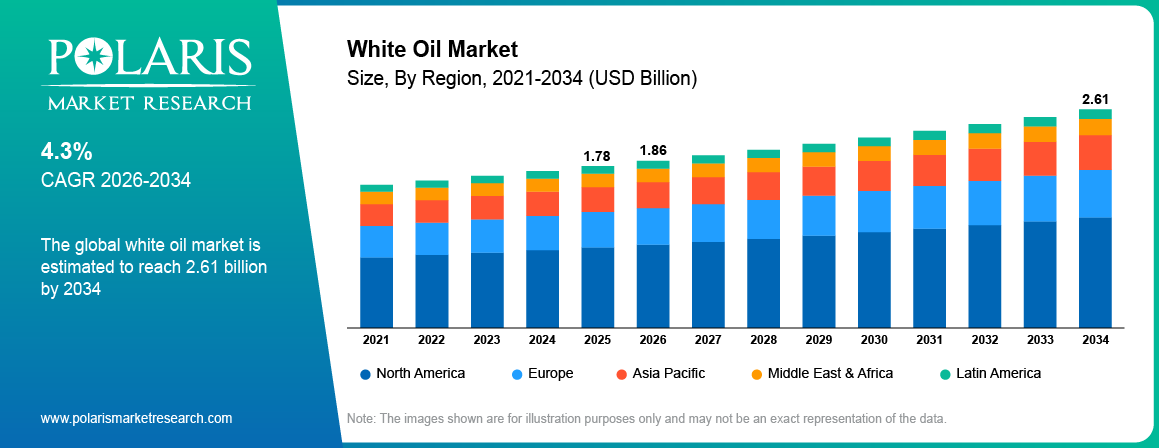
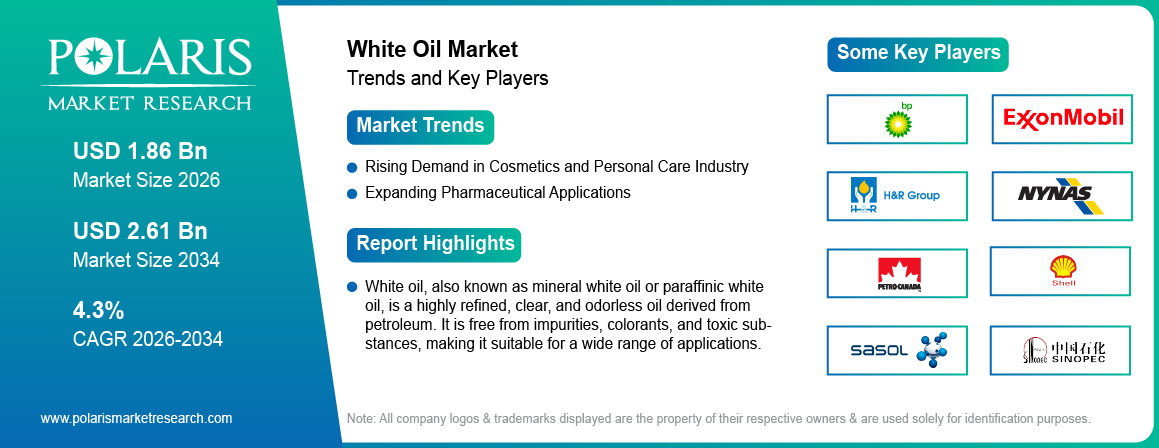
White oil market size was valued at USD 1.86 billion in 2026, growing at a CAGR of 4.3% during the forecast period. The market is primarily driven by rising demand across cosmetics, pharmaceuticals, food, and plastics due to its high purity, non-toxicity, and versatility in industrial and consumer applications.
Market Statistics
White Oil Market Key Takeaways by Region and Application
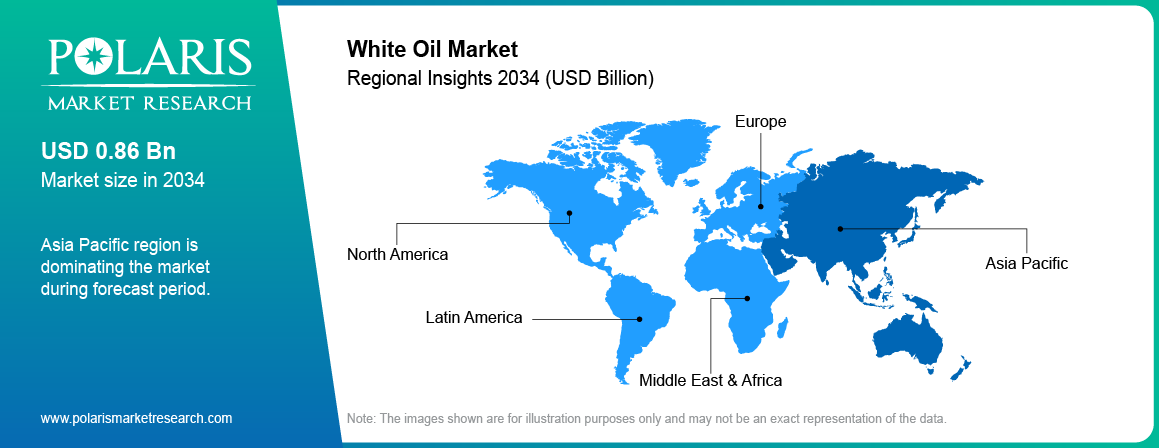
- Asia Pacific held the leading market position with 33.1% share in 2025. This is due to rapid growth in the pharmaceuticals and polymers industries in the region.
- North America is growing gradually at a 3.8% CAGR due to increasing consumption of white oil in food-grade and construction applications against stringent purity standards in the region.
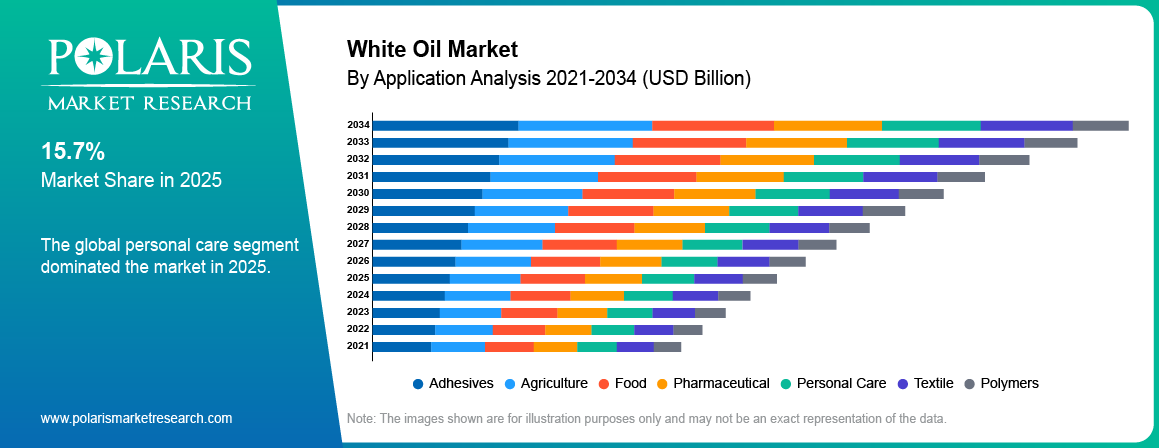
- The personal care segment dominated the market and captured 15.7% market share in 2025 because of its outstanding performance as a moisturizer and barrier former.
- The adhesives segment is expected to witness fast-paced growth at a 3.5% CAGR during the forecast period, driven by the high demand for efficient and nontoxic adhesives in packaging and automotive applications.
- The food segment accounted for a 16.9% market share in 2025. The extensive use of white oil as a food-grade release agent drives the segment’s growth.
Note: Figures and projections outlined in this report are the result of Polaris Market Research’s proprietary analytical processes, grounded in the latest available datasets and market observations.
White Oil Market Dynamics: Drivers, Restraints, Opportunities and Challenges
- Expanding infant care and premium cosmetic markets encourage manufacturers to adopt white oil for its stability and skin-safe characteristics.
- The increasing prevalence of gastrointestinal issues boosts demand for white oil as a lubricant in oral and topical pharmaceutical products.
- The surge in the geriatric population and chronic health conditions increases white oil usage in safe, ingestible drug delivery systems and emollients.
- Regulatory hurdles and approval complexities in pharmaceutical applications may slow the adoption of white oil across medical formulations.
Source: Polaris Market Research Analysis
To Understand More About this Research: Download Sample Report
What Is White Oil? Definition, Properties, Grades and Uses
White oil, also known as mineral white oil or paraffinic white oil, is a highly refined, clear, and odorless oil derived from petroleum. It is free from impurities, colorants, and toxic substances, making it suitable for a wide range of applications. White oil is commonly used in the cosmetic, pharmaceutical, food, and plastic industries as a base ingredient or lubricant due to its stability, non-reactive nature, and high purity. White oil is also utilized in industrial applications such as textile manufacturing and as a release agent in rubber and polymer production. The growing food and beverage industry is driving demand for white oil, thereby fueling the market expansion. Furthermore, white oil is widely utilized as a plasticizer and lubricant in the production of polymers such as PVC and high performance thermoplastics which is further propelling the white oil market growth.
Rapid industrialization and urbanization in developing regions, such as Asia Pacific, have led to increased consumption of white oil in diverse applications, from textiles to machinery. Moreover, white oil's utility in rubber processing, adhesives, and specialty lubricants has led to its growing adoption across various industrial sectors, thereby increasing the white oil market demand.
White Oil vs Mineral Oil vs Base Oil: Purity, Properties and Applications
| Factor | White Oil | Mineral Oil | Base Oil |
| Purity Level | Highly refined and pure | Moderately refined | Primarily used for lubricant manufacturing |
| Appearance | Clear and colorless | Slightly colored | Depends on grade |
| Primary Uses | Cosmetics, pharmaceuticals, foods | General purposes | Lubricants and engine oil |
| Compliance Requirements | Completely adheres to safety standards | Generally complies with safety regulations | Industry guidelines |
| Smell | Odorless | Slight odor may be present | Industrial smell |
| Chemical Stability | High chemical stability | Moderate stability | Variable based on formulation |
Source: Polaris Market Research Analysis
Market Dynamics
Rising Demand in Cosmetics and Personal Care Industry
White oil plays a crucial role as a base ingredient in cosmetics and personal care products, such as lotions, creams, and baby oils, due to its high purity, stability, and ability to blend seamlessly with other ingredients. White oil’s odorless and colorless nature ensures that it does not interfere with the fragrance or appearance of the final product, making it a preferred choice for formulators. The rising consumer awareness of skincare and hygiene, coupled with the growing demand for mild and safe products suitable for all skin types, has further fueled its adoption. For instance, according to the Food and Drug Administration (FDA), individuals typically use 6 to 12 cosmetic products on a daily basis. Additionally, the trend toward premium personal care products and the increasing focus on infant care has boosted the white oil market expansion.
Expanding Pharmaceutical Applications
The increasing global focus on healthcare and the rising prevalence of skin conditions and gastrointestinal disorders expands the demand for white oil in pharmaceutical applications. For instance, according to Oshi Health Inc., approximately 70 billion Americans are impacted by gastrointestinal (GI) disorders annually, which is twice the number of individuals diagnosed with diabetes. The pharmaceutical industry extensively uses white oil due to its non-toxic and hypoallergenic properties, making it safe for ingestion and external application. White oil serves as a critical component in various formulations, such as ointments, where it provides a smooth texture and acts as an emollient to soothe the skin. Moreover, in laxatives, white oil functions as a lubricant, aiding in intestinal movement without causing irritation. Furthermore, white oil use in capsule manufacturing enhances the smoothness and ease of swallowing which is further increasing the white oil market demand.
Usage in Textile and Industrial Sectors
White oil finds extensive use in the textile and industrial industries due to its lubrication and chemical stability. In the textile industry, white oil finds applications in processing fibers, yarn lubrication, fabric finishing, and maintenance of textile machinery. Moreover, white oil enhances the efficiency and productivity in the textile industry by improving the production process. In the industrial industry, white oil is employed as a lubricant and protector of machinery and processes in production systems. The stability of this compound makes it appropriate for such purposes.
Rising Agricultural and Horticultural Applications
White oil has been gaining significance in agriculture and horticulture due to its usage in protecting crops and eliminating pest infestation. White oil can be easily incorporated into spray formulations used in agriculture to control pests and fungi, thereby making pesticides more effective. The white oil coating on plant surfaces acts as a means of managing the pest issue without damaging crops when applied properly. It has become popular within the fruit orchard industry, greenhouses, and horticultural crops because of its use in proper crop management. Increased awareness of efficient agriculture and crop protection has led to higher demands for white oil in agricultural sectors.
Source: Polaris Market Research Analysis
Segment Insights
Assessment by Application Outlook
The global white oil market segmentation, based on application, includes adhesives, agriculture, food, pharmaceutical, personal care, textile, polymers, and others. In 2025, the personal care segment held the largest white oil market share of 15.7%, due to its ability to act as an excellent moisturizer and occlusive agent. White oil creates a protective barrier on the skin, preventing water loss and improving hydration. This feature is particularly valuable in products targeting dry and sensitive skin, which are witnessing growing demand due to shifting consumer preferences toward specialized skincare solutions. Furthermore, the rising trend of clean-label and chemical-free personal care products has propelled manufacturers to incorporate white oil, which is free of harmful additives, into their formulations. The segment's growth is further supported by innovations in product delivery mechanisms, such as sprays and gels, which control white oil's viscosity and compatibility with active ingredients for better performance.
The adhesives segment is also expected to witness the fastest growth at a CAGR of 3.5% during the forecast period. The growth is attributed to the rising demand for white oil in the production of high-performance adhesives used across various industries, including packaging, automotive, and construction. White oil is widely used as a plasticizer and processing aid in adhesives due to its excellent lubricating properties, high thermal stability, and compatibility with other formulation ingredients. The increasing demand for flexible and durable adhesives in industrial and consumer applications, coupled with advancements in adhesive technologies, has accelerated the adoption of white oil in this segment. Additionally, the growing focus on environmentally friendly and non-toxic adhesives has further fueled the use of white oil as a preferred ingredient in adhesive formulations.
Source: Polaris Market Research Analysis
Regional Insights
By region, the study provides white oil market insights into North America, Europe, Asia Pacific, Latin America, and the Middle East & Africa. In 2025, Asia Pacific accounted for the largest market share of 33.1% due to the rapid expansion of the personal care, pharmaceutical, and polymer industries in countries such as China, India, and South Korea. For instance, in the fiscal year 2023-2024, the Indian pharmaceutical industry reported a turnover of approximately USD 50.08 billion USD, reflecting a 10% growth compared to USD 45.53 billion USD in 2022-2023. The region's large population base, increasing disposable incomes, and growing awareness of health and skincare have driven the demand for white oil across various applications. Additionally, the presence of cost-effective manufacturing facilities and a strong supply chain network in the region further boosted its market dominance.
North America is expected to witness significant white oil market growth at a CAGR of 3.8% over the forecast period. This growth is due to the rising demand for food-grade white oil in the food processing and packaging industries, coupled with advancements in healthcare and pharmaceutical applications. The region's strict regulatory framework promoting the use of high-purity, non-toxic products has also encouraged the adoption of white oil in industrial and consumer applications. Moreover, the increasing use of white oil in the production of adhesives and polymers for the growing construction and automotive sectors is expected to drive market growth further. For instance, according to the International Trade Administration, in 2022, the US sold 11.5 billion light vehicles, making it the second-largest global market for vehicle sales and production.
Source: Polaris Market Research Analysis
White Oil Market Competitive Landscape and Leading Companies
The white oil market is highly competitive, with key players focusing on product innovation, capacity expansions, and strategic partnerships to strengthen their market position. Major companies such as ExxonMobil Corporation, Sinopec Corporation, Royal Dutch Shell, BP PLC, and TotalEnergies dominate the market, leveraging their extensive distribution networks and advanced refining technologies. These players are increasingly investing in the production of high-purity white oils to meet stringent regulatory standards and growing demand from industries like pharmaceuticals, personal care, and polymers. Regional players, particularly in Asia Pacific, are also emerging as strong competitors, benefiting from cost-effective manufacturing processes and proximity to high-demand markets. Additionally, the white oil industry is witnessing consolidation through mergers and acquisitions as companies aim to expand their global footprint and enhance their product portfolios. The focus on sustainability and eco-friendly formulations is becoming a key differentiator, with manufacturers exploring bio-based alternatives to traditional white oil products.
Exxon Mobil Corporation is a multinational oil and gas corporation. It was formed in 1999 through the merger of Exxon Corporation and Mobil Corporation, two of the most prominent oil companies in the United States. ExxonMobil is headquartered in Irving, Texas. Exxon Mobil is primarily engaged in the exploration, production, refining, and marketing of oil and natural gas, as well as the manufacturing and marketing of petrochemicals and other chemical products. Its core operations span the entire energy value chain. Exxon Mobil is a global energy company with operations in over 70 countries.
Royal Dutch Shell, commonly referred to as Shell, is a global energy and petrochemical industry specializing in oil and gas, chemicals, and energy solutions. The company operates as one of the mobility networks; Shell serves approximately 33 billion customers daily across more than 47,000 retail stations worldwide. The company has over 54,000 public electric vehicle (EV) charging points at Shell stations, on-street locations, and key destinations. The company's main operations include oil and natural gas exploration, liquefied natural gas (LNG), gas-to-liquids (GTL) technology, methane emissions management, deep-water exploration, and the development of shale oil and gas. Additionally, Shell is involved in renewable energy, carbon capture and storage (CCS), and nature-based solutions.
Key Companies
- British Petroleum
- ExxonMobil Corporation
- H&R Group
- JX Nippon Oil & Energy Corporation
- Nynas AB
- Petro-Canada
- Renkert Oil, Inc.
- Royal-Dutch Shell N.V.
- Sasol
- Sinopec Corporation
- TotalEnergies
White Oil Market Recent Developments: Acquisitions, Expansions and Distribution Agreements
July 2025: Shell Lubricants announced the completion of the acquisition of Raj Petro Specialities from the Brenntag Group. The company stated that the acquisition will help strengthen its presence in India. (source: shell.in)
June 2025: Brenntag SE and Exxon Mobil Corporation entered into a distribution agreement for white oils, broadening their coverage from the DACH, CEE, and Baltic regions to also include Iberia, the Netherlands, and Israel. (Source: brenntag.com)
White Oil Market Segmentation by Grade, Base Oil, Viscosity and Application
By Application Outlook (Revenue, USD billion; Volume, Kilotons; 2021 - 2034)
- Adhesives
- Agriculture
- Food
- Pharmaceutical
- Personal Care
- Textile
- Polymers
- Others
By Regional Outlook (Revenue, USD billion; Volume, Kilotons; 2021 - 2034)
- North America
- US
- Canada
- Europe
- Germany
- France
- UK
- Italy
- Spain
- Netherlands
- Russia
- Rest of Europe
- Asia Pacific
- China
- Japan
- India
- Malaysia
- South Korea
- Indonesia
- Australia
- Vietnam
- Rest of Asia Pacific
- Middle East & Africa
- Saudi Arabia
- UAE
- Israel
- South Africa
- Rest of Middle East & Africa
- Latin America
- Mexico
- Brazil
- Argentina
- Rest of Latin America
White Oil Market Report Scope, Segmentation and Forecast Period
| Report Attributes | Details |
| Market Size Value in 2025 | USD 1.78 billion |
| Market Size Value in 2026 | USD 1.86 billion |
| Revenue Forecast in 2034 | USD 2.61 billion |
| CAGR | 4.3% from 2026 to 2034 |
| Base Year | 2025 |
| Historical Data | 2021– 2024 |
| Forecast Period | 2026 – 2034 |
| Quantitative Units | Revenue in USD billion, Volume in Kilotons, and CAGR from 2026 to 2034 |
| Report Coverage | Revenue Forecast, Market Competitive Landscape, Growth Factors, and Industry Trends |
| Segments Covered |
|
| Regional Scope |
|
| Competitive Landscape |
|
| Report Format |
|
| Customization | Report customization as per your requirements with respect to countries, regions, and segmentation. |
Source: Polaris Market Research Analysis
White Oil Market FAQs: Size, Growth, Applications, Grades and Leading Region
The global white oil market size was valued at USD 1.78 billion in 2025 and is projected to grow to USD 2.61 billion by 2034.
The global market is projected to grow at a CAGR of 4.3% during the forecast period
Asia Pacific held the leading market position with 33.1% share in 2025.
Some of the key players in the market are British Petroleum; ExxonMobil Corporation; H&R Group; JX Nippon Oil & Energy Corporation; Nynas AB; Petro-Canada; Renkert Oil, Inc.; Royal-Dutch Shell N.V.; Sasol, Sinopec Corporation; and TotalEnergies
The personal care segment dominated the market and captured 15.7% market share in 2025
Download Sample Report of White Oil Market
Please fill out the form to request a customized copy of the research report.


