
Reports

Structural Steel Market Size, Statistics, Global Report, 2026-2034
REPORT DETAILS
REPORT DETAILS
ABOUT THIS REPORT
Structural Steel Market Summary
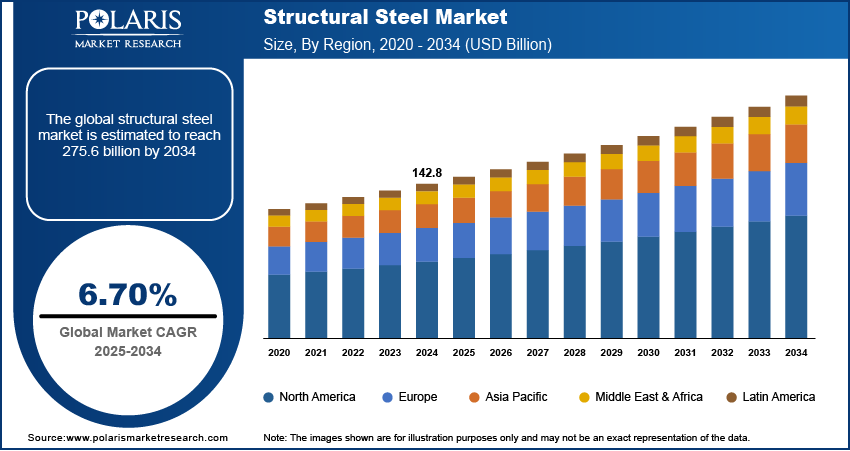
The global structural steel market was valued at USD 158.49 billion in 2025 and is anticipated to grow at a CAGR of 6.72% from 2026 to 2034. The market is expanding due to growing construction activities and infrastructure development. In addition, advancements in construction technologies and engineering design practices enhance the efficiency of structural steel, further boosting its market growth.
Market Statistics
Key Takeaways
- Asia Pacific dominated the industry in terms of revenue share of 56.0% in 2025. The dominance is attributed to the region's growing economic and infrastructural projects.
- The North America structural steel industry is expected to witness the highest growth rate of 4.8% during the forecast period. Rapidly growing construction activities across the region propels the industry growth.
- The heavy structural steel segment dominated the structural steel market with 67.2% share in 2025. It is due to the robustness and ability of heavy structural steel to withstand significant loads.
- The non-residential segment dominated the revenue share capturing 38.0% share in 2025. Significant investments in commercial complexes, office spaces, and retail establishments boost the demand for structural steel in the segment.
*Note: Figures and projections outlined in this report are the result of Polaris Market Research’s proprietary analytical processes, grounded in the latest available datasets and market observations.
Industry Dynamics
- The rise in commercial and residential construction activities serves as a significant driver, propelling the market's growth.
- Increasing advancements in construction technologies and engineering design practices are expected to offer lucrative opportunities during the forecast period.
- Fluctuations in raw material prices hinder the structural steel industry expansion.
AI Impact on Structural Steel Market
- Artificial intelligence (AI)-enabled tools are used to streamline structural analysis and optimize steel usage in building designs.
- By analyzing sensor data. AI systems detect defects early in production. This minimizes waste and improves product reliability.
- The systems forecast demand trends and automate inventory management. It helps manufacturers avoid overproduction and shortages.
- Its adoption also enhances logistics services by optimizing delivery routes and schedules.
- The technology alleviates labor shortages as it automates repetitive tasks and supports skilled workers with intelligent tools.
- Smarter processes lower emissions and waste, complying with global green building standards.
To Understand More About this Research: Download Sample Report
What are Structural Steel?
Structural steel is a high-strength and versatile metal alloy primarily composed of iron and a small percentage of carbon, with additional alloying elements such as manganese, silicon, and traces of other elements. Its strength, durability, and flexibility make it a fundamental material in the construction industry for a wide range of structural applications. Structural steel is utilized in the fabrication of beams, columns, and other load-bearing components. It provides the framework for buildings, bridges, industrial facilities, and various infrastructure projects.
Structural Steel vs Reinforced Concrete
Structural steel is preferred for projects requiring faster construction, lighter structures, seismic resistance, and design flexibility. Reinforced concrete remains widely used where compressive strength, fire resistance, and lower initial costs are prioritized. Increasing emphasis on sustainable and high-performance infrastructure boosts the adoption of structural steel in commercial and industrial construction.
| Parameter | Structural Steel | Reinforced Concrete |
| Strength-to-Weight Ratio | High strength with lower overall structural weight, making it ideal for high-rise buildings, bridges, and long-span structures | Lower strength-to-weight ratio due to heavier mass, requiring larger structural sections |
| Construction Speed | Faster construction because steel components are prefabricated and quickly assembled on-site | Slower construction due to formwork, curing time, and on-site casting requirements |
| Design Flexibility | Offers greater architectural flexibility, longer spans, and easier future modifications or expansions | More rigid structure with limited flexibility for alterations after construction |
| Durability | Highly durable when properly coated against corrosion; performs well under dynamic loading | Excellent resistance to weathering, moisture, and fire, but may crack over time |
| Cost | Higher initial material cost but lower lifecycle and labor costs due to speed and recyclability | Lower upfront material cost but higher maintenance and longer construction timelines |
| Sustainability | Highly sustainable because steel is recyclable and reusable with minimal material waste | Cement production generates significant carbon emissions, reducing sustainability performance |
| Seismic Performance | Superior ductility and flexibility help absorb and dissipate earthquake forces effectively | Higher stiffness but more brittle behavior under severe seismic loading |
| Structural Weight | Lightweight structure reduces foundation loads and transportation costs | A heavier structure increases foundation requirements and seismic loads |
| Maintenance | Requires periodic corrosion protection and inspection | Lower routine maintenance but repairs can be expensive if structural damage occurs |
| Key Applications | High-rise buildings, industrial facilities, airports, stadiums, and bridges | Residential buildings, dams, parking structures, foundations, and low-rise projects |
The global demand for structural steel continues to rise due to its widespread use in the construction industry. Increasing urbanization, population growth, and infrastructure development projects worldwide contribute significantly to the market's expansion. The wider applicability and high strength-to-weight ratio of structural steel make it an essential material for constructing residential, commercial, and industrial buildings, as well as bridges and other infrastructure.
The structural steel market is hindered by fluctuations in raw material prices, particularly for iron ore and scrap metal. This impacts production costs and subsequently affects the overall market. Stricter regulations regarding emissions, energy consumption, and the carbon footprint of steel production increase operational costs for manufacturers and limit the market's growth.
The market research report offers an in-depth analysis of the industry to support informed decision-making. It offers a meticulous breakdown of various market niches and keeps readers updated on the latest industry developments. Along with tracking the structural steel market on the basis of SWOT and Porter’s Five Forces models, the research report includes graphs, tables, charts, and other pictorial representations to help readers understand the key insights and important data easily.
Growth Drivers
Rise in Commercial and Residential Construction Activities
The rise in commercial and residential construction activities acts as a significant driver propelling the growth of the market. With an upsurge in the construction industry globally, the demand for materials capable of providing superior structural strength and toughness becomes important. Structural steel, known for its extraordinary strength and durability, emerges as a crucial solution meeting strict usage criteria. In commercial construction, skyscrapers, office complexes, and shopping malls demand materials that can support the vertical and horizontal loads imposed by complex architectural designs. Similarly, in residential construction, the need for durable frameworks to ensure the safety and longevity of buildings is essential. Structural steel, with its high strength-to-weight ratio, not only meets but often exceeds these requirements by offering engineers and architects the flexibility to design and innovate.
Rapid Urbanization & Smart City Development
Rapid urbanization and increasing smart city development projects propel the demand for structural steel across the global construction industry. Growing populations in urban areas accelerate the construction of high-rise buildings, transportation networks, airports, bridges, and commercial infrastructure. In this infrastructure development, structural steel is widely used due to its strength and design flexibility. Smart city initiatives also require advanced and durable infrastructure systems. Increasing smart city projects encourage the adoption of steel in modular and prefabricated construction projects. In addition, governments are investing heavily in metro rail systems, industrial corridors, and energy-efficient buildings. It supports the market growth. Structural steel is increasingly preferred because it enables faster construction. It also supports sustainable building practices through recyclability. The structural steel also offers strong seismic performance for modern urban infrastructure.
Report Segmentation
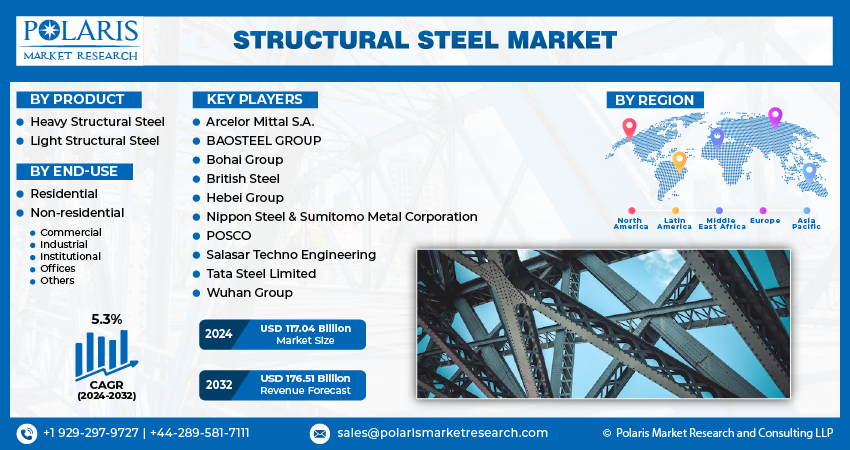
The market is primarily segmented based on product, end-use, and region.
| By Product | By End-Use | By Region |
|
|
|
To Understand the Scope of this Report: Request Customization
By Product Analysis
The Heavy Structural Steel Segment dominated the Market Share
The heavy structural steel segment dominated the structural steel market in 2025 with 67.2% share, because of the robustness and ability of heavy structural steel to withstand significant loads. The surge in large-scale projects, such as industrial complexes, bridges, and high-rise buildings, requires materials with heavy load-bearing capacity and durability. Heavy structural steel, with its high strength and resistance to deformation, emerges as the material of choice for these applications. Also, modern architectural designs often involve complex structures that demand the use of heavy steel components to ensure stability and safety. The industrial sector's expansion, including energy-related projects, manufacturing plants, and infrastructure development, further increases the demand for heavy structural steel.
By End-Use Analysis
The Non-Residential Segment Dominated the Revenue Share in 2025
The segment accounted for the dominating revenue share of 38.0% in 2025, because of the robust demand arising from various non-residential construction activities encompassing commercial, industrial, and institutional projects. It exhibits a heavy dependence on structural steel due to its extraordinary strength, durability, and adaptability. The rising global economy has led to significant investments in commercial complexes, office spaces, and retail establishments, all of which require materials capable of supporting complex architectural designs and heavy loads. Structural steel emerges as an essential product in meeting these requirements, offering engineers and builders the flexibility to build non-residential structures without compromising on structural strength. Manufacturing plants, warehouses, and infrastructure projects require materials that can withstand the difficulties of industrial processes and environmental factors, making heavy structural steel an ideal choice.
Regional Insights
Asia Pacific held the Largest Revenue Share
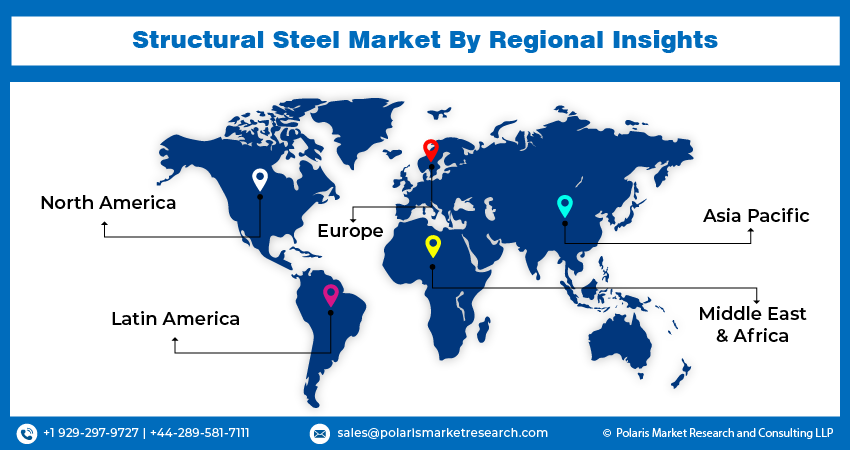
Asia Pacific dominated the market with 56.0% revenue share in 2025 due to the region's growing economic and infrastructural projects. The urbanization and population growth in this region have led to an increasing demand for commercial, residential, and industrial spaces. As countries in the region focus on infrastructure development projects, structural steel turns up as a necessary material due to its strength, adaptability, and cost-effectiveness.
The China structural steel market captured 69.4% share in the APAC region in 2025, due to its large population and rapidly developing industrial sector. Additionally, the growth of the industry in the region has been further strengthened by supportive government programs such as "Make In India" in countries like India.
The surge in construction activities, ranging from skyscrapers and residential complexes to transportation infrastructure such as bridges and airports, propels the demand for structural steel across various applications.
The North America structural steel market is expected to witness the highest growth rate of 4.8% during the forecast period because of rapidly growing construction activities across the region. A strong economy, population growth, and an increasing focus on urban development and redevelopment projects drive the burgeoning construction sector in the region. The demand for structural steel in the region is propelled by the need for high-strength materials that can support modern architectural designs and meet stringent safety standards.
Key Market Players & Competitive Insights
The global structural steel market is highly competitive and moderately fragmented. Major players in the industry undertake key strategies such as mergers & acquisitions and joint ventures. A surge in partnerships and acquisitions is expected to create new market opportunities for key players.
A few of the major players operating in the global market include:
- Arcelor Mittal S.A.
- BAOSTEEL GROUP
- Bohai Group
- British Steel
- Hebei Group
- Nippon Steel & Sumitomo Metal Corporation
- POSCO
- Salasar Techno Engineering
- Tata Steel Limited
- Wuhan Group
Recent Developments
- March 2025: SSAB collaborated with Putzmeister to supply fossil-free steel for concrete pumps and mixers, building on their long-standing collaboration. The initiative aims to reduce carbon emissions in construction by using high-strength, lightweight steel to improve equipment efficiency. (Source: ssab.com)
We provide our clients the option to personalize the structural steel market report to suit their needs. By customizing the report, you can get data as per your format and definition. Also, the customization option allows you to gain a deeper dive into a specific segment, region, customer, or market competitor.
Structural Steel Market Report Scope
| Report Attributes | Details |
| Market Size Value in 2025 | USD 158.59 billion |
| Market Size Value in 2026 | USD 169.06 billion |
| Revenue Forecast in 2034 | USD 284.82 billion |
| CAGR | 6.72% from 2026 to 2034 |
| Base Year | 2025 |
| Historical Data | 2021–2024 |
| Forecast Period | 2026–2034 |
| Quantitative Units | Revenue in USD billion and CAGR from 2026 to 2034 |
| Segments Covered | By Product, By End-Use, By Region |
| Regional Scope | North America, Europe, Asia Pacific, Latin America, Middle East & Africa |
| Customization | Report customization as per your requirements concerning countries, regions, and segmentation. |
We provide our clients the option to personalize the Structural Steel Market report to suit their needs. By customizing the report, you can get data as per your format and definition. Also, the customization option allows you to gain a deeper dive into a specific segment, region, customer, or market competitor.
Browse Our Top Selling Reports
Subcutaneous Immunoglobulin Market Size, Share 2024 Research Report
Antiparasitic Drugs Market Size, Share 2024 Research Report
Corticosteroids Market Size, Share 2024 Research Report
Carboprost Tromethamine Market Size, Share 2024 Research Report
Cytomegalovirus Treatment Market Size, Share 2024 Research Report
FAQ's
The structural steel market was valued at USD 158.59 billion in 2025 and is expected to grow to USD 284.82 billion by 2034.
A few top market players are Arcelor Mittal S.A., BAOSTEEL GROUP, Bohai Group, British Steel, and Wuhan Group.
• Asia Pacific dominated the industry in terms of revenue share of 56.0% in 2025.
The global structural steel market is projected to grow at a CAGR of 6.72% during the forecast period.
A few key segments in the structural steel market are product, end-use, and region.
Download Sample Report of structural steel market
Please fill out the form to request a customized copy of the research report.


