
Steel Rebar Market Opportunity, Share & Growth Analysis, 2026-2034
REPORT DETAILS
Steel Rebar Market Overview and Key Insights
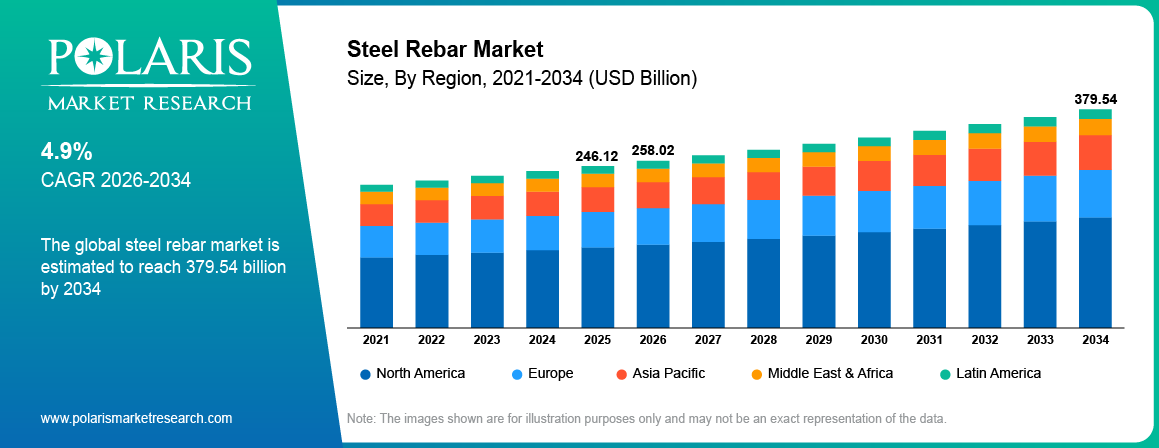
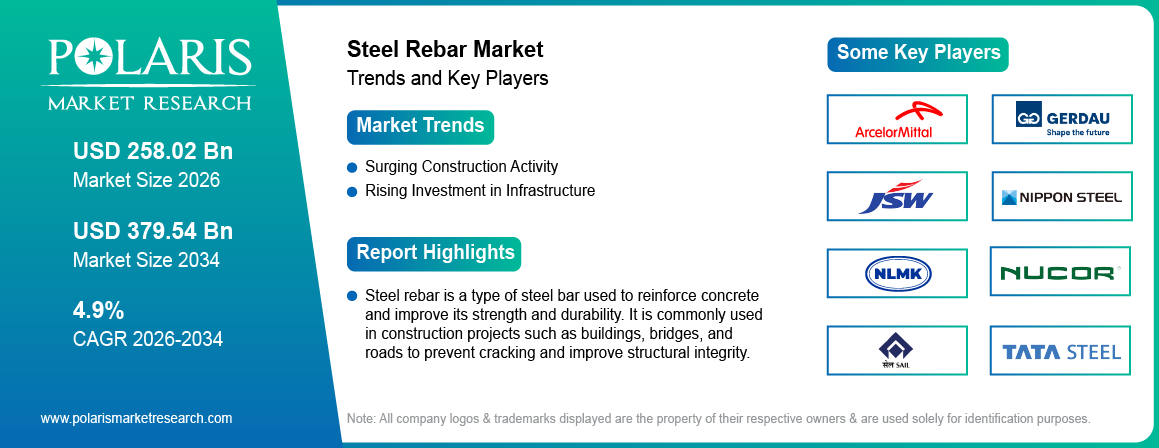
The global steel rebar market size was valued at USD 258.02 billion in 2026. The market is projected to grow at a CAGR of 4.9% from 2025 to 2034. The introduction of government initiatives for improving connectivity between key domestic economies and increased demand for residential buildings due to rising disposable incomes are propelling market growth.
Market Statistics
Steel Rebar Market Key Takeaways
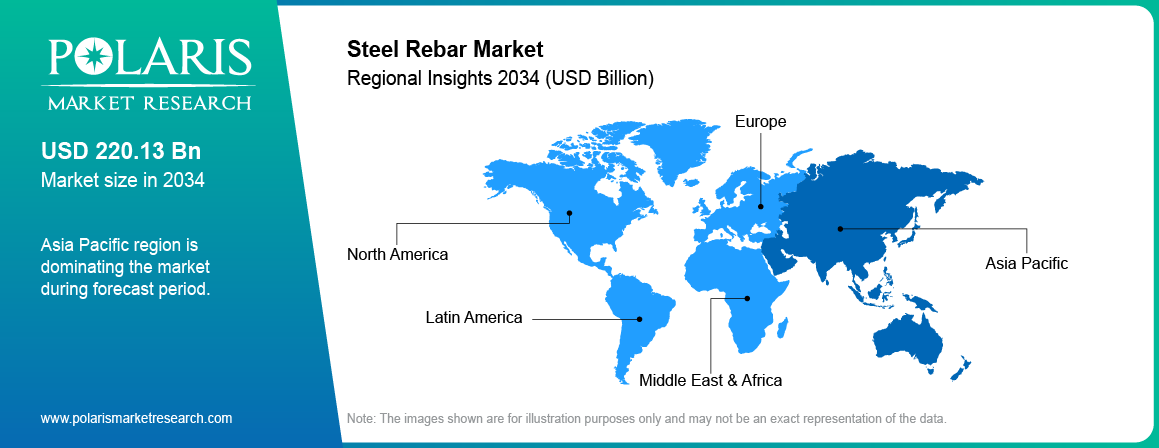
- Asia Pacific accounted for the largest market revenue share of 58.00% in 2025 . Rapid urbanization and industrialization contribute to the region's leading market position.
- North America is projected to register significant growth at a 5.20% CAGR . Rising investments in infrastructure are fueling market growth in the region.
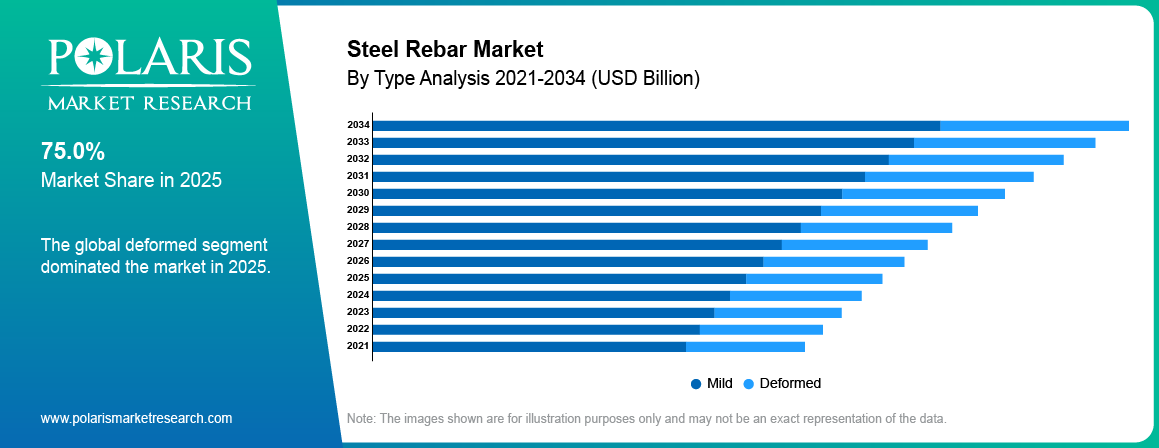
- The deformed segment accounted for the largest revenue share of 75.00% in 2025 . This is owing to its high demand in the construction of high-rise buildings.
- The mild segment is projected to grow at a 4.40% CAGR . Surging urbanization and the expansion of mass housing projects drive the segment's growth.
- The construction & infrastructure segment led with a 61.60% revenue share in 2025 . This is primarily due to the rising number of construction and infrastructure projects globally.
Note: Figures and projections outlined in this report are the result of Polaris Market Research’s proprietary analytical processes, grounded in the latest available datasets and market observations.
Steel Rebar Market Dynamics
- The rising number of commercial, residential, and infrastructure projects has led to an increased need for reinforcement materials like steel rebar.
- Growing investments in infrastructure development by governments and the private sector are boosting market expansion.
- Increased focus on sustainable construction practices is creating several market opportunities.
- High initial cost of manufacturing steel rebars may present market challenges.
Impact of Artificial Intelligence on Steel Rebar Manufacturing
- AI assists in making steel rebar manufacturing processes more efficient and in minimizing material waste.
- AI aids in maintaining strict quality control by monitoring defective products and their strength consistency.
- AI helps in conducting predictive maintenance by identifying equipment malfunctions and minimizing downtime.
- AI facilitates better management of construction company inventories and demand forecasts.
Source: Polaris Market Research Analysis
To Understand More About this Research: Download Sample Report
Steel rebar is a type of steel bar used to reinforce concrete and improve its strength and durability. It is commonly used in construction projects such as buildings, bridges, and roads to prevent cracking and improve structural integrity.
The steel rebar market is growing due to rising government initiatives for the development of roads and highways. Governments worldwide are aiming to develop better connectivity between key domestic economies for seamless transportation activity. For instance, A report by the Ministry of Information & Broadcasting in February 2025 stated that under the Bharatmala Pariyojana scheme India's National Highway (NH) network expanded from 91,287 km in 2014 to 1,46,145 km in 2024. These government backed initiatives are significantly boosting the demand for steel rebar, thereby driving market growth.
The increase in disposable income is driving the steel rebar market expansion, as people now have greater purchasing power to invest in better housing and infrastructure. For instance, according to the US Bureau of Economic Analysis, personal disposable income in the US rose by 0.1% from August to September 2024. Rising income levels have led to increased demand for residential buildings, which in turn boosts the need for steel rebar to reinforce concrete structures. Additionally, with more money to spend, both governments and private developers are investing in larger and more advanced construction projects, further boosting market demand.
Mild vs. Deformed Steel Rebar: Properties, Grades and Applications
| Factor | Mild Steel Bar | Deformed Steel Bar |
| Surface | Smooth | Ribbed or Textured |
| Strength of Bond with Concrete | Bonding is weaker | Better bond with concrete |
| Tensile Strength | Moderate | Higher |
| Flexibility | Brittle | High Rigidity |
| Uses | Small Scale Projects | Large Scale Projects |
| Cost | Lower in comparison | Higher |
Source: Polaris Market Research Analysis
Steel Rebar Market Trends
Growth in Residential and Commercial Construction
With more residential, commercial, and infrastructure projects being undertaken globally, the need for reinforcement materials like steel rebar has increased. For instance, according to the Indian Department of Economics Affairs, in 2024, India recorded USD 818.67 billion worth of new infrastructure projects by public-private partnerships, highlighting the growth in construction activity. Additionally, population growth and urbanization are fueling construction projects in both urban and rural areas, creating a strong demand for steel rebar. Thus, the surge in construction activity is boosting the steel rebar market demand.
Rising Investment in Transport and Public Infrastructure
The steel rebar market is growing rapidly due to increased investment in infrastructure development. Governments and private sectors are spending heavily on building roads, bridges, airports, and other large-scale projects, driving the rising demand for steel rebar. For instance, according to the US Department of Treasury, the US allocated USD 1.2 trillion for infrastructure development under the Bipartisan Infrastructure Law. This surge in infrastructure spending is fueled by the need for modernization and better connectivity. Additional funds are being directed toward urban development, transport networks, and industrial projects, further boosting the steel rebar market revenue.
Benefits of Steel Rebar in Reinforced Concrete Structures
The use of steel rebars enhances the strength of concrete structures. Although concrete has good compression strength, it is quite weak in tension and resistance to stress. The use of rebars makes concrete stronger by reducing the likelihood of cracking or breaking under excessive loads. Reinforced concrete is quite resilient to vibrations, temperature, and mechanical stresses. This aspect makes it extremely durable for any construction project, as all the above features are relevant for building elaborate structures such as bridges, roads, tunnels, dams, and skyscrapers.
Source: Polaris Market Research Analysis
Steel Rebar Market Segment Analysis
Steel Rebar Market, by Type
The steel rebar market assessment, based on type, includes mild and deformed. In 2025, the deformed segment recorded the largest revenue share of 75.00% due to its high demand in the construction of high-rise buildings. Deformed rebars are preferred for their superior grip on concrete, providing better strength and resistance to tension and bending. These properties make them ideal for tall structures that require durability and stability. Additionally, the ongoing growth of urbanization and the rise in skyscraper construction have fueled the demand for deformed steel rebars in the global market.
Steel Rebar Market, by Application
The steel rebar market evaluation, based on application, includes construction & infrastructure and industrial. The construction & infrastructure segment dominated the market in 2025 with 61.60% share due to the increasing number of construction and infrastructure projects worldwide. This growth is fueled by rising demand for housing, transportation systems, and essential services. Additionally, advancements in construction technology, materials, and project management have made large-scale projects more feasible and cost-effective, further accelerating global infrastructure development and boosting demand for steel rebar.
Source: Polaris Market Research Analysis
Steel Rebar Market Regional
By region, the study provides the steel rebar market insights into North America, Europe, Asia Pacific, Latin America, and the Middle East & Africa. In 2025, Asia Pacific had the largest revenue with 58.00% share of the global market due to its rapid industrialization, urbanization, and significant infrastructure development. Countries such as China, India, and Japan are investing heavily in large-scale construction projects, including roads and high-rise buildings. The region's growing population and increasing demand for residential and commercial properties further boost the need for steel rebar. Additionally, the availability of low-cost raw materials and established manufacturing facilities in Asia Pacific contribute to its market dominance.
The North America steel rebar market is experiencing significant growth of CAGR 5.2% in the global market due to increased investment in infrastructure. Governments and private sectors are allocating substantial funds to upgrade transportation networks, construct new roads, bridges, and airports, and enhance residential and commercial buildings. These projects require large amounts of steel rebar for reinforcement. The focus on infrastructure renewal and development in both the US and Canada is further fueling the demand for durable, high-strength materials like steel rebar, thereby supporting regional market growth.
The steel rebar market in Canada is experiencing substantial growth due to the country’s ongoing industrial development. The expansion of Canada’s manufacturing, mining, and energy sectors has increased the demand for strong and durable infrastructure. For instance, according to the Canada Renewable Energy Association, in 2024 the energy industry expanded its generation capacity by 2.3 GW. Large industrial projects, including factories, pipelines, and energy plants, require steel rebar for structural reinforcement. The growing need for robust construction materials in these sectors is pushing up the demand for steel rebar, thereby propelling market growth in Canada.
Source: Polaris Market Research Analysis
Steel Rebar Market Competitive Landscape
The steel rebar market is constantly evolving, with numerous companies striving to innovate and distinguish themselves. Leading global corporations dominate the market by leveraging extensive research and development, and advanced techniques. These companies pursue strategic initiatives such as mergers and acquisitions, partnerships, and collaborations to enhance their product offerings and expand into new markets.
New companies are impacting the market by introducing innovative products to meet the demand of specific market sectors. This competitive environment is amplified by continuous progress in product offerings. Major players in the steel rebar market include ArcelorMittal, SAIL, NLMK, Tata Steel, JSW, NIPPON STEEL CORPORATION, Nucor, Gerdau S/A, Mechal, and Steel Dynamics Inc.
Tata Steel, established in 1907 in Jamshedpur, India, is a steel producer and a flagship company of the Tata Group. With an annual crude steel capacity of approximately 35 million tons per annum (MnTPA), it ranks among the world's leading steel manufacturers. The company operates across five continents, with facilities in India, Europe, and Southeast Asia. Tata Steel offers a diverse product portfolio for various sectors. Its key segments include automotive and special products, providing high-strength steels for the automotive industry; industrial products, serving construction and engineering needs; branded products and retail offerings, such as galvanized sheets; and services, including design and automation solutions. In India, Tata Steel’s major plants are located in Jamshedpur and Kalinga Nagar, with ongoing capacity expansions. In Europe, the company has significant operations in the Netherlands and the UK. Additionally, its presence in Southeast Asia is strengthened through acquisitions like Millennium Steel in Thailand.
Nippon Steel Corporation, headquartered in Chiyoda-ku, Tokyo, was formed through the merger of Nippon Steel and Sumitomo Metal Industries in 2012. Nippon Steels has an annual production capacity of approximately 37 million tons of crude steel, making it the third-largest steel producer worldwide. Nippon Steel operates across four primary business segments which include steelmaking and steel fabrication, engineering, chemicals, and system solutions. The steelmaking segment is the core of its operations, producing a diverse range of products, including flat products, structural steel, bars and wire rods, pipes and tubes, and specialty steels tailored for automotive applications. In addition to its manufacturing prowess, Nippon Steel provides engineering services that support its operations and infrastructure projects. The chemicals segment develops products that complement its steel manufacturing processes, while the system solutions segment focuses on delivering integrated solutions. Nippon Steel's global footprint extends across several regions, with major operations in Asia Pacific, particularly Japan and Southeast Asia. The company has also established partnerships and manufacturing sites in North America to cater to growing market demands. In Europe, Nippon Steel engages in joint ventures to strengthen its presence.
Leading Steel Rebar Manufacturers and Suppliers
- ArcelorMittal
- Gerdau S/A
- JSW
- Mechal
- NIPPON STEEL CORPORATION
- NLMK
- Nucor
- SAIL
- Steel Dynamics Inc.
- Tata Steel
Steel Rebar Market Future Outlook
The future outlook for the steel rebar market is promising, driven by rapid urbanization and increasing demand for robust construction materials worldwide. The growth of government-sponsored transport and intelligent city infrastructure will play a major role in driving future market development. In addition, advances in reinforcement steel technology, sustainable production processes, and the emphasis on safety are set to support market growth prospects.
Steel Rebar Market Recent Developments
April 2026: ArcelorMittal’s Hamburg site achieved ResponsibleSteel Core Site Certification. This achievement, according to ArcelorMittal, underscores the plant’s dedication to environmentally sound ESG policies and low emission steel manufacturing. (source: arcelormittal.com)
December 2025: The Board of Tata Steel Limited approved a 4.80 MTPA capacity expansion at Neelachal Ispat Nigam Limited (NINL) and downstream manufacturing facilities in Maharashtra. With the expansion, the company aims to capitalize on surging domestic construction and infrastructure demand. (source: tatasteel.com).
Steel Rebar Market Segmentation and Forecast
By Type Outlook (Volume – Kilotons, Revenue – USD Billion, 2021–2034)
- Mild
- Deformed
By Application Outlook (Volume – Kilotons, Revenue – USD Billion, 2021–2034)
- Construction & Infrastructure
- Industrial
By Regional Outlook (Volume – Kilotons, Revenue – USD Billion, 2021–2034)
- North America
- US
- Canada
- Europe
- Germany
- France
- UK
- Italy
- Spain
- Netherlands
- Russia
- Rest of Europe
- Asia Pacific
- China
- Japan
- India
- Malaysia
- South Korea
- Indonesia
- Australia
- Rest of Asia Pacific
- Middle East & Africa
- Saudi Arabia
- UAE
- Israel
- South Africa
- Rest of Middle East & Africa
- Latin America
- Mexico
- Brazil
- Argentina
- Rest of Latin America
Steel Rebar Market Report Scope and Methodology
| Report Attributes | Details |
| Market size value in 2025 | USD 246.12 billion |
| Market size value in 2026 | USD 258.02 billion |
| Revenue Forecast by 2034 | USD 379.54 billion |
| CAGR | 4.9% from 2026–2034 |
| Base year | 2025 |
| Historical Data | 2021–2024 |
| Forecast Period | 2026–2034 |
| Quantitative Units | Volume in kilotons, Revenue in USD billion, and CAGR from 2026 to 2034 |
| Report Coverage | Volume Forecast, Revenue Forecast, Market Competitive Landscape, Growth Factors, and Trends |
| Segments Covered |
|
| Regional Scope |
|
| Competitive Landscape |
|
| Report Format |
|
| Customization | Report customization as per your requirements with respect to countries, regions, and segmentation. |
Source: Polaris Market Research Analysis
Steel Rebar Market Frequently Asked Questions
• The steel rebar market size was valued at USD 246.12 billion in 2025 and is projected to grow to USD 379.54 billion by 2034.
• The global market is projected to register a CAGR of 4.9% from 2026 to 2034.
• Asia Pacific had the largest revenue share of 58.00% in 2025.
• A few of the key players in the market are ArcelorMittal, SAIL, NLMK, Tata Steel, JSW, NIPPON STEEL CORPORATION, Nucor, Gerdau S/A, Mechal, and Steel Dynamics Inc.
• The deformed segment recorded the largest revenue share of 75.00% in the global market in 2025 due to its high demand in the construction of high-rise buildings.
• The construction & infrastructure segment dominated the market with 61.60% in 2025 due to the increase in number of construction and infrastructure projects worldwide.
Download Sample Report of Steel Rebar Market
Please fill out the form to request a customized copy of the research report.


