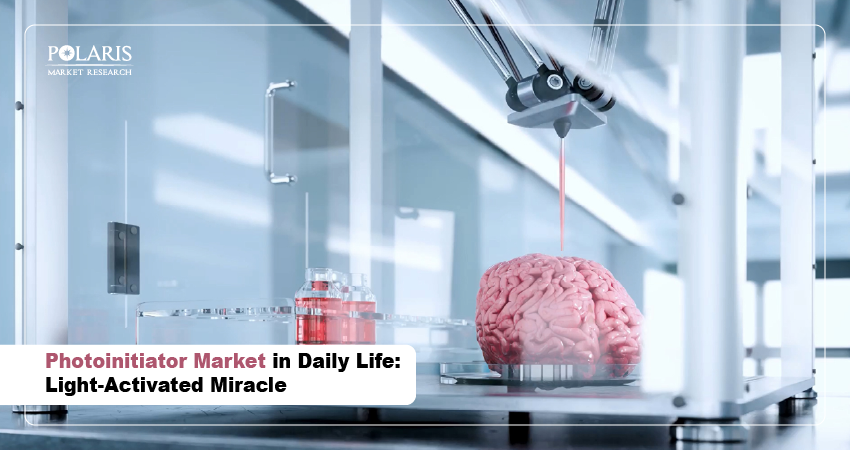
Ever wondered how it is possible for paints, coatings, and resins to harden within seconds under light, or how 3D printing can be that fast and that accurate? It all comes down to one tiny but powerful helper that works behind the scenes. Without it, all that magic of light-driven reactions just would not happen. That little hero's name is photoinitiator.
What is Photoinitiator?
A photoinitiator is a chemical that initiates a reaction upon absorbing light. It is intended to hasten hardening or other specific changes in paints, inks, and resins. It's like a little spark that gets it all up and running.
How Photoinitiators Work?
It all starts when light shines on a photoinitiator. The first step that occurs is the absorption of that light by the photoinitiator and its activation. Immediately afterward, it cleaves into smaller, highly reactive fragments. These fragments acquire mobility and trigger a chain reaction in the material. The reaction spreads and progressively hardens what was previously a soft material. The reaction will turn paints, resins, or 3D printing materials from a soft, liquid state into a ready-for-use product in seconds.
Photoinitiator Industry Facts that Matter
The global photoinitiators market size was valued at USD 145.26 million in 2024 and is expected to register a significant CAGR of 10.0% from 2025 to 2034. Here are some of the factors contributing to this growth:
- With increasing global vehicle production and the development of electric and light vehicles, the demand for photoinitiators in coatings, adhesives, and composites is increasing correspondingly.
- The rapid industrialization of emerging markets has increased demand for faster, more sustainable UV-curing solutions.
- Expansion in the electronics manufacturing sector, including flexible and foldable devices, increases the usage of photoinitiator-based materials.
- New technological developments in areas such as faster curing, lower-energy UV use, and bio-based, nontoxic formulations open new opportunities for use across industries.
Types of Photoinitiators
There are various types of photoinitiators, each suited to specific applications. Their proper selection is very important to optimize the curing result. Here are the major types in use in industries today.
Radical Photoinitiators
These photoinitiators cleave upon light irradiation into reactive radicals. They are mainly applied in coatings, inks, and resins for 3D printing. These radical photoinitiators react rapidly and are suitable for curing thin layers.
Cationic Photoinitiators
Cationic photoinitiators are a type of photoinitiator that produces reactive ions upon light exposure. Applications include uses in adhesives, coatings, and composites market. They can cure materials even in areas where light does not fully reach.
Type I Photoinitiators
Type I photoinitiators cleave directly into reactive fragments upon irradiation. They are uncomplicated and act rapidly; hence, they find wide application in a wide range of UV-curing applications.
Type II Photoinitiators
Initiation in Type II photoinitiators requires a co-initiator. Such systems are commonly used for thicker coatings and colored materials. They offer controlled, efficient curing in complex formulations.
Why Use Photoinitiators?
Photoinitiators ensure rapid hardening of materials upon exposure to light. Obviously, this saves time and energy compared to traditional heat curing. They allow precise control, so only the areas exposed to light are cured. They work at room temperature, which is important for sensitive materials. Photoinitiators enable more efficient and environmentally friendly processes. Photoinitiated reactions minimize waste and the use of noxious chemicals. In short, they make coatings, adhesives, inks, and materials from the 3D printing filaments market speedier, cleaner, and more reliable.
Applications in Daily Life
Photoinitiators are used in many everyday products. They assist in setting materials under light quickly, thereby making them harder and more resilient. Here are some of the common applications:
Nail Gels and UV Polishes: These harden quickly, leaving a very smooth finish that resists chipping.
3D Printing Resins: Allow rapid curing of printed objects, enabling them to retain fine details and strong shapes.
Printing Inks: Used in UV-curable inks, they make colors dry instantly and stay vibrant without smudging.
Coatings and Paints: These materials allow coatings to dry fast while developing a tough, smooth, and shiny surface.
Adhesives: UV-cured adhesives set quickly and provide strong bonds across different materials.
Dental Restoratives: Photoinitiators safely harden dental fillings under light, making them durable and suitable for use.
Composites: They reinforce materials used in the automotive and electronics industries, improving performance and durability.
How are Photoinitiators Improving?
Over recent years, photoinitiator technology has greatly improved. New formulations in the photoinitiator market cure materials faster and work with lower-energy UV light. Many are more compatible with various materials, which has expanded their industrial uses. Bio-based, nontoxic alternatives are also in development, making them much safer for both humans and the environment. These developments make photoinitiators for coatings, inks, adhesives, and 3D printing even more efficient, reliable, and environmentally friendly.
Who is Leading Photoinitiator Market?
Companies offering photoinitiators are competing through continuous product development, partnerships, research investments, and expansion into new markets to maintain their edge in this fast-growing industry. Here are some key companies:
ADEKA Corporation: ADEKA develops photoinitiators for coatings, inks, and adhesives, with emphasis on quick curing and high performance.
Arkema S.A.: Arkema produces advanced photoinitiators used in UV-curable resins and 3D printing materials worldwide.
BASF SE: BASF offers a wide range of photoinitiators for industrial coatings, inks, and electronic applications.
Chitec Technology Corp.: Chitec Technology supplies photoinitiators for adhesives, inks, and coatings that have efficient UV-curing properties.
Eutec Chemical Co., Ltd.: Eutec Chemical specializes in photoinitiators for UV-curable coatings, printing inks, and composite materials.
Final Saying
Tiny yet formidable chemicals, photoinitiators are used to accelerate the curing of materials under light exposure. They play an important role in coatings, inks, adhesives, and 3D printing. With new technology and increasing demand, they are becoming faster, safer, and more efficient, thereby shaping the future of many industries.