Access Control Systems Market Size, Share, Trends & Forecast, 2026–2034
REPORT DETAILS
Access Control Systems Market Summary
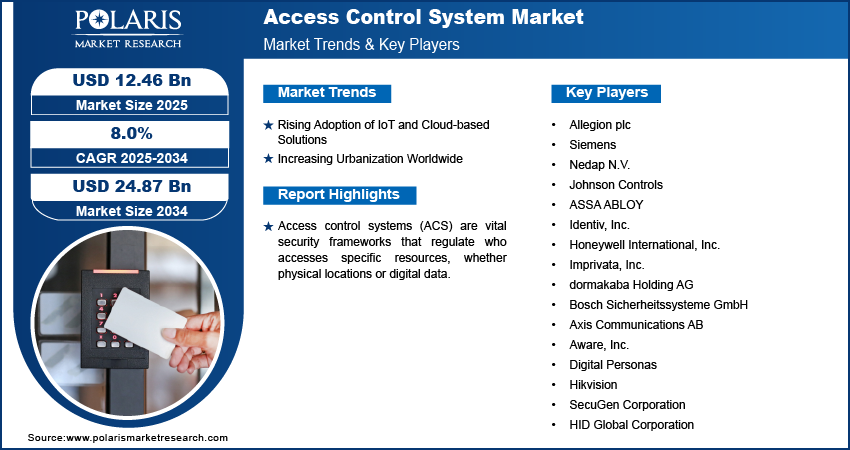
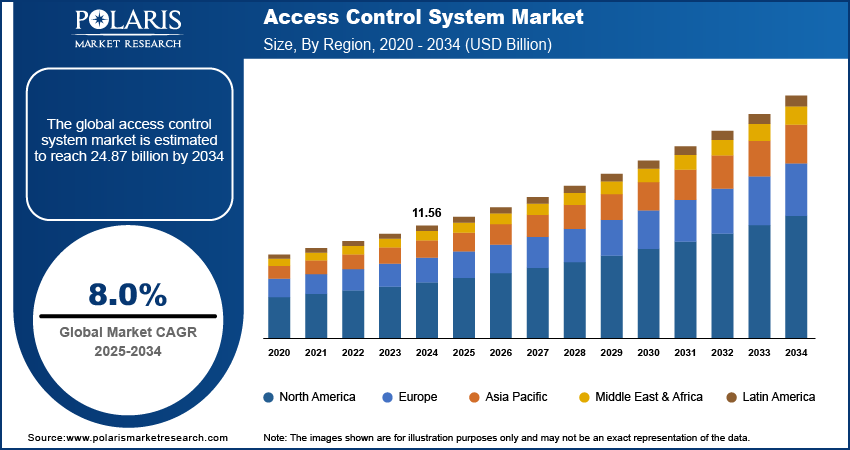
The global access control systems market size was valued at around USD 11.89 billion in 2025 and is expected to register a CAGR of 8.45% from 2026 to 2034. Increasing investments in smart city projects drive the market growth. Also, growing adoption of IoT and cloud-based solutions will fuel the market expansion in the coming years.
Market Statistics
Access Control Systems Market Key Takeaways
- North America held the largest market share of 35.50% in 2025, owing to increased focus on protecting critical infrastructure and rapid adoption of advanced security technologies.
- Asia Pacific is projected to register 9.60% CAGR during the projection period. The region’s robust growth is attributed to rising smart city initiatives and the growing need to secure large-scale infrastructure projects.
- The hardware segment held a 55.0% revenue share in 2025. Rising investments in controllers, electronic locks, readers, and authentication devices across commercial, industrial, and institutional spaces drive the dominance.
- The role-based access control (RBAC) segment accounted for the largest market share of 45.0% in 2025. This is primarily due to the ability of role-based access control systems to streamline permissions.
- The businesses & enterprises segment led the market with 22.0% in 2025, driven by the rising need for security measures in IT hubs, coworking spaces, and corporate offices.
Note: Figures and projections outlined in this report are the result of Polaris Market Research’s proprietary analytical processes, grounded in the latest available datasets and market observation.
What is an Access Control System?
Access control systems (ACS) are vital security frameworks that regulate who accesses specific resources, whether physical locations or digital data. These systems ensure that only authorized individuals enter secure areas or utilize sensitive information, thereby protecting assets and maintaining privacy. ACS combines various hardware and software components, including access cards, keypads, electronic locks, biometric scanners, readers, controllers, and management platforms. Modern systems are using fingerprints, facial recognition, PINs, mobile credentials, or RFID cards for authentication. Organizations are installing access management systems to protect employees, assets, confidential information, and critical infrastructure. It also helps them maintain records of entry and exit activities. ACS are being widely deployed across residential complexes, commercial buildings, healthcare facilities, educational institutions, government facilities, industrial sites, transportation hubs, and data centers. Integration with video surveillance, alarm systems, cloud platforms, and identity management solutions enhances security, monitoring, and centralized access management.
How Does an Access Control System Work?
Access control systems operate through a native authentication and authorization scheme that the system employs to establish whether it is safe to grant the user access to the resource. The process is triggered when an individual submits credentials through RFID access control, mobile credentials, smart cards, PINS, or biometric access control solutions such as facial recognition access and fingerprint access control. The credential is validated by the system against predefined rights and complex procedures, such as multi-factor authentication, can be applied for high-security environments. After verification, the controller issues a command to the connected electronic locks or security hardware to release the door, while logging the event for auditing and monitoring. From cloud-based applications, an access control system owner can manage permissions and active users, and revoke credentials. An on-premise access control system also provides a local administrator to manage, publish, and alter granted access rights, track user behavior, and rescind users' platform access. Hybrid access control is a mix of both, while access control as a service (ACaaS) allows central management of the security for multiple facilities and locations on a subscription basis.
Access Control System vs Traditional Lock
The organizations’ security needs are evolving in the commercial, institutional, and multi-site environment. Thus, they seek alternatives to traditional locks. Some objects can reasonably be described as having a physical security aspect, but once keys have been distributed, traditional locks provide little visibility, scalability, or control. Access control systems also feature a more dynamic approach, such as the use of digital credentials, remote management, comprehensive log files, and the ability to instantly revoke access rights that have been compromised or lost. In support of this, they enable organizations to centrally manage multiple sites to meet increasing security, operational visibility, and compliance demands.
Comparison Matrix: Traditional Locks vs Access Control
| Feature | Traditional Locks | Access Control Systems |
| Security level | Basic. Single physical key | Advanced. Layered, revocable digital credentials |
| Authentication method | Physical key only | Biometrics, RFID/smart card, PIN, mobile credential |
| Remote monitoring | Not available | Real-time, cloud-based monitoring |
| Access tracking/audit trail | None | Detailed, timestamped entry/exit logs |
| Revoking lost/stolen credentials | Requires re-keying or lock replacement | Instant revocation via software |
| Scalability across sites | Limited. Per-site hardware only | Highly scalable via centralized, multi-site management |
| Regulatory compliance support (GDPR, HIPAA) | Minimal | Built-in audit logging and role-based permissions |
Source: Polaris Market Research Analysis

Source: Polaris Market Research Analysis
AI's Role in Access Control Systems
- Artificial intelligence enhances access control accuracy through advanced facial recognition, behavioral biometrics authentication, and anomaly detection.
- Machine learning algorithms analyze access patterns, user behavior, credential, and surveillance stream usage. They help identify anomalies that may indicate unauthorized access or credential misuse.
- AI-powered systems enable real-time decision-making, allowing access permissions based on risk assessments.
- Continuous AI learning improves system adaptability, ensuring stronger protection against evolving security challenges.
- AI-based systems also allow for integration with cameras and identity management systems, which can significantly reduce security's need to manually monitor and increase immediacy.
- During the forecast period, with the increasing penetration of smart building and networked security system solutions, enterprises will leverage AI-enabled predictive analytics with the access control system to deliver more proactive, scalable, and context-aware security management.
Market Dynamics
Driver: Rising Adoption of IoT and Cloud-Based Solutions
Increase in the usage of IoT and cloud based technology is expected to boost the access control market growth. With IoT, access control products can be integrated with other connected security and building management systems to facilitate real-time monitoring, automated notifications, centralized management, and remote credential administration. According to the UK Government’s Cloud Challenge Book 2026, cloud services are utilized by 60% of UK businesses. The UK cloud market is worth around USD 14.28 billion and growing at nearly 30% year on year. The government added that 60% of its digital services have already moved to the cloud, underscoring a growing penetration of cloud infrastructure among public and private sector bodies. These developments are enabling cloud-based access control by allowing enterprises to automatically manage security across multiple sites. Additionally, decentralized corporate and hybrid work environments are driving demand for remote security management, IoT integration with mobile credentials for contactless authentication, immediate permission updates, and greater visibility across locations (Source: gov.uk).
Driver: Increasing Urbanization Across World
Growing urbanization globally is driving the market growth of the global access control systems market due to the increasing number of residential complexes, commercial establishments, transportation stations, and other public infrastructure that needs secured and controlled access. The U.S. Census Bureau reported in May 2026 that Charlotte outpaced net population growth between 2024 and 2025, with 20,731 more residents, and Fort Worth, Texas, gained 19,512 residents and crossed the 1.02 million mark. The Census Bureau also noted that 10 of the 15 fastest-growing cities in the U.S. with more than 20,000 people were located in the South, indicating continued growth of large urban and suburban centers. With populations of cities and their built environments increasing, so does the need for card-based access, biometric access control, mobile credentials, and centrally managed security systems. These products allow such organizations to effectively manage high volume traffic, prevent unauthorized access, and ensure auditable entry records, all within a multi-facility environment. As a result, continued urbanization is driving the rising demand for scalable and intelligent access control network (Source: census.gov).
Restraint: Cost & Integration Complexity
Cost and installation and integration complexity remain major barriers to the access control system market, especially for companies with large or multi-site operations. Advanced system deployment also requires controllers, readers, electronic locks, software platforms, network infrastructure, installation, and maintenance. Replacing and retrofitting outdated security hardware to support newer authentication methods increases costs. Integration is also challenging as access control platforms are required to integrate with surveillance, identity management, building automation, and enterprise IT systems from various providers. Organizations need to strike a balance between holding data center access control organizations accountable and allowing the requisite rigor to link with the inherent complexity of the existing network and monitoring architecture for local and remote users, introducing yet another layer of complexity when it comes to access control in data centers and facilitating deployment. Like healthcare access control, it must carefully integrate segregated clinical areas within the facility, employee credentials, visitor management, and compliance-driven security procedures. These technical and financial demands can also increase lead times, necessitate more customization, and discourage smaller enterprises from employing state-of-the art access control solutions at the scale.
Opportunity: Mobile Credentials & ACaaS
Rising adoption of mobile credentials and bring your own device (BYOD) practice, combined with access control as a service, will provide a market growth opportunity. Organizations move away from hardware-heavy security management toward flexible, digitally managed access control solutions. Smartphone-based credentials enable a reduced reliance on physical cards and simplify the credential issuance process, and administrators can quickly alter or revoke permissions without the added expense of swapping out physical tokens.
ACaaS takes this model a step further, offering centralized, subscription-based management that can scale across multiple sites, without the problem of managing dedicated security servers. These functions are useful especially in smart building security, where access rights need to be synchronized with building systems and occupancy changes. They also enable airport access control, large workforces, contractors, restricted zones, etc., to maintain control of their credentials in real-time and continuously monitor - day and night. As enterprises focus on delivering scalable, secure, flexible operations, and simplified admin, mobile credential solutions in an ACaaS environment are well-positioned to accelerate deployment, drive further service consumption, and access infrastructure modernization at scale.
Access Control Systems Market Trend 2027
Growth of Biometric Authentication
Biometric authentication is becoming increasingly important in access control systems. Enterprises seek robust forms of identity verification and less reliance on physical credentials. This technology highlights the importance of facial recognition access, fingerprint access control, biometric access control, and multi factor authentication as significant areas in expanding technology centric coverage. Biometric systems enhance security by tying access rights to a person’s unique physical traits, making credentials complex to share, copy, or steal. They are being increasingly adopted in enterprise offices, healthcare environments, transportation hubs, government facilities, and others security is paramount. With integration into digital access management systems, biometric authentication can be used alongside cards, PINs, and other credentials to implement multi-factor authentication. Improvements in sensor precision, processing power, and system-level integration are driving the emergence of biometric solutions optimized for use in bustling environments. Thus, with the growing focus on contactless access, more robust identity assurance, and automated admission management, biometric authentication will likely be the identity element to experience further growth in advanced access control solutions.

Source: Polaris Market Research Analysis
Segmentation Analysis
The report provides a comprehensive analysis of the market by offering, type, and end user to identify key revenue-generating and high-growth segments.
Market by Offering
Based on offering category analysis, the market is segmented into hardware, software, and services. The hardware segment accounted for 55.0% share in 2025, driven by continued spending on controllers, electronic locks, readers, and authentication devices for commercial, industrial, and institutional spaces. To protect entrances and process large user numbers, organizations need a proven, enterprise-scale physical security solution. The increasing replacement of traditional locks with connected devices is also driving demand for RFID access control in multi-site and high-traffic environments.
From 2026 to 2034, the software segment is predicted to record a CAGR of 10.25%. The increasing number of companies are adopting centralized and remotely managed security solutions. Software allows system administrators to set permissions, review access logs, connect to identity systems, and administer multiple sites from a single interface. The rising popularity of hybrid access control is also driving demand for software that works through on-premises infrastructure, with DOAS traffic management, RMA, analytics, automation, and continuous security visibility remotely.
The services segment accounted for the largest share of 21.0% in 2025. This is owing to the availability of services such as installation, integration, maintenance, upgrades, and technical support. As access control environments converge, these organizations need their security platforms to be integrated with their existing networks, surveillance systems, and building infrastructure, and require specialized expertise to do so. The growing convergence with IoT security environments is also boosting such professional services that provide for interoperability, system integrity, cybersecurity updates, and long-term performance.
Type Analysis
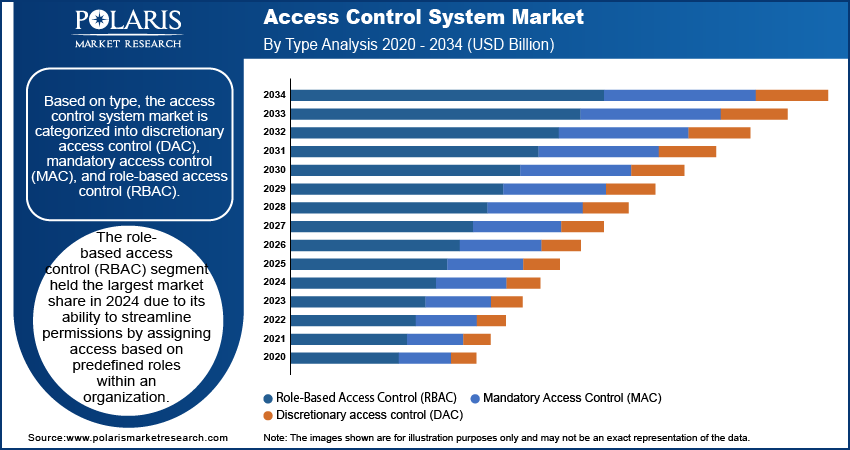
Based on type category analysis, the market has been segmented on the basis of discretionary access control (DAC), mandatory access control (MAC), and role-based access control (RBAC). The DAC segment is estimated to grow at a CAGR of 9.99% during 2026–2034, driven by its widespread use in commercial buildings, offices, schools, and small business environments where administrators need flexibility in granting access. Entities can adjust permission levels as staffing and business needs evolve, without overhauling systems. Adoption in logistics facilities and warehouse security is also gaining traction as organizations demand flexible access solutions to manage workers, contractors, and temporary staff.
MAC segment will register a 6.80% CAGR during the forecast period, led by adoption in the government, defense, critical infrastructure, and other heavily regulated sectors. Growing concerns about cybersecurity and more stringent information-handling protocols are driving organizations to adopt centrally governed access policies that inherently restrict unauthorized changes. Integration with IoT security is also driving the demand as the connected building needs unified access policies for all types of devices, systems, and trusted operational areas.
The RBAC segment held the largest share of 45.0% in the market in 2025, fueled by increasing enterprise demand for scalable permission management. Access privileges can be tailored to employee roles, departments, and responsibilities, making managing large workforces simpler than ever. The proliferation of smart building security is also driving adoption, with businesses merging employee access, visitor management, building automation, and centralized security systems.
End User Assessment
In terms of end user, the access control system market is divided into businesses & enterprises, financial institutions, hospitality & entertainment, retail & customer-facing, government & public services, residential, education & research, healthcare & life sciences, energy & utility infrastructure, and transportation & logistics.
The business and enterprises segment accounted for the largest access control systems market share of 22.0% in 2025, due to its extensive application in corporate offices, commercial buildings, production plants, data centers, and multi-site organizations. Enterprises are increasingly focused on controlling access by providing a single point of access for centralized management of employees, assets, secrets, and restricted operational areas, while generating rich access records. Increasing convergence with the video surveillance market is further propelling growth as end users link access events with visual verification to enhance incident confirmation and security response. Demand for security solutions that can scale easily to support multiple entry points or different user types is also being driven by large workforces, hybrid workplace models, and growing company infrastructure.
Government & public services segment is anticipated to register a CAGR of 7.40% from 2026 to 2034 owing to the increasing investments in secure government administrative buildings, transportation facilities, public infrastructure, and other vital government properties The growth in citizen safety, regulated access, and centralized security management is prompting public organizations to replace legacy systems. Stronger coordination with the public safety and security market is also driving adoption as governments link access management to other surveillance, emergency-response, and infrastructure-protection programs.
The residential segment is expected to exhibit a CAGR of 8.60% during the forecast period due to increasing demand for connected home security and digitally managed entry systems. Homeowners are gravitating towards smartphone-based access, remote monitoring, temporary credentials, and consolidated security solutions for greater convenience and security. In addition, the growth of the smart lock market is boosting adoption in residences, particularly in apartments, gated communities, and elite housing projects, where connected access solutions are becoming a standard for modern home security systems.
Cloud-Based vs. On-Premise Access Control
Organizations are now considering the cloud and on-premise access control options available to them based on their unique operational, security, and IT requirements. Cloud-based access control systems offer features such as remote access, centralized multi-site management, and vendor-managed updates, which make them an excellent choice for organizations with multiple locations or mobile workforces. Locally hosted solutions offer more direct control over both data and infrastructure. However, they require more upfront investments and continuous maintenance. The decision is influenced by scalability, data residency needs, in-house IT resource availability. and the necessity of centralized access management.
| Attribute | Cloud-Based Access Control | On-Premise Access Control |
| Upfront cost | Lower. Subscription (ACaaS) model | Higher. Hardware and server investment |
| Remote management | Yes, from any location via web/app | Limited to local network unless VPN-enabled |
| Multi-site management | Centralized, single-dashboard | Requires separate management per site |
| Maintenance & updates | Vendor-managed, automatic | IT-team managed, manual patching |
| Data control | Hosted by vendor/cloud provider | Fully retained on-site |
| Best fit | Distributed enterprises, multi-site retail, hybrid workplaces | Government, defense, and data centers with strict data-residency needs |
Source: Polaris Market Research Analysis

Source: Polaris Market Research Analysis
Regional Analysis
By region, the study provides access control system market insights into North America, Europe, Asia Pacific, Latin America, and the Middle East & Africa.
North America Access Control Systems Market
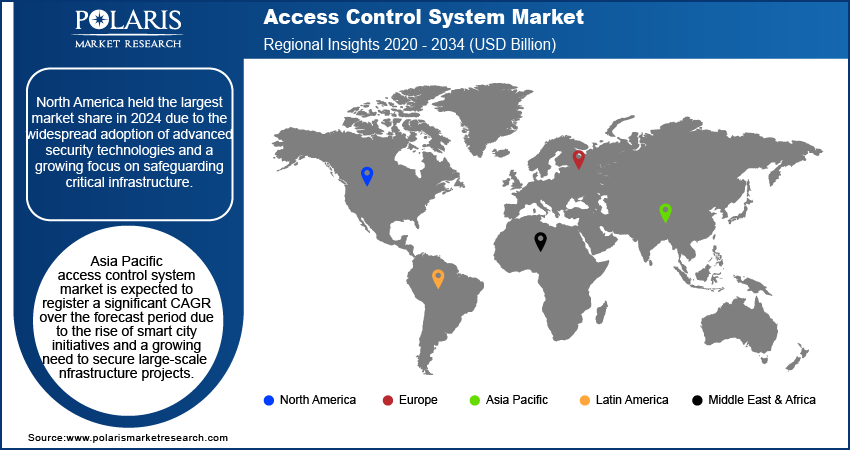
North America dominated the global access control market share by holding 35.50% of total revenue in 2025, followed by Europe. A developed digital infrastructure, substantial security spending, early adoption of connected building technology, and frequent physical security platform upgrades drive the region’s growth. According to the Monthly Construction Spending, July 2026 report published by the U.S. Census Bureau in September 2026, total U.S. construction spending for private nonresidential construction was USD 755.2 billion. As a result of ongoing investment in commercial and institutional construction, the number of buildings with controlled access, credentials to administer, visitors to monitor, and integrated surveillance to manage continues to grow. Increasing concerns for cybersecurity are likewise driving enterprise customers to combine physical access management with broader identity and security solutions. In addition, there is strong demand from regions and sectors where buildings of varying height demand high level security, auditable protection and centralized management. Even broader integration with overall security solutions market is contributing to the convergence of access control, surveillance, alarms, building management and identity solutions technologies. This combination of infrastructure investments, technology maturity, and enterprise security modernization bodes well for the continued domination of the North American market (Source: census.gov).
U.S. Access Control Systems Market Insight
The U.S. accounted for 79.0% of the North American market in 2025, due to presence of mature enterprise security modernization, huge commercial space, and deep penetration in government and critical infrastructure. The continued proliferation of multimodal biometrics is enhancing identity verification and in high security and high-volume areas, further promoting the adoption of advanced access control.
Europe Access Control Systems Market
Europe accounted for 27.0% of the access control systems market in 2025, owing to the growing modernization of commercial offices and the public transportation sector, industrial facilities, and public-sector security systems. Entities now place a higher premium on controlled access, identity assurance, audibility and interfacing with larger building-management environments. Because of the stringent data-protection rules and high focus on security in the workplace, organizations are motivated to move from the disjointed legacy systems to centrally-managed access solutions. Furthermore, the smart-building renovation trend and increasing demand for digitally connected buildings, in which security systems are linked with occupancy and facility-management systems, are driving adoption. The growth of the intelligent building automation market is providing access control companies to integrate entry management with building operations, building monitoring and building automation. Growth in airports, offices, healthcare facilities, and critical infrastructure is anticipated to drive growth in the major European countries.
Asia Pacific Access Control Systems Market
The Asia Pacific market is expected to register a CAGR of 9.60% during 2026–2034. This is attributed to the factors such as growing urbanization, development of commercial spaces and manufacturing industries, and increasing investments in digital and physical security infrastructure. The large-scale construction of office buildings, industrial parks, transport facilities, data centers, apartment complexes, and public works is driving demand for scalable access management. Companies are replacing traditional entry systems with connected solutions that can enable centralized monitoring and integration with surveillance and building management systems. Increased security consciousness of corporate and government organizations is further driving a wider deployment in high-traffic and restricted areas. The growth of the technology ecosystem across the region is driving adoption of advanced authentication apparatus and remotely managed solutions, mainly in China, India Japan, South Korea and Southeast Asia. Growth in the market for industrial access control is especially pertinent as protection is enhanced by manufacturers of production facilities, warehouses, research facilities, and critical operation areas. Additional mainstreaming of connected platforms is also making multi-site management a better experience and powering recurring software and service revenue. Such developments are anticipated to drive the Asia Pacific market among the fastest growing regional markets.
China
China is expected to account for 10.35% growth during the projected period. The growth is attributed to the rising emphasis on smart infrastructure, industrial facilities, transportation networks, and large urban development. Growing convergence with the video analytics industry is enhancing automated surveillance and event validation, enabling organizations to invest in more intelligent and networked access control environments.
The market in Latin America is expected to exhibit a CAGR of 10.10% during the forecast period. Commercial infrastructure development, increasing penetration of electronic security solutions, and growing investments in smart buildings are expected to drive revenue growth of the regional market. Increasing demand from banking, retail, transportation and government facilities for enhanced security has led organizations to replace traditional security systems with integrated access control solutions.
Middle East & Africa Access Control Systems Market
The Middle East & Africa market is expected to a grow at a CAGR of 8.65% during the forecast period. The growth is attributed to large-scale infrastructure development, rapid urbanization and escalating security concerns in critical infrastructure. Investments in airports, commercial complexes, hospitality projects, data centers and government buildings are fueling demand for next generation access management systems. In addition, digital transformation strategies and increasing awareness of centralized security monitoring are driving the regional market expansion.

Source: Polaris Market Research Analysis
Access Control System Use Cases
Access control systems are being installed more frequently in high-security, high-volume environments where an organization requires tighter control of movement, positive identification of individuals and/or more secure access to restricted areas.
- Data Centers: Access systems contribute to confining server rooms, network equipment, and mission-critical areas to the hands of the right users. Data center access control can integrate the use of credentials, biometrics, video, and audit trails to further enhance physical security around critical digital infrastructure.
- Healthcare Industry: Hospitals employ restricted access to operating rooms, laboratories, pharmacies, filing systems, and clinical areas. RBAC may be applied in this architecture to achieve fine-grained predefined access in such roles as physicians, nurses, technicians, contractors, and visitors, and accountability is improved accordingly.
- Airports and Transportation Centers: Access-control systems make it possible to segregate public areas from restricted-access operational zones, including baggage handling, work areas, corridors for employees only and areas on the airfield. With centralized credentialing, administrators can manage distributed, dynamic populations.
- Manufacturing and Warehousing: Factory buildings and distribution centers use access control for production lines, stock, hazardous sites, and delivery bays. Video and badge-based employee access control integration can cohesively enhance security at extensive multi-site operations.
- Government & Public Infrastructure: Both public and private services are served by security system solutions that prevent unauthorized access, and manage employee and contractor access including the integration with public safety and security programs for the protection of the public.
Role in Smart Buildings & Smart Cities
Access control systems are being increasingly integrated within wider smart building management and city security systems, with access events used for occupancy management, surveillance, building management and centralized monitoring. Growing expenditure on smart urban infrastructure is propelling the global market for access control systems. According to the Ministry of Housing & Urban Affairs, August 2026 report, Government of India, under the Smart Cities Mission sanctioned, 8,064 projects worth USD 1.73 trillion were taken up as on March 31st, 2026, out of which 7,790 projects worth USD 1.64 trillion were completed. The mission has also established 100 Integrated Command and Control Centres (ICCC) and installed the highest number of CCTV surveillance cameras reaching over 83,000 cameras to enhance urban safety. Integrating technology such as biometric authentication, RFID based access, electronic credentials, surveillance and centralized security management, smart city infrastructure protects critical facilities and manages access to residential, commercial, transportation, and public infrastructure, smart city infrastructure is protecting critical facilities and managing access to residential, commercial, transportation, and public infrastructure. As a result, ongoing development of smart cities is boosting the demand for integrated access control systems (Source: pib.gov.in).
- Integrated building operations: In the smart building market, security systems are being integrated with access control, elevator, lighting, HVAC, visitor management, and video surveillance systems. It enables facilities to respond more dynamically to occupancy and security events.
- Coordinated monitoring for the urban core: Smart-city infrastructure integrates access information with the operations of command centers, cameras, transit systems, and public-safety applications for enhanced situational awareness within a city’s critical infrastructure and public areas.
- Flexible Occupancy Management: Digital credentials allow offices, multifamily buildings and mixed-use developments to instantly modify access permissions as tenants, staff, visitors and contractors come and go.
- Enhanced Security Coordination: Access control and smart building platform integration allows for the rapid identification of incidents, the automatic notification of personnel and an orchestrated response at multiple facilities.
Competitive Landscape
The competitive landscape features top access control companies such as Allegion plc; ASSA ABLOY; Aware, Inc.; Axis Communications AB; Bosch Sicherheitssysteme GmbH; dormakaba Holding AG; HID Global Corporation; Hikvision; Honeywell International, Inc.; Imprivata, Inc.; Johnson Controls; Nedap N.V.; SecuGen Corporation; Siemens as the key players.
The access control market is highly fragmented, ranging from sprawling global conglomerates to niche tech companies to regional hardware powerhouses. The physical lock and credential space are now firmly dominated by ASSA ABLOY, Allegion, and dormakaba who benefit from massive distribution channels and well-established legacy-based interoperability. Honeywell and Johnson Controls also have access control as part of its overall building automation solutions, which are targeted towards enterprise level-facility managers. Siemens and Bosch have a strong presence in the high-security and industrial markets, where system reliability and integration with surveillance and fire protection are crucial.
HID Global has a strong position in the credential technologies and mobile access space on the software and identity side, while Imprivata specializes very much in healthcare identity workflows. Identiv and SecuGen are focusing on biometric readers and fingerprint sensors and competing with Aware when it comes to authentication algorithms. Axis Communications is strengthening their expertise in IP cameras to provide network-centric door controllers. Nedap differentiates itself through flexible, scalable access management solutions designed for complex and dynamic environments, while Hikvision offers integrated hardware and software solutions with a broad product portfolio that supports cost-conscious deployments across diverse markets. The race is now more about cyber-security, cloud management and mobile-first user experiences as opposed to just hardware quality.
List of Key Access Control System Providers
- Allegion plc
- ASSA ABLOY
- Aware, Inc.
- Axis Communications AB
- Bosch Sicherheitssysteme GmbH
- dormakaba Holding AG
- HID Global Corporation
- Hikvision
- Honeywell International, Inc.
- Imprivata, Inc.
- Johnson Controls
- Nedap N.V.
- SecuGen Corporation
- Siemens
Vendor Positioning Snapshot
| Vendor | Core Strength | Primary End Markets |
| Allegion plc | Broad electronic and mechanical access portfolio, including locks, credentials, biometric technologies, connected access solutions, and door hardware | Commercial, residential, education, healthcare, institutional |
| ASSA ABLOY | Comprehensive access solutions spanning mechanical and digital locks, mobile access, automatic doors, identity solutions, and access control | Commercial, residential, healthcare, education, hospitality, government, transportation |
| Aware, Inc. | Biometric identity and authentication technologies covering face, fingerprint, palmprint, voice, iris, liveness detection, and biometric orchestration | Government, public sector, travel & border security, financial services, enterprise |
| Axis Communications AB | IP-based access control integrated with network video, intercoms, analytics, mobile access, and vehicle access solutions | Enterprise, retail, transportation, data centers, commercial real estate, public sector |
| Keenfinity Group / Radionix (formerly Bosch Sicherheitssysteme GmbH business) | Bosch-branded intrusion and access control systems combined with detectors and integrated security technologies | Commercial, industrial, institutional and critical-security facilities |
| dormakaba Holding AG | Integrated door and access solutions spanning electronic access, digital locking, entrance systems, mechanical locks, and credential technologies | Commercial buildings, hospitality, airports, healthcare, education, critical infrastructure |
| HID Global Corporation | Strong credentials and identity ecosystem covering smart cards, mobile credentials, biometrics, controllers, readers, cloud access control, and PIAM | Enterprise, government, healthcare, manufacturing, oil & gas, transportation, events |
| Hikvision | Broad access control hardware and software portfolio integrated with video surveillance, including controllers, readers, terminals, intercoms, and biometric products | Commercial, residential, retail, education, industrial and public-sector facilities |
| Honeywell International, Inc. | Comprehensive on-premises, cloud and hybrid access-control platforms, supported by locking, video, mobile access, and visitor-management solutions | Commercial, enterprise, industrial and high-security facilities |
| Imprivata, Inc. | Identity and access management with strong capabilities in password less authentication, MFA, biometric authentication, privileged access, and medical-device access | Healthcare, manufacturing and other mission-critical industries |
| Johnson Controls | Extensive physical access portfolio spanning electronic hardware, virtual credentials, hosted and managed access control, frictionless access, and integrated security software | Commercial buildings, enterprises, campuses, industrial facilities, data centers |
| Nedap N.V. | Adaptive access management through AEOS, PIAM, on-premises, cloud-native and hybrid platforms, mobile credentials, integrations, and vehicle identification | Industrial manufacturing, finance, pharmaceuticals, oil & gas, critical infrastructure |
| SecuGen Corporation | Fingerprint biometric specialization covering readers, smart-card/fingerprint devices, OEM modules, SDKs, and authentication technologies | Enterprise authentication, OEMs, system integrators, government and biometric-access applications |
| Siemens | Building-security integration combining access control with smart-building management, automation and related security infrastructure | Commercial buildings, industrial facilities, campuses and critical infrastructure |
Source: Polaris Market Research Analysis
Access Control Systems Industry Developments
- June 2026: Siemens enhanced Building X Security Manager with remote door opening and time-based door scheduling through mobile and web interfaces. The update also added Apple Wallet credentials, improved activity logs, and synchronized mobile-access photographs, strengthening cloud-based physical access management. (Source: siemens.com)
- May 2026: Allegion introduced its Campus-to-Community Student Living solution, a mobile-first ecosystem designed to provide students with a unified access experience across campus and off-campus properties. Allegion also fully launched the SimonsVoss FORTLOX Series for high-security access applications in Europe. (Source: us.allegion.com)
- March 2026: Johnson Controls announced major access control and video-security enhancements at ISC West 2026, including C CURE IQ 3.2, CCURE IQ VMS, C CURE IQ Incident Management, EntraPass 9.10, and exacqVision 26.0. It also expanded integrations with SALTO and Scylla. (Source: johnsoncontrols.com)
Future Outlook
As per our access control market forecast 2034, the market is expected to grow rapidly in the coming years. As organizations upgrade their physical security infrastructure, the access control systems market is anticipated to shift toward more connected, intelligent, and centrally managed security platforms. User growth in this space will be increasingly driven by the availability of cloud-based access control systems, mobile credentials, biometric authentication, AI-based monitoring, and integration with building automation platforms. Enterprises will continue to seek scalable solutions that enable multi-site administration, remote credential management, real-time access monitoring, and stronger identity assurance. The growing prevalence of smart buildings and smart cities will also drive greater integration among access control, surveillance, occupant management, and overall facility operations. Growth is also being driven by data centers, healthcare, airports, warehouses, government infrastructure, and other ultra-secure environments where entry management must be auditable and flexible.
Research Methodology
Overview
Polaris Market Research estimates the access control systems market using a combination of top-down and bottom-up research approaches. Market sizing is derived by triangulating company-level revenues, product shipment trends, regional adoption patterns, and demand indicators across major end-use industries. These inputs are reconciled to establish the historical market base and develop market size and forecast estimates for 2026–2034.
Data Sources
The research process incorporates both primary and secondary sources. Primary research includes interviews with C-level executives, product managers, distributors, system integrators, and channel partners operating across access control hardware, software, and service segments. Secondary research is conducted using company annual reports, investor presentations, regulatory publications, government smart-city and infrastructure investment data, industry association publications, trade sources, and paid databases.
Validation & Forecasting
Analysts cross-validate collected data points across multiple independent sources and review them internally to resolve inconsistencies. Analysts then apply demand-side and supply-side models to project market growth through 2034. Forecast assumptions are assessed through year-over-year consistency checks and compared with historical market developments during 2021–2024.
Update Cadence
Market estimates and the competitive landscape are reviewed periodically, with updates reflecting material acquisitions, product developments, regulatory changes, infrastructure investments, and emerging technology shifts affecting the access control systems market.
Market Segmentation
By Offering Outlook (Revenue, USD Billion, 2021–2034)
- Hardware
- Card-based Readers
- Biometric Readers
- Multi-technology Readers
- Electronic Locks
- Controllers
- Others
- Software
- Visitor Management System
- Others
- Services
- Installation & Integration Services
- Support & Maintenance Services
By Type Strength Outlook (Revenue, USD Billion, 2021–2034)
- Discretionary Access Control (DAC)
- Mandatory Access Control (MAC)
- Role-Based Access Control (RBAC)
By End User Outlook (Revenue, USD Billion, 2021–2034)
- Businesses & Enterprises
- Financial Institutions
- Hospitality & Entertainment
- Retail & Customer-Facing
- Government & Public Services
- Residential
- Education & Research
- Healthcare & Life Sciences
- Energy & Utility Infrastructure
- Transportation & Logistics
By Regional Outlook (Revenue, USD Billion, 2021–2034)
- North America
- U.S.
- Canada
- Europe
- Germany
- France
- UK
- Italy
- Spain
- Netherlands
- Russia
- Rest of Europe
- Asia Pacific
- China
- Japan
- India
- Malaysia
- South Korea
- Indonesia
- Australia
- Vietnam
- Rest of Asia Pacific
- Middle East & Africa
- Saudi Arabia
- UAE
- Israel
- South Africa
- Rest of Middle East & Africa
- Latin America
- Mexico
- Brazil
- Argentina
- Rest of Latin America
Access Control Systems Market Report Scope
| Report Attributes | Details |
| Market Size in 2025 | USD 11.89 Billion |
| Market Size in 2026 | USD 12.88 Billion |
| Revenue Forecast by 2034 | USD 24.68 Billion |
| CAGR | 8.45% from 2026 to 2034 |
| Base Year | 2025 |
| Historical Data | 2021–2024 |
| Forecast Period | 2026–2034 |
| Quantitative Units | Revenue in USD Billion and CAGR from 2026 to 2034 |
| Report Coverage | Revenue Forecast, Competitive Landscape, Growth Factors, and Industry Trends |
| Segments Covered |
|
| Regional Scope |
|
| Competitive Landscape |
|
| Report Format |
|
| Customization | Report customization as per your requirements with respect to countries, regions, and segmentation. |
Source: Polaris Market Research Analysis
Access Control Systems Market FAQ's
• The global access control system market size was valued at USD 11.89 billion in 2025 and is projected to grow to USD 24.68 billion by 2034.
• The global market is projected to grow at a CAGR of 8.45% during the forecast period, due to rising installation of ACS in smart buildings and smart city projects.
• North America had the largest share of 35.50% in the global market in 2025, due to rising emphasis on protecting critical infrastructure and growing adoption of advanced security technologies.
• Some of the key players in the market are Allegion plc; ASSA ABLOY; Aware, Inc.; Axis Communications AB; Bosch Sicherheitssysteme GmbH; dormakaba Holding AG; HID Global Corporation; Hikvision; Honeywell International, Inc.; Imprivata, Inc.; Johnson Controls; Nedap N.V.; SecuGen Corporation; Siemens.
• The discretionary access control (DAC) segment is projected for 9.99% growth in the global market, due to its rising use in commercial buildings, schools, offices, and small business environments.
• The business & enterprises segment dominated the access control system market with 22.0% share in 2025. The dominance is attributed to its expanded applications in corporate offices, production plants, commercial buildings, data centers, and multi-site organizations
• Access control systems are vital security frameworks that regulate who can access specific resources, whether physical locations or digital data, protecting assets and maintaining privacy.
• Key trends include rising IoT and cloud-based solution adoption, growing smart city investments, increasing smartphone-based access credentials, AI-enhanced biometric authentication, and expanding urbanization worldwide driving demand.
• Access control systems authenticate a user’s credentials, verify their assigned permissions, and then approve or deny entry to a secured location or resource. Authentication includes the use of smart cards, RFID credentials, biometrics, PINs, or mobile credentials. Once verified, the system communicates with electronic locks or other security devices and records the access event for monitoring, auditing, and security management.
• Access control systems provide greater flexibility, visibility, and security management than traditional physical locks. Traditional locks rely mainly on physical keys and require rekeying when credentials are lost, whereas digital access systems let administrators revoke permissions instantly. They can also maintain timestamped access records, support remote monitoring, integrate biometric or mobile authentication, and centrally manage security across multiple locations.
• Cloud-based access control emphasizes remote management and scalability, while on-premise systems provide greater direct control over local infrastructure and data. Cloud platforms generally support centralized multi-site administration, automatic vendor-managed updates, and subscription-based deployment. On-premise solutions typically require greater upfront infrastructure and internal IT maintenance but can be preferred where organizations have stringent data-residency or security requirements.
Download Sample Report of Access Control Systems Market
Please fill out the form to request a customized copy of the research report.