
LEO Satellite Constellation Market Size, Share, Trends & Forecast, 2026–2034
REPORT DETAILS
LEO Satellite Constellation Market Summary
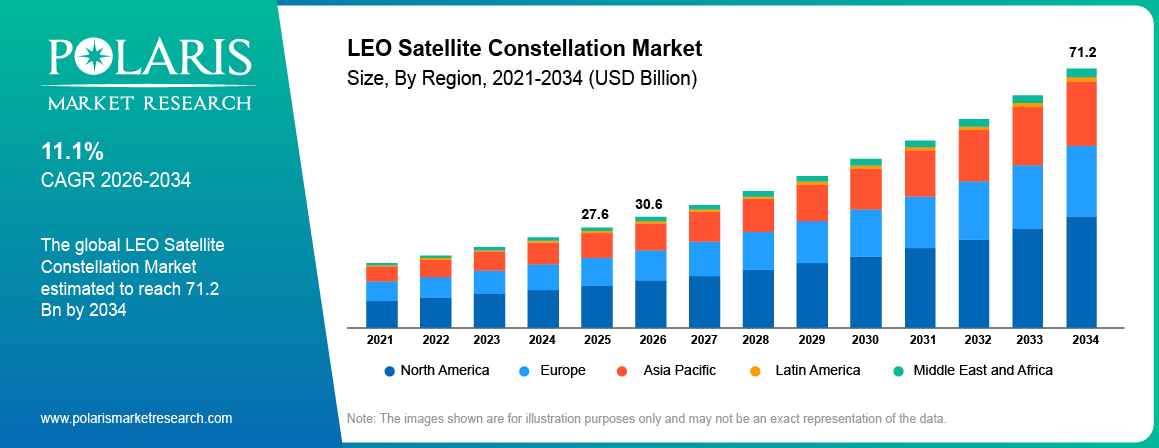
The LEO satellite constellation market size is valued at USD 27.6 billion in 2025 and is projected to reach USD 71.2 billion by 2034, growing at a CAGR of 11.1% from 2026 till 2034. This growth is majorly because operators move from initial deployment toward broader service coverage, replenishment, and network densification. The expansion is also closely linked to the scale-up schedules of Starlink, Amazon Leo, Eutelsat OneWeb, Telesat Lightspeed, and emerging direct-to-device networks.
Market Statistics
Key Takeaways
- The market was valued at USD 27.6 billion in 2025 and is on pace to reach USD 71.2 billion by 2034, an 11.1% CAGR driven by operators shifting from initial deployment into full-scale coverage, replenishment, and network densification.
- North America accounted for USD 11.7 billion of that total, carried almost entirely by Starlink's scale, more than 8,000 satellites and 6 million subscribers, with Amazon Leo adding to the region's lead (Source: lightreading.com).
- China is running two constellation programs at once. Guowang has roughly 177 satellites in orbit today against a planned build-out near 13,000, while Qianfan has moved faster on near-term deployment, reaching 218 satellites (Source: china-in-space.com).
- The FCC's EPFD spectrum-sharing proposal, released in April 2025, could cut the number of satellites needed for equivalent coverage, a change that lowers the cost floor for new constellations.
- Government demand is becoming a real revenue line, not just a side market. Telesat Lightspeed alone has pulled in USD 2.54 billion in government-backed funding and holds a backlog north of USD 1 billion.
- Europe's IRIS² adds a third model to the mix: a USD 12.22 billion sovereign connectivity concession covering 290 satellites, 272 of them in LEO.
Note: Figures and projections outlined in this report are the result of Polaris Market Research’s proprietary analytical processes, grounded in the latest available datasets and market observations.
Market Definition and Growth Analysis
Launch economics are improving the commercial outlook for large constellation programs. As launch costs go down, satellite launches are becoming cheaper, and this trend is motivating organizations to build their satellite network and replace older satellites. This is also generating chances for launch services providers, satellite manufacturers, and ground stations.
Deployment plans and regulatory developments also affect the market. Amazon Leo, Telesat Lightspeed, Guowang, and Europe’s IRIS² program are at various development stages, resulting in many new possibilities in terms of satellite deployment and connectivity services. Further constellation growth is forecasted to boost the demand for satellite manufacturing, launches, ground infrastructure, and networks.
The prospects continue to be optimistic with the emphasis by the players on increasing the network coverage and building the network capacity. There will be increased participation from the business players and development of new government programs that will widen the market for the LEO satellites.
The LEO satellite constellation market is developing around coordinated networks of satellites deployed in low Earth orbit to provide connectivity across consumer, enterprise, government, and direct-to-device applications. The market is different from the general LEO satellite market since the scope is narrowed down to connectivity and broadband constellations only and not Earth observations, scientific payloads, and other applications of the satellites. There are more than 11,700 satellites operational by mid-2025, according to Live Science, giving the industry an already huge installed base (Source: https://www.livescience.com/space/space-exploration/how-many-satellites-could-fit-in-earth-orbit-and-how-many-do-we-really-need).
There are four major programs that are driving the competitive environment. Starlink is currently winning the competition through scale, and Amazon Leo is growing in size too. Eutelsat OneWeb is adding to its satellite constellation, and Telesat Lightspeed is building up a constellation targeted at enterprises. Competition is moving towards coverage, capacity, and deployment times.
Opportunities for commercial use are not limited to deployment of the satellites. Broadband connectivity is the main use case, but direct-to-device connectivity opens new channels of accessing the network. In April 2026, Amazon made an agreement to buy out Globalstar in order to increase direct-to-device connectivity based on the LEO satellites and use satellites for Apple devices' services (Source: aboutamazon.com).
Regulation is impacting constellation economics. Spectrum-sharing regulation by the FCC will lower satellite needs for equal coverage, while deorbiting regulations will introduce more compliance regulations. Europe is working on IRIS², while China is working on the Guowang and Qianfan constellations. The market is going beyond competition among the number of satellites. Launch cost, spectrum access, orbit compliance, connectivity, and customer acquisition are becoming important factors that determine commercial success.
Market Dynamics
Driver Impact Analysis
| Market Driver | Est. CAGR Impact | Geographic Relevance | Impact Timeline |
| FCC EPFD spectrum-sharing reform | +2.1% | North America | Medium term, 2-4 years |
| Reusable launch cost compression | +2.8% | Global | Short to medium term |
| Digital divide / underserved connectivity demand | +2.4% | Global, especially Latin America, Africa, rural North America | Long-term structural |
| China state-backed constellation build-out | +2.0% | Asia Pacific | Medium to long term |
| Direct-to-device / D2D network expansion | +1.8% | North America, Global | Short to medium term |
Source: Polaris Market Research Analysis.
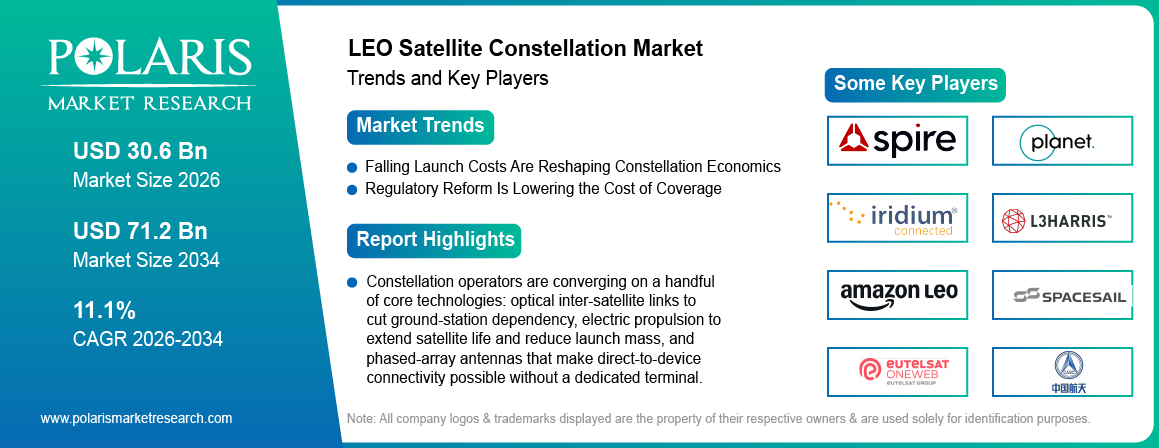
Driver: Falling Launch Costs Are Reshaping Constellation Economics
Lower deployment costs are making large LEO constellations more commercially viable. The cost of placing satellites into orbit has a direct impact on the economics of building, expanding, and replenishing a constellation. Reusable launch systems have significantly improved these economics. With decreased launch expenses, it will be much easier to launch satellites regularly and implement expansion programs that are economically viable. Reusable Falcon 9 boosters developed by SpaceX were already lowering the launch costs by 70-80% per launch, saving approximately USD 450 million per reused booster, with some launches costing even less than USD 30 million (Source: wionews.com).
The increasing need for connectivity in poorly served regions is driving the addressable market for LEO network systems. LEO satellites offer broadband connectivity in areas that are difficult and expensive to serve using terrestrial networks, such as rural, remote, and challenging geographic areas. In August 2025, NBN Co decides to use Amazon’s Project Kuiper to introduce low Earth orbit (LEO) satellites for providing broadband connectivity in Australia. In addition, in February 2026, Amazon Leo has collaborated with DIRECTV Latin America and SKY Brazil to provide LEO satellite broadband connectivity in eight Latin American nations. It demonstrates how the satellite broadband service is being integrated into the connectivity plans of nations and regions instead of being merely an alternate for terrestrial networks.
Driver: Regulatory Reform Is Lowering the Cost of Coverage
The FCC's NGSO/GSO EPFD Spectrum Sharing NPRM of April 2025 is among the most notable regulatory considerations impacting the economic aspect of LEO constellations. The initiative may cut down the satellite count needed for coverage from 462 to 360 (Source: fcc.gov). A lower satellite requirement could reduce manufacturing, launch, and operational costs for eligible constellation designs.
The effect extends beyond satellite counts. FCC licensing streamlining efforts and the use of waivers and shot clocks can influence the time required to move from constellation planning to deployment. At the same time, the five-year deorbit requirement adds compliance costs for new LEO systems. The commercial outcome therefore depends on whether regulatory flexibility in spectrum sharing offsets the additional cost of orbital sustainability requirements.
Restraint: Capital Intensity and Compliance Costs Are Limiting Market Entry
Capital intensity remains a major barrier. For instance, Amazon had invested more than $10 billion in Amazon Leo and committed billions more, according to an FCC filing (Source: satellitetoday.com). Large operators must also maintain launch access, ground infrastructure, terminals, spectrum rights, and spacecraft replenishment programs over an extended operating period.
Spectrum licensing and deorbiting also contribute to the challenge. Network performance needs to be balanced against limitations of the orbits and spectrum, along with stricter disposal requirements. This will increase cost pressures on operators, especially those that are newer and that do not have established capabilities with respect to launches, regulation, and production.
Opportunity: China's Parallel Buildout and Direct-to-Device Are Opening New Ground
The parallel constellation build-out in China also presents both competition and a unique supply chain opportunity. Guowang is on track toward a planned constellation of roughly 13,000 satellites, with approximately 177 already in orbit. Qianfan has moved faster on near-term deployment, reaching 218 satellites as of July 2026 (Source: china-in-space.com). The magnitude of such ambitions provides an opportunity in satellite manufacturing, propulsion, launches, ground equipment, and networking equipment.
Direct-to-device connectivity is another emerging opportunity. AST SpaceMobile has received FCC authorization for Supplemental Coverage from Space and is targeting 45 satellites in April 2026 (Source: fcc.gov). Its network architecture uses large phased arrays to connect directly with smartphones, creating a different commercialization path from conventional broadband services that depend on dedicated terminals.
Market Segmentation Analysis
The report provides a comprehensive analysis of the LEO satellite constellation market by satellite mass, payload type, orbit altitude, orbital delivery mode, application, end use, and region to identify key revenue-generating and high-growth segments.
Satellite Mass Class Insights
Small satellites (100–500 kg) are projected to hold dominant size of USD 9.7 billion in 2025 owing to the trade-off between payload, performance, and cost-effectiveness in terms of launches. The size is appropriate for constellations for communications, earth observation, among others, enabling the deployment of multiple satellites at once.
Microsatellites (10–100 kg) are expected to grow at the fastest rate of 11.8% during the forecast period as operators increasingly use smaller spacecraft to reduce deployment costs and accelerate constellation expansion. Their relatively compact size also makes them well suited to rideshare launches and distributed satellite networks.
Payload Type Insights
Communication Payload is dominating the market due to the fast-paced growth in broadband and communications constellations. The increasing demand for satellite communication calls for more communication satellites, making communication payloads an integral component of LEO constellations.
Remote Sensing and Imaging Payloads are anticipated to experience the fastest growth due to the growing demand for Earth observation and high-resolution images. Better imaging technology is leading to increased applications of LEO satellites in monitoring and data gathering, resulting in further demand for remote sensing payloads.
Orbit Altitude Insights
Low Earth Orbit (LEO) is leading the market in 2025 with the estimated market size of USD 27.4 billion, due to its appropriateness for satellite constellations, broadband communication, Earth observation, and similar low latency operations. The proven usage of this type of orbit in commercial and governmental satellite systems will continue to increase the popularity of LEO satellite constellations.
Very Low Earth Orbit (VLEO), which is 160 to 450 km above the earth’s surface, is projected to exhibit the highest growth rate, as organizations seek lower orbits for use in scenarios that demand closer proximity to the earth’s surface. The VLEO has the potential to facilitate low-latency communication and high-resolution observation. In August 2026, Sarmony announced plans to launch its SAR DiskSat demonstration satellite on the KAIROS rocket, with the mission designed to validate a compact SAR architecture suited for Very Low Earth Orbit (VLEO) operations. The development supports VLEO growth by demonstrating smaller, high-resolution Earth-observation satellites optimized for lower-altitude deployment.
Orbital Delivery Mode Insights
Direct orbital deployment is estimated to dominate the market in 2025 due to the capability of the satellite operators to share launch capacity and cut down on the cost of deploying the satellites. Commercial services such as SpaceX Transporter, Rocket Lab, and ISRO PSLV allow satellite operators to get to orbit through constellations.
In-Space Transportation & On-Orbit Delivery is projected to experience the highest growth as constellation operators demand greater flexibility for transporting satellites from deployment orbit to operational orbit. The availability of specialized orbital transportation solutions can streamline deployment processes and enable better constellation management.
Application Insights
The market size of Communications & Connectivity application segment is estimated to be USD 14.9 billion in 2025. This market growth is due to the proliferation of satellite broadband networks and increased connectivity needs in rural or remote regions. Large LEO constellations have been launched for high-speed, low-latency connectivity, which requires sustained investment in satellites and launch vehicles, along with ground equipment.
Earth Observation & Remote Sensing is estimated to experience the highest growth rate, as rising demand for high-resolution imaging and environmental monitoring pushes operators toward dedicated sensing payloads alongside their communications fleets.
End Use Insights
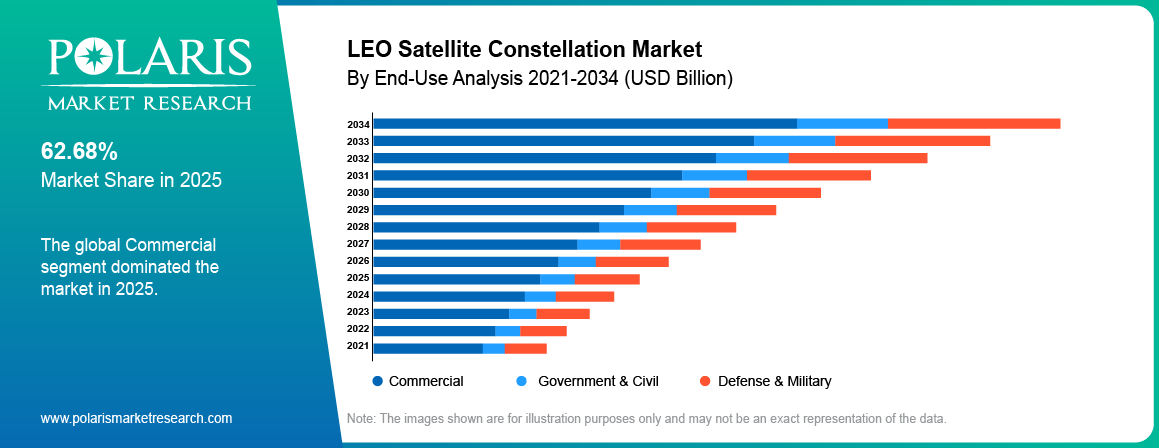
The commercial segment accounted for the largest market, an estimated USD 17.3 billion in 2025. Increasing private satellite deployments, growth in commercial launch services, and the scale-up of broadband constellations are supporting segment dominance. Lower launch costs are also making it possible for private companies to launch more spacecraft into space. In August 2026, VinSpace had signed a SpaceX agreement to launch its first LEO satellite constellation in 2027, marking Vietnam’s entry into private LEO satellite operations (Source: nasdaq.com).
Government and civil users are the fastest-growing end-use segment, driven by national security connectivity programs and sovereign broadband initiatives such as Europe's IRIS² and Canada's Arctic satcom investment. Defense and military demand adds a separate layer of growth, as governments seek resilient, jam-resistant constellations that don't depend on a single commercial provider.
Market Segment Performance Summary
| Segment Category | Segment | Base-Year Status | Forecast CAGR | Key Driver |
| Application | Communications & Connectivity | Largest share, 54.0% | 10.4% | Broadband constellation scale-up |
| Application | Earth Observation & Remote Sensing | Fastest growing | 12.6% | Demand for high-resolution imaging |
| End Use | Commercial | Largest share, 62.7% | 10.9% | Private constellation deployment |
| End Use | Government & Civil | Fastest growing | 12.9% | Sovereign connectivity programs |
Source: Polaris Market Research Analysis.
Regional Insights
North America LEO Satellite Constellation Market Trends
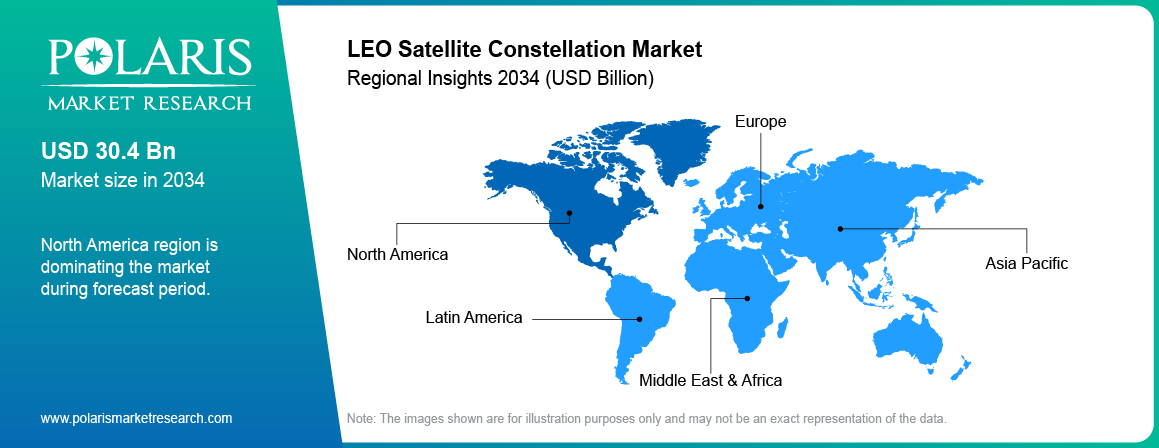
North America dominated the LEO satellite constellation market, valued at USD 11.7 billion in 2025. Starlink's installed base and Amazon Leo's accelerating deployment schedule anchor the region's lead, backed by mature launch infrastructure, deep aerospace manufacturing capacity, and a regulatory environment that's actively being reshaped to favor faster constellation buildout. The US is continually expanding the launch services market, while changes in the licensing regulations of the FAA are helping the emergence of the commercial space industry in the region.
The US remains the center of gravity for the region, given its concentration of launch, manufacturing, defense, and commercial constellation activity. FCC licensing reform is directly lowering the barrier to launching new constellations, and that regulatory shift is likely to matter more to this market over the next few years than any single mission.
Canada maintains capabilities across satellite technologies and ground infrastructure and participates in the wider North American aerospace supply chain. Increasing demand for satellite communication and Earth observation systems is expected to support infrastructure requirements in the country.
Europe LEO Satellite Constellation Market Trends
Europe accounted for a significant share of more than 27% in the global LEO satellite constellation market in 2025. This is due to its established satellite manufacturing, aerospace engineering, and ground-system capabilities. In August 2026, Eutelsat announced the launch of the LEO satellite segment of Europe's IRIS² program, deploying 330 LEO satellites to strengthen Europe's sovereign connectivity infrastructure (Source: eutelsat.com).
Cross-border cooperation remains an important feature of the European market, as infrastructure programs often involve companies and agencies across multiple countries. Growing investment in satellite manufacturing, launch access, and ground infrastructure is expected to support the regional market during the forecast period.
Asia Pacific LEO Satellite Constellation Market Trends
Asia Pacific is projected to register the fastest CAGR of more than 11% during the forecast period. This growth is due to increasing satellite deployments, government investment, and growing participation of private space companies. China is expanding its satellite infrastructure through the Guowang and Qianfan constellations. Increasing constellation deployment is supporting demand for spacecraft manufacturing, launch systems, satellite ground stations, and network infrastructure.
India is also developing its commercial space ecosystem via private sector involvement under governmental support. The government of India has initiated a Technology Adoption Fund (TAF), which involves a total budget of around USD 57 million for facilitating the commercialization of space technologies. The program provides partial funding for startups, MSMEs, and industry players, with support of up to USD 2.9 million per project to help advance early-stage technologies toward commercial deployment (Source: inspace.gov.in). Increasing commercialization is expected to create opportunities for domestic satellite, launch, and supporting infrastructure providers.
Latin America LEO Satellite Constellation Market Trends
Latin America represents an emerging market for satellite communication, Earth observation, and supporting ground infrastructure. The region remains dependent on international launch and satellite suppliers for a significant portion of its infrastructure requirements. Brazil represents an important regional market owing to demand for satellite connectivity and Earth observation services.
Increasing expansion of international satellite networks into Latin America is expected to support demand for ground systems and communication infrastructure. Domestic satellite manufacturing and launch capacity remain limited, though, which keeps the region reliant on foreign operators and suppliers for the foreseeable future.
Middle East and Africa LEO Satellite Constellation Market Trends
The Middle East and Africa LEO satellite constellation market is developing primarily through satellite communication, Earth observation, and ground infrastructure requirements. Demand for connectivity and satellite-based services is supporting investment in ground systems and related infrastructure across the region.
Locally operated constellation capability remains an early-stage ambition here, well behind North America and Asia Pacific, so near-term growth will keep flowing through international operators serving the region rather than homegrown ones. Near-term market growth is expected to remain concentrated around satellite and ground-system infrastructure.
Regulatory Environment Heatmap
| Region/Country | Policy Environment | Key Regulations/Programs | Market Implication | Trend |
| US | Favorable, contested | FCC EPFD NPRM, Apr. 2025; five-year deorbit rule | Potentially lower satellite requirements, but higher deorbit compliance costs | Developing |
| European Union | Favorable | IRIS² USD 12.22 billion SpaceRISE concession contract | Sovereign connectivity build-out toward 2029 | Expanding |
| China | Favorable, state-directed | Guowang and Qianfan programs | Rapid state-funded capacity growth | Expanding |
| Canada | Favorable | Telesat Lightspeed financing of USD 1.52 billion+ from the Government of Canada | National strategic asset positioning | Stable |
| India | NA | India-specific regulatory/deployment information not verified | Regulatory and deployment position requires further validation. | Uncertain |
Source: Federal Communications Commission (FCC); European Commission; SpaceRISE; China Satellite Network Group; International Telecommunication Union (ITU); Government of Canada; Telesat; Polaris Market Research Analysis.
LEO Satellite Constellation Market Competitive Landscape
The global LEO Satellite Constellation market includes established aerospace companies, commercial launch providers, satellite manufacturers, and constellation operators competing for subscriber share, enterprise contracts, and government business. Competition is based on launch capabilities, mission reliability, spacecraft technology, manufacturing capacity, and the ability to win large, multi-year government contracts.
Competitive Landscape Snapshot
| Company | Estimated Market Position | Primary Strength | Geographic Focus |
| SpaceX (Starlink) | Top 3 | Scale and launch vertical integration | Global |
| Amazon (Leo/Kuiper) | Top 5 | Capital scale and distribution deals | Global |
| Eutelsat OneWeb | Top 5 | Enterprise/B2B incumbency | Global, Europe-anchored |
| Telesat (Lightspeed) | Regional leader | Guaranteed-SLA enterprise model | North America, global enterprise |
| AST SpaceMobile | Niche leader | Direct-to-device phased-array technology | North America, global |
Source: Company filings and named press releases.
Government contracts are increasingly deciding who wins in this market. Telesat's Arctic satcom deal and Rocket Lab's Space Force award both show large, multi-year government commitments now shaping competitive position as much as commercial subscriber growth does.
Technology and Innovation Landscape
Constellation operators are converging on a handful of core technologies: optical inter-satellite links to cut ground-station dependency, electric propulsion to extend satellite life and reduce launch mass, and phased-array antennas that make direct-to-device connectivity possible without a dedicated terminal.
Technology and Innovation Landscape
| Technology | Adoption Stage | Key Development | Market Impact |
| Optical inter-satellite links | Growing deployment | 2025–2026, Amazon Leo/Telesat | Reduces ground-station dependency and raises mesh capacity |
| Electric propulsion | Mainstream adoption | 2025–2026, Qianfan | Lower launch mass, longer mission life, cost reduction |
| Large phased-array antennas | Early commercial deployment | 2025–2026, AST SpaceMobile | Enables direct-to-smartphone connectivity without terminals |
| EPFD-compliant spectrum-sharing systems | Pilot/early research | 2025–2026, FCC NPRM-driven | Could reduce satellites required per constellation |
Source: Company filings and trade publications.
Buyer Analysis
As constellation deployment accelerates, telecom carriers, government agencies, and enterprise buyers all need clearer visibility into capacity, coverage, and reliability before committing to a network. That's driving demand for the kind of research this report provides. Market Intelligence is employed by institutional investors, aerospace manufacturers, government entities, telecom operators, and infrastructure providers to detect growth areas, analyze technology trends, understand their competitive position, and make investment and procurement decisions.
Buyer Analysis Framework
| Buyer / Investor Type | Primary Use Case | Key Insight Sought | Decision Horizon |
| Telecom carrier | Rural/remote network extension | Capacity and SLA reliability | 2–5 years |
| Government/defense | Secure, resilient connectivity | Sovereignty and redundancy | 3–7 years |
| Maritime/aviation enterprise | Always-on connectivity at sea/in flight | Coverage and latency | 2–5 years |
| Consumer/rural household | Broadband access | Price and installation simplicity | 1–3 years |
Source: Polaris Market Research Analysis.
Barriers to Market Entry
- Capital Requirements: Building and launching hundreds or thousands of satellites, plus the ground infrastructure to operate them, takes billions in upfront investment before a single subscriber signs up.
- Spectrum and Regulatory Access: Operators need cleared spectrum rights and regulatory approval in every market they serve, a slow, jurisdiction-by-jurisdiction process that can stall deployment for years.
- Launch Access at Scale: Deploying a full constellation requires reliable, high-cadence launch capacity, something only a handful of providers can currently offer at the volume large constellations need.
- Ground Infrastructure: Gateway stations, terminals, and network operations centers require significant capital and local permitting, particularly in markets with limited existing telecom infrastructure.
- Deorbit and Sustainability Compliance: The FCC's five-year deorbit rule and similar international requirements add engineering and operational cost that smaller operators may struggle to absorb.
- Incumbent Scale Advantage: Starlink's existing satellite count and customer base give it cost and coverage advantages that new entrants can't easily match without years of sustained deployment.
Premium Insights and Forward Outlook
Direct-to-Device Expansion
Direct-to-device connectivity is moving from pilot programs to commercial reality. AST SpaceMobile's FCC authorization and Amazon's Globalstar acquisition both point toward smartphones connecting directly to satellites without a dedicated terminal, a shift that could open the market to billions of existing mobile devices rather than requiring new hardware purchases.
Government Contracts as a Growth Engine
Large, multi-year government contracts, Telesat's Arctic satcom deal and Rocket Lab's Space Force award among them, are becoming a bigger share of constellation revenue than consumer broadband alone. Operators that can win sovereign and defense contracts are positioning themselves for more predictable, higher-margin revenue than the consumer market offers.
Cost and Pricing Benchmarking Analysis
| Product/Service Type | Estimated Price Range | Key Cost Driver | Complexity Tier |
| Dedicated small launch, Electron-class | Approx. USD 7.5M per mission | Dedicated orbit and payload processing | Tier 2 |
| Falcon 9 dedicated launch | Approx. USD 69.75M | Booster reuse and launch cadence | Tier 2 |
| Falcon 9 LEO transport | Approx. USD 2,700-3,000/kg | Payload mass and mission configuration | Tier 2 |
| Consumer user terminal | USD 400-600 per unit | Phased-array antenna manufacturing at scale | Tier 1 |
| Ground gateway station | Vendor/project pricing | Site development, backhaul, and regulatory permitting | Tier 3 |
Source: Pricing sources and Polaris Market Research Analysis.
Key Players in the LEO Satellite Constellation Market
Constellation Operators
- Amazon (Amazon Leo)
- China SatNet
- Eutelsat Group (OneWeb)
- Iridium Communications, Inc.
- Planet Labs PBC
- Shanghai Spacesail Technologies
- Spire Global, Inc.
- SpaceX
- Telesat
Satellite & Platform Manufacturers
- Airbus
- Boeing
- L3Harris Technologies
- Lockheed Martin
- Northrop Grumman
- Thales (Thales Alenia Space)
Launch & In-Orbit Services
- Astroscale
- Blue Origin
- Rocket Lab
Industry Developments
- August 4, 2026: Telesat secured a $2.3 billion Arctic military satellite communications contract with the Government of Canada, expanding its Lightspeed constellation by 69 satellites, a 44% capacity increase, with MDA Space building the additional satellites (Source: telesat.com)
- July 30, 2026: Rocket Lab signed a $397 million contract with the U.S. Space Force to design, manufacture, launch, and operate Flatellite satellites for the Space-Based Airborne Moving Target Indicator program, a next-generation flat satellite design built for large constellations (Source: rocketlabcorp.com)
- July 4, 2026: China's Shanghai Spacesail-operated Qianfan constellation reached 218 satellites in orbit following continued deployment activity, advancing the country's large-scale LEO infrastructure buildout (Source: friendsofnasa.org)
- June 29, 2026: Rocket Lab entered into a definitive agreement to acquire Iridium Communications for approximately $8 billion in cash and stock, uniting Rocket Lab's launch and satellite manufacturing capabilities with Iridium's global LEO communications network and spectrum, creating a vertically integrated space company. The deal is expected to close in mid-2027, pending regulatory approval (Source:
rocketlabcorp.com) - Planned, mid-2026: Amazon Leo is targeting deployment of 700 satellites, positioning itself as the primary near-term challenger to SpaceX's Starlink in the consumer broadband constellation market (Source: satellitetoday.com)
LEO Satellite Constellation Market Report Segmentation
By Satellite Mass Class (Revenue, USD Billion, 2021–2034)
- Nano & Pico Satellites (<10 kg)
- Microsatellites (10–100 kg)
- Small Satellites (100–500 kg)
- Medium Satellites (500–1,000 kg)
- Large Satellites (>1,000 kg)
By Payload Type (Revenue, USD Billion, 2021–2034)
- Communication Payloads
- Earth Observation & Imaging Payloads
- Navigation & PNT Payloads
- SSA & Tracking Payloads
- Scientific & Technology Payloads
- Other Payloads
By Orbit Altitude (Revenue, USD Billion, 2021–2034)
- Very Low Earth Orbit (160–450 km)
- Low Earth Orbit (>450–2,000 km)
By Orbital Delivery Mode (Revenue, USD Billion, 2021–2034)
- Direct Orbital Deployment
- In-Space Transportation & Orbital Delivery
By Application Outlook (Revenue, USD Billion, 2021–2034)
- Communications & Connectivity
- Earth Observation & Remote Sensing
- Positioning, Navigation & Timing (PNT)
- Space Situational Awareness & Tracking
- Scientific Research & Technology Demonstration
- Other Applications
By End Use Outlook (Revenue, USD Billion, 2021–2034)
- Commercial
- Government & Civil
- Defense & Military
By Regional Outlook (Revenue, USD Billion, 2021–2034)
North America
- US
- Canada
Europe
- Germany
- France
- UK
- Italy
- Spain
- Netherlands
- Rest of Europe
Asia Pacific
- China
- Japan
- India
- South Korea
- Taiwan
- Australia
- Rest of Asia Pacific
Latin America
- Brazil
- Mexico
- Argentina
- Rest of Latin America
Middle East & Africa
- Saudi Arabia
- UAE
- South Africa
- Rest of Middle East & Africa
Report Scope
| Report Attributes | Details |
| Market Size in 2025 | USD 27.6 Billion |
| Market Size in 2026 | USD 30.6 Billion |
| Revenue Forecast by 2034 | USD 71.2 Billion |
| CAGR | 11.1% from 2026–2034 |
| Base Year | 2025 |
| Historical Data | 2021–2024 |
| Forecast Period | 2026–2034 |
| Quantitative Units | Revenue in USD Billion and CAGR |
| Report Coverage | Revenue Forecast, Growth Factors, Competitive Landscape, Industry Trends, and Strategic Analysis |
| Segments Covered | By Satellite Mass Class, Payload Type, Orbit Altitude, Orbital Delivery Mode, Application, End Use, and Region |
| Regional Scope | North America, Europe, Asia Pacific, Latin America, Middle East & Africa |
| Competitive Landscape | Company Profiling, Product Benchmarking, Financial Analysis, Market Developments, and Strategic Initiatives |
| Report Format | PDF + Excel |
| Customization | Available by Country, Region, and Segment |
Source: Polaris Market Research Analysis
LEO Satellite Constellation Market Research Methodology
The research methodology for the LEO satellite constellation market combines secondary research, primary validation, market sizing, forecasting, and data validation. This report draws on 15 primary sources and 13 secondary sources, spanning regulatory filings, government publications, company disclosures, industry associations, and trade journals.
The secondary research provides the regulatory, technological, deployment, and competitive context. Primary research includes structured interviews, validation calls, and surveys/panels to validate the market assumptions.
Market sizing is achieved via a combination of a top-down/bottom-up approach and cross-validation. The sources of data used include corporate disclosures, government data, and internal databases. Forecasting links the evolution of the market to regulation, launch economics, and confirmed constellation deployment plans.
Data validation comes at the end to ensure consistency in results. Findings that have both quantitative and qualitative elements are cross-referenced prior to analyst approval.
LEO Satellite Constellation Market Research Methodology Overview
| Research Phase | Key Activities | Data Sources Used | Purpose / Output |
| Secondary Research | Regulatory filing review, trade press tracking, company disclosure review | Government publications, company releases, industry associations | Establish sourced drivers, regulatory, and competitive context |
| Primary Research | Structured interviews, validation calls, survey/panel data | Industry executives, analysts | Validate secondary findings and qualitative context |
| Market Sizing & Triangulation | Top-down and bottom-up estimation, cross-validation | Company filings, government data, internal databases | Produce base-year and forecast-year estimates |
| Forecasting | CAGR modeling tied to named drivers and regulatory timelines | Confirmed market drivers and regional deployment data | Produce forecast-period growth trajectory |
| Data Validation | Cross-check and analyst sign-off | Internal review layer | Confirm accuracy prior to publication |
Source: Polaris Market Research Analysis.
LEO Satellite Constellation Market FAQ's
The market size stood at USD 27.6 billion in 2025 and is expected to reach USD 71.2 billion by 2034, growing at a CAGR of 11.1%.
The market is expected to register a CAGR of 11.1% during 2026-2034, driven by expanding constellations, growing broadband demand, and the rise of direct-to-device connectivity.
SpaceX's Starlink leads the market in terms of installed satellites, with more than 8,000 in orbit and over 6 million users.
Newer LEO satellites must be deorbited within five years of the end of their mission to comply with this regulation.
Amazon Leo has pledged more than USD 10 billion, while Telesat Lightspeed has secured USD 2.54 billion in government-backed funding.
China is expanding through Guowang and Qianfan, but Starlink remains significantly ahead in deployed satellite scale.
Reusable launch vehicles and falling launch costs are making deployment and maintenance of LEO constellations cheaper.
The IRIS² project is targeting satellite deployment by 2029, with a planned constellation of 290 satellites.
Small satellites (100-500 kg) hold the largest share, valued at USD 9.7 billion in 2025, favored for their balance of payload capacity, performance, and launch cost. Microsatellites (10-100 kg) are the fastest-growing class, at a CAGR of 11.8%, as operators use smaller spacecraft to cut deployment costs and speed up constellation expansion.
Low Earth Orbit accounted for USD 27.4 billion in 2025, the dominant altitude band for broadband constellations and low-latency operations. Very Low Earth Orbit is projected to grow fastest, as operators pursue closer proximity to Earth for lower latency and higher-resolution observation.
Communications & Connectivity leads, with a market size of USD 14.9 billion in 2025, driven by the scale-up of broadband constellations serving rural and underserved regions.
The commercial segment leads, valued at USD 17.3 billion in 2025, supported by private satellite deployment, broadband constellation growth, and falling launch costs that make large-scale private operations viable.
Direct orbital deployment places satellites straight into their operational orbit and currently dominates the market, since it lets operators share launch capacity and reduce cost. In-space transportation moves satellites from an initial deployment orbit to their final operational orbit using dedicated orbital transfer vehicles, and it's the faster-growing delivery mode as constellation operators seek more flexible deployment options.
Download Sample Report of LEO Satellite Constellation Market
Please fill out the form to request a customized copy of the research report.


