
5G NTN Market Size, Share, Trends & Forecast, 2026–2034
REPORT DETAILS
5G NTN Market Summary
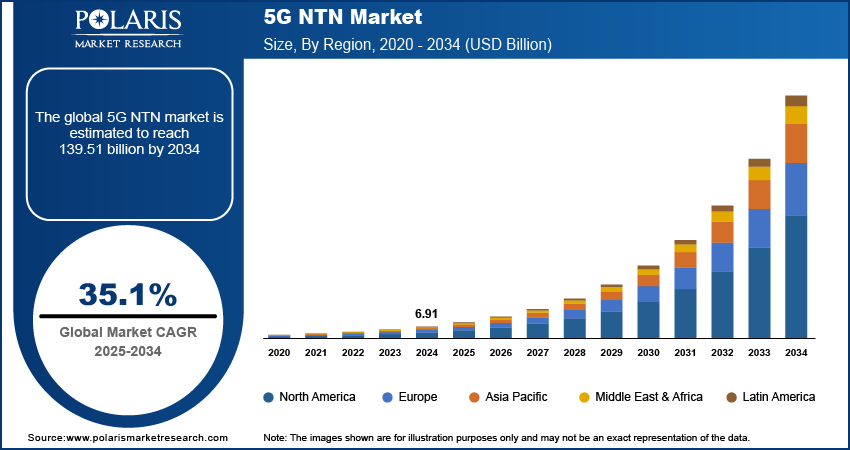
The global 5G Non-Terrestrial Network (NTN) market size was valued at USD 9.07 billion in 2025 and is projected to exhibit a CAGR of 31.04% from 2026 to 2034. The market is experiencing strong growth due to rising demand for reliable global connectivity, particularly in remote and rural areas. Advances in satellite technology, including Low Earth Orbit (LEO) satellites to support the expansion of IoT and critical communications for the maritime, aviation, and defense sectors, drive the 5G non-terrestrial network market growth.
Market Statistics
5G NTN market Key Takeaways
- North America held the largest market share of 38.7% in 2025, supported by the presence of major technology, satellite, and telecommunications players.
- The U.S. accounted for the largest share of 81.6% within the North American market in 2025, driven by the need to expand connectivity to underserved and remote areas.
- The Asia Pacific 5G NTN market is anticipated to record the highest CAGR of 34.2% during the forecast period due to its diverse landscapes, including remote and island territories.
- LEO satellites dominated the 5G NTN market with a 52.8% share in 2025 due to lower signal delay and faster communication capabilities.
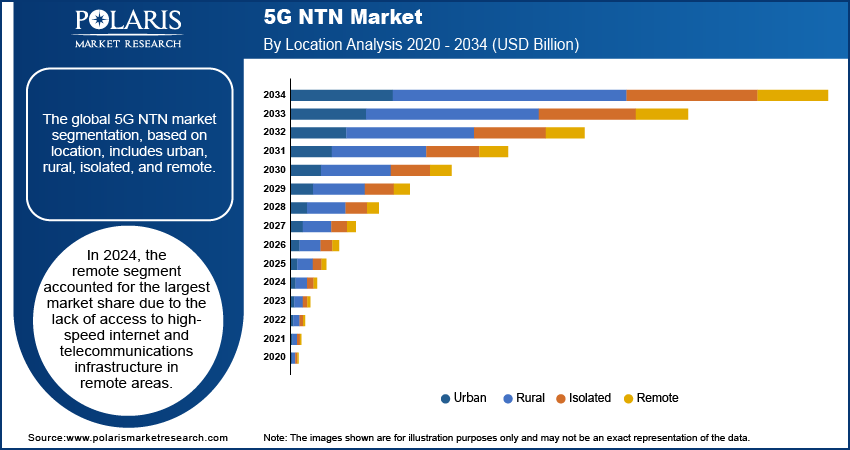
- In 2025, the remote segment accounted for the largest share of 46.5%, driven by limited access to high-speed internet and telecommunications infrastructure in remote areas.
Note: Figures and projections outlined in this report are the result of Polaris Market Research’s proprietary analytical processes, grounded in the latest available datasets and market observations.
What is 5G NTN Market?
5G NTN (Non-Terrestrial Network) is the combination of 5G mobile technology with space- and air-borne communication infrastructure. 5G NTN includes Low Earth Orbit (LEO), Medium Earth Orbit (MEO), and Geostationary (GEO) satellites, as well as High Altitude Platforms (HAP) and Unmanned Aircraft Systems (UAS).
Unlike traditional cellular networks that rely on towers on the ground, 5G NTN uses satellites and aircraft as relay stations. 5G NTN enables 5G satellite connectivity in remote locations not covered by terrestrial base stations.
5G NTN technology allows cellphones, IoT sensors, vehicles, aircraft, and ships to maintain connectivity via satellite links even when the user equipment is out of range of terrestrial cell towers. The connections use satellite or airborne relays that backhaul to terrestrial 5G core networks through ground stations acting as gateways, enabling standard 5G services for phones, messaging, IoT, and broadband even when the device is not in the range of a tower. The proliferation of 5G devices significantly propels the 5G non-terrestrial network industry demand. As both consumers and businesses increasingly embrace 5G technology and transition to 5G-enabled devices, there is a growing demand for dependable, high-speed connectivity on the 5G NTN network.
Standardized in 3GPP Release 17 and improved in Release 19, 5G NTN interworks with terrestrial 5G radio access networks and core via standardized procedures. This standardization enables smartphones and IoT devices to connect directly to 5G NTN satellites for voice, messaging, broadband, and tracking. 5G NTN technology targets aerospace and defense, maritime, government, mining, and rural broadband, and acts as an enabler for future 6G fully connected networks.
How Does 5G NTN Work?
5G NTN (Non-Terrestrial Network) connects mobile devices using satellite 5G, high-altitude platforms, or drones instead of only ground towers. A user’s phone sends signals to a satellite or aerial platform. The signal is then passed to a ground station and connected to the main 5G network. This helps provide coverage in places where mobile towers are unavailable, such as oceans, mountains, deserts, and remote villages. NTN works together with normal 5G networks to improve connectivity. It can support emergency communication, IoT devices, and basic mobile services. The main goal is to provide wider coverage and better connectivity everywhere.
5G NTN vs. Traditional Terrestrial 5G Networks
Traditional terrestrial 5G networks rely on earth-based cellular towers to provide service. 5G NTN makes use of satellites, drones, or other aerial means to provide cellular service. Terrestrial networks provide significantly faster speeds and lower latency, but cannot provide service to many areas of the earth’s surface, particularly rural, oceanic, mountainous, and other challenging terrain not accessible by 5G. 5G NTN could provide cellular service to alternative places outside the reach of terrestrial networks. The combination of terrestrial and satellite networks would provide broader coverage and be more reliable than terrestrial networks alone.
Comparison Matrix: 5G NTN vs Terrestrial 5G
| Dimension | 5G NTN | Traditional Terrestrial 5G |
| Coverage footprint | Global, including oceans, deserts, and polar regions | Limited to built cell-tower infrastructure |
| Typical latency | Higher for GEO/MEO; near-terrestrial for LEO | Lowest available, optimized for URLLC |
| Infrastructure cost model | Satellite/HAPS launch + ground gateway capex | Dense tower and fiber backhaul capex |
| Deployment speed in new areas | Fast, no physical tower build required | Slow, requires site acquisition and construction |
| Mobility support | Strong for maritime, aviation, and remote mobile assets | Strong within dense urban/suburban footprints |
| Best-fit use cases | Remote IoT, maritime, aviation, defense, disaster response | Dense urban eMBB, enterprise campuses, fixed wireless access |
Source: Polaris Market Research Analysis
Direct-to-Device/Direct-to-Cell Connectivity
Direct-to-cell & direct-to-device connectivity allow satellites to communicate with phones and other devices, enabling cellular service for phones where it was previously impossible or difficult to provide. This provides cellular coverage in rural areas, on mountains, over oceans, and in disaster scenarios. Messaging, alarms, voice, and data service are available to users. The 5G NTN industry offers cellular services beyond terrestrial networks with direct-to-device services. This creates business opportunities by providing cellular service to phones in an uninterrupted manner.
The growing demand for data-intensive applications and services across various sectors drives the adoption of 5G NTN networks. The rising adoption of high-definition video streaming, online gaming, IoT, and cloud computing boosts the requirement for 5G NTN networks. These networks offer the high-speed, low-latency connectivity needed to support these applications effectively, boosting the 5G non-terrestrial network (NTN) industry growth.
The introduction of 5G services and the anticipated arrival of 6G presents a significant opportunity for the 5G NTN industry. NTN technologies, utilizing satellites, drones, or balloons, extend connectivity to remote rural areas and challenging environments such as mountains, deserts, and oceans where ground infrastructure is limited or absent. This expansion helps bridge the digital divide by ensuring high-speed data services in underserved regions.
AI Impact on 5G NTN Market
- Artificial intelligence (AI) enables intelligent optimization of satellite beams, traffic routing, and network resources in 5G NTN systems.
- AI-driven predictive analytics improves handovers between satellites and terrestrial networks.
- Machine learning enhances dynamic spectrum allocation and interference management.
- AI-powered automation reduces operational costs through predictive maintenance and autonomous network management.
- AI enables new 5G NTN applications, including direct-to-device connectivity, IoT, and autonomous mobility.
Source: Polaris Market Research Analysis
Market Dynamics
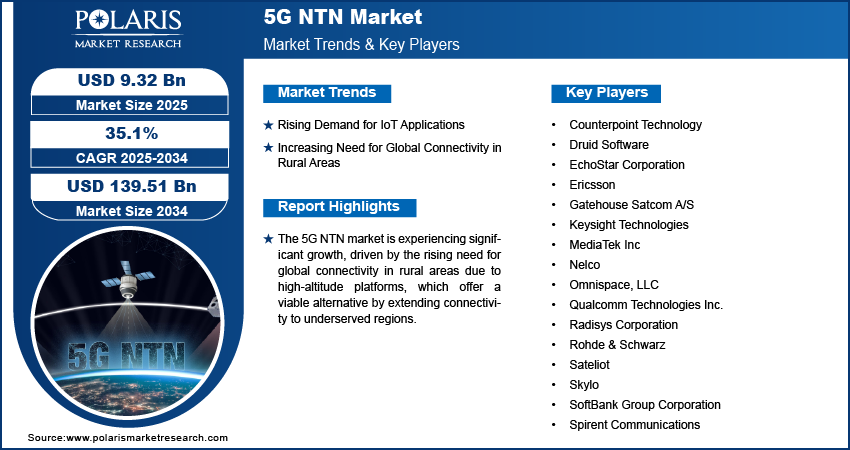
Driver: Rising Demand for IoT Applications
The 5G NTN market expansion is being driven by the increasing demand for IoT (Internet of Things) applications. IoT devices require reliable, high-speed connectivity to transmit and receive data efficiently across various sectors, such as smart cities, industrial automation, healthcare, and transportation. These 5G NTN technologies leverage advancements in satellite and HAP (High-Altitude Platform) technologies to deliver high-speed data transmission and reduced latency, which is critical for applications such as autonomous vehicles and remote operations.
Key players and organizations in the industry are leveraging advancements in non-terrestrial network technologies. In September 2026, Mobile Satellite Services Association announced Reference Architecture Version to address architectural and service challenges in NTN systems. Their efforts are instrumental in delivering global connectivity, high bandwidth, low latency, resilience, scalability, and integration capabilities. These are essential for meeting the diverse and expanding needs of IoT ecosystems worldwide, and their role is crucial in the future of the industry (Source: businesswire.com).
Driver: Increasing Need for Global Connectivity in Rural Areas
The 5G NTN market is experiencing significant growth, driven by the rising need for global connectivity in rural areas due to high-altitude platforms, which offer a viable alternative by extending connectivity to underserved regions. This capability bridges the digital divide, ensuring that rural communities have access to reliable internet and communication services. Also, access to broadband internet is crucial for fostering economic growth and development in rural areas.
Rural areas often rely on agriculture and natural resource industries, which benefit significantly from IoT applications for monitoring, automation, and resource management. Leading companies are expanding broadband access to rural areas, and forming strategic partnership to achieve socio-economic development objectives. For instance, in November 2025, Viasat and Space42 announced partnership for shared multi-orbit 5G NTN infrastructure. These initiatives play a crucial role in the deployment of 5G NTN solutions in rural regions (Source: viasat.com).
Restraint: High Deployment and Infrastructure Costs
High costs of 5G NTN deployment and infrastructure restrain the industry growth. Satellite constellation development and launch involve significant costs, including satellite manufacturing, launch, ground stations, and network infrastructure. Satellite networks’ maintenance contains high operational expenditures. These factors limit the entry for companies with limited resources. Furthermore, the additional costs of integration with existing 5G networks slows the commercialization of 5G NTN services, particularly in the developing countries, where telecom operators are less inclined to adopt new expensive technologies.
Restraint: Signal Delay, Coverage, and Complexity
The risk of signal delay, coverage issues, and network complexity is restraining the industry growth. Signal delays are inevitable in the 5G NTN due to the satellites’ distance from the earth. 5G NTN is susceptible to bad weather and other topographical changes which cause interruptions in service. Additionally, 5G mobile phones are expected to require more advanced technology to connect to satellites, and networks linking cell towers to satellites need optimization to ensure seamless communication, thereby restraining the industry growth.
Opportunity: Direct-to-Device Connectivity Expansion
The direct-to-cellular device connectivity is creating an opportunity for market expansion. The advantage of direct device connectivity is that it enables seamless communication from anywhere on the world, including remote areas with no cellular coverage. It is expected to facilitate cellular network densification and provide reliable connections in hard-to-reach locations such as mountainous regions, over oceans, and in disaster response scenarios. The rising need for cellular backup and uninterrupted networks is driving industry players to invest in direct-to-cellular satellite communication. Thus, 5G NTN technology is expected to enable high levels of connectivity by providing an alternate high-speed communication channel for millions of cellular devices worldwide.
Opportunity: 3GPP Release 17/19 & 5G-Advanced Evolution
The development of 5G NTN standards in 3GPP Release 17 NTN and 19 NTN is expected to expand the market. The main goals of 3GPP Release 17 were related to defining the framework within which satellite networks will be integrated into 5G networks. 3GPP Release 19 NTN aims to improve capabilities and performance of NTN to increase coverage, capacity and support diverse devices, which will enable the adoption of satellites for 5G-Advanced communication. Additionally, the standardization process enables the seamless coordination between terrestrial and non-terrestrial networks. It also allows the companies to develop the products and solutions faster. This trend is expected to fuel the commercialization process of 5G NTN and push the transition to 6G.
Cybersecurity & Network Security Challenges
Cybersecurity and network security are major challenges for the 5G NTN market. This network covers satellites, airplanes, and terrestrial components. Hackers can target the data on the network and interrupt signal transmission. Additionally, satellite links can be vulnerable to jamming and spoofing signals. The security of networks with multiple interconnections is further creates a challenge in the industry. Moreover, rising concern about cyberattacks worldwide limits the adoption of network. According to the GÉANT, the average number of weekly cyberattacks per organization across the world reached 1,984, a 21% rise compared to the same in Q2 2024. Such incidents are limiting the adoption of 5G NTN technologies (Source: security.geant.org).
Source: Polaris Market Research Analysis
Segment Insights
By Component Insights
The hardware segment dominated with the largest share of 57.6% in 2025 due to the need for large infrastructure to create satellite-based networks, including satellites, antennas, terminals, gateways, and communication equipment. Increasing investments in satellite launches are driving demand for advanced hardware components. Moreover, the need for more compact and efficient satellite equipment is supporting hardware demand. As companies expand 5G coverage to remote locations, demand for reliable, high-performance hardware is rising.
The software segment is projected to register a significant CAGR of 33.8% during the forecast period, due to the need to manage satellite networks and 5G traffic efficiently. The demand for automating processes is also expected to fuel the growth of the software segment. The software can ensure better utilization of networks and help operators in maximizing network efficiency. Therefore, as the network scales up, the need for software that performs efficiently and helps operate the core communication network infrastructure would be essential for companies, thereby driving segment growth.
By Platform Insights
The LEO satellites segment dominated 5G NTN market share with 52.8% in 2025 due to lower signal delay and faster communication, enabling them to provide improved mobility services and real-time communication. The small distance compared to other satellites makes it ideal for mobile connectivity. A growing LEO satellite constellation is also enabling global coverage and expanding the reach of 5G NTN. Growing investments from private and telecommunication companies are further supporting the LEO satellite 5G segment.
The MEO satellites segment is expected to register a CAGR of 32.6% during the forecast period due to its wider coverage compared to other satellites with relatively good communication performance. These satellites enable connection to large geographic areas and offer critical connectivity solutions. Growing need for reliable connectivity across remote areas drives the segment growth. MEO satellites can facilitate expanding networks across challenging terrains and connecting remote regions further fueling the growth.
LEO vs. MEO vs. GEO Satellite Platforms
| Platform | Typical Altitude | Latency Profile | Primary 5G NTN Role |
| LEO (Low Earth Orbit) | ~300–2,000 km | Lowest of the three. Near-terrestrial | Broadband, direct-to-device, low-latency IoT |
| MEO (Medium Earth Orbit) | ~2,000–35,786 km | Moderate | Regional backhaul, wide-area coverage |
| GEO (Geostationary Orbit) | ~35,786 km | Highest. Fixed round-trip delay | Broadcast, fixed-point coverage, resilience layer |
Source: Polaris Market Research Analysis
By Application Insights
The eMBB segment dominated with the largest share of 48.9% in 2025 due to rising demand for faster internet and efficient mobile connectivity. Growing demand for reliable broadband access to video streaming, online services, and cloud services is driving the need for 5G NTN to offer improved connectivity to remote areas. Growing smartphone penetration and data consumption trends support the segment growth. eMBB is expected to become an important application area for 5G NTN as looks for constant connectivity, thereby driving the industry growth.
The mMTC segment is expected to record a CAGR of 34.5% during the forecast period due to the growth in connected devices worldwide. Growing adoption of sensors, meters, trackers, and other IoT-enabled devices in various industries is fueling the need for reliable satellite-based networks. Many of these devices are being deployed in remote areas with limited or no cellular connectivity. 5G NTN provides connectivity for tracking and monitoring of such devices, thereby driving the segment growth.
By Location Insights
The remote segment accounted for the largest share of 46.5% in 2025 due to lack of access to high-speed internet and telecommunications infrastructure. The increasing demand for broadband connectivity, driven by IoT applications, digital transformation initiatives, and the need for reliable communications in remote industries such as mining, agriculture, and oil & gas, has fueled the adoption of these solutions.
Major players are at the forefront, implementing aggressive expansion strategies to capture a major share of the remote connectivity market. This includes launching new solutions and leveraging existing infrastructure to accelerate the deployment and adoption of 5G NTN technologies in underserved areas, supporting the industry's progress.
By End User Insights
The aerospace & defense segment is projected to register the highest CAGR of 35.7% during the forecast period. Military forces and defense organizations operate globally and in diverse terrains, including remote areas, oceans, and conflict zones. 5G NTN technologies offer extensive coverage capabilities, ensuring that military personnel and assets remain connected and communication channels remain operational across vast geographic regions.
Ongoing advancements in satellite technology, including higher throughput, improved signal processing, and enhanced encryption capabilities, contribute to the need for 5G NTN solutions for aerospace and defense applications. These advancements enable faster data transmission, improved network efficiency, and enhanced security features tailored to defense requirements.
Real-World Use Cases & Applications
| Domain / Sector | Use Case | How 5G NTN Enables It | Typical Deployment Mode |
| Consumer mobility | Direct-to-Device (D2D) emergency messaging & SOS | Smartphones connect directly to LEO/MEO satellites when terrestrial coverage is absent or during outages; supports SMS/text and limited data. | D2D (satellite access to standard 5G UE) |
| Consumer mobility | Global voice/data continuity for travelers | Seamless handover between terrestrial 5G and satellite for calls/data in remote corridors (deserts, oceans, polar routes). | D2D or UE relay via onboard picocell |
| Rural & remote broadband | Village/town broadband backhaul | Small cells in underserved areas use satellite feeder links to reach the 5G Core where fiber/microwave is uneconomical. | NTN backhaul to gNB |
| Rural & remote broadband | Pop-up coverage for events & temporary sites | Rapidly deployable cells with satellite backhaul for festivals, mining camps, construction sites. | NTN backhaul + mobile gNB |
| Public safety & disaster relief | Network resilience during disasters | Maintains connectivity when towers are damaged or congested; supports emergency alerts, first-responder comms. | D2D + NTN backhaul; service ubiquity |
| Public safety & disaster relief | PPDR (Public Protection & Disaster Relief) broadband | High-reliability links for command centers, drones, and field units in crisis zones. | NTN backhaul; private 5G slices over NTN |
| Maritime | Ship-to-shore & ship-to-ship communications | Continuous 5G service for crew, passengers, and operational IoT; supports LAN access even when feeder links are intermittent. | Onboard picocell + NTN feeder; S&F for delay-tolerant IoT |
| Maritime | Fleet telemetry & safety IoT | Sensor data (engine health, cargo conditions, AIS augmentation) from vessels across open ocean. | IoT-NTN (narrowband), S&F |
| Aviation | In-flight connectivity & passenger broadband | Aircraft picocells connect via Ka/Ku/LEO to 5G Core for consistent QoS across flight paths. | Onboard picocell + NTN feeder |
| Aviation | Operational telemetry & maintenance data | Real-time or near-real-time aircraft system data to ground operations/MRO. | IoT-NTN / broadband NTN |
| Land transport & logistics | Highway/rail corridor coverage | Fill coverage gaps along remote highways/rail lines for fleet management, safety, and passenger services. | NTN backhaul to roadside gNBs; D2D fallback |
| Land transport & logistics | Heavy equipment & container IoT | Track and monitor assets in mines, deserts, and ports where terrestrial networks are sparse. | IoT-NTN (NB-IoT/eMTC over NTN) |
| Energy & utilities | Remote grid/oil & gas monitoring | SCADA, pipeline, and wellhead telemetry from isolated sites with strict reliability needs. | IoT-NTN; private NTN slices |
| Agriculture | Precision agriculture in remote farms | Soil sensors, irrigation controllers, and equipment telemetry across large, unconnected fields. | IoT-NTN |
| Environment & climate | Environmental monitoring (buoys, weather stations, wildlife tags) | Collect data from oceans, forests, and mountains for research and early warning systems. | IoT-NTN, S&F for delay-tolerant streams |
| Industrial IoT | Firmware updates & broadcast to massive IoT | Efficient multicast/broadcast of updates to devices spread over wide, hard-to-reach areas. | NTN broadcast/multicast |
| Network planning & optimization | Usage analytics to guide terrestrial rollout | Aggregate 5G-NTN usage stats to identify where terrestrial expansion is most needed. | Analytics over NTN access |
| Defense & national resilience | Secure, resilient comms for dispersed units | Redundant paths and wide-area reach for command, control, and ISR data links. | Private NTN slices; D2D + backhaul |
Source: Polaris Market Research Analysis
Key Areas of 5G NTN Industry
-
Maritime & Aviation Connectivity Solutions
5G NTN can enable reliable connectivity for ships and airplanes beyond the reach of mobile phone networks. Using satellites as relays, it can provide internet, communication, and navigation services for these transport means, increasing their efficiency and passenger capacity. The growing need to keep transport connected during operations fuels demand. The current lack of coverage over oceans and airspace is further driving the development of this application area.
-
IoT & Massive Machine-to-Machine (M2M) Communication
5G NTN can enable a large number of IoT devices to stay connected by relaying their signals via satellites. The technology can create opportunities for massive IoT, which enables a wide variety of semi-autonomous devices located far from each other to stay online. 5G NTN also supports M2M satellite communication by enabling connected machines, sensors, and industrial devices to exchange data without direct human intervention. This capability can facilitate real-time monitoring, remote asset management, and automated decision-making across geographically dispersed operations. It reaches remote locations using satellites and addresses the growing need for data on various aspects of the environment and human activity. Therefore, the increasing use of IoT devices in farming, transport, mining, and other economic activities is expected to drive the need for 5G NTN technology.
-
Bridging the Digital Divide in Remote Areas
The technology can help bridge the digital divide by providing remote areas with internet and telecommunications access. It can achieve this by enabling base stations and other infrastructure to be placed in remote areas where it would be challenging to erect towers or other structures needed for mobile phone coverage. Thus, 5G NTN can help address the rising need for better connectivity in hard-to-reach locations through an alternative to the conventional tower-building approach. Growing interest in supporting remote and disconnected communities is expected to further fuel demand for 5G NTN solutions.
-
Disaster Recovery & Emergency Communication Applications
5G NTN can play a major role in disaster management by providing emergency communication services during natural disasters. Such events may disrupt the conventional mobile phone networks if the infrastructure is damaged, but 5G NTN relays can ensure that the network remains functional. It will allow emergency crews to better coordinate their response to the disaster and provide assistance to affected populations. Thus, the growing concern with managing the consequences of natural disasters and emergencies will drive the growth of this application area.
-
Connected Vehicles & Autonomous Mobility
5G NTN can be used to ensure that connected vehicles remain online even beyond cellular coverage. It is expected to enable vehicles such as cars, ships, planes, and autonomous machines to provide better navigation and communication services and offer better safety guarantees. This is an important challenge considering the growing interest in autonomous vehicles and long-distance car travel and the inability of current cellular networks to provide consistent coverage.
Source: Polaris Market Research Analysis
Regional Insights
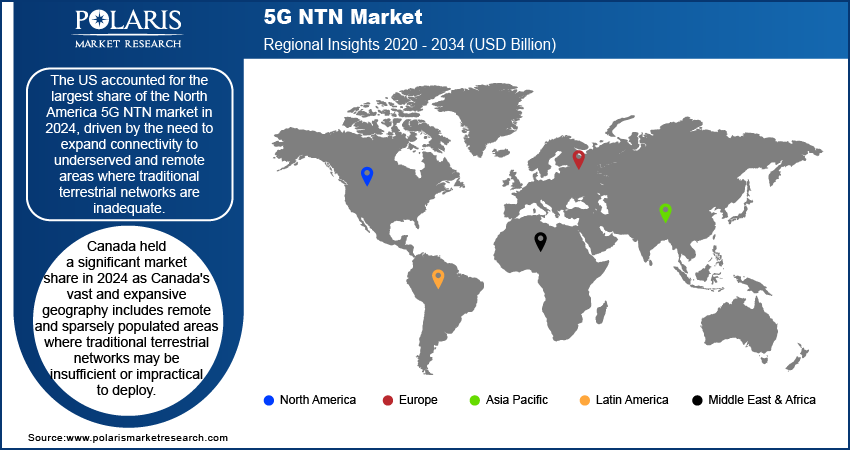
North America 5G NTN market held the largest market share of 38.7% in 2025. The presence of major players such as EchoStar Corporation, Keysight Technologies, and VIAVI Solutions Inc strengthens the industry landscape in North America. Also, key market players are merging, acquiring, and collaborating to strengthen their market presence and offer better solutions in North America, further driving the 5G NTN market expansion in the region.
The U.S. 5G NTN market accounted for the largest share, at 81.6%, in 2025. The market is driven by the need to expand connectivity to underserved and remote areas where traditional terrestrial networks are inadequate. Non-terrestrial networks, including satellite-based solutions, extend high-speed internet access to rural communities, islands, and hard-to-reach locations. Competition among telecom operators, satellite companies, and technology providers boosts innovation and drives investment in 5G NTN technologies.
The Canada 5G non-terrestrial network market is expected to witness a CAGR of 30.2% during the projected period. Canada's vast and expansive geography includes remote and sparsely populated areas where traditional terrestrial networks may be insufficient or impractical to deploy. Ongoing advancements in satellite technology, including increased satellite capacity, improved throughput, and reduced latency, make 5G NTN solutions more attractive in Canada. Collaboration between international and domestic players further accelerates the deployment and adoption of these technologies to meet 5G NTN industry demands.
The Europe 5G NTN market size is expected to witness a 29.8% CAGR during the forecast period, driven by strong investments in satellite communication and advanced 5G infrastructure. Supportive government initiatives and space programs are encouraging technology development. The region also has a growing need for reliable connectivity in remote and rural areas. Increasing demand from maritime, aviation, defense, and emergency services is supporting market growth. Partnerships between telecom operators and satellite companies are further accelerating deployment. Europe's focus on digital connectivity and network resilience is expected to create strong demand for 5G NTN solutions.
The Germany 5G NTN market is expected to witness a CAGR of 30.6% during the forecast period. The market expansion is driven by strong investments in advanced communication and satellite technologies. The country's well-developed automotive and manufacturing sectors are increasing demand for reliable connectivity. Growing use of connected vehicles and industrial IoT is also fueling the demand for 5G NTN technologies. Government support for digital infrastructure and space technologies further drives development. Germany's focus on improving connectivity in rural areas creates additional opportunities. Partnerships between telecom companies, technology firms, and satellite operators are expected to accelerate 5G NTN adoption.
The Asia Pacific 5G NTN market is anticipated to record the highest CAGR of 34.2% during the forecast period due to diverse landscapes, including remote and island territories, where traditional terrestrial networks face limitations in coverage and capacity. Emerging economies in Asia Pacific, such as India, China, and Australia, are witnessing rapid technological adoption and infrastructure modernization. The deployment of 5G NTN networks supports economic growth, facilitates innovation in industries such as agriculture, healthcare, and education, and accelerates the adoption of 5G services among businesses and consumers.
China accounted for the largest regional share of 41.7% in 2025. The China 5G NTN market expansion is attributed to its large population concentrated in urban centers and the growing need for enhanced connectivity to support IoT applications, smart city initiatives, and digital transformation efforts. Meanwhile, the Japan 5G NTN market is expected to continue its significant growth during the forecast period. Technological innovation and advances in satellite technology boosts the 5G NTN demand in the country. Such key players' initiatives and development of integrated network solutions are tailored to meet industry demands in APAC.
Source: Polaris Market Research Analysis
3GPP Standards & Regulatory Developments
3GPP standards enable 5G NTN market growth by enabling satellite connectivity for mobile devices. The 5G NTN Release 17 included the basic functionalities, while the 5G NTN Release 18 introduced improved support for coverage, mobility, frequency, and location validation. The regulations address spectrum allocation, satellite coordination, emergency services, and security aspects. The evolution of 5G NTN standards promotes interoperability among satellite-based solutions, attracting investment, and supporting adoption across diverse commercial applications globally.
| 3GPP Release | Freeze / Status | NTN Scope & Key Features | NTN Bands Introduced / Enhanced | Payload Architecture | Key Regulatory / Spectrum Notes |
| Rel‑17 | Frozen mid‑2022 | First normative 5G NTN standard; supports NR‑NTN and IoT‑NTN (NB‑IoT/eMTC); transparent (bent‑pipe) satellites; GNSS mandatory for UEs | n255 (L‑band), n256 (S‑band) | Transparent only | Enabled commercial “direct‑to‑cell” concepts; spectrum use tied to existing mobile allocations (L/S bands) and national rules |
| Rel‑18 | Frozen 2024 | 5G‑Advanced NTN enhancements: mobility (TN↔NTN handover, conditional handover), coverage & power improvements for IoT, resource management; higher‑frequency NR‑NTN studies | n254 (L‑band extension); Ka‑band n510/n511/n512 (20/30 GHz) | Transparent | Aligns with WRC‑23 outcomes; supports use of higher bands for fixed‑satellite services; device certification begins under regional regimes (e.g., ETSI, FCC) |
| Rel‑19 | Target freeze Dec‑2025 / early‑2026 | Regenerative payloads permitted; on‑board base station functions; inter‑satellite links over Xn; store‑and‑forward for deep IoT; multi‑connectivity (TN+NTN); positioning enhancements; RedCap for NTN | Additional sub‑3 GHz NTN bands (e.g., n250, n251, n253) and refinements below 3 GHz | Transparent + Regenerative | Supports new licensing models for space‑based base stations; national frameworks (e.g., FCC SCS) increasingly used to authorize mobile spectrum for satellite use |
| Rel‑20 | Stage‑2 targeted Sep‑2026; Stage‑3 Mar‑2027 | Early 6G‑oriented NTN studies; GNSS‑resilient operation; voice over NB‑IoT NTN (including GEO); further capacity & efficiency improvements | Studies on additional bands and TDD options for NB‑IoT NTN | Both | Anticipated alignment with ITU Radio Regulations (2024 edition, in force 2025) and evolving national rules for integrated TN/NTN services |
Source: Polaris Market Research Analysis
Competitive Insights
5G NTN key players are driving advancements in satellite technology, network infrastructure, and service offerings to meet the increasing demand for high-speed, reliable connectivity across diverse geographical locations. Companies are investing in the market development and deployment of robust network infrastructure. This includes satellite constellations, ground stations, and integrated network solutions that ensure broad coverage and reliable service delivery.
Strategic partnerships between telecom operators, satellite manufacturers, and technology providers are boosting collaboration and innovation in the market ecosystem. These partnerships enable the integration of satellite and terrestrial networks, expanding service offerings and enhancing 5G NTN industry competitiveness.
To differentiate in a competitive industry landscape, 5G NTN players are focusing on offering customer-centric solutions tailored to various industry verticals. These solutions include IoT applications, smart city initiatives, industrial automation, and critical communications, all of which require reliable, low-latency connectivity.
List of Key 5G NTN Companies
- Anritsu Corporation
- AST SpaceMobile
- Counterpoint Technology
- Druid Software
- EchoStar Corporation
- Ericsson
- Gatehouse Satcom A/S
- Intelsat
- Keysight Technologies
- MediaTek Inc
- Nelco
- Nokia
- Omnispace, LLC
- Qualcomm Technologies Inc.
- Radisys Corporation
- Rohde & Schwarz
- Sateliot
- SES S.A.
- Skylo
- SoftBank Group Corporation
- Spirent Communications
- Telesat
- Thales Group
- Viasat
- VIAVI Solutions Inc.
- ZTE Corporation
Vendor Positioning of Major Companies
| Company | Primary Role in 5G NTN | Notable Recent Move |
| Qualcomm Technologies Inc. | NTN-capable modems/chipsets (212S, 9205S) | Satellite IoT modem launches |
| Skylo | Commercial NTN vRAN / connectivity service | Qualcomm Aware Platform integration |
| Keysight Technologies | NTN test, simulation & validation | 3GPP Release 17 NR-RAN validation with Capgemini |
| EchoStar Corporation | Direct-to-device NTN services | North America NTN market presence |
| Thales Group | Direct-to-device demonstrations, secure comms | 5G.MIL Advanced NTN base station payload work (via Lockheed Martin) |
Source: Polaris Market Research Analysis
5G NTN Industry Developments
- September 2026: ST Engineering announced pilot version of its multi-waveform 5G New Radio Non-Terrestrial Network (NR-NTN) User Equipment (UE) modem named INT3000 at European Space Agency (ESA) 5G NTN Forum. The technology ensures interoperability and scalability across services provided by global telecom carriers, manufacturers of 5G mobile devices, and chip companies. (Source: thefastmode.com)
- June 2026: WiSig Networks and Viasat announced a partnership to develop a 3GPP Release 17–compliant NB-IoT NTN chipset and module for Viasat’s L‑band ecosystem, targeting maritime, government, enterprise, and safety‑of‑life satellite IoT applications worldwide. (Source: telecom.economictimes.indiatimes.com)
- December 2025: Myriota launched HyperPulse, a commercial 5G non-terrestrial IoT network, delivering scalable, low-latency connectivity across five countries. Built on 3GPP standards and Viasat infrastructure, the service supported asset tracking, environmental monitoring, smart metering, and remote operations. (Source: iotbusinessnews.com)
Future Outlook
The future of 5G NTN (Non-Terrestrial Networks) market outlooks is positive with the rising emphasis on satellite-terrestrial convergence. These direct-to-device services are expected to witness significant demand in the future. Furthermore, the proliferation of Low Earth Orbit (LEO) satellite constellations is also projected to propel the market growth in the years to come. The demand for ubiquitous connectivity, including remote locations, maritime, and disaster-affected areas, is expected to drive future market growth. Moreover, the growth of the Internet of Things (IoT), connected cars, and industrial applications would offer new growth opportunities for the market. Additionally, 5G standards and 5G-Advanced innovations would enable enhanced network capabilities, which in turn would boost the industry growth in the years to come.
5G NTN Market Segmentation
By Component Outlook (USD Billion, 2021–2034)
- Hardware
- Software
- Services
By Platform Outlook (USD Billion, 2021–2034)
- UAS Platform
- MEO Satellite
- LEO Satellite
- GEO Satellite
By Application Outlook (USD Billion, 2021–2034)
- eMBB (Enhanced Mobile Broadband)
- mMTC (Massive Machine-Type Communications)
- URLLC (Ultra Reliable and Low Latency Communications)
By Location Outlook (USD Billion, 2021–2034)
- Urban
- Rural
- Isolated
- Remote
By End User Outlook (USD Billion, 2021–2034)
- Maritime
- Aerospace & Defense
- Government
- Mining
- Others
By Regional Outlook (USD Billion, 2021–2034)
- North America
- U.S.
- Canada
- Europe
- Germany
- France
- UK
- Italy
- Spain
- Netherlands
- Russia
- Rest of Europe
- Asia Pacific
- China
- Japan
- India
- Malaysia
- South Korea
- Indonesia
- Australia
- Vietnam
- Rest of Asia Pacific
- Middle East & Africa
- Saudi Arabia
- UAE
- Israel
- South Africa
- Rest of Middle East & Africa
- Latin America
- Mexico
- Brazil
- Argentina
- Rest of Latin America
5G NTN Market Report Scope
| Report Attributes | Details |
| Market Size in 2025 | USD 9.07 billion |
| Market Size in 2026 | USD 11.86 billion |
| Revenue Forecast by 2034 | USD 103.32 billion |
| CAGR | 31.04% from 2026 to 2034 |
| Base Year | 2025 |
| Historical Data | 2021–2024 |
| Forecast Period | 2026–2034 |
| Quantitative Units | Revenue in USD Billion and CAGR from 2026 to 2034 |
| Report Coverage | Revenue Forecast, Market Competitive Landscape, Growth Factors, and Trends |
| Segments Covered |
|
| Regional Scope |
|
| Competitive Landscape |
|
| Report Format |
|
| Customization | Report customization as per your requirements with respect to countries, regions, and segmentation. |
Source: Polaris Market Research Analysis
5G NTN Market FAQ's
The global market size was valued at USD 9.07 billion in 2025 and is expected to reach USD 103.32 billion by 2034.
The global market is projected to register a CAGR of 31.04% during 2026–2034.
North America accounted for the largest market share of 38.7% in 2025.
A few key players in the market are Counterpoint Technology; Druid Software; EchoStar Corporation; Ericsson; Gatehouse Satcom A/S; Keysight Technologies; MediaTek Inc; Nelco; Omnispace, LLC; Qualcomm Technologies Inc.; Radisys Corporation; Rohde & Schwarz; Sateliot; Skylo; SoftBank Group Corporation; Spirent Communications; Telesat; Thales Group; VIAVI Solutions Inc.; and ZTE Corporation.
The remote segment accounted for the largest market share of 46.5% in 2025, driven by the growing adoption of remote work solutions and digital technologies.
The aerospace & defense segment is projected to exhibit the highest CAGR during the forecast period.
Growing demand for global connectivity, satellite communication, remote area coverage, IoT adoption, and direct-to-device services are key market growth drivers.
Key applications include maritime connectivity, aviation, emergency communication, IoT connectivity, remote broadband services, connected vehicles, and disaster recovery operations.
The market is expected to grow rapidly as satellite technology advances, direct-to-device services expand, and global demand for seamless connectivity increases.
Download Sample Report of 5G NTN Market
Please fill out the form to request a customized copy of the research report.


