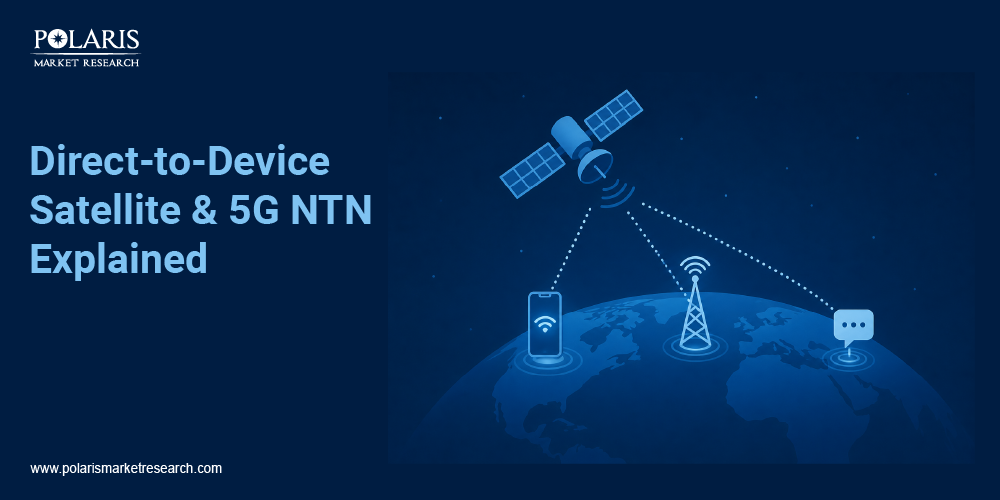
Where there are no mobile towers, 5G Non-Terrestrial Networks (NTN) can help provide connectivity. Remote locations, mountains, and oceans are some places where regular mobile networks struggle to provide coverage. This is where satellite connectivity becomes important. It also helps fill in gaps in the network, allowing compatible smartphones and IoT devices to connect via satellites.
In This Article
-
What Is 5G NTN?
-
How Direct-to-Device Satellite Connectivity Works
-
Direct-to-Device vs Satellite Phones vs Terrestrial 5G
-
Key Use Cases
-
Who Is Building Direct-to-Device Networks?
-
Challenges to Solve
-
Future Outlook
-
Frequently Asked Questions
What Is 5G NTN?
Non-Terrestrial Network is the full form of 5G NTN. To provide connectivity beyond traditional mobile towers it uses satellites and airborne platforms. Where building regular network infrastructure is difficult this technology helps telecom operators reach locations.
Satellite NTN is an important part of this development. It uses satellite infrastructure to extend communication services to locations beyond regular terrestrial network coverage.
5G NTN uses three main types of satellites:
Low Earth Orbit (LEO): These satellites operate closer to Earth and provide lower communication delays.
Medium Earth Orbit (MEO): These satellites provide wider regional coverage with moderate latency.
Geostationary Orbit (GEO): These satellites operate approximately 35,786 kilometres above Earth and cover large geographical areas.
High altitude platforms and drones can also support non terrestrial connectivity.
3GPP Release 17 and Beyond
3GPP Release 17 introduced support for non-terrestrial networks within the 5G framework. For connecting satellite and mobile networks it created a common technical foundation.
Through 5G-Advanced Release 18 brought further improvements. These developments focus on network coverage, mobility, and performance. To improve satellite integration with terrestrial networks later releases continue.
How Direct-to-Device Satellite Connectivity Works
To communicate with satellites without depending on nearby mobile towers direct-to-device satellite connectivity allows compatible smartphones.
When a phone enters an area without cellular coverage, it can search for an available satellite connection. To a satellite passing overhead the phone sends a signal. The satellite then transfers the communication through a ground station or connected network infrastructure.
The communication eventually reaches its destination through the relevant network. Users do not always need a separate satellite phone or internet terminal. Hence, device compatibility and service availability remain important.
LEO vs GEO Satellites
LEO and GEO satellites have different roles in satellite communication.
| Attribute | LEO Satellites | GEO Satellites |
| Orbit altitude | 300–2,000 km | 35,786 km |
| Latency | Lower | Higher |
| Coverage | Multiple satellites required | Large geographical areas |
| Handover | Frequent | Generally less frequent |
| Applications | Broadband, direct-to-device, IoT | Broadcasting and fixed connectivity |
For direct-to-device services because they operate closer to Earth LEO satellites are useful. However, their movement requires frequent handovers. GEO satellites cover larger areas but have higher communication delays.
Spectrum: Satellite Bands vs Mobile Bands
Spectrum determines how satellite-to-phone communication works. Some services use Mobile Satellite Service (MSS) bands. Using existing spectrum others work through partnerships with mobile operators.
Both approaches require regulatory approval. Operators must not interfere with existing mobile networks.
Direct-to-Device vs Satellite Phones vs Terrestrial 5G
These technologies provide connectivity in different ways.
| Attribute | Direct-to-Device | Satellite Phone | Terrestrial 5G |
| Device | Compatible smartphone | Dedicated phone | 5G smartphone |
| Coverage | Satellite-supported areas | Satellite coverage zones | Areas with towers |
| Typical service | Messaging and limited data | Voice and limited data | High-speed data |
| Latency | Depends on orbit | Depends on network | Generally low |
| Best use | Emergency messaging | Remote communication | Everyday connectivity |
Direct-to-device technology aims to bring satellite connectivity to compatible smartphones. Traditional satellite phones require separate hardware. Terrestrial 5G remains important for everyday mobile communication.
These technologies can work together rather than replace one another.
Key Use Cases
Across consumer communication and several industries Direct-to-device connectivity has applications.
Emergency SOS and Messaging
People travelling through mountains or remote areas may lose their regular mobile signal. To contact emergency services satellite messaging provides another way.
Some services already support emergency SOS and basic messaging. Availability depends on device compatibility and regional coverage.
Rural and Remote Coverage
Many remote villages and islands still have limited mobile coverage. Building towers in these locations can be expensive. For extending connectivity to underserved areas satellite networks offer another option.
IoT and Asset Tracking
Satellite connectivity can help businesses monitor devices operating outside regular mobile coverage.
Applications include vehicle tracking, agricultural monitoring, livestock tracking, and remote energy infrastructure. For compatible devices NB-IoT over satellite can also support low-power communication.
In industrial facilities, private 5G network can also support connected equipment, sensors, and automation. Combining private mobile networks with satellite connectivity can help businesses maintain communication across remote operations.
Maritime, Aviation and Public Safety
Ships travel across oceans where regular mobile networks are unavailable. Satellite connectivity helps maritime operators maintain communication and monitor vessels.
Aviation and public safety agencies can also benefit from satellite-based communication. When terrestrial infrastructure is unavailable these networks provide another option.
Who Is Building Direct-to-Device Networks?
For ordinary mobile devices several companies are working on satellite connectivity.
SpaceX Starlink: Its partnership with T-Mobile aims to extend mobile connectivity through satellites.
AST SpaceMobile: It is developing satellite-based cellular broadband services for ordinary smartphones.
Iridium: It operates a global satellite communication network and is developing standards-based NTN technology.
Globalstar: It provides mobile satellite communication services and supports satellite connectivity features in compatible devices.
Chipset makers are helping this development, too. Qualcomm and MediaTek are working on technologies that support satellite and NTN connectivity.
Challenges to Solve
Direct-to-device connectivity still faces some technical and commercial challenges.
Spectrum coordination: Operators need suitable frequencies and must prevent interference.
Satellite handovers: Fast-moving LEO satellites require regular connection transfers.
Device limitations: Small smartphone antennas and limited transmission power can affect signal quality.
Network capacity: Satellite networks must handle increasing demand from connected devices.
Regulatory approval: Operators need to follow different countries' licensing and spectrum rules.
Deployment costs: Satellite manufacturing, launches, and maintenance require significant investment.
How quickly direct-to-device services expand can be influenced with these factors.
Future Outlook
The growing interest in satellite communication is creating opportunities for the 5G NTN market.
According to Polaris Market Research, the global 5G NTN market was valued at USD 9.07 billion in 2025. It is expected to reach USD 11.86 billion in 2026. The market is projected to reach USD 103.32 billion by 2034. It is expected to grow at a CAGR of 31.04% during 2026–2034.
LEO satellite deployments and telecom partnerships are supporting this development. To improve device compatibility and network performance companies are also working.
Satellite connectivity will not replace mobile towers. In populated areas ground based networks will continue to handle most communication. However, combining both technologies can help reduce coverage gaps.
Frequently Asked Questions
What does NTN mean in 5G?
NTN stands for Non-Terrestrial Network. It uses satellites and airborne platforms to provide connectivity beyond traditional mobile towers.
Can a normal smartphone connect to a satellite?
Yes, compatible smartphones can connect through supported satellite services. Availability depends on the device and service provider.
How is 5G NTN different from satellite internet terminals?
Satellite internet usually requires a separate dish or terminal. Direct-to-device connectivity allows compatible smartphones to communicate with satellites directly.
Which companies offer direct-to-device satellite services?
Important companies include SpaceX Starlink, AST SpaceMobile, Iridium, and Globalstar. Qualcomm and MediaTek also contribute to NTN technology development.
Will direct-to-device satellites replace cell towers?
No. Satellite networks will complement existing mobile infrastructure. Cell towers will continue providing most connectivity in populated areas.
Talk to Our Analyst
Want to understand the latest developments in the 5G NTN market? Connect with our analysts to discuss market trends and industry opportunities.

.webp)
.webp)