
Aesthetic Medicine Market Outlook 2027–2034: Size, Growth Drivers and Competitive Landscape
REPORT DETAILS
Aesthetic Medicine Market Summary
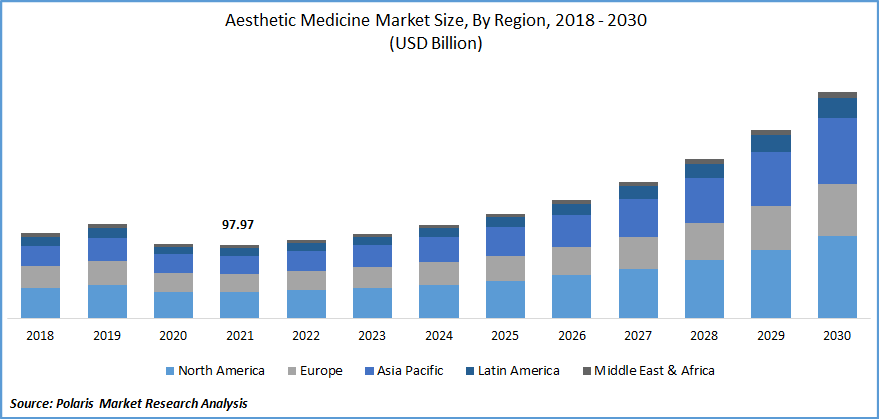
The global aesthetic medicine market is estimated at USD 103.20 billion in 2026 and is projected to reach USD 115.03 billion in 2027, expanding to USD 251.13 billion by 2034 at a CAGR of 11.8% during 2027–2034. Injectable treatments such as neuromodulators, hyaluronic-acid fillers and biostimulators are attracting younger and male patients, and GLP-1-driven weight loss is creating new demand for facial volume restoration. Regulatory approvals for new indications and ready-to-use formats keep expanding the addressable market.
Market Statistics
Key Takeaways
• Invasive aesthetic rocedures hold the largest share, an estimated 59.7% of revenue in 2026.
• Neuromodulators are the leading product category, at an estimated 44.5% share in 2026.
• Dermatology Clinics hold the largest end-user share, estimated at 35.40% of global market revenue in 2026, supported by increasing demand for injectable and skin rejuvenation treatments.
• GLP-1-related weight loss is creating new demand for facial volume restoration.
• North America holds regional share, at an estimated 32.7% in 2026.
• Asia Pacific is expected to be the fastest-growing region, currently at an estimated 14.20% CAGR.
• Competition is led by global aesthetics companies, with 2026 activity focused on new formats and approvals.
The demand for aesthetic procedures has increased due to the manufacturers' creation of unique aesthetic medicines & devices in recent years. In the coming years, technologically advanced products like non-invasive body sculpting tools that use fat-freezing technology, for instance, are likely to produce lucrative potential. The global market for aesthetic medicine is anticipated to grow due to these advances in the beauty industry.
Know more about this report: Download Sample Report
Due to Allergan's Cool Sculpting gadget, the most well-known current technology for body contouring and fat reduction is probably cryolipolysis. Cryolipolysis is a non-surgical and non-invasive process that freezes subcutaneous fat cells with the administration of slow, intense, regulated chilling; following this, the cells go through apoptosis and are eliminated from the body. As reported by the Aesthetic Society (U.S.), non-invasive body fat reduction was one of the top five non-invasive procedures in the U.S. in 2020, with 140,314.
The increased concerns about their physical appearance among middle- and upper-class Americans are anticipated to increase demand for aesthetic medicine in the U.S. In North America, botox injection is the most popular and widely used technique. Cosmetic procedures are also gaining popularity with patients due to how quickly they can recover.
Know more about this report: Download Sample Report
Industry Dynamics
Growth Drivers
The market for aesthetic medicine is expected to expand as a result of rising awareness of and demand for preventative procedures that give injectable drugs with anti-aging benefits early in life. Additionally, it is anticipated that market participants' emphasis on R&D expenditures will result in advances in aesthetic medications, hence increasing demand for them.
However, it is anticipated that throughout the projection period, unfavorable reimbursement regulations and the high cost of cosmetic operations will restrain the market. The demand for cosmetic operations is rising globally. It is predicted to significantly boost the aesthetic medicine market. Rising interest in skin texture, there is a growth in demand for different non-invasive or minimally invasive therapies like re-surfacing, injectables, and other services.
Report Segmentation
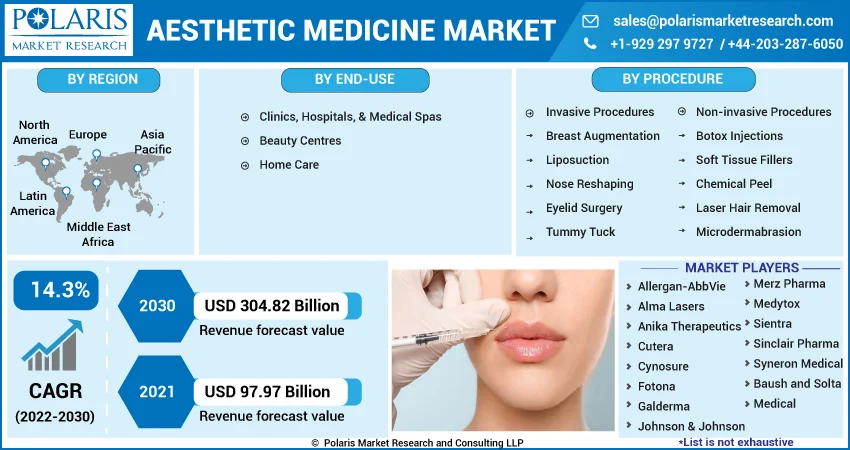
The market is primarily segmented based on procedure, end-use, and region.
| By Procedure | By End-Use | By Region |
|
|
|
Source: Polaris Market Research Analysis
Know more about this report: Download Sample Report
Non-invasive segment is expected to grow at a highest CAGR over the projected period
In 2021, the non-invasive procedures market segment held a significant market share. Over the projection period, the segment is also anticipated to grow at the fastest CAGR. The desire for non-invasive procedures has increased globally due to fewer pain, quick outcomes, and low costs. Botox injections, soft tissue fillers, and chemical peels are popular non-invasive procedures. US FDA approved JUVEDERM VOLUMATM for chin augmentation in adults aged 21 or above in June 2020. Allergan Aesthetics is a division of AbbVie Inc.
Invasive cosmetic operations like liposuction, breast augmentation, and nose contouring will be among the most common in 2021. According to the Aesthetic Society, the popularity of abdominoplasty, buttock augmentation, breast operations, and liposuction has increased by 63% since 2020. Specialized facial operations, such as brow and face lifts, increased by 54% in 2017.
Beauty sector is expected to hold a significant revenue share in 2021
A large portion of the global medical aesthetics market is anticipated to be accounted for by beauty centers due to the expansion of these facilities and growing consumer awareness of skin conditions. The medical spas, hospitals, and clinics held the most significant market share in the global medical aesthetics market in 2018. They will continue to be the leading revenue-generating sector over the forecast period.
The better availability of financial and infrastructural resources with clinics and hospitals, including qualified surgeons and others, can be attributable to several things, including this share. Over the past few decades, homecare facilities have become increasingly popular in the healthcare sector due to several factors, such as the increased use of technological devices in these settings and their integration with information technology.
Asia Pacific is expected to witness highest growth over the forecast period
Asia Pacific is anticipated to experience a quicker revenue growth rate throughout the forecast period. High demand from nations like South Korea, China, and India boosts market income. The rise of medical tourism, particularly in Asian countries, is anticipated to fuel market revenue growth. The first fully injectable liquid polycaprolactone in the world, GOURI, was created by DEXLEVO, an Asian aesthetic and medical device company, and was selected as the best injectable at the 20th Aesthetic & Anti-aging Medicine World Congress (AMWC), which will take place between March 31 and April 2, 2022.
North America accounted for the largest revenue share in 2021. The market for aesthetic medicine is anticipated to grow as people become more aware of and want preventative therapies that, early in life, offer the anti-aging benefits of injectable drugs. The American Society of Plastic Surgeons (ASPS) analyzed the growth in cosmetic surgery procedure rates between 2000 and 2018. Botox injection use surged by 845%, compared to a 48% increase in breast augmentation procedures.
Competitive Insight
Some of the major players operating in the global market:
- Allergan-AbbVie
- Alma Lasers
- Anika Therapeutics
- Cutera
- Cynosure
- Fotona
- Galderma
- Johnson & Johnson
- Merz Pharma
- Medytox
- Sientra
- Sinclair Pharma
- Syneron Medical
- Baush and Solta Medical.
A stringent regulatory approval procedure, however, makes it difficult for new products to enter the market. Rapid technological advancement and acceptance of new gadgets for better treatment are the main factors influencing the competitiveness. Leading companies have made mergers and acquisitions a major component of their market share retention strategies.
Recent Developments
In August 2026, Galderma's Restylane Shaype, a hyaluronic acid injectable was approved by the European Union for temporary chin augmentation and facial shaping. The product includes the company’s NASHA HD technology, which aims to provide structural support for facial contouring. The approval expands Galderma’s Restylane injectable esthetics portfolio and addresses the growing demand for customized, non-surgical facial enhancement procedures. The development suggests ongoing innovation in dermal fillers, especially in products focused on facial structure and contour definition, over wrinkle correction. (Source: Galderma)
In August 2026, Allergan Esthetics, an AbbVie company, today announced that the US Food and Drug Administration has accepted its supplemental Biologics License Application for BOTOX Cosmetic for the temporary improvement in the appearance of marked to severe masseter muscle prominence in adults. The application was supported by two Phase 3 clinical studies evaluating the efficacy of the treatment and patient satisfaction. If granted, the indication would extend the use of BOTOX Cosmetic in non-surgical lower face contouring and potentially pave the way for other opportunities in facial esthetics. The development highlights continued investment in neuromodulator innovation and the expansion of established injectable products into new esthetic indications. (Source: AbbVie)
In February 2026, Galderma received regulatory approvals in the European Union, United States and Canada for its next-generation Restylane syringe, for use with selected NASHA lidocaine dermal filler products. The redesigned syringe has been ergonomically engineered with a cushioned finger grip, and improved thumb support for enhanced handling and injection control by the practitioner. The company also introduced new packaging meant to boost product recognition and sustainability. This development illustrates the growing importance of delivery-system innovation in esthetic medicine where the accuracy of treatment, the convenience for the practitioner and product differentiation influence purchase decisions. (Source: Galderma)
Aesthetic Medicine Market Report Scope
| Report Attributes | Details |
| Market size value in 2027 | USD 115.03 billion |
| Revenue forecast in 2034 | USD 251.13 billion |
| CAGR | 11.8% from 2027 - 2034 |
| Base year | 2026 |
| Historical data | 2022 - 2025 |
| Forecast period | 2027 - 2034 |
| Quantitative units | Revenue in USD million/billion and CAGR from 2027 to 2034 |
| Segments covered | By Procedure, By End-Use, By Region |
| Regional scope | North America, Europe, Asia Pacific, Latin America; Middle East & Africa |
| Key companies | Allergan-AbbVie, Alma Lasers, Anika Therapeutics, Cutera, Cynosure, Fotona, Galderma, Johnson & Johnson, Merz Pharma, Medytox, Sientra, Sinclair Pharma, Syneron Medical, Baush and Solta Medical |
Source: Polaris Market Research Analysis
Aesthetic Medicine Market FAQ's
The aesthetic medicine market is valued at USD 103.20 billion in 2026 and is expected to reach USD 115.03 billion in 2027 and USD 251.13 billion by 2034, according to Polaris Market Research.
The aesthetic medicine market is projected to grow at a CAGR of 11.8% from 2027 to 2034, adding roughly USD 134.34 billion in value over the forecast period.
Injectable treatments such as neuromodulators, hyaluronic-acid fillers and biostimulators are attracting younger and male patients, and GLP-1-driven weight loss is creating new demand for facial volume restoration. Regulatory approvals for new indications and ready-to-use formats keep expanding the addressable market.
The main applications are neuromodulators, dermal fillers, biostimulators, energy-based devices, and skincare. Injectables, new indications and GLP-1-related volume loss sustain growth.

Download Sample Report of Aesthetic Medicine Market
Please fill out the form to request a customized copy of the research report.


