
AI In Healthcare Market Size, Share, Growth Report, 2026-2034
REPORT DETAILS
REPORT DETAILS
ABOUT THIS REPORT
AI In Healthcare Market Summary
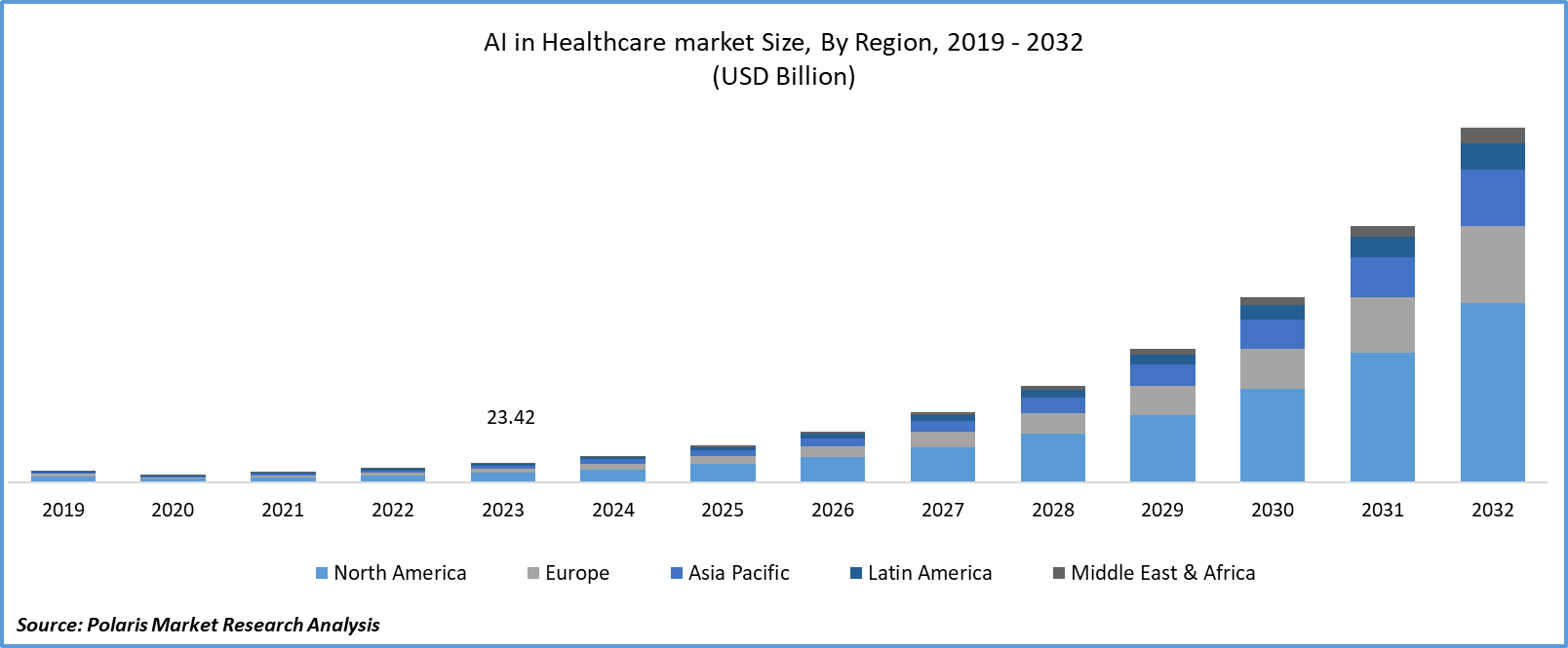
The global AI in healthcare market is estimated around USD 44.41 Billion in 2025,?with consistent growth anticipated during 2026–2034. This growth is driven by rising healthcare data volumes and growing physician shortages to improve clinical decision-making and automate healthcare workflows. The market is projected to grow at a CAGR of 38.3% during the forecast period.
Market Statistics
Key Takeaways
- The software segment dominated the market in 2025 by 44.3% revenue share due to rising adoption of AI-powered healthcare platforms.
- The machine learning segment dominated the market in 2025 by holding 38.6% share due to broad deployment across diagnostics and predictive analytics.
- The drug discovery segment is projected to grow at the fastest CAGR of 38.6% during the forecast period due to rising pharmaceutical AI investments.
- North America dominated the global market by 44.51% share in 2025 due to strong healthcare IT infrastructure.
- Asia Pacific is projected to grow at the fastest CAGR of 39.1% during the forecast period due to expanding healthcare infrastructure and rising digital health investments.
Industry Dynamics
- Rising healthcare data volumes are increasing demand for AI analytics platforms.
- Physician shortages are accelerating adoption of workflow automation tools.
- Data privacy concerns remain a major challenge for healthcare providers.
- Generative AI integration is creating major growth opportunities.
What is AI in Healthcare?
Artificial intelligence in healthcare refers to the use of machine learning, deep learning, natural language processing, computer vision, and generative AI technologies across healthcare workflows. These solutions help improve diagnostics, automate clinical documentation, support treatment planning, optimize hospital operations, and improve patient engagement.
The players in the value chain will include artificial intelligence technology suppliers, cloud computing service suppliers, healthcare application developers, healthcare equipment suppliers, healthcare providers, pharmaceuticals, insurers, and end users. The firms provide software, which consists of algorithms and AI platforms used by the healthcare organizations during collaboration and as an enterprise strategy.
The shift towards the digitalization of the healthcare industry opens up many opportunities for the future. The growing demand for digital services in the healthcare industry will consist of such solutions as electronic health records, smart medical devices, telemedicine solutions, and cloud computing.
Drivers & Opportunities
Rising Healthcare Data Volumes Are Increasing AI Adoption: There is an abundance of data collected by healthcare organizations using imaging technology, electronic health records, sensors, and genomics. An AI-based platform allows healthcare organizations to leverage their data to improve their ability to diagnose patients, monitor them, and develop therapies for them. As an example, in May 2026, InsideTracker announced its new AI-based platform, which helps wellness organizations guide people towards better health based on biomarker, wearable device, and genetic data.
Physician Shortages Are Accelerating Workflow Automation: There is an acute shortage of physicians and health practitioners within healthcare organizations all around the world. According to WHO, there will be a shortage of 11 million health professionals by 2030, and majority of these professionals will hail from underdeveloped countries.[World Health Organization, "Health Workforce", who.int] This indicates that the use of documentation software, virtual health assistance systems, and workflow automation applications through artificial intelligence technology minimizes the paperwork burden on physicians.
Restraints & Challenges
Data Privacy and Regulatory Challenges Are Limiting Adoption: The utilization of AI systems to process highly confidential data relating to people's health results in worries linked to privacy, security, and regulatory challenges. The business should make sure that their operations are HIPPA and GDPR compliant. The high cost of compliance and AI biases hinder the adoption of this innovation by small enterprises.
Opportunity
Generative AI Expansion Is Creating New Revenue Opportunities: There are many benefits that generative AI can offer in the areas of documentation, programming, medication discovery, patient engagement, and health care research. Microsoft reported that global generative AI adoption reached 16.3% of the population, up from 15.1% in H1 2025.[Microsoft Research, "Global AI Adoption in 2025: A Widening Digital Divide", microsoft.com] Thus, hospitals are increasingly deploying AI copilots to automate repetitive workflows.
Segmental Insights
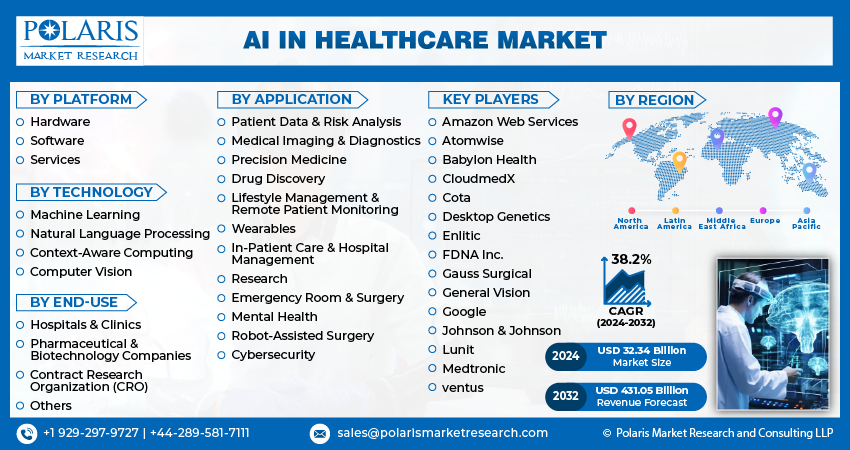
The report offers an exhaustive analysis of the AI in healthcare market by component, technology, application, and end use is helping identify the most profitable and promising areas.
By Component
-
Software
The software segment dominated the market in 2025 by 44.3% revenue share due to rising adoption of AI-powered imaging platforms, analytics tools, and workflow automation solutions. Healthcare providers prefer scalable software platforms that improve deployment flexibility and reduce infrastructure costs.
-
Services
The services segment is projected to grow at the fastest CAGR during the forecast period due to rising demand for AI consulting, integration services, compliance support, and model training services. There is a rising need for deployment expertise from third parties within healthcare organizations.
By Technology
-
Machine Learning
The machine learning segment dominated the market in 2025 by holding 38.6% share owing to high adoption rates for applications including diagnostics, predictive analytics, and patient monitoring. Machine learning models are widely adopted by hospitals to streamline their operations.
-
Natural Language Processing
The natural language processing segment is projected to grow at the fastest CAGR during the forecast period due to rising adoption of AI documentation platforms, chatbots, and voice assistants. Generative AI adoption is accelerating growth in this segment.
By Application
-
Medical Imaging
The medical imaging segment dominated the market in 2025 due to rising adoption of AI-powered radiology and pathology platforms. These systems improve diagnostic accuracy and reduce reporting turnaround time.
-
Drug Discovery
The drug discovery segment is projected to grow at the fastest CAGR of 38.6% during the forecast period due to increasing pharmaceutical investments in molecule discovery, clinical trial optimization, and protein modeling.
By End Use
-
Hospitals & Healthcare Providers
The hospitals & healthcare providers segment dominated the market in 2025 by 52.5% share due to rising investments in clinical AI platforms, automation tools, and predictive analytics systems. The large healthcare system sector is focusing on implementing AI solutions to enhance patient care.
-
Pharmaceutical Companies
The pharmaceutical companies segment is estimated to grow at the highest CAGR in the forecast period owing to the increasing implementation of AI in drug discovery, clinical trials, and biomarker discovery. There has been an increasing adoption of AI platforms by pharmaceuticals to streamline their drug development process.
Regional Analysis
North America AI in Healthcare Market Overview
North America dominated the global market by 44.51% share in 2025 owing to robust healthcare IT infrastructure, significant AI investment, and rapid adoption of enterprise healthcare solutions. The US held the dominant share owing to extensive adoption by hospitals, insurance companies, and pharmaceutical companies. In May 2026, Viz.ai introduced its AI-based Pulmonary Suite to provide efficient treatment for COPD, lung nodules, and pulmonary embolism, decreasing the time of high-risk PE patients from 1.75 days to 0.56 days.
Asia Pacific AI in Healthcare Market Insights
Asia Pacific is projected to grow at the fastest CAGR of 39.1% during the forecast period due to expanding healthcare infrastructure and rising digital health investments. China, India, Japan, and South Korea are major contributors. Large patient populations are increasing demand for AI-driven healthcare solutions. For instance, in May 2026, Singapore General Hospital, SingHealth, and the Ministry of Health of Singapore created an AI algorithm for forecasting diabetic amputations up to 3–5 years ahead based on data from over 830,000 patients to enable timely interventions.
Europe AI in Healthcare Market Insights
Europe possesses substantial market share owing to increasing healthcare digitization programs and conducive regulatory policies. Germany, the UK, and France are key players in contributing towards regional growth. Growing investments in digital diagnostic and telemedicine platforms are driving AI adoption. The European Commission allocated USD 68 million to accelerate AI innovation in healthcare and digital health across Europe.[European Commission, "Commission Makes EUR 632 Million Available to Support AI Innovation, Health and Online Safety", digital-strategy.ec.europa.eu]
Latin America AI in Healthcare Market Insights
Latin America is witnessing steady growth due to rising adoption of telemedicine and diagnostic automation platforms. Brazil and Mexico remain major markets. Healthcare modernization initiatives are supporting regional expansion.
Middle East & Africa AI in Healthcare Market Insights
The Middle East & Africa market is growing steadily due to smart hospital investments and healthcare modernization initiatives. Saudi Arabia and UAE are major contributors. Government healthcare digitization programs are supporting demand. For instance, Saudi Ministry of Health’s Vision 2030 initiative announced to advance healthcare digital transformation through AI tools, smart hospitals, digital health partnerships, and health data platforms.[Ministry of Health Saudi Arabia, "Ministry News – October 29, 2025", moh.gov.sa]

Competitive Landscape & Key Players
The AI in healthcare market is moderately fragmented due to the presence of global technology companies, healthcare software providers, and medical device firms. Key competition factors include platform capabilities, pricing, compliance, scalability, and product innovation. There is increasing emphasis on partnerships, acquisition, cloud computing, and integration with generative AI.
Major players in the industry include Amazon Web Services, Inc., Cerner Corporation, GE HealthCare Technologies Inc., Google LLC, International Business Machines Corporation, Medtronic plc, Microsoft Corporation, NVIDIA Corporation, Koninklijke Philips N.V., Siemens Healthineers AG, Tempus AI, Inc., Veradigm Inc., and others.
Premium Insights
ROI Benchmarking
AI use cases within the healthcare sector increase efficiencies and decrease burdens of administration. The potential for administrative time reduction by implementing AI within the healthcare field is 25% to 40%. Documentation tools that leverage AI to help doctors save multiple hours each week by automating note-taking, billings, and other documentation processes.
Cost Benchmarking
Implementation of AI technology within an enterprise varies depending on several factors. Significant cost drivers of enterprise AI include:
- Infrastructure scale
- Data integration complexity
- Compliance requirements
- Deployment model
Cloud-based AI platforms have smaller initial costs than on-premise systems, thereby offering better value propositions to mid-sized healthcare companies.
Investment Attractiveness
There is a significant flow of investments into the market due to increasing interest in automation solutions in healthcare applications like workflow optimization, diagnostics, and drug discovery. Scalability, revenue generation through software subscriptions, and growing usage by enterprises enhance investment appeal.
Future Outlook
- The usage of AI in multimodal platforms is anticipated to enhance decision-making by conducting analysis based on image data, medical histories, and genomics.
- Federated learning-based models have increasingly become popular as health-care organizations focus on safe data-sharing without any risk to patient privacy.
- AI copilot systems along with ambient intelligence platforms is expected to be widely adopted in hospitals to ease the burden of doctors' work.
Key Players
- Amazon Web Services, Inc.
- Cerner Corporation
- GE HealthCare Technologies Inc.
- Google LLC
- International Business Machines Corporation
- Medtronic plc
- Microsoft Corporation
- NVIDIA Corporation
- Koninklijke Philips N.V.
- Siemens Healthineers AG
- Tempus AI, Inc.
- Veradigm Inc.
Industry Developments
- May 2026: Anthropic and the Gates Foundation launched a USD 200 million partnership to expand AI adoption across global health, life sciences, education, and economic mobility. [source: anthropic.com]
- May 2026: Virtual Science AI launched an AI-driven platform to track competitor activity and support successful pharma asset launches. [source: virtualscienceai.com]
AI in Healthcare Market Segmentation
By Component Outlook (Revenue, USD Billion, 2021-2034)
- Software
- Hardware
- Services
By Technology Outlook (Revenue, USD Billion, 2021-2034)
- Machine Learning
- Natural Language Processing
- Computer Vision
- Context-Aware Computing
By Application Outlook (Revenue, USD Billion, 2021-2034)
- Medical Imaging
- Drug Discovery
- Virtual Assistants
- Clinical Workflow Management
- Cybersecurity
- Fraud Detection
By End Use Outlook (Revenue, USD Billion, 2021-2034)
- Hospitals & Healthcare Providers
- Pharmaceutical Companies
- Diagnostic Centers
- Insurance Providers
- Research Institutions
By Regional Outlook (Revenue, USD Billion, 2021-2034)
- North America
- US
- Canada
- Europe
- Germany
- France
- UK
- Italy
- Spain
- Netherlands
- Russia
- Rest of Europe
- Asia Pacific
- China
- Japan
- India
- Malaysia
- South Korea
- Indonesia
- Australia
- Vietnam
- Rest of Asia Pacific
- Middle East & Africa
- Saudi Arabia
- UAE
- Israel
- South Africa
- Rest of Middle East & Africa
- Latin America
- Mexico
- Brazil
- Argentina
- Rest of Latin America
AI in Healthcare Market Report Scope
| Report Attributes | Details |
| Market Size in 2025 | USD 44.41 Billion |
| Market Size in 2026 | USD 61.26 Billion |
| Revenue Forecast by 2034 | USD 822.0 Billion |
| CAGR | 38.3% from 2026 to 2034 |
| Base Year | 2025 |
| Historical Data | 2021–2024 |
| Forecast Period | 2026–2034 |
| Quantitative Units | Revenue in USD Billion and CAGR from 2026 to 2034 |
| Report Coverage | Revenue Forecast, Competitive Landscape, Growth Factors, and Industry Trends |
| Segments Covered |
|
| Regional Scope |
|
| Competitive Landscape |
|
| Report Format |
|
| Customization | Report customization as per your requirements with respect to countries, regions, and segmentation. |
FAQ's
• The global market size was valued at USD 44.41 Billion in 2025 and is projected to grow to USD 822.0 Billion by 2034.
• North America dominated the global market by 44.51% share in 2025 due to strong healthcare IT infrastructure.
• Medical imaging dominated the market in 2025 by 30.9% share due to rising AI deployment in diagnostics.
• A few of the key players in the market are Amazon Web Services, Inc., Cerner Corporation, GE HealthCare Technologies Inc., Google LLC, International Business Machines Corporation, Medtronic plc, Microsoft Corporation, NVIDIA Corporation, Koninklijke Philips N.V., Siemens Healthineers AG, Tempus AI, Inc., Veradigm Inc., and others.
• Growth is driven by rising healthcare data volumes and physician shortages.
• The major use cases are seen in Hospitals, healthcare providers, and pharmaceutical companies.
• The market is expected to witness strong growth due to generative AI, multimodal AI, and predictive healthcare platforms.
Download Sample Report of AI In Healthcare Market
Please fill out the form to request a customized copy of the research report.


