
AI in Neurology Market Size, share, Growth Report, 2026-2034
REPORT DETAILS
AI in Neurology Market Summary
The global AI in neurology market is estimated around USD 759.2 Million in 2025,with consistent growth anticipated during 2026–2034. Growth is driven by increasing prevalence of neurological disorders and rising demand for advanced diagnostic tools. The market is projected to grow at a CAGR of 25.0% during the forecast period.
Market Statistics
Key Takeaways
- Deep learning segment dominated in 2025 with 44.6% revenue due to strong capability in processing complex neurological data and imaging analysis.
- Machine learning segment is expected to grow rapidly at CAGR of 25.6% due to increasing use in predictive analytics and clinical decision support.
- Diagnostics segment held 40.5% share in global market due to high adoption of AI-based neuroimaging and early disease detection tools.
- Drug discovery segment is projected to grow at a fast pace of 25.4% CAGR due to rising use of AI in identifying neurological therapies.
- North America dominated the market by 40.63% revenue share due to strong AI adoption in hospitals and advanced healthcare infrastructure.
Industry Dynamics
- Rising prevalence of neurological disorders is increasing demand for AI-based diagnostic solutions.
- Aging population is driving need for early detection and continuous monitoring systems.
- High implementation costs and regulatory requirements are limiting adoption in smaller healthcare facilities.
- Increasing use of AI in drug discovery and clinical research is expanding market opportunities.
What is AI in Neurology?
AI in neurology refers to the use of artificial intelligence technologies to analyze neurological data, support clinical decision-making, and improve diagnosis and treatment of neurological disorders. The solutions make use of machine learning and deep learning models to examine large volumes of data obtained from brain scanning, patient medical history, and clinical trials. AI application in neurology is seen in neuroimaging AI, disease prediction, and treatment of neurological diseases such as Alzheimer’s disease, Parkinson's disease, and Stroke.
The demand for such products are increasing due to the rising cases of neurological disorders and need for efficient diagnostic methods. The use of artificial intelligence technology in healthcare has brought better understanding of complex neuroimaging studies, helping doctors to diagnose patients at an early stage. Neuroimaging AI tools have been widely used in MRI and CT scans in neurology disorders.
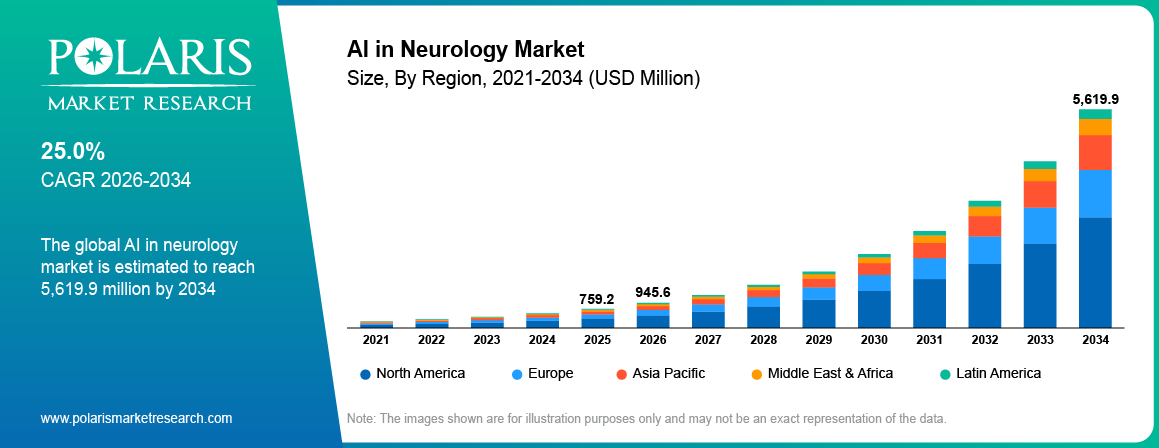
Source: Polaris Market Research Analysis
Growing access to healthcare data and advancements in computing abilities are driving the adoption of AI in neurology applications. The pharmaceutical industry adopts artificial intelligence technology in the development of drugs and fastens the drug development process. Moreover, investment in healthcare infrastructure and favorable regulations are boosting the adoption of artificial intelligence in neurology.
Technology Penetration Trends
| Technology | Adoption Level | Growth Outlook |
| Machine Learning | High | Widely deployed across diagnostics and workflow tools; steady expansion expected |
| Deep Learning | Very High | Core technology for neuroimaging and pattern recognition; driving major advancements |
| NLP in Neurology | Medium | Emerging use in clinical documentation, patient data analysis, and decision support |
| Predictive Analytics | High | Fast-growing adoption for early risk detection, disease progression tracking, and treatment planning |
Source: Polaris Market Research Analysis
Drivers & Opportunities
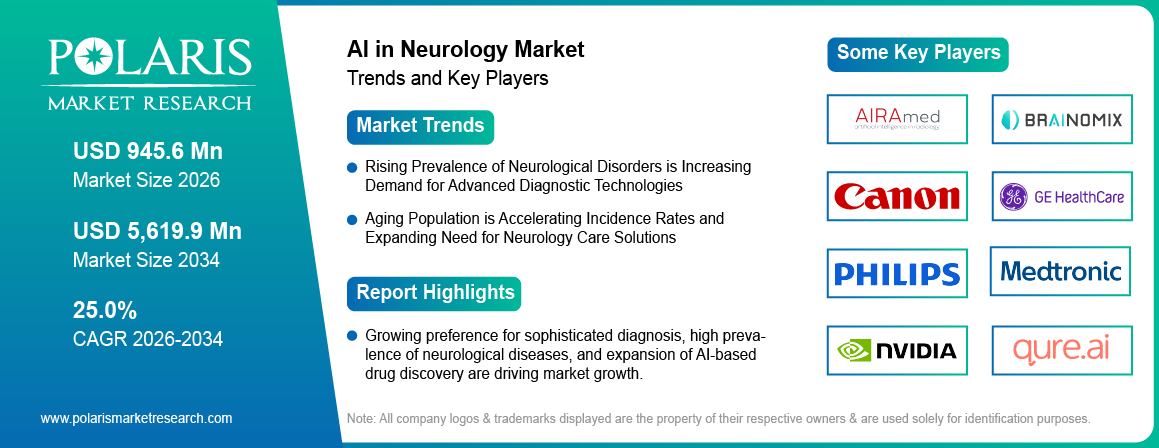
Rising Prevalence of Neurological Disorders is Increasing Demand for Advanced Diagnostic Technologies: Growing prevalence of neurological disorders, including Alzheimer's disease, Parkinson's disease, and epilepsy, is boosting the demand for advanced diagnostic technologies. As per Alzheimer's Disease International, more than 55 million people were suffering from dementia worldwide in 2020. This number is estimated to rise to 78 million by 2030 and to 139 million by 2050.[Alzheimer's Disease International, "more than 55 million people were suffering from dementia worldwide in 2020", www.alzint.org] Increasing disease burden is encouraging healthcare providers to deploy AI tools for early detection, imaging analysis, and clinical decision support.
Aging Population is Accelerating Incidence Rates and Expanding Need for Neurology Care Solutions: Increasing percentage of elderly populations, which is highly vulnerable to neurological diseases, resulting in higher demand for AI-based healthcare solutions. Based on reports from the United Nations, the world’s population aged above 65 is projected to hit 2.2 Million in the 2070s, outgrowing the population of individuals aged below 18 years.[United Nations, "world’s population aged above 65 is projected to hit 2.2 billion in the 2070s", www.un.org] Aging trends are likely to ensure steady adoption of AI-based diagnostics and patient management systems within neurology applications.
Restraints & Challenges
High Implementation Costs and Regulatory Complexities are Limiting Market Expansion: Implementation of AI-based technologies in neurology requires significant capital expenditure on infrastructure development, data processing, and validation procedures. Healthcare regulations and data security guidelines add to the complexities involved in implementing the AI-based technologies. High-cost implications and complex regulatory issues pose constraints on the deployment of AI-based applications within smaller healthcare facilities and developing nations.
Opportunities
AI-Driven Drug Discovery is Opening Up New Growth Prospects in Neurology-Based Treatment: AI-based technologies used for drug discovery purposes are facilitating rapid identification of potential molecules that are utilized as therapeutic agents for treating neurological conditions. In April 2026, Brenig Therapeutics introduced a new approach to drug discovery that incorporated physics-based structural biology and machine learning in its AI model.[Brenig Therapeutics, "new approach to drug discovery that incorporated physics-based structural biology”, www.brenigther.com] Increasing focus on AI-enabled pharmaceutical innovation is opening new pathways for faster and more efficient development of neurology treatments.
Source: Polaris Market Research Analysis
Segmental Insights
This report provides focused analysis of the AI in neurology market by application and end-user, highlighting only the dominating and fastest growing segments to help stakeholders understand high-impact opportunities across AI neurology end users.
By Technology
-
Deep Learning
Deep learning segment dominated in 2025 with 44.6% revenue due to its strong capability in processing complex neurological data and delivering high accuracy in AI diagnostics neurology applications. These models are widely used in imaging-based analysis, pattern recognition, and disease prediction across neuroimaging and clinical datasets.
-
Machine Learning
Machine learning segment is expected to grow rapidly at CAGR of 25.6% during the forecast period due to its expanding role in predictive analytics, patient monitoring, and clinical decision support. Machine learning algorithms are increasingly used in AI neurosurgery market for risk assessment, surgical planning, and outcome prediction.
By Application
-
Diagnostics
In 2025, diagnostics segment held 40.5% share in global market due to increasing adoption of AI diagnostics neurology solutions for early detection and accurate assessment of neurological disorders. AI-powered tools are widely used in neuroimaging AI to analyze MRI and CT scans for conditions such as stroke, Alzheimer’s disease, and brain tumors.
-
Drug Discovery
Drug discovery segment is projected to grow at a fast pace of 25.4% CAGR during the forecast period due to rising use of AI drug biomarker discovery platforms for identifying novel CNS therapeutics. AI models are accelerating target identification, biomarker discovery, and clinical trial optimization.
By End-User
-
Hospitals
Hospital segment accounted for the leading market share of 54.6% in 2025 due to increasing use of AI-enabled neurology solutions for diagnosis, treatment planning, and patient monitoring. Growing healthcare AI adoption and availability of advanced imaging infrastructure are supporting integration of AI tools in hospital settings.
-
Pharma Companies
Pharma companies segment is projected to grow at the fastest rate during the forecast period driven by increasing investment in AI for drug development and clinical research. Companies are leveraging AI platforms to streamline research processes and accelerate development of neurological therapies.
Source: Polaris Market Research Analysis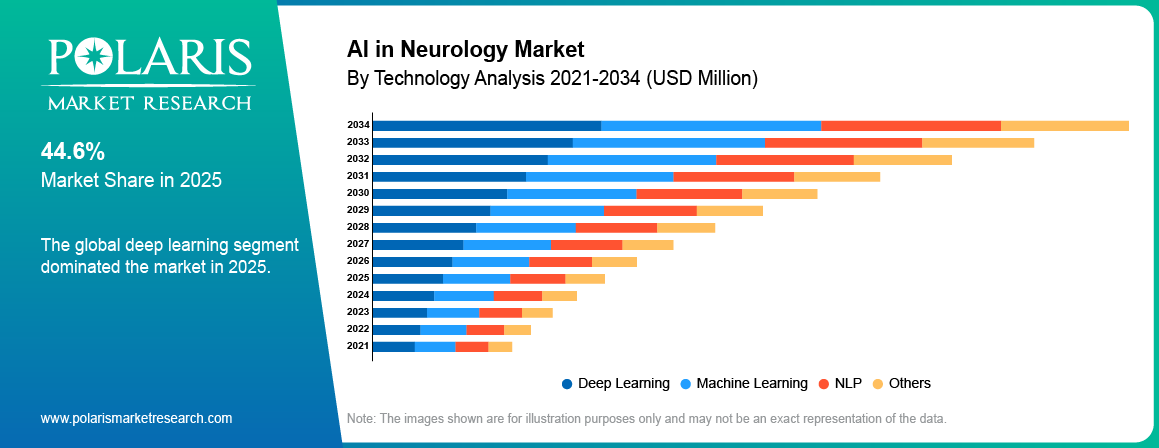
Regional Analysis
North America AI in Neurology Market Overview
North America dominated the market by 40.63% revenue share in the AI neurology regional market due to strong AI adoption across hospitals and healthcare systems. The US leads with advanced clinical infrastructure and high integration of AI-based diagnostic tools. For example, in April 2026, Viz.ai collaborated with the National Rural Health Association to increase the adoption of AI technology in rural hospitals, which involved analyzing imaging and clinical data in real-time for detecting conditions such as stroke and pulmonary embolism.[Viz.ai, "collaborated with the National Rural Health Association to increase the adoption of AI technology", www.viz.ai]
Europe AI in Neurology Market Insights
Europe AI neurology regional market is shaped by strict regulatory compliance and strong focus on AI ethics. Patient data privacy and AI implementation transparency have been prioritized by all countries in the region. The regulatory framework has been instrumental in promoting proper use of AI solutions in neurology applications. Demand remains steady due to increasing use of AI in diagnostics and clinical decision support systems.
Asia Pacific AI in Neurology Market Insights
Asia Pacific is witnessing rapid regional growth of 25.6% CAGR in the AI neurology regional market due to heavy government investment and expanding healthcare infrastructure. Countries such as China and India are focusing on AI-driven healthcare transformation. According to World Economic Forum, AI expenditure in India is expected to reach USD 11.78 Million by 2025 and contribute nearly USD 1 trillion to the economy by 2035.[World Economic Forum, "AI expenditure in India is expected to reach USD 11.78 billion by 2025", www.weforum.org] Rising demand for advanced diagnostics and large patient population are supporting AI healthcare Asia Pacific expansion.
Rest of the World AI in Neurology Market Outlook
The rest of the world is gradually expanding in the AI neurology regional market. Middle East is moving towards smarter hospitals with the use of artificial intelligence in healthcare, Latin America is witnessing its adoption at an initial stage. The factors driving growth include improvements in the overall healthcare system and rising awareness about the use of AI-based technologies in neurological disease treatments.
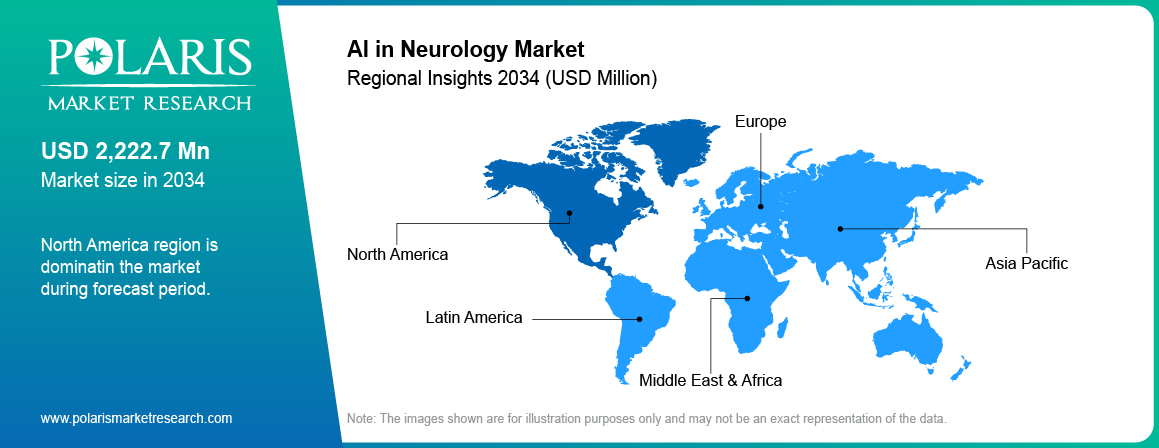
Source: Polaris Market Research Analysis
Competitive Landscape & Key Players
The AI in neurology industry is moderately concentrated, with competition is driven by healthcare technology firms, AI software vendors, and medical equipment makers. The level of competition within the market is influenced by the precision of algorithms, clinical validation, hospital integration, and regulatory adherence. The emphasis for organizations is on increasing accuracy in diagnostics, lowering the time to treatment, and optimizing clinical decision support using sophisticated AI models.
Some of the major players in the AI in neurology market are Activ Surgical, Airamed GmbH, Brainomix Limited, BrainQ Technologies Ltd., Canon Inc., GE Healthcare, Koninklijke Philips N.V., Medtronic Plc, Neosoma Inc., Neuralink Corporation, Neurox, NVIDIA Corporation, Qure.AI, Siemens Healthineers AG, and Viz.ai Inc.
Premium Insights
ROI & Clinical Value
There have been excellent results from AI applications in neurology, including shortened diagnostic periods, increased precision in imaging studies, and early disease diagnosis. Healthcare organizations have noted financial gains due to streamlined processes, less human involvement, and improved resource allocation. Improved medical results are decreasing future expenses on treatment.
Key Investment Trends
- Neurology companies specializing in AI are receiving substantial investment due to the need for innovative diagnostic tools
- Pharmaceutical organizations are partnering with AI businesses to expedite the process of discovering and testing new drugs
- The M&A process is becoming more common due to large healthcare technology organizations acquiring AI capabilities through niche acquisitions
Key Players
- Activ Surgical
- Airamed GmbH
- Brainomix Limited
- BrainQ Technologies Ltd.
- Canon Inc.
- GE Healthcare
- Koninklijke Philips N.V.
- Medtronic Plc
- Neosoma Inc.
- Neuralink Corporation
- Neurox
- NVIDIA Corporation
- Qure.AI
- Siemens Healthineers AG
- Viz.ai Inc.
Industry Developments
- February 2025: Viz.ai announced new clinical study results demonstrating the effectiveness of its AI-powered stroke solution in improving treatment timelines, care coordination efficiency, and financial outcomes for neurovascular patients across healthcare systems. (Source: evtoday.com)
- October 2024: Viz.ai published study findings showing that its AI-enabled stroke care coordination platform reduced interfacility stroke transfer times by 44%, supporting faster neurological intervention and improved patient outcomes. (Source: viz.ai)
- February 2024: UC Davis Health implemented Viz.ai’s AI-driven stroke detection technology to accelerate identification of suspected stroke patients through automated CT scan analysis and real-time neurological workflow optimization. (Source: ucdavis.edu)
AI in Neurology Market Segmentation
By Technology Outlook (Revenue, USD Million, 2021-2034)
- Deep Learning
- Machine Learning
- NLP
- Others
By Application Outlook (Revenue, USD Million, 2021-2034)
- Diagnostics
- Drug Discovery
- Neurosurgery
- Others
By End-User Outlook (Revenue, USD Million, 2021-2034)
- Hospitals
- Research Institutes
- Pharma Companies
- Others
By Regional Outlook (Revenue, USD Million, 2021-2034)
- North America
- US
- Canada
- Europe
- Germany
- France
- UK
- Italy
- Spain
- Netherlands
- Russia
- Rest of Europe
- Asia Pacific
- China
- Japan
- India
- Malaysia
- South Korea
- Indonesia
- Australia
- Vietnam
- Rest of Asia Pacific
- Middle East & Africa
- Saudi Arabia
- UAE
- Israel
- South Africa
- Rest of Middle East & Africa
- Latin America
- Mexico
- Brazil
- Argentina
- Rest of Latin America
AI in Neurology Market Report Scope
| Report Attributes | Details |
| Market Size in 2025 | USD 759.2 Million |
| Market Size in 2026 | USD 945.6 Million |
| Revenue Forecast by 2034 | USD 5,619.9 Million |
| CAGR | 25.0% from 2026 to 2034 |
| Base Year | 2025 |
| Historical Data | 2021–2024 |
| Forecast Period | 2026–2034 |
| Quantitative Units | Revenue in USD Million and CAGR from 2026 to 2034 |
| Report Coverage | Revenue Forecast, Competitive Landscape, Growth Factors, and Industry Trends |
| Segments Covered |
|
| Regional Scope |
|
| Competitive Landscape |
|
| Report Format |
|
| Customization | Report customization as per your requirements with respect to countries, regions, and segmentation. |
Source: Polaris Market Research Analysis
AI in Neurology Market FAQ's
The global market size was valued at USD 759.2 Million in 2025 and is projected to grow to USD 5,619.9 Million by 2034.
North America dominated the market by holding 40.63% revenue share due to extensive adoption of AI technology by hospitals and healthcare systems.
Key applications include diagnostics, neuroimaging technology, drug discovery and development, and clinical decision-making.
Key players include GE Healthcare, Siemens Healthineers AG, Medtronic Plc, NVIDIA Corporation, Viz.ai Inc., and others.
Key growth factors include increasing incidence of neurological disorders, technological advancements, and increasing availability of healthcare data.
Major demand comes from hospitals, research institutions, and pharmaceutical companies.
AI technology uses CT and MRI scans in real-time to diagnose stroke pattern and facilitates better decision-making and treatment process.
ROI for artificial intelligence in hospitals includes increased efficiency, quicker diagnosis, improved patient outcomes, which leads to high returns on investment.
Artificial intelligence increases the efficiency of neurological diagnosis through accurate identification of complex patterns from data.
Download Sample Report of AI in Neurology Market
Please fill out the form to request a customized copy of the research report.


