
Air Ambulance Services Market Share, Trends, Industry Analysis Report, 2026 - 2034
REPORT DETAILS
Air Ambulance Services Market Summary
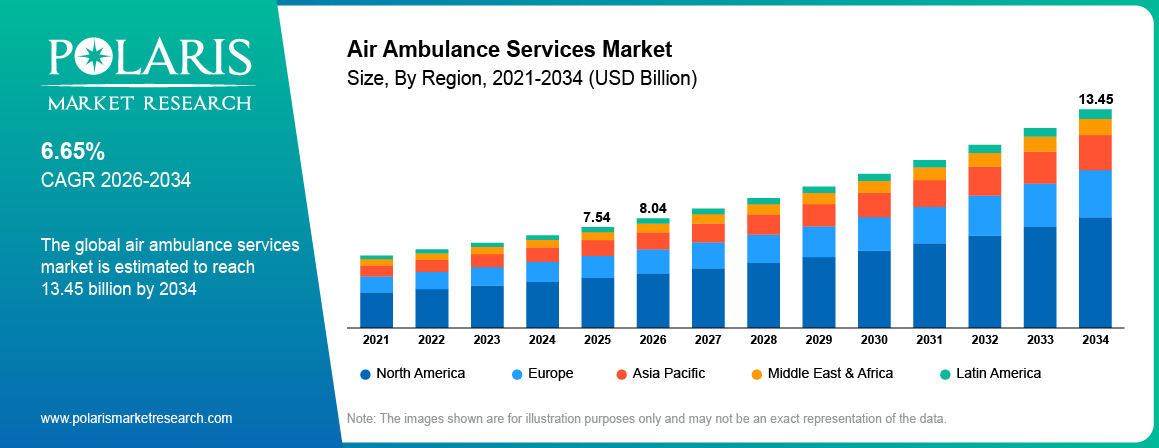
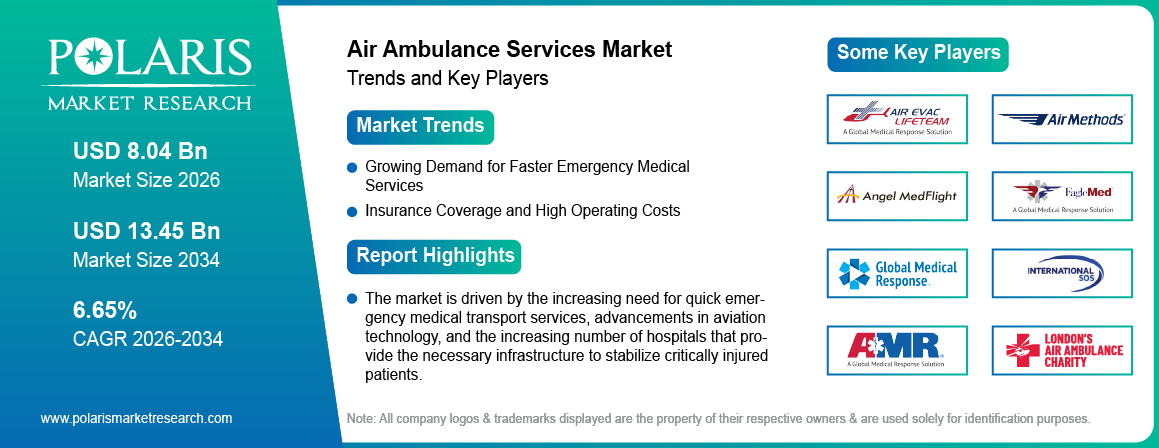
The air ambulance services market size was valued at USD 7.54 billion in 2025. The market is projected to account for a CAGR of 6.65% during the forecast period, 2026 to 2034. The market is driven by the increasing need for quick emergency medical transport services, advancements in aviation technology, and the increasing number of hospitals that provide the necessary infrastructure to stabilize critically injured patients.
Market Statistics
Air Ambulance Services Market Key Takeaways
- The North America air ambulance services market dominated with a 42.2% revenue share in 2025. This is due to its highly developed healthcare infrastructure, emergency response standards, and established fleet of helicopters and fixed-wing aircraft.
- The Asia Pacific air ambulance services market is expected to witness a CAGR of 7.97% during the projection period. This is because of an expanding healthcare infrastructure, growing awareness of air medical transport services, medical tourism, and access to specialized medical services in vast regions with diverse populations.
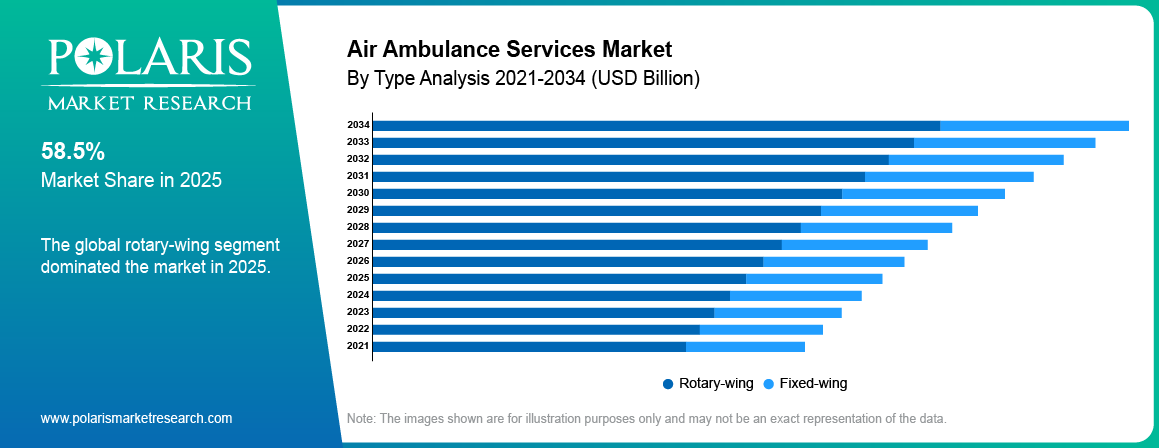
- The rotary-wing segment dominated the market with a 58.5% revenue share in 2025. This is owing to the speed, flexibility, and ability to land at accident scenes, hospitals, and remote areas. Rotary-wing air ambulance is helpful in emergency cases where the availability of time is crucial, and land transport cannot be used.
- The community-based segment is projected to account for a 7.08% CAGR. There has been a rapid adoption of these services to fill critical gaps in emergency medical transportation where traditional infrastructure may be lacking.
Note: Figures and projections outlined in this report are the result of Polaris Market Research’s proprietary analytical processes, grounded in the latest available datasets and market observations.
What are Air Ambulance Services?
The air ambulance services market refers to the organized transport of patients by air, including helicopters and fixed-wing air ambulances, for urgent, critical, or long-distance medical needs. This kind of transport is necessary in cases where land transport is too slow, difficult, or unsafe to be used. Air ambulance services include scene responses, interhospital transports, organ transport, neonatal/pediatric transport, infectious disease transport, and international medical repatriation, depending on the aircraft used, the medical crew, and the distances involved.
In addition to conventional emergency response activities, market growth is enabled by inter-facility transfers, organ transplant logistics, medical tourism-related transportation, and the growing need for rapid access to trauma and specialized care in remote areas. The incorporation of telemedicine into air ambulance services and increased private-sector participation are expected to enhance market growth. With improved access to healthcare globally, the demand for air ambulance services is also expected to continue rising.
AI Impact on Air Ambulance Services Market
- Artificial intelligence (AI) enables emergency teams to make timely responses by identifying the nearest available aircraft and determining the best route to take.
- AI enables decision-making through the analysis of patient information to determine the best hospital to attend to the patient.
- It improves flight safety through weather condition prediction and minimization of flight delays.
- AI enables cost savings through the optimization of flight schedules, fuel consumption, and efficiency.
Source: Polaris Market Research Analysis
To Understand More About this Research:Download Sample Report
Market Dynamics
Driver: Growing Demand for Faster Emergency Medical Services
A key market driver is the increasing requirement for rapid emergency medical transportation. For life-threatening conditions such as severe trauma, stroke, heart attacks, organ failure, and high-risk neonatal transport, delays in receiving medical care can affect survival and recovery. Air ambulances can significantly minimize response times, especially when ground transport is slow or when terrain, weather, and distance make it difficult to access healthcare facilities.
Air ambulance services are most needed in rural, mountainous, offshore, disaster-affected, and underserved regions, where there are limited advanced hospitals. According to a study published in the Journal of Trauma and Acute Care Surgery in 2022, air ambulances reduce mortality rates in patients in rural and underserved areas, highlighting the importance of air ambulances in the healthcare system. This need is both medical and structural. It’s because healthcare infrastructure usually centralizes the most advanced medical services in large hospitals, making efficient rural emergency transport a priority.
As the quality of emergency health services improves in different parts of the world, the emphasis is on minimizing the interval between the arrival of the patient and the commencement of treatment, as well as the continuation of treatment during transport. This has created a need for airplanes that function as flying ICUs, equipped with ventilators, monitors, emergency drugs, and medical staff.
Driver: Advancements in Aviation Technology and Medical Equipment
The enhancement of aviation technology and medical equipment is also a factor that is contributing to better air ambulance services. Modern air ambulances are equipped with navigation systems, fuel efficiency, and lightweight medical equipment. They also have real-time patient monitoring systems and improved communication with ground specialists. These improvements help make services more reliable. They also improve care during transport.
Technologies like IFR-capable helicopters, AI dispatch technology, and new types of aircraft like eVTOLs are making air ambulance services more efficient and effective. For example, IFR technology allows air ambulance services to operate even in low-visibility conditions. Similarly, AI technology is also helpful in route planning and making the most efficient use of resources. Advanced medical equipment is making the transport of patients more effective and is also helpful in reducing costs and time.
Advanced life support systems are enhancing the value of air ambulance services. Modern air ambulances are now equipped with cardiac monitors, ventilators, infusion equipment, and even access to specialist consultation. As medical equipment is becoming more portable and connected, air ambulances are able to treat more serious conditions that previously required more controlled environments.
Increasing Integration of Telemedicine in Air Ambulance Operations
The use of telemedicine in air ambulance services is a new trend. It enables the team to communicate with specialists on the ground in real-time. This is particularly useful in managing complicated cases such as trauma cases, neonates, severe heart problems, and cases that require critical care coordination with the hospital before landing.
The integration of telemedicine ensures the continuity of care. It facilitates the provision of better clinical support during transport and improves referral network coordination . It also adds value to premium air ambulance services, especially in private and cross-border medical transport services. The growth in telemedicine adoption across the world, fueled by improvements in communication technology and regulatory acceptance, supports this trend in air ambulance services.
Market Restraint: Insurance Coverage and High Operating Costs
Insurance for air ambulance is limited or inconsistent in many regions, and this is a major market restraint. There is a significant variance in insurance coverage policies for air ambulance in different countries. This is a challenge for service providers in regions where there is a demand for air ambulance services, but financial support is lacking. In addition, the high operating expenses remain a major barrier. Aircraft acquisition, fuel, maintenance, pilot staffing, medical crews, compliance requirements, and 24/7 readiness are factors that put pressure on the cost.
Source: Polaris Market Research Analysis
Segment Insights
Assessment by Type
Based on type, the market is segmented into rotary-wing and fixed-wing. The rotary-wing segment led the market in 2025 with over 58.5% revenue share. This is especially true in trauma transport, accident response, stroke patients, and rescue operations where quick stabilization and transport are critical. The use of rotary-wing aircraft, also known as helicopters, is common in short-distance medical transport, especially in urban centers, rural areas, accident scenes, and areas where access is limited. Rotary-wing air ambulance is advantageous because it can access any place within a short distance and land near the patient or hospital, which is crucial in accident scene evacuation and emergency situations.
Fixed-wing aircraft is expected to witness 6.36% CAGR, as they are used for long-distance medical transport, intercity referral transport, and international patient transportation. This is because they are fuel-efficient, faster, and have more cabin space. Fixed-wing air ambulances can also be used for critical patients over long distances. This is important for international patient transportation because they can help in remote areas and island transfers.
While rotary-wing aircraft are used for immediate response in emergency situations and for direct access to crash scenes, fixed-wing aircraft are used for planned long-distance transfer and referral. Rotary-wing services are associated with rapid response and easy landing at the scene, whereas fixed-wing aircraft are associated with long-range transfer, fuel efficiency, and international patient transport.
Assessment by Service Model
The air ambulance services market segmentation, based on service model, includes hospital-based and community-based services. The hospital-based air ambulance services held 64.0% share in 2025, as these services are connected to healthcare institutions that provide aircraft services for patients in need of rapid transfer to specialized or tertiary care centers. This segment has a large market share due to the high volume of trauma cases, organ transplants, emergency referrals, and interhospital transfers in a healthcare setting.
The hospital-based programs also have the advantage of close association with emergency centers, ICU facilities, as well as the networks. This ensures coordination as well as the right facility for the patient as soon as possible. In developed health infrastructures, the services provide both emergency response as well as planned transfers for critical care patients, making it a significant contributor to stable and continuous demand in the market.
The community-based segment is projected to account for a 7.08% CAGR. Community-based air ambulance services are usually provided by independent air ambulance operators or non-profit organizations, and their main goal is to offer emergency transport in local areas, rural areas, and underserved areas. These services are usually helpful in areas where public emergency transport is inadequate, or where good hospitals are far from small towns and rural areas.
Assessment by Application
Based on application, the market is segmented into inter-facility, rescue helicopter service, organ transplant logistics, infectious disease service, neonatal and pediatric transport, and others. Inter-facility transport held significant share of 34.3% in 2025, given that higher levels of care are typically provided in specialized hospitals. There is a regular flow of patients transported from small hospitals to larger hospitals for trauma care, stroke care, complex surgeries, neonatal care, heart care, and organ transplants. This segment is important because it is repeatable, medically necessary, and closely linked to structured healthcare systems.
Another significant segment is rescue helicopter services expanding at a CAGR of 6.98%. This is particularly true in accident response services, search and rescue operations, mountain rescue operations, offshore rescue operations, and disaster response operations. This segment is particularly well-suited for the flexibility and speed of helicopter operations. It is particularly significant in areas with challenging terrain and higher industrial and outdoor risk.
Organ transplant logistics and neonatal and pediatric transfer represent niche markets for specialized services, which add tremendous value to high-end operators. Organ transport services require speed, time, and coordination. Neonatal and pediatric services require specialized teams and strong hospital connections. These markets may be niche in size compared to regular transfers, but they are critical in making operators stand out.
Infectious disease service and bariatric/high dependency patient transfer are emerging niche market segments. These service requirements include onboard isolation facilities, infection control procedures, and medical equipment.
Assessment by Service Type
By service type, the market is segmented into domestic and international. Domestic air ambulance services account for a major share of 73.5% in 2025, due to emergency medical transport in developed healthcare systems. Domestic medical transport facilitates accident response and patient transfer in rural areas. They also support inter-hospital transport within a nation. These flights are typically shorter, more recurrent, and more closely related to hospital systems.
International air ambulance services is expected to withess CAGR of 7.30%, as these involve cross-border healthcare, medical tourism, expatriate support, and bringing patients back home after illness or injury in a foreign country. Such missions are longer and more complicated, involving the coordination of airports, hospitals, insurance companies, embassies, and medical staff. As international travel and medical tourism transport increase, this segment is becoming increasingly important, especially for fixed-wing aircraft.
Source: Polaris Market Research Analysis
Regional Insights
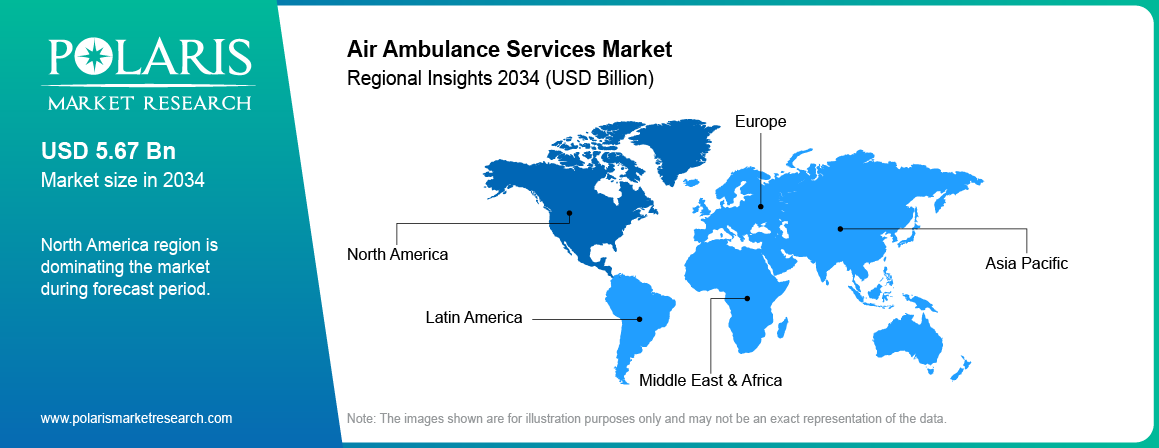
The air ambulance services market covers North America, Europe, Asia Pacific, Latin America, and Middle East & Africa. The North America air ambulance services market led the global market with a 42.2% revenue share in 2025. This is due its advanced emergency care systems and strong hospital infrastructure. North America also has an established networks of operators. The region has high awareness of air ambulance services and strong integration between healthcare institutions. This supports the use of both helicopters and fixed-wing aircraft.
North America's strong position is further underpinned by a large rural and semi-rural population base. The remoteness of this demographic from specialized hospitals creates a strong requirement for air transport. The U.S. and Canada have well-developed emergency transport infrastructures. The consistent demand for air ambulances in the U.S. air ambulance market and Canada air ambulance market is fueled by trauma care and inter-hospital transport. Specialized services such as transporting newborn babies and organ transplants also contribute to demand.
Europe accounts for a notable share of the air ambulance services market valued at 28.5%. This is because Europe has advanced healthcare facilities and a high demand for air ambulance services. This market is dominated by both private and public air ambulance service providers. This is mainly because of the UK, Germany, and France. Europe is home to advanced healthcare facilities and a number of hospital-based air ambulance service providers. In addition to that, the trend towards telemedicine and aviation technology is contributing to greater efficiency and service delivery. Moreover, there is a growing need for air ambulance services across international boundaries. This is because of the ease of travel between European Union members. It has led to to a more interconnected and rapid emergency medical transportation network.
The Asia Pacific air ambulance services market is projected to witness rapid growth, at a 7.97% CAGR. The growth is attributed to increasing healthcare infrastructure and awareness of emergency transportation services. The regional market is also driven by the growth in medical tourism as well as the need to enhance accessibility in this vast and diversified region. Some of the key countries driving the market in this region are India, China, Japan, and Australia. The Asia Pacific market is driven by the growth in private healthcare investments as well as the need for specialized care. Asia Pacific is experiencing a rise in the middle-class population that is increasingly seeking quicker access to high-end care. For several countries where large healthcare facilities are located in cities, air ambulance services help bridge the regional healthcare gap.
Latin America and Middle East & Africa are providing opportunities for air ambulance services. Latin America has mixed healthcare infrastructure with varying levels in urban and rural areas. Though the adoption rate is low, growth in these regions is driven by the development in private healthcare services, infrastructure, and rising awareness of the importance of timely medical transport.
Source: Polaris Market Research Analysis
Key Market Players and Competitive Insights
Key air ambulance service providers include Air Methods Corporation; REVA, Inc.; International SOS; Air Evac Lifeteam; AMSA (Australian Medical Services Association); Med-Trans Corporation; PHI Air Medical; Lifeguard Ambulance; Angel MedFlight; Scandinavian Air Ambulance; Global Medical Response; Rapid Response; London’s Air Ambulance; Alpin Rescue; and EagleMed. These air ambulance companies operate in various regions and service types such as helicopter and fixed-wing transport, emergency response, planned transfers, and domestic and international patient movement.
The competitive landscape is influenced by factors such as response times, fleet capability, safety, medical staffing, network, and partnerships with hospitals or emergency services. Service providers that offer specialized air ambulance services such as organ transport, neonatal transport, repatriation, and high-acuity transport are likely to gain a competitive advantage since these require high levels of coordination. Companies are also investing in newer aircraft, better dispatch systems, telemedicine, and expansion into new regions to improve efficiency and stand out in the market.
Air Methods Corporation is one of the prominent companies in the air ambulance service market. It provides emergency medical transport services in the US. Air Methods has a large fleet of helicopters and airplanes. It provides rapid response transport for those in need of immediate medical care. It enables medical transport to both rural and urban areas. Air Methods provides essential medical transport, including critical care, trauma, and emergency evacuation.
Global Medical Response is a well-known player in the air ambulance business that provides different types of emergency medical services through its subsidiaries, including air and ground ambulance services. Global Medical Response provides services in North America and worldwide, offering medical transport services to patients who need immediate medical attention.
List of Key Companies
- Air Evac Lifeteam
- Air Methods Corporation
- Alpin Rescue
- AMSA (Australian Medical Services Association)
- Angel MedFlight
- EagleMed
- Global Medical Response
- International SOS
- Lifeguard Ambulance
- London’s Air Ambulance
- Med-Trans Corporation
- PHI Air Medical
- Rapid Response
- REVA, Inc.
- Scandinavian Air Ambulance
Industry Developments
- May 2025: RapidSOS announced its new collaboration with Global Medical Response (GMR). According to the company, the partnership leverages RapidSOS UNITE to reduce critical response times. It enables dispatch with a single click. (Source: prnewswire.com)
Market Segmentation
By Type Outlook (Revenue, USD Billion, 2021–2034)
- Rotary-wing
- Fixed-wing
By Service Model Outlook (Revenue, USD Billion, 2021–2034)
- Hospital-based
- Community-based
By Service Type Outlook (Revenue, USD Billion, 2021–2034)
- Domestic
- International
By Application Outlook (Revenue, USD Billion, 2021–2034)
- Inter-facility
- Rescue Helicopter Service
- Organ Transplant Logistics
- Infectious Disease Service
- Neonatal And Pediatric Transport
- Others
By Regional Outlook (Revenue, USD Billion, 2021–2034)
- North America
- US
- Canada
- Europe
- Germany
- France
- UK
- Italy
- Spain
- Netherlands
- Russia
- Rest of Europe
- Asia Pacific
- China
- Japan
- India
- Malaysia
- South Korea
- Indonesia
- Australia
- Vietnam
- Rest of Asia Pacific
- Middle East & Africa
- Saudi Arabia
- UAE
- Israel
- South Africa
- Rest of Middle East & Africa
- Latin America
- Mexico
- Brazil
- Argentina
- Rest of Latin America
Air Ambulance Services Market Report Scope
| Report Attributes | Details |
| Market Size in 2025 | USD 7.54 billion |
| Market Size in 2026 | USD 8.04 billion |
| Revenue Forecast by 2034 | USD 13.45 billion |
| CAGR | 6.65% |
| Base Year | 2025 |
| Historical Data | 2021–2024 |
| Forecast Period | 2026–2034 |
| Quantitative Units | Revenue in USD billion, and CAGR from 2026 to 2034 |
| Report Coverage | Revenue Forecast, Market Competitive Landscape, Growth Factors, and Trends |
| Segments Covered |
|
| Regional Scope |
|
| Competitive Landscape | Air Ambulance Services Industry Trend Analysis (2025) Company profiles/industry participants profiling include company overview, financial information, product/service benchmarking, and recent developments |
| Report Format | PDF + Excel |
| Customization | Report customization as per your requirements with respect to countries, regions, and segmentation. |
Source: Polaris Market Research Analysis
Air Ambulance Services Market Outlook
The future direction of the air ambulance services market will be shaped by growing demand for emergency transport services, improved access to healthcare, and ongoing advances in aviation-based critical care. Providers with good response times, medical support, a range of services, and fleet usage are more likely to perform better than those with only good availability.
In the next decade, it is expected that the market will advance beyond the current stage of merely transporting people in emergency situations and will be more integrated in terms of advanced patient transport. This includes hospital referral, medical repatriation, transplant, neonatal, and cross-border transport.
How is the report valuable for an organization?
Workflow/Innovation Strategy
The air ambulance services market has been segmented into detailed segments of type, service model, service type, and application. Moreover, the study provides the reader with a detailed understanding of the different segments at both the global and regional levels.
Growth/Marketing Strategy
The strategies employed in the growth and marketing of the air ambulance services market include expanding the services offered and leveraging technological developments in the fleet of aircraft. This has been done through the acquisition of new aircraft to enable faster response and lower operational costs. Strategic alliances with hospitals and healthcare institutions, as well as with the government, have been employed to expand the market and enhance the reliability of the services offered. Moreover, the use of telemedicine and other technological developments to improve the level of care offered in air ambulance services is being emphasized in the market.
Air Ambulance Services Market FAQ's
The air ambulance services market was valued at USD 7.54 billion in 2025 and is projected to reach USD 13.45 billion by 2034.
The market is driven by the rising demand for rapid emergency medical transportation. It is also benefiting from advancements in aviation and onboard medical systems.
The rotary-wing segment dominated the market with a 58.5% revenue share in 2025.
Hospital-based services are important as they support trauma cases, transplant logistics, and ICU transfers.
Rotary-wing aircraft are best for short-distance and high-urgency transport. Fixed-wing aircraft are preferred for long-distance transfers, repatriation, and cross-border patient movement.
The North America air ambulance services market dominated with a 42.2% revenue share in 2025.
The Asia Pacific air ambulance services market is expected to witness a CAGR of 7.97% during the projection period.
Major applications include inter-facility transport, rescue helicopter services, and organ transplant logistics.
Telemedicine allows real-time communication between in-flight clinicians and ground-based specialists. It improves continuity of care and pre-arrival preparation.
Download Sample Report of Air Ambulance Services Market
Please fill out the form to request a customized copy of the research report.


