
Airport Security Market Size, Share, Trends, Industry Analysis Report, 2026 - 2034
REPORT DETAILS
Airport Security Market Summary
The global airport security market size was valued at USD 16.64 billion in 2025. The market is projected to grow at a CAGR of 8.18% during 2026 to 2034. Key factors driving demand for airport security include increasing passenger traffic, the constant threat of terrorism and smuggling, and stringent government regulations.
Market Statistics
Airport Security Market Key Takeaways
- Asia Pacific dominated the airport security market in 2025 with 37.6% due to escalating terrorist activities and increased expenditures in aviation infrastructure.
- North America is expected to witness a high CAGR of 8.9% in the coming years. This is due to the presence of established players, ongoing infrastructural developments, and increasing air passenger numbers.
- The cybersecurity segment held the largest revenue share of 29.8% in 2025. This dominance is attributed to the rising need to safeguard networks and data from being attacked and compromised.
- In 2025, the backscatter X-Ray system segment accounted for the largest market share of 34.5% owing to its ability to offer photo-like images for improved security screening of passengers, luggage, and vehicles.
Note: Figures and projections outlined in this report are the result of Polaris Market Research’s proprietary analytical processes, grounded in the latest available datasets and market observations.
What is Airport Security?
Airport security is the combination of systems, procedures, and technologies that protect passengers, staff, and aircraft from threats such as terrorism and smuggling. It helps to detect and prevent the movement of dangerous goods, unauthorized individuals, or prohibited substances. Airport security includes multiple layers of protection, such as baggage screening, identity verification, surveillance, and physical checks to ensure safe and secure air travel. The growth in the airport security market is being driven by an increase in international trade and the number of flying travelers around the world. Besides, the rising government spending for airline safety is also the factor that is driving the market growth during the forecast period. For instance, in 2018, the TSA has announced that it is spending USD 7.6 Billion on aviation safety. In addition, the European airports would need to invest over USD 17 billion by 2022 to fulfill EU baggage screening rules, according to Airports Council International (ACI).
The potential of criminal attacks and terrorism has prompted governments around the world to improve their safety measures, which leading to an increase in market revenue. Market growth has been also fueled by technological improvements and the availability of a wide range of solutions. Government regulations relating to aviation safety have a beneficial influence on the adoption of monitoring, screening, and access control technology. For instance, the Federal Aviation Regulation (FAR) controls all aviation activities in the United States. The FAR 1542 establishes several airline securities programs. This law encourages the building and using safety equipment, such as the Security Identification Display Area (SIDA), to prevent crimes and terrorism. Similarly, the International Air Transport Association (IATA) resolution 753, in June 2018, mandated member airlines to inspect luggage before aircraft loading. These rules encourage the sector to put in place robust safety measures to manage passengers and goods more effectively.
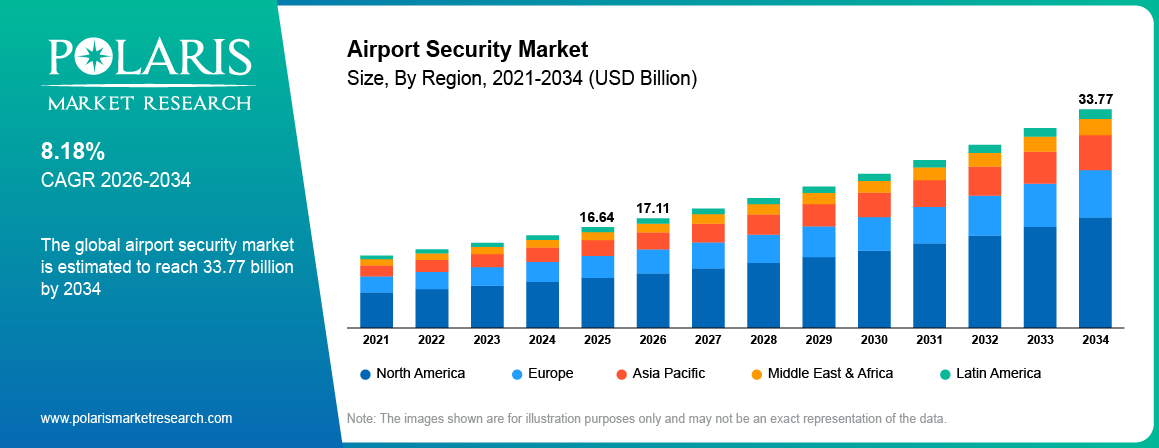
Source: Polaris Market Research Analysis
To Understand More About this Research: Download Sample Report
AI Impact on Airport Security Market
- Enhances threat detection by analyzing passenger behavior, baggage scans, and facial recognition.
- Improves risk assessment and resource allocation.
- Helps in continuous monitoring with higher accuracy.
- AI with cybersecurity safeguards airport systems from digital threats alongside physical security.
Difference Between Traditional Airport Security vs Smart Airport Security
| Parameter | Traditional Airport Security | Smart Airport Security |
| Automation Level | Relies heavily on manual screening, physical document verification, and human-operated surveillance systems | Uses automated screening systems, AI-enabled threat detection, and self-service passenger processing technologies |
| AI Integration | Limited or no use of artificial intelligence in monitoring and threat assessment | Integrates AI for behavioral analytics, facial recognition, anomaly detection, and predictive security monitoring |
| Biometric Verification | Primarily depends on passports, boarding passes, and manual identity checks | Uses biometric authentication such as facial recognition, fingerprint scanning, and iris recognition for seamless passenger verification |
| Operational Efficiency | Security processes are time-consuming and labor-intensive, often leading to congestion | Enhances throughput with automated checkpoints, smart baggage screening, and real-time data-driven operations |
| Passenger Experience | Longer waiting times, repeated document checks, and higher dependency on manual intervention | Provides faster, touchless, and more seamless passenger journeys with reduced queue times and improved convenience |
| Real-Time Monitoring | Surveillance systems operate with limited analytics and delayed response capabilities | Enables real-time monitoring through AI-powered CCTV analytics, integrated command centers, and instant threat alerts |
| Threat Detection Accuracy | Human-dependent screening may increase the risk of oversight or inconsistent detection | Advanced analytics and machine learning improve detection accuracy for prohibited items and suspicious activities |
| Data Integration | Security systems often function independently with fragmented data management | Smart platforms integrate airport, airline, and government security databases for centralized situational awareness |
| Scalability | Expansion requires significant manpower and infrastructure investment | Cloud-enabled and digital systems allow scalable and adaptive airport security operations |
| Cost Structure | Lower initial technology investment but higher long-term labor and operational costs | Higher initial investment in digital infrastructure but improved long-term efficiency and cost optimization |
Source: Polaris Market Research Analysis
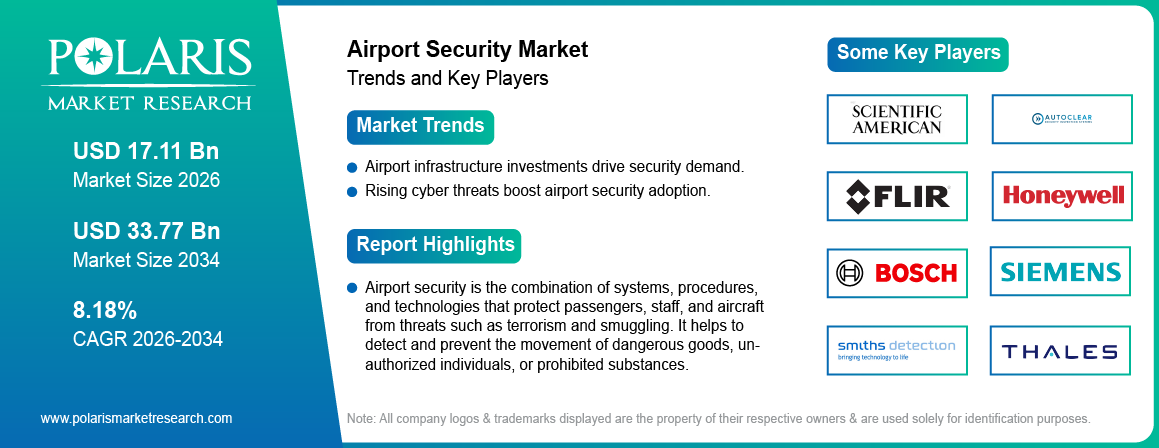
Source: Polaris Market Research Analysis
Know more about this report: Download Sample Report
Market Dynamics
Growth Drivers
The increasing investment in the development of aviation infrastructure, especially in emerging countries such as India and Thailand is propelling the market growth. According to India Investment Grid, India is set to construct an additional 80 airports over the next five years. This is increasing the need for airport security systems and equipment such as biometric screening, AI-powered surveillance, and smart baggage handling, as the constructruction of new airports require advanced systems to handle rising passenger volumes and evolving security challenges. The growing number of sophisticated cyberattacks on airport safety systems worldwide has led airports to increase their investment in cyber safety to protect operations and passengers, which contributed to the market growth. Moreover, the growing safety norms by International Air Transport Association is leading to the adoption of airport security systems, which is fueling the market growth.
Report Segmentation
The market is primarily segmented based on type, systems & equipment, technology, and region.
| By Type | By Systems & Equipment | By Technology | By Region |
|
|
|
|
Source: Polaris Market Research Analysis
Know more about this report: Download Sample Report
Insight by Type
Based on the type segment, the cybersecurity segment held the largest revenue share in 2025. This is due to the rising need to safeguard networks and data from being attacked and compromised. Cybersafety encompasses a broad range of operational and information technology safety tools, methods, and techniques, to safeguard networks and data from being attacked and compromised. Cybersecurity also employs protective and responsive measures such as traditional malware protection, web filtering, and advanced threat protection to protect consumers from Internet-borne dangers. These benefits offered by cybersecurity solutions at the airports contributed to the dominance of the segment.
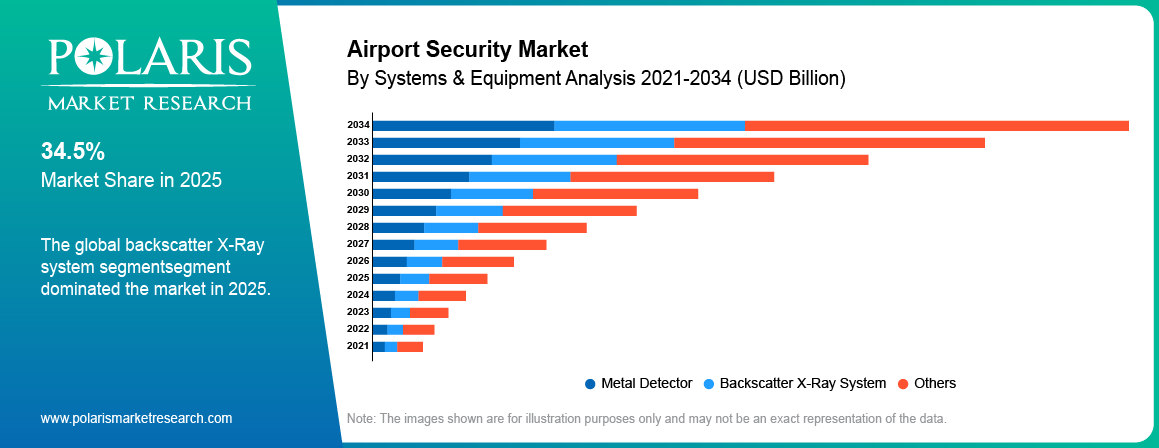
Source: Polaris Market Research Analysis
Insight by Systems & Equipments
Based on the systems & equipments segment, the backscatter X-Ray system segment accounted for the largest market share in 2025, owing to its ability to offer photo-like images for improved security screening of passengers, luggage, and vehicles. This machine is widely used at airports to screen passengers for concealed weapons or explosives by creating detailed images of goods hidden under clothing. use low-energy Moreover, backscatter X-Ray system use low-energy X-radiation, which propelled airports and governments bodies across the globe to invest in these backscatter X-Ray system.
Technological Advancements in Airport Security
| Technology | Advancement & Industry Impact |
| AI-Powered Surveillance | AI-enabled surveillance systems analyze passenger behavior, detect suspicious activities, and enhance threat identification through real-time video analytics and automated alert generation. |
| Biometric Boarding Systems | Facial recognition, iris scanning, and fingerprint authentication are streamlining passenger verification, reducing boarding times, and enabling touchless airport security processes. |
| Smart X-Ray Screening | Advanced X-ray scanners integrated with AI and machine learning improve prohibited item detection accuracy, automate baggage inspection, and reduce dependency on manual screening. |
| Autonomous Security Robots | AI-powered robotic patrol systems support airport security personnel by conducting autonomous surveillance, monitoring restricted areas, and identifying unusual activities in real time. |
| Cloud-Based Monitoring Platforms | Cloud-enabled security management systems centralize surveillance data, improve remote monitoring capabilities, and enhance coordination between airport authorities and security agencies. |
| Predictive Threat Detection | Predictive analytics and AI algorithms assess historical and real-time security data to identify potential risks, enabling proactive threat prevention and faster incident response. |
| Integrated Command & Control Centers | Modern airports are adopting centralized security operation centers that combine CCTV feeds, passenger data, and threat intelligence for improved situational awareness. |
| IoT-Enabled Security Infrastructure | Connected sensors, smart access control systems, and IoT-enabled devices improve monitoring efficiency and provide real-time operational visibility across airport facilities. |
| Cybersecurity Enhancements | Airports are increasingly implementing advanced cybersecurity frameworks to protect digital infrastructure, passenger databases, and connected security networks from cyber threats. |
| Automated Passenger Flow Analytics | AI-driven passenger flow management systems optimize checkpoint operations, reduce congestion, and improve airport capacity planning through real-time movement analysis. |
Source: Polaris Market Research Analysis
Geographic Overview
Asia Pacific dominated the airport security market in 2025 due to escalating terrorist activities and increased expenditures in aviation infrastructure. The growing government initiatives to promote air travel in countries such as India further contributed to the regional dominance. India launched UDAN Scheme to boost regional connectivity and promote air travel. Moreover, China's Aviation Administration aims to build 200 additional airports by 2035 to fulfill 450 airports. China invested about USD 70 billion on upgrades to ground infrastructure, air traffic control systems, and other systems. These factors propelled the market dominance in the Asia Pacific.
North America is expected to witness a high CAGR growth in the global market in the coming years. This is attributed to the presence of established players, continuing infrastructural developments, and growing air passengers. Moreover, market development is influenced by the adoption of international standards increased safety, and the use of modern machinery for safety. The Department of Homeland Security (DHS) and the Transportation Security Administration (TSA), among other regulatory agencies in the United States are concentrated on guaranteeing safety standards adapted to the particular operational environment of each airport, which is fueling the market growth.
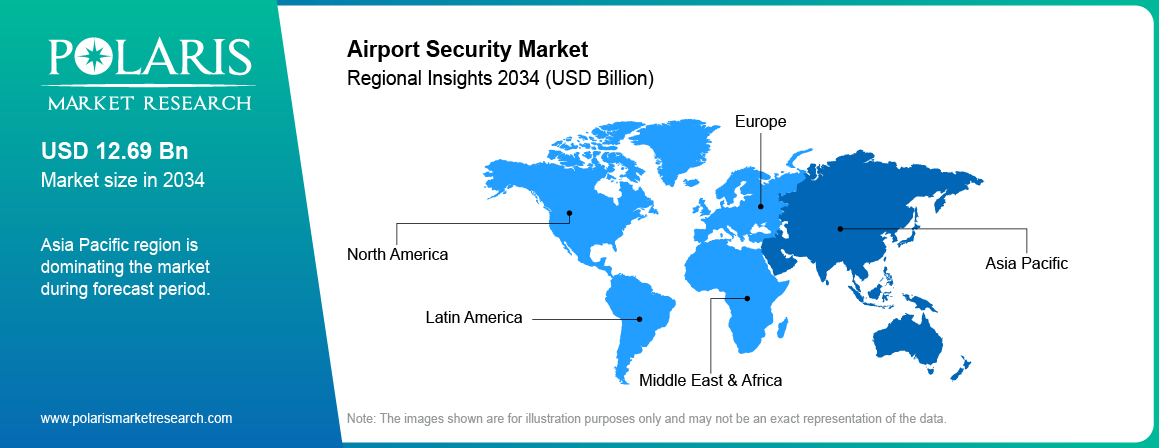
Source: Polaris Market Research Analysis
Some of the major players operating in the global market include:
- American Science,
- Engineering Inc,
- Autoclear LLC,
- Axis Communication AB,
- Delta Air Lines Inc.,
- FLIR Systems Inc.,
- Honeywell International Inc,
- OSI Systems Inc,
- Robert Bosch GmbH,
- SafranMorpho,
- Siemens AG,
- Smiths Detection,
- Thales Group.
Recent Developments
- May 2026: Mitie announced a two-year extension of its contract with Birmingham Airport. The extension created 60 new security officer roles across airport operations. (Source: mitie.com).
Airport Security Market Report Scope
| Report Attributes | Details |
| Market size value in 2025 | USD 16.64 billion |
| Market size value in 2026 | USD 17.11 billion |
| Revenue forecast in 2034 | USD 33.77 billion |
| CAGR | 8.18% from 2026 - 2034 |
| Base year | 2025 |
| Historical data | 2021 - 2024 |
| Forecast period | 2026- 2034 |
| Quantitative units | Revenue in USD Billion and CAGR from 2026 to 2034 |
| Segments covered |
|
| Regional scope |
|
| Key Companies | American Science and, Engineering Inc, Autoclear LLC, Axis Communication AB, Delta Air Lines Inc., FLIR Systems Inc., Honeywell International Inc, OSI Systems Inc, Robert Bosch GmbH, SafranMorpho, Siemens AG, Smiths Detection, Thales Group. |
Source: Polaris Market Research Analysis
Airport Security Market FAQ's
• The global market size was valued at USD 16.64 billion in 2025 and is projected to grow to USD 33.77 billion by 2034.
• The global market is projected to register a CAGR of 8.18% during the forecast period.
Asia Pacific dominated the global airport security market in 2025, holding a 37.6% share — driven by escalating terrorist activities and increased expenditure on aviation infrastructure.
• A few of the key players in the market include American Science and, Engineering Inc, Autoclear LLC, Axis Communication AB, Delta Air Lines Inc., FLIR Systems Inc., Honeywell International Inc, OSI Systems Inc, Robert Bosch GmbH, SafranMorpho, Siemens AG, Smiths Detection, Thales Group.
The Cybersecurity segment dominated the market revenue share in 2025, holding 29.8% — driven by the rising need to safeguard networks and data from cyberattacks and breaches.
Download Sample Report of Airport Security Market
Please fill out the form to request a customized copy of the research report.


