
Veterinary Clinical Chemistry Diagnostics Market Size, Share, Trends & Forecast, 2026-2034
REPORT DETAILS
Veterinary Clinical Chemistry Diagnostics Market Summary
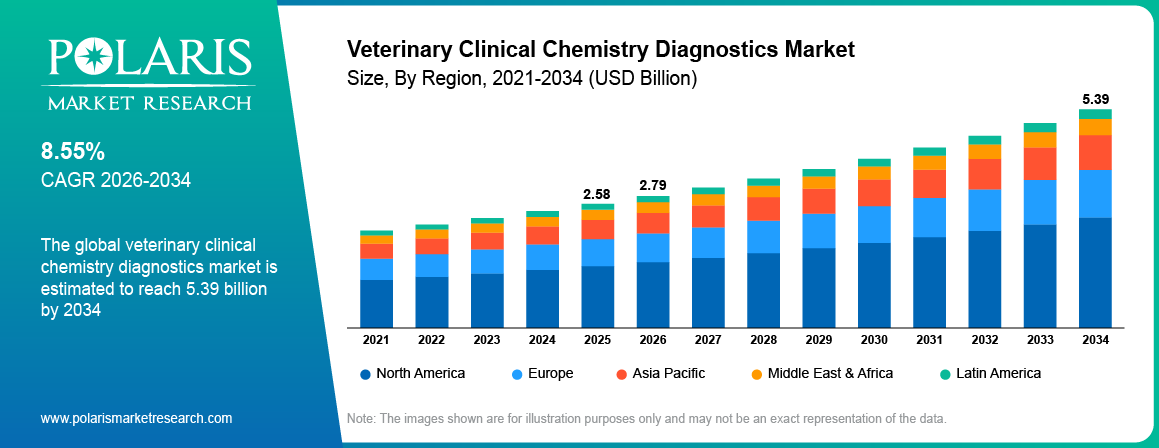
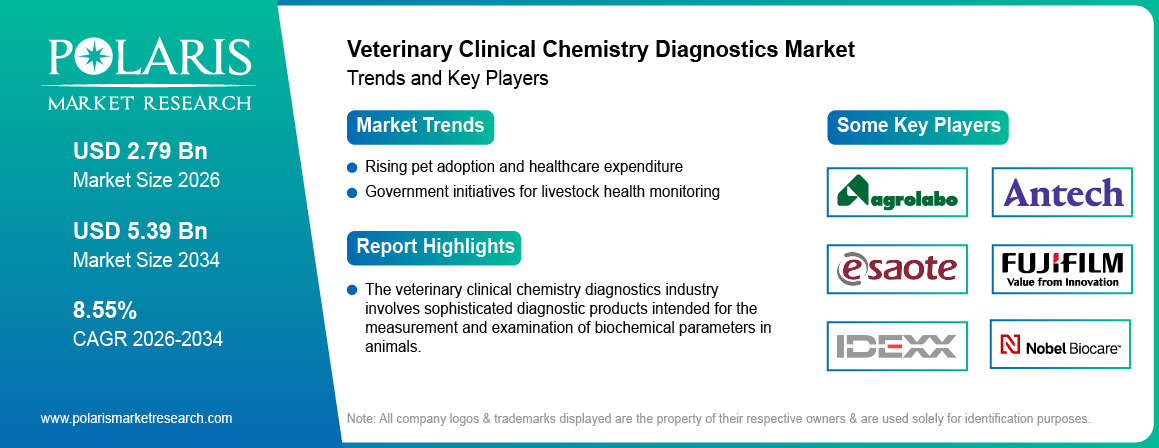
The global veterinary clinical chemistry diagnostics market size was valued at USD 2.58 billion in 2025. The market is projected to grow at a CAGR of 8.55% from 2026 to 2034. Rising pet adoption and healthcare expenditure, coupled with government initiatives for livestock health monitoring, are boosting market growth.
Market Statistics
Veterinary Clinical Chemistry Diagnostics Market Key Takeaways
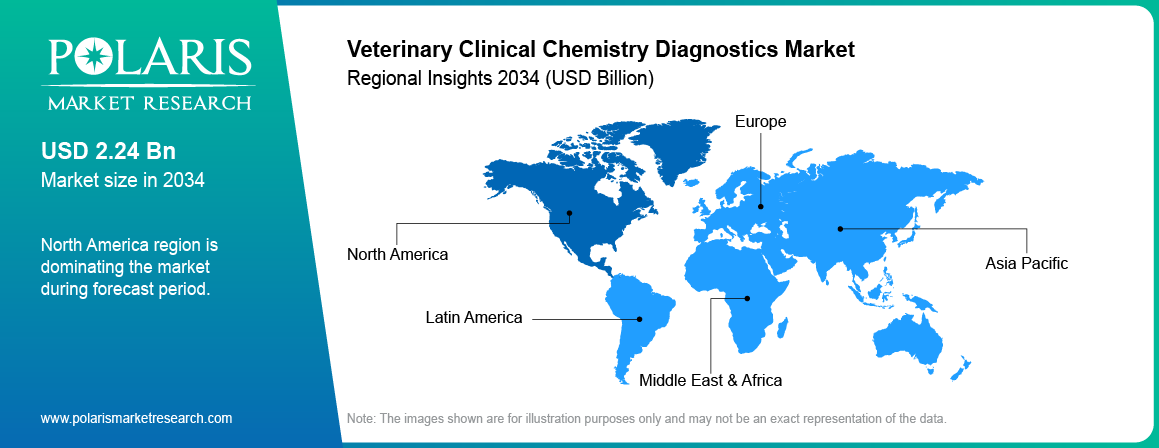
- North America accounted for a 41.6% share in 2025. This is owing to the region’s robust expenditure on companion animal healthcare services.
- The U.S. accounted for a 78.5% share in 2025. This is due to the presence of advanced veterinary infrastructure in the country.
- Asia Pacific is projected to grow at a 10.9% CAGR. The regional growth is driven by increasing awareness of zoonotic diseases.
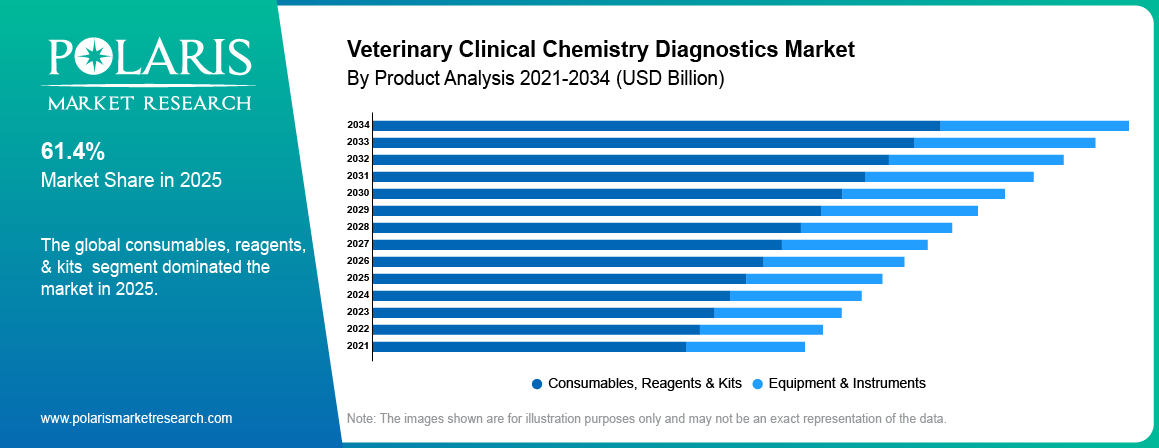
- Consumables, reagents, & kits held a 61.4% share in 2025. They are used in routine diagnostic testing in veterinary clinics and laboratories.
- The production animals segment is anticipated to register a CAGR of 11.3% during the forecast period. The segment’s growth is driven by the increasing requirement for herd health management.
Note: Figures and projections outlined in this report are the result of Polaris Market Research’s proprietary analytical processes, grounded in the latest available datasets and market observations.
What Are Veterinary Clinical Chemistry Diagnostics? Tests, Biomarkers, Samples & Use Cases
The veterinary clinical chemistry diagnostics industry involves sophisticated diagnostic products intended for the measurement and examination of biochemical parameters in animals. They are widely utilized across veterinary clinics, diagnostic labs, research institutes, and animal husbandry to provide animal health, disease diagnosis, and effective treatment.
The increasing prevalence of infectious and chronic diseases in companion animals and livestock is creating an urgent need for ongoing health monitoring and early diagnosis. Veterinarians are turning to sophisticated clinical chemistry tests to identify metabolic disorders, organ failure, and nutritional deficiencies with greater precision. This development is fueling high demand for advanced veterinary diagnostic solutions.
AI in Veterinary Clinical Chemistry: QC, Result Interpretation, Workflow Automation & Predictive Monitoring
- AI enables quick and accurate analysis of the test results in veterinary clinical chemistry tests. This leads to fast diagnosis and facilitates faster decision-making for the treatment of patients.
- AI can recognize any pattern within the laboratory data that may reflect early symptoms of a disease. This helps veterinarians diagnose problems early and start treatment at an early stage.
- AI eliminates the manual effort involved in the analysis of data and creation of reports. This increases laboratory efficiency and helps veterinary professionals devote their time to caring for the patients.
- Increasing adoption of AI-based tools by veterinary clinics and diagnostic laboratories is anticipated to contribute towards innovations in the veterinary clinical chemistry diagnostics market.
Source: Polaris Market Research Analysis
The rapid expansion of veterinary clinics, diagnostic laboratories, and animal healthcare facilities in rural and urban areas is building a strong ecosystem for high-end diagnostic adoption. The presence of in-house and point-of-care diagnostics adds to the ease of access to real-time diagnostic services.
How Do Veterinary Clinical Chemistry Tests Work? Sampling, Analyzer, Reagents, QC & Interpretation
Sampling: Blood, urine, or any other body fluid samples are taken from the animal depending on what kind of condition is to be checked.
Sample Preparation: Sample preparation and analysis take place in the clinical chemistry analyzer. The process ensures correct measurements of biochemical markers.
Biochemical Analysis: The analyzer measures biochemical markers including enzymes, proteins, glucose, and electrolytes to determine the animal's condition.
Results: Information analysis takes place and results are obtained indicating if the measurements are normal.
Clinical Diagnosis: The veterinarian examines results, taking into consideration the symptoms of the animal in order to detect health problems.
Treatment and Monitoring: According to the results of the analysis, the veterinarian gives a prescription for a treatment or further testing.
Veterinary Clinical Chemistry vs Hematology vs Immunodiagnostics: What Each Test Measures
| Feature | Veterinary Clinical Chemistry Diagnostics | Traditional Veterinary Diagnosis |
| Method of Diagnosis | Involves testing through laboratory analysis of blood, urine, and other samples | Based on physical examination and clinical manifestations of the disease |
| Identification of Disease | Allows for early detection of illnesses and health issues | Tends to identify the disease when the symptoms have already occurred |
| Outcome | Generates precise measurement results | Dependent on the clinical manifestation of the condition |
| Monitoring | Provides a means of monitoring treatment effectiveness | Based on the physical observation of the animal’s body |
| Common Usage | Preventive and therapeutic purposes, diagnostics | Initial and routine examination |
Source: Polaris Market Research Analysis
Market Dynamics
Rising pet adoption and healthcare expenditure: Growing pet ownership and increasing disposable income levels in developed economies are driving expenditure on preventive animal care and wellness diagnostic tests. According to the American Pet Products Association (APPA) 2025 Industry Report, about 94 million U.S. households, or 71% of all households, own at least one pet (source: americanpetproducts.org). This increasing focus on companion animal health is driving market growth.
Government initiatives for livestock health monitoring: Government-sponsored initiatives targeting livestock disease monitoring, biosecurity, and food safety are driving the demand for veterinary clinical chemistry diagnostics. The Australian Government and the Food and Agriculture Organization (FAO) unveiled a three-year regional program in April 2025 for strengthening Southeast Asian and Pacific animal health systems (source: fao.org). These programs are reinforcing diagnostics' role in improving livestock productivity and safety.
Rise of Point-of-Care Veterinary Diagnostics
Point-of-care veterinary diagnostics is becoming increasingly significant in modern animal medicine due to the possibility of getting test results quickly on-site. This enables veterinarians to diagnose health conditions and initiate treatment in one session. Such tests can help save time in emergencies when rapid action is required. The use of portable devices is advantageous in terms of gaining better access to testing in rural locations, where laboratories might not be available. Rapid test results will help reduce the amount of stress experienced by the animal and its owner. As veterinary clinics pay attention to efficiency in their operations, point-of-care testing will become more popular.
Emerging Home-Based Pet Diagnostics
Home-based pet diagnostic tests are increasingly becoming common among pet owners who are looking for convenient means of checking on the health of their pets between veterinary consultations. There are portable diagnostic equipment and kits that can be used by pet owners to check the health of their pets and identify any signs of problems that might necessitate consultation. They are especially helpful in managing pets suffering from long-term health problems that require constant monitoring. Pet owners can also use home-based tests to identify possible health problems early enough and consult with veterinary experts before the situation becomes worse. Although such solutions cannot substitute for laboratory tests, they offer considerable help in managing the health of pets.
Technological Advancements in Veterinary Diagnostics
| Technology | Description |
| Automated Clinical Chemistry Analyzers | Modern automated clinical chemistry analyzers perform many tests with reduced human effort. |
| Digital Diagnostic Systems | Digital diagnostic systems maintain patient records and lab results on a single platform, enabling easy tracking of the animal's health status. |
| AI-enabled Test Data Analysis | AI-based tools help the veterinarian identify patterns in the results and provide additional information about the diagnosis process. |
| Portable Diagnostic Tools | Portable diagnostic tools help conduct tests outside laboratories. |
| Cloud Storage for Diagnostic Information | Cloud-based storage helps in secure storage and sharing of diagnostic information among veterinarians. |
| Integrated Lab Software | Advanced software connects veterinary blood chemistry analyzers with the veterinary practice management systems. |
Source: Polaris Market Research Analysis
Source: Polaris Market Research Analysis
Veterinary Clinical Chemistry Diagnostics Market Segmentation Analysis
Veterinary Clinical Chemistry Diagnostics Market by Product
Based on product the market is divided into consumables, reagents & kits and equipment & instruments. Consumables, reagents, & kits held a 61.4% share in 2025 due to regular usage in diagnostic laboratories and veterinary clinics for routine and specialty testing.
Equipment and instruments are expected to expand at a very high rate driven by the heightened demand for automated analyzers, point-of-care products, and sophisticated instruments for quicker and more precise results.
Veterinary Clinical Chemistry Diagnostics Market by Animal Type
The production animals segment is anticipated to register a CAGR of 11.3% during the forecast period. Companion animals led the market with mounting pet ownership, heightened preventive healthcare focus, and regular health monitoring practice.
Production livestock are projected to growth at a rapid pace, driven by rising demand for health management, optimization of productivity, and disease control among livestock and farm animals.
Veterinary Clinical Chemistry Diagnostics Market by Test Type
On the basis of test type, the market is divided into renal function test (RFT), liver function test (LFT), electrolyte panel, and others. Renal function tests (RFT) segment are leading the market propelled by its critical role in the assessment of organ health and also disease detection at an early stage.
Electrolyte panels are anticipated to grow at a fast pace fueled by the rising use of monitoring hydration, metabolic disorders, and overall animal wellness.
Veterinary Clinical Chemistry Diagnostics Market By Sample Type
In terms of sample type, the market is segmented into blood/plasma/serum, urine, and other samples. Blood, plasma, and serum dominated the market driven by its consistent providing insights for numerous clinical chemistry assays.
Samples of urine are expected to register a rapid growth driven by increasing adoption for non-invasive diagnostics and for metabolic monitoring.
Veterinary Clinical Chemistry Diagnostics Market By End Use
Based on end use, the market is segmented into reference laboratories, veterinarians, and animal owners. The reference laboratories segment held the largest share, propelled by its ability to analyze high volumes of diagnostic tests using sophisticated equipment and skilled personnel.
Veterinarians are projected to grow at a high growth rate driven by in-clinic testing needs and point-of-care diagnostics.
Use Cases of Veterinary Clinical Chemistry Diagnostics
| Application | Description |
| Detection of Kidney Disease | Blood and urine tests assist in detecting any changes in kidney functioning. |
| Assessment of Liver Functionality | Clinical Chemistry tests assess the health of the liver and aid in diagnosing liver problems. |
| Detection of Metabolic Disorders | Tests aid in detecting metabolic disorders that may cause malnutrition, poor growth, etc. |
| Pre-Surgery Health Screening | Diagnostic tests assess the functioning of organs before conducting any surgical procedure. |
| Treatment Monitoring | Tests assist veterinarians in knowing how an animal responds to various treatments. |
| Preventive Health Screening | Part of regular veterinary checkups. |
Source: Polaris Market Research Analysis
Source: Polaris Market Research Analysis
Sustainability in Veterinary Diagnostics
Sustainability has gained significance in veterinary diagnostics and the animal health diagnostics market as efforts are being made by healthcare professionals and the manufacturers of the products to limit the environmental impact associated with testing. There have been new developments in analytical devices that make use of smaller sample sizes and utilize less laboratory material for conducting tests. Effective laboratory procedures are being implemented that save on energy and do not affect the accuracy of diagnosis. The use of eco-friendly disposable laboratory products and recycling materials is slowly becoming common within the industry. Diagnostic equipment that uses energy efficiently has helped reduce operating expenses for veterinary facilities.
Regional Analysis
North America accounted for a 41.6% share in 2025 in the veterinary clinical chemistry diagnostics market driven by significant pet ownership and robust consumer expenditure on the healthcare of companion animals. Also, the strong presence of top veterinary diagnostics firms and regular R&D efforts focused on making testing more precise and automated are further propelling the market growth.
The U.S. Veterinary Clinical Chemistry Diagnostics Market Overview
The U.S. accounted for a 78.5% share in 2025 due to the developed veterinary healthcare facilities and extensive penetration of advanced diagnostic labs. In November 2025, the National Institute of Food and Agriculture announced an anticipated USD 3.8 million investment in the Veterinary Services Grant Program. The investment intends to address rural veterinary shortages and improve livestock diagnostic access (source: nifa.usda.gov).
Asia Pacific Veterinary Clinical Chemistry Diagnostics Market Insights
Asia Pacific is projected to grow at a 10.9% CAGR, due to swift expansion in livestock farming and increasing demand for animal feed products. This growth is expanding the use of advanced diagnostic equipment for early disease detection and productivity improvement. Moreover, growing pet adoption and rising awareness of preventive veterinary care are further propelling demand for regular health diagnostics.
India Veterinary Clinical Chemistry Diagnostics Market Analysis
India led the market in the Asia Pacific, propelled by the ongoing growth of veterinary hospitals, clinics, and animal diagnostic service providers. In the Indian Union Budget for 2026–27, the Department of Animal Husbandry & Dairying received a record allocation of ₹6,153.5 crore (approximately USD 741.4 million). The budget allocation reflects continued governmental support toward the development of animal health infrastructure in the country (source: pib.gov.in) .
Europe Veterinary Clinical Chemistry Diagnostics Market Assessment
Europe accounted significant market share in the veterinary clinical chemistry diagnostics market due to well-established veterinary infrastructure and a vast network of veterinary physicians facilitating high diagnostic penetration. Rising regulatory emphasis on zoonotic disease prevention, livestock traceability, and food safety compliance is also propelling the use of advanced clinical chemistry diagnostic systems in veterinary practices.
Source: Polaris Market Research Analysis
Veterinary Clinical Chemistry Diagnostics Competitive Landscape & Leading Chemistry Analyzer Companies
The global veterinary clinical chemistry diagnostics market is moderately competitive, with firms prioritizing accuracy, automation, and quick turnaround times for animal health testing. Players in the market are concentrating on creating portable and high-throughput diagnostic platforms, applying advanced analytics, and increasing capability for companion and livestock animals. Partnerships with veterinary clinics, research institutes, and diagnostic laboratories are assisting firms in increasing reach and adoption, while advances in reagents, analyzers, and point-of-care testing are continuing to drive market expansion.
Who are the players in veterinary clinical chemistry diagnostics market?
Key companies operating in the global veterinary clinical chemistry diagnostics market include Agrolabo S.p.A., Antech Diagnostics, Inc. (Mars Inc.), Cormay Diagnostics Sp. z o.o., Embark Veterinary, Inc., Esaote SPA, FUJIFILM Corporation, IDEXX Laboratories, Inc., Innovative Diagnostics SAS, Nobel Biocare Services AG, and Thermo Fisher Scientific, Inc.
Key Players
- Agrolabo S.p.A.
- Antech Diagnostics, Inc. (Mars Inc.)
- Cormay Diagnostics Sp. z o.o.
- Embark Veterinary, Inc.
- Esaote SPA
- FUJIFILM Corporation
- IDEXX Laboratories, Inc.
- Innovative Diagnostics SAS
- Nobel Biocare Services AG
- Thermo Fisher Scientific, Inc.
Veterinary Clinical Chemistry Diagnostics Industry Developments
- April 2026: Zoetis Inc. announced improvements in the capabilities of its artificial intelligence-powered hematology analyzer, Vetscan OptiCell. The company stated that the update makes Vetscan OptiCell the first point-of-care hematology analyzer that offers cellular hemoglobin concentration mean (CHCM). (source: zoetis.com)
- January 2026: Antech revealed the addition of SDMA testing to its in-house diagnostic platform, Element i+. According to Antech, the addition enables clinicians to use its in-house Element i+ for immediate and more sensitive assessment of kidney function. (source: antechdiagnostics.com)
- In July 2025, Diatron unveiled its new flagship clinical chemistry analyzer, the P780, which was positioned for mid- to high-throughput laboratories with capabilities up to 600 photometric tests plus 230 ISE tests per hour.
Veterinary Clinical Chemistry Diagnostics Market Future Outlook: POC Chemistry, Automation, AI & Connected Diagnostics
The global market for veterinary clinical chemistry diagnostics is poised to grow steadily as awareness of animal health and preventive care increases. The rise in pet ownership and expenditure on veterinary services is driving an increase in tests for companion animals. In addition, there is increased investment by livestock farmers in diagnostic solutions that enhance animal health and productivity. Future developments in terms of automation, portability of diagnostic equipment, digitization, and artificial intelligence are set to increase the speed and convenience of diagnostic tests. Growth in terms of the number of veterinary clinics and diagnostic laboratories is expected to boost market expansion globally.
Veterinary Clinical Chemistry Diagnostics Market Segmentation
By Product Outlook (Revenue, USD Billion, 2021–2034)
- Consumables, Reagents & Kits
- Equipment & Instruments
By Animal Type Outlook (Revenue, USD Billion, 2021–2034)
- Companion Animals
- Dogs
- Cats
- Horses
- Other Companion Animals
- Production Animals
- Cattle
- Poultry
- Swine
- Other Production Animals
By Test Type Outlook (Revenue, USD Billion, 2021–2034)
- Renal Function Test (RFT)
- Liver Function Test (LFT)
- Electrolyte Panel
- Other Tests
By Sample Type Outlook (Revenue, USD Billion, 2021–2034)
- Blood/Plasma/Serum
- Urine
- Other Samples
By End Use Outlook (Revenue, USD Billion, 2021–2034)
- Reference Laboratories
- Veterinarians
- Animal Owners
By Regional Outlook (Revenue, USD Billion, 2021–2034)
- North America
- U.S.
- Canada
- Europe
- Germany
- France
- UK
- Italy
- Spain
- Netherlands
- Russia
- Rest of Europe
- Asia Pacific
- China
- Japan
- India
- Malaysia
- South Korea
- Indonesia
- Australia
- Vietnam
- Rest of Asia Pacific
- Middle East & Africa
- Saudi Arabia
- UAE
- Israel
- South Africa
- Rest of Middle East & Africa
- Latin America
- Mexico
- Brazil
- Argentina
- Rest of Latin America
Veterinary Clinical Chemistry Diagnostics Market Report Scope
| Report Attributes | Details |
| Market Size in 2025 | USD 2.58 Billion |
| Market Size in 2026 | USD 2.79 Billion |
| Revenue Forecast by 2034 | USD 5.39 Billion |
| CAGR | 8.55% from 2026 to 2034 |
| Base Year | 2025 |
| Historical Data | 2021–2024 |
| Forecast Period | 2026–2034 |
| Quantitative Units | Revenue in USD Billion and CAGR from 2026 to 2034 |
| Report Coverage | Revenue Forecast, Competitive Landscape, Growth Factors, and Industry Trends |
| Segments Covered |
|
| Regional Scope |
|
| Competitive Landscape |
|
| Report Format |
|
| Customization | Report customization as per your requirements with respect to countries, regions, and segmentation. |
Source: Polaris Market Research Analysis
Veterinary Clinical Chemistry Diagnostics Market FAQ's
The global market size was valued at USD 2.58 billion in 2025 and is projected to grow to USD 5.39 billion by 2034.
The global market is projected to register a CAGR of 8.55% during the forecast period.
North America dominated the market with a 41.6% share in 2025, driven by strong market demand and advanced healthcare infrastructure.
A few of the key players in the market are Agrolabo S.p.A., Antech Diagnostics, Inc. (Mars Inc.), Cormay Diagnostics Sp. z o.o., Embark Veterinary, Inc., Esaote SPA, FUJIFILM Corporation, IDEXX Laboratories, Inc., Innovative Diagnostics SAS, Nobel Biocare Services AG, and Thermo Fisher Scientific, Inc.
The consumables, reagents, and kits segment accounted for the largest market share of 61.4%, driven by their frequent use and recurring demand in research and diagnostic applications.
The production animal segment is projected to witness the fastest growth, registering a CAGR of 11.3% during the forecast period.
Veterinary clinical chemistry diagnostics are diagnostic tools that include tests of blood, urine, and other body fluids to determine the state of health of the animal. These tests are used by veterinarians in diagnosing diseases and assessing the functioning of organs.
These tests can help to identify health issues in the early stages before they develop into more serious conditions. In addition, these tests help in making accurate diagnoses, treatment choices, and monitoring of the animal's recovery process.
The major factors driving market expansion are the growing pet population, rising expenditure on the health care of animals, and increased demand for early detection of diseases.
Download Sample Report of Veterinary Clinical Chemistry Diagnostics Market
Please fill out the form to request a customized copy of the research report.


