
Microbiome Skincare Products Market Growth Opportunities, Industry Revenue, 2025-2034
REPORT DETAILS
Market Statistics
What is the microbiome skincare products market size?
The global microbiome skincare Products market size was valued at USD 437.71 million in 2024, growing at a CAGR of 12.7% from 2025 to 2034. Growth of E-commerce and D2C-driven microbiome beauty adoption coupled with rising premium wellness spending among next-gen consumers is boosting the market growth.
Key Insights
- Serums dominated the market in 2024 owing to the rising adoption of high skin absorption efficiency, high concentration actives, and increasing demand for anti-aging, barrier repair, and sensitivity-oriented treatments.
- Probiotic-based products projected to grow at a rapid pace propelled by high demand for live-active cultures providing clinically validated benefits for eczema, rosacea, and compromised barrier skin.
- The Asia Pacific is expected to project high growth in the microbiome skincare products market propelled by huge consumer base with increasing sensitivity toward lifestyle and environmental-induced skin issues in Japan, China, India, and South Korea.
- South Korea dominated the region, driven by K-beauty products and J-beauty trends focused on barrier repair, fermented actives, and microbiome-friendly formulations.
- The U.S. dominated the North American market, driven by increasing incidence of eczema, acne, and rosacea, boosting demand for microbiome-restoring skincare.
Industry Dynamics
- Increasing attention to preventive and barrier-friendly skincare is driving the adoption of microbiome-friendly product formats ahead of traditional cosmetics.
- Scaling up D2C platforms and skin analysis technology is making personalized recommendation models available, boosting consumer confidence and product uptake.
- High R&D spending and complexity of maintaining live microbiome actives are restraining the market growth.
- Improvements in DNA-based skin microbiome mapping and AI-formulation technologies are building strong opportunities for innovation.
Market Statistics
- 2024 Market Size: USD 437.71 Million
- 2034 Projected Market Size: USD 1,443.65 Million
- CAGR (2025–2034): 12.7%
- North America: Largest Market Share
What are microbiome skincare products market comprises of?
The microbiome skincare products market encompasses products intended to balance and maintain the skin's own natural microbial balance, with emphasis placed on barrier function, inflammation management, and general skin health. Such products utilize prebiotics, probiotics, postbiotics, and bio-fermented actives to counteract acne, eczema, sensitivity, and premature aging.
Increasing global demand for preventive and wellness-oriented skincare is driving the move towards microbiome-based formulations that promote long-term skin barrier health over treating seen issues. Companies are increasingly framing microbiome skincare as a core health habit rather than a corrective solution, in line with shifting consumer expectations towards scientifically informed self-care.
Source: Polaris Market Research Analysis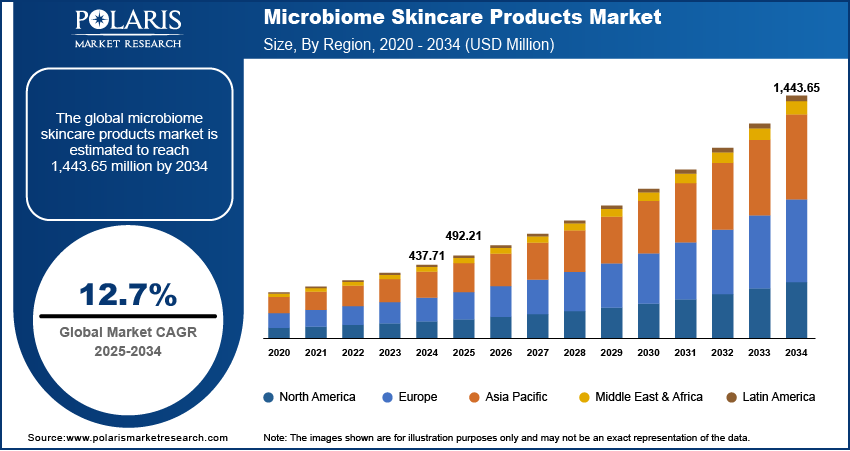
Rising number of dermatologists, clinical testing, and evidence-driven product claims is reinforcing confidence in microbiome skincare solutions. Steady demand is rising for science-validated skin microbiome-supported formulations, which is driving brands towards medically focused, research-linked beauty positioning in order to achieve credibility among consumers.
Drivers & Opportunities
Growth of E-Commerce and D2C-Driven Microbiome Beauty Adoption: The swift growth of e-commerce and D2C-first beauty models is driving the global scale-up of microbiome-based skincare. According to the International Trade Administration, global B2C e-commerce revenue is expected to grow to USD 5.5 trillion by 2027 at a 14.4% CAGR, supporting increasing cross-border penetration of science-backed microbiome beauty products.
Rising Premium Wellness Spending Among Next-Gen Consumers: Gen Z and millennial premium skincare expenditures are rising dramatically fueled by long-term skin barrier resilience and holistic well-being priorities over short-term cosmetic results. The Global Wellness Institute states that the global wellness economy in 2023 was USD 6.3 trillion, representing 6.03% of global GDP, which signifies rapid consumer demand for health-rooted microbiome skincare solutions.
Source: Polaris Market Research Analysis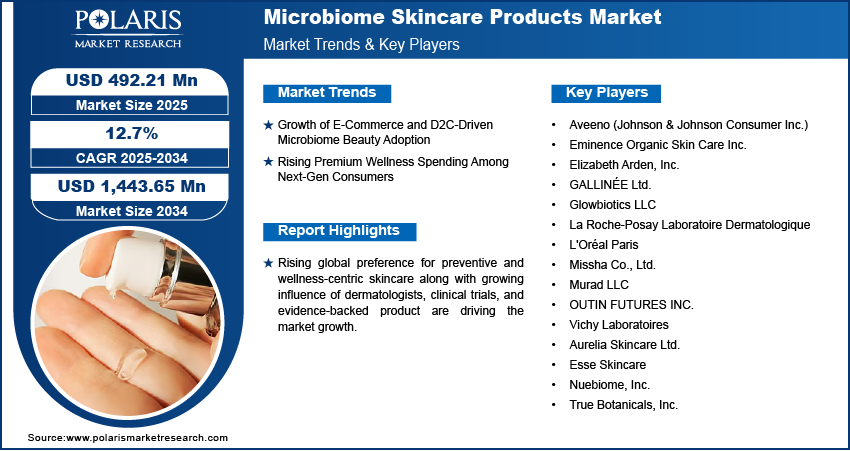
Segmental Insights
By Product
On the basis of products, the market is divided into serums, creams, masks, and others. Serum segment dominated the market due to their superior absorption rates, high-concentration formulations, and expanding demand for focused treatment options like anti-aging, barrier repair, and skin sensitivity control.
Masks are expected to grow at a fast pace, driven by increasing popularity of weekly deep-treatment usage and adoption among premium and wellness-focused skincare routines.
By Ingredients
On the basis of ingredients, the market is segmented into prebiotic and probiotic products. Prebiotic formulas led the market fueled by the growth of healthy skin microorganisms without adding live cultures, which are safe for sensitive and acne-prone skin.
The probiotic segment projected register significant growth due to the increasing consumer awareness of live-active cultures for personalized, scientifically endorsed skincare outcomes, particularly for addressing conditions such as eczema, rosacea, and compromised skin barriers.
By Distribution Channel
By distribution channel, the market is classified into hypermarket/supermarket, pharmacy and drug stores, e-commerce, and others. Hypermarket/supermarket segment holds a major market share owing to the extensive coverage of mass-market and premium microbiome skincare brands under one roof, along with growing shelf presence and brand trust.
E-commerce is expected to rise at a fast rate driven by the growth of digital-native skincare companies, subscription models, and AI-powered personalized skincare recommendations.
Source: Polaris Market Research Analysis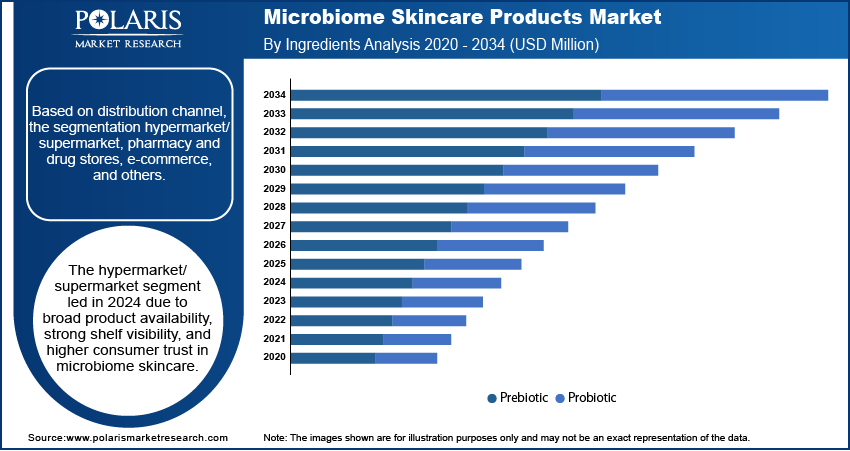
Regional Analysis
North America dominated the microbiome skincare products market fueled by significant consumer demand for science-supported and dermatologist-recommended skincare products in the region. Increasing penetration of AI-based diagnostics and DNA-based personalized skincare platforms is also driving the shift towards barrier-repair and microbiome-restoring products.
The U.S. Microbiome Skincare Products Market Overview
The U.S. dominated the North America market, fueled by increasing prevalence of skin diseases like eczema, rosacea, and acne. The Asthma and Allergy Foundation of America reported that about 16 million Americans suffer from eczema, with 6.6 million having moderate to severe forms highlighting high clinical need for sensitive, microbiome-friendly treatments.
Asia Pacific Microbiome Skincare Products Market Insights
The Asia Pacific is expected to project high growth in the microbiome skincare products market propelled by huge consumer base with increasing sensitivity toward lifestyle and environmental-induced skin issues in Japan, China, India, and South Korea. Consumers in urban areas are gradually moving toward natural, non-irritating products driven by fear of air pollution, humidity, and chemical-laden products.
South Korea Microbiome Skincare Products Market Analysis
South Korea led the Asia Pacific market, due to K-beauty and J-beauty trends built around skin barrier care, fermented actives, and probiotic formulas continuing to influence product innovation. According to the International Trade Administration, in 2022 South Korea was one of the world's top 10 beauty markets, with the K-beauty market worth around USD 3.9 billion, further solidifying its position as a world innovation center for microbiome skincare.
Europe Microbiome Skincare Products Market Assessment
Europe held strong market share in the microbiome skincare products market, propelled by early and rapid adoption of microbiome skincare products, led by high consumer confidence in clinically tested, pharma-grade skin products. EU cosmetic regulations encouraging skin-friendly, microbiome-friendly formulations are also driving the transition away from traditional actives towards barrier-protective and probiotic skincare technologies.
Source: Polaris Market Research Analysis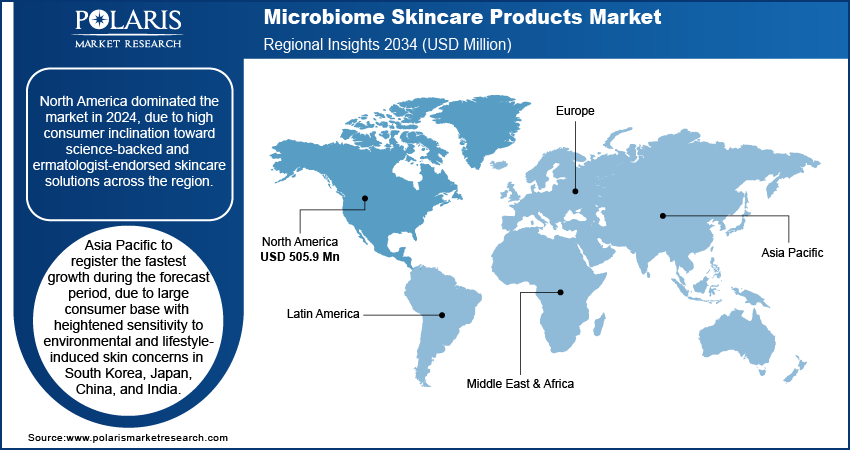
Key Players & Competitive Analysis
The global microbiome skincare products market is fairly competitive, with players focusing on microbiome-friendly, barrier-repairing, and probiotic/postbiotic ingredients to promote skin health at a biological level. Driving innovation are increases in consumer demand for clean-label, dermatologically tested, and skin microbiome–safe products, especially in sensitive skin, anti-aging, and acne care applications. Players are investing in proprietary bacterial strains, AI-led personalization, and skin microbiome testing platforms to stand out. Collaborations with dermatologists, skin research labs, and wellness-oriented store owners are gaining clinical stature and consumer confidence.
Key companies operating in the global microbiome skincare products market include Aveeno (Johnson & Johnson Consumer Inc.), Eminence Organic Skin Care Inc., Elizabeth Arden, Inc., GALLINÉE Ltd., Glowbiotics LLC, La Roche-Posay Laboratoire Dermatologique, L'Oréal Paris, Missha Co., Ltd., Murad LLC, OUTIN FUTURES INC., Vichy Laboratoires, Aurelia Skincare Ltd., Esse Skincare, Nuebiome, Inc., and True Botanicals, Inc.
Key Players
- Aveeno (Johnson & Johnson Consumer Inc.)
- Eminence Organic Skin Care Inc.
- Elizabeth Arden, Inc.
- GALLINÉE Ltd.
- Glowbiotics LLC
- La Roche-Posay Laboratoire Dermatologique
- L'Oréal Paris
- Missha Co., Ltd.
- Murad LLC
- OUTIN FUTURES INC.
- Vichy Laboratoires
- Aurelia Skincare Ltd.
- Esse Skincare
- Nuebiome, Inc.
- True Botanicals, Inc.
Microbiome Skincare Products Industry Developments
In October 2025, Leucine Rich Bio Pvt. Ltd., an India-based microbiome company launched BugSpeaks the first facial skin microbiome test in the region. The innovation allows personalized, science-driven skincare by examining one's unique skin microbiome ecosystem.
In September 2024, Terra Quantum partnered with Unilever to leverage quantum machine learning for analyzing complex skin microbiome data. The partnership will discover novel biological insights and speed the creation of next-generation skincare formulas, especially for dermatological conditions like eczema.
Microbiome Skincare Products Market Segmentation
By Product Outlook (Revenue, USD Million, 2020–2034)
- Serums
- Prebiotic
- Probiotic
- Creams
- Prebiotic
- Probiotic
- Masks
- Prebiotic
- Probiotic
- Others
- Prebiotic
- Probiotic
By Ingredients Outlook (Revenue, USD Million, 2020–2034)
- Prebiotic
- Probiotic
By Distribution Channel Outlook (Revenue, USD Million, 2020–2034)
- Hypermarket/Supermarket
- Pharmacy and Drug stores
- E-commerce
- Others
By Regional Outlook (Revenue, USD Million, 2020–2034)
- North America
- U.S.
- Canada
- Europe
- Germany
- France
- UK
- Italy
- Spain
- Netherlands
- Russia
- Rest of Europe
- Asia Pacific
- China
- Japan
- India
- Malaysia
- South Korea
- Indonesia
- Australia
- Vietnam
- Rest of Asia Pacific
- Middle East & Africa
- Saudi Arabia
- UAE
- Israel
- South Africa
- Rest of Middle East & Africa
- Latin America
- Mexico
- Brazil
- Argentina
- Rest of Latin America
Microbiome Skincare Products Market Report Scope
| Report Attributes | Details |
| Market Size in 2024 | USD 437.71 Million |
| Market Size in 2025 | USD 492.21 Million |
| Revenue Forecast by 2034 | USD 1,443.65 Million |
| CAGR | 12.7% from 2025 to 2034 |
| Base Year | 2024 |
| Historical Data | 2020–2023 |
| Forecast Period | 2025–2034 |
| Quantitative Units | Revenue in USD Million and CAGR from 2025 to 2034 |
| Report Coverage | Revenue Forecast, Competitive Landscape, Growth Factors, and Industry Trends |
| Segments Covered |
|
| Regional Scope |
|
| Competitive Landscape |
|
| Report Format |
|
| Customization | Report customization as per your requirements with respect to countries, regions, and segmentation. |
Source: Polaris Market Research Analysis
Microbiome Skincare Products Market FAQ's
The global market size was valued at USD 437.71 million in 2024 and is projected to grow to USD 1,443.65 million by 2034.
The global market is projected to register a CAGR of 12.7% during the forecast period.
North America dominated the market in 2024.
A few of the key players in the market are Aveeno (Johnson & Johnson Consumer Inc.), Eminence Organic Skin Care Inc., Elizabeth Arden, Inc., GALLINÉE Ltd., Glowbiotics LLC, La Roche-Posay Laboratoire Dermatologique, L'Oréal Paris, Missha Co., Ltd., Murad LLC, OUTIN FUTURES INC., Vichy Laboratoires, Aurelia Skincare Ltd., Esse Skincare, Nuebiome, Inc., and True Botanicals, Inc.
The serums segment dominated the market revenue share in 2024.
The probiotic segment is projected to witness the fastest growth during the forecast period.
Download Sample Report of Microbiome Skincare Products Market
Please fill out the form to request a customized copy of the research report.


