
Alcoholic Beverages Market Size, Growth, Forecast, 2026 - 2034
REPORT DETAILS
Alcoholic Beverages Market Summary
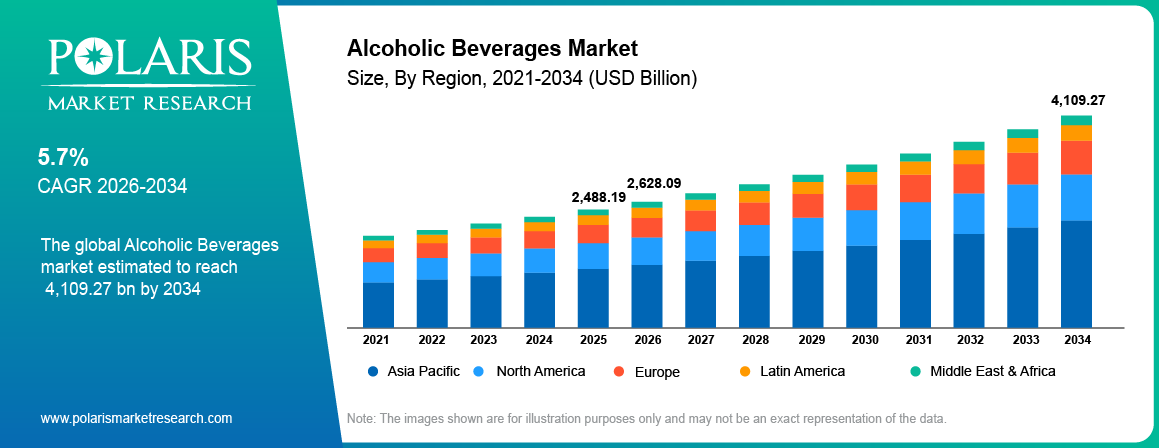
The global alcoholic beverages market was valued at USD 2,488.19 billion in 2025. The market is expected to register a CAGR of 5.7% from 2026 to 2034. Increasing social drinking culture and premiumization trends are supporting steady demand for alcoholic beverages. The growing popularity of premium beer, especially in developed economies such as the U.S. and the UK, propels the industry expansion
Market Statistics
Key Takeaways
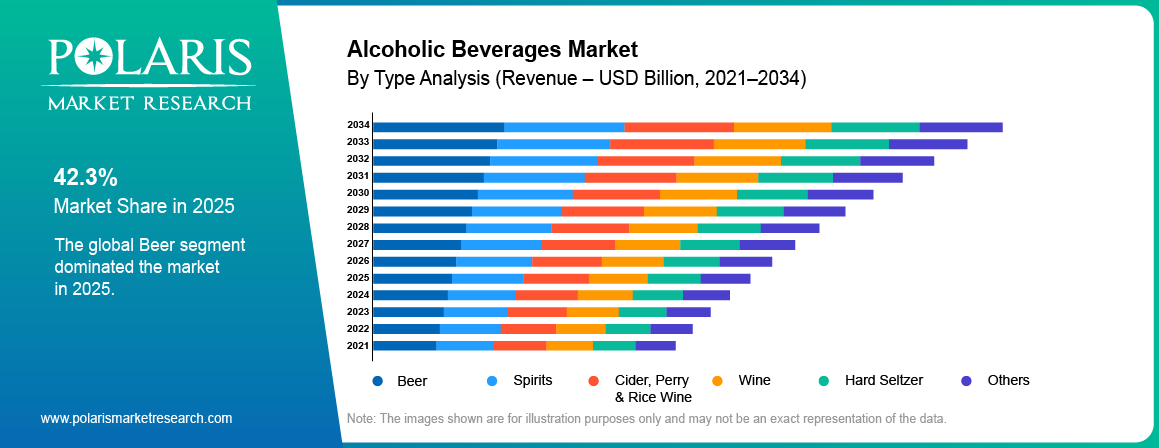
- Asia Pacific dominated with a 38.5% market share in 2025. The regional market growth is attributed to the increasing demand for agave-based spirits in emerging economies.
- The North America alcoholic drinks industry is expected to register the highest CAGR of 6.2% during the forecast period. The increasing demand for refined malt Scotch whiskey in the U.S. and Canada propels the market expansion.
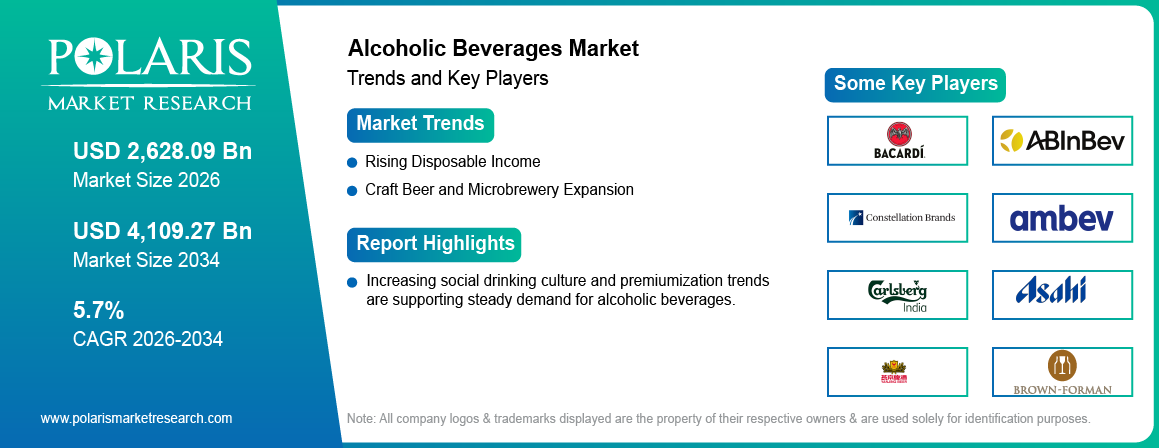
- The beer segment accounted for the largest revenue share of 42.3% in 2025. The rise in popularity of California common beer contributed to the segment’s dominance.
- The liquor stores segment held a revenue share of 25.6% in 2025. Domestic liquor stores, offering a diverse range of alcoholic beverages at competitive prices, boost segmental growth.
- The internet retailing segment is expected to grow at a 7.9% CAGR during the projected period. This is attributed to suppliers' increased focus on the adoption of advanced e-commerce trading technology.
Note: Figures and projections outlined in this report are the result of Polaris Market Research’s proprietary analytical processes, grounded in the latest available datasets and market observations.
What are Alcoholic Beverages?
Alcoholic beverages are drinks that contain alcohol and are made through fermentation or distillation. The alcoholic beverages market comprises research and development, production, and commercialization of alcoholic drinks. A few alcoholic beverages include beer, wine, spirits, cider, perry (pear-based alcoholic drink), rice wine, and hard seltzer. The market also emphasizes ready-to-drink (RTD) beverages. RTD products include pre-mixed cocktails and other packaged alcoholic drinks. Non-alcoholic beverages market, including alcohol-free alternatives, are excluded from this market. Market value is usually measured in revenue, such as US dollars (USD), while volume is measured in litres or kilolitres. The market is structured by type, distribution channel, and region. Sales include both on-trade outlets and off-trade retail channels.
Increasing popularity of pubs, bars, and restaurants contribute to the demand for alcoholic beverages, including beer, wine, and dark spirits. The industry is driven by the growing appreciation for the distinctive flavors of beers that support digestive health. Furthermore, the increasing interest in artisanal spirits in emerging economies like China and India is expected to drive the expansion of the alcoholic drinks market. An upcoming opportunity lies in the growing demand for affordable value-added hard seltzer products.
The alcoholic drinks market is experiencing renewed growth with substantial investments from leading U.K.-based players in acquiring high-quality Scotch whisky products. Key Alcoholic Beverages market players are sourcing top-tier cider, perry, and rice wine to meet the increasing demand. The U.S. market is witnessing a surge in interest for lower-calorie beer supplements, contributing to the industry's expansion. An upcoming opportunity lies in the rising demand for value-added, cost-effective hard seltzer products. Despite these positive trends, challenges include the hindrance posed by the growing preference for non-alcoholic beverages and the considerable capital and time investments required for new businesses in the alcoholic drinks industry. The market is also impacted by health-conscious consumers, limiting overall growth. To address health concerns, major players are introducing cordials and liquors with lower alcoholic content, aligning with the ongoing trend of expanding consumer bases. Additionally, strategies like the "Quarter Strategy," as employed by key players like the Asahi brand, involve offering free beer with every twenty-bottle order through liquor stores to maximize market share.
Alcoholic Beverages Market Trends
1. Premiumization and Craft
There is a rising consumption of premium beer in developed economies like the U.S. and the U.K. Consumers are increasingly choosing higher-quality alcoholic drinks with better ingredients, unique flavours, and attractive packaging. Craft brands are gaining attention by offering small-batch products with distinct tastes and local appeal.
2. RTD Cocktails, Hard Seltzer and Hybrid Drinks
Ready-to-drink cocktails and hard seltzers are popular because they are convenient and easy to consume. Hybrid drinks combine different beverage styles or ingredients to offer new flavours and attract younger adult consumers.
3. Low- and No-Alcohol Moderation
More consumers are reducing their alcohol intake due to health awareness and changing lifestyles. This is increasing interest in low-alcohol drinks and non-alcoholic alternatives.
4. Online and Direct-to-Consumer Retail
Online platforms are helping consumers explore different brands, compare products, and access a wider range of beverages where local laws permit. Direct-to-consumer sales allow brands to connect with customers through their own websites or approved sales channels.
Impact of U.S. Tariffs on Alcoholic Beverages
The U.S. tariffs may lead to augmented costs and disrupt the international sales of alcoholic beverages. According to research conducted by Anderson and Wittwer in 2025, the universal tariff increase in the United States may lead to a decrease in overall exports of wine by 13%, spirit by 22%, and beer by 33%. Therefore, the growing cost and trade instability may lead to a reduction in demand and profit margins for exporters. Moreover, the increased tariffs may lead to the introduction of new customers in some regions due to the relocation of trade to other countries (Source: cambridge.org).
AI Impact on Alcoholic Beverages Market
- Online retailers use AI-powered chatbots that provide personalized recommendations, which enhance customer experiences.
- Brand marketers use AI tools to analyze current and emerging industry trends to create targeted marketing strategies.
- AI-based systems help market players optimize logistics and forecast future demand, which streamlines supply chain management efficiently.
- Beverage producers adopt the technology to create interactive customer experiences and preferences. It helps them develop innovative alcoholic drinks.
Market Dynamics
Drivers: Rising Disposable Income
The surge in spending on alcoholic beverages is notable in various developing economies, including China, India, Singapore, and Indonesia, driven by the expanding young adult workforce. According to the National Bureau of Statistics China, in 2025 the per capita income in China was recorded approx. 43,377 Yuan or USD 6480.83, which was an increase of 5.0% compared to previous year of 2024. With the global economy on the rise and robust growth in developing economies like India, Brazil, and China, disposable income is expected to increase, leading to heightened purchases of premium alcoholic beverages. Consequently, the escalating alcohol consumption among young adults, fueled by a rise in disposable income, is a significant driver of market growth (Source: stats.gov.cn).
Driver: Craft Beer and Microbrewery Expansion
The craft beer market and microbreweries sector has been witnessing immense growth as consumers have become increasingly interested in unique, locally made, high-quality drinks. Unlike industrially made beers, the craft beer movement is associated with small-scale brewing, unique tastes, seasonal beers, and artisanal brewing methods, which are particularly appealing to younger generations. In addition, innovations related to the growing demand for beverages that contain flavors from beer, fruity beers, non-alcoholic craft beers, and other innovative products are boosting innovation in the industry. Also, other trends, such as craft beer tours, beer festivals, brewery tourism, and social media marketing are helping the breweries build their clientele
Driver: On-Trade and Tourism
Bars, restaurants, hotels, and pubs are driving the demand for alcoholic beverages as they are key distribution channels. The need for local liquors, premium spirits, beer, and wine, in particular, is expected to increase with the growing trend of tourism. In addition, the development of nightclubs, festivals, and hospitality businesses is expected to further contribute to the growth of the market. Therefore, an increase in on-trade sales will enable beverage makers to expand their customer base and brand footprint.
Restraint: Excise Taxation
Alcoholic beverages worldwide typically pose higher tax from local and state government. For instance, in the city of Chicago Illinois, beverages containing 20% or more alcohol by volume has a tax rate of USD 2.68 per gallon. This high tax rate fuel up the prices of the end products, which limits the purchase rate for the cost sensitive buyers. High taxation further reduces the industry margin which affects businesses structurally, and operationally. This in turn limit expansion of the industry (Source: chicago.gov).
Restraint: Non-Alcoholic Drinks Impact on Alcohol Sales
The shift towards non-alcoholic and low-alcohol beverage consumption are restraining the industry growth. Consumers are adhering to a healthy lifestyle and limit their alcohol intake. As a result, there is a growing demand for non-alcoholic beer, wine, and other beverages. Moreover, non-alcoholic options are increasingly used as a substitute for hard liquor in social settings. A similar trend is observed in the women’s segment, thereby restraining the market growth.
Opportunity: Value-Added RTDs and Premium Demand in Emerging Markets
Value-added hard seltzers and ready-to-drink (RTD) beverages offer opportunities through new flavours, convenient packaging, and innovative drink formats. There is a growing need for premium spirit drinks among consumers in emerging markets. Consumers are increasingly willing to spend more on high-quality products, including alcoholic beverages. This trend can be taken advantage of by launching value-added products and expanding distribution in high-income countries. Additionally, partnerships with local distributors and product developers is further expected to create an opportunity for global alcohol market size expansion.
Challenge: Licensing Complexity, Capital Intensity, and Input-Cost Volatility
The alcoholic beverages market is highly regulated, which raises the barriers to entry for new players. In addition, distribution and sale of such products requires compliance with strict tax and licensing policies, which also restricts market growth. Moreover, the high capital intensity of production, as well as the volatility of input prices, which reduces producers’ profit margins is further creating challenge for industry growth.
Report Segmentation
By Type Analysis
The beer segment accounted for the largest revenue share of 42.3% in 2025. The segment offers a varied selection of ales, German-style altbiers, and the conventional special bitter type of beer. The expected rise in popularity of California common beer is poised to stimulate market growth in the upcoming years. Furthermore, the increasing request for Belgian-style Flanders to provide B-group vitamins will contribute to the sales of the beer over the forecast period and thereby driving the beer market.
The cider, perry & rice wine segment is expected to witness growth of CAGR 6.1% during the forecast period due to growing demand for fruit-based beverages and traditional alcoholic. This demand is fuelled by the appeal of distinctive flavors and local preferences, as well as product innovations and wider distribution, supporting market growth for this segment.
Wine is expected to witness growth of CAGR 5.4% during the forecast period. An increase in premium beverages consumption, as well as changing consumer behavior, including wine tourism and dining, as well as a growing awareness of the diversity of grape varieties, will drive demand for wine. Moreover, availability plays a critical role in determining the growth of wine market.
Spirits is expected to witness growth of CAGR 5.9% during the forecast period. The rising popularity of premium spirits, cocktails, and the increasing use of spirits for social events, as well as the growing interest in whisky, vodka, rum, and gin, is expected to drive the demand for this segment. Moreover, product development and brand building activities will also contribute to the growth of the spirits market.
Hard Seltzer is expected to witness fastest growth of CAGR 7.2% during the forecast period. Growing mainstream acceptance of this segment, along with the convenience of the packaging and the variety of flavors, as well as ongoing product development, will drive the growth of this segment. Moreover, changing consumer preferences and wider distribution will also contribute to the development of the hard seltzer market.
Beer vs Wine vs Spirits Market
| Factors | Beer | Wine | Spirits |
| Major Raw Materials | Grains | Grapes/ Fruits | Grains/sugar/fruits (distilled) |
| Alcoholic Composition | Low to medium | medium | high |
| Process of Manufacture | Brewing | Fermentation | Distillation |
| Taste Characteristics | Of malt & hops | Fruity & tannic | Concentrated and robust |
| Use by Consumers | Social | Dining/Celebratory | Premium/cocktails |
| Forms of Consumption | Bottles & Cans | Bottles | Bottles & Cocktails |
| Share 2025 / CAGR 2026-2034 | 42.3% Share | 5.4% CAGR | 5.9% CAGR |
Source: Polaris Market Research Analysis
By Distribution Channel Analysis
The liquor stores segment held a revenue share of 25.6% in 2025. The ongoing urbanization in emerging economies is set to establish a well-connected network of liquor stores. The increasing inclination of consumers towards embracing Western culture is anticipated to drive the growth of the alcoholic drinks market. Domestic liquor stores, offering a diverse range of alcoholic beverages at competitive prices, are poised to contribute to segmental growth. Supportive initiatives undertaken by various governments globally to streamline liquor licensing processes are expected to propel market growth.
The internet retailing segment is expected to grow at a 7.9% CAGR throughout the forecast period. This is attributed to suppliers' heightened focus on adopting advanced e-commerce trading technology. Internet retailing facilitates doorstep liquor delivery, contributing to market growth. The rising demand for super-premium wine products via e-commerce portals is a key factor driving market expansion. The proactive measures taken by private firms in the U.S. to meet the demand for alcoholic beverages through e-commerce platforms are further propelling market growth.
Supermarkets is expected to witness growth of CAGR 5.8% during the forecast period. Offering a wide range of products at attractive prices and convenient shopping conditions, such as discounts, and a broad choice, including high and low-priced options, is expected to drive the growth of this channel. A large amount of coverage will also boost sales.
Grocery shops is expected to witness growth of CAGR 5.2% during the forecast period. Convenience of shopping and accessibility make this channel a significant driver for sales. Moreover, since these retailers provide an opportunity to choose from a wide variety of products, including those segments mentioned above, demand will be increased.
Pubs, bars & restaurants is expected to witness growth of CAGR 6.0% during the forecast period. The popularity of alcoholic beverages, especially in pubs and bars, is fueled by the social aspect of drinking. Moreover, a wide range of cocktails and spirits offered by restaurants and bars is expected to further contribute to the rising sales within this channel, as well as the growing tourism industry.
Comparison Matrix, By Distribution Channel
| Segment | Share /CAGR | Driver |
| Supermarkets | 5.8 CAGR | Availability of wide range of products at attractive prices |
| Liquor Stores | 25.6% share | Ongoing urbanization in emerging economies |
| Grocery Shops | 5.2% CAGR | Convenience of shopping and accessibility make this channel a significant driver for sales |
| Internet Retailing | 7.9% CAGR | Driven by suppliers' heightened focus on adopting advanced e-commerce trading technology |
| Pub, Bars & Restaurants | 6.0% CAGR | Driven by social aspect of drinking |
Source: Polaris Market Research Analysis
Regional Insights
Asia Pacific dominated with a 38.5% market share in 2025. This growth can be attributed to the increasing demand for agave-based spirits in emerging economies such as China and India, meeting the rising demand for alcoholic beverages. The emerging trend in India of consuming local spirits is driving market growth. China alcoholic beverages market size is expected to witness fastest growth of CAGR 6.3% during the forecast period due to the increasing adoption of beer, premium gin, and tequila flavors in the country. Moreover, India alcoholic beverages market size is driven by demographic shifts, economic growth, and changing social behaviors.
The North America alcoholic drinks industry is expected to register the highest CAGR of 6.2% due to the increasing demand for refined malt Scotch whiskey in the U.S. and Canada. The rising trend in the U.S. to embrace classic brands of alcoholic beverages, such as Arnold Palmer Spiked Half & Half, Bergenbier, and Burgasko, is poised to contribute to market growth. Furthermore, the financial support provided by private firms in Canada to acquire premium alcoholic beverages is anticipated to enhance market growth. The U.S. alcoholic beverages market size and Canada are expected to witness growth of CAGR 6.3% and 5.8% respectively during the forecast period due to high disposable income, deep-rooted cultural normalization, high affordability due to long-stagnant excise taxes, and widespread retail availability.
Europe alcoholic beverages market is expected to witness growth of CAGR 5.1% during the forecast period driven by the region’s demand for wine and beer, deep-rooted drinking culture, and well-established hospitality industry. Both tourism and food culture play an important role in fueling the demand for alcoholic beverages in the region. Moreover, the growing interest for premium spirits, craft beer, and ready-to-drink cocktails also account for the major influence on the development of the European alcoholic beverages market.
Latin America witnessed alcoholic beverages market growth rate of 6.4% during the forecast period driven by the growing popularity of beer and spirits, as well as the increasing number of tourists and leisure travelers who visit the region. Moreover, the rising middle class and developing retail networks contribute to the growing demand for alcoholic beverages. The local market are offering a wide range of local brands and specialties. The demand for premium spirits and innovative cocktails is further rising, this in turn is fueling the expansion of alcoholic beverages market share in the region.
Middle East & Africa is expected to witness growth of CAGR 4.8% during the alcoholic beverages market forecast 2034 period driven by the growing tourism industry and hospitality sector, which see a demand for local specialties, as well as imported products in markets where alcohol sales are legal. In both regions, developing leisure networks and entertainment industries drives the growth of the industry. Moreover, urbanization and population growth in several African countries contribute to the rising demand for alcoholic beverages, thereby driving the market growth.
Which are the Major Export Countries of Vodka Across the World?
Sweden is the leading exporter of vodka with a share of 17.7%, which is USD 533.4 million in value, in 2025. France ranks second, followed by the United States, Poland, and the Netherlands. saw the highest growth in vodka exports with 36.6%, followed by Sweden with 8.2%. In contrast, U.S. exports of vodka decreased by 3.9% compared to 2024.
Top 5 Exporters of Vodka in 2025
| Rank | Exporter | 2025 Vodka Export Value | Global Share | Change vs. 2024 |
| 1 | Sweden | USD 533.4 million | 17.7% | +8.2% |
| 2 | France | USD 470.8 million | 15.6% | +2.7% |
| 3 | United States | USD 293.5 million | 9.8% | -3.9% |
| 4 | Poland | USD 229.4 million | 7.6% | +2.1% |
| 5 | Netherlands | USD 166.8 million | 5.5% | +36.6% |
(Source: worldstopexports.com)
Key Market Players & Competitive Insights
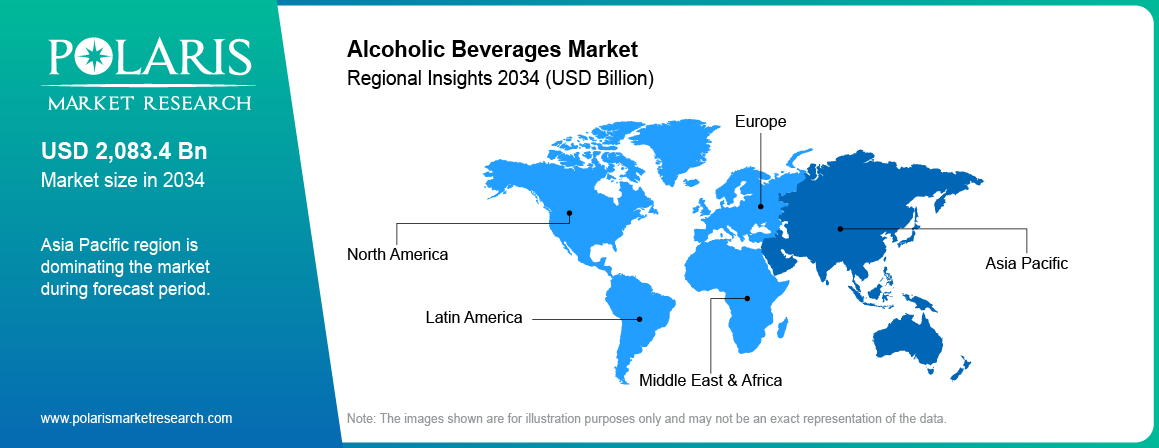
The market is characterized by intense competition, with established players relying on advanced technology, high-quality products, and a strong brand image to drive revenue growth. These companies employ various strategies such as research and development, mergers and acquisitions, and technological innovations to expand their product portfolios and maintain a competitive edge in the market.
Top Alcoholic Beverage Companies:
- Ambev
- Anheuser-Busch InBev SA/NV
- Asahi Group Holdings, Ltd.
- Bacardi Limited
- Beijing Yanjing
- Brown-Forman
- Carlsberg A/S
- Constellation Brands Inc.
- Davide Campari-Milano N.V.
- Diageo plc
- Heineken N.V.
- Kirin Holdings
- Kweichow Moutai
- Molson Coors Beverage Company
- Pernod Ricard SA
- Suntory Global Spirits
- Wuliangye (baijiu)
Vendor Positioning
| Vendor | Headquarters | Core Categories | Market Positioning |
| Ambev S.A. | São Paulo, Brazil | Beer; lager; non-alcoholic beverages; soft drinks | Leading Latin American beverage company with strong mass-market beer presence, extensive distribution, and a broad beverage portfolio. |
| Anheuser-Busch InBev SA/NV | Leuven, Belgium | Beer; lager; premium beer; non-alcoholic beer; hard seltzers; RTDs | Global-scale brewing leader with an extensive international brand portfolio, strong premium beer exposure, and increasing focus on beyond-beer categories. |
| Asahi Group Holdings, Ltd. | Tokyo, Japan | Beer; premium lager; non-alcoholic beer; spirits; soft drinks | Premium beer-focused beverage group with a strong Japanese base and expanding international presence across premium beer and related categories. |
| Bacardi Limited | Hamilton, Bermuda | Rum; vodka; tequila; gin; whisky; liqueurs; RTDs | Diversified global spirits company with strong premium brand positioning and growing exposure to cocktails, convenience formats, and RTDs. |
| Beijing Yanjing Brewery Co., Ltd. | Beijing, China | Lager; draft beer; premium beer | Major Chinese brewer with a strong domestic and regional footprint, supported by mainstream lager and expanding premium beer offerings. |
| Brown-Forman Corporation | Louisville, Kentucky, USA | Whisky; bourbon; tequila; vodka; wine; RTDs | Premium spirits specialist with strong whiskey and bourbon franchises and selective expansion into tequila, RTDs, and other premium categories. |
| Campari Group | Milan, Italy | Aperitifs; bitters; liqueurs; spirits; whisky; tequila; RTDs | Premium spirits and aperitif specialist differentiated by globally recognized brands and a strong presence in premium cocktail-oriented categories. |
| Carlsberg A/S | Copenhagen, Denmark | Beer; premium lager; craft/specialty beer; non-alcoholic beer | Global brewing company with a balanced mainstream and premium portfolio and increasing emphasis on craft, specialty, and low/no-alcohol offerings. |
| Constellation Brands, Inc. | New York, USA | Mexican beer; wine; spirits; RTDs | Premium beer-led company in the U.S. with strong Mexican beer franchises and selective exposure to wine, spirits, and emerging beverage formats. |
| Diageo plc | London, United Kingdom | Whisky; vodka; gin; rum; tequila; beer; RTDs | Leading global spirits company with extensive premium brands, broad geographic reach, and strong category diversification across spirits and ready-to-drink products. |
| Heineken N.V. | Amsterdam, Netherlands | Premium lager; beer; cider; low/no-alcohol beer; RTDs | Major international brewer with strong premium beer positioning, extensive global distribution, and continued investment in low/no-alcohol and adjacent beverage categories. |
| Kirin Holdings Company, Limited | Tokyo, Japan | Beer; beer-like beverages; spirits; wine; soft drinks; pharmaceuticals | Diversified Japanese beverage group with a strong domestic beer position and exposure to multiple beverage and adjacent businesses. |
| Kweichow Moutai Co., Ltd. | Renhuai, Guizhou, China | Baijiu; premium Chinese spirits | Leading premium baijiu producer with exceptional domestic brand equity and a strong position in China's high-end spirits segment. |
| Molson Coors Beverage Company | Chicago, Illinois / Golden, Colorado, USA | Mainstream beer; premium beer; flavored beverages; RTDs; beyond-beer products | Major North American brewer with a broad beer portfolio and increasing diversification into flavored beverages, RTDs, and beyond-beer categories. |
| Pernod Ricard SA | Paris, France | Whisky; cognac; vodka; gin; rum; tequila; champagne; wine | Global premium spirits leader with a highly diversified international brand portfolio and strong exposure to premiumization and luxury consumption trends. |
| Suntory Global Spirits | Chicago, Illinois, USA | Whisky; bourbon; Japanese whisky; tequila; vodka; gin; liqueurs; RTDs | Global premium spirits company with strong American whiskey and Japanese whisky franchises and growing exposure to premium and ready-to-drink categories. |
| Tsingtao Brewery Co., Ltd. | Qingdao, China | Lager; premium beer; craft beer; non-alcoholic beer | Major Chinese brewer anchored by its flagship lager brand, with growing emphasis on premium, craft, specialty, and non-alcoholic beer segments. |
| United Spirits Limited | Bengaluru, India | Whisky; brandy; rum; vodka; gin; RTDs | Leading Indian spirits company with a strong whisky portfolio, extensive domestic distribution, and broad participation across multiple spirits categories. |
| Wuliangye Yibin Co., Ltd. | Yibin, Sichuan, China | Baijiu; premium Chinese spirits | Major premium baijiu producer with strong domestic brand recognition and a well-established position in China's high-end spirits market. |
Source: Polaris Market Research Analysis
Recent Developments
- October 2026: United Spirits launched Smirnoff Ice in India, entering the growing ready-to-drink market. The company aimed to attract younger consumers and expand its premium portfolio through convenient, flavored alcoholic beverages. (source: livemint.com)
- October 2026: Constellation Brands acquired SpikedAde, a vodka-based, sports-drink-inspired ready-to-drink brand, for $75 million plus up to $278 million in performance-based payments. The deal expanded its RTD portfolio and strengthened its position in the fast-growing category. (source: cbrands.com)
- April 2026: Molson Coors Beverage Company announced the completion of the acquisition of Atomic Brands Inc. According to Molson Coors, the acquisition establishes the company as one of the leading suppliers in the rapidly expanding ready-to-drink cocktail segment. (source: molsoncoors.com)
- April 2026: GALLO announced the finalization of an agreement with Kirin Holdings for the acquisition of Four Roses Bourbon. GALLO stated that the acquisition marks a major milestone for Four Roses as it steps into a new era of heritage and growth. (source: prnewswire.com)
- May 2025: Carlsberg Group announced plans to strengthen its India footprint by setting up 2–3 new breweries in Mysuru, Karnataka, aiming to boost annual production capacity from 80 million liters to 160 million liters. (Source: foodtechnetwork.in)
- January 2025: United Breweries launched its new Kingfisher Flavors range, introducing innovative alcoholic beverage options in lemon masala and mango berry twist to expand its flavored offerings. (Source: brewer-world.com)
Alcoholic Beverages Market Segmentations
By Type Outlook (Revenue – USD Billion, Volume – Kiloliters, 2021–2034)
- Cider, Perry & Rice Wine
- Wine
- Beer
- Spirits
- Hard Seltzer
- Others
By Distribution Channel Outlook (Revenue – USD Billion, Volume – Kiloliters, 2021–2034)
- Supermarkets
- Liquor Stores
- Grocery Shops
- Internet Retailing
- Pub, Bars & Restaurants
- Others
By Regional Outlook (Revenue-USD Billion, Volume – Kiloliters, 2021–2034)
- North America
- U.S.
- Canada
- Mexico
- Europe
- Germany
- France
- UK
- Italy
- Spain
- Netherlands
- Russia
- Rest of Europe
- Asia Pacific
- China
- Japan
- India
- Malaysia
- South Korea
- Indonesia
- Australia
- Vietnam
- Rest of Asia Pacific
- Middle East & Africa
- Saudi Arabia
- UAE
- Israel
- South Africa
- Rest of Middle East & Africa
- Latin America
- Brazil
- Argentina
- Rest of Latin America
Alcoholic Beverages Market Report Scope
| Report Attributes | Details |
| Market size in 2025 | USD 2,488.19 billion |
| Market size in 2026 | USD 2,628.09 billion |
| Revenue forecast in 2034 | USD 4,109.27 billion |
| CAGR | 5.7% from 2026 – 2034 |
| Base year | 2025 |
| Historical data | 2021 – 2024 |
| Forecast period | 2026 – 2034 |
| Quantitative units | Revenue in USD billion, Volume in Kiloliters, and CAGR from 2026 to 2034 |
| Segments Covered |
|
| Regional scope |
|
| Customization | Report customization as per your requirements with respect to countries, region, and segmentation. |
Source: Polaris Market Research Analysis
Research Methodology
- Market estimates are derived using a blend of primary and secondary research, validated through weighted-average and combined top-down/bottom-up modeling approaches.
- Secondary research covers company filings, excise tax and alcohol regulation data, trade association reports, consumption and production statistics, industry journals, and paid third-party databases to build baseline estimates.
- Primary research includes interviews with key industry participants such as brewers, distillers, wineries, distributors, and retail and on-trade channel operators, to validate accuracy and capture forward-looking insights.
- Base year considered is 2025, with a forecast provided through 2034; revenues are expressed in USD Billion and volumes in Kiloliters.
- Parent market is identified as the global beverages market; the addressable segment is narrowed using alcohol consumption patterns and per-capita spending across beer, wine, spirits, and emerging categories.
- Bottom-up model aggregates regional alcoholic beverage demand across type and distribution channel, validated against vendor revenue disclosures from Anheuser-Busch InBev, Diageo, Heineken, Pernod Ricard, Constellation Brands, and others.
- Regional coverage spans North America, Europe, Asia Pacific, Middle East & Africa, and Latin America, further segmented by major countries.
- Projected 5.7% CAGR (2026–2034) reflects weighted analysis of rising disposable incomes, growing premiumization trends, expanding e-commerce and online alcohol retail, and increasing popularity of hard seltzers and ready-to-drink products.
- Findings are cross-validated across multiple estimation methods to ensure consistency, accuracy, and reliability of the final market sizing
Alcoholic Beverages Market FAQ's
The global Alcoholic Beverages market size is expected to reach USD 4,109.27 billion by 2034.
The global Alcoholic Beverages market was valued at USD 2,488.19 billion in 2025 and is expected to grow at a CAGR of 5.7% during the forecast period.
Top market players in alcoholic beverages market are Anheuser-Busch InBev SA/NV,Asahi Breweries Ltd. Bacardi Limited Beam Suntory Inc. Carlsberg A/S
Asia Pacific dominated with a 38.5% market share in 2025.
The market is expected to reach USD 2,628.09 billion by the end of 2026.
The key segments in the alcoholic beverages market are type, distribution channel, and region.
Beer holds the largest share of 42.3%, supported by widespread consumption, affordable pricing, strong brand presence, and easy availability across retail and hospitality channels.
The internet retailing segment is expected to witness growth of CAGR 7.9% during the forecast period due to expansion of e-commerce and rising demand for convenient shopping.
Key drivers include rising disposable incomes, premium products, tourism, hospitality growth, social gatherings, product innovation, and expanding retail networks.
These alternatives attract health-conscious consumers and moderate drinkers, encouraging traditional beverage companies to diversify their products and respond to changing preferences.
Tariffs increase import costs, raise consumer prices, disrupt trade flows, and encourage buyers to consider locally produced alternatives.
Download Sample Report of Alcoholic Beverages Market
Please fill out the form to request a customized copy of the research report.


