
Global Automatic Tube Cleaning System Market Size, Share & Growth Analysis Report, 2024-2032
REPORT DETAILS
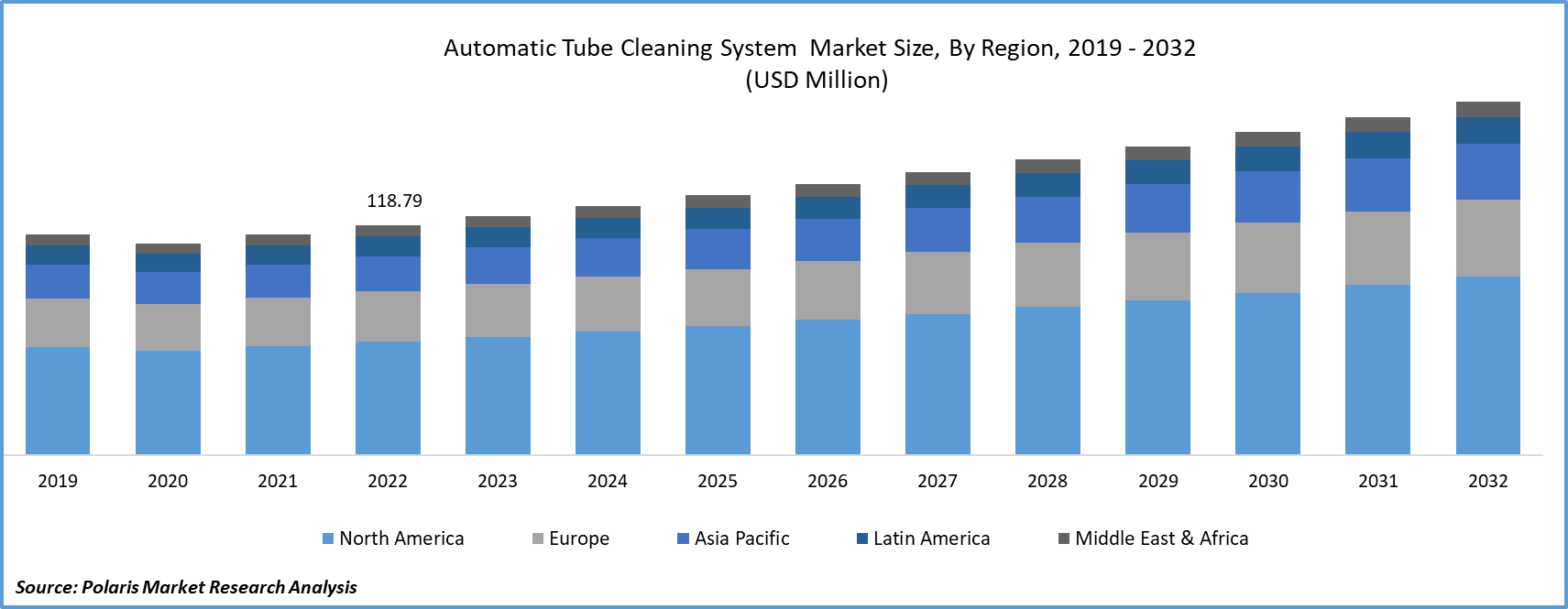
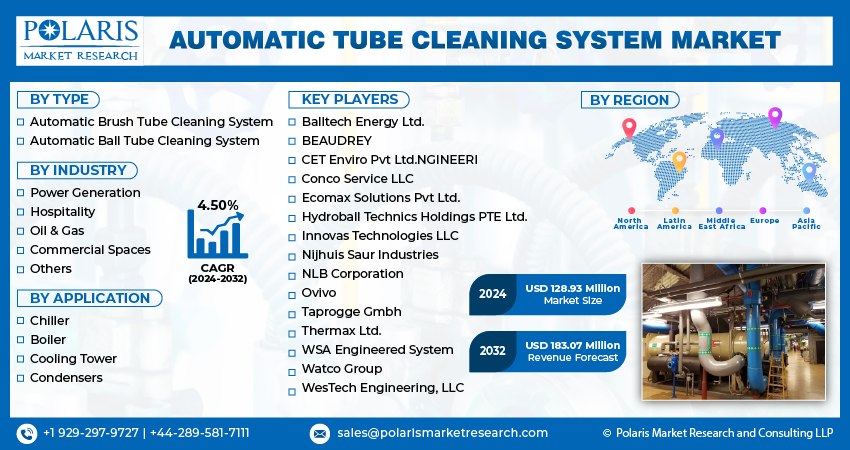
The global automatic tube cleaning system market was valued at USD 123.72 million in 2023 and is expected to grow at a CAGR of 4.50% during the forecast period.
Automatic Tube Cleaning System is a type of system designed for the maintenance and cleanliness of tubes in heat exchangers delivers notable benefits such as cost savings, simplified upkeep, and enhanced energy efficiency. These systems employ hydro-mechanical cleaning techniques to ensure that heat exchanger surfaces remain entirely free from fouling, thus preserving their operational efficiency.
Source: Polaris Market Research Analysis
To Understand More About this Research: Download Sample Report
Automatic tube cleaning systems are utilized to maintain the cleanliness and efficiency of pipes in various industrial applications. These systems prevent or remove deposits to ensure optimal performance of the equipment and can employ techniques like brushes, scrapers, or high-pressure water jets. This improves energy efficiency, reduces maintenance costs, and prolongs the lifespan of industrial equipment, particularly in heat exchangers, condensers, and other areas where deposits can accumulate and hinder fluid flow.
- For instance, Furthermore, individuals with diabetes often require ongoing medical attention due to increased hospitalization rates. It, in turn, contributes to the higher demand for coronary stents, as they are frequently used in treating diabetic patients with coronary artery disease.
Growing demand for automatic tube cleaning systems in power generation, HVAC and manufacturing industries due to their ability to maintain optimal performance of heat exchangers and tube-based equipment. This leads to efficient heat transfer, reduced energy consumption, and significant economic benefits. Their alignment with energy efficiency, sustainability objectives, and environmental rules makes them an attractive choice for various industries.
The COVID-19 pandemic has significantly impacted the automatic tube cleaning system market. This market caters primarily to industries such as HVAC, power generation, and industrial processing, where efficient heat exchanger and condenser tube systems are critical. Due to lockdowns and social distancing measures, many of these industries experienced disruptions, leading to a reduced demand for automatic tube cleaning systems. As a result, companies prioritized cost-cutting and deferred non-essential capital investments, leading to decreased maintenance and cleaning of tube systems.
Source: Polaris Market Research Analysis
However, the pandemic has also highlighted the importance of maintaining clean and efficient HVAC systems in healthcare facilities and public spaces. This has led to an increased focus on improving indoor air quality. This shift in perspective could drive demand for automatic tube cleaning systems, particularly in sectors where clean air and environmental safety are essential. As companies explore more automated and contactless solutions in the post-pandemic landscape, the adoption of smart technologies in the operation and maintenance of tube systems might see an upswing.
Industry Dynamics
Growth Drivers
-
Increasing awareness about the hygiene and safety will drives Market Growth
Rising awareness about hygiene and safety will facilitate the growth of market. The growing emphasis on hygiene and safety in various industries is significantly fueling the expansion of the automatic tube cleaning system market. As businesses and organizations increasingly recognize the critical importance of maintaining clean and safe environments, the demand for innovative solutions that can automate and enhance tube cleaning processes is on the rise. These automatic tube cleaning systems offer a proactive approach to preventing contamination, microbial growth, and scale buildup within tubes and pipes, ensuring that equipment operates efficiently and that the risk of contamination-related issues is minimized.
With the heightened awareness of hygiene and safety standards, industries ranging from food processing to HVAC and power generation are actively adopting these systems to ensure compliance with stringent regulations and to safeguard the well-being of both their products and personnel. As a result, the automatic tube cleaning system market is witnessing robust growth as it addresses the pressing need for improved sanitation and safety across various sectors.
Report Segmentation
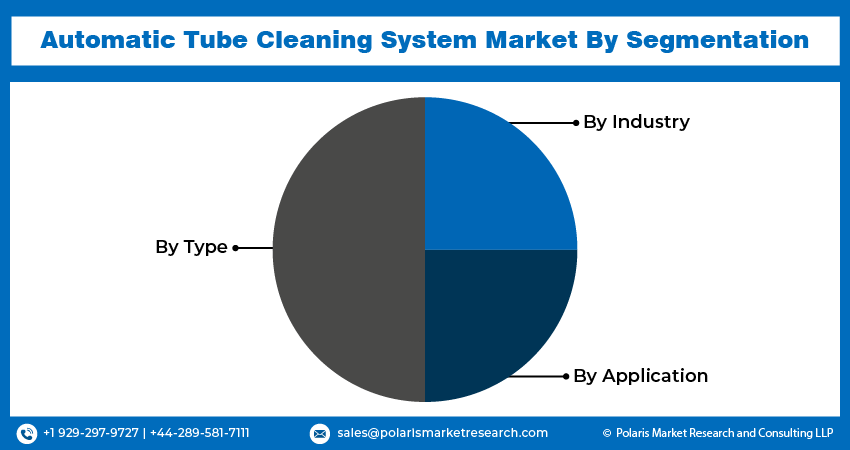
The market is primarily segmented based on type industry, application, and region.
| By Type | By Industry | By Application | By Region |
|
|
|
|
Source: Polaris Market Research Analysis
To Understand the Scope of this Report: Request Customization
By Type Analysis
-
The automatic ball tube cleaning system segment accounted for the largest revenue share during the forecast period
On the basis of type the automatic tube cleaning system market is bifurcated into automatic brush tube cleaning system and automatic ball tube cleaning system. Between this the ball tube cleaning system is dominating the market with the highest revenue share. The ball tube cleaning system has gained growing popularity as a tube-cleaning method. This method involves using an injection pump to introduce rubberized balls, which are just slightly larger than the tube's circumference, into heat exchanger tubes. These balls are dispersed throughout multiple tubes, effectively cleaning them. This technology has proven particularly beneficial for large condensers utilized in power plants, leading to improved heat transfer efficiency. Furthermore, ongoing technological advancements in ball tube cleaning systems have yielded more efficient, reliable, and scalable solutions.
Enhancing power generation efficiency while reducing expenses associated with decreased fuel consumption is the primary goal. The sponge-ball tube cleaning system technology has long served as a widely recognized and embraced industry standard for maximizing condenser efficiency in the power generation sector.
By Industry Analysis
-
The power generation segment dominating the market with largest revenue share during the forecast period
On the basis of Industry, the market has been bifurcated into power & generation, hospitality, oil & gas, commercial spaces and others. The power generation segment dominating the market with largest share during the forecast period. It plays a vital role in industrial operations, particularly in processes like steam production and cooling condensation. Water-based cooling systems within power plants often encounter a persistent problem of heat exchanger surfaces becoming clogged. This leads to decreased efficiency, resulting in higher energy consumption, increased CO2 and NOx emissions, and elevated operational costs.
The accumulation of deposits on the condenser reduces its overall effectiveness and necessitates higher energy usage in power plants, ultimately impacting their profitability. Consequently, the installation of automated tube cleaning systems is a common practice in power generation facilities, ensuring optimal energy production by continuous and automatic clog removal.
Source: Polaris Market Research Analysis
Regional Insights
-
Asia-Pacific dominating the market with largest revenue share during the forecast period
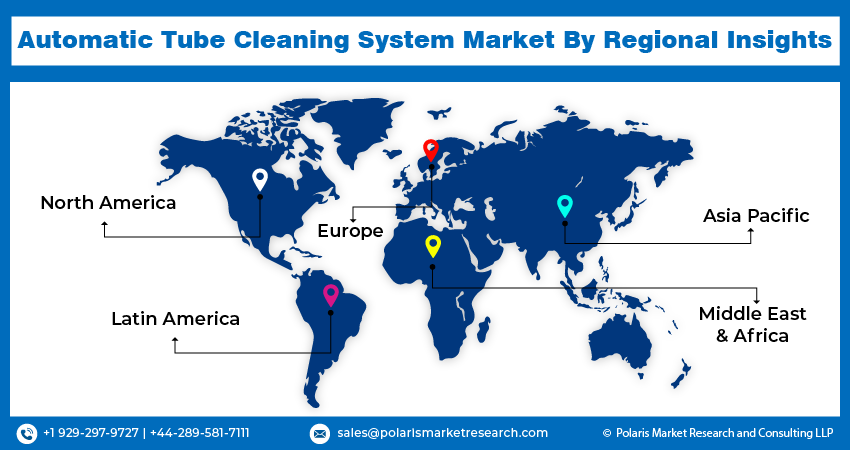
Asia-Pacific dominating the market with largest revenue share in the forecast period. The surging adoption of automatic tube cleaning systems across various sectors in the Asia Pacific region, including industrial settings, the oil and gas industry, and hospitals, has led to a surge in customer demand for these systems. Notably, China, India, and Japan have witnessed increased investment and substantial advancements in their industrial sectors. These nations, serving as global industrial hubs, exhibit substantial growth potential for the automatic tube cleaning system market.
Furthermore, the escalating demand for electricity, driven by urbanization and population growth, underscores the necessity for power plants to meet the rising energy needs. As India and China continue to expand their utilization of renewable energy sources, it is expected that the market for automatic tube cleaning systems within these power plants will experience significant growth throughout the forecast period.
North America is anticipating to grow fastest during the forecast period. Due to the increasing acceptance of automatic tube cleaning, particularly in industries such as oil and gas, as well as various institutions, is fueling a considerable surge in demand for this product. Moreover, the expanding possibilities and prospects for growth in the automatic tube cleaning system market are creating ample opportunities for increased demand.
Source: Polaris Market Research Analysis
Key Market Players & Competitive Insights
The market is characterized by intense competition, with established players relying on advanced technology, high-quality products, and a strong brand image to drive revenue growth. These companies employ various strategies such as research and development, mergers and acquisitions, and technological innovations to expand their product portfolios and maintain a competitive edge in the market.
Some of the major players operating in the global market include:
- Balltech Energy Ltd.
- BEAUDREY
- CET Enviro Pvt Ltd.NGINEERI
- Conco Service LLC
- Ecomax Solutions Pvt Ltd.
- Hydroball Technics Holdings PTE Ltd.
- Innovas Technologies LLC
- Nijhuis Saur Industries
- NLB Corporation
- Ovivo
- Taprogge Gmbh
- Thermax Ltd.
- WSA Engineered System
- Watco Group
- WesTech Engineering, LLC
Recent Developments
- In October of 2022, Innovas Technologies launched the Helios Automatic Tube Cleaning System, an innovative solution designed to address fouling problems in water-cooled chiller plants. This pioneering system is a testament to Innovas Technologies' commitment to constantly pushing the limits of energy-efficient technology.
Automatic Tube Cleaning System Market Report Scope
| Report Attributes | Details |
| Market size value in 2024 | USD 128.93 million |
| Revenue forecast in 2032 | USD 183.07 million |
| CAGR | 4.50% from 2024 – 2032 |
| Base year | 2023 |
| Historical data | 2019 – 2022 |
| Forecast period | 2024 – 2032 |
| Quantitative units | Revenue in USD million and CAGR from 2024 to 2032 |
| Segments Covered | By Type, By Industry, By Application, By Region |
| Regional scope | North America, Europe, Asia Pacific, Latin America; Middle East & Africa |
| Customization | Report customization as per your requirements with respect to countries, region and segmentation. |
Source: Polaris Market Research Analysis
Download Sample Report of Automatic Tube Cleaning System Market
Please fill out the form to request a customized copy of the research report.


