
Autonomous ISR Systems Market Size, Share, Trends and Forecast, 2026–2034
REPORT DETAILS
Autonomous ISR Systems Market Summary
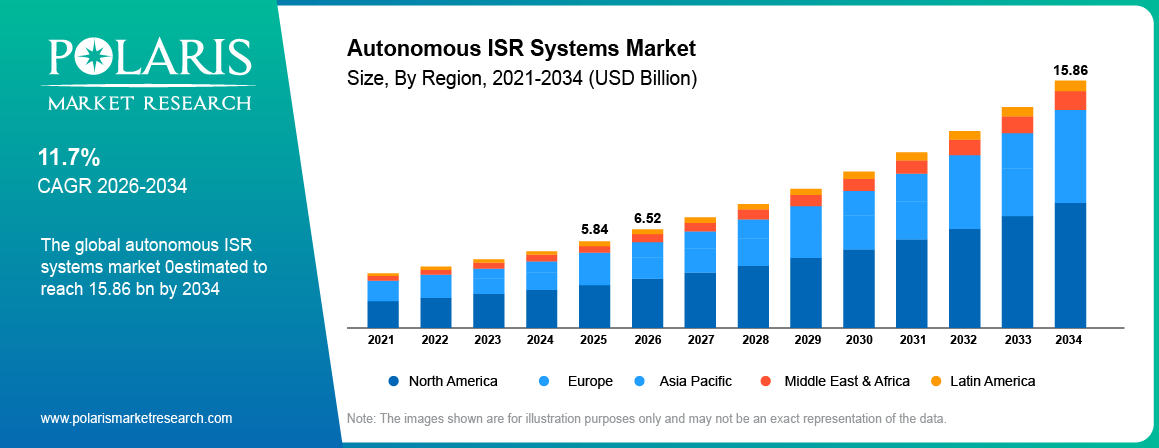
Autonomous ISR systems market size was valued at USD 5.84 billion in 2025. The market is expected to grow at a CAGR of 11.7% from 2026 to 2034. Market growth is driven by rising demand for persistent intelligence collection, expanding procurement of uncrewed surveillance platforms, and growing adoption of autonomous technologies across air, land, sea, and space.
Market Statistics
Key Takeaways
- North America accounted for 37.30% of the market in 2025, driven by US military procurement and satellite intelligence programs.
- Asia Pacific is growing at the highest CAGR of 12.90% during 2026–2034, driven by rising demand for autonomous ISR platforms and defense surveillance.
- Air platform segment constituted 44.60% market share in 2025, with ISR drones and maritime surveillance aircraft being dominant.
- Space platform segment is forecasted to register a growth rate of 15.36% CAGR, owing to rising demand for satellite imagery and reconnaissance services.
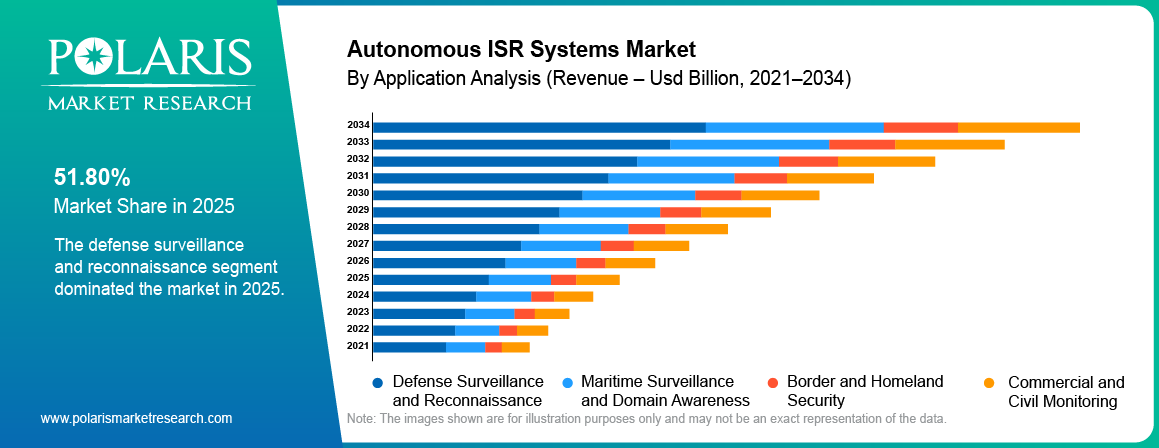
- The defense surveillance and reconnaissance segment constituted 51.80% market share in 2025, on account of increasing military demand for intelligence and uncrewed platforms.
Note: Figures and projections outlined in this report are the result of Polaris Market Research’s proprietary analytical processes, grounded in the latest available datasets and market observations.
What is an Autonomous ISR Systems Market?
The autonomous ISR systems market covers uncrewed and autonomy-enabled platforms designed to collect intelligence, conduct surveillance, and perform reconnaissance across air, land, sea, and space. The unmanned ISR systems market includes platforms, sensors, mission software, and data links used to collect and transmit operational information. These platforms cater to defense and security purposes such as border surveillance and threat detection among others. The level of autonomy varies by platform and mission, so systems are classified according to their documented capabilities and intended use.
The market includes unmanned aerial vehicles, unmanned ground vehicles, unmanned surface vehicles, uncrewed undersea vehicles, and space-based intelligence services. The key technologies are electro optical and infrared sensors, synthetic aperture radar, signal intelligence, edge AI, and secure data links. They assist in collecting information under different conditions for surveillance missions. The autonomous ISR systems market analysis concentrates on the part of each platform and service associated with the intelligence, surveillance, and reconnaissance and not the total value of each defense system.
The market boundaries differentiate autonomous ISR systems from other defense categories. The military drones and airborne ISR systems are considered only up to the point when their mission documentation confirms intelligence collection or surveillance or reconnaissance. Programs from companies such as Boeing and L3Harris Technologies require mission-level classification rather than automatic inclusion of every aircraft or defense system. A collaborative combat aircraft also requires evidence of a stated ISR mission. Platforms focused solely on strike, logistics, or fire support remain outside the core market scope. The Space Development Agency Tracking Layer is adjacent to ISR because it is missile warning from space (Source: Business Wire). The boundary test is whether a source names an intelligence, surveillance or reconnaissance mission, and systems with a stated strike or logistics role only fall outside the scope.
Market Dynamics
Driver and Opportunity Impact Analysis
Demand for autonomous surveillance platforms and commercial satellite intelligence, together with maritime autonomy and cross platform software integration, shapes the outlook for the autonomous ISR systems market.
| Driver or Opportunity | Type | Est. CAGR Impact | Geographic Relevance | Impact Timeline |
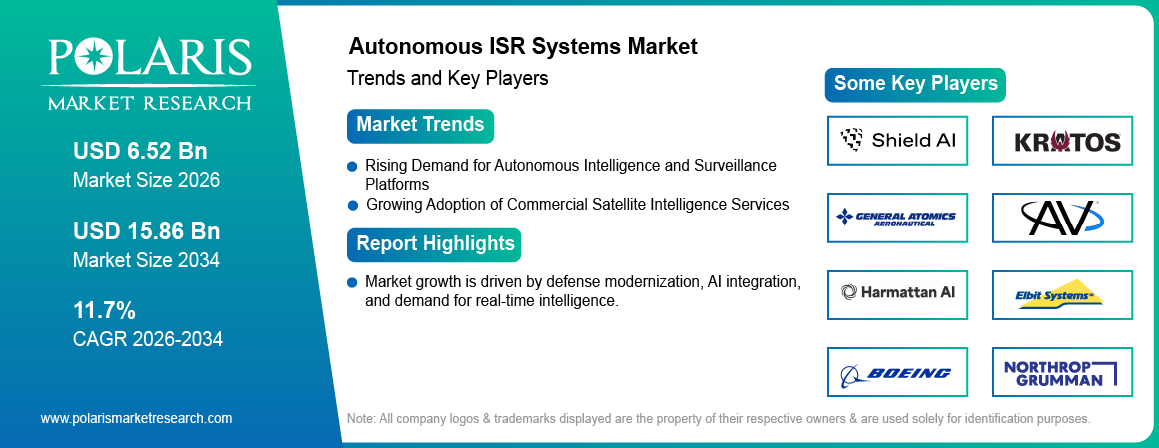
| Rising Demand for Autonomous Intelligence and Surveillance Platforms | Driver | 2.60% | Global | Short to Medium Term |
| Growing Adoption of Commercial Satellite Intelligence Services | Driver | 1.40% | North America, Europe | Medium Term |
| Expanding Autonomous Maritime and Undersea Surveillance | Opportunity | 1.80% | North America, Europe | Medium to Long Term |
| Cross-Platform Autonomy Software and Sensor Integration | Opportunity | 2.20% | North America, Europe | Long Term |
** Indicative estimates based on market context and analyst judgment. Figures reflect relative driver weight. Source: Polaris Market Research Analysis.
Driver: Rising Demand for Autonomous Intelligence and Surveillance Platforms
The autonomous ISR systems market serves defense users that require intelligence collection, surveillance, and reconnaissance across different operational areas. Uncrewed platforms help collect information without requiring personnel to remain at the point of operation. The ISR drones market covers aerial systems used for observation and reconnaissance missions. In June 2025 Quantum Systems opened a new US production and integration facility in California, to increase manufacturing capacity and speed delivery of AI-powered autonomous ISR drones. They gather and send data through sensors, communication systems and mission software. Edge AI helps process information closer to the source. This reduces reliance on remote processing for some tasks. Demand also includes ground, maritime and undersea platforms. These systems give defense users more options to watch areas and collect mission data (Source: Quantum Systems).
Driver: Growing Adoption of Commercial Satellite Intelligence Services
Commercial satellites fall within the broader category of autonomous ISR systems. The satellites deliver imagery and other data for intelligence gathering, surveillance, and reconnaissance operations. In September 2026, Kepler Aerospace raised USD 8 million to develop and deploy six autonomous ISR satellites for India’s defense space ecosystem under two iDEX contracts. Government agencies use commercial data to extend their access to intelligence resources. Proliferated low Earth orbit satellite networks add more collection options across large geographic areas. Satellite operators also provide tasking services to direct data collection toward areas of interest. Tip and cue methods help users direct one sensor to investigate information identified by another source. These capabilities connect commercial space assets with wider intelligence operations. The market includes relevant data services, collection systems, and related technologies used for ISR missions (Source: Inc42).
Restraint: Limited Disclosure of Mission Scope, Contract Value, and Autonomy
Limited public information creates challenges in measuring the autonomous ISR systems market. Announcements may not state a platform’s mission, contract value, quantity, or level of autonomy. Some programs cover several activities, making it difficult to separate ISR-related spending from other costs. A datalink may support communication between a platform and its operator, but its presence alone does not establish that a system performs an ISR mission. Market analysis therefore requires a clear distinction between confirmed ISR applications and wider defense programs. Missing details also limit comparisons across suppliers.
Opportunity: Expanding Autonomous Maritime and Undersea Surveillance
Autonomous platforms for maritime and undersea operations enable surveillance of coastal waters, shipping lanes, and the undersea environment. An unmanned surface vehicle collects information from the water’s surface, while an autonomous undersea vehicle gathers data below the surface. In October 2026, Exail unveiled Neptis, an autonomous maritime surveillance system that combines uncrewed surface vessels, distributed sensors, and command-and-control software for ISR and naval missions. These developments create opportunities for ISR orders for surface vehicles as naval forces expand maritime surveillance capabilities. Key applications include reconnaissance, vessel monitoring, and maritime domain awareness. Demand also creates opportunities for sensors, navigation systems, communication links, and mission software. The U.S. Navy's CAMP program, which selected Anduril's Dive XL extra large undersea vehicle in March 2026, is a relevant area for tracking procurement activity (Source: Naval News). (Source: Ocean News)
Opportunity: Cross-Platform Autonomy Software and Sensor Integration
Autonomy software and sensor technologies present opportunities across aerial, ground, maritime and space-based ISR platforms. Software enables platforms to navigate, process sensor inputs and execute tasks assigned to them, with different levels of operator involvement. Sensors, such as electro-optical and infrared systems, synthetic aperture radar and signals intelligence equipment gather different types of information. Edge AI helps process selected data at or near the point of data collection. In March 2026, Shield AI raised USD 2 billion to scale its Hivemind autonomy software (Source: The Next Web). Cross-platform integration also helps operators manage data from different systems.
Market Segmentation Analysis
The report provides a comprehensive autonomous ISR systems market analysis by platform, component, and application, and region to identify key market segments and emerging growth opportunities.
Segment Summary Table
| Segment | Category | Forecast CAGR | Key Driver |
| Air | Largest platform | 10.42% | Long endurance ISR drones |
| Space | Fastest growing platform | 15.36% | Satellite imagery demand |
| Platform Hardware | Largest component | 30.20% | Physical ISR platforms |
| Software and Autonomy | Fastest growing component | 15.82% | Autonomy functions |
| Defense Surveillance and Reconnaissance | Largest application | 51.80% | Defense intelligence needs |
| Maritime Surveillance and Domain Awareness | Fastest growing application | 14.34% | Naval surveillance expansion |
Source: Polaris Market Research Analysis
Platform Insights
Air is leading the autonomous ISR systems market with the largest market share of 44.60% in 2025. This segment includes unmanned aerial vehicles used for intelligence collection, surveillance, and reconnaissance. Airborne platforms are equipped with electro-optical sensors, infrared detectors, SAR radars, and other mission payloads. Their applications include area monitoring, border surveillance, and defense reconnaissance. Airborne platforms differ in flight endurance, operating range, payload capacity, and autonomy. The segment also covers ISR drones used to collect and transmit mission data.
Land is growing at a CAGR of 10.86% during 2026–2034. This segment includes unmanned ground vehicles used for reconnaissance, perimeter monitoring, and surveillance. These vehicles carry cameras, sensors, navigation and communications systems to gather information. Using autonomous functions, vehicles find their way along routes and carry out tasks assigned to them, with the driver taking part to differing extents. Users in the defense sector use ground platforms to gather information in areas that could be dangerous for personnel. Milrem Robotics is a significant industry player in this segment.
Sea accounts for 20.10% of the autonomous ISR systems market in 2025. This segment includes unmanned surface vehicles and uncrewed undersea vehicles for maritime intelligence, surveillance and reconnaissance. Surface vehicles collect information in coastal waters, ports and shipping lanes. Underwater vehicles collect data below the water’s surface for naval surveillance. These platforms are equipped with sensors, navigational equipment and communication links. Applications include vessel monitoring, underwater observation and maritime domain awareness. Saildrone is a key player in maritime data collection in the industry.
Space will represent 13.90% of the autonomous ISR systems market in 2025. Space is growing at the highest CAGR of 15.36% during 2026 to 2034. This section is concerned with satellite-based systems and related services used in intelligence collection and surveillance. Satellite images and remote sensing data enable users to monitor vast geographic areas. Collection and tasking services are also available from commercial satellite providers to government and defense customers. Larger LEO networks create more collection opportunities. Tip and cue methods help operators use information from one source to guide collection through another.
Component Insights
Platform Hardware is leading the market with the largest market share of 30.20% in 2025. This segment includes physical platforms used for aerial, ground, maritime, undersea, and space-based ISR missions. Hardware includes the vehicle structure, propulsion, power systems, navigation equipment and onboard computing hardware. Operational range, persistence, payload capacity and mission applicability are affected by platform design. Different configurations serve different environments and different collection requirements. The market estimates do not capture the full value of broad defense programs, but only hardware related to qualifying ISR missions.
Sensors, Payloads and Datalinks to Account for 20.10% of the Autonomous ISR Systems Market in 2025. This section covers equipment used to gather and transmit mission information. Sensors consist of electro-optical and infrared systems, synthetic aperture radar and signals intelligence gear. The payload selected depends on the information required and the operating environment. Datalinks transfer information between platforms, operators, and mission systems. These components serve aerial, ground, maritime, undersea, and space-based platforms. General communication equipment is included only when its connection to an eligible ISR mission is documented.
Software and Autonomy is growing at the highest CAGR of 15.82% during 2026–2034. This segment includes mission software, navigation tools, sensor control, autonomy functions, and platform management systems. These technologies help platforms to do what they are supposed to do, processing sensor inputs and relaying mission data. Edge AI allows some information to be processed closer to where it is collected. The degree of autonomy is a function of the platform and the mission. Shield AI's Hivemind is an example of ISR autonomy software.
In 2025, Data and Services will account for 20.30% of the market. This element encompasses ISR data access, imagery products, collection tasking, data processing, and associated analytical services. Users in government and defense get their information from dedicated platforms and commercial providers. Services include access to satellite imagery, collection planning, data delivery and processing for surveillance missions. Also, commercial providers provide information used to monitor maritime activity. This portion includes revenue directly related to eligible ISR data and services. Where contracts are wider and include unrelated activities care needs to be taken in the use of reported values.
Application Insights
Defense Surveillance and Reconnaissance leads the market, holding the largest market share of 51.80% in 2025. This application is for defense missions such as intelligence collection, surveillance, and reconnaissance. Platforms monitor operational areas, observe routes, collect battlefield information, and monitor activity in areas of interest. Systems may operate in air, on land, at sea, underwater, or in space. Sensors and datalinks transfer mission data to operators and command centers. Platforms used solely for strike, logistics, or other non-ISR missions are excluded.
Maritime Surveillance and Domain Awareness is growing at the highest CAGR of 14.34% during 2026–2034. This application covers monitoring of coastal areas, ports, shipping routes, and offshore waters. Unmanned surface vehicles, uncrewed undersea vehicles, aerial platforms, and satellite data provide maritime information. These capabilities enable users to view vessel activity and monitor areas of interest. The combination of data from multiple sources can improve maritime domain awareness. The segment contains naval and commercial activity stated as surveillance or reconnaissance.
Border and Homeland Security account for 18.20% of the autonomous ISR systems market in 2025. This application includes autonomous and uncrewed systems used to monitor borders, coastal approaches, restricted areas, and critical facilities. Aerial platforms provide observation over wide areas, while ground systems monitor defined locations and access routes. Satellite imagery and remote sensing services help users observe activity across larger areas. Sensors collect information for security teams, and communication systems transfer data to operators. The segment includes platforms and services with a documented border or homeland security surveillance role.
In 2025, Commercial and Civil Monitoring represents 9.40% of the autonomous ISR market. The application includes ISR data services and appropriate autonomous platforms for non-military surveillance. Examples are monitoring maritime traffic, examining infrastructure, monitoring environment and surveillance of remote areas. Unmanned aerial platforms collect visual information, while surface and undersea vehicles monitor selected water-based environments. Commercial satellite services provide imagery and related information for large areas. Software and data services help users process collected information. The segment includes activities with a documented intelligence, surveillance, or reconnaissance purpose.
Regional Insights
The autonomous ISR systems market covers North America, Europe, Asia Pacific, Middle East and Africa, and Latin America. Regional demand depends on defense procurement, unmanned platform deployment, satellite intelligence services, and autonomy software investments. The analysis covers defense reconnaissance, maritime security, border monitoring, and commercial applications involving ISR drones, unmanned ground vehicles, and uncrewed undersea vehicles.
North America Autonomous ISR Systems Market Trends
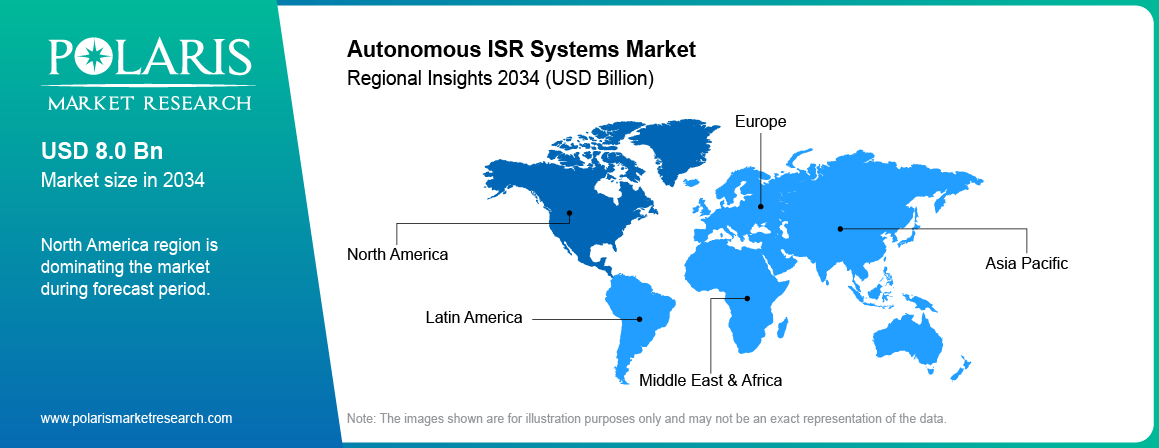
North America dominated the autonomous ISR systems market with the largest market share of 37.30% in 2025. Demand comes from defense programs focused on intelligence collection, surveillance, and reconnaissance across air, land, sea, and space platforms. Skydio launched its ISR Command platform in October 2026 to coordinate autonomous drones, conduct persistent aerial surveillance, and share real-time intelligence across military command networks. The region also has established suppliers of unmanned systems, autonomy software, sensors, and satellite intelligence services. Defense agencies use these technologies for surveillance, intelligence collection, and mission planning. Commercial satellite data further strengthens regional monitoring capabilities. Demand also reflects procurement of unmanned ground vehicles, autonomous ISR drones, and maritime platforms. Contracts for autonomous ISR drones in 2026 reflect continued procurement activity as defense agencies expand their surveillance and reconnaissance capabilities (Source: Skydio). In June 2026, the U.S. Air Force awarded Increment 1 collaborative combat aircraft production contracts to Anduril Industries and General Atomics Aeronautical Systems (Source: DefenseScoop)
Europe Autonomous ISR Systems Market Trends
Europe held 24.00% of the autonomous ISR systems market in 2025. Regional demand reflects defense reconnaissance, border monitoring, maritime surveillance, and the deployment of unmanned platforms. In October 2026, Czech-based TRL Defense unveiled its ISR Mapper drone, designed to connect tactical reconnaissance with satellite-based intelligence. Governments and defense organizations procure aerial and ground systems for intelligence collection and operational monitoring. Unmanned ground vehicles serve reconnaissance missions, with unmanned ground vehicle reconnaissance orders reflecting demand for ground-based intelligence capabilities. Advanced sensors, data links, and mission software improve data collection and communication. Regional suppliers also develop autonomous platforms and related technologies, contributing to the autonomous surveillance and reconnaissance systems market. Market growth depends on defense procurement priorities, cross-border security requirements, and investment in surveillance capabilities (Source: Army Recognition). In June 2026, France ordered 5,000 additional Sonora ISR drones from Harmattan AI, expanding a 1,000 unit program signed in June 2025 (Source: Army Technology)
Asia Pacific Autonomous ISR Systems Market Trends
Asia Pacific is projected to grow at the highest CAGR of 12.90% during 2026–2034. Regional demand spans defense surveillance, maritime monitoring, border security, and satellite-based intelligence collection. In August 2026, XTEND delivered hundreds of M6F tactical ISR systems to an Asia-Pacific defense customer for portable, real-time intelligence, surveillance and reconnaissance operations. Reconnaissance over large operating areas is performed by aerial platforms, and maritime systems watch coastal waters and shipping routes. Uncrewed underwater vehicles conduct naval surveillance and underwater observation missions. These systems are equipped with sensors, datalinks and autonomy software. Commercial satellite services also provide intelligence for surveillance of selected areas. Market growth is driven by defense spending, platform procurement, technology investment, and changing mission requirements (Source: XTEND).
Middle East and Africa Autonomous ISR Systems Market Trends
Autonomous ISR systems market in the Middle East and Africa was 5.00% in 2025. Regional demand includes border surveillance, defense reconnaissance, coastal monitoring and critical infrastructure protection. Large areas are monitored by unmanned aerial platforms and ground systems support surveillance around strategic sites and transport routes. Maritime platforms support coastal surveillance and vessel monitoring. Satellite imagery and associated services are also part of intelligence gathering. Market demand varies across countries, depending on security priorities, defense budgets and access to cutting-edge technologies. In June 2026, Harmattan AI announced a strategic partnership with Morocco's Royal Armed Forces to establish local autonomous systems production and an AI research center (Source: Tech Times).
Latin America Autonomous ISR Systems Market Trends
The autonomous ISR systems market in Latin America was 5.80% in 2025. Regional demand includes border monitoring, maritime surveillance, environmental observation and defense reconnaissance. Unmanned aerial vehicles patrol remote areas and border routes. Maritime platforms and satellite data also support maritime domain awareness. For these activities, government agencies and commercial users require sensors, communication systems, and data services. Market growth depends on procurement budgets, operational requirements, and access to suitable technologies.
Import Export Analysis
Trade in ISR platforms depends on export control policy, as the U.S. State Department moved to review advanced unmanned aircraft in the same way as crewed fighter aircraft in September 2025 (Source: Arms Control Association).
| Region | Trade Position | Export Control Context | Trade Link | Implication |
| North America | Net exporter | MTCR policy shift and BIS civil UAV rule | U.S. supply to allied forces | Easier licensing for suppliers |
| Europe | Exporter and importer | National licensing under MTCR | Local production partnerships | Supply shifts to local assembly |
| Asia Pacific | Importer | National licensing and offsets | Direct purchases and joint ventures | Local production requirements |
| Middle East and Africa | Importer | MTCR and end use rules | Partnerships with European suppliers | Demand for local production |
| Latin America | Importer | National licensing | No dated award found | Limited verified trade data |
Source: Polaris Market Research Analysis.
Competitive Landscape
The autonomous ISR systems market includes platform manufacturers, autonomy software developers, sensor suppliers, and intelligence data providers. Companies compete across aerial, ground, maritime, and space-based systems. Kratos Defense & Security Solutions and Shield AI are relevant companies in the autonomous systems landscape. Competitive positioning is a function of platform capabilities, autonomy software, sensor integration, communication systems and mission requirements. Suppliers also vary in their focus on hardware, software and integrated solutions. These differences affect customer choice across defense surveillance and reconnaissance programs.
The competition in the autonomous ISR systems industry is driven by factors such as operating range, endurance, payload capacity, autonomy, sensor performance, data processing, and system reliability. Secure datalink helps to transfer mission information between platforms and operators. Software integration and compatibility with existing defense systems also impact supplier selection. Buyers evaluate mission suitability, maintenance requirements, deployment time, and lifecycle costs. The leading companies include businesses with a range of capabilities across platforms and technologies.
Autonomous ISR Systems Vendor Landscape Snapshot
| Company | Market Position | Primary Strength | Domain | Geographic Focus |
| General Atomics Aeronautical Systems | Leader | Long endurance UAS and CCA production | Air | North America, Global |
| Northrop Grumman | Leader | Long endurance maritime surveillance UAS | Air | North America |
| Elbit Systems | Leader | Hermes 900 and maritime autonomy | Air, Sea | Global |
| Lockheed Martin | Leader | Mission integration for naval autonomy | Sea, Space | North America |
| L3Harris Technologies | Leader | Space sensors and onboard processing | Space | North America |
| Kratos Defense & Security Solutions | Challenger | Unmanned aircraft production | Air | North America |
| AeroVironment | Challenger | Autonomous systems segment | Air | North America |
| Anduril Industries | Challenger | Autonomous air and undersea platforms | Air, Sea | North America, Asia Pacific |
| Boeing | Challenger | Collaborative combat aircraft | Air | North America, Asia Pacific |
| Shield AI | Challenger | Hivemind autonomy software | Air, Software | North America |
| Teledyne FLIR | Niche Player | EO and IR sensors and payloads | Sensors | Global |
| Skydio | Niche Player | Small unit autonomous ISR drones | Air | North America |
| Planet Labs | Niche Player | Satellite imagery and analytics | Space | Global |
| BlackSky | Niche Player | Real time geospatial intelligence | Space | North America |
| Saildrone | Niche Player | Long endurance surface vehicles | Sea | North America, Europe |
| Exail | Niche Player | Maritime autonomy and navigation | Sea | Europe |
| Milrem Robotics | Niche Player | Unmanned ground vehicles | Land | Europe |
| Harmattan AI | Emerging Player | Mass produced short range ISR drones | Air | Europe |
| Quantum Systems | Emerging Player | AI enabled ISR drones | Air | Europe, North America |
** Market positions reflect Polaris analyst judgment based on ISR relevance, scale and program evidence, and are not ranked by market share. Source: Polaris Market Research Analysis.
Program and Contract Table
| Class | Date | Program or contract | Buyer | Value or quantity |
| Air | Jun 23, 2026 | Sonora ISR drones France order | French DGA | 5,000 units, up from 1,000; value undisclosed |
| Air | Sep 29, 2025 | Hermes 900, long range maritime surveillance | Unnamed international customer | About $120 million |
| Sea | Oct 26, 2026 | Saildrone Voyager managed service, Baltic Sea | Swedish Armed Forces | 4 vehicles, 360 days each; value not stated |
| Sea | May 11, 2026 | Saildrone Voyager border security and maritime domain awareness | U.S. Coast Guard | $15.5 million, 16 vehicles |
| Space | Jun 9, 2026 | AROS modification | National Reconnaissance Office | 8 figure modification; total contract over $150 million; flight ready by 2028 |
| Space | Jun 4, 2026 | Luno B maritime surveillance extension | NGA | $21.9 million, one year |
| Space | Jun 4, 2026 | Vessel detection renewal, Pacific | U.S. Navy | $7.5 million, six months |
| Space | May 2026 launch | Sweden sovereign reconnaissance satellite on Pelican | Sweden | Value not stated; about 4 months from contract to launch |
Dates are announcement dates. Sources: Sonora order (Global Defense Corp); Hermes 900 (Elbit Systems); Saildrone Sweden (DroneLife); Saildrone Coast Guard (Saildrone); AROS (Defense Daily); Luno B extension and Sweden satellite (Planet Labs SEC filing); Navy vessel detection renewal (Yahoo Finance).
Technology and Innovation Landscape
Technology and Innovation Landscape Snapshot
| Technology | Adoption Stage | Key Development | Market Impact |
| Edge AI | Growing Deployment | Processing near the point of collection | Reduces data transmission needs |
| Autonomy Software | Growing Deployment | Autonomous operations across platforms | Lowers operator workload |
| Synthetic Aperture Radar | Growing Deployment | All weather imaging payloads | Supports surveillance in low visibility |
| EO and IR Sensors | Mature Adoption | Higher resolution infrared sensing on satellites | Improves detection accuracy |
| Tip and Cue | Early Commercial Deployment | Wide area mapping paired with point monitoring | Improves tasking efficiency |
| Secure Datalinks | Mainstream Adoption | Links between platforms and operators | Enables shared targeting data |
| Maritime Autonomy | Emerging Adoption | Distributed surface and undersea vehicles | Extends persistent coverage |
Source: Polaris Market Research Analysis
Autonomous ISR Technologies
The autonomous ISR systems market is advancing through improvements in unmanned platforms, onboard sensors, AI, and data processing. Edge AI enables faster data analysis near the point of collection, while synthetic aperture radar improves surveillance in low-visibility conditions. These technologies help military users collect and process intelligence across air, land, maritime, and space operations.
Autonomy Software and Mission Coordination
Autonomy software helps unmanned platforms navigate and perform assigned missions. Shield AI's Hivemind enables autonomous operations across platforms. Tip-and-cue technology also helps systems direct sensors toward areas of interest for detailed observation. BlackSky uses satellite intelligence to monitor activity and support further analysis. Anduril autonomous undersea vehicles have accumulated more than 42,355 km and 6,752 hours of mission time, which shows the maturity of long duration undersea autonomy (Source: Ocean News)
Data Links and Sensor Integration
Secure datalinks connect unmanned platforms with operators and intelligence systems. Edge processing reduces data transmission needs, while effective sensor integration improves mission coordination. Market classification is dependent on purpose. The role of ISR drone is collecting intelligence while that of combat drone is striking missions. A platform should count as an autonomous ISR system only when its surveillance or reconnaissance role is documented.
Use Case Analysis
Defense Surveillance and Reconnaissance
Military forces use autonomous ISR systems to monitor areas of interest, collect tactical intelligence, and improve situational awareness. Defense forces use unmanned aircraft, autonomous ground platforms and maritime systems to conduct persistent surveillance and reconnaissance across land and sea. Advanced sensors, autonomous navigation, and real-time data processing enhance target detection, threat monitoring, and intelligence collection. These capabilities enable military forces to make informed decisions and respond more effectively to changing operational conditions.
Maritime Surveillance and Domain Awareness
Autonomous aircraft, unmanned surface vessels and satellites contribute to monitoring vessel movements and enhancing maritime domain awareness. The US National Geospatial-Intelligence Agency and US Navy are customers of Planet Labs for maritime surveillance services. Saildrone also builds unmanned maritime platforms for data collection and surveillance missions. These technologies broaden monitoring of coastal waters, shipping routes and remote maritime areas.
Border and Homeland Security
Border and homeland security agencies are employing unmanned platforms, ground systems and satellite imagery for remote area monitoring and situational awareness. Autonomous ISR systems can identify suspicious activity, monitor movement across border areas, and deliver information to security teams in a timely manner. Surveillance coverage, terrain, response requirements and secure data sharing influence demand. Developments in sensors and autonomous navigation are increasing the role of unmanned ISR systems in border monitoring and homeland security operations.
Commercial and Civil Monitoring
Satellite imagery and geospatial intelligence are used by commercial and government users to monitor vessels, infrastructure, and activity over large areas. Planet Labs offers maritime surveillance services while BlackSky develops geospatial intelligence capabilities for wide-area surveillance and multispectral mapping. BlackSky’s AROS program aims to expand its imagery collection and tip-and-cue operations to help users find areas that need more observation. These capabilities extend the use of autonomous ISR technologies to applications in maritime surveillance, infrastructure inspection and commercial intelligence.
Premium Insights and Forward Outlook
The FQ-42A, the MQ-28 and the Fury: Why a Platform Contract Is Not ISR Revenue
The autonomous ISR systems industry overlaps with collaborative combat aircraft programs, but platform contracts should not automatically count as ISR revenue. The FQ-42A announcement did not confirm an ISR mission, while Boeing's MQ-28 contract covered A$754 million for seven aircraft without specifying an ISR role. Anduril Industries' Fury program also highlights the need to distinguish production capacity from confirmed orders (Source: Inside Unmanned Systems). Market analysis should count only documented ISR missions and contracts, including relevant tip and cue capabilities and contributions from companies such as AeroVironment (Source: Boeing).
Sweden's Satellite Arrived Four Months After the Contract: How Fast Space ISR Now Moves
Commercial space intelligence is also changing procurement timelines. Planet Labs' Swedish sovereign satellite program reached satellite arrival approximately four months after the contract, while BlackSky's planned AROS capability targets flight readiness in 2028 and aims to expand multispectral mapping and tip and cue operations. L3Harris' USD 843 million contract for 18 infrared satellites mainly serves missile warning, so its full value should not count toward the autonomous ISR systems market without evidence of a qualifying ISR mission (Source: BlackSky, L3Harris).
Key Players in the Autonomous ISR Systems Market
Key Players by Value Chain Category
| Value chain category | Companies | Basis |
| Air platform makers | General Atomics Aeronautical Systems; Kratos Defense & Security Solutions; AeroVironment; Shield AI; Elbit Systems; Northrop Grumman; Boeing; Harmattan AI; Skydio; Quantum Systems | Production contracts, orders and results |
| Sea, ground and integrator names | Anduril Industries; Saildrone; Milrem Robotics; Lockheed Martin; Exail | Undersea and surface vehicles, UGVs and integration |
| Sensor and data suppliers | L3Harris Technologies; BlackSky; Planet Labs; Teledyne FLIR | Satellites and imagery programs |
Source: Polaris Market Research Analysis
Some of the key players in the market includes:
- General Atomics Aeronautical Systems, Inc.
- Kratos Defense & Security Solutions, Inc.
- AeroVironment, Inc.
- Shield AI, Inc.
- Elbit Systems Ltd.
- Northrop Grumman Corporation
- The Boeing Company
- Harmattan AI
- Anduril Industries, Inc.
- Saildrone, Inc.
- Milrem Robotics AS
- Lockheed Martin Corporation
- L3Harris Technologies, Inc.
- BlackSky Technology Inc.
- Planet Labs PBC
- Skydio, Inc.
- Exail Technologies SA
- Teledyne FLIR Defense, Inc.
- Quantum Systems GmbH
Industry Developments
-
October 2026: Elbit Systems completed its acquisition of Canada-based International Submarine Engineering (ISE), adding autonomous underwater vehicles and remotely operated systems to expand its capabilities in underwater surveillance, mine countermeasures, and anti-submarine warfare. (Source: Elbit Systems)
-
October 2026: Skydio launched ISR Command, a tactical ISR platform that coordinates multiple autonomous drones and shares real time intelligence across military command networks. (Source: UAS Weekly)
-
October 2026: Exail unveiled Neptis, an integrated autonomous maritime surveillance system built around the Oryx family of uncrewed surface vessels for ISR, anti submarine warfare and undersea infrastructure protection missions. (Source: Exail)
-
June 2026: Harmattan AI secured a renewed program of record with France's Directorate General of Armaments (DGA), which ordered an additional 5,000 Sonora short-range ISR drones following delivery of the initial 1,000 units. (Source: Harmattan AI)
-
June 2026: General Atomics Aeronautical Systems received a US Air Force production contract for its FQ-42A Collaborative Combat Aircraft, advancing the uncrewed combat aircraft from development to production. The announcement did not identify a dedicated ISR mission. The Air Force also awarded Anduril Industries an Increment 1 production contract. (Source: Defense News)
-
June 2026: BlackSky received a National Reconnaissance Office contract modification to accelerate its AROS satellites, with a flight ready system targeted for 2028. (Source: Via Satellite)
-
March 2026: The Defense Innovation Unit and US Navy selected Anduril Industries to participate in the Combat Autonomous Maritime Platform (CAMP) program using its Dive-XL extra-large autonomous underwater vehicle. The selection covers an operational demonstration of long-range autonomous undersea capabilities. (Source: The Defense Post)
-
January 2026: The U.S. Bureau of Industry and Security issued an interim final rule easing export controls on certain civil unmanned aerial vehicles, which is relevant to commercial monitoring platforms. (Source: Federal Register)
-
December 2025: The Space Development Agency awarded L3Harris Technologies up to USD 843 million for 18 infrared Tracking Layer satellites and Northrop Grumman up to USD 764 million for 18 satellites in the same tranche. (Source: Space Development Agency)
-
September 2025: The U.S. State Department changed its military drone export review policy so that advanced unmanned aircraft systems are reviewed in the same way as crewed fighter aircraft and not as missile systems. (Source: Government Contracts Navigator)
Market Segmentation
By Platform (Revenue, USD Billion, 2021–2034)
- Air
- Land
- Sea
- Space
By Component (Revenue, USD Billion, 2021–2034)
- Platform Hardware
- Sensors, Payloads and Datalinks
- Software and Autonomy
- Data and Services
By Application (Revenue, USD Billion, 2021–2034)
- Defense Surveillance and Reconnaissance
- Maritime Surveillance and Domain Awareness
- Border and Homeland Security
- Commercial and Civil Monitoring
By Regional Outlook (Revenue, USD Billion, 2021-2034)
- North America
- US
- Canada
- Europe
- Germany
- France
- UK
- Italy
- Spain
- Netherlands
- Russia
- Rest of Europe
- Asia Pacific
- China
- Japan
- India
- Malaysia
- South Korea
- Indonesia
- Australia
- Vietnam
- Rest of Asia Pacific
- Middle East & Africa
- Saudi Arabia
- UAE
- Israel
- South Africa
- Rest of Middle East & Africa
- Latin America
- Mexico
- Brazil
- Argentina
- Rest of Latin America
Report Scope
| Report Attributes | Details |
| Market Size in 2025 | USD 5.84 Billion |
| Market Size in 2026 | USD 6.52 Billion |
| Revenue Forecast by 2034 | USD 15.86 Billion |
| CAGR | 11.7% from 2026 to 2034 |
| Base Year | 2025 |
| Historical Data | 2021–2024 |
| Forecast Period | 2026–2034 |
| Quantitative Units | Revenue in USD Billion and CAGR from 2026 to 2034 |
| Report Coverage | Revenue Forecast, Competitive Landscape, Growth Factors, and Industry Trends |
| Segments Covered |
|
| Regional Scope |
|
| Competitive Landscape |
|
| Report Format |
|
| Customization | Report customization as per your requirements with respect to countries, regions, and segmentation. |
Source: Polaris Market Research Analysis
Why Choose Polaris Market Research
Polaris Market Research & Consulting, Inc. combines market data with demand analysis, technology mapping, application analysis, and supplier benchmarking. This autonomous ISR systems market report focuses on autonomous ISR systems on aerial, maritime and underwater platforms. It reviews mission requirements, sensor capabilities, autonomous operations, safe communication, and industry patterns to identify market opportunities and competitive dynamics.
Clients can request custom autonomous ISR market research by platform type, application, region, or end user. The research covers defense surveillance, maritime domain awareness, border security, and space-based intelligence. Supplier benchmarking evaluates platform capabilities, technology development, production capacity, and competitive positioning across key markets in the autonomous ISR systems industry. If you need this scope cut by mission share or by autonomy level, Polaris Market Research & Consulting, Inc. will build a custom study around it.
Research Methodology
The study follows five phases: market definition and scope control, secondary evidence collection, primary validation, model construction and triangulation, and analyst review. Secondary sources include company disclosures, government contracts, defense publications, technical documents, and official procurement data. This helps to provide consistent and autonomous analysis of the ISR systems markets, regardless of platform, application or geographic location.
The primary research is conducted with experts in defense procurement and military users, ISR system technology suppliers and integrators. Interviews examine mission requirements, platform performance, procurement criteria, pricing, deployment needs, and technology adoption. The study also assesses edge AI, autonomous navigation, secure datalinks, and multi-platform intelligence collection.
Research Methodology Phases
| Phase | Activity |
| 1 Scoping | ISR mission revenue versus general military drone and crewed ISR revenue, overlap check with three Polaris reports |
| 2 Secondary research | Company releases, one SEC filing exhibit, defense and trade press |
| 3 Estimation | Revenue sizing on a stated basis |
| 4 Validation | Contract, order, capacity and backlog evidence |
| 5 Quality review | Senior analyst review and 40 item checklist |
Source: Polaris Market Research Analysis
Autonomous ISR Systems Market FAQ's
The market was valued at USD 5.84 billion in 2025.
The market is projected to grow at a CAGR of 11.7% from 2026 to 2034.
North America is a dominating region, led by defense spending and military modernization.
Airborne platforms, including autonomous ISR drones, are key market segments.
Edge AI, autonomy software, synthetic aperture radar, electro optical and infrared sensors, and tip and cue tasking are the main technologies behind market growth.
Key companies include AeroVironment, Anduril Industries, General Atomics, Shield AI, Kratos, L3Harris, BlackSky, Planet Labs, Skydio, Exail, Teledyne FLIR, and Quantum Systems.
It employs unmanned platforms, sensors and AI to collect and process intelligence with minimal human involvement.
Not all the time. It is classified based on documented ISR capabilities and mission needs.
The largest disclosed value is up to USD 843 million for 18 L3Harris infrared satellites, which serve missile warning, while France's order for 5,000 additional Sonora drones has no disclosed value.
France initially ordered 1,000 units of Sonora drones and 5,000 more in 2026, making the total 6,000.
It delivers imagery and analytics for maritime surveillance, border monitoring and activity detection.
An ISR drone is for intelligence gathering. A combat drone is for combat missions. Some platforms can perform both.
Contracts combine platforms, sensors, software, and support. Some also cover combat or missile-warning missions rather than dedicated ISR.
Autonomous undersea vehicles support underwater surveillance, seabed mapping, naval reconnaissance, and intelligence collection.
Military forces, defense agencies, intelligence organizations, border security agencies, and government surveillance agencies are key buyers.

Download Sample Report of Autonomous ISR Systems Market
Please fill out the form to request a customized copy of the research report.


