
Global Biomethane Market Demand, Share, Industry Analysis Report, 2026-2034
REPORT DETAILS
Biomethane Market Overview and Growth Forecast, 2026–2034
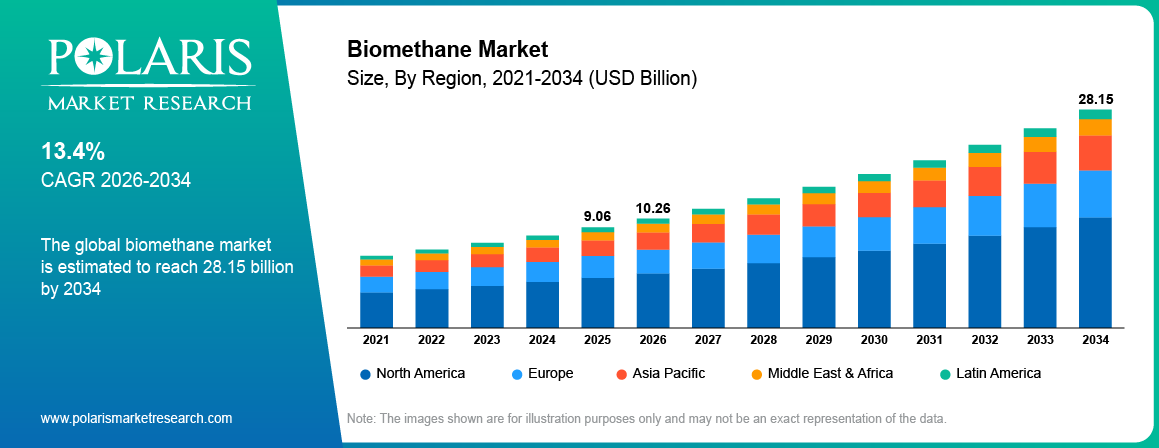
The global biomethane market size was valued at USD 9.06 billion in 2025, growing at a CAGR of 13.4% from 2026 to 2034. The rising global renewable energy consumption and the introduction of innovative technologies are the key factors fueling market growth.
Market Statistics
Key Biomethane Market Takeaways by Technology, Application, Feedstock, and Region
- Europe dominated the market with 46.0% share in 2025, owing to the region’s strong regulatory support and high adoption rates of biomethane fuels and technologies.
- Asia Pacific is projected to witness rapid growth at a CAGR of 15.72%, driven by the increased demand for renewable energy in the region.
- The anaerobic digestion segment accounted for the largest market share valued at 82.0% in 2025. Anaerobic digestion has been widely adopted as an efficient and cost-effective technology for the production of renewable gas.
- The electricity generation segment held 23.0% share of the market in 2025. The increased focus on the integration of renewable energy into power grids contributes to the segment’s leading market position.
- Agriculture segment accounted for 37.0% share in 2025.
Note: Figures and projections outlined in this report are the result of Polaris Market Research’s proprietary analytical processes, grounded in the latest available datasets and market observations.
Industry Dynamics
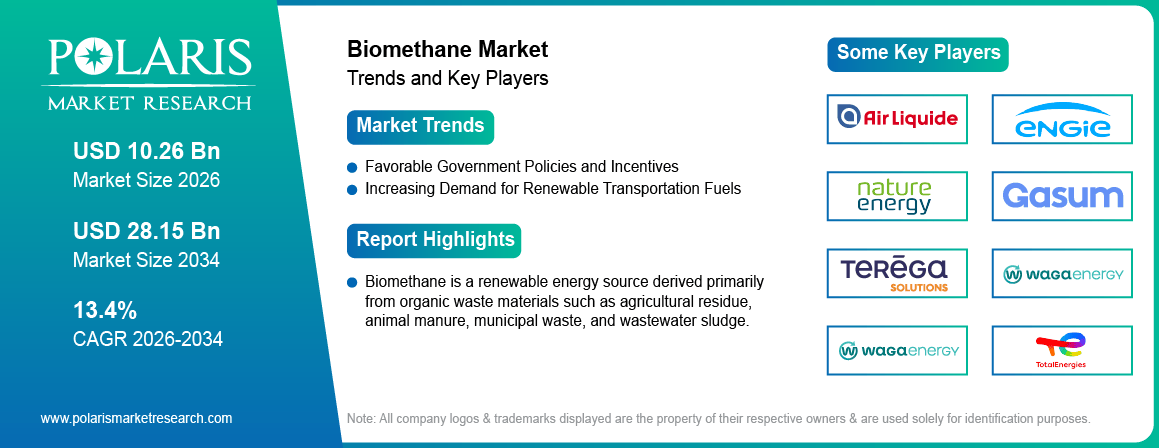
- The introduction of financial incentives and favorable policies by governments globally to promote biomethane production and utilization drives market growth.
- The significant contribution of the transportation sector to global greenhouse gas emissions has created a need for sustainable fuel solutions, including biomethane.
- The development of large scale biomethane projects is expected to provide several market opportunities during the projection period.
- High setup costs associated with biomethane production plants can hinder market growth.
Source: Polaris Market Research Analysis
To Understand More About this Research: Download Sample Report
What Is Biomethane and How Is It Produced?
Biomethane is a renewable energy source derived primarily from organic waste materials such as agricultural residue, animal manure, municipal waste, and wastewater sludge. Biomethane is produced through anaerobic digestion or gasification processes and is chemically similar to natural gas, making it a sustainable alternative for energy production, heating, and transportation.
Biomethane vs Biogas vs Natural Gas
| Parameter | Biomethane | Biogas | Natural Gas |
| Definition | Upgraded renewable gas produced by purifying biogas to remove CO₂, moisture, and impurities | Raw gas generated from anaerobic digestion of organic waste, manure, sewage sludge, and agricultural residues | Fossil fuel extracted from underground hydrocarbon reserves |
| Main Composition | Typically 90–98% methane (CH₄) | Usually 45–75% methane with high CO₂ content and trace gases | Around 85–98% methane with small amounts of ethane, propane, and nitrogen |
| Energy Content | High energy density, similar to natural gas (~36 MJ/m³) | Lower calorific value due to CO₂ content (~16–28 MJ/m³) | High calorific value (~35–40 MJ/m³) |
| Renewable Nature | Renewable and sustainable | Renewable and waste-derived | Non-renewable fossil fuel |
| Carbon Footprint | Low-carbon or near carbon-neutral fuel | Lower emissions than fossil fuels but may require purification | High greenhouse gas emissions during extraction and combustion |
| Infrastructure Compatibility | Fully compatible with existing natural gas infrastructure and pipelines | Limited direct pipeline compatibility without upgrading | Existing global gas infrastructure designed specifically for it |
| Storage & Transportation | Can be compressed or liquefied like natural gas | More difficult due to impurities and lower methane concentration | Well-established storage and transportation systems |
| Typical Applications | Grid injection, transportation fuel (Bio-CNG/LNG), industrial heating, power generation | Combined heat & power (CHP), electricity generation, cooking fuel, local heating | Residential heating, industrial fuel, electricity generation, petrochemical feedstock |
| Major End-Use Industries | Transportation, utilities, manufacturing, food processing, municipal energy systems | Agriculture, wastewater treatment, farms, food processing plants | Power generation, chemicals, fertilizers, residential utilities, heavy industries |
| Sustainability Advantage | Converts waste into high-quality renewable fuel compatible with net-zero goals | Waste management and renewable energy recovery solution | Reliable energy supply but environmentally intensive |
| Economic Consideration | Higher production cost due to upgrading technologies | Lower production cost but lower commercial versatility | Generally lower cost due to mature extraction infrastructure |
| Key Limitation | Requires advanced purification and upgrading infrastructure | Lower methane concentration and impurity management challenges | Finite fossil reserves and increasing regulatory pressure on emissions |
Source: Polaris Market Research Analysis
The biomethane market demand is driven by increasing global consumption of renewable energy. For instance, the International Energy Agency estimates that renewable energy consumption in the power, heat, and transport sectors will increase by nearly 60% from 2024 to 2030. The surge in renewable energy adoption drives investments in biomethane production facilities and infrastructure, particularly in industries such as transportation, electricity generation, and heating, which are turning to biomethane to reduce emissions and achieve sustainability goals.
The growing advancement in technology is also contributing to the biomethane market growth. Innovative technologies, such as biogas upgrading systems, make it easier to convert organic waste into biomethane. Advances in digital monitoring, automation, and data analytics allow for better control over biomethane production, enhancing output quality and reducing energy consumption. Businesses and governments are investing in large-scale biomethane projects with greater confidence as these technologies become more accessible. Additionally, technological advancements in transportation and storage infrastructure enable easier integration of biomethane into existing energy systems, further fueling market revenue.
Biomethane Market Growth Drivers, Opportunities, Restraints, and Challenges
Government Incentives and Renewable Gas Mandates Accelerate Biomethane Deployment
Governments across the globe are implementing policies and offering financial incentives to promote biomethane production and utilization. These policies include subsidies, feed-in tariffs, tax rebates, and grants, lowering the cost of biomethane production. In Europe, the Renewable Energy Directive II (RED II) mandates that at least 14% of the energy used in the transportation sector must come from renewable sources by 2030, boosting biomethane adoption. Similarly, the US Renewable Fuel Standard (RFS) and California’s Low Carbon Fuel Standard (LCFS) are driving investments in biomethane production facilities. These regulatory frameworks ensure a profitable market for producers, enhancing the affordability and adoption of biomethane.
Low-Carbon Transport Demand Expands Bio-CNG and Bio-LNG Adoption
The transportation sector contributes significantly to global greenhouse gas emissions, creating an urgent need for sustainable fuel solutions. Biomethane, with its near-zero carbon emissions, is emerging as a preferred renewable fuel for vehicles, particularly in heavy-duty trucking and public transportation. Countries such as Germany, Sweden, and the Netherlands are dominating the adoption of bio-CNG and bio-LNG as cleaner alternatives to diesel. Fleet operators are also showing growing interest due to biomethane’s ability to reduce operating costs while meeting emission compliance standards. Moreover, advancements in liquefaction technologies and the development of fueling infrastructure are making biomethane a viable option for long-haul transportation. Therefore, the transportation sector’s decarbonization efforts are driving the biomethane market development.
Source: Polaris Market Research Analysis
Segment Insights
By Production Technology Insights
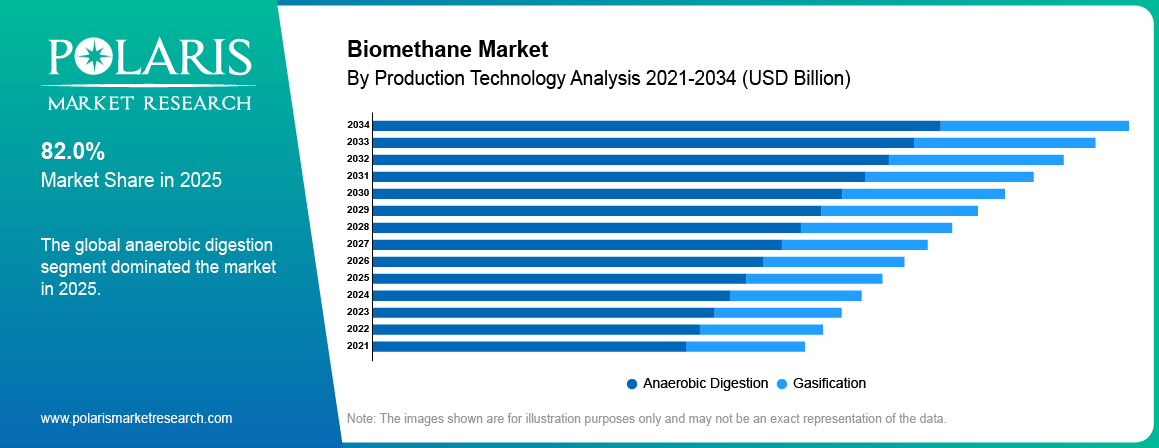
Based on production technology, the biomethane market is divided into anaerobic digestion and gasification. The anaerobic digestion segment held the largest biomethane market share of 82.0% in 2025 due to its widespread adoption as an efficient and cost-effective technology for producing renewable gas. This technology uses organic waste materials such as agricultural residues, food waste, and animal manure to generate energy-rich methane through microbial activity. Its scalability and compatibility with diverse feedstocks make it a preferred choice for biomethane producers in both developed and developing regions. Governments and regulatory bodies have further accelerated the adoption of this technology by offering subsidies and tax incentives to encourage waste-to-energy projects. Additionally, the growing focus on circular economy practices, which emphasize recycling organic waste into renewable energy, has driven the adoption of anaerobic digestion technology.
By Application Insights
In terms of application, the biomethane market is segregated into electricity generation, vehicle fuel, and heating. The electricity generation segment held 23.0% market share in 2025, due to the increasing global focus on renewable energy integration into power grids. Industries and utilities are prioritizing renewable gas as a sustainable alternative for generating electricity, particularly in regions with aggressive decarbonization goals, such as Europe and North America. Additionally, the energy crisis in several regions has led to a surge in demand for reliable and locally sourced energy solutions, further strengthening the electricity generation segment's dominance.
Source: Polaris Market Research Analysis
Regional Analysis
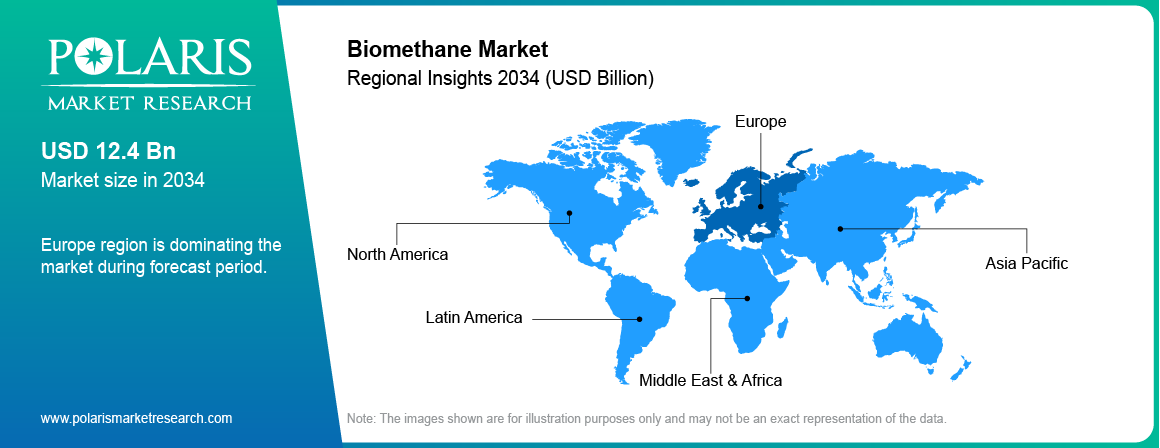
By region, the report provides the biomethane market insights into North America, Europe, Asia Pacific, Latin America, and the Middle East & Africa. Europe held the largest biomethane market share of 46.0% in 2025 due to strong regulatory support, a well-established infrastructure for biomethane production, and high adoption rates of biomethane technologies and fuels. Germany dominated the region owing to its advanced biomethane infrastructure and strong government support. The country’s focus on transitioning to renewable energy, along with its comprehensive policies, such as the Renewable Energy Sources Act (EEG), have propelled biomethane production and utilization. Countries such as France and the UK have robust policies, such as feed-in tariffs and mandatory blending quotas, which are supporting the market growth in the region. Furthermore, the high number of biomethane plants in the region contributed to the regional market dominance. For instance, according to a report by the European Biogas Association, there were 1,322 biomethane-producing facilities in Europe by April 2023.
The Asia Pacific biomethane market is estimated to grow rapidly at a CAGR of 15.72% in the coming years, driven by increasing demand for renewable energy. Government initiatives in countries such as India and China are also contributing to the market expansion in the region. For instance, India launched the Sustainable Alternative Towards Affordable Transportation (SATAT) initiative, which aims to establish 5,000 biomethane plants by 2025 to support the transportation and energy sectors. Similarly, the carbon-neutrality goals set by the government of China are contributing to the regional market growth.
Source: Polaris Market Research Analysis
Key Players and Competitive Insights
Major market players are investing heavily in research and development in order to expand their offerings, which will help the biomethane market grow even more. These market participants are also undertaking a variety of strategic activities to expand their global footprint, with important market developments including innovative launches, international collaborations, higher investments, and mergers and acquisitions between organizations.
The biomethane market is fragmented, with the presence of numerous global and regional market players. Major players in the market include Air Liquide; Engie; Nature Energy Biogas A/S; Gasum; Terega Solutions; Waga Energy; TotalEnergies; Chevron; Kinder Morgan; Archea Energy; Envitec Biogas AG; Future Biogas Ltd.; E.ON SE; Verbio Vereinigte Bioenergie AG; and South Hills RNG.
Air Liquide S.A., a French multinational founded in 1902, is recognized as a global leader in the production and supply of industrial gases, technologies, and services across various sectors, including healthcare, chemicals, and energy. The company is headquartered in Paris and operates in over 70 countries. Its primary gases include oxygen, nitrogen, hydrogen, and argon, which are pivotal for numerous industrial processes. Air Liquide has increasingly focused on sustainable solutions in recent years, particularly in the field of biomethane and renewable energy.
Engie SA, a prominent French multinational utility company, was established in 2008 through the merger of Gaz de France and Suez. Headquartered in La Défense, Courbevoie, Engie operates in over 70 countries. The company is engaged in a diverse range of activities, including electricity generation and distribution, natural gas supply, biomethane, nuclear power plant control system, and renewable energy. Engie's strategic transformation has been marked by a significant shift towards low-carbon energy solutions, with an ambitious goal to achieve net-zero carbon emissions by 2045. This transition is supported by substantial investments in renewable energies such as solar, wind, hydroelectric, and biomass.
List of Key Companies
- Air Liquide
- Engie
- Nature Energy Biogas A/S
- Gasum
- Terega Solutions
- Waga Energy
- TotalEnergies
- Chevron
- Kinder Morgan
- Archea Energy
- Envitec Biogas AG
- Future Biogas Ltd.
- E.ON SE
- Verbio Vereinigte Bioenergie AG
- South Hills RNG
Biomethane Industry Developments
- May 2026: Greenlane Renewables Inc. signed definitive agreements with Panasonic do Brasil Limitada. With this agreement, Greenlane will localize production of its proprietary next-generation Cascade LF landfill gas upgrading technology in Brazil. (Source: biomassmagazine.com)
- September 2025: Shell Biogas and Hapag-Lloyd entered a long-term agreement to supply liquefied biogas for the carrier’s decarbonization plans. Building on their 2023 partnership, the deal allows LNG dual-fuel vessels to use renewable fuel without equipment changes. Shell supplies bio-LNG at 22 global bunkering sites, while ISCC EU-certified biomethane delivers major lifecycle GHG reductions. (Source: hapag-lloyd.com)
- August 2025: Gasum signed a deal with Wasaline to supply the ferry Aurora Botnia with 100% liquefied biogas (bio-LNG), creating the first carbon-neutral shipping route across the Baltic Sea. Enabled through FuelEU Maritime pooling with Stena Line, the agreement uses waste-based bio-LNG with about 90% lower lifecycle GHG emissions, supporting maritime decarbonization without added surcharges for passengers or cargo. (Source: gasum.com)
What is the Future of Biomethane Market?
The market is expected to witness strong long-term growth in the coming years. The expansion would be fueled by the expanding renewable energy infrastructure. Rising investments in low-carbon fuel alternatives will drive the market growth. There will be an increasing adoption of biomethane as a transportation fuel, particularly in heavy-duty vehicles and public transit systems. This factor would support market expansion across developed and emerging economies. Technological advancements in biogas upgrading, purification, and gas grid injection systems are improving production efficiency and commercial viability. In addition, supportive government policies will promote decarbonization, carbon neutrality, and renewable gas integration. Their imposition will accelerate biomethane industry adoption. Growing emphasis on circular economy models and sustainable waste management practices will strengthen demand for biomethane solutions worldwide.
Biomethane Market Segmentation
By Production Technology Outlook (Revenue – USD Billion, 2021–2034)
- Anaerobic Digestion
- Gasification
By Application Outlook (Revenue – USD Billion, 2021–2034)
- Electricity Generation
- Vehicle Fuel
- Heating
By Feedstock Outlook (Revenue – USD Billion, 2021–2034)
- Agricultural Waste
- Municipal Waste
- Animal Manure
- Wastewater Sludge
By Regional Outlook (Revenue – USD Billion, 2021–2034)
- North America
- US
- Canada
- Europe
- Germany
- France
- UK
- Italy
- Spain
- Netherlands
- Russia
- Rest of Europe
- Asia Pacific
- China
- Japan
- India
- Malaysia
- South Korea
- Indonesia
- Australia
- Vietnam
- Rest of Asia Pacific
- Middle East & Africa
- Saudi Arabia
- UAE
- Israel
- South Africa
- Rest of Middle East & Africa
- Latin America
- Mexico
- Brazil
- Argentina
- Rest of Latin America
Report Scope
| Report Attributes | Details |
| Market Size Value in 2025 | USD 9.06 billion |
| Revenue Forecast in 2026 | USD 10.26 billion |
| Revenue Forecast by 2034 | USD 28.15 billion |
| CAGR | 13.4% from 2026 to 2034 |
| Base Year | 2025 |
| Historical Data | 2021–2024 |
| Forecast Period | 2026–2034 |
| Quantitative Units | Revenue in USD billion and CAGR from 2026 to 2034 |
| Report Coverage | Revenue Forecast, Market Competitive Landscape, Growth Factors, and Trends |
| Segments Covered |
|
| Regional Scope |
|
| Competitive Landscape |
|
| Report Format |
|
| Customization | Report customization as per your requirements with respect to countries, regions, and segmentation. |
Source: Polaris Market Research Analysis
Biomethane Market FAQs
• The global biomethane market size was valued at USD 9.06 billion in 2025 and is projected to grow to USD 28.15 billion by 2034.
• The global market is projected to grow at a CAGR of 13.4% during the forecast period.
• Europe dominated the market with 46.0% share in 2025.
• Some of the key players in the market are Air Liquide; Engie; Nature Energy Biogas A/S; Gasum; Terega Solutions; Waga Energy; TotalEnergies; Chevron; Kinder Morgan; Archea Energy; Envitec Biogas AG; Future Biogas Ltd.; E.ON SE; Verbio Vereinigte Bioenergie AG; and South Hills RNG.
• The anaerobic digestion segment accounted for the largest market share valued at 82.0% in 2025.
• A renewable energy source derived from organic waste such as agricultural residue, animal manure, municipal waste, and wastewater sludge, produced via anaerobic digestion or gasification, chemically similar to natural gas.
• Key trends include rising government policy incentives, growing transportation decarbonization demand, increasing biogas upgrading technology advancements, expanding large-scale biomethane projects, and surging renewable energy integration into global power grids.
Download Sample Report of Biomethane Market
Please fill out the form to request a customized copy of the research report.


