
Bone Growth Stimulator Market Size & Share Global Analysis Report, 2026-2034
REPORT DETAILS
Bone Growth Stimulator Market Summary
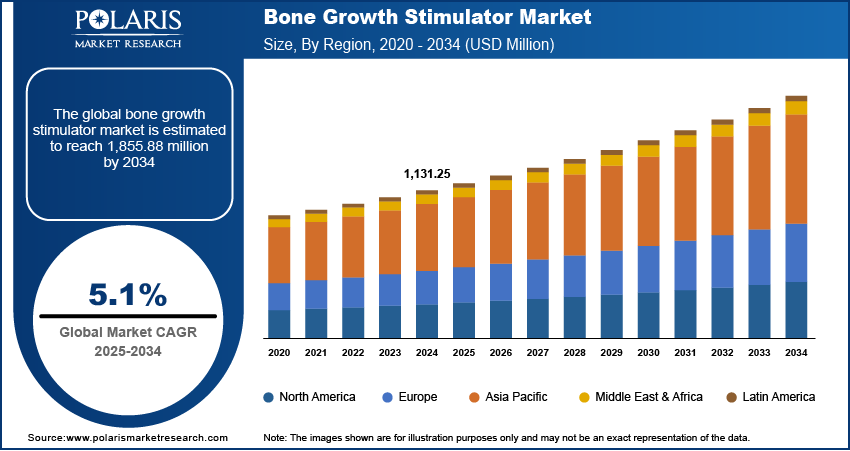
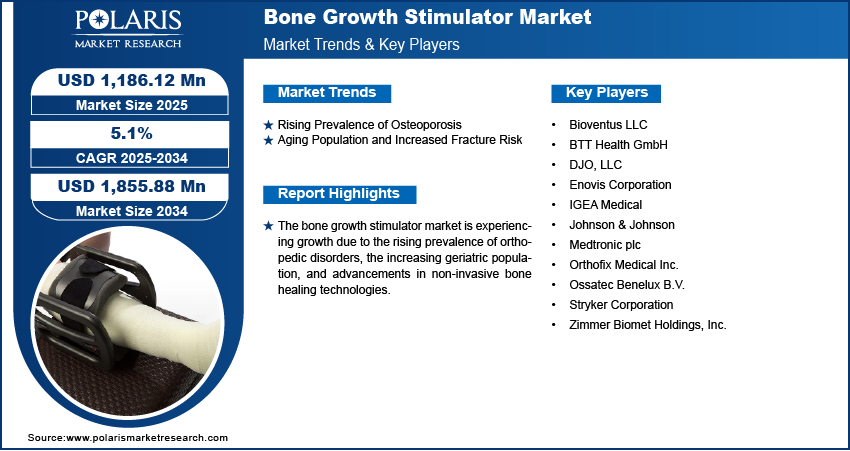
The bone growth stimulator market size was valued at USD 1,186.12 million in 2025, growing at a CAGR of 5.1% from 2026 to 2034. The growing incidence of bone fractures, rising osteoporosis cases, and advancements in biophysical stimulation technologies are a few of the key factors fueling market growth.
Market Statistics
Key Takeaways
- The bone growth stimulation devices segment led the market in 2025. The rising prevalence of bone and joint disorders contributes to the segment’s leading market position.
- The spinal fusion surgeries segment represented the largest share in 2025. Advancements in surgical techniques and rising preference for minimally invasive procedures propel the segment dominance.
- North America dominates the market. The high prevalence of orthopedic disorders and growing adoption of advanced medical technologies drive the leading revenue share.
- Asia Pacific is witnessing substantial growth. The increasing number of orthopedic surgeries and improving healthcare infrastructure fuel robust market growth in the region.
Industry Dynamics
- The growing incidence of osteoporosis, which is characterized by reduced bone density and increased fracture risk, drives market expansion.
- The aging population, which has a high risk of falls and subsequent fractures, is another factor fueling the demand for bone growth stimulators.
- Rising awareness about advanced treatment options would create lucrative opportunities for market players in the coming years.
- High investment costs associated with bone growth stimulators may hinder market growth. Beyond bone growth stimulator cost, adoption can be constrained by payer documentation requirements, variability in coverage pathways across geographies, and patient adherence challenges (wear-time compliance), which directly influence clinical outcomes and perceived cost-effectiveness
Source: Polaris Market Research Analysis
What is a Bone Growth Stimulator?
A bone growth stimulator is a medical device or biologic therapy. It is designed to enhance the natural bone healing process in cases of fractures, spinal fusion procedures, or delayed and nonunion bone fractures. These devices use electrical stimulation, ultrasound waves, or biologic materials like bone morphogenetic proteins (BMPs) and platelet-rich plasma (PRP) to promote bone regeneration. Bone growth stimulators are used to improve healing and shorten recovery time. The stimulators decrease the need for additional surgeries. They are available in implantable and external forms. The use of these forms depend on the clinical requirement. Bone growth stimulators use electrical, ultrasonic, or magnetic stimulation to enhance bone healing, particularly in cases of delayed union or nonunion fractures. Device-based stimulation is delivered through pulsed electromagnetic field (PEMF), combined magnetic field (CMF), capacitive coupling, and low-intensity pulsed ultrasound (LIPUS) modalities, each with distinct adoption patterns by indication and care setting.
The bone growth stimulator market growth is driven by the rising prevalence of bone fractures, increasing cases of osteoporosis, and the growing demand for non-invasive treatment options. The market is experiencing growth due to advancements in biophysical stimulation technologies and the increasing adoption of these devices in orthopedic and spinal procedures. Additionally, the aging population and the rising number of sports-related injuries are contributing to the market expansion. For instance, a 2023 report by the NSC revealed a consistent rise in sports and recreational injuries, with a 20% increase in 2021, followed by 12% in 2022, and another 2% in 2023, compared to 2020 baseline figures.
From a care-delivery standpoint, the continued shift toward outpatient orthopedic pathways and shorter inpatient stays increases the attractiveness of non-invasive, home-use bone growth stimulation devices that can support continuity of care after discharge. As a result, manufacturers are increasingly differentiating through wearable form factors, adherence-support programs, and (where applicable) connected monitoring features that improve utilization and outcomes in real-world settings. Key industry trend is the integration of wearable and portable bone growth stimulation devices. These devices help patient compliance and treatment results. Regulatory approvals and reimbursement policies significantly influence the market landscape.
Market Dynamics
Rising Prevalence of Osteoporosis
Osteoporosis is marked by lower bone density and a higher risk of fractures. Fragility fractures related to osteoporosis lead to delayed healing. This has increased interest in using bone growth stimulation, especially for high-risk patients. Preventing complications and repeat interventions is essential for both providers and payers. For example, a report published by the FDA in May 2024 showed that about 10 million Americans have osteoporosis. Over 8 million of them, which is around 80%, are women. In the US, one in four women aged 65 or older has osteoporosis, raising their fracture risk. Therefore, the rising number of osteoporosis cases is driving demand for bone growth stimulators.
Aging Population and Increased Fracture Risk
There is a growing shift toward a geriatric population in many areas. An October 2024 report from the WHO noted that the number of people aged 60 and older will rise from 1 billion in 2020 to 1.4 billion by 2030. The risk of falls and related fractures goes up as people age. More than one out of four older adults in the U.S. experience a fall each year. The risk of falling, combined with age-related bone loss, leads to more fractures in older people. As a result, more bone growth stimulators are being used for managing fractures and improving outcomes in this expanding group. The aging population also increases demand for home care services. In such settings, noninvasive bone growth stimulation devices can reduce follow-up burden and support standardized post-operative protocols in high-volume orthopedic centers. Thus, the increasing geriatric population and rising fracture risks directly influences the bone growth stimulator industry growth.
Source: Polaris Market Research Analysis
Segment Insights
By Product Type Insights
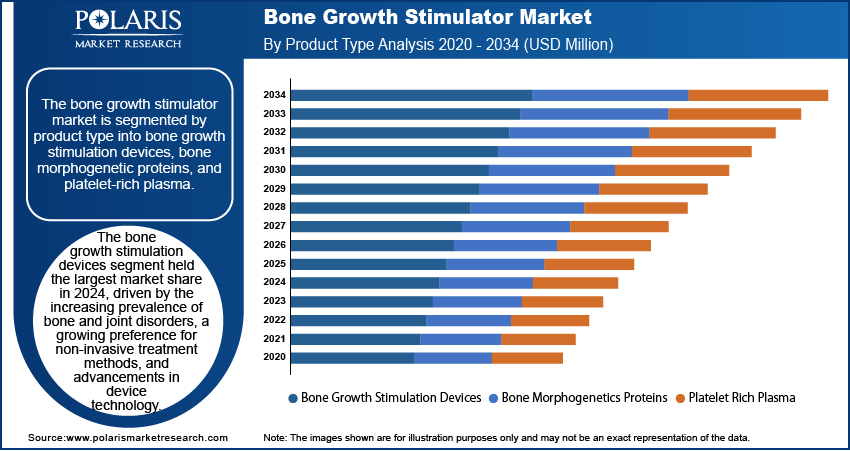
The market, by product type, is segmented into bone growth stimulation devices, bone morphogenetic proteins, and platelet-rich plasma. The bone growth stimulation devices segment held the largest market share in 2025. The segment growth is driven by the increasing prevalence of bone and joint disorders and a growing preference for non-invasive treatment methods. Advancements in device technology also boost the segment expansion. These devices include external bone growth stimulators. They are popular because they are noninvasive, affordable, and do not need surgical implantation. The aging global population increases the demand for these devices since older people are more likely to have bone-related issues. There are two main types of bone growth stimulation devices: electrical stimulation, which includes PEMF/CMF and capacitive coupling, and ultrasound stimulation, such as LIPUS. The choice of method depends on the specific condition, the clinician's preference, and reimbursement options.
The platelet-rich plasma segment is expected to grow the fastest during the forecast period. PRP's minimally invasive nature attracts patients seeking alternatives to traditional bone grafting procedures. Platelet-rich plasma has shown effectiveness in improving bone healing for different conditions. The PRP treatment provides effective results with shorter recovery times. It has led to greater acceptance by healthcare providers and patients. The increasing number of orthopedic surgeries and sports injury cases also boosts the demand for platelet-rich plasma treatments.
By Application Insights
The market is segmented by application into spinal fusion surgeries, delayed union and non-union bone fractures, oral & maxillofacial surgeries, and others. The spinal fusion surgeries segment held the largest share in 2025. This is due to the increasing incidence of spinal disorders and improvements in surgical techniques. Growing preference for minimally invasive procedures also boosts the segment dominance. Bone growth stimulators play a key role in improving the success rates of spinal fusions. They enable effective bone healing and shorten recovery times. The rising rate of degenerative spinal conditions and increasing geriatric population boost the demand for these devices in spinal fusion applications. Spinal fusion continues to be a top focus because the success rates influence revision risk, long-term patient results, and overall care costs. This makes the use of bone growth stimulation important for providers handling complex degenerative spine cases.
By End Use Insights
The bone growth stimulator industry is segmented by end use into hospitals & ambulatory surgical centres, home care, academic & research institutes, and others. The hospitals and ambulatory surgical centers segment had the largest revenue share in 2025. This is due to the high number of patient admissions for orthopedic procedures. The availability of modern medical equipment and skilled healthcare professionals in these facilities also drives segment growth. Patients often prefer hospitals and surgical centers for complex treatments because they offer thorough care and immediate access to various teams. Furthermore, the use of bone growth stimulators in standard postoperative protocols in these facilities improves patient recovery outcomes. However, the home care segment is expected to grow as outpatient orthopedic pathways increase. Patients increasingly prefer portable, noninvasive bone growth stimulators that can be used outside hospital settings with guidance from their physician.
Source: Polaris Market Research Analysis
Regional Analysis
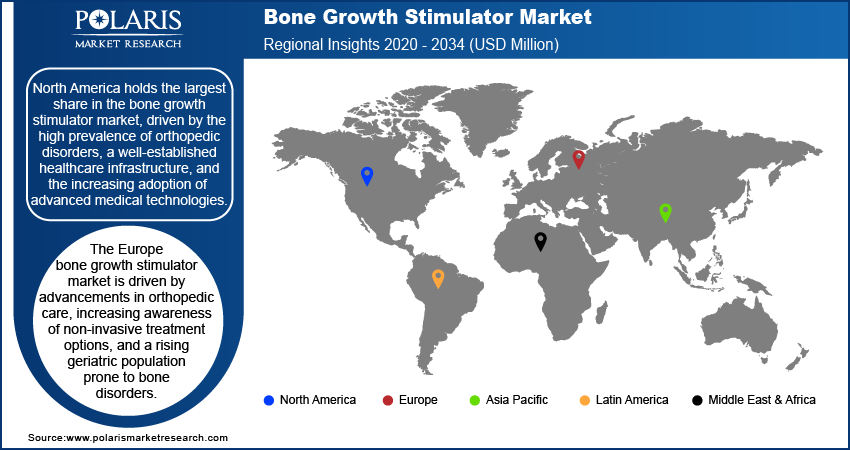
By region, the study provides the bone growth stimulator market insights into North America, Europe, Asia Pacific, Latin America, and the Middle East & Africa. North America has the largest share of the market. The dominance is driven by the high rates of orthopedic disorders, a strong healthcare system, and the growing use of modern medical technologies. A report from the CDC in September 2024 showed that in 2021, 80.5% of physicians in office-based settings used telemedicine for patient care. This highlights the shift toward modern medical methods. The region benefits from solid reimbursement policies, active research and development, and a growing number of spinal fusion and orthopedic procedures. The presence of major market players and supportive regulations also boost market growth. Furthermore, an aging population and a rise in osteoporosis-related fracture cases increase the demand for bone growth stimulation devices. Europe follows closely, benefiting from improvements in orthopedic care and greater awareness of noninvasive treatment options. At the same time, Asia Pacific is experiencing significant growth due to better healthcare infrastructure, more orthopedic surgeries, and rising healthcare spending in countries like China and India. Market leadership in this region is also supported by higher procedure volumes for spinal fusion and orthopedic trauma, established reimbursement systems for certain conditions, and quicker adoption of modern orthopedic technologies across integrated delivery networks.
Europe is driven by advancements in orthopedic care, increasing awareness of non-invasive treatment options, and a rising geriatric population prone to bone disorders. Germany, France, and the UK are a few key contributors. Well-established healthcare systems and widespread use of medical technologies are driving market growth in these countries. Favorable reimbursement criteria and government support for orthopedic research boost the market in Europe. Additionally, the rising rates of spinal disorder and fracture cases increase the demand for bone growth stimulators in the region. A growing preference for outpatient procedures also propels the market expansion. In Europe, procurement cycles and EU MDR compliance expectations influence commercialization timelines and evidence requirements. This encourages manufacturers to improve clinical documentation and post-market surveillance capabilities.
The Asia Pacific bone growth stimulator market is experiencing substantial growth. Improving healthcare infrastructure and rising healthcare expenditure drive the market growth. An increasing number of orthopedic surgeries propels the demand for these stimulators. China, India, and Japan are seeing a rising demand for bone healing solutions. The aging population and more cases of bone fractures and osteoporosis are contributing to this demand. Greater awareness of treatment options and the increase in medical tourism in the region offer more opportunities for growth. Additionally, government initiatives to improve healthcare access and boost local production of medical devices. Such efforts make bone growth stimulators more accessible and affordable in Asia Pacific. The growing number of spine and trauma centers also fuels industry growth.
Source: Polaris Market Research Analysis
Key Players and Competitive Insights
The bone growth stimulator industry is dominated by several key players. They are actively contributing to advancements in bone healing technologies. Notable companies include Medtronic plc; Zimmer Biomet Holdings, Inc.; Orthofix Medical Inc.; Bioventus LLC; and Stryker Corporation. These organizations are recognized for their innovative approaches to developing bone growth stimulation devices and therapies. Other significant participants in the market are Johnson & Johnson; DJO, LLC; Ossatec Benelux B.V.; BTT Health GmbH; Enovis Corporation; and IGEA Medical. These companies are actively engaged in providing solutions for bone growth stimulation.
Companies emphasize technological advancements, partnerships, and other growth strategies to strengthen their positions. Medtronic plc offers the Infuse Bone Graft. It uses recombinant human bone morphogenetic protein-2 (rhBMP-2) to promote bone formation. This improves spinal fusion and orthopedic trauma surgeries. Zimmer Biomet Holdings, Inc. provides the OrthoPak Non-invasive Bone Growth Stimulator System, which aims to heal fractures that have not healed properly. Orthofix Medical Inc. specializes in pulsed electromagnetic field (PEMF) technology, offering devices that help with spinal fusion and fracture healing.
Xenco Medical is bringing new solutions. Their TrabeculeX Continuum combines regenerative biomaterials with digital health monitoring to improve postoperative recovery. Bonesupport AB focuses on injectable bioceramic bone graft substitutes that help speed up bone healing in orthopedic surgeries. The Straumann Group is known for dental implants. However, it has expanded its product line to include items that support bone regeneration. Mathys Ltd Bettlach offers implants for joint replacement and biomaterials for treating bone defects. This increases the choices in the bone growth stimulator industry.
Competitive differentiation increasingly centers on indication breadth, modality specialization (PEMF/LIPUS), evidence quality by use case, patient adherence support (wear-time protocols and training), and service models that help providers navigate reimbursement and documentation workflows.
List of Key Companies
- Bioventus LLC
- BTT Health GmbH
- DJO, LLC
- Enovis Corporation
- IGEA Medical
- Johnson & Johnson
- Medtronic plc
- Orthofix Medical Inc.
- Ossatec Benelux B.V.
- Stryker Corporation
- Zimmer Biomet Holdings, Inc.
Bone Growth Stimulator Industry Developments
- June 2024: Johnson & Johnson MedTech announced that DePuy Synthes received FDA clearance for the VELYS Robotic-Assisted Solution in Unicompartmental Knee Arthroplasty (UKA). This approval covers medial and lateral procedures and is designed to assist surgeons in achieving precise implant placement without the need for a CT scan.
- January 2023: Orthofix Medical Inc. and SeaSpine Holdings Corporation finalized their merger. It created a combined entity focused on developing innovative bone growth therapies and spinal fusion devices. This strategic move aims to leverage combined research and development capabilities.
- May 2022: Orthofix Medical Inc. received FDA pre-market approval for AccelStim, a LIPUS-based Class III device for treating fresh fractures and nonunions.
Bone Growth Stimulator Market Segmentation
By Product Type Outlook (Revenue – USD Million, 2021–2034)
- Bone Growth Stimulation Devices
- Bone Morphogenetics Proteins
- Platelet Rich Plasma
By Application Outlook (Revenue – USD Million, 2021–2034)
- Spinal Fusion Surgeries
- Delayed union & Non-Union Bone Fractures
- Oral & Maxillofacial Surgeries
- Others
By End Use Outlook (Revenue – USD Million, 2021–2034)
- Hospital & Ambulatory Surgical Centres
- Home Care
- Academic & Research institutes
- Others
By Regional Outlook (Revenue – USD Million, 2021–2034)
- North America
- US
- Canada
- Europe
- Germany
- France
- UK
- Italy
- Spain
- Netherlands
- Russia
- Rest of Europe
- Asia Pacific
- China
- Japan
- India
- Malaysia
- South Korea
- Indonesia
- Australia
- Vietnam
- Rest of Asia Pacific
- Middle East & Africa
- Saudi Arabia
- UAE
- Israel
- South Africa
- Rest of Middle East & Africa
- Latin America
- Mexico
- Brazil
- Argentina
- Rest of Latin America
Bone Growth Stimulator Market Report Scope
| Report Attributes | Details |
| Market Size in 2025 | USD 1,186.12 million |
| Market Size in 2026 | USD 1,244.24 million |
| Revenue Forecast in 2034 | USD 1,855.88 million |
| CAGR | 5.1% from 2026 to 2034 |
| Base Year | 2025 |
| Historical Data | 2022–2024 |
| Forecast Period | 2026–2034 |
| Quantitative Units | Revenue in USD million, 2021–2034 and CAGR from 2026 to 2034 |
| Report Coverage | Revenue Forecast, Market Competitive Landscape, Growth Factors, and Trends |
| Segments Covered |
|
| Regional Scope |
|
| Competitive Landscape |
|
| Report Format |
|
| Customization | Report customization as per your requirements with respect to countries, regions, and segmentation. |
Source: Polaris Market Research Analysis
Why to Buy this Report?
Workflow/Innovation Strategy: The bone growth stimulator industry has been segmented into detailed segments of product type, application, and end use. Moreover, the study provides the reader with a detailed understanding of the different segments at both the global and regional levels.
Growth/Marketing Strategy: Companies in the bone growth stimulator industry focus on product innovation, strategic partnerships, and geographic expansion to strengthen their market presence. Research and development efforts aim to enhance device efficacy, improve patient compliance, and introduce minimally invasive solutions. Mergers and acquisitions help companies expand their product portfolios and enter new regional markets. Strong marketing strategies include programs to educate physicians, advertisements aimed at consumers, and partnerships with healthcare providers to raise awareness of noninvasive bone healing solutions. Good reimbursement policies and clinical studies that demonstrate product effectiveness are also important for driving market adoption.
Bone Growth Stimulator Market FAQ's
The global bone growth stimulator market is projected to reach USD 1,855.88 million by 2034. It is expected to register a CAGR of 5.1% during 2026-2034.
The bone growth stimulation devices segment held the largest share in 2025. Rising noninvasive treatment preferences and increasing prevalence of orthopedic disorders globally fuel the segment growth.
The spinal fusion surgeries segment dominated in 2025, followed by delayed/nonunion bone fractures and orthopedic trauma surgeries. It is reflecting increasing surgical volumes and a focus on patient outcomes.
North America dominated the revenue share in 2025. It is driven by advanced healthcare infrastructure and high orthopedic disorder prevalence. Also, the presence of major manufacturers drives the regional market growth.
Reimbursement and insurance coverage affect affordability, physician prescribing, and patient access. Favorable, well-defined policies significantly accelerate adoption. However, limited coverage restricts market penetration.
Bioventus LLC; BTT Health GmbH; DJO, LLC; Enovis Corporation; IGEA Medical; Johnson & Johnson; Medtronic plc; Orthofix Medical Inc.; Ossatec Benelux B.V.; Stryker Corporation; and Zimmer Biomet Holdings, Inc. are a few key players.
A new company entering the bone growth stimulator industry must emphasize developing cost-effective, noninvasive devices like smart stimulators with remote monitoring capabilities. Investing in biologic therapies such as next-generation BMPs and PRP) could give a competitive edge. Expanding into emerging markets with a high demand for orthopedic surgery, like Asia Pacific and Latin America, can provide growth opportunities. Strong partnerships with hospitals, research institutions, and orthopedic specialists can improve market penetration. Additionally, securing regulatory approvals and favorable reimbursement policies will be crucial for long-term success.
Companies manufacturing, distributing, or purchasing bone growth stimulators and related products, and other consulting firms must buy the report.
A new company entering the bone growth stimulator market could focus on developing cost-effective and technologically advanced non-invasive devices, such as smart stimulators with remote monitoring capabilities. Investing in biologic therapies like next-generation bone morphogenetic proteins (BMPs) and platelet-rich plasma (PRP) could offer a competitive edge. Expanding into emerging markets with high orthopedic surgery demand, such as Asia Pacific and Latin America, can provide growth opportunities. Strong partnerships with hospitals, research institutions, and orthopedic specialists can enhance market penetration. Additionally, securing regulatory approvals and favorable reimbursement policies would be crucial for long-term success.
Companies manufacturing, distributing, or purchasing bone growth stimulators and related products, and other consulting firms must buy the report
Download Sample Report of Bone Growth Stimulator Market
Please fill out the form to request a customized copy of the research report.


