
Centrifuge Market Size, Share, Growth 2026-2034
REPORT DETAILS
Centrifuge Market Summary
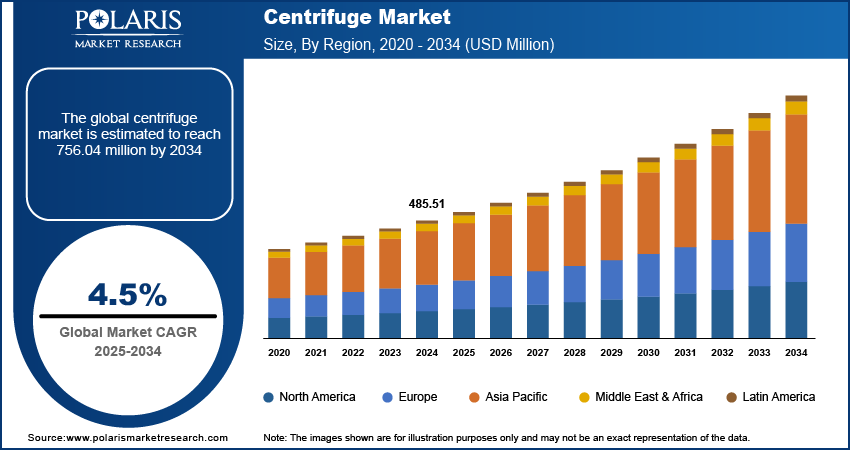
The centrifuge market size was valued at USD 507.38 million in 2025. The market is projected to grow from USD 529.80 million in 2026 to USD 753.55 million by 2034, exhibiting a CAGR of 4.5% during 2026–2034.
Market Statistics
Key Takeaways
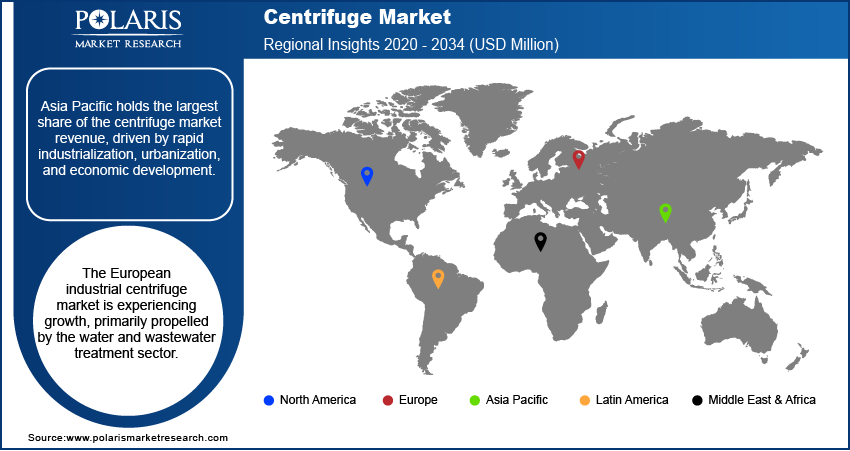
- By region, Asia Pacific held the largest share of 37.0% in 2025. This is driven by rapid industrialization and urbanization, and economic development.
- China dominated the Asia Pacific market with 39.0% in 2025. Increasing investments in research and development support the market growth.
- The European market is projected to record the highest CAGR of 4.07% during the forecast period. It is fueled by the upsurging demand from the water and wastewater treatment sector.
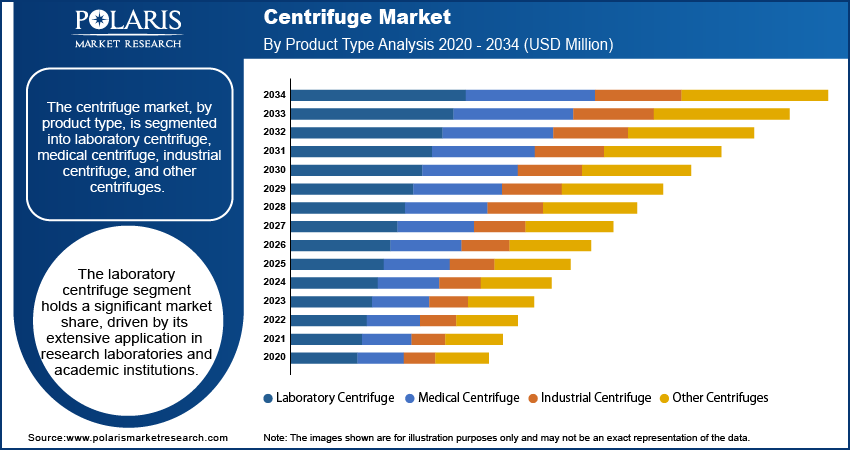
- The laboratory centrifuge segment held a significant share of 38.0%. The dominance is fueled by its extensive application in research laboratories and academic institutions.
- The medium capacity segment dominated the market with 44.0% revenue share. This is attributed to its versatility and widespread application across various industries.
Note: Figures and projections outlined in this report are the result of Polaris Market Research’s proprietary analytical processes, grounded in the latest available datasets and market observations.
Industry Dynamics
- Increasing demand for advanced diagnostic testing and clinical research propels the adoption of centrifuges in healthcare laboratories.
- Growth in the biopharmaceutical and biotechnology industries boosts the need for high-performance centrifugation equipment for sample separation and processing.
- High acquisition and maintenance costs of sophisticated centrifuge systems hinder adoption among small and medium-sized laboratories.
- Rising investments in life sciences research and personalized medicine would create lucrative opportunities for centrifuge manufacturers.
- Increasing integration of automation, digital controls, and smart monitoring features to enhance centrifuge efficiency and user convenience would become a key trend.
AI Impact on Centrifuge Market
- AI-based predictive maintenance helps identify potential equipment failures in advance. It is used to reduce downtime and maintenance costs.
- Real-time data analytics is adopted to enhance sample monitoring, quality control, and laboratory workflow management.
- Automation through AI integration reduces manual intervention and minimizes human errors. It also improves productivity in research and clinical laboratories.
- AI-powered laboratory management systems facilitate seamless connectivity between centrifuges and digital laboratory infrastructure. They are used for better data tracking and compliance.
- Advanced machine learning (ML) algorithms support faster analysis of centrifugation results. It accelerates research and biopharmaceutical development processes.
What Does Centrifuge Market Includes?
The centrifuge market focuses on the manufacturing, distribution, and application of centrifuge equipment used in laboratories, industrial processes, and medical diagnostics. Centrifuges are critical for separating substances of different densities, including biological samples, chemicals, and wastewater components. The market is driven by advancements in biotechnology, increasing demand for diagnostics, and the expanding pharmaceutical and healthcare sectors. Additionally, the growing need for efficient water and wastewater treatment and industrial processing applications further supports centrifuge market demand. Technological innovations, such as high-speed and automated centrifuges, are also enhancing operational efficiency and broadening application scope.
Key drivers of the centrifuge market growth include the rising prevalence of chronic diseases, leading to increased diagnostic testing, as well as stringent regulatory requirements for pharmaceutical and biotechnology research. The expansion of the food and beverage industry, where centrifuges are used for quality control and processing, also contributes to market growth. Furthermore, the adoption of high-capacity and energy-efficient centrifuges is gaining traction in industrial and laboratory applications.
Source: Polaris Market Research Analysis
To Understand More About this Research: Download Sample Report
Market Dynamics
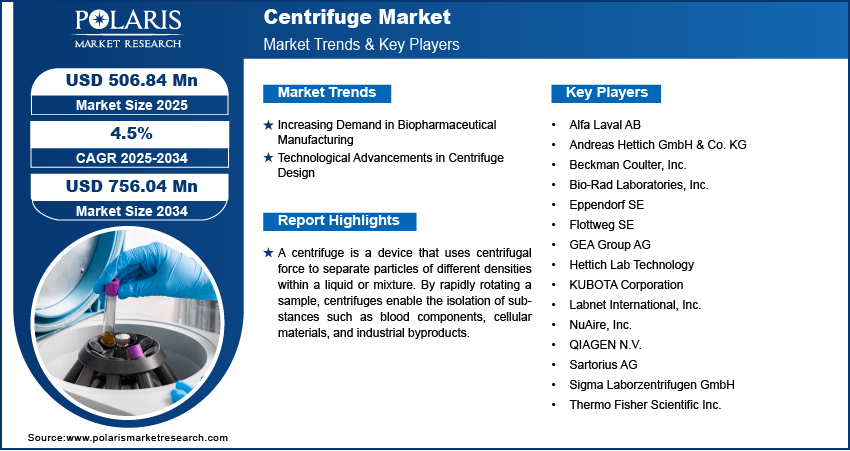
Increasing Demand in Biopharmaceutical Manufacturing
Centrifuge devices are essential for processes such as cell harvesting, protein purification, and viral vector separation. The surge in biologics and personalized medicine production necessitates efficient separation technologies to ensure product purity and efficacy. For instance, Sartorius introduced a high-capacity bioprocess centrifuge in July 2023 to meet the escalating needs of large-scale biopharmaceutical manufacturing. Thus, the biopharmaceutical industry's expansion significantly drives the centrifuge market development.
Technological Advancements in Centrifuge Design
Continuous technological advancements in centrifuge design have led to the development of centrifuges with enhanced automation, improved safety features, and energy-efficient models, thereby boosting their performance and reliability. These advancements reduce human error, streamline processes, and lower operational costs, making centrifuges more appealing across various applications. For example, in April 2023, Eppendorf launched a new series of microcentrifuges featuring advanced rotor designs and intuitive digital controls, enhancing laboratory efficiency and user experience. Hence, the rising technological advancements in centrifuge design contribute to the centrifuge market opportunities.
Source: Polaris Market Research Analysis
Segment Insights
Centrifuge Market Assessment – By Product Type
The centrifuge market, by product type, is segmented into laboratory centrifuge, medical centrifuge, industrial centrifuge, and other centrifuges. The laboratory centrifuge segment holds a significant centrifuge market share of 38.0% in 2025, driven by its extensive application in research laboratories and academic institutions. These centrifuges are essential for processes such as cell culture, protein purification, and nucleic acid extraction. The demand for efficient and accurate sample separation techniques has led to technological advancements, with key industry participants focusing on developing novel equipment.
Comparison Matrix: Laboratory vs Industrial Centrifuges
| Parameter | Laboratory Centrifuges | Industrial Centrifuges |
| Primary Application | Used for medical diagnostics, research, and sample analysis | Used for large-scale separation, purification, and dewatering processes |
| Typical End Users | Hospitals, diagnostic laboratories, research institutes, and universities | Chemical, pharmaceutical, food & beverage, wastewater treatment, and mining industries |
| Processing Capacity | Small sample volumes (milliliters to liters) | High-volume processing (hundreds to thousands of liters) |
| Key Function | Blood separation, cell harvesting, DNA/RNA analysis, and laboratory testing | Solid-liquid separation, sludge dewatering, product purification, and material recovery |
| Speed & Precision | High-speed operation with precise sample handling | Optimized for continuous operation and bulk material processing |
| Design Focus | Accuracy, ease of use, and contamination control | Durability, reliability, and operational efficiency |
| Automation Level | Often semi-automated or benchtop systems | Highly automated systems integrated into production lines |
| Maintenance Requirements | Lower maintenance due to smaller operational loads | Higher maintenance due to continuous heavy-duty usage |
| Cost Range | Generally lower capital investment | Higher capital investment due to larger size and capacity |
| Market Demand Driver | Growing demand for diagnostics, biotechnology, and clinical research | Rising industrial production, wastewater treatment, and process optimization needs |
Centrifuge Market Evaluation – By Capacity
The centrifuge market, by capacity, is segmented into small capacity, medium capacity, and large capacity. The medium capacity segment holds 44.0% centrifuge market revenue share in 2025, driven by its versatility and widespread application across various industries. These centrifuges, typically accommodating volumes between 10 to 100 liters, are extensively utilized in sectors such as biotechnology, pharmaceuticals, and wastewater treatment. Their ability to efficiently process moderate sample sizes makes them ideal for research laboratories and industrial processes that require reliable separation techniques. The growing emphasis on research and development activities, coupled with the need for efficient sample processing, has led to increased adoption of medium-capacity centrifuges. Additionally, advancements in centrifuge technology have enhanced the performance and user-friendliness of these devices, further boosting their demand in the market.
High-Speed vs Low-Speed Centrifuges
| Parameter | High-Speed Centrifuges | Low-Speed Centrifuges |
| Primary Application | Used for molecular biology, protein analysis, cell fractionation, and advanced research | Used for routine laboratory separation, sample preparation, and clinical testing |
| Operating Speed | Typically operates at very high RPM for rapid separation | Operates at lower RPM suitable for standard separation tasks |
| Separation Efficiency | Provides faster, more precise, and high-resolution separation | Adequate for basic separation requirements and routine analyses |
| Sample Types | Proteins, nucleic acids, organelles, and other small particles | Blood samples, cell cultures, and general laboratory specimens |
| End Users | Research laboratories, biotechnology firms, and pharmaceutical companies | Hospitals, diagnostic laboratories, educational institutions, and testing facilities |
| Processing Time | Shorter processing times due to higher centrifugal force | Longer processing times compared to high-speed systems |
| Equipment Cost | Higher acquisition and maintenance costs | More cost-effective and budget-friendly |
| Energy Consumption | Generally higher due to greater operating speeds | Lower energy consumption and operating costs |
| Design Focus | Precision, performance, and advanced analytical applications | Simplicity, reliability, and routine laboratory operations |
| Market Demand Driver | Increasing investments in biotechnology and life science research | Growing demand for clinical diagnostics and routine laboratory testing |
Source: Polaris Market Research Analysis
Regional Insights
By region, the study provides centrifuge market insights into North America, Europe, Asia Pacific, Latin America, and the Middle East & Africa. Asia Pacific holds the largest share of 37.0% of the market in 2025, driven by rapid industrialization, urbanization, and economic development. These factors have led to increased demand across sectors such as oil and gas, pharmaceuticals, and wastewater treatment. The region's focus on environmental testing and sustainability and stringent regulatory frameworks has further propelled the adoption of centrifuges for efficient liquid-solid separation. Additionally, significant investments in research and development have contributed to technological advancements, enhancing the efficiency and appeal of centrifuge technologies in the region.
The European industrial centrifuge market is experiencing growth with 4.07% CAGR, primarily propelled by the growing demand from the water and wastewater treatment sector. Government initiatives aimed at environmental protection have led to significant investments in wastewater treatment facilities across the region.
Source: Polaris Market Research Analysis
Key Players and Competitive Insights
The centrifuge market comprises several active key players contributing to its dynamic landscape. Notable companies include Alfa Laval AB; Beckman Coulter, Inc.; Benchmark Scientific, Inc.; Bio-Rad Laboratories, Inc.; Drucker Diagnostics; Eppendorf SE; Flottweg SE; GEA Group AG; HERMLE Labortechnik GmbH; MPW MED. INSTRUMENTS; NuAire, Inc.; OHAUS Corporation; QIAGEN N.V.; Sigma Laborzentrifugen GmbH; Thermo Fisher Scientific Inc.
The companies offer a diverse range of centrifuge products catering to various industries, including biotechnology, pharmaceuticals, and environmental science. Thermo Fisher Scientific Inc. and Eppendorf AG are recognized for their comprehensive laboratory centrifuge portfolios, addressing the needs of research and clinical laboratories. Beckman Coulter, under Danaher Corporation, provides advanced centrifugation solutions emphasizing automation and efficiency. Sartorius AG and QIAGEN focus on integrating centrifugation with molecular biology workflows, enhancing sample preparation and analysis processes.
In the industrial sector, companies such as Alfa Laval AB, GEA Group AG, and Flottweg SE specialize in large-scale centrifuge systems designed for applications such as wastewater treatment, food and beverage processing, and chemical production. These organizations invest in research and development to innovate energy-efficient and high-performance centrifuges, aligning with global sustainability trends. The competitive landscape is characterized by continuous product development, strategic partnerships, and a commitment to meeting the evolving demands of diverse end-user industries.
Thermo Fisher Scientific Inc. is a prominent provider of scientific instrumentation, reagents, and consumables, serving sectors such as healthcare, life sciences, and industrial applications. The company offers a comprehensive range of products, including laboratory equipment, analytical instruments, and diagnostic tools, supporting research and development activities globally.
Bio-Rad Laboratories, Inc., founded in 1952 by David and Alice Schwartz, is a life sciences and clinical diagnostics company headquartered in Hercules, California. Bio-Rad focuses on developing and manufacturing instruments, software, reagents, and consumables for research in cell biology, gene expression, protein purification, drug discovery, food safety, and science education. Its diagnostic products are used in blood transfusion, diabetes monitoring, autoimmune disease testing, and infectious disease diagnostics. Bio-Rad's centrifuge offerings include the ID-Centrifuge L, which is designed to handle various laboratory tasks. This device combines gel card, traditional tube, and sample centrifugation capabilities using interchangeable heads. It automatically adjusts its settings based on the installed head type. The centrifuge features a post-transportation ID-card centrifugation head, an analytical centrifuge head, a traditional tube centrifuge head, and a sample tube centrifuge head. The device is equipped with a touchscreen interface for ease of use. Bio-Rad operates in multiple regions worldwide, including North America, Europe, Asia, and other areas such as Canada and Latin America.
List of Key Companies
- Alfa Laval AB
- Beckman Coulter, Inc.
- Benchmark Scientific, Inc.
- Bio-Rad Laboratories, Inc.
- Drucker Diagnostics
- Eppendorf SE
- Flottweg SE
- GEA Group AG
- HERMLE Labortechnik GmbH
- MPW MED. INSTRUMENTS
- NuAire, Inc.
- OHAUS Corporation
- QIAGEN N.V.
- Sigma Laborzentrifugen GmbH
- Thermo Fisher Scientific Inc.
Centrifuge Industry Developments
- March 2026: Eppendorf announced the commercial launch of the SpinPro® 6 R centrifuge. It is the first in the new range of SpinPro floor-standing and benchtop centrifuges. (Source: news-medical.net)
- February 2025: Thermo Fisher announced its agreement to acquire Solventum's purification and filtration division for approximately USD 4.1 billion. This strategic move aims to enhance Thermo Fisher's bioprocessing capabilities by entering the filtration segment, complementing its existing services in accelerating drug development for biopharmaceutical companies. (Source: ir.thermofisher.com)
Market Segmentation
By Product Type Outlook (Revenue-USD Million, 2021–2034)
- Laboratory Centrifuge
- Medical Centrifuge
- Industrial Centrifuge
- Other Centrifuges
By Capacity Outlook (Revenue-USD Million, 2021–2034)
- Small Capacity
- Medium Capacity
- Large Capacity
By Speed Range Outlook (Revenue-USD Million, 2021–2034)
- Low Speed
- Medium Speed
- High Speed
By Application Outlook (Revenue-USD Million, 2021–2034)
- Blood Separation
- Biotechnology
- Pharmaceutical
- Food & Beverage
- Oil & Gas
By Regional Outlook (Revenue-USD Million, 2021–2034)
- North America
- US
- Canada
- Mexico
- Europe
- Germany
- France
- UK
- Italy
- Spain
- Netherlands
- Russia
- Rest of Europe
- Asia Pacific
- China
- Japan
- India
- Malaysia
- South Korea
- Indonesia
- Australia
- Rest of Asia Pacific
- Middle East & Africa
- Saudi Arabia
- UAE
- Israel
- South Africa
- Rest of Middle East & Africa
- Latin America
- Brazil
- Argentina
- Rest of Latin America
Centrifuge Market Report Scope
| Report Attributes | Details |
| Market Size Value in 2025 | USD 507.38 million |
| Market Size Value in 2026 | USD 529.80 million |
| Revenue Forecast by 2034 | USD 753.55 million |
| CAGR | 4.5% from 2026 to 2034 |
| Base Year | 2025 |
| Historical Data | 2021–2024 |
| Forecast Period | 2026–2034 |
| Quantitative Units | Revenue in USD million and CAGR from 2026 to 2034 |
| Report Coverage | Revenue Forecast, Market Competitive Landscape, Growth Factors, and Industry Trends |
| Segments Covered |
|
| Regional Scope |
|
| Competitive Landscape |
|
| Report Format |
|
| Customization | Report customization as per your requirements with respect to countries, regions, and segmentation. |
Source: Polaris Market Research Analysis
Centrifuge Market FAQ's
The market size was valued at USD 507.38 million in 2025 and is projected to grow to USD 753.55 million by 2034.
The market is projected to register a CAGR of 4.5% during the forecast period.
Asia Pacific held the largest share of 37.0% in 2025.
A few notable companies include Alfa Laval AB; Beckman Coulter, Inc.; Benchmark Scientific, Inc.; Bio-Rad Laboratories, Inc.; Drucker Diagnostics; Eppendorf SE; Flottweg SE; GEA Group AG; HERMLE Labortechnik GmbH; MPW MED. INSTRUMENTS; NuAire, Inc.; OHAUS Corporation; QIAGEN N.V.; Sigma Laborzentrifugen GmbH; Thermo Fisher Scientific Inc.
The laboratory centrifuge segment held a significant share of 38.0%.
A centrifuge is a mechanical device used to separate components of a mixture based on their density by applying centrifugal force.
Download Sample Report of Centrifuge Market Size, Share, Growth 2026-2034
Please fill out the form to request a customized copy of the research report.


