
Compressed Air Energy Storage Market Size, Trends Analysis 2026-2034
REPORT DETAILS
Compressed Air Energy Storage Market Summary
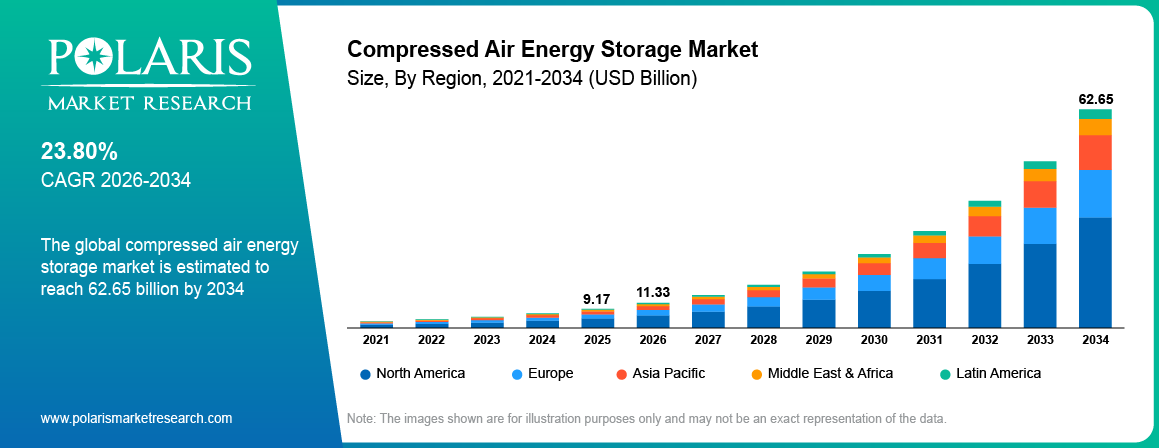
The global compressed air energy storage market size was valued at USD 9.17 billion in 2025, growing at a CAGR of 23.80% from 2026–2034. Key factors driving the growth is increase in investment, favorable government policies, and technological advancement.
Market Statistics
Key Takeaways
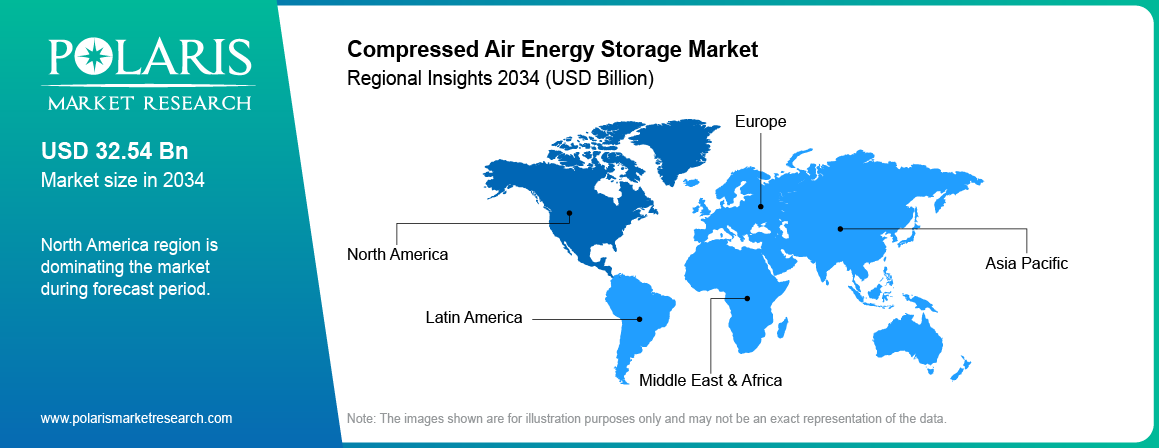
- North America compressed air energy storage market is dominated with largest share accounting for 32.0% in 2025 due to increase in demand for the long duration energy storage
- The Asia Pacific compressed air energy storage market is expected to register CAGR of 28.0% during the forecast period due to rising need for energy resilience.
- Europe is expected to witness CAGR of 23.4% during the forecast period due to rising renewable energy penetration.
- Diabatic segment dominated the market with 62.0% share in 2025, due to rising demand for large scale energy storage system in less time.
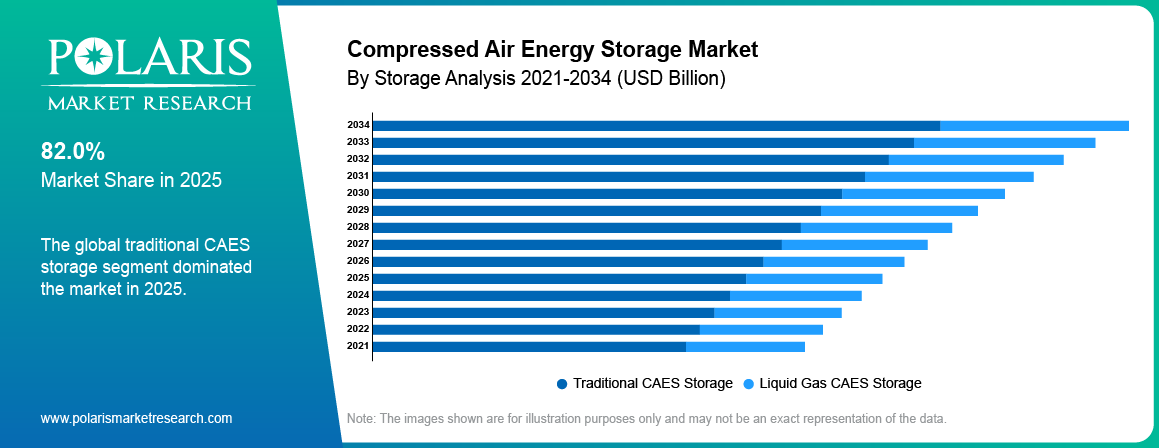
- Traditional CAES storage accounted for 82.0% share in 2025 as it is most established, and commercially available form of compressed energy storage.
*Note: Figures and projections outlined in this report are the result of Polaris Market Research’s proprietary analytical processes, grounded in the latest available datasets and market observations.
Industry Dynamics
- The rising government investment and favorable policies is driving the growth.
- Increase in focus on energy resilience and renewable energy integration is fueling the growth.
- Technological advancement is boosting the growth.
- High capital expenditure and geological constraint limit the growth of the market.
What is compressed air energy storage technology?
Compressed-air energy storage is a long-duration storage technology that stores energy by compressing air into underground caverns or engineered vessels and later expands it through turbines to generate electricity. It typically uses large-scale geologic formations to hold massive volumes of compressed air. CAES operates as a long duration energy storage technology. This makes it suitable for grid balancing, renewable energy, and peak-shifting. Moreover, their design enables high-power outputs which supports bulk energy management and grid reliability.
CAES vs Lithium-ion Batteries
CAES delivers longer durations at lower incremental cost than lithium-ion batteries. This makes CAES more cost effective compared to lithium-ion batteries. It supports inexpensive cavern volume which makes it ideal for multi-hour to multi-day applications such as renewable energy integration and capacity support during extended weather events. CAES typically offers stronger grid services like inertia and stable, dispatchable power, but has slower response times compared to the millisecond-level reaction of batteries. However, it requires suitable geology, larger project footprints, and longer permitting times, which limit deployment locations.
Why CAES matters in energy transition?
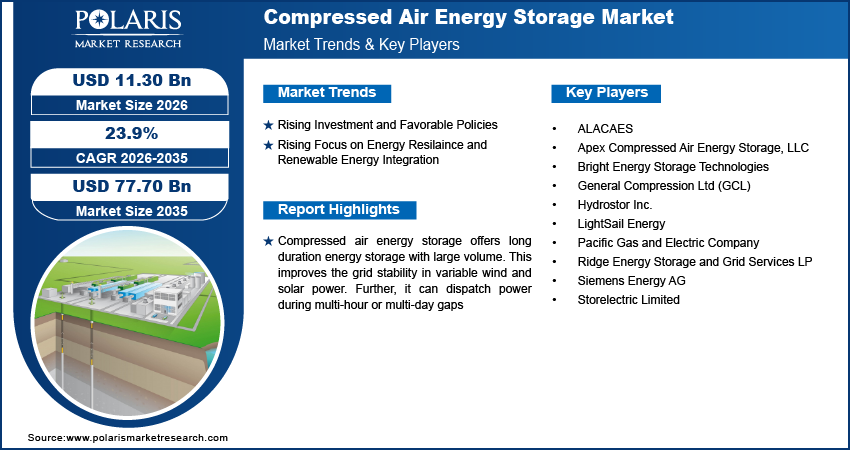
Compressed air energy storage offers long duration energy storage with large volume. This improves the grid stability in variable wind and solar power. Further, it can dispatch power during multi-hour or multi-day gaps. This advantage fuels the preference for compressed air energy storage technology during the energy transition. Moreover, it supports underground storage and offer grid-strengthening services in low cost, which fuels the renewable energy penetration and further supports the energy transition.
Drivers, Opportunities & Trends
Rising Investment and Favorable Policies: Governments worldwide are increasingly spending and funding on the advance energy storage system. This rise the spending is driven by need to update existing outdated power infrastructure. According to the California Energy Commission, the California State in the United States have allocated USD 270 million for non-lithium-ion long duration energy storage technologies under the Long Duration Energy Storage program. This rise in the spending is fueling the demand for the long duration energy storage system such as compressed air energy storage technology. Moreover, rising grants and low interest financing are supporting manufacturers to overcome high upfront cost require for production and deployment of the CAES technology. This further supports companies to improve design and develop new cavern, thereby driving the industry growth.
The U.S. Department of Energy have introduced Long-Duration Energy Storage portfolio. This includes three more programs with dedicated focus on non‑lithium technologies with 10+ hour discharge duration. The government issued Notices of Funding Opportunity or Funding Opportunity Announcements in which the U.S. Department of Energy are providing federal grants to private entities, utilities, and consortia for developing long-duration energy storage projects.
| Program | Funding Opportunity | Issued Date |
| LDES Pilot Program | USD 100 Million | September 2024 |
| LDES Demonstration Program | USD 349 Million | November 2022 |
Source: Polaris Market Research Analysis
Rising Focus on Energy Resilaince and Renewable Energy Integration: Government and utilities companies are increasingly focusing on energy resilience and security. This rise in the focus is driven by rise in the cross-border tension, extreme weather events, heatwaves, and grid failures. According to the European Commission, in May 2022, the European Commission launched REPowerEU Plan to save energy, diversify energy supplies, and produce more clean energy for the region. This is driving the demand for the long duration energy storage systems. Consequently, the demand for the compresses air energy storage system is rising. It provides a dependable backup that operate through multi-day disruptions. Moreover, this focus on the energy resilience is fueling the integration of renewable energy in the existing energy infrastructure. According to the International Energy Agency, in 2022, 38.2% of total energy in Europe was generated through renewables. This rise in the integration is further fueling the demand for the compresses air energy storage technology, thereby driving the growth.
Phases of Renewable Energy Integration
| Country | Renewable Energy Integration Phase in 2023 |
| Denmark | Phase 5 |
| Ireland | Phase 4 |
| Spain | Phase 4 |
| Netherland | Phase 4 |
| Germany | Phase 4 |
| UK | Phase 4 |
| Chile | Phase 3 |
| Japan | Phase 3 |
| Australia | Phase 3 |
| Jordan | Phase 3 |
Source: Polaris Market Research Analysis
Source: International Energy Agency
Market Challenges & Restrain
- High Capital Expenditure: Building a compressed air energy storage plants require high upfront cost. The cost of compressors, turbines, caverns, and large-scale infrastructure is expensive when compared to battery energy storage systems. This limits the market entry for players with low budget or investment. Governments are introducing policies and grants for long duration energy storage systems but its still limited to developed nations, which further limits the growth of the market. The long construction timelines also mean investors must wait years before seeing returns, thereby restraining the adoption of the technology.
- Geological and Site Availability Constraints: Compressed air energy storage systems are suitable in the underground spaces such as salt caverns, hard-rock caverns, or depleted gas fields. These underground spaces are not available everywhere. This limits the number of locations where projects can be built. Further, it requires extensive geological surveys which adds up time and cost for the projects. Environmental concern, land rights and safety concern further restrain the adoption of the technology, thereby restraining the industry growth.
Segmental Insights
By Technology Analysis
Diabatic segment dominated the market with 62.0% share in 2025, due to rising demand for large scale energy storage system in less time. The governments worldwide are spending heavily on large scale energy storage systems. This is fueling the demand for the diabatic CAES systems. Its simpler design and long operational track record make it easier to permit, finance, and integrate into existing grid infrastructure, thereby driving the segment growth.
Isothermal segment is expected to witness CAGR of 25.7% due to its cost effectiveness. Isothermal systems offer higher efficiency and low operational cost when compared to the traditional compressed air energy storage system. Isothermal CAES systems maintain a nearly constant temperature during air compression and expansion. This reduces thermal energy losses and improves round-trip efficiency. This improves the appeal of the system for long duration energy storage. Moreover, Isothermal CAES requires less thermal-management components, which reduces the maintenance cost of the system, consequently, the adoption is rising, thereby driving the segment growth.
Adiabatic segment is growing at a CAGR of 29.1% during the forecast year, because it eliminates the need for fossil fuels and captures the heat generated during compression for reuse. This makes it a fully renewable and emissions-free storage option. Governments and utility companies are setting up decarbonization goals and adiabatic CAES aligns strongly with global decarbonization goals and utility mandates to add clean long-duration storage. It also improves round-trip efficiency by storing and reapplying thermal energy. This helps to reduce operating costs over time, thereby driving the segment growth.
By Storage Analysis
Traditional CAES storage accounted for 82.0% share in 2025 as it is most established, and commercially available form of compressed energy storage. This form of storage is proven for long duration operations. These systems have decades of operational history, which reduces perceived technical and financial risks compared to newer variants like adiabatic or isothermal designs. Moreover, existing storage infrastructure and trust is driving the segment growth.
Liquid gas CAES storage is expected to grow at a CAGR of 22.9%, due to its advantages in energy density. This storage system offers higher energy density, flexible siting, and fewer geological limitations than traditional cavern-based CAES. Consequently, the driving its demand. This storage systems can integrate with renewable energy capacity and provide long duration storage and stable grid support. Moreover, technological advancement in the storage system is further improving the appeal of the system in the commercial settings, thereby driving its segment growth.
Storage Forms & Geological / Configuration Considerations
| Storage approach | Typical storage form | Geological setting / siting considerations | Configuration considerations (pressure, integrity, layout) |
| Traditional CAES storage (underground caverns, aquifers, mines) | Solution‑mined salt caverns used as high‑pressure air reservoirs. | Requires thick, laterally continuous bedded or domal salt with low permeability and self‑healing creep behavior; depth must balance cavern stability against excessive temperature/pressure; salt thickness and overburden stress must accommodate cavern span and roof beam thickness. | Caverns are leached to a defined shape (often cylindrical or bottle‑shaped) and operated at pressures typically in the multi‑MPa range; stability analysis addresses cavern convergence, roof span, pillar width, and cycling‑induced fatigue; well design and casing cement must ensure long‑term sealing under repeated pressure cycles. |
| Traditional CAES storage (porous rock aquifers) | Confined saline aquifers or porous sandstone reservoirs used as air storage instead of natural gas. | Needs a permeable reservoir (adequate porosity and permeability) overlain by a competent, low‑permeability caprock to limit air migration; structural or stratigraphic traps (anticlines, fault‑bounded closures) preferred to retain air; depth affects pressure, temperature, and risk of air–water interactions. | Injection and withdrawal wells completed similarly to gas storage; operating pressure band constrained by fracture gradient of caprock and residual water saturation; numerical models are used to predict air plume movement, pressure propagation, and potential impacts on groundwater. |
| Traditional CAES storage (mines, hard‑rock caverns, lined caverns) | Abandoned mines, excavated rock caverns, or lined underground caverns adapted for compressed‑air storage. | Host rock must provide sufficient strength and low fracture connectivity; existing mine geometry and support condition limit allowable pressures; in hard‑rock caverns, stress field orientation, joint sets, and potential for spalling or rock bursts are assessed. | Often operated at lower pressures than solution‑mined salt unless lined; liners or water curtains may be used to reduce leakage; layout must address access drifts, shaft connections, and monitoring for deformation and seepage over many pressure cycles. |
| Liquid‑gas / liquid air CAES (LAES) – cryogenic tank storage | Insulated above‑ground or shallow‑buried cryogenic tanks storing liquefied air or other liquefied gas working fluids at low temperature. | Site selection is largely independent of subsurface geology, focusing instead on surface safety, ambient conditions, and planning constraints; conventional geotechnical checks for foundations, settlement, and seismic loading are still required, but no specific deep geologic structure is needed. | Storage is at near‑ambient pressure but very low temperature, so design focuses on boil‑off minimization, insulation, and integration with liquefaction and power blocks; modular tank farms can be configured flexibly and co‑located with industrial sites or power plants without the need for cavern or aquifer characterization. |
| Liquid‑gas / hybrid CAES with thermal integration | Combination of cryogenic liquid storage tanks and separate thermal or cold reservoirs (e.g., packed beds, phase‑change materials) in above‑ground vessels. | No dedicated deep geologic storage; standard civil/structural and geotechnical assessments for foundations and tank supports; siting may consider access to waste heat or cold sources, industrial clusters, and grid connection rather than specific rock formations. | Configuration optimizes the arrangement of compressors, expanders, heat exchangers, and storage tanks; design aims to manage stratification, pressure drops, and thermal cycling in tanks, and can be scaled by adding or removing modules without changing underlying geology. |
Source: Polaris Market Research Analysis
Applications & Business Use Cases
Utility-Scale Storage & Renewable Integration
Utility-scale storage: It involves large-capacity systems that store electricity as compressed air during off-peak periods and release it during peak demands. These systems provide dependable grid balancing, peak shaving, and black start capabilities. This improves overall grid stability. It supports long-duration energy storage which is critical for maintaining continuous power supply and manage load fluctuations for long duration. This makes it attractive for utilities who are looking for scalable and cost-effective energy storage solutions to support grid modernization and increase resilience without reliance on fossil fuel plants.
Renewable Integration: It facilitates the efficient use of variable renewable energy like wind and solar. It stores surplus generation and dispatches it when renewable output falls short. It also reduces curtailment of renewable resources which increases their capacity factor, and smooths power supply variability. It provides firm, dispatchable power crucial for reliable renewable penetration on the grid which reduces fossil backup power reliance.
Ancillary Services & Grid Balancing
CAES offers more value than simple energy arbitrage. It offers frequency regulation to stabilize grid frequency by adjusting power output. Its ability to ramp quickly enables spinning reserve and fast-deploy capacity. This supports grid reliability during sudden outages. CAES units can start without an external power source which gives them black-start capability for restoring the grid after failures. Moreover, storage for long time and high reliability improves the appeal of the CAES.
Industrial, Off-grid & Microgrid Use Cases
CAES provides dependable, dispatchable power where grid access is weak or unreliable. It offers advantages such as multi-hour storage. This offers smooth integration of variable renewables. CAES offers long lifetimes with less faults compared with batteries. This makes it well suited for industrial applications. When paired with solar or wind in microgrids, CAES delivers stable, low-carbon power while sharply reducing dependence on diesel generators.
Commercial / Revenue Model Stack
| Revenue Model | Description | Key Benefits / Applicability |
| Energy Arbitrage | Purchase low-cost off-peak electricity to compress and store air; sell during high-price peak periods. | Capitalizes on price volatility; primary revenue but often insufficient alone for project viability. |
| Capacity Payments / Auctions | Compensation for providing reliable capacity in capacity markets or auctions, rewarding long-duration availability. | Premium for firm power; supports grid reliability in renewable-heavy systems. |
| Ancillary Services Payments | Revenue from frequency regulation, spinning reserves, black-start, and voltage support markets. | High-value short-term services; adds $23-28/kW-yr to revenues via co-optimization. |
| Long-term PPAs / Tolling Agreements | Fixed-price contracts with utilities or customers, often hybrid renewable+CAES for dispatchable power. | Revenue certainty; ideal for de-risking investments in firm renewable output. |
| Grid Decarbonization / Stability Contracts | Long-term agreements tied to emissions reduction, renewables support, and grid stability mandates. | Policy-driven premiums; aligns with decarbonization targets and storage incentives. |
Source: Polaris Market Research Analysis
Regional Analysis
North America
North America compressed air energy storage market is dominated with largest share accounting for 32.0% in 2025, due to increase in demand for the long duration energy storage. Governments and utilities companies are spending on long duration energy storage systems to improve energy resilience and upgrade the ageing power infrastructure. Consequently, the demand for CAES in the region is rising, thereby driving the growth.
Asia Pacific
The Asia Pacific compressed air energy storage market is expected to register CAGR of 28.0% during the forecast period due to rising need for energy resilience. Major countries in the region are expanding renewable energy and are building more resilient power systems. Countries in the region are also introducing nationwide clean-energy goals. India, Japan, and Southeast Asia are exploring CAES for microgrids, industrial hubs, and remote regions, thereby boosting the growth.
Europe
Europe is expected to witness CAGR of 23.4% during the forecast period due to rising renewable energy penetration. The region is actively investing in the renewable energy infrastructure. This is driving the demand for long duration energy storage system which can integrate with renewable energy infrastructure. Consequently, the demand for compresses air energy storage system is rising, thereby driving the growth.
Latin America and MEA – Emerging Markets
Latin America and MEA are emerging but promising regions for industry. The regions are expanding renewable energy infrastructure and upgrading power systems. In Latin America, countries such as Brazil, Chile, and Mexico are looking for long-duration storage to manage variability from wind and solar while supporting remote mining and off-grid communities. In MEA, growing solar and wind capacity, especially in Gulf nations, increases demand for reliable storage. The African regions benefit from CAES for stable off-grid and microgrid power.
Key Players & Competitive Analysis
The market is competitive, with major brands like Bayer, Herb Pharm, Herbalife, Hims & Hers, Natrol, Nature’s Bounty, Nestlé, NOW Foods, Olly, and Zarbee’s Naturals offering diverse sleep-support products. Companies compete through melatonin formulas, herbal blends, gummies, and natural sleep aids tailored to different consumer needs. Strong branding, broad retail and online distribution, and a focus on clean-label, fast-acting, and wellness-oriented products drive competition as demand for safe, effective sleep solutions continues to grow.
List Of Key Companies
- ALACAES
- Apex Compressed Air Energy Storage, LLC
- Bright Energy Storage Technologies
- General Compression Ltd (GCL)
- Hydrostor Inc.
- LightSail Energy
- Pacific Gas and Electric Company
- Ridge Energy Storage and Grid Services LP
- Siemens Energy AG
- Storelectric Limited
Project Tracker: Landmark & Emerging CAES Installations
| Project Name / Location | Technology Type | Capacity / Duration | Status | Key Features / Notes |
| PowerSouth Energy Cooperative / McIntosh, Alabama, USA | Traditional CAES (salt cavern) | 110 MW / 26 hours | Operational | Only operational CAES facility in USA; diabatic system; provides peaking power and load following. |
| Huntorf Power Plant / Schleswig-Holstein, Germany | Traditional CAES (salt cavern) | 321 MW / 2-3 hours | Operational | Oldest CAES facility globally (commissioned 1978); diabatic; operates for peak load management. |
| Jintan CAES Project / Jiangsu Province, China | Adiabatic CAES (salt cavern) | 50-60 MW | Under Construction | Uses existing salt cavern; zero external fuel input; designed for solar curtailment reduction. |
| Hubei Yingchang CAES / Hubei Province, China | Advanced CAES | 300 MW / 1,500 MWh (5 hrs) | Recently Announced | Large-scale system supporting renewable integration and grid stability in China. |
| Willow Rock Energy Storage Center / Kern County, California, USA | Advanced CAES (A-CAES) | 500 MW / 4,000 MWh (8 hrs) | Conditionally Funded (DOE: $1.76B loan) | Uses water-based pressure maintenance; 25-year PPA with Central Coast Community Energy; innovative technology. |
| Iowa Stored Energy Park (ISEP) / Des Moines, Iowa, USA | Traditional CAES | 270 MW / Multi-hour | Proposed / Development | Proposed 270 MW, $400 million project; advanced policy and tariff development focus. |
Source: Polaris Market Research Analysis
Future Outlook: Opportunities & Risks
The market is expected to grow in the future due to rising renewable penetration and the need for long-duration storage. Major opportunities in the market are deployment in utility-scale projects, microgrids, and industrial sites. Further advancements in adiabatic and hydrogen-hybrid CAES technologies that improve efficiency and eliminate emissions is expected to fuel the market.
Risks in the industry are high upfront capital costs, geological site limitations, and competition from advanced batteries and other long-duration storage technologies. This may slow adoption. Regulatory uncertainty and lengthy permitting also pose challenges.
Industry Developments
March 2025: Segula Technologies launched its Remora Stack, a 12-meter containerized isothermal CAES system claiming 70% efficiency and a 30-year lifespan. It built two 200 kW prototypes in Spain and advanced plans for a 2026 pilot ahead of 2028/29 commercialization. (Source: segulatechnologies.com)
December 2025: EllisDon and Cache Power announced Canada’s first commercial CAES facility in northeast Alberta. They secured regulatory approvals, began early construction in late 2025, and advanced plans to store up to 48 hours of energy using Siemens Energy technology and underground salt caverns. (Source: globenewswire.com)
Compressed Air Energy Storage Market Segmentation
By Technology Outlook (Revenue, USD Billion, 2021–2034)
- Diabatic
- Adiabatic
- Isothermal
By Storage Outlook (Revenue, USD Billion, 2021–2034)
- Traditional CAES Storage
- Liquid Gas CAES Storage
By Application Outlook (Revenue, USD Billion, 2021–2034)
- Energy Management
- Backup and Seasonal Reserves
- Renewable Integration
By End Use Industry Outlook (Revenue, USD Billion, 2021–2034)
- Power Station
- Distributed Energy System
- Automotive Power
By Regional Outlook (Revenue, USD Billion, 2021–2034)
- North America
- US
- Canada
- Europe
- Germany
- France
- UK
- Italy
- Spain
- Netherlands
- Russia
- Rest of Europe
- Asia Pacific
- China
- Japan
- India
- Malaysia
- South Korea
- Indonesia
- Australia
- Vietnam
- Rest of Asia Pacific
- Middle East & Africa
- Saudi Arabia
- UAE
- Israel
- South Africa
- Rest of Middle East & Africa
- Latin America
- Mexico
- Brazil
- Argentina
- Rest of Latin America
Compressed Air Energy Storage Market Report Scope
| Report Attributes | Details |
| Market Size in 2025 | USD 9.17 Billion |
| Market Size in 2026 | USD 11.33 Billion |
| Revenue Forecast by 2034 | USD 62.65 Billion |
| CAGR | 23.80% from 2026 to 2034 |
| Base Year | 2025 |
| Historical Data | 2021–2024 |
| Forecast Period | 2026–2034 |
| Quantitative Units | Revenue in USD Billion and CAGR from 2026 to 2034 |
| Report Coverage | Revenue Forecast, Competitive Landscape, Growth Factors, and Industry Trends |
| Segments Covered |
|
| Regional Scope |
|
| Competitive Landscape |
|
| Report Format |
|
| Customization | Report customization as per your requirements with respect to countries, regions, and segmentation. |
Source: Polaris Market Research Analysis
Compressed Air Energy Storage Market FAQ's
The global market size was valued at USD 9.17 billion in 2025 and is projected to grow to USD 62.65 billion by 2034.
The global market is projected to register a CAGR of 23.80% during the forecast period.
North America dominated the market in 2025 with 32.0% share.
A few of the key players in the market are Bright Energy Storage Technologies, Pacific Gas and Electric Company, Apex Compressed Air Energy Storage, LLC, Storelectric Limited, ALACAES, General Compression Ltd (GCL), LightSail Energy, Siemens Energy AG, Hydrostor Inc., Ridge Energy Storage and Grid Services LP.
Diabatic segment dominated the market with 62.0% share in 2025, due to rising demand for large scale energy storage system in less time.
Liquid gas CAES storage is expected to grow at a CAGR of 22.9%, due to its advantages in energy density.
Download Sample Report of Compressed Air Energy Storage Market
Please fill out the form to request a customized copy of the research report.


