
AI in Interior Design Market Size, Share Report 2026-2034
REPORT DETAILS
AI in Interior Design Market Summary
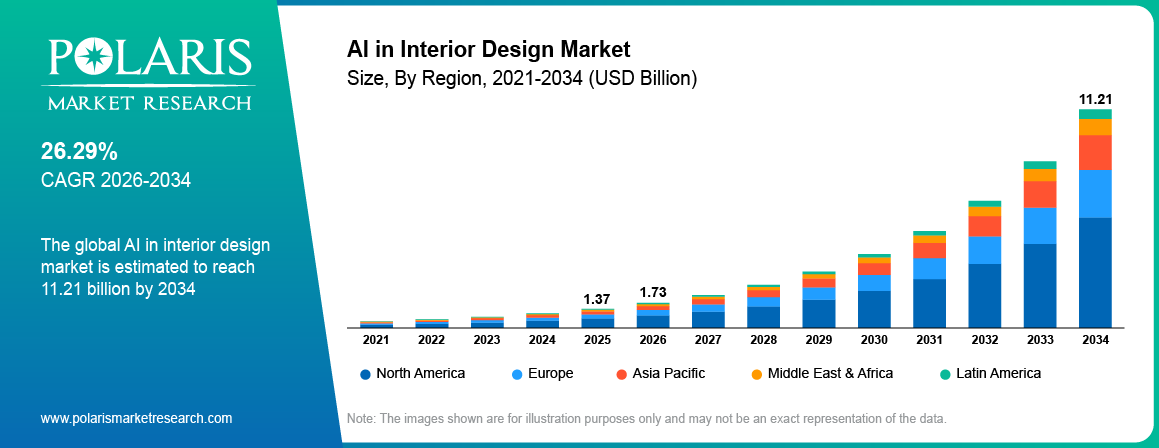
The global AI in Interior Design market was valued at USD 1.37 billion in 2025 and is projected to reach USD 11.21 billion by 2034, registering a CAGR of 26.29% during the forecast period. Market is driven by the increasing use of artificial intelligence in residential and commercial design projects, growing demand for automatic visualization technology, and rising investment in digital design technology.
Market Statistics
AI in Interior Design Market Key Takeaways 2025
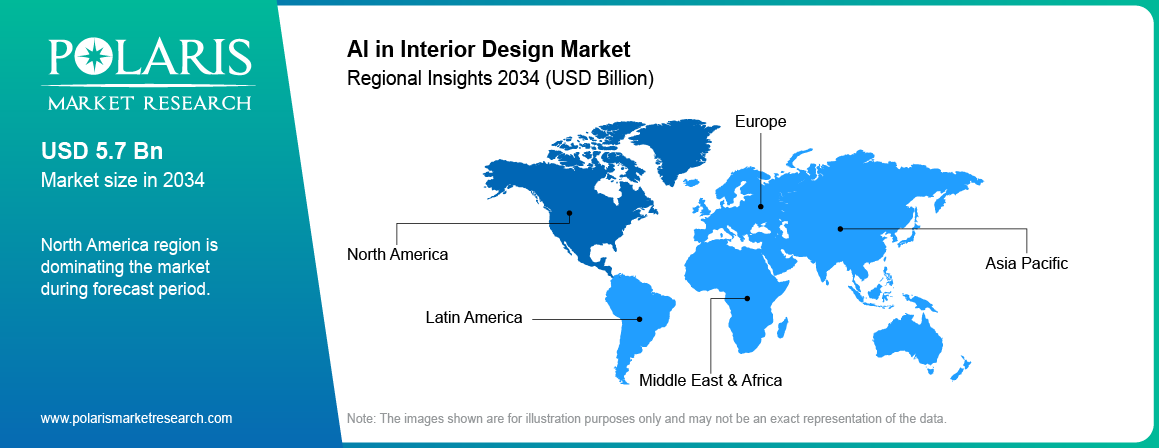
- North America led the market with a 39.80% share in 2025, due to high adoption rates of AI software, increasing digital spending, and the presence of major technology players.
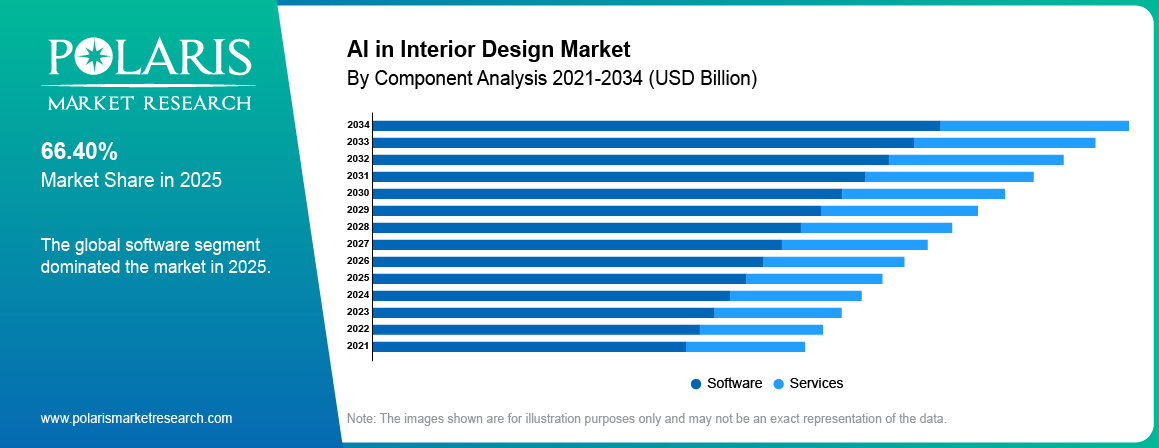
- The Software category captured the highest market share of 66.40% in 2025, driven by increasing adoption of AI-powered visualization, room planning, and interior design tools.
- The Cloud category dominated the deployment segment with a 63.10% market share in 2025, as businesses favored scalable and remote design solutions.
- The Residential category was the leading end-user segment with a 57.50% market share in 2025, driven by increasing home renovation initiatives and growing consumer adoption of AI-based home design applications.
Note: Figures and projections outlined in this report are the result of Polaris Market Research’s proprietary analytical processes, grounded in the latest available datasets and market observation
What is AI in Interior Design?
AI for Interior Design refers to the use of AI technology to help in planning the interior, space optimization, furniture arrangement, materials choice, color choices, and visualization. The software uses data on the user's needs, dimensions of the rooms, lighting, and design styles to create personalized designs.
In the AI for interior design value chain, there are AI software developers, cloud computing service providers, 3D visualization software companies, furniture makers, e-commerce websites, architectural and design companies, real estate firms, retailers, and the end users of the products. Collaboration between software developers, hardware providers, design firms, and technology companies is continuous.
Source: Polaris Market Research Analysis
AI in Interior Design Market Driver Impact Analysis
AI in Interior design market is projected to grow significantly in the coming years due to digitization of architecture and interior design services, increasing demand from consumers for customized living spaces, and rapid penetration of artificial intelligence technology within creative sectors. Increasing investments in generative AI tools, cloud computing facilities, and immersive visualization systems are contributing to increase the efficiency of projects and customer engagements of designers.
| Market Driver | Est. CAGR Impact | Geographic Relevance | Impact Timeline |
| Growing adoption of AI-powered design software | 26.40% | North America, Europe, Asia Pacific | Short to medium term |
| Expansion of digital home renovation platforms | 24.90% | Global | Medium term |
| Rising investments in generative AI technologies | 27.80% | Global | Ongoing |
| Growing adoption of cloud-based design solutions | 25.70% | Global | Medium to long term |
| Increasing demand for personalized interior experiences | 24.60% | Asia Pacific, North America | Long term |
* Indicative estimates based on market context and analyst judgment. Figures reflect relative driver weight, not additive CAGR contributions. Source: Polaris Market Research Analysis.
AI in Interior Design Market Industry Dynamics
- Increasing adoption of artificial intelligence technology is revolutionizing interior designing, visualization, and customer engagements in both residential and commercial spaces.
- Growing investments in cloud computing facilities and generative AI tools are improving the functionalities of digital interior design platforms.
- Data privacy concerns and dependence on high-quality design datasets continue to remain important challenges for software developers.
- Increasing demand for virtual staging, AI-assisted customization, and smart home integration is creating new business opportunities across the market.
AI in Interior Design Market Drivers, Restraints and Opportunities
How Is Growing Adoption of Generative AI Driving the Market?
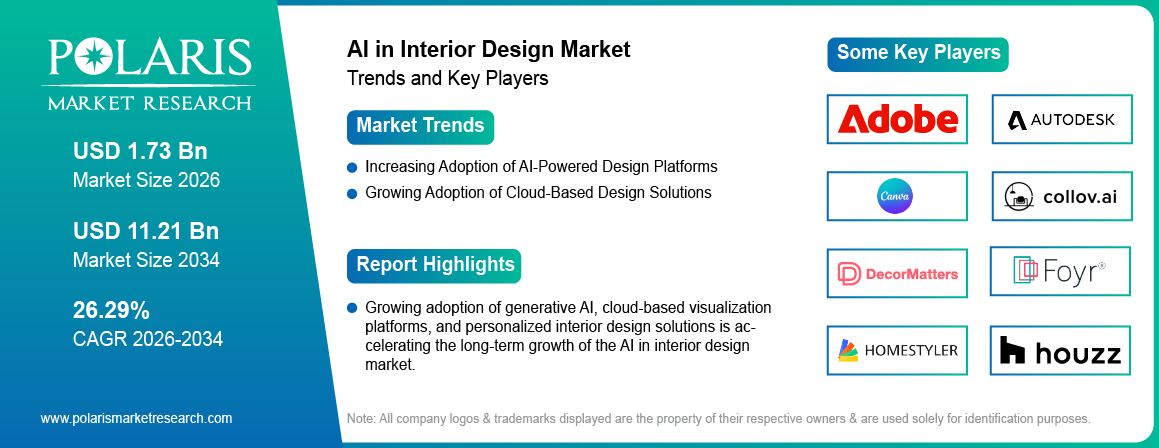
Increasing Adoption of AI-Powered Design Platforms
Growing use of generative artificial intelligence is transforming the way interior spaces are planned and designed. In July 2022, IKEA introduced an interior design platform with the help of AI technology, where clients can easily come up with their room layouts, furniture placements, and custom designs for their homes. Platforms with the help of AI technologies assist designers in coming up with multiple designs for the rooms, assist in suggesting furniture placement, provide suggestions on color palettes, and also allow generating a realistic 3D view of the space in a few minutes.
How Is Digital Transformation Supporting Market Expansion?
Growing Adoption of Cloud-Based Design Solutions
Interior design companies, furniture stores, and real estate developers use cloud-based AI systems for the better project management process and more effective client collaboration through these platforms. The cloud-based AI platforms facilitate remote access to design tools for clients, enable project sharing in real-time, and allow managing different designs from one single place. With the integration of AI with AR, VR, and BIM models, it is becoming easier to work with projects and engage clients in them.
What Challenges Limit Growth of the Market?
Data Privacy and Limited Creative Flexibility
Despite technology has developed quickly, data privacy and intellectual property issues continue to pose a significant problem while developing AI-based solutions for interior design. For instance, most solutions involve the need to input layouts of properties, preferences, and project information into cloud systems, posing issues related to data safety. Moreover, AI-generated solutions cannot always reflect personal artistic or architectural considerations, requiring professional designers to make manual refinements.
What Opportunities Exist in the Market?
Expansion of Smart Homes and Virtual Interior Design Services
The increasing popularity of smart homes and virtual consultations for interior design are creating opportunities for suppliers of AI solutions. The growing investments made in digital renovation systems and customer experience development create new income opportunities for AI software providers during the forecast period. In January 2024, Beams raised USD 12.2 million to expand its AI-based platform for digital renovation in Europe.
Source: Polaris Market Research Analysis
Segment and Regional Leaders at a Glance
According to Polaris Market Research, North America leads the market while Asia Pacific the fastest-growing region.
- Dominant Region: North America
- Fastest Growing Region: Asia Pacific
- Largest Component Segment: Software
- Fastest Growing Component Segment: Services
- Largest Deployment Mode Segment: Cloud-Based
- Fastest Growing Deployment Mode Segment: Hybrid Deployment
- Largest End User Segment: Residential
- Fastest Growing End User Segment: Commercial
Segmentation Analysis
The report provides a comprehensive analysis of the AI in interior design market by component, deployment mode, and end user to identify major revenue-generating segments and emerging growth opportunities across the global interior design software industry.
AI in Interior Design Market by Component
Which Component Segment Dominates the Market?
The software segment accounted for the largest market share in 2025. Increasing use of room planning tools using AI, automation of visualization, space optimization, and design recommendation platforms has resulted in a higher demand for intelligent software solutions. Constant developments in the fields of generative AI algorithms, cloud computing, and 3D rendering have been beneficial for software vendors to provide a faster and more accurate design experience, thus, reinforcing the segment's dominant position.
Which Component Segment Is Expected to Register the Fastest Growth?
The services segment is projected to register the fastest CAGR during the forecast period. Increasing implementation of AI solutions across architecture firms, real estate companies, and interior design consultancies is driving demand for system integration, customization, technical support, and consulting services.
AI in Interior Design Market by Deployment Mode
Which Deployment Mode Segment Holds the Largest Share of the Market?
The cloud-based segment represented the largest market share in 2025. Cloud-based platforms provide more scalability, remote access capability, automatic updates of software, and reduced costs of infrastructure, and hence become the preferred deployment option for interior designers, retailers, and enterprises. Increasing preference for SaaS solutions is likely to drive segment growth.
Which Deployment Mode Segment Is Growing at the Fastest Rate?
The hybrid deployment segment is anticipated to register the highest growth rate over the forecast period. Enterprises that need more flexibility, better data security, and integration with enterprise-level systems are increasingly deploying the hybrid model of deployment.
AI in Interior Design Market by End User
Which End User Leads the Market?
The residential segment accounted for the largest share of the AI in interior design market in 2025. Rising home renovation activities, growing consumer spending on home décor, and increasing use of AI-powered design applications among homeowners continue to support segment growth.
Which End User Segment Is Expected to Grow the Fastest?
The commercial segment is projected to register the fastest CAGR during the forecast period. AI-enabled design platforms have been increasingly gaining prominence in the hotel, office, retail, restaurant, healthcare, and commercial real estate development industries for better planning, optimized space usage, and cost savings on the design front.
Segment Summary Table
| Segment | Category | 2025 Status | Forecast CAGR | Key Driver |
| Software | Component | Largest Share | 24.80% | Growing adoption of AI-powered design platforms |
| Services | Component | Fastest Growing | 27.60% | Rising implementation and consulting demand |
| Cloud-Based | Deployment Mode | Largest Share | 25.10% | Expansion of cloud-based SaaS solutions |
| Hybrid Deployment | Deployment Mode | Fastest Growing | 26.90% | Increasing enterprise demand for flexible deployment |
| Residential | End User | Largest Share s | 24.50% | Growing home renovation and personalized interior design demand |
| Commercial | End User | Fastest Growing | 27.20% | Rising adoption of AI solutions across commercial construction and real estate |
Source: Polaris Market Research Analysis
Source: Polaris Market Research Analysis
AI in Interior Design Market Regional Analysis
North America AI in Interior Design Market Size and Share
North America accounted for the largest share of the AI in interior design market in 2025. The region is favored by the early adoption of AI-based technology, presence of top software companies, and investments in digital design platforms. In December 2025, Applied Digital raised a USD 25 million investment round in favor of Diverge, an AI-powered engineering and digital design platform. The investment strengthens digital design capabilities in the region by accelerating AI-powered product development, simulation, and advanced engineering workflows.
Europe AI in Interior Design Market Analysis
Europe is expected to witness steady growth during the forecast period owing to increasing digital transformation across the architecture and construction sectors. For instance, in June 2026, Architecture launched BIMTESS, a dedicated BIM consultancy division to support the digital transformation of the construction and architecture sectors across Europe. Rising adoption of Building Information Modeling (BIM), increasing renovation activities, and strong focus on energy-efficient buildings are encouraging greater use of AI-powered interior design platforms throughout the region.
Asia Pacific AI in Interior Design Market Growth Rate and Forecast
Asia Pacific is projected to register the fastest CAGR during the forecast period. Rapid urbanization, expanding residential construction activities, and rising disposable incomes are increasing demand for intelligent interior design solutions across China, India, Japan, South Korea, and Southeast Asian countries. According to the UN Habitat report, the urban population in Asia is estimated to increase by 50%, resulting in an additional 1.2 billion inhabitants in the region's cities by 2050.(Source:unhabitat.org).There have been significant investments made in smart cities, digital home improvement tools, and AI design solutions, which have led to the widespread use of automated interior design and visualization.
Latin America AI in Interior Design Market
The region is anticipated to witness steady growth over the forecast period owing to increasing residential construction, rising urban housing projects, and adoption of digital design technologies. Some of the countries including Brazil, Mexico, Argentina, and Chile are witnessing growing adoption of cloud-based interior design software.
Middle East & Africa AI in Interior Design Market
The Middle East & Africa segment is projected to experience steady growth due to growing investments in smart infrastructural projects, luxurious residential buildings, and hospitality projects in countries such as UAE, Saudi Arabia, Qatar, and South Africa. These nations are implementing AI-based designing tools for more accurate planning and premium customer experiences.
Source: Polaris Market Research Analysis
Regulatory Heatmap
| Country | Policy Environment | Key Regulations | Market Implication | Trend |
| US | Favorable | AI governance initiatives and digital innovation programs | Supports AI software development and enterprise adoption | Expanding |
| European Union | Favorable | AI Act, digital privacy regulations, and sustainability policies | Encourages responsible AI deployment and software innovation | Expanding |
| China | Favorable | National AI development strategy and digital economy initiatives | Accelerates AI commercialization and technology investment | Expanding |
| Japan | Favorable | Digital transformation and smart city programs | Supports AI innovation across architecture and design sectors | Stable |
| India | Developing | Digital India initiatives and AI adoption programs | Creates long-term opportunities for software providers | Developing |
| Middle East | Developing | Smart city and digital infrastructure initiatives | Encourages AI deployment in construction and real estate | Early Stage |
| Latin America | Neutral | Digital transformation and urban development policies | Supports gradual adoption of AI-enabled design solutions | Developing |
Source: Polaris Market Research Analysis
AI in Interior Design Market Competitive Landscape and Key Players
The AI in interior design market features moderate competition among global software providers, AI-based platform providers, interior design technology firms, and visualization software providers. The competition within the market depends based on AI functionality, visualization capability, usability, integration with cloud services, cost structure, and customer service.
Competitive Positioning Table
| Company | Est. Market Position | Primary Focus | Geographic Focus | In Report |
| Autodesk Inc. | Top Market Participant | AI-enabled design and BIM software | Global | Yes |
| Adobe Inc. | Major Market Participant | Creative AI tools and visualization software | Global | Yes |
| Planner 5D | Major Market Participant | AI-powered home design platform | Global | Yes |
| Houzz Inc. | Major Market Participant | Interior design marketplace and visualization | North America | Yes |
| IKEA | Major Market Participant | AI-assisted room planning solutions | Global | Yes |
| Canva | Major Market Participant | AI-driven visual design tools | Global | Yes |
Source: Polaris Market Research Analysis
AI in Interior Design Market Technology and Innovation Landscape 2025–2026
Artificial intelligence continues to transform interior design through rapid improvements in generative design, computer vision, cloud computing, and immersive visualization technologies. Intelligent design assistants which are equipped with the ability to produce personalized room designs, suggest decoration products, help in placing furniture efficiently, and produce realistic 3D designs are developed by software vendors.
| Technology | Adoption Stage | Key Development (2025–2026) | Market Impact |
| Generative AI Design | Growing Deployment | Automated room layout and style generation | Faster project execution |
| Computer Vision | Early Commercial Deployment | AI-powered room recognition and measurement | Improved planning accuracy |
| Augmented Reality Integration | Growing Deployment | Real-time furniture and décor visualization | Better customer engagement |
| Digital Twin Technology | Pilot to Early Commercial Stage | Virtual simulation of interior spaces | Improved project planning |
| AI Recommendation Engines | Growing Deployment | Personalized furniture and color recommendations | Enhanced customer experience |
Source: Polaris Market Research Analysis
Increasing usage of cloud-based AI systems and visualization technologies is assisting interior designers in improving their efficiency and producing more personalized designs solutions. Predictive analytics and intelligent rendering tools are continuously innovated which are expected to boost market growth in the coming years.
AI in Interior Design Market Buyer Use Cases and Market Entry Barriers
The demand for interior design solutions using AI is rising rapidly from the architects, interior design professionals, furniture retailers, real estate builders, hospitality industry and home owners that requires designs quickly and efficiently. The factors that buyers consider while choosing an AI platform include visualization features, integration capacity, customizability, cloud connectivity, cost and data protection.
| Buyer / Investor Type | Primary Use Case | Key Insight Sought | Decision Horizon |
| Interior Design Firms | Project planning and visualization | Design quality, automation capabilities, workflow efficiency | 1–5 years |
| Real Estate Developers | Virtual property staging | Customer engagement and project visualization | 2–6 years |
| Furniture Retailers | Product visualization | Customer experience and sales conversion | 1–3 years |
| Commercial Property Owners | Space planning and renovation | Cost optimization and operational efficiency | 2–5 years |
| Private Investors | AI software investments | Market scalability and long-term growth potential | 3–8 years |
Source: Polaris Market Research Analysis
What are the Entry Barriers to the Market?
- Higher investments in developing AI software and upgrading the platform.
- The need for large quality data sets to enhance the precision of AI models.
- Tough competition from existing design software companies.
- Privacy and security issues related to cloud platforms.
- Constant need for training AI models and introducing innovative products.
- Difficulty in integrating the platform with existing architecture and design software.
- Dependency on AI and design experts.
AI innovating companies with user-friendly and scalable cloud platforms will become more competitive in the international market.
Premium Insights and Future Prospects
The AI in interior design market will continue witnessing robust growth in the coming years owing to the growing importance of AI in digital design processes. The rising need for customized interior designs, virtual property viewing, and design suggestions via automation has encouraged software providers to integrate AI technologies into their products.
The adoption of generative AI, augmented reality, and cloud computing will be essential in transforming the future of interior design due to their potential benefits. Continuous investments in intelligent automation, immersive technologies, and smart home ecosystems are likely to create new business opportunities for software developers, technology providers, and design firms throughout the forecast period.
Cost Benchmarking Table
| Product / Service Type | Est. Price Range (USD) | Key Cost Driver | Complexity Tier |
| AI Interior Design Software | USD 20–300 per month | Features, AI capabilities, subscription model | Standard to Premium |
| Enterprise AI Design Platform | USD 5,000–100,000+ per deployment | Customization and enterprise integration | Enterprise |
| AI Visualization & Rendering Software | USD 500–10,000 per license | Rendering quality and processing capability | Premium |
| AI Consulting & Implementation Services | USD 2,000–100,000+ per project | Project scope and implementation complexity | Project Based |
| Cloud-Based AI Design Platform | USD 50–500 per user/month | Cloud infrastructure and collaboration features | Subscription Based |
Source: Polaris Market Research Analysis.
Key Players
- Adobe Inc.
- Autodesk Inc.
- Canva
- Collov AI
- DecorMatters
- Foyr
- Homestyler
- Houzz Inc.
- Interior AI
- IKEA
- Planner 5D
- REimagineHome AI
- RoomGPT
- Spacejoy
Industry Developments
- December 2025: Foyr introduced AI Hub within the Foyr Neo platform, which offered the capabilities of generative AI in interior design and home remodeling services. The launch advances AI in interior design by enabling faster concept generation, design visualization, and personalized space planning(source: foyr.com).
Market Segmentation
By Component Outlook (Revenue, USD Billion, 2021–2034)
- Software
- Services
By Deployment Mode Outlook (Revenue, USD Billion, 2021–2034)
- Cloud-Based
- On-Premises
- Hybrid
By End User Outlook (Revenue, USD Billion, 2021–2034)
- Residential
- Commercial
- Hospitality
- Real Estate
- Others
By Regional Outlook (Revenue, USD Billion, 2021–2034)
- North America
- US
- Canada
- Europe
- Germany
- France
- UK
- Italy
- Spain
- Netherlands
- Russia
- Rest of Europe
- Asia Pacific
- China
- Japan
- India
- Malaysia
- South Korea
- Indonesia
- Australia
- Vietnam
- Rest of Asia Pacific
- Middle East & Africa
- Saudi Arabia
- UAE
- Israel
- South Africa
- Rest of Middle East & Africa
- Latin America
- Mexico
- Brazil
- Argentina
- Rest of Latin America
Report Scope
| Report Attributes | Details |
| Market Size in 2025 | USD 1.37 Billion |
| Market Size in 2026 | USD 1.73 Billion |
| Revenue Forecast by 2034 | USD 11.21 Billion |
| CAGR | 26.29% from 2026 to 2034 |
| Base Year | 2025 |
| Historical Data | 2021–2024 |
| Forecast Period | 2026–2034 |
| Quantitative Units | Revenue in USD Billion and CAGR from 2026 to 2034 |
| Report Coverage | Revenue Forecast, Competitive Landscape, Growth Factors, Clinical Pipeline, Technology, and Industry Trends |
| Segments Covered | By Component, By Deployment Mode, By End User, and By Region |
| Regional Scope | North America, Europe, Asia Pacific, Latin America, Middle East & Africa; country detail for US, Canada, Germany, UK, France, China, Japan, India, South Korea, Australia |
| Competitive Landscape | Company Profiles including platform overview, clinical pipeline, partnerships, and recent developments |
| Report Format | PDF + Excel |
| Customization | Report customization available as per requirements with respect to countries, regions, modalities, and therapeutic areas. |
AI in Interior Design Market FAQ's
• The AI in interior design market was valued at USD 1.37 billion in 2025 and is projected to reach USD 11.21 billion by 2034.
• The market is expected to grow at a CAGR of 26.29% during the forecast period from 2026 to 2034.
• Growing adoption of generative AI, increasing digital transformation across the architecture and design industry, rising demand for personalized interior solutions, and expanding use of cloud-based design platforms are supporting market growth.
• The Software category captured the highest market share of 66.40% in 2025 fueled by the growing use of AI-based visualization and automation design software solutions.
• The Residential category was the leading end-user segment with a 57.50% market share in 2025 owing to the growing home renovation projects and increasing adoption of AI-driven interior design software solutions.
• North America led the market with a 39.80% share in 2025 due to the early adoption of AI and advanced technology infrastructure in the region along with the presence of major software vendors.
Download Sample Report of AI in Interior Design Market
Please fill out the form to request a customized copy of the research report.


