
Exoskeleton Market Size, Share & Trends Analysis Report, 2026-2034
REPORT DETAILS
Exoskeleton Market Summary
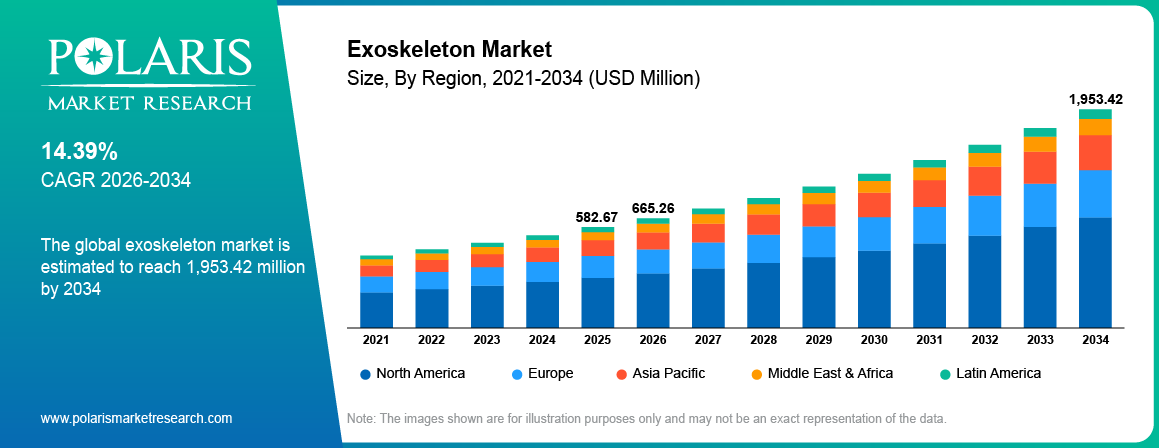
The global Exoskeleton market was valued at approximately USD 582.67 million in 2025 and is expected to reach USD 1,953.42 million by 2034, registering a CAGR of 14.39%during the forecast period. The market expansion is fueled by the increasing adoption of robotic rehabilitation equipment, growing need for workplace safety measures, and rising investment in assistive devices. The rapidly growing adoption of powered exoskeletons in healthcare, manufacturing, defense, and logistics is boosting the growth of the market.
Market Statistics
Key Takeaways
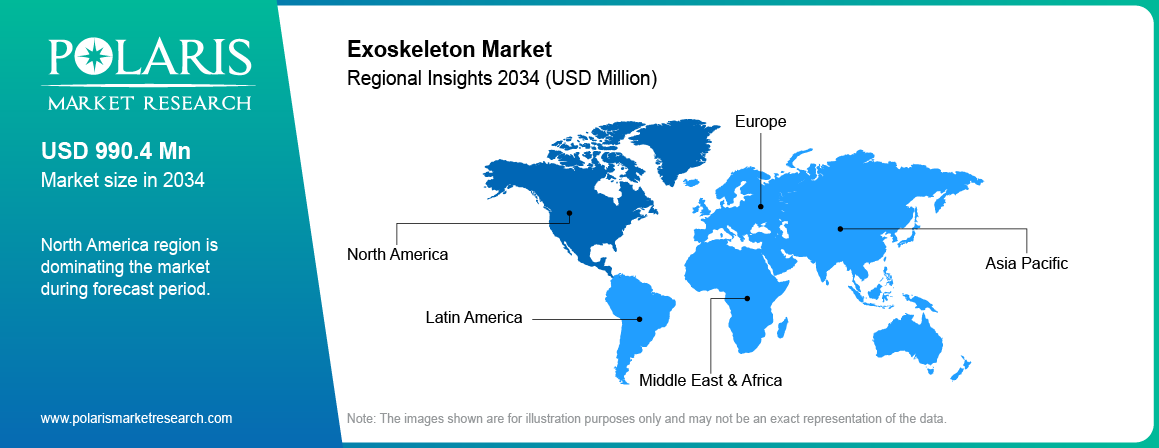
- North America dominated the market with a 40.50% share in 2025, owing to increasing adoption of robotic rehabilitation technologies and favorable reimbursement initiatives.
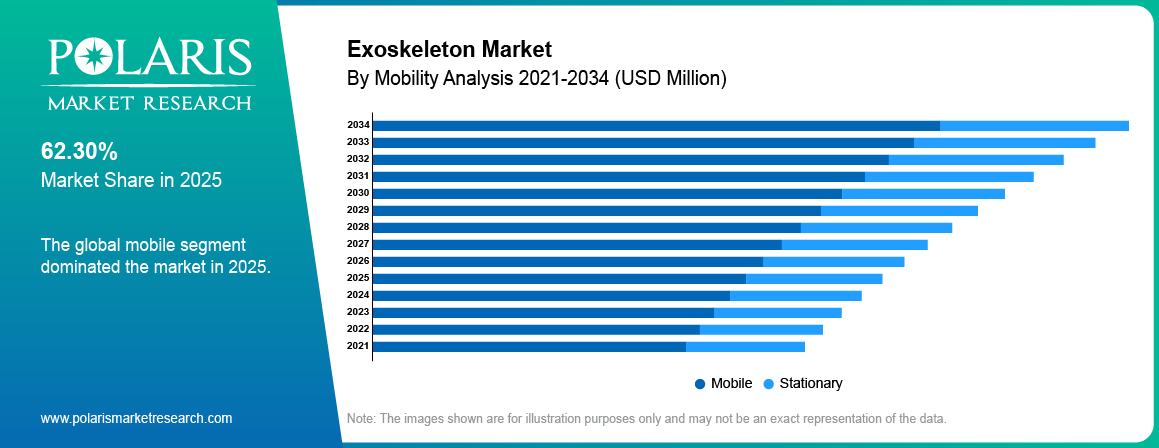
- Mobile exoskeletons accounted for the largest mobility segment with a 62.30% share in 2025, due to their extensive use across healthcare and industrial applications.
- Rehabilitation remained the leading application segment with a 45.80% share in 2025, because of growing demand for neurological and orthopedic recovery solutions.
- Manufacturing is projected to register the fastest CAGR of 17.90% during the forecast period, due to rising workplace safety investments and increasing industrial automation.
- Hospitals held the largest end-user share of 51.40% in 2025, owing to increasing deployment of rehabilitation robotics and advanced patient mobility solutions.
Note: Figures and projections outlined in this report are the result of Polaris Market Research’s proprietary analytical processes, grounded in the latest available datasets and market observation
What is Exoskeleton?
An exoskeleton is a mechanical device that improves, replaces, and assists human movement. This machine comprises of sensors, actuators, control systems, and structural elements that increase human physical strength, mobility, and endurance. Exoskeletons find applications in rehabilitation, industrial activities, military, and human mobility.
The value chain comprises component providers, actuator and sensor producers, software providers, exoskeleton producers, system integration firms, distributors, healthcare organizations, industries, and end consumers. The manufacturers continue to enhance their products by using lightweight components, intelligent control systems, and ergonomically designed products.
The growing demand for rehabilitation devices, the introduction of workplace safety programs, and increasing funding in robotics is expected to propel market expansion. The continuous innovation in products, positive regulatory approvals, and development of the healthcare sector are likely to generate growth opportunities in the forecast period.
Exoskeleton Market Driver Impact Analysis
The growing investment in rehab robotics, automation in the workplace, and wearable medical devices is helping to fuel the market growth. More healthcare organizations are using robotic rehabilitation machines for increasing mobility and fast recovery among patients. Powered exoskeletons are used by more industrial firms to reduce the fatigue of their workers and increase efficiency.
Advancements in technology related to lightweight materials, artificial intelligence, and battery systems results in improved performance and increases user comfort. The manufacturers are continuously launching new products that offer increased mobility, operating time, and ergonomic design. These advancements help to sustain market growth over the forecast period.
Rising government funding towards rehabilitation programs and occupational health projects provides more growth opportunities. Growing prevalence of musculoskeletal disorders and increasing need for mobility aids from the aging population provide more strength to market demand.
| Market Driver | Est. CAGR Impact | Geographic Relevance | Impact Timeline |
| Rising rehabilitation robotics adoption | +2.6% | North America, Europe | Medium to Long Term |
| Workplace safety automation | +2.2% | North America, Europe, Asia Pacific | Short to Medium Term |
| Growing aging population | +1.9% | Global | Long Term |
| Advances in wearable robotics | +1.7% | Global | Medium Term |
| Government healthcare investments | +1.4% | North America, Europe, Japan | Medium to Long Term |
* Indicative estimates based on market context and analyst judgment. Figures reflect relative driver weight, not additive CAGR contributions. Source: Polaris Market Research Analysis.
Exoskeleton Market Industry Dynamics
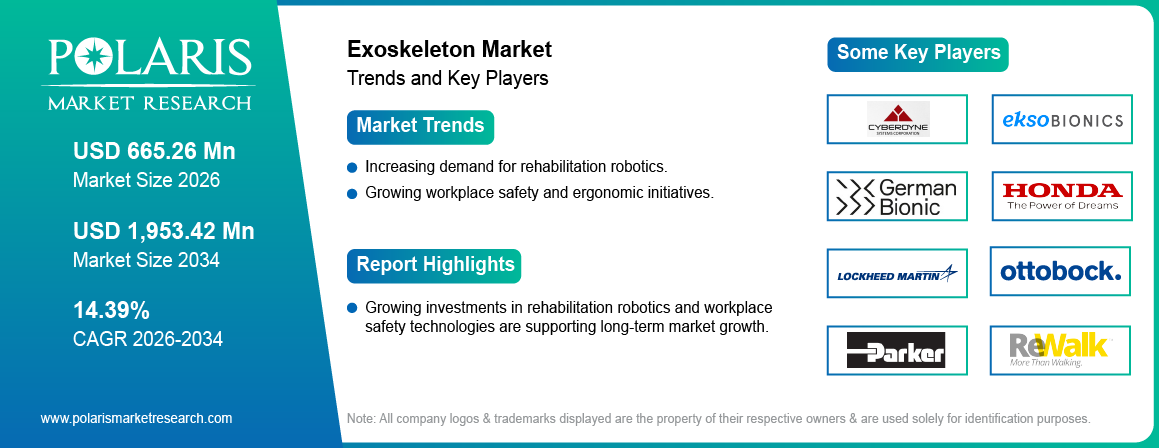
- Rising adoption of rehabilitation robotics is increasing demand for powered exoskeleton systems.
- Growing popularity of workplace safety measures is promoting adoption of wearable robotics in industries.
- High pricing of products and limited availability of reimbursement facilities is restraining market growth.
- Continuous innovation in artificial intelligence and lightweight materials is creating new growth opportunities.
Exoskeleton Market Drivers, Restraints and Opportunities
How Is the Growing Demand for Rehabilitation Robotics Driving the Exoskeleton Market?
The growing adoption of robotic rehabilitation equipment systems is increasing demand for medical exoskeletons across healthcare facilities. The hospitals and rehabilitation centers are making use of these devices to enhance mobility of patients and increase recovery. The AI-based MAYO Suit exoskeleton was introduced by ETH Zurich in June 2026 and it is meant to improve mobility and make walking easier for senior adults and those with mobility issues. Increasing investments in rehabilitation infrastructure and robotic assisted therapy is driving the growth in the market forecast period.
How Are Workplace Safety Initiatives Supporting Market Expansion?
Exoskeletons have been increasingly used in industry to address issues related to fatigue among workers as well as for increasing efficiency of operations. In June 2026, the US National Safety Council mentioned exoskeletons, artificial intelligence (AI), and ergonomic technology using sensors as some of the innovations that helps to decrease workplace injuries and musculoskeletal disorders(Source: www.nsc.org).The wearable devices is expected to help in reducing workplace accidents through difficult and repetitive work activities.
What Challenges Restrict Exoskeleton Market Growth?
The high cost of the products continues to hinder the use of exoskeletons in different sectors. The cost includes advanced technology, software installation, and maintenance. The lack of funding and lack of reimbursements are expected to hinder the development of the industry, especially in the emerging markets.
What Opportunities Exist in the Exoskeleton Market?
Technological improvements in artificial intelligence, light-weight materials, and batteries are paving new paths for exoskeletons makers. In April 2026, Vastnaut introduced the Vastnaut One 4×4 AI-driven exoskeleton system to lessen the load on users and boost their endurance when venturing out into nature or fieldwork environments. Firms are developing better exoskeleton systems that makes them easier to use in healthcare and industries sectors. Growth potential is expected to continue due to rising demands for mobility aid robots.
Segment and Regional Leaders at a Glance
According to Polaris Market Research, North America leads the market while Asia Pacific the fastest-growing region.
- Dominant Region: North America
- Fastest Growing Region: Asia Pacific
- Largest Mobility Segment: Mobile Exoskeleton
- Largest End User Segment: Hospitals
Segmentation Analysis
The study provides a comprehensive analysis of the exoskeleton market based on mobility, application, and end user to identify key revenue-generating and high-growth segments.
Exoskeleton Market by Mobility
Which Mobility Segment Dominated the Market in 2025?
The mobile segment dominated the market in 2025 owing to its broad use across rehabilitation, industrial, and defense applications. The mobile exoskeleton segment offers increased flexibility and allows patients to conduct their everyday activities with better mobility and decreased physical exertion. Continued enhancements in battery technology and lighter materials aid in the growth of the segment going forward.
Which Mobility Segment Is Growing Fastest?
The stationary segment is expected to witness the highest CAGR during the forecast period. Stationary exoskeletons are becoming increasingly popular among healthcare professionals for conducting rehabilitation exercises where controlled movements are required. Rising investments in advanced rehabilitation equipment are expected to accelerate segment expansion.
Exoskeleton Market by Application
Which Application Dominated the Market in 2025?
The rehabilitation segment dominated the market in 2025 owing to the increasing number of patients recovering from stroke, spinal cord injuries, and neurological disorders. In November 2025, the U.S. FDA approval of Wandercraft's Atalante X robotic exoskeleton was broadened in order to allow its use for the purposes of rehabilitation of people suffering from multiple sclerosis and high-level spinal cord injuries(Source: www.wandercraft.eu) Medical establishments are embracing the use of robotic therapy equipment for rehabilitation purposes.
Which Application Is Growing Fastest?
The industrial assistance segment is expected to have the highest CAGR over the forecast period. Industrial companies are using wearable robotic devices to lower the strain of workers and increase efficiency in repetitive lifting and assembling tasks. Increasing workplace safety regulations and automation initiatives are expected to drive future demand.
Exoskeleton Market by End User
Which End User Dominated the Market in 2025?
The hospitals segment dominated the market in 2025 owing to increasing adoption of robotic rehabilitation technologies across orthopedic and neurological treatment programs. Hospitals are also investing in modern rehabilitation equipment to ensure better treatment of their patients and offer more therapy services. These investments are expected to sustain segment growth.
Which End User Is Growing Fastest?
The manufacturing segment is projected to grow at the fastest CAGR during the forecast period. Exoskeletons have been incorporated by many industrial firms for improving safety and decreasing occupational injuries and operational inefficiency. Rising investments in smart manufacturing and workforce protection are expected to support segment expansion.
Segment Summary Table
| Segment | Category | 2025 Status | Forecast CAGR | Key Driver |
| Mobile | Mobility | Largest Share | Moderate | Growing rehabilitation and industrial adoption |
| Stationary | Mobility | Fastest Growing | High | Expansion of rehabilitation centers |
| Rehabilitation | Application | Largest Share | Moderate | Rising neurological rehabilitation demand |
| Industrial Assistance | Application | Fastest Growing | High | Workplace safety initiatives |
| Hospitals | End User | Largest Share | Moderate | Increasing robotic rehabilitation deployment |
| Manufacturing | End User | Fastest Growing | High | Industrial automation and worker safety investments |
Source: Polaris Market Research Analysis
Regional Analysis
North America Exoskeleton Market Size and Share
North America dominated the market in 2025 owing to strong adoption of rehabilitation robotics and wearable assistive technologies. In June 2026, Northwestern University developed a robotic exoskeleton therapy system to improve gait rehabilitation and walking recovery for stroke survivors(Source: news.northwestern.edu).The US and Canada have been making investments in modern healthcare infrastructure, occupational health & safety, and defense modernization programs. The rising number of approvals and implementation in hospitals and industries is expected to drive regional market growth.
Europe Exoskeleton Market Size and Share
Europe occupied a notable market share in 2025 owing to increasing investment in the development of rehabilitation solutions and industrial automation technology. The increase in the utilization of wearable robotics is evident in Germany, France, the UK, Italy, and Netherlands within the sectors of healthcare and industries. In February 2026, Comau introduced the MATE-XT GO exoskeleton aimed at reducing the physical burden experienced by workers while undertaking repetitive and overhead industrial activities(Source: www.comau.com).
Asia Pacific Exoskeleton Market Size and Share
Asia Pacific is projected to grow at the fastest CAGR during the forecast period. China, Japan, South Korea, and India are increasing investments in robotics, healthcare infrastructure, and smart manufacturing. In June 2026, the Severance Hospital in South Korea initiated a government-supported initiative for the development of brain-controlled wearable exoskeletons for quadriplegics. Rising industrial automation and growing demand for rehabilitation devices are expected to accelerate regional market growth.
Latin America Exoskeleton Market Size and Share
Latin America is witnessing steady market growth due to improving healthcare infrastructure and rising industrial modernization. Brazil, Mexico, and Argentina are gradually adopting robotic rehabilitation systems and workplace safety technologies. Government investments in healthcare services and manufacturing development are expected to create new growth opportunities.
Middle East & Africa Exoskeleton Market Size and Share
The Middle East & Africa market is expected to grow steadily during the forecast period. Saudi Arabia, the UAE, South Africa, and Israel are investing in advanced healthcare technologies and industrial automation. Growing rehabilitation programs and increasing workplace safety initiatives are expected to support future market expansion. In December 2025, Verita Neuro and Lifeward have collaborated to include the ReWalk Personal Robotic Exoskeleton in their rehabilitation program for spinal cord injuries within the UAE(Source: veritaneuro.com).
Regulatory Heatmap
| Region/Country | Policy Environment | Key Regulations | Market Implication | Trend |
| US | Favorable | FDA Medical Device Regulations, Veterans rehabilitation programs | Supports commercialization and clinical adoption | Expanding |
| Canada | Developing | Medical device licensing framework | Encourages healthcare innovation | Developing |
| Germany | Favorable | EU Medical Device Regulation (MDR) | Supports product quality and patient safety | Expanding |
| UK | Favorable | UK Medical Device Regulations | Promotes clinical adoption | Stable |
| China | Favorable | National robotics and intelligent manufacturing initiatives | Supports domestic production and innovation | Expanding |
| Japan | Favorable | Society 5.0 and robotics development programs | Accelerates rehabilitation robotics adoption | Expanding |
| South Korea | Favorable | Intelligent Robot Development Strategy | Supports wearable robotics commercialization | Expanding |
| India | Developing | National Medical Device Policy and Make in India | Creates opportunities for domestic manufacturing | Developing |
Source: Polaris Market Research Analysis
Competitive Landscape and Key Players
The exoskeleton market is moderately fragmented owing to the existence of global players and robotics firms. The competition is mainly driven by the performance of products, light weight, battery power, software integration, and therapeutic effects. Players are diversifying their product range through innovation, collaboration, acquisition, and geographical extension to gain competitive advantage in the market.
Large players such as Ekso Bionics, CYBERDYNE, Ottobock, ReWalk Robotics, German Bionic, and Wandercraft are focusing on the development of wearable robotics, AI, and lightweight exoskeletons. Companies are also focusing on rehabilitation solutions, industrial safety, and strategic partnerships to strengthen their market growth.
Competitive Positioning Table
| Company | Est. Market Position | Primary Strength | Geographic Focus | In Report |
| CYBERDYNE Inc. | Top 10 | Medical rehabilitation robotics | Asia Pacific | Yes |
| Ekso Bionics Holdings, Inc. | Top 5 | Rehabilitation and industrial portfolio | Global | Yes |
| German Bionic Systems GmbH | Regional Leader | Industrial exoskeletons | Europe | Yes |
| Lockheed Martin Corporation | Regional Leader | Defense exoskeleton technologies | North America | Yes |
| Ottobock SE & Co. KGaA | Top 5 | Orthopedic and rehabilitation solutions | Global | Yes |
| ReWalk Robotics Ltd. | Top 10 | Personal mobility systems | Global | Yes |
| Sarcos Technology and Robotics Corporation | Top 10 | Industrial automation | North America | Yes |
| SUITX (Ottobock) | Regional Leader | Occupational exoskeletons | North America | Yes |
| Wandercraft SAS | Regional Leader | Self-balancing rehabilitation exoskeletons | Europe | Yes |
Source: Polaris Market Research Analysis
Technology and Innovation Landscape
Shorter product development cycles and rapid advances in wearable robotics are improving product capabilities across healthcare and industrial applications. Companies are now employing smart software and lightweight materials to enhance mobility and efficiency.
Rise in expenditure on digital healthcare and smart manufacturing is prompting the use of connected exoskeletons. Such technological advancements are anticipated to lead to improved performance of products and increase the scope of their application over the forecast period.
| Technology | Adoption Stage | Key Development | Market Impact |
| Artificial Intelligence | Growing deployment | Real-time motion assistance | Improves movement accuracy |
| Lightweight Composite Materials | Mainstream adoption | Reduced device weight | Enhances user comfort |
| IoT Connectivity | Growing deployment | Remote monitoring | Improves operational efficiency |
| Advanced Battery Systems | Commercial deployment | Longer operating time | Supports continuous usage |
| Motion Sensors | Mainstream adoption | Precise movement detection | Improves rehabilitation outcomes |
Source: Polaris Market Research Analysis
Who Buys Exoskeleton Market Research and Why?
The exoskeletons market research report provides information on growth prospects, technology adoption, competitive positioning, and investment potential of the various regions. The report can be useful for making strategic decisions for expanding into markets, developing products, and investing.
| Buyer / Investor Type | Primary Use Case | Key Insight Sought | Decision Horizon |
| Corporate Strategy Teams | Market expansion | Regional demand and growth opportunities | 2–5 Years |
| Healthcare Providers | Equipment procurement | Clinical performance and patient outcomes | 1–3 Years |
| Manufacturing Companies | Worker safety planning | Productivity improvement and injury reduction | 1–3 Years |
| Private Equity Firms | Investment evaluation | Market potential and competitive landscape | 3–7 Years |
| Government Agencies | Healthcare and workforce planning | Rehabilitation and industrial automation trends | 3–7 Years |
Source: Polaris Market Research Analysis
What are the Barriers to Entering the Market?
- High investment required for product development and commercialization.
- Complex regulatory approval procedures across major countries.
- High manufacturing cost of advanced robotic components.
- Limited reimbursement coverage in several healthcare systems.
- Requirement for continuous product testing and clinical validation.
- Strong competition from established wearable robotics companies.
Premium Insights and Forward Outlook
Increasing demand for exoskeletons designed for rehabilitation and workplace safety is projected to drive growth in the long term. There is continuous innovation being undertaken in the use of lightweight materials, intelligent software and batteries to enhance performance. Increasing adoption across healthcare, manufacturing, logistics, and defense is creating new business opportunities. Continuous product innovation and expanding regulatory approvals are expected to strengthen market expansion during the forecast period.
Cost Benchmarking Table
| Product | Est. Price Range | Key Cost Driver | Complexity Tier |
| Passive Exoskeleton | USD 3,000–10,000 | Structural materials | Low |
| Industrial Powered Exoskeleton | USD 15,000–50,000 | Actuators and sensors | Medium |
| Rehabilitation Exoskeleton | USD 40,000–120,000 | Medical-grade robotics | High |
| Military Exoskeleton | USD 80,000–200,000 | Advanced electronics and mobility systems | Premium |
Source: Polaris Market Research Analysis
Key Players
- CYBERDYNE Inc.
- Ekso Bionics Holdings, Inc.
- German Bionic Systems GmbH
- Honda Motor Co., Ltd.
- Lockheed Martin Corporation
- Ottobock SE & Co. KGaA
- Parker Hannifin Corporation
- ReWalk Robotics Ltd.
- Sarcos Technology and Robotics Corporation
- SUITX
- Wandercraft SAS
- Wearable Robotics Srl
Industry Developments
- May 2026: Hypershell released the AI-enabled Hypershell X Series exoskeletons, which come with HyperIntuition motion control technology to enhance mobility in outdoor and professional uses(source: hypershell.tech).
- January 2026: RoboCT presented its light-weight GoGo Exoskeleton line at CES 2026 with AI-powered adaptive support for enhanced mobility and rehabilitation(source: www.mpo-mag.com).
Market Segmentation
By Mobility Outlook (Revenue, USD Million, 2021–2034)
- Mobile
- Stationary
By Application Outlook (Revenue, USD Million, 2021–2034)
- Rehabilitation
- Industrial Assistance
- Military
- Personal Mobility Assistance
By End User Outlook (Revenue, USD Million, 2021–2034)
- Hospitals
- Rehabilitation Centers
- Manufacturing
- Defense
- Logistics & Warehousing
- Others
By Regional Outlook (Revenue, USD Million, 2021-2034)
- North America
- US
- Canada
- Europe
- Germany
- France
- UK
- Italy
- Spain
- Netherlands
- Russia
- Rest of Europe
- Asia Pacific
- China
- Japan
- India
- Malaysia
- South Korea
- Indonesia
- Australia
- Vietnam
- Rest of Asia Pacific
- Middle East & Africa
- Saudi Arabia
- UAE
- Israel
- South Africa
- Rest of Middle East & Africa
- Latin America
- Mexico
- Brazil
- Argentina
- Rest of Latin America
Report Scope
| Report Attributes | Details |
| Market Size in 2025 | USD 582.67 Million |
| Market Size in 2026 | USD 665.26 Million |
| Revenue Forecast by 2034 | USD 1,953.42 Million |
| CAGR | 14.39% from 2026 to 2034 |
| Base Year | 2025 |
| Historical Data | 2021–2024 |
| Forecast Period | 2026–2034 |
| Quantitative Units | Revenue in USD Million and CAGR from 2026 to 2034 |
| Report Coverage | Revenue Forecast, Competitive Landscape, Growth Factors, and Industry Trends |
| Segments Covered |
|
| Regional Scope |
|
| Competitive Landscape |
|
| Report Format |
|
| Customization | Report customization as per your requirements with respect to countries, regions, and segmentation. |
Exoskeleton Market FAQ's
• The global exoskeleton market was valued at USD 582.67 million in 2025 and is projected to witness steady growth during the forecast period.
• The market is projected to reach USD 1,953.42 million by 2034, registering a CAGR of 14.39% from 2026 to 2034.
• North America dominated the market with a 40.50% share in 2025 owing to strong healthcare infrastructure and increasing rehabilitation robotics adoption.
• Mobile exoskeletons accounted for the largest mobility segment with a 62.30% share in 2025 due to its extensive use across rehabilitation, industrial, and military applications.
• Major companies include Ekso Bionics Holdings, Inc., CYBERDYNE Inc., Ottobock SE & Co. KGaA, ReWalk Robotics Ltd., German Bionic Systems GmbH, Sarcos Technology and Robotics Corporation, SUITX, Wandercraft SAS, Honda Motor Co., Ltd., and Wearable Robotics Srl.
• Growing demand for rehabilitation robotics, rising workplace safety initiatives, increasing investments in wearable robotics are driving market growth.
• Advances in AI, lightweight materials, smart sensors, and battery technologies are expected to create new opportunities across healthcare and industrial applications.
Download Sample Report of Exoskeleton Market
Please fill out the form to request a customized copy of the research report.


