
Battery Raw Materials Market Size, Share & Analysis Report 2026-2034
REPORT DETAILS
Battery Raw Materials Market Summary
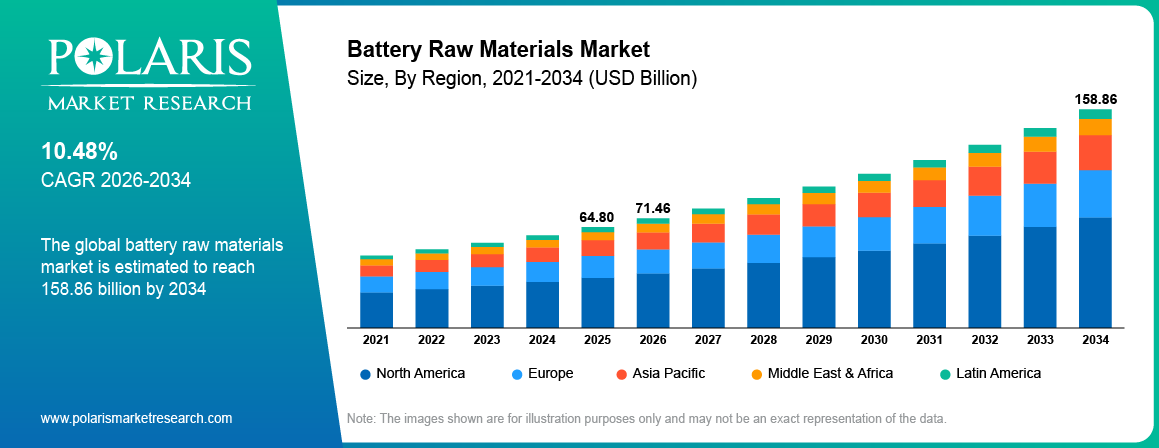
The global battery raw materials market was valued at USD 64.80 billion in 2025 and is projected to reach USD 158.86 billion by 2034, registering a CAGR of 10.48% during the forecast period. Growth of the market is attributed to growing demand for batteries, higher EV production, expansion of energy storage systems, and investments in developing local supply chains for critical minerals.
Market Statistics
Battery Raw Materials Market Key Takeaways 2025
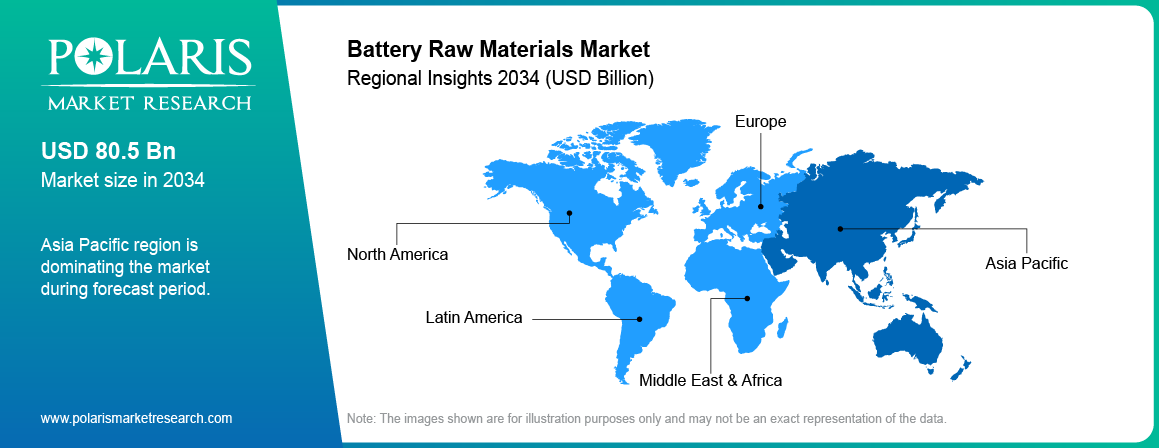
- Asia Pacific held the largest regional share of 49.20% in 2025, driven by robust mining operations, strong battery manufacturing capabilities, and a highly integrated battery value chain.
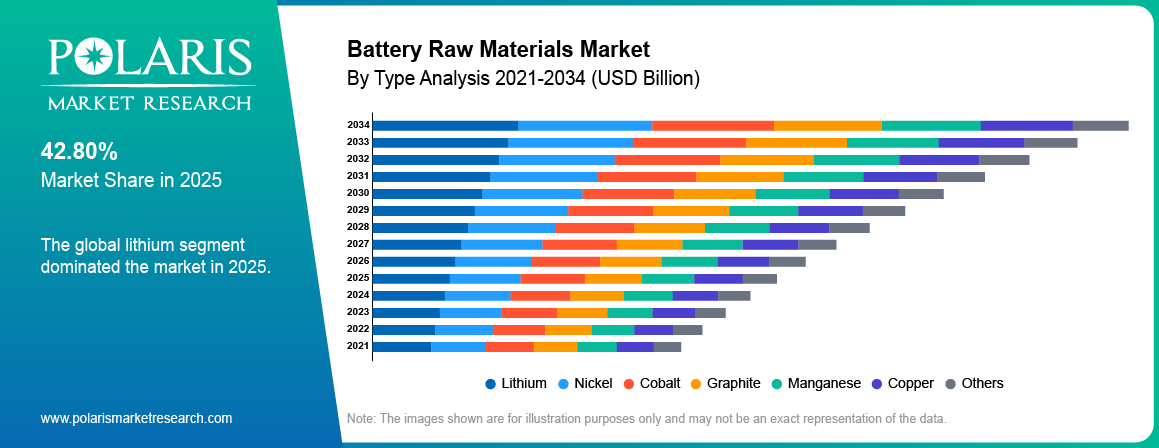
- Lithium raw materials accounted for the largest market share of 42.80% in 2025, owing to their widespread use in lithium-ion batteries across electric vehicles and energy storage systems.
- Electric Vehicle Batteries represented the largest application segment with a 56.40% market share in 2025, supported by the rapid growth in global electric vehicle production.
- Battery Manufacturers dominated the end-user segment with a 61.70% market share in 2025, driven by increasing investments in gigafactory construction and expansion of battery cell manufacturing capacity.
Note: Figures and projections outlined in this report are the result of Polaris Market Research’s proprietary analytical processes, grounded in the latest available datasets and market observation
What is Battery Raw Materials?
Battery raw materials refer to the minerals and processed products that are required in the production of rechargeable batteries for electric cars, storage units, consumer devices, and industrial applications. The materials include lithium, nickel, cobalt, graphite, manganese, copper, and various speciality minerals that influence the battery’s performance, safety, energy density, and life span.
The battery raw materials supply chain involves the mining companies, mineral processors, producers of cathode and anode materials, chemical processors, battery manufacturers, pack assembly units, system integrators, distributors, and the end-users. Close coordination throughout the supply chain ensures sufficient supply of minerals and massive battery production.
Source: Polaris Market Research Analysis
Battery Raw Materials Market Driver Impact Analysis
The battery raw materials market is likely to experience stable growth throughout the forecast period driven by growing demand for rechargeable batteries in applications such as electric mobility, renewable energy storage, and consumer electronics. Construction of battery factories, rising capital expenditures in mineral processing, and innovations in battery recycling solutions provide new business opportunities for raw material producers.
| Market Driver | Est. CAGR Impact | Geographic Relevance | Impact Timeline |
| Expansion of electric vehicle production | 12.40% | Asia Pacific, Europe, North America | Short to medium term |
| Government support for domestic critical mineral production | 11.30% | Global | Medium term |
| Growth in renewable energy storage installations | 11.90% | Global | Medium to long term |
| Advancements in battery recycling technologies | 12.80% | Global | Ongoing |
| Expansion of battery manufacturing capacity | 11.60% | Asia Pacific, North America, Europe | Long term |
Indicative estimates based on market context and analyst judgment. Figures reflect relative driver weight, not additive CAGR contributions. Source: Polaris Market Research Analysis.
Battery Raw Materials Market Industry Dynamics
- Higher production volumes of electric vehicles increase demand for essential battery minerals on a global scale.
- Growth in renewable energy storage projects boosts demand for battery raw materials.
- Supply chain issues and fluctuations in raw material prices pose challenges for market expansion.
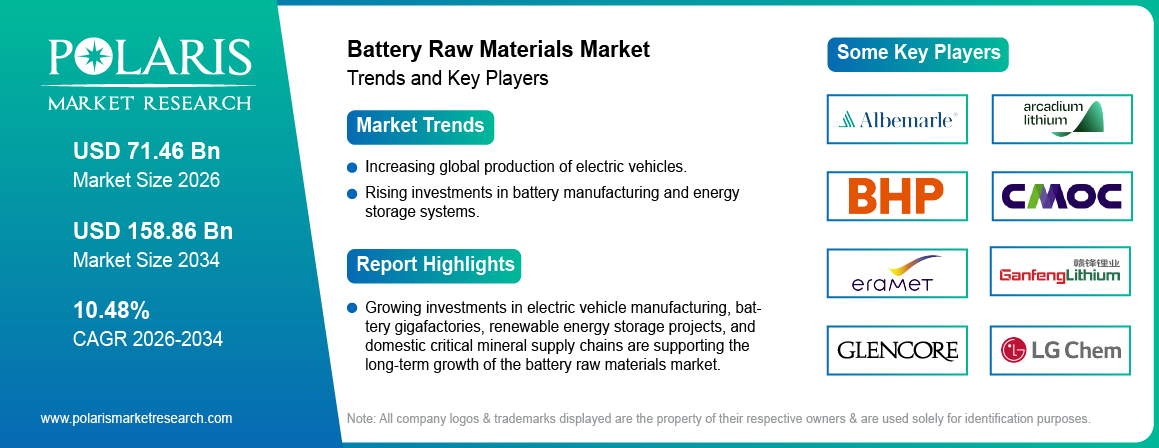
- Investments in recycling and domestic mineral processing are creating new growth opportunities.
Battery Raw Materials Market Drivers, Restraints and Opportunities
How Is Rising Electric Vehicle Production Driving the Battery Raw Materials Market?
The rapid growth of electric vehicle production is increasing the demand for battery raw materials across global markets. Global sales of electric vehicles (EVs) were more than 20 million in 2025, according to the Global EV Outlook 2025 report. There was an upward growth by 20% compared to 2024.(Source:iea.org).The growth of battery manufacturing capabilities are fueled by the escalating consumer demand and environmental emission requirements from the governments. Consequently, there has been high demand for lithium, nickel, graphite, cobalt, and manganese needed in battery production, thus propelling market growth.
How Is Expansion of Energy Storage Systems Supporting Market Growth?
The rise in installations of renewable energy plants is increasing the need for battery energy storage systems. The utilities and generation companies are adopting battery energy storage systems to stabilize the grid and incorporate renewable energy into the grids. For instance, in June 2026, ABB introduced a portfolio of high efficiency power conversion solutions for utility scale solar and battery energy storage systems. This is prompting an increase in the use of essential battery metals for energy storage.
What Challenges Limit Growth of the Battery Raw Materials Market?
Raw Material Price Volatility and Supply Chain Constraints
The prices of the key materials used in batteries usually fluctuates due to various reasons such as supply issues, geopolitics, export controls, and mining output changes. The long-term development period of projects and low refining capacities have an impact on the availability of materials. Environmental rules and licensing processes slow down the mining capacity growth. High costs of battery manufacturing and uncertainty prevail in the battery raw materials supply chain due to these reasons.
What Opportunities Exist in the Battery Raw Materials Market?
Expansion of Battery Recycling and Circular Supply Chains
Battery recycling is emerging as a potential opportunity for battery raw material providers. Large amounts of used EV batteries become a steady source of valuable materials like lithium, nickel, and cobalt. In May 2026, as part of the EU–India Trade & Technology Council (TTC), the European Union and the Government of India launched a third call for proposals on EV battery recycling with the total budget of about USD 17.8 million(Source: www.eeas.europa.eu).The initiative aims to strengthen critical raw material recovery and advance the circular economy.
Source: Polaris Market Research Analysis
Segment and Regional Leaders at a Glance
According to Polaris Market Research, Asia Pacific leads the market while North America the fastest-growing region.
- Dominant Region: Asia Pacific
- Fastest-Growing Region: North America
- Largest Type Segment: Lithium Raw Materials
- Fastest-Growing Type Segment: Graphite Raw Materials
- Largest Application Segment: Electric Vehicle Batteries
- Largest End User Segment: Battery Manufacturers
Battery Raw Materials Market Segmentation Analysis
The report provides a comprehensive analysis of the battery raw materials market by type, application, and end user to identify major revenue-generating segments and emerging growth opportunities across the global battery materials industry.
Battery Raw Materials Market by Type
Which Type Segment Dominates the Market?
Lithium raw materials accounted for the largest market share in 2025. Lithium is currently the most used battery component due to its high energy density capabilities and ability to produce lithium-ion batteries, which are found in electric cars and consumer electronics.
Which Type Segment Is Expected to Register the Fastest Growth?
Graphite raw materials are projected to register the fastest CAGR during the forecast period. Graphite is an essential anode material used in most lithium-ion batteries, and rising battery production is increasing its consumption worldwide. Growing investments in synthetic and natural graphite production, together with efforts to localize battery supply chains, are supporing strong growth for this segment. In March 2026, POSCO Future M announced an investment of approximately USD 260 million to establish an overseas synthetic graphite anode production plant, expanding its global manufacturing footprint.
Battery Raw Materials Market by Application
Which Application Segment Holds the Largest Share of the Market?
Electric vehicle batteries represented the largest application segment in 2025. Growing production of electric vehicles, favorable government regulations, and investment made by automobile manufacturers are propelling the demand for battery raw materials. Increasing production of electric vehicles in the world has been fueling the consumption of lithium, nickel, cobalt, graphite, and manganese at various battery manufacturing facilities.
Which Application Segment Is Growing at the Fastest Rate?
The energy storage system market is expected to grow at the highest rate over the forecast period. The increasing installations of renewable energy projects and grid-scale energy storage battery installation are generating the need for battery components. Utility companies and IPPs have been increasing battery storage capabilities to ensure the reliability of the grid.
Battery Raw Materials Market by End User
Which End User Leads the Market?
Battery manufacturers accounted for the largest share of the battery raw materials market in 2025. This growth is due to the rapid surge in lithium-ion batteries production for electric cars, consumer electronics, and energy storage solutions, thus increasing demand for critical minerals. Lithium-ion battery manufacturers have entered into supply contracts with mineral miners and refiners in order to ensure the security of the supply chain of raw materials.
Which End User Segment Is Expected to Grow the Fastest?
Automobile manufacturers are estimated to witness the highest CAGR during the forecast period. Car manufacturers are increasingly investing in the production and supply chain management of batteries. Various companies have entered into joint ventures and acquisitions in order to gain access to lithium, nickel, cobalt, and graphite.
Segment Summary Table
| Segment | Category | 2025 Status | Forecast CAGR | Key Driver |
| Lithium Raw Materials | Type | Largest Share | 11.20% | Strong demand from lithium-ion battery production |
| Graphite Raw Materials | Type | Fastest Growing | 12.70% | Rising anode material consumption |
| Electric Vehicle Batteries | Application | Largest Share | 11.50% | Expansion of global EV manufacturing |
| Energy Storage Systems | Application | Fastest Growing | 13.10% | Increasing renewable energy storage projects |
| Battery Manufacturers | End User | Largest Share | 11.40% | Expansion of battery production facilities |
| Automotive Manufacturers | End User | Fastest Growing | 12.30% | Growing investments in electric vehicle production |
Source: Polaris Market Research Analysis
Source: Polaris Market Research Analysis
Battery Raw Materials Market Regional Analysis
Asia Pacific Battery Raw Materials Market Size and Share
Asia Pacific held the highest share in the battery raw materials market in 2025 owing to active mining operations, mineral processing industries, and battery manufacturing companies. As per the Green Finance & Development Center, the Chinese investment in the metals and mining industry has crossed a historic USD 32.6 billion mark in 2025(Source: greenfdc.org).Countries across the region continue investing in battery production and refining capacity to strengthen regional supply chains.
North America Battery Raw Materials Market Analysis
North America is expected to witness significant growth during the forecast period due to increasing investments in domestic critical mineral production and battery manufacturing facilities. In March 2026, the US Department of Energy has awarded USD 45.7 million to 19 projects to develop robust domestic supply chains of critical minerals and materials that play a vital role in clean energy technologies.(Source: www.energy.gov).Also, growing electric vehicle production and energy storage installations continue to create new opportunities for battery raw material suppliers across the region.
Europe Battery Raw Materials Growth Rate and Forecast
Europe is expected to experience steady growth during the forecast period owing to increasing battery manufacturing investments and ambitious clean mobility targets. In March 2023, the European Council amended the CO₂ emission standards for new passenger cars and vans. The updated rules require emissions to be reduced by 55% for new cars and 50% for new vans between 2030 and 2034, compared with the 2021 baseline.(Source: www.consilium.europa.eu).Strong regulatory support for sustainable battery manufacturing and recycling is expected to accelerate demand for battery raw materials across Europe.
Latin America Battery Raw Materials Market
Latin America is projected to register gradual growth during the forecast period. Chile, Argentina, and Brazil have large deposits of lithium and battery minerals, making the region a key player in the industry. The region is set to become even more influential in terms of source of raw materials for batteries due to rising investments in mining operations and growing export capabilities across the globe.
Middle East & Africa Battery Raw Materials Market
The Middle East and Africa market is forecast to record steady growth owing to investments made in mineral exploration, mining, and energy transition projects. In July 2026, the international holding company based in Abu Dhabi, UAE is scheduled to make an investment worth USD 11.5 billion in an integrated aluminum project in Odisha, India. This project is a joint venture between IHC and India's Adani group. Several countries are trying to tap into their critical minerals as future battery manufacturing and clean energy projects.
Source: Polaris Market Research Analysis
Regulatory Heatmap
| Country | Policy Environment | Key Regulations | Market Implication | Trend |
| US | Favorable | Critical mineral production incentives and clean energy programs | Supports domestic mining and battery supply chain expansion | Expanding |
| European Union | Favorable | Critical Raw Materials Act and battery sustainability regulations | Encourages local sourcing and battery material recycling | Expanding |
| China | Favorable | Battery manufacturing and critical mineral development policies | Strengthens domestic supply chain and refining capacity | Expanding |
| Japan | Favorable | Battery technology and resource security initiatives | Supports long-term material procurement | Stable |
| India | Developing | Critical mineral exploration and battery manufacturing incentives | Creates opportunities for domestic production | Developing |
| Middle East | Developing | Mining diversification and industrial development programs | Encourages investment in mineral production | Early Stage |
| Latin America | Neutral | Mining regulations and export policies | Supports gradual expansion of battery mineral supply | Developing |
Source: Polaris Market Research Analysis
Competitive Landscape and Key Players
The competitive intensity within the raw materials for batteries market are moderate, with the presence of global mining companies, chemicals producers, material processors, and battery supply chain companies. Competitiveness within the sector is driven by the availability of resources, production capacity, processing technologies, product quality, and long-term supply agreements.
Competitive Positioning Table
| Company | Est. Market Position | Primary Focus | Geographic Focus | In Report |
| Albemarle Corporation | Top Market Participant | Lithium production and processing | Global | Yes |
| Arcadium Lithium plc | Major Market Participant | Lithium chemicals and raw materials | Global | Yes |
| BHP Group | Major Market Participant | Nickel and critical minerals | Global | Yes |
| Glencore plc | Top Market Participant | Cobalt, nickel, and battery metals | Global | Yes |
| Rio Tinto Group | Major Market Participant | Lithium and critical mineral mining | Global | Yes |
Source: Polaris Market Research Analysis
Technology and Innovation Landscape 2025–2026
Continuous investments in mining technology, mineral processing, battery recycling, and digital supply chain management are improving the availability and quality of battery raw materials. Companies operate in the direction of boosting production efficiency, minimizing environmental damage, and searching for sustainable supplies of critical minerals.
| Technology | Adoption Stage | Key Development (2025–2026) | Market Impact |
| AI-enabled Mining Operations | Growing Deployment | Artificial intelligence improves exploration and mining efficiency | Increases production and reduces operating costs |
| Advanced Mineral Refining | Early Commercial Deployment | Improved refining technologies enhance battery-grade material quality | Supports high-performance battery production |
| Battery Recycling Technologies | Growing Deployment | Recovery of lithium, nickel, cobalt, and graphite from used batteries | Reduces dependence on newly mined materials |
| Digital Supply Chain Monitoring | Pilot to Early Commercial Stage | Real-time tracking of raw material sourcing and logistics | Improves supply chain transparency |
| Sustainable Mining Technologies | Growing Deployment | Low-emission mining and resource-efficient processing methods | Supports environmental compliance and sustainability |
Source: Polaris Market Research Analysis
Developments within recycling and digital mining industries contribute to improving the production efficiency and sustainability of the process of working with battery raw materials.
Buyer Use Cases and Market Entry Barriers
The demand for raw materials for batteries is increasing due to the growing interest of battery manufacturers, automobile manufacturers, energy storage companies, electronics manufacturers, and machinery manufacturers. Companies evaluate the performance of their suppliers through material quality, production capacity, reliable long-term supply, sustainable standards, and pricing.
| Buyer / Investor Type | Primary Use Case | Key Insight Sought | Decision Horizon |
| Battery Manufacturers | Battery production | Material quality and supply reliability | 5–10 years |
| Automotive Manufacturers | EV battery sourcing | Long-term raw material availability | 3–8 years |
| Energy Storage Developers | Grid-scale battery projects | Material cost and supply security | 3–7 years |
| Electronics Manufacturers | Consumer battery production | Consistent material quality | 2–5 years |
| Institutional Investors | Mining and processing investments | Market growth and long-term returns | 5–12 years |
Source: Polaris Market Research Analysis
What are the Barriers to Entering the Market?
- High capital investment required for mining and mineral processing facilities.
- Lengthy permitting and environmental approval processes.
- Price volatility of critical battery minerals.
- Limited availability of high-quality mineral reserves.
- Complex refining and processing technologies.
- Supply chain concentration in selected countries.
- Long project development and commercialization timelines.
Companies that increase production capability, ensure availability of mineral supply and develop sustainable processes will have an advantage in the battery raw materials market across the world.
Premium Insights and Future Prospects
Projections indicate that the outlook for the battery raw materials market is upright due to the increasing investments in electric mobility, energy storage and domestic battery production. There is expansion in mining capabilities, refining capacity and processing of critical minerals by both governments and private enterprises.
Battery recycling will become more important for obtaining future supplies of raw materials. This area becomes a new driver of growth owing to development of circular economy principles, technology development and sustainable mining. Continuous expansion of battery manufacturing facilities and strategic supply agreements are expected to support market development throughout the forecast period.
Cost Benchmarking Table
| Product / Service Type | Est. Price Range (USD) | Key Cost Driver | Complexity Tier |
| Lithium Raw Materials | USD 8,000–18,000 per metric ton | Ore grade, refining process, and global demand | Premium |
| Nickel Raw Materials | USD 14,000–22,000 per metric ton | Mining capacity and processing cost | Premium |
| Graphite Raw Materials | USD 700–3,500 per metric ton | Material purity and processing technology | Mid to Premium |
| Cobalt Raw Materials | USD 28,000–40,000 per metric ton | Mining supply and geopolitical factors | Premium |
| Battery Material Processing Services | USD 500,000–20 Million per project | Processing complexity and production scale | Project Based |
Source: Polaris Market Research Analysis.
Key Players
- Albemarle Corporation
- Arcadium Lithium plc
- BHP Group
- China Molybdenum Co., Ltd.
- Eramet S.A.
- Ganfeng Lithium Group Co., Ltd.
- Glencore plc
- LG Chem Ltd.
- Rio Tinto Group
- SQM S.A.
- Umicore NV
- Zhejiang Huayou Cobalt Co., Ltd.
Industry Developments
- July 2026: Altilium secured UK government funding to advance the recovery of critical battery-grade materials from recycled lithium-ion batteries. The initiative strengthens battery raw material supply by increasing the availability of sustainable lithium, nickel, cobalt, and graphite for next-generation battery manufacturing(source: altilium.tech).
Market Segmentation
By Type Outlook (Revenue, USD Billion, 2021–2034)
- Lithium
- Nickel
- Cobalt
- Graphite
- Manganese
- Copper
- Others
By Application Outlook (Revenue, USD Billion, 2021–2034)
- Electric Vehicle Batteries
- Energy Storage Systems
- Consumer Electronics
- Industrial Batteries
- Portable Devices
- Others
By End User Outlook (Revenue, USD Billion, 2021–2034)
- Battery Manufacturers
- Automotive Manufacturers
- Energy Storage Companies
- Consumer Electronics Manufacturers
- Industrial Sector
- Others
By Regional Outlook (Revenue, USD Billion, 2021–2034)
- North America
- US
- Canada
- Europe
- Germany
- France
- UK
- Italy
- Spain
- Netherlands
- Russia
- Rest of Europe
- Asia Pacific
- China
- Japan
- India
- Malaysia
- South Korea
- Indonesia
- Australia
- Vietnam
- Rest of Asia Pacific
- Middle East & Africa
- Saudi Arabia
- UAE
- Israel
- South Africa
- Rest of Middle East & Africa
- Latin America
- Mexico
- Brazil
- Argentina
- Rest of Latin America
Report Scope
| Report Attributes | Details |
| Market Size in 2025 | USD 64.80 Billion |
| Market Size in 2026 | USD 71.46 Billion |
| Revenue Forecast by 2034 | USD 158.86 Billion |
| CAGR | 10.48% from 2026 to 2034 |
| Base Year | 2025 |
| Historical Data | 2021–2024 |
| Forecast Period | 2026–2034 |
| Quantitative Units | Revenue in USD Billion and CAGR from 2026 to 2034 |
| Report Coverage | Revenue Forecast, Competitive Landscape, Growth Factors, Clinical Pipeline, Technology, and Industry Trends |
| Segments Covered | By Type, By Application, By End User, and By Region |
| Regional Scope | North America, Europe, Asia Pacific, Latin America, Middle East & Africa; country detail for US, Canada, Germany, UK, France, China, Japan, India, South Korea, Australia |
| Competitive Landscape | Company Profiles including platform overview, clinical pipeline, partnerships, and recent developments |
| Report Format | PDF + Excel |
| Customization | Report customization available as per requirements with respect to countries, regions, modalities, and therapeutic areas. |
Battery Raw Materials Market FAQ's
• The battery raw materials market was valued at USD 64.80 billion in 2025 and is projected to reach USD 158.86 billion by 2034.
• The market is expected to grow at a CAGR of 10.48% during the forecast period from 2026 to 2034.
• Rising electric vehicle production, growing battery manufacturing capacity, expanding renewable energy storage projects, increasing investments in critical mineral mining, and advancements in battery recycling technologies are supporting market growth.
• Lithium raw materials accounted for the largest market share of 42.80% in 2025 due to its widespread use in lithium-ion batteries for electric vehicles, energy storage systems, and consumer electronics.
• Electric Vehicle Batteries represented the largest application segment with a 56.40% market share in 2025, supported by increasing global electric vehicle production and continued investments in battery manufacturing.
• Asia Pacific held the largest regional share of 49.20% in 202 owing to its strong mining industry, extensive battery manufacturing capacity, and well-established battery supply chain.
Download Sample Report of Battery Raw Materials Market
Please fill out the form to request a customized copy of the research report.


